
The Overwhelm Recovery ProtocolWellness & Routines · ~5 min
About this template · Updated September 2026
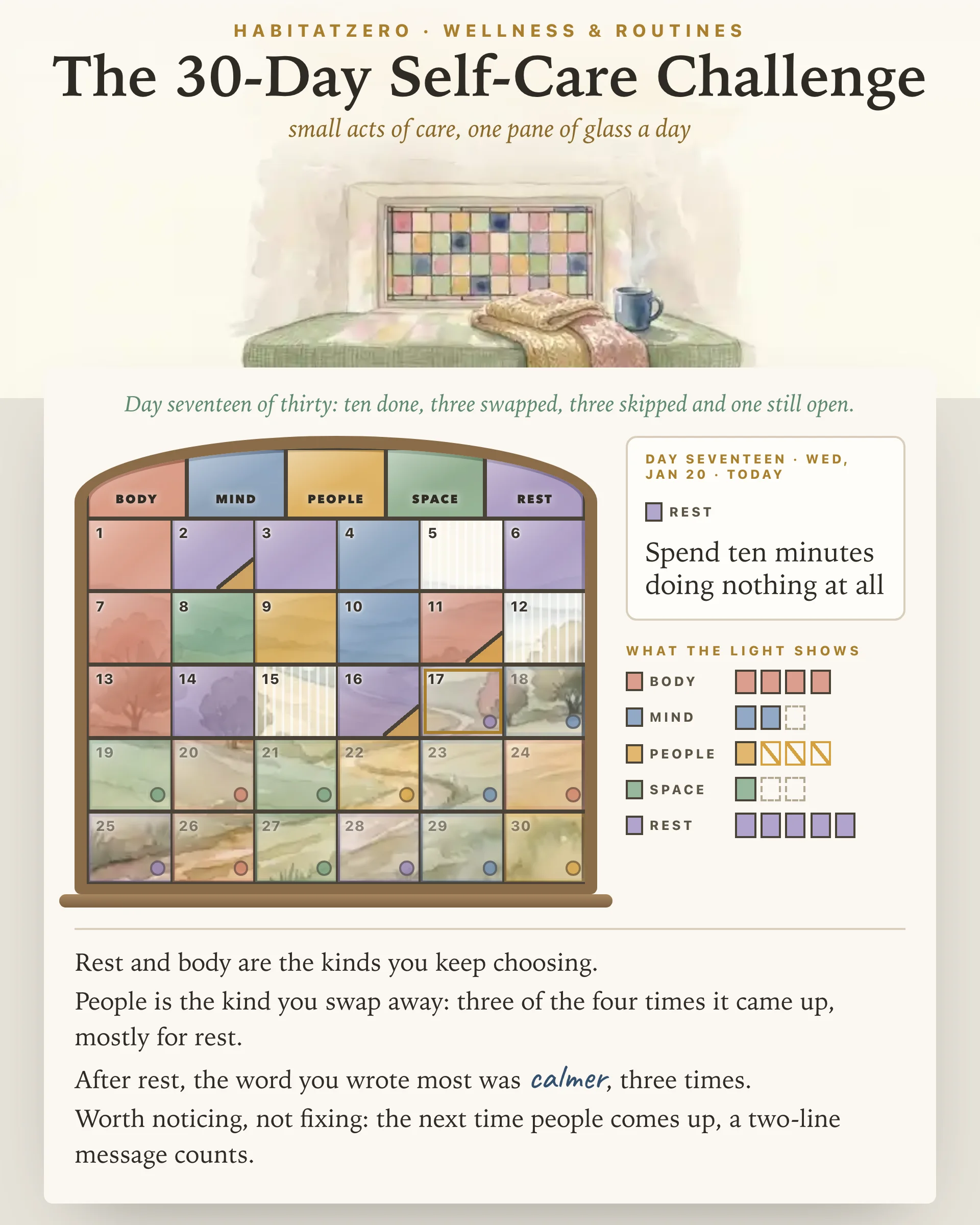
Most versions of a 30 day self care challenge come as a printable calendar: thirty squares, a face mask in one, a gratitude list in the next. You start strong, miss a Thursday, and by the second week the grid feels like a scorecard you are losing. This self care challenge is built the other way around. It hands you thirty small acts of care, lets you trade any day's act for a different kind of care, and counts a skipped day as information rather than a broken streak. After a few weeks it shows you something a printout never can: which kinds of care you actually reach for, and which you keep passing over.
The month draws on five kinds of care. Body covers movement, food, water and daylight. Mind covers attention and quiet thought, like ten pages of a novel. People covers connection, from a two-line message to a coffee with a neighbor. Space covers the rooms around you, such as one cleared surface. Rest covers doing less on purpose: a nap, an early night.
When you sketch your thirty days, the page deals six acts of each kind and spreads them so that every run of five days holds all five kinds once. No kind can crowd into the first week and vanish by the third. That balance is what makes the ending fair: each kind gets the same six chances, so the pattern at the end is yours, not the calendar's.
Your month appears as a leaded window of thirty panes, with a band of five colored panes across the top as the key. Each pane opens on its own date. You can tap ahead to see what is coming, but a pane only takes a mark once its day arrives, and marking a day late still files it under its own date.
Every open pane takes one of three marks:
Then you add one word for how it felt: tap calmer, lighter, meh or tired, or write your own. After five marks, the window starts to read back. It names the kinds you keep choosing, the kind you swap away most and how often it came up, where your skips land, and the word you tend to write after a particular kind of care.
The National Institute of Mental Health describes self-care as taking the time to do things that help you live well. The same page says even small daily acts can matter, and that finding what works for you may take trial and error. A month of varied acts, each one marked, is exactly that trial and error, written down.
Writing it down is part of the point. A meta-analysis of 138 experiments found that monitoring progress toward a goal helped people reach it, and that the effect was larger when progress was physically recorded. Setting a pane each day is a small physical record of that kind.
Skips matter less than they feel. In a study that followed 96 volunteers building a daily habit, the time it took a behavior to become automatic ranged from 18 to 254 days, and missing a single opportunity did not materially change the process. A clear pane on day nine does not reset anything.
What the evidence does not say: no study has tested this window, and given that range, thirty days may be too short for a new routine to feel automatic. The challenge is a way to sample kinds of care and notice your own leanings. It is not a treatment.
Treat the reading as a pattern, not a verdict. If rest keeps coming out on top, that may be exactly what this month needs. If people is the kind you keep trading away, ask whether the act was too big for the day. A two-line message counts as connection, and it is far easier to send than a phone call on a tired evening. If skips pile up on one kind, the time of day may be the problem rather than the act.
Start at the beginning of a month, after a draining stretch, or when your self-care has shrunk to one habit on repeat. Before you begin, the Self-Care Wheel can show which areas of your life feel thin right now. If you would rather pin fixed acts to fixed weekdays, the Self-Care Planner does that job, and the Self-Care Checklist holds a longer menu to borrow from.
Small care helps an ordinary week, but it is not a substitute for help. If most days have felt heavy or distressing for two weeks or more, talk with a therapist or your doctor; reaching out is a kind of care too.
It is a month of small daily acts of care, usually one short task a day, meant to widen what self-care means to you. This version spreads the thirty acts evenly across body, mind, people, space and rest, so by the end you can see which kinds you gravitated toward.
Keep each one small enough to do on a tired day. Try a ten-minute walk with no destination, a few pages of a book read just for fun, a two-line message to someone you miss, one cleared surface, or getting into bed half an hour early. The page holds fifty such acts and deals thirty of them.
Nothing breaks. A skipped pane stays clear and keeps its place, you can still mark a day late if you did the act and forgot to log it, and the reading treats skips as a clue about timing or size rather than a failure.
Small acts of care can steady an ordinary week, but they do not replace help. If most days have felt heavy or distressing for two weeks or more, talk with a therapist or your doctor about what you are noticing.
You can look through the sample window on this page without an account. To sketch your own month, mark each pane and watch the window read back your pattern, personalize the challenge in the free HabitatZero app.
By the team behind Fabulous, the science-based self-care app used by over 30 million people.


