Reading JournalStudy & Learning · ~4 min
About this template · Updated September 2026
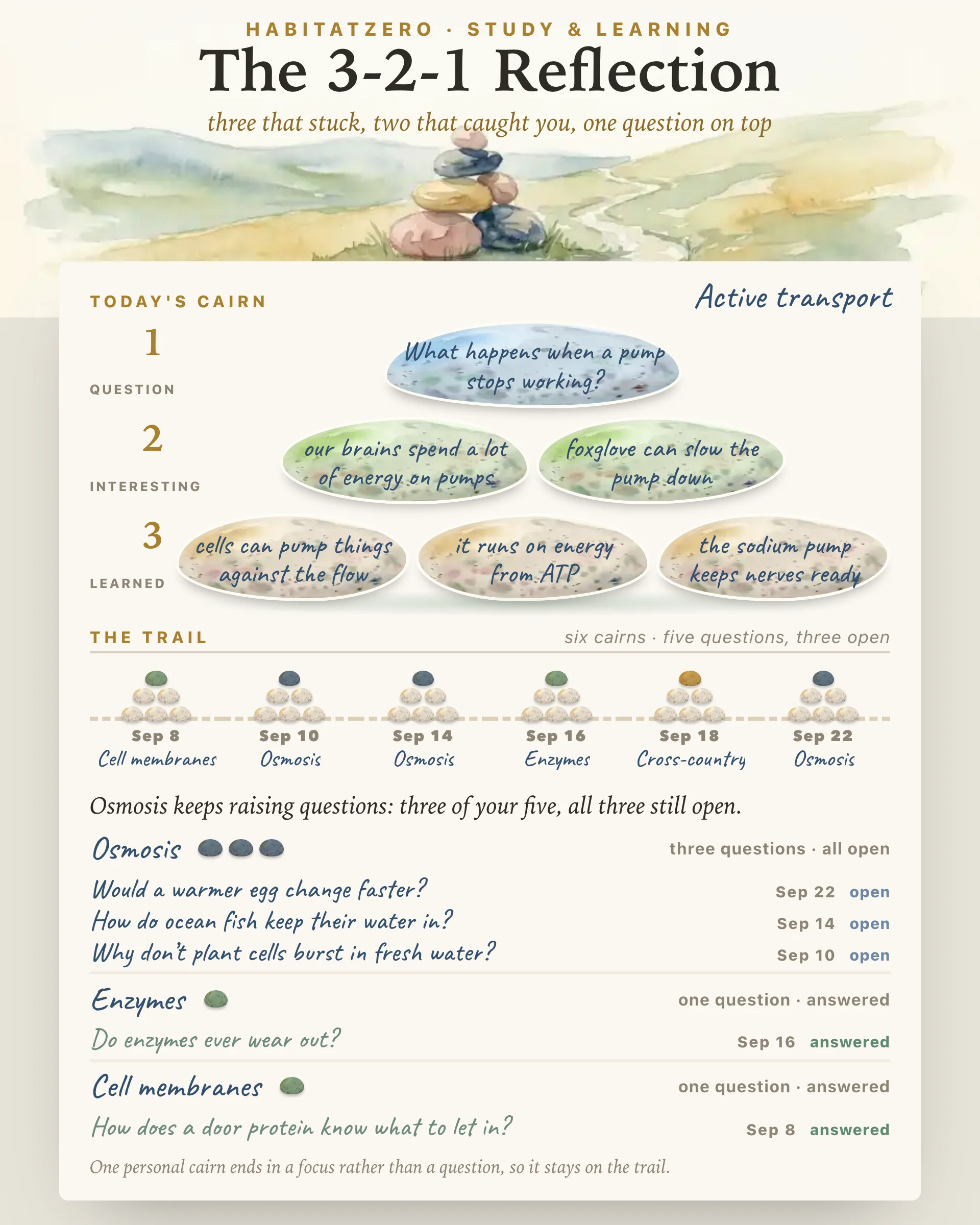
A 3-2-1 reflection asks for three things you learned, two things that caught your interest and one question you still have. It takes about four minutes, and teachers have passed it around for so long that nobody can say who wrote it first. You will find it on printable exit tickets and in teacher guides, usually as the last thing a class does before the bell.
This page turns the three lines, two lines and one line into a small cairn of stones, the kind hikers stack to mark a trail. What you learned is the base, the two sparks rest on it, and your question sits on top, where it points the way to what you study next.
Each stone is a line you write, and it stays a pale outline until you do. If a line won't come, tap a starter such as I learned that or What would happen if and finish it yourself. A starter on its own doesn't set a stone.
Give the cairn a topic, the lesson or unit it came from, and leave it on the trail. The trail keeps up to thirty-six cairns, about one per week for a school year, and each shows its date, its topic and a colored top stone: blue while its question is open, green once you've answered it.
Below the trail, your questions gather by topic. This is the part a paper exit ticket can't do. After a few weeks the page tells you which topic keeps raising questions and how many of them are still open. Tap answered when you find out. If you later rewrite a question, its answered mark clears, because the new words haven't been answered yet.
There is also a personal form for the end of a week or a project: three wins, two lessons and one focus. Those cairns stand on the trail too, with a gold top stone, but a focus isn't a question, so they stay out of the question pile.
The base does the most work, but only if you write it without looking. Pulling ideas back out of memory is a small test, and tests do more than measure. In Roediger and Karpicke's experiments, students who read prose passages and then wrote down everything they could recall remembered more two days and a week later than students who restudied the passages instead. The restudiers felt more confident about how much they would remember, and on those later tests they remembered less.
A large review of study techniques points the same way. Its authors rated practice testing as one of the two most useful techniques they examined and rated summarizing as low utility. A 3-2-1 copied off the board is summarizing. The same three lines written from memory is much closer to a practice test.
Writing a question makes you find the exact edge of what you understand. A review of studies that taught students to generate their own questions about what they read found gains in comprehension, measured on tests of new material rather than the passages the students had practiced on.
Be honest about the limits, though. These studies tested free recall and question writing as separate practices. None of them tested a 3-2-1 sheet, so treat the research as support for the parts, not a verdict on the format.
A topic with three open questions is the first thing to review before a quiz. Take those questions to class or office hours, and mark each one answered as it falls. When a whole topic stays stubbornly open, a from-memory review on the Blurting Pad will show you exactly which pieces are missing. Before a new unit, the KWL Chart records what you already know; the 3-2-1 picks up after each lesson.
Print blank tickets from the sheet, two to a page, each with lines for a name, a date and a topic. Collect them at the door and read them as a stack. The Teacher Toolkit's write-up of the strategy calls reviewing the responses the most important step. Look for the points that repeat and for questions that gather around one part of the lesson; that part probably went too fast. Open the next class with the most common question.
The prompts can change to fit the lesson. Some classes use three takeaways, two questions and one thing they enjoyed; a compare-and-contrast version asks for three similarities, two differences and one question. Don't confuse any of these with the 3-2-1 Bridge from Project Zero, which asks for three words or thoughts, two questions and one metaphor or simile before a lesson and again after it, then has students explain how their thinking shifted.
Stack a cairn in the last five minutes of a class, at the end of a week of lessons or when a project wraps up. For a group project, try the personal form first, then take the lessons to a Start, Stop, Continue with your team. Keep each stone to one plain sentence, and let the question be one you actually want answered.
It is a quick closing prompt with a fixed shape: three things you learned, two things you found interesting and one question you still have. The fixed numbers push you to recall more than one idea while keeping the whole thing to a few minutes.
Students fill one in during the last few minutes of class and hand it over on the way out the door. A quick read of the stack shows which ideas landed, what sparked curiosity and which questions deserve the first minutes of the next lesson.
No. The 3-2-1 Bridge is a thinking routine from Project Zero at the Harvard Graduate School of Education: three words, two questions and one metaphor, written before a lesson and again after it, followed by a note on how your thinking shifted. The plain 3-2-1 happens once, after the learning.
Teachers bend the prompts to the lesson: three takeaways, two questions and one thing you enjoyed, or three similarities, two differences and one question when comparing two ideas. This page adds a personal form for a week or a project, with three wins, two lessons and one focus.
No sign-up is needed to see how it works: the preview shows a filled trail of cairns. Stacking your own, keeping the question pile and printing blank tickets for a class all happen once you personalize it in HabitatZero, which is free.
By the team behind Fabulous, the science-based self-care app used by over 30 million people.