
The Overwhelm Recovery ProtocolWellness & Routines · ~5 min
About this template · Updated September 2026
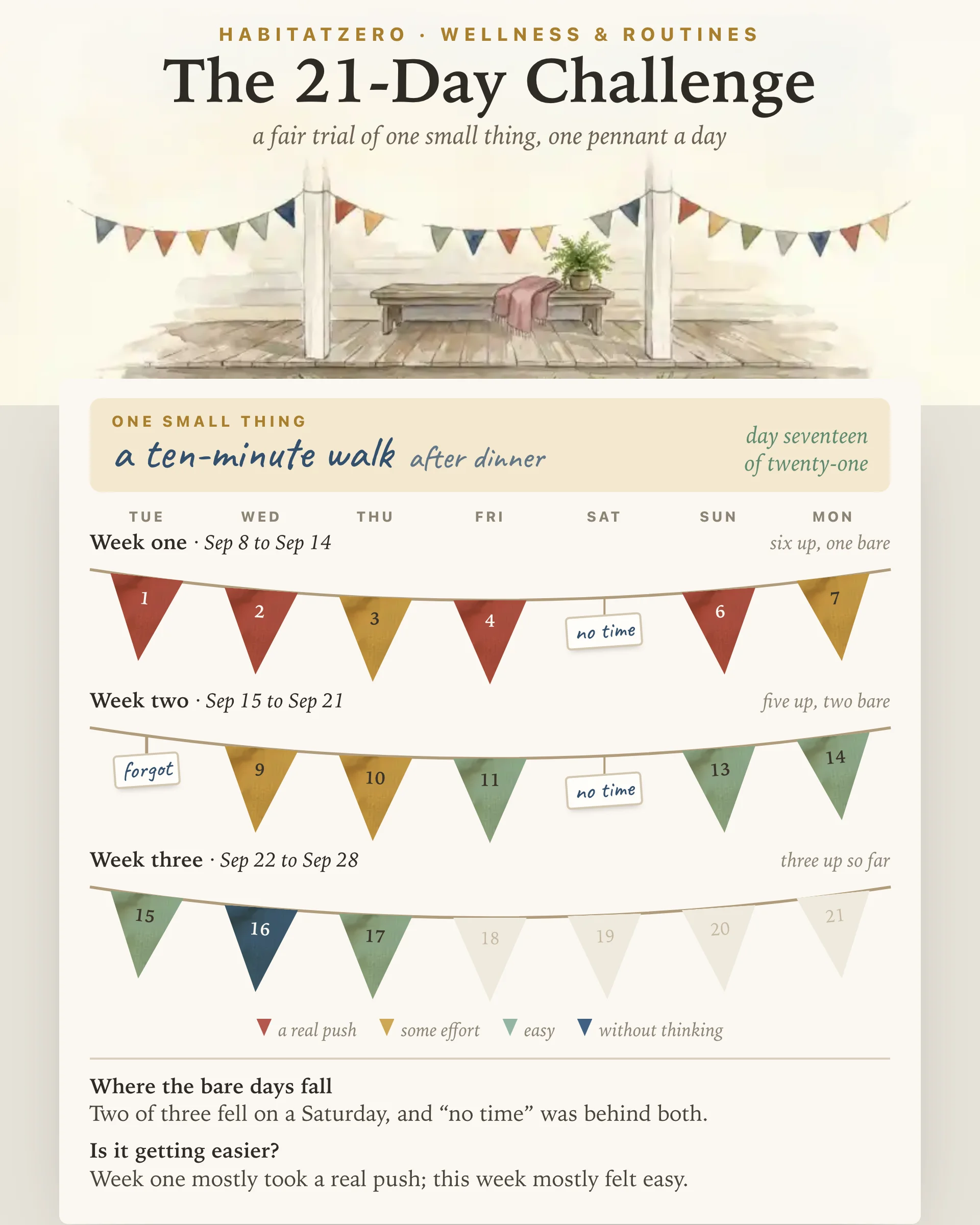
Twenty-one days has a reputation it never earned. You have probably heard that a habit takes three weeks to form, and that once you reach day twenty-one the new thing will run by itself. That is not what the research found. Three weeks is still useful for a different job: it is long enough to give one small change a fair trial, and short enough to start today.
That is how this page treats it. You choose one small thing, mark it for twenty-one days, and end with evidence about your own life instead of a pass or a fail.
The number is usually traced to Maxwell Maltz, a plastic surgeon whose 1960 book Psycho-Cybernetics asked readers to keep practicing his exercises for at least three weeks before judging them. He had noticed that people seemed to need a minimum of about 21 days to get used to a change, such as a new face after surgery or a new house. Health psychologists who have looked into the myth trace it back to those surgery anecdotes. Maltz described a minimum for adjusting. Somewhere in the retelling, his minimum became a deadline for habits.
The best-known test of how habits form ran for twelve weeks. In the study by Phillippa Lally and her colleagues, 96 volunteers each picked one eating, drinking or activity behavior to repeat daily in the same setting, for example after breakfast, and rated every day how automatic it felt. Automaticity climbed fastest in the early weeks and then leveled off. How long each person took to reach that plateau ranged from 18 to 254 days, with a median of 66. Simple actions, like drinking a glass of water, got there sooner than demanding ones.
Two findings from that study shape this page. First, missing one day did not materially set anyone back, so a missed day here is a gap in the record, never a reset. Second, the steepest gains come early. Twenty-one days will not finish the job for most people, but it covers the stretch where you learn the most: whether the thing fits your days, which days fight it, and whether it has started to take less out of you.
Pick one small thing by tapping a suggestion or writing your own, then say when you will do it. Tying the action to something you already do every day, like after dinner or on your lunch break, gives it a cue to hang on. The same research group recommends a cue inside an existing routine because it turns up reliably, day after day.
Each day of the challenge is a pennant on one of three strings, one string per week, with the weekdays lined up in columns. When you have done the thing, tap the day and say how hard it felt: a real push, some effort, easy, or without thinking. The pennant goes up in that color, so the garland records effort as well as attendance. When a day slips, leave it bare and tag what got in the way, whether that is no time, a late shift, or simply not wanting to. You can log a forgotten day later, but never a day ahead.
Once a few days are in, the page reads the garland back to you. It looks for the weekday your bare days share, the reason that keeps coming up, and whether your latest week is taking less effort than week one. That is the work a printed chart leaves to you.
Change the wording partway and the page asks whether it is the same thing in new words or a different thing. Rewording keeps your marks; a different thing starts its own twenty-one days, and the earlier marks stay on record without counting toward it.
You will have three honest options.
If most days held and the pennants drifted from rust toward sage and blue, run another round. Three rounds come to sixty-three days, close to that median, and the page keeps a line for each round, so you can see how each one held.
If it held but still takes a real push every day, the thing may be too big for now. Shrink it until it fits your worst day. The Two-Minute Rule is a good way to find a version that small.
If the bare days never let up, or you found you do not actually want it, let it go. That is a result too, and you learned it in three weeks instead of three months. When you want to try something else, The Habit Catalog lists small, specific habits to choose from.
Choose something you could do on a bad day. Ten minutes is plenty, and so is one page. You can always raise it in round two.
Read the garland at the end of each week rather than every morning. A single bare day tells you little, but three tags on the same weekday tell you where to plan.
To build several changes at once, or to keep going well past three weeks, The 90-Day Challenge holds up to three daily commitments.
It is a promise to do one small thing every day for three weeks, such as a ten-minute walk or five pages of a book, while keeping an honest record of the days it happened and the days it did not.
Usually not. In a twelve-week study of daily habits, the time an action took to reach its most automatic ranged from 18 to 254 days, with a median of 66. Three weeks is better used as a trial run that shows whether the action fits your life.
It is usually traced to the plastic surgeon Maxwell Maltz. In his 1960 book Psycho-Cybernetics he asked readers to practice for at least three weeks before judging his methods, because people seemed to need about that long to get used to a change. Later retellings turned his minimum into a deadline for habits.
No. Missing a single day made no real difference to habit formation in the research, which is why a missed day here stays on the garland as a bare spot with a tag rather than resetting a streak.
Not to try it. The garland on this page is a working preview, and your own three weeks need somewhere to live between visits. Personalizing it in HabitatZero keeps every pennant and tag, and costs nothing.
By the team behind Fabulous, the science-based self-care app used by over 30 million people.


