ADHD Daily Task OrganizerFocus & ADHD · ~10 min
About this template · Updated September 2026
Two people are credited with a two-minute rule, and this page uses both. David Allen, who created the Getting Things Done method, says that any action you can finish in less than two minutes should be done the moment you decide on it, and he explains why in a short episode on the Getting Things Done site. James Clear, author of Atomic Habits, uses the same name for a different idea: a new habit should begin with a version that takes less than two minutes. This worksheet is an independent practice page. Neither author nor the David Allen Company made it, reviewed it or has any connection to it, and Getting Things Done and GTD are registered trademarks of the David Allen Company.
Allen's rule is for work that already exists: the email, the form, the dishwasher that needs emptying. Clear's rule is for habits that do not exist yet: the reading you mean to start, the stretching you keep postponing. Clear acknowledges the overlap himself, with a footnote on his article that tips its hat to Allen's version. The page keeps them in separate sections.
Allen's argument is about bookkeeping. A job that takes ninety seconds does not stay a ninety-second job once it goes on a list. You write it down, file it, notice it again tomorrow, reread it, decide again, and only then do it. As he puts it in the episode, looking at it again and reviewing it later would take longer than two minutes on its own.
The rule belongs to the moment of sorting, once you know what the next action on an item actually is. It is not an order to drop focused work whenever a small request pings you.
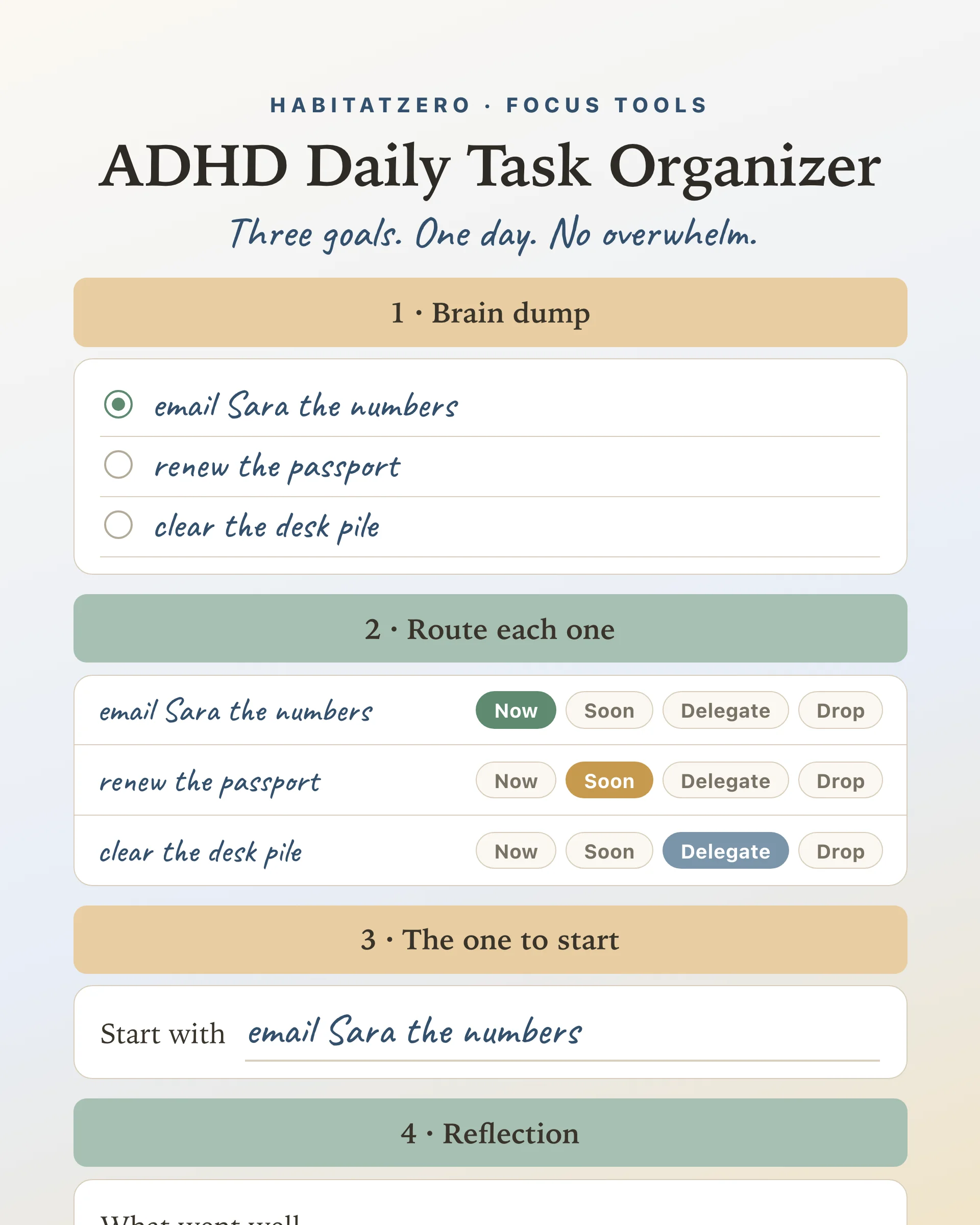
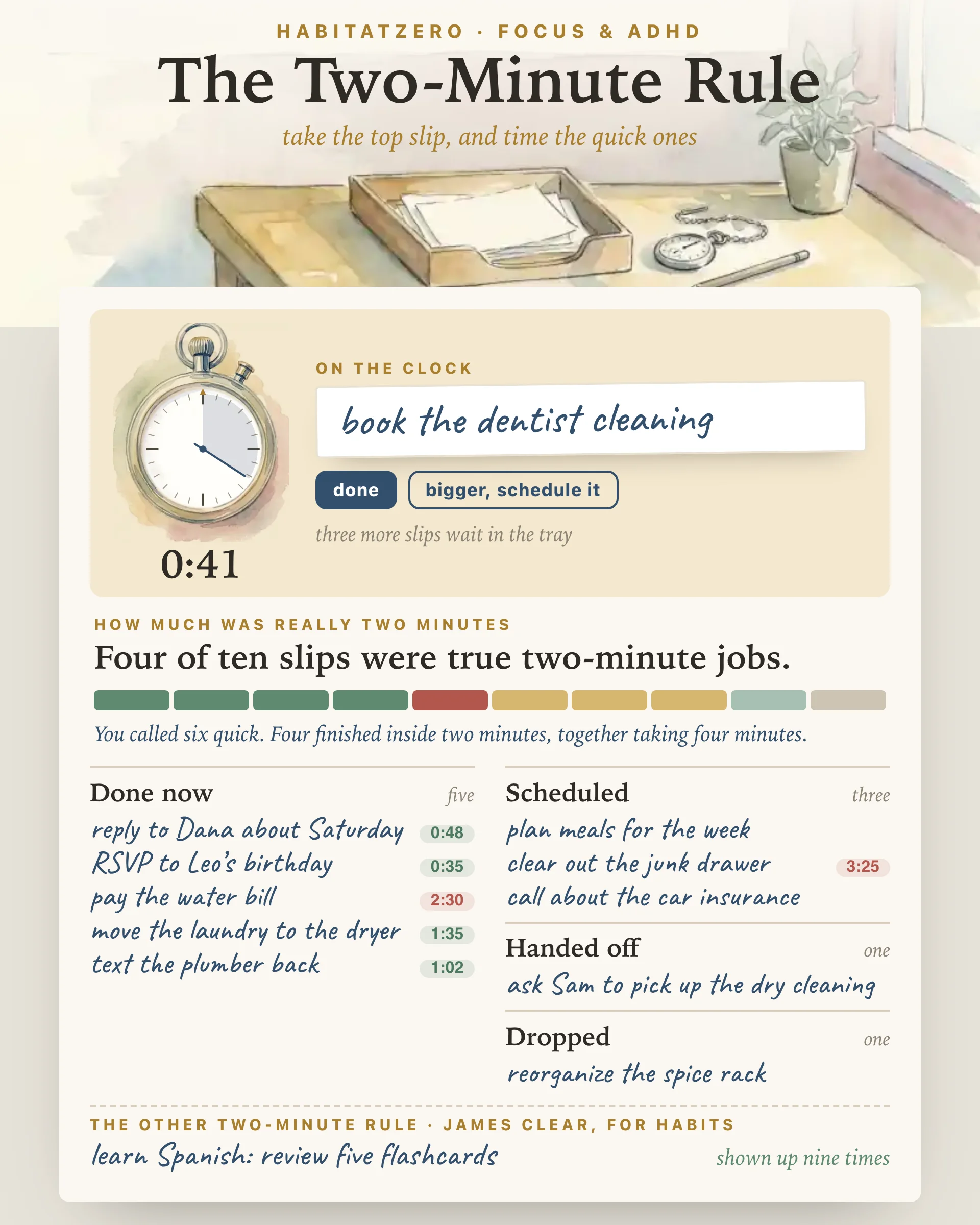
Start by emptying your head into the in-tray, one thing per slip. Type a line or tap a suggestion. The tray holds twelve, so a long list gets sorted in rounds. The oldest slip sits on the desk next to a stopwatch, and the page asks one question about it: could it be done in under two minutes?
You have four answers. Do it now starts the stopwatch. Schedule it is for work that needs its own time and place. Hand it off is for work someone else should do. Drop it is for the things you were never going to do, which is an honest answer rather than a failure. The desk only offers the top slip, because picking the easy ones first is how piles grow back.
The stopwatch counts from the moment you started it, so leaving the page does not lose the time. Press done when the job is finished. If it turns out bigger than it looked, send it to the schedule instead, and the page records it as a quick call that ran long.
Once a few jobs are timed, the reading appears: how many slips were true two-minute jobs, a bar with one cell per slip, how long the quick ones took together, and which ones ran long. That last line is the useful one, because it shows which kinds of jobs you keep underestimating.
Nobody has run a trial of the two-minute rule itself, so treat it as a working habit rather than a proven cure for procrastination. Buehler, Griffin and Ross found that people's predictions of how long their own tasks would take were too optimistic across academic and everyday tasks, and in one of their studies the optimism disappeared when people tied their forecast to how similar tasks had gone before. Their tasks were far larger than two-minute jobs, so read this as a reason to check your guesses, not as proof about small ones. The stopwatch gives you that record for your own quick jobs.
For Clear's rule, the relevant work is on how habits form. In a study that followed volunteers repeating one daily behavior in the same setting, automaticity grew with repetition, the time people took to reach their plateau ranged from 18 to 254 days, and missing a single opportunity did not materially set the process back. A start small enough to manage on a bad day makes that repetition easier to keep.
The habit section keeps up to three two-minute starts. Name the habit, write its start, and press the countdown. Clear suggests that if the rule starts to feel like a trick, you do the start for two minutes and then stop, so the countdown ends at two minutes and tells you that you can. Log each time you show up. That count is the point for now: you are building the habit of showing up before you build the whole routine.
Sort the tray once or twice a day in one sitting, rather than whenever something small appears. If your head is too full to write the first slip, the Brain Dump Worksheet is a gentler first step, and the slips you schedule can feed tomorrow's card in The Ivy Lee Method. When a two-minute start has become routine and you want to design the whole habit around it, the Habit Loop Worksheet takes it apart piece by piece.
The name covers two separate ideas. David Allen's rule, from Getting Things Done, says to do any action that takes less than two minutes as soon as you decide on it. James Clear's rule, from Atomic Habits, says a new habit should start with a version you can do in under two minutes.
It is a step in clearing an inbox or a to-do pile. Once you know the next action on an item and it would take under two minutes, you do it right away, because writing it down, storing it and reading it again later costs more time than finishing it.
Quick jobs can quietly swallow a morning, and most people guess too short. Use the rule while you are sorting a pile rather than in the middle of focused work, and time a few jobs so you learn what really fits in two minutes.
It can help, because it swaps a decision for an action and keeps the start small. It can also turn into a string of detours, so sort in one sitting, keep a visible clock, and schedule anything that runs long. Treat it as a practice to try, not a treatment.
No. This is an independent practice page that credits both authors for the rule it is named after. It was not made or reviewed by David Allen, James Clear, the David Allen Company or any of their publishers. For each rule in its author's own words, read Getting Things Done and Atomic Habits.
This page shows a filled-in example you can look through. To fill your own tray, time your jobs and keep your habit starts from one day to the next, open it in HabitatZero, which is free.
By the team behind Fabulous, the science-based self-care app used by over 30 million people.