ADHD Daily Task OrganizerFocus & ADHD · ~10 min
About this template · Updated September 2026
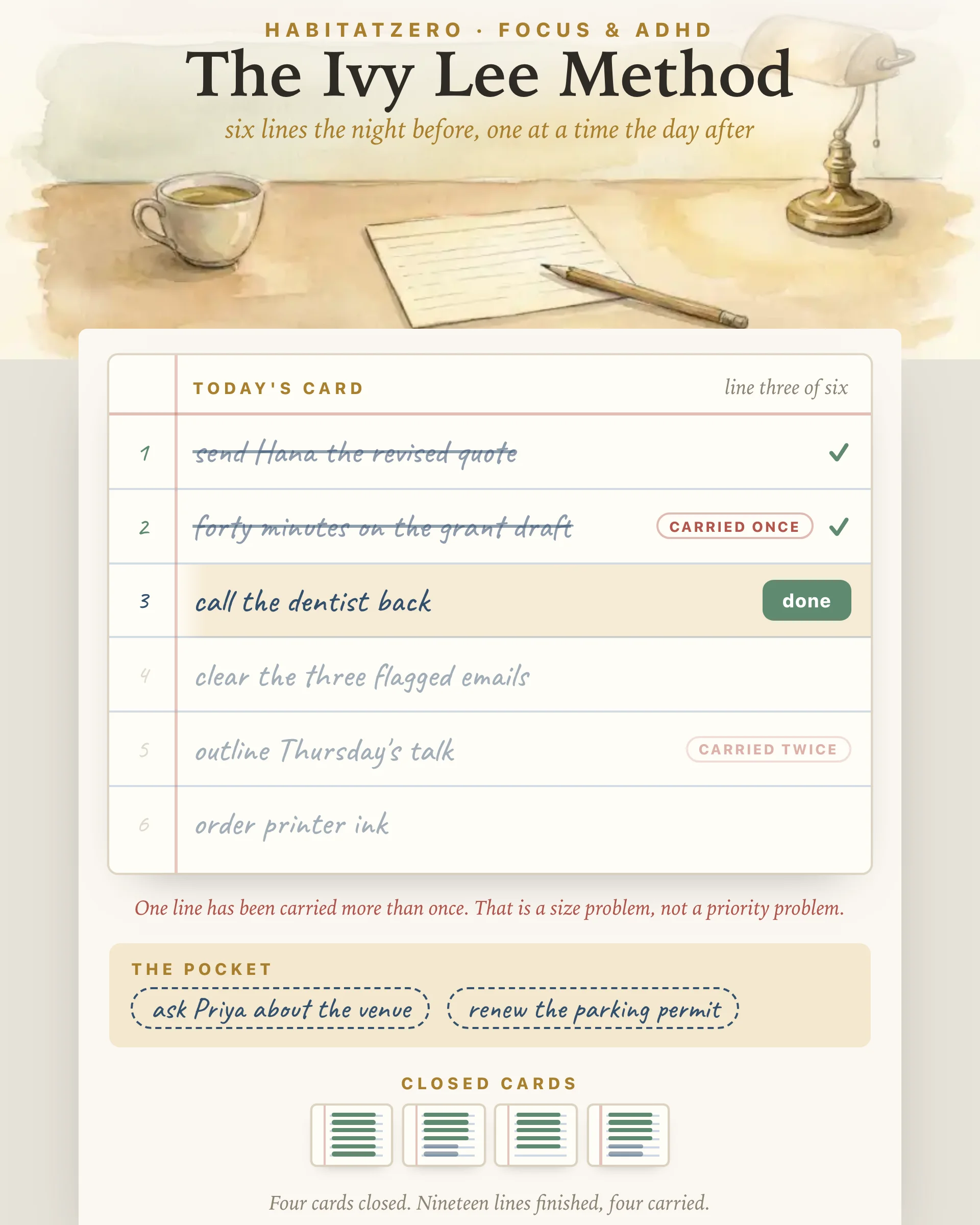
The method takes its name from Ivy Ledbetter Lee, the public relations pioneer who is said to have handed it to Charles M. Schwab's executives at Bethlehem Steel around 1918. The version most people know today comes from James Clear's telling of the story, which sets out the six-task rule in the form used here. This is an independent practice card, not affiliated with, endorsed by, or connected to James Clear or to anyone representing Lee's legacy.
Lee's instructions were short enough to remember without the card:
Schwab reportedly sent Lee a cheque for twenty-five thousand dollars. Nobody can verify that now; the routine stands on its own.
Writing tonight takes the deciding out of the morning, when a fresh brain tends to get spent on the inbox. It also settles the mind before you leave. Masicampo and Baumeister found that unfinished goals kept intruding on people's attention, and that making a concrete plan for them was enough to stop the intrusion. You do not need to do the task tonight, only to have decided its place.
Stopping at six is the move most people skip and most people need. Ranking twenty items against each other is not something anyone does honestly; six can be ranked in a minute. The discipline is not in the writing; it is in what gets left off.
Ranking turns the card into a promise. Line one is the task you would be most relieved to have finished by ten o'clock.
One at a time is where the method earns its keep. Every switch from one task to another has a cost paid in seconds and mistakes, which Rubinstein, Meyer and Evans measured in the lab, and the cost grew as the task rules got more complex. A ranked list with a single lit line removes the switching from the day.
Carrying over is the honest part. Most days you will not finish six. The leftover lines go onto tomorrow's card and keep their place near the top, so nothing is lost and nothing is quietly dropped.
The sheet is one index card with six ruled lines and a red margin. Type a line and it lands in handwriting, or tap one of the common ones to get started. A seventh line does not go on the card; it drops into the pocket underneath, where it can try again for a later day.
Ranking is done by tapping the small arrow beside a line to move it up. When the order is right, you start the day and the card changes: only line one is lit, the lines beneath fade, and a single done button sits on the live line. Finish it and the next line lights up. A line that cannot move right now can be sent to the bottom, but it stays on the card until it is done or carried.
At the end of the day you close the card. Finished lines are counted, unfinished ones move to tomorrow's card at the top, and a tiny card joins a ledger, one per day, showing which lines earned a green stroke. After a week the ledger tells you something the card alone cannot: how many lines you finish on a typical day, and whether you are writing six because you can or because the rule says so.
The card also watches for one pattern. A line that has been carried twice gets a flag, because a task that survives three cards is almost never a priority problem. It is a size problem. Shrink it until a morning is enough, and if shrinking is the hard part, The Shrinker exists for exactly that.
Nobody has run a trial of the Ivy Lee method as a package, and the Bethlehem Steel story is an anecdote, not a study. What the research supports are the parts. Deciding in advance where and when you will act is the best studied of them: Gollwitzer and Sheeran's meta-analysis of ninety-four tests found that these advance decisions helped people reach their goals across a wide range of tasks. Together with the switching cost and the settled mind described above, that is reasonable ground for a routine, not a guarantee.
The card suits a working day with a shape: a job, a course, a project. Fill it in the last ten minutes of the day, before the screen goes dark. If you arrive with forty things and no idea which six, sort the pile first with the ADHD Priority Matrix and bring only the now column here. And if closing the card is the step you tend to skip, fold it into a workday shutdown ritual so that tomorrow's six get written before today's laptop lid comes down.
Six lines, in order, one at a time. Then a fresh card.
A century-old routine for a working day: before you leave, write the six most important things to do tomorrow, put them in order of importance, and the next day work them strictly from the top, one at a time. Anything unfinished moves to the following day's list.
Six is small enough to rank honestly and to finish on an ordinary day. The cap forces the real decision, which is not what to do but what to leave off. On this card a seventh line goes into a pocket rather than onto the list.
Nothing dramatic. The leftover lines move to tomorrow's card and keep their place near the top. If the same line keeps carrying over, the card flags it, because a task that survives three days is usually too big rather than too unimportant.
This page is one. It keeps the card, the ranking and the carry-over in the browser, and it draws a tiny card into a ledger for every day you close, so a week of cards can be read at a glance.
The example on this page is fixed so you can see what a card looks like mid-day. Writing your own and keeping it from one evening to the next means personalizing it in HabitatZero, which costs nothing.
By the team behind Fabulous, the science-based self-care app used by over 30 million people.