ADHD Daily Task OrganizerFocus & ADHD · ~10 min
About this template · Updated July 2026
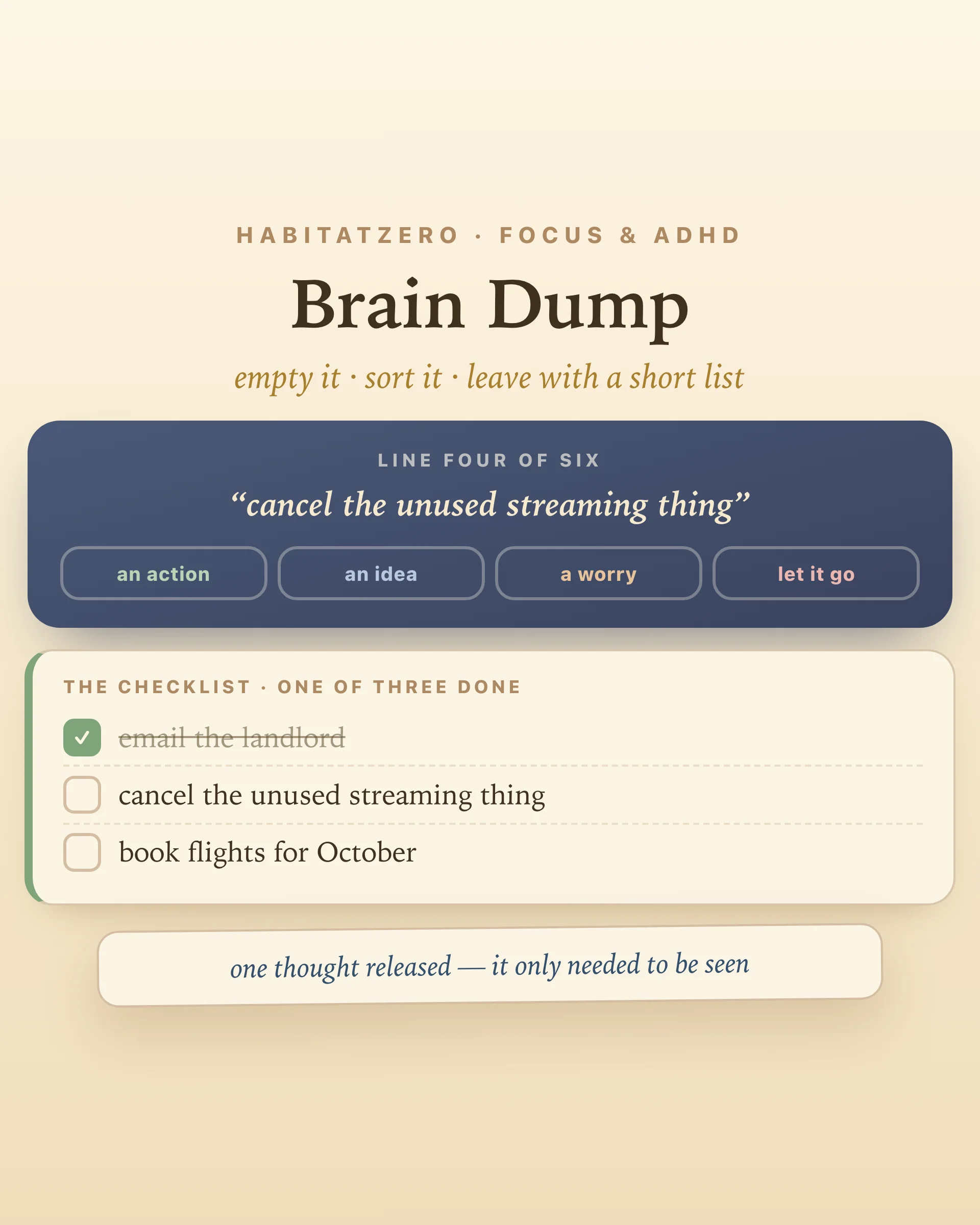
Your head is a terrible office. Everything in it is filed under now, every item interrupts every other item, and the filing system wakes you at 3am to re-read the folder marked "things you might be forgetting." A brain dump is the eviction notice: set a timer, get every open loop onto the page one line at a time, and then — this is the part most brain dumps skip — sort the pile so it ends as a checklist instead of a longer version of the mess you started with.
Pick your container: three, five, or ten minutes. Then one line per thought, no filtering, no sorting, no finishing sentences that don't want to be finished. The unpaid invoice, the dentist, the app idea, the thing you said on Tuesday that you keep replaying — all of it, in whatever order it arrives. Speed matters more than sense: judging thoughts mid-dump slows the flow to a trickle, and the silly items are often escorting a real one out the door.
The relief you feel doing this isn't placebo. The mind treats unfinished business as its own reminder system — rehearsing loops so they won't be lost — and research on task tension shows the nagging quiets once a plan or a written home exists for each item, well before anything is actually done. Offloading to the page is also just good engineering: external memory is how minds handle more than they can hold, the cognitive equivalent of writing the phone number down instead of chanting it.
When the timer rings, you can keep typing — it's a container, not a cage. But the ring is your cue that the second half is waiting.
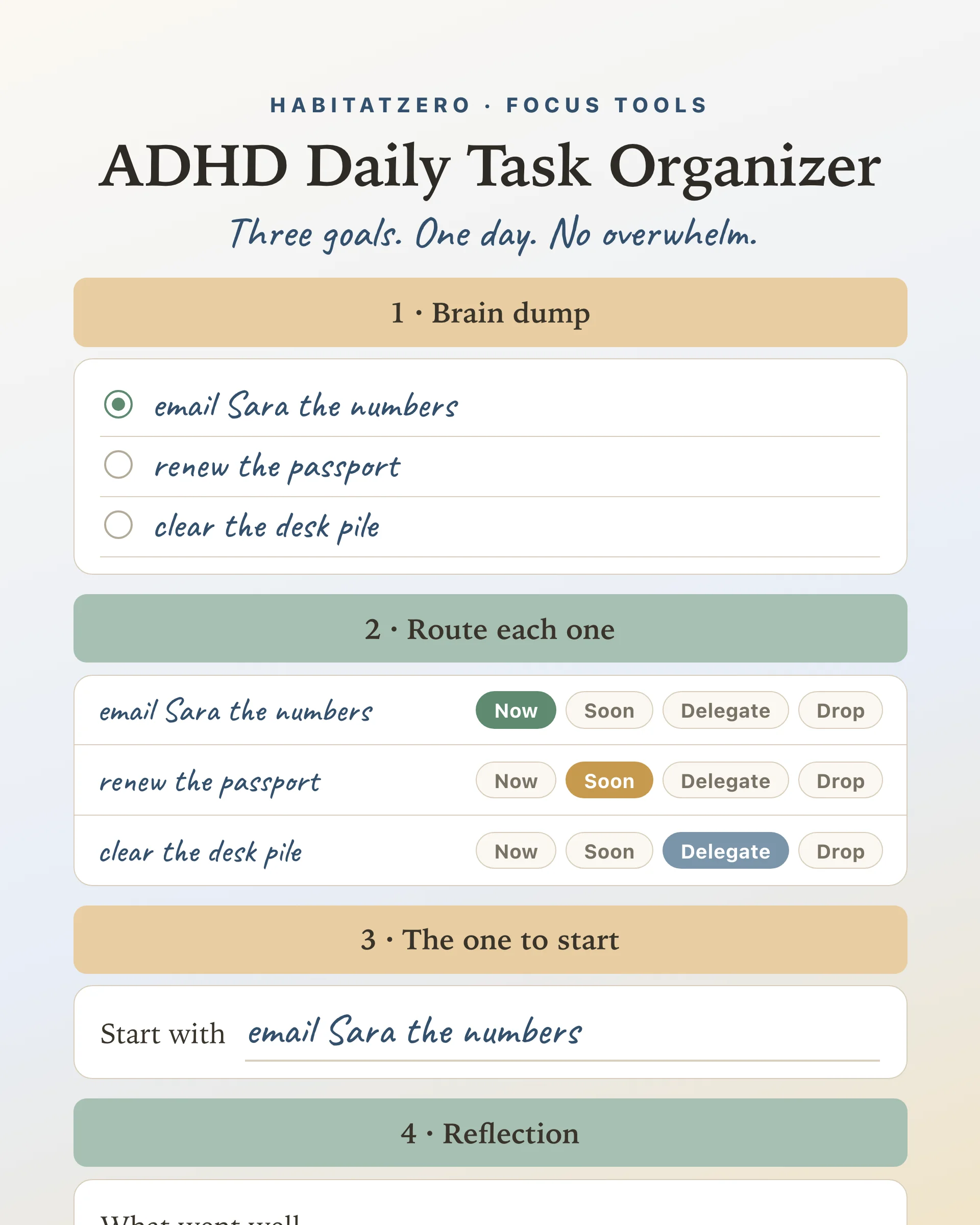
A dump that stays a pile has only moved the clutter from your head to a page. So the worksheet deals every line back to you, one at a time, and asks one question per card: what is this?
Four honest boxes, one tap each. The one-at-a-time dealing is deliberate: a full pile invites re-reading and re-shuffling, while a single line demands a single decision.
What survives is small on purpose. The actions become a live checklist — tick them here, or download the list and take it with you. Ideas and worries wait in their own lists, visible but out of the action lane. And when the head fills again — it will — a fresh dump is one tap away.
Two neighbors complete the picture. If it's 11pm and the loop that's circling is keeping you from sleep, use the bedtime brain dump instead — same emptying, but worries get released rather than actioned, and the list locks until morning. And if the checklist that comes out of a dump is really a day trying to happen, the ADHD priority matrix will deal those actions into now-decide-shrink-drop, one card at a time — the same trick, one level up.
Three minutes of emptying, two minutes of sorting, one short list. The office in your head was never meant to hold this much — and now it doesn't have to.
A timed sprint of getting every open loop out of your head and onto the page — tasks, worries, half-ideas, the thing you keep almost forgetting — with zero sorting while you write. The sorting comes after, and that order matters: capture is fast precisely because nothing has to be decided yet, and research on unfinished tasks suggests the mental nagging quiets once a thought has a written home.
Three rules cover it. One line per thought, so each item stays sortable. No filtering, because judging thoughts mid-dump slows the flow to a trickle — the silly ones come out too. And always sort afterwards: a dump that stays a pile just moves the clutter from your head to a page. This worksheet times the capture, then deals every line back to you for a one-tap sort into actions, ideas, worries, or let-go.
A bedtime dump is its own ritual with its own rules — worries get released rather than actioned, and the list locks until morning so your brain stops rehearsing it. That version lives in the Bedtime Brain Dump worksheet. This page is the general-purpose, any-hour tool: same emptying, but built to end in a checklist you act on today.
Naming a worry as unactionable is the point — it stops masquerading as a task you are failing to do. The worries list keeps them visible without letting them back into the action lane. If one turns out to have an action hiding inside it, run the next dump and it will sort itself into the checklist where it now belongs.
Yes — free, in your browser, no signup. Your lines, the sorted piles, and the checklist ticks save as you go, and the checklist downloads as an image. In the Fabulous app the same worksheet syncs across devices.
By the team behind Fabulous, the science-based self-care app used by over 30 million people.