
The Overwhelm Recovery ProtocolWellness & Routines · ~5 min
About this template · Updated September 2026
This page borrows its shape from The 100 Day Project. The format began as an assignment from the designer Michael Bierut, who described it in his essay Five Years of 100 Days: each graduate graphic design student in his workshop at the Yale School of Art chose one design operation, repeated it every day for a hundred days, documented every version and presented the whole run to the class at the end. Elle Luna and friends opened the idea to anyone on Instagram in 2014, and Lindsay Jean Thomson has co-led it with her since 2017. We built this worksheet on our own. It has no connection to the project or to any of those people, and none of them has reviewed or endorsed it.
A 100 day challenge asks for one thing every day for a hundred days, whether you call it a 100 days challenge or the 100 Day Project. The versions that last keep the daily unit small and let the days add up to something you can stand back and look at.
The project's own FAQ suggests a practice that fits into five or ten minutes, with tools you can carry in a bag. A make that needs a free afternoon loses to the first crowded week; one small ink drawing or four lines of a poem can survive a cold, a deadline and a trip.
This page follows Bierut's instinct: every day becomes a frame on a wall, and you see the run you have made, not just a number.
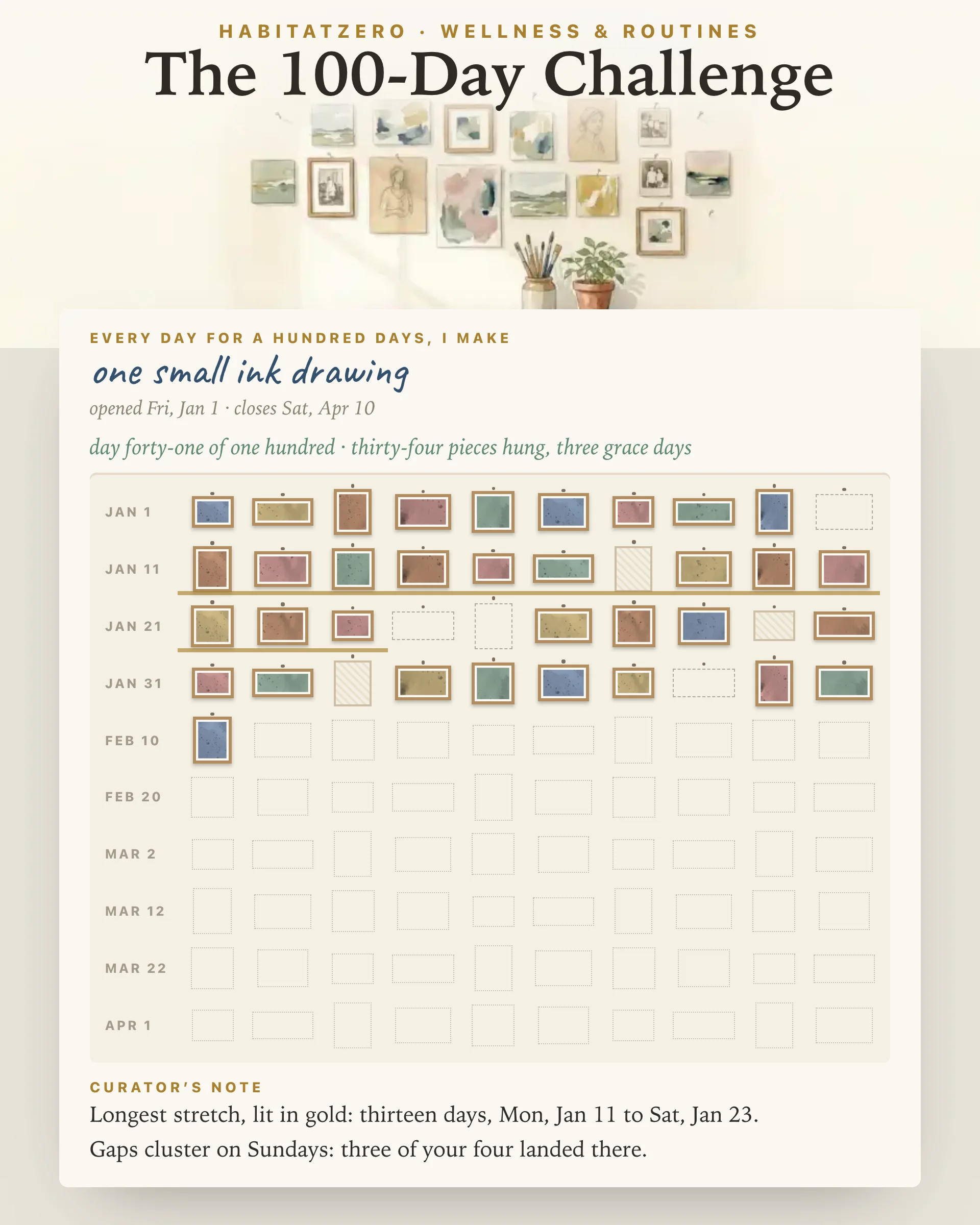
You start at the placard. Tap an idea or write your own make, then set the opening day: today, the first of next month, or any date you step to. The placard names the closing day a hundred days later.
Each day, the easel under the placard holds that day's frame. Give the piece a title if it has one, choose one of five watercolor washes for its frame, and hang it. Below it, ten short walls of ten dated frames hold the whole hundred on one page. Forgot to log a day you did make something? Tap its frame and hang the piece late.
Ten grace days wait in reserve. Taking one rests a frame behind a linen card and keeps your stretch intact, and you can give it back if you change your mind. Once all ten are gone the page says so and still lets a day go blank. A gap is a bare nail, nothing more.
After a week of frames, the curator's note starts reading the wall. It lights your longest stretch in gold. It checks whether your gaps cluster on one weekday or on one wall of ten, and whether one missed day tends to pull a second behind it. If nothing has gone up for a week or more, the note calls that a quiet spell rather than dressing it up as a pattern.
A hundred days is a reasonable length, not a magic one. In a widely cited study on habit formation, Lally and colleagues asked 96 volunteers to repeat one eating, drinking or activity behavior each day in the same setting for twelve weeks. For the 39 people whose data fit the researchers' model well, the median time to reach 95 percent of their automaticity plateau was 66 days, and the range ran from 18 to 254 days. So a hundred days carries many people past the median for a simple behavior and leaves others short of it, and a creative practice is messier than a glass of water after breakfast. Nothing here promises that your practice will stay with you for good.
The same study found that missing one opportunity did not materially change how the habit formed, which is why a gap here is a bare nail and never a reset.
The grace days come from different research. Sharif and Shu studied goals that carry an emergency reserve: a few allowed skips that still feel costly to spend. People preferred goals built that way, and in a task that ran over time they persisted more with them; the later studies traced that persistence to wanting to avoid spending the reserve. Ten grace days, visible and counted, are that reserve.
Then there is the date. Work on the fresh start effect found that searches for dieting, gym visits and goal commitments all rose after temporal landmarks such as a new week, month or year, which makes January 1 a strong opening day. The effect concerns starting, though; the middle weeks are where the curator's note has the most to tell you.
Set it up in late December for a New Year's Day opening, or ahead of the first of any month. The project's own shared round begins in February 2027, and any other day works just as well. If a hundred days feels like a lot at first, The 30-Day Challenge deals a different small task for each day of a single month. If you want starting points for drawing on days when words fail, Expressive Art Prompts offers three. And if this hundred sits inside a bigger plan for the year, keep New Year Goals open beside it.
You pick one thing and do it every day for a hundred days, usually a small creative practice or a habit you want to keep. A hundred days is long enough for the work to change under your hands and short enough that the last day is visible from the first.
Michael Bierut set it as an assignment for graduate graphic design students at the Yale School of Art: repeat one design operation daily for a hundred days and document every version. Elle Luna and friends opened it to everyone on Instagram in 2014. This tracker was made separately by Fabulous and has no link to Bierut, Luna or the project.
Choose a make that takes five to ten minutes and needs tools you can carry: one small drawing, a photo of something ordinary, four lines of a poem, a few rows of knitting, a hundred words of a story or a minute of dance. The smaller the make, the better it survives a hard week.
You carry on the next day. Ten grace days are yours to spend on purpose, and any other missed day simply leaves a bare nail on the wall. In a well-known habit study, missing a single day made little difference to how the habit formed.
Looking costs nothing and needs no download: the sample wall here holds forty-one days of an ink drawing project. Hanging your own pieces and keeping them across all hundred days happens in HabitatZero, which is free.
By the team behind Fabulous, the science-based self-care app used by over 30 million people.


