
Breast Density and Mammogram Blind Spots Explained
(BEST OF) Breast Cancer Intel That Could Save Your Life | Amanda’s Surgeon Dr. Lucy De La Cruz
▶ Listen to the full episode More from We Can Do Hard Things
The brief
Breast surgeon Lucy de la Cruz explains how dense breast tissue hides cancer from mammograms and what surgical choices patients are rarely offered. Georgetown University Hospital's de la Cruz covers density categories, lumpectomy versus mastectomy recurrence odds, direct-to-implant reconstruction, and nerve grafts that restore nipple sensation within one to two years.
A mammogram works by contrast. Fat shows up black. Tumors show up white. For most people, that contrast is enough: a radiologist looks at the dark field and the white spot announces itself. But for roughly one in ten people with breasts, the entire breast is white to begin with. There is no dark field to set a tumor against. The cancer is there, and it is invisible, not because the machine failed but because it was never built to see through that kind of tissue.
This is the opening problem of a solo segment by Amanda Doyle, cohost of We Can Do Hard Things, before she's joined by her breast surgeon, Dr. Lucy de la Cruz, chief of breast surgery at Georgetown University Hospital. Three days before her double mastectomy, Doyle went in for an insurance-mandated mammogram. The technicians read it as completely clear and told her they would never have recommended further screening (16:18). She already had cancer. Her breast tissue is classified as Category D, the densest of four categories the American College of Radiology uses to grade breast tissue (17:21). Mammograms miss 50 to 60 percent of cancers in patients with dense breasts, and Category D tissue carries an independent four-to-six-times higher risk of developing breast cancer in the first place (21:37, 25:27). The two facts compound each other: the group most likely to get cancer is also the group least likely to have it found by standard screening.
The frustrating part, as Doyle points out, is that a mammogram report will note whether tissue is dense, but it will not say whether a patient is Category C or Category D unless she asks (18:55). Doyle is blunt about why that information gets buried. "This is for sure, like anything else, a money issue," she says, explaining that additional screening, like an MRI, costs more, and insurers only cover it once a patient crosses a documented risk threshold (22:49). The workaround, both women suggest, is to ask directly: am I category C or D, and if D, I want an MRI on record as requested. Patients who push, Doyle says, usually get approved, in part because a denial on record becomes a liability for the practice that issued it (23:18). For those who hit a wall entirely, there is a cheaper option: a mini MRI, which runs about $500 out of pocket versus thousands for a full scan, and is similarly effective diagnostically (27:08).
What makes this episode more than a screening PSA is the second half, where de la Cruz walks through what happens after diagnosis, and how many of the choices presented as single answers are actually the first of several real decision points. Doyle describes seeing four surgeons before meeting de la Cruz and getting four different plans, not because the science disagreed but because each surgeon was offering what she personally was equipped to do (08:31). De la Cruz traces her own approach to a mentor who taught her a simple rule.
"A woman deserves a choice when they have it." — Dr. Lucy de la Cruz [41:53]
Lumpectomy, mastectomy, and the myth of the safer cut
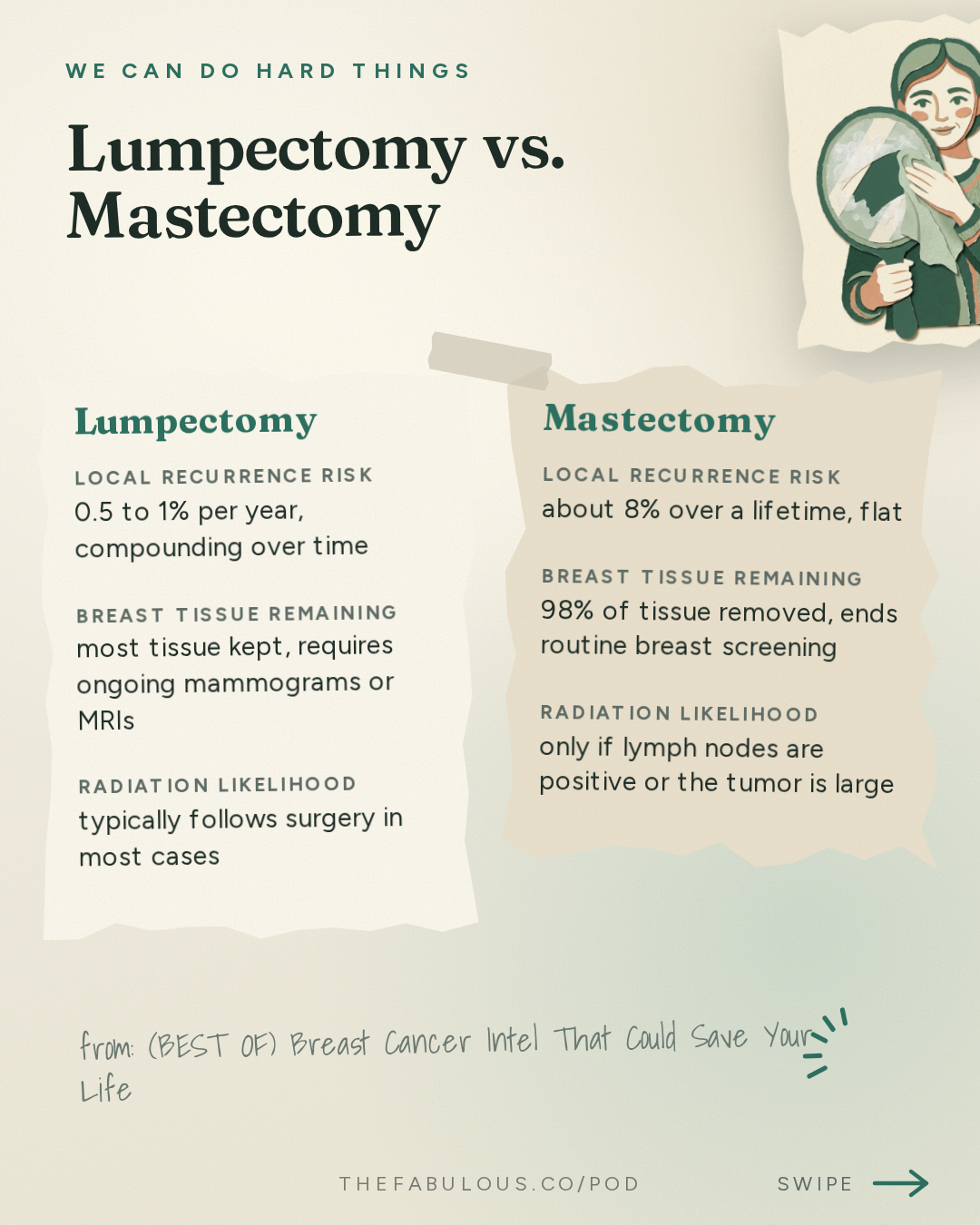
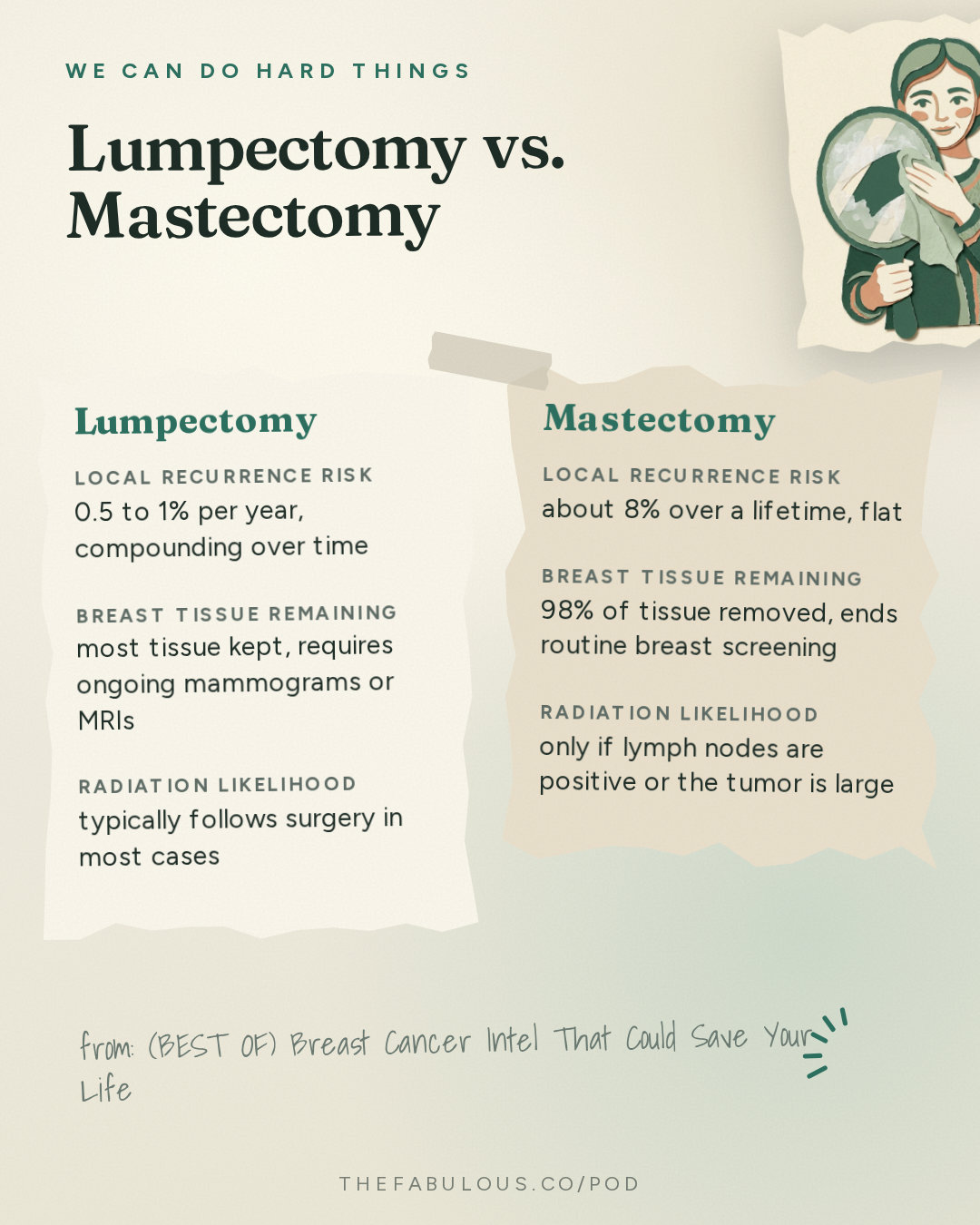
The first fork in the road is lumpectomy versus mastectomy: remove just the tumor and surrounding tissue, or remove the whole breast. De la Cruz states the central fact plainly: oncologically, the two procedures have the same survival rate (50:01). What differs is recurrence risk, and the shape of that risk matters. Lumpectomy carries a 0.5 to 1 percent chance of local recurrence per year, and that risk compounds, reaching roughly 5 to 10 percent at ten years and 15 to 30 percent at thirty years (54:13). Mastectomy, which removes about 98 percent of breast tissue, carries a flat lifetime local recurrence risk of about 8 percent (54:29). Neither number is a death sentence on its own. De la Cruz is careful to separate local recurrence, cancer returning in the breast or chest wall, from systemic disease, cancer that has spread elsewhere in the body. Surgeons treat the local problem. Medical oncologists, through chemotherapy and hormone-blocking drugs, treat the systemic one, and it is the systemic treatment that actually drives survival (60:50). About 80 percent of women diagnosed have estrogen- or progesterone-positive cancer, meaning hormone-blocking drugs like tamoxifen can starve the cancer cells of what feeds them (63:35). Skipping those drugs, de la Cruz warns, is the decision that actually affects survival, more than which surgery a patient chooses.
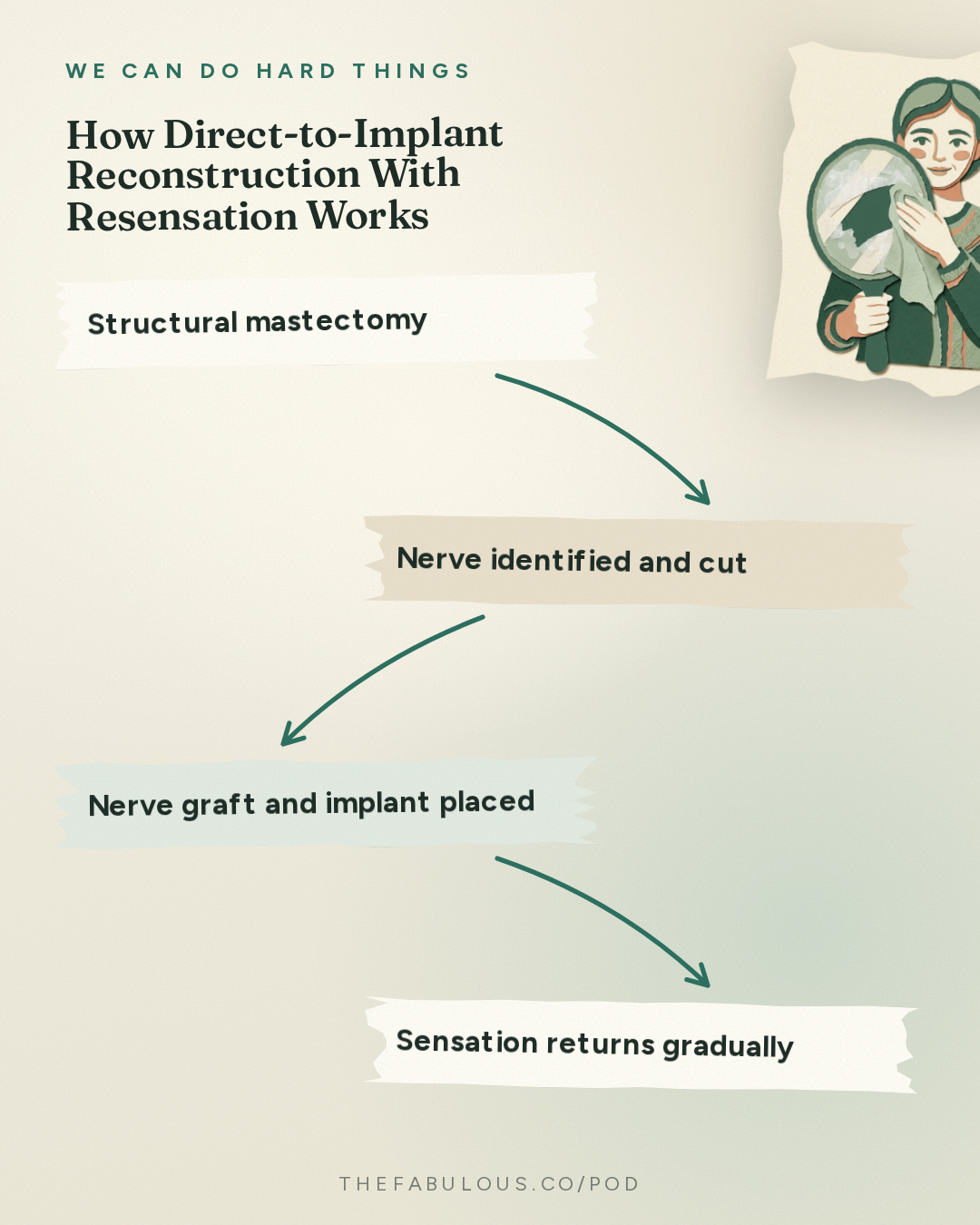
The reconstruction conversation carries its own hidden fork. The version Doyle initially expected, and the version most patients still get, involves two surgeries: a mastectomy followed by temporary tissue expanders, essentially silicone balloons placed under the skin to stretch it, and then a second operation months later to swap expanders for permanent implants (70:17). De la Cruz stopped doing it that way around 2017, after her plastic surgeon noticed that direct-to-implant patients, who get the permanent implant in the same surgery as the mastectomy, recovered just as well without the extra operation, the extra time off work, or the extra copay (73:08). The catch is availability. By de la Cruz's own count, only 11 percent of institutions in the United States offer direct-to-implant reconstruction, and the technique's revision rate runs up to 50 percent, meaning the question is worth asking any prospective surgeon directly (97:18).
Feeling, and who gets to keep it
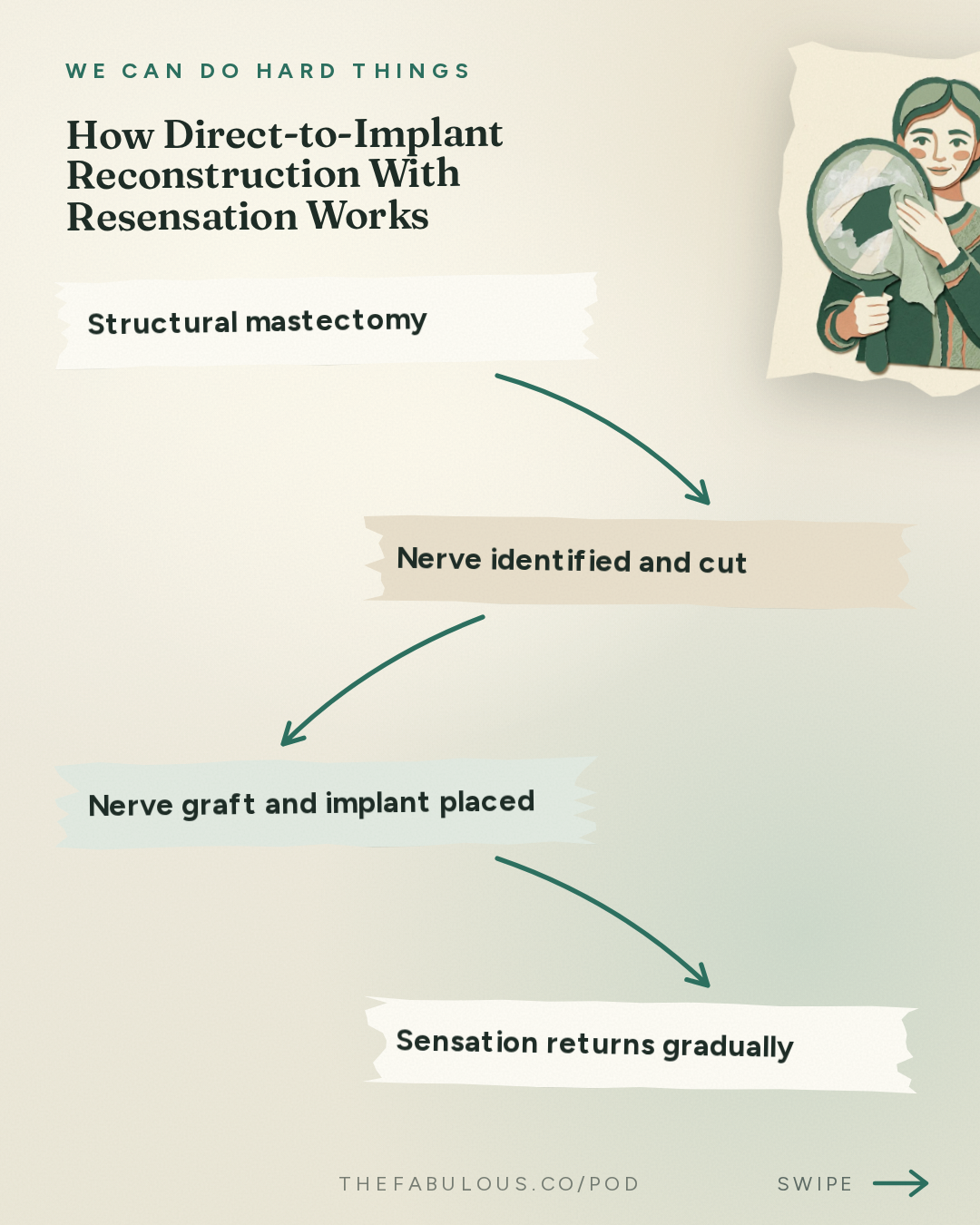
The detail most listeners will not have heard anywhere else is resensation: nerve grafting that can restore feeling to the chest wall and nipple after mastectomy. Standard mastectomy severs the nerve running from the chest wall to the nipple, leaving the skin permanently numb, a fact de la Cruz says is rarely disclosed to patients at all (80:27). The technique, pioneered by surgeon Anna Pellin, grafts a donor nerve onto the cut nerve stump during the same operation. The original nerve keeps firing, searching, as de la Cruz puts it, for its match, and over one to two years many patients regain sensation, enough to feel a hug, a curling iron, or a burn before it becomes serious (94:42).
"It takes 15 extra minutes of our lives to give you a whole life of feeling." — Dr. Lucy de la Cruz [96:11]
The same philosophy, tissue is innocent until the pathology says otherwise, shapes de la Cruz's approach to nipples and lymph nodes. Rather than preemptively removing a nipple because imaging looks worrying, she operates first, sends tissue margins to pathology, and only removes the nipple afterward if cancer cells are found at the edge (101:21). A similar tool, an injectable tracer called Magtrace, lets surgeons mark the lymph nodes most likely to catch spreading cancer without removing them outright, sparing 95 percent of DCIS, or stage-zero, patients an unnecessary lymph node surgery that carries a roughly 5 percent risk of permanent arm swelling, called lymphedema (107:40, 106:10).
"All nipples are innocent until proven guilty. If they're guilty, they're gone." — Dr. Lucy de la Cruz [102:56]
None of this is presented as a radical departure from medicine. It is presented, repeatedly, as information that already exists and simply is not offered unless a patient knows to ask for it. The conversation closes not with a prescription but with a short list of questions worth bringing into any surgical consult: what is your nipple-sparing rate, your direct-to-implant rate, your revision rate. Awareness, as Doyle frames it early on, is only useful once it turns into a plan.
Ask this episode anything
Pod's AI answers from the episode itself, with the minute mark so you can hear it yourself.
Or start with one of these
Ask this episode
Pod's AI listens to the whole episode to answer, and points you to the minute it comes from.
The rest of this answer, and any question after it
Answers come from the episode itself, never from a summary of it.
ContinueKey takeaways
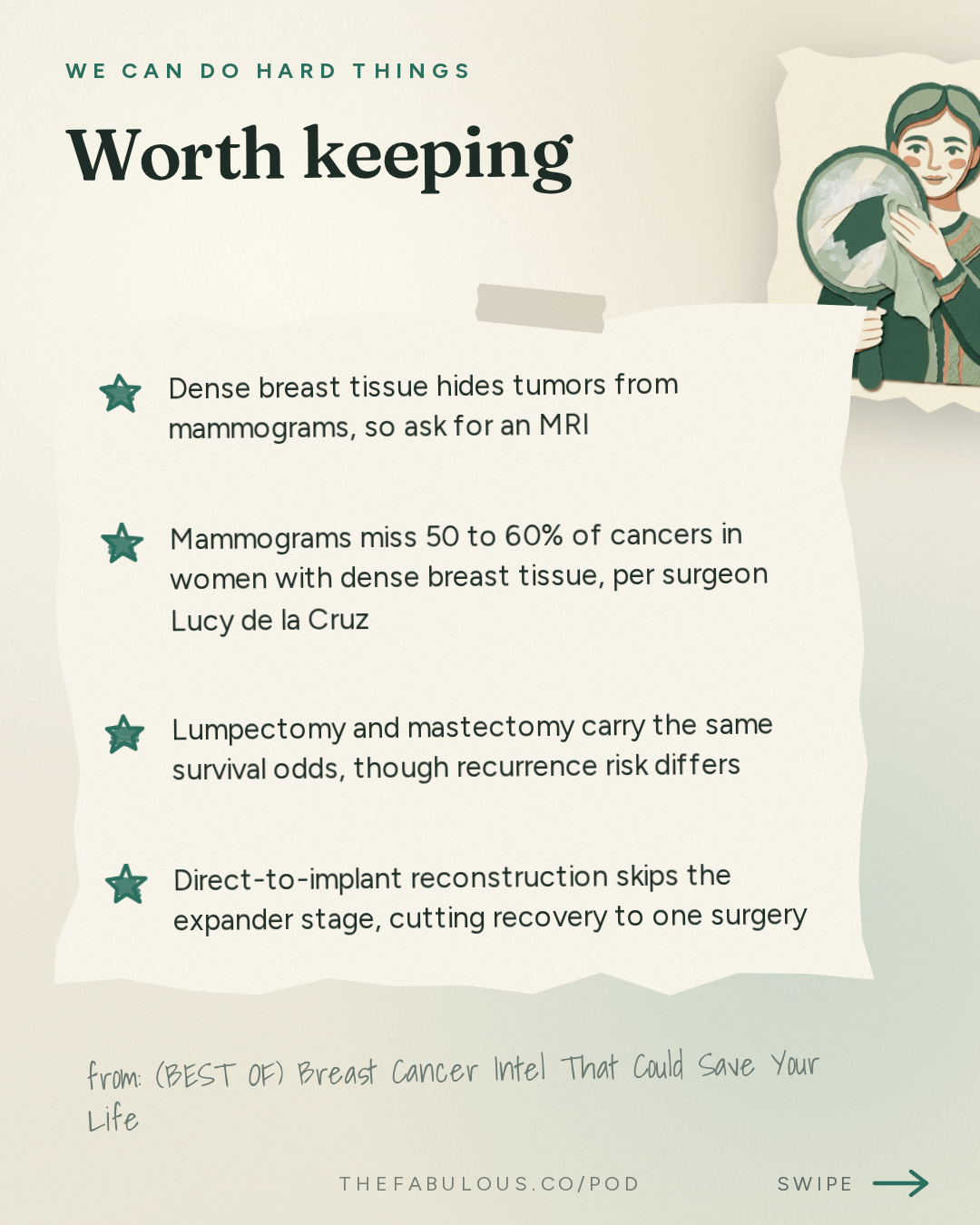
- Dense breast tissue hides tumors from mammograms, so ask for an MRI
- Mammograms miss 50 to 60% of cancers in women with dense breast tissue, per surgeon Lucy de la Cruz
- Lumpectomy and mastectomy carry the same survival odds, though recurrence risk differs
- Direct-to-implant reconstruction skips the expander stage, cutting recovery to one surgery
- Nerve grafting, called resensation, can restore nipple and chest feeling within one to two years
The episode in cards


By the numbers
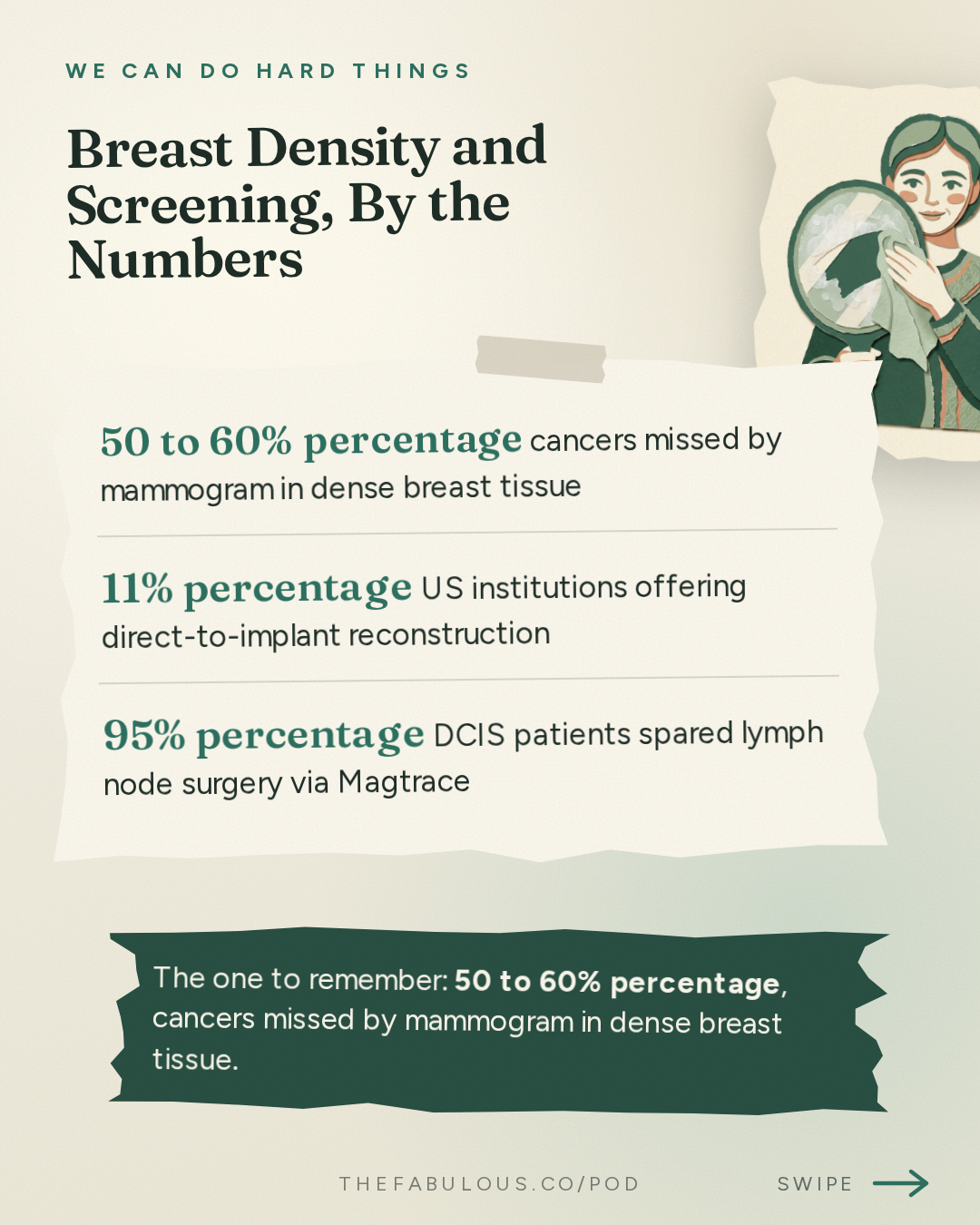
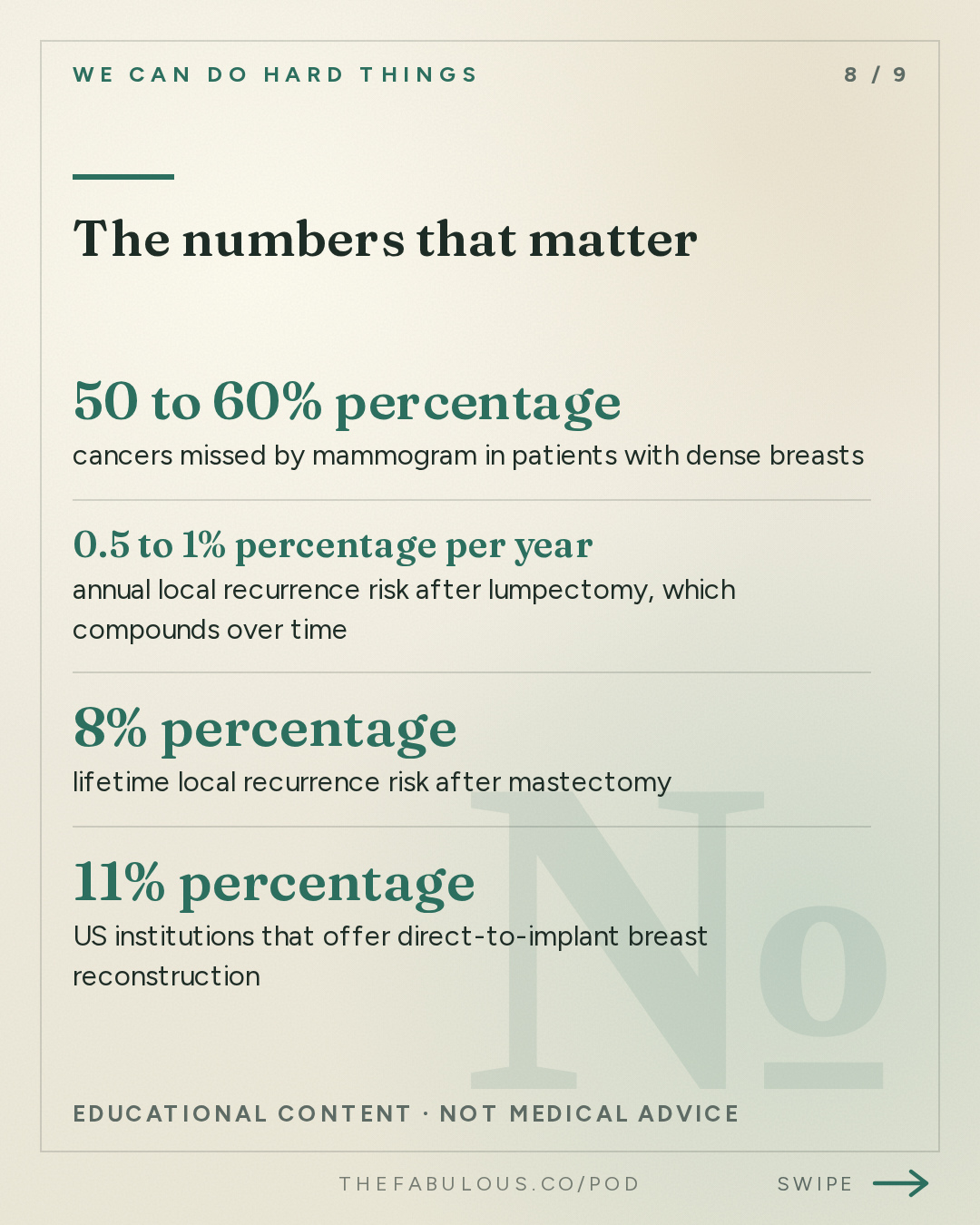
- 50 to 60% percentage cancers missed by mammogram in patients with dense breasts
- 0.5 to 1% percentage per year annual local recurrence risk after lumpectomy, which compounds over time
- 8% percentage lifetime local recurrence risk after mastectomy
- 11% percentage US institutions that offer direct-to-implant breast reconstruction
- 95% percentage DCIS patients spared unnecessary lymph node surgery using Magtrace tracer
In their words
“Awareness without information is just anxiety.”
“A woman deserves a choice w- when they have it”
“All nipples are innocent until proven guilty. If they're guilty, they're gone.”
“A lumpectomy and a mastectomy oncologically have the same survival.”
Protocols
-
Ask your density category before relying on a mammogram
Dr. Lucy de la Cruz advises anyone told they have dense breast tissue to ask their provider whether they are Category C or Category D, since mammograms miss 50 to 60 percent of cancers in dense tissue, and to request an MRI and get that request on record if they are Category D.
at each mammogram or screening visit
-
Screen a surgeon with outcome questions
Dr. Lucy de la Cruz recommends asking any prospective breast surgeon for their nipple-sparing mastectomy rate, their direct-to-implant reconstruction rate, and their nipple necrosis rate before choosing where to have surgery.
once, during surgical consultation
Questions this episode answers
Why do mammograms miss cancer in dense breasts?
Dense breast tissue shows up white on a mammogram, the same color as tumors, so there is no contrast to flag a problem. Surgeon Lucy de la Cruz states that mammograms miss 50 to 60 percent of cancers in patients with dense breasts, and recommends anyone in the densest category, roughly one in ten people, ask explicitly for an MRI (21:37).
Is mastectomy safer than lumpectomy?
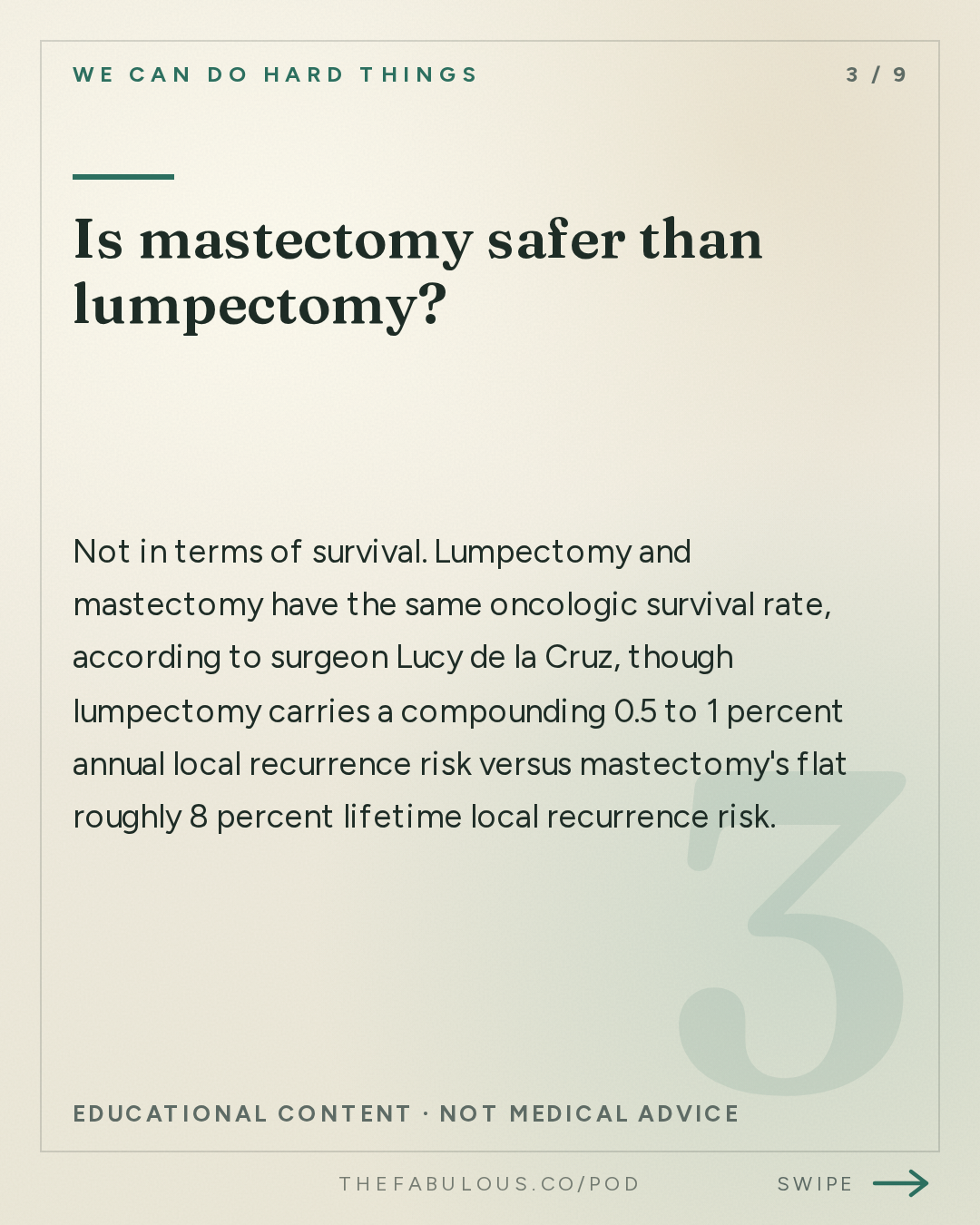
Not in terms of survival. Lumpectomy and mastectomy have the same oncologic survival rate, according to surgeon Lucy de la Cruz, though lumpectomy carries a compounding 0.5 to 1 percent annual local recurrence risk versus mastectomy's flat roughly 8 percent lifetime local recurrence risk (50:01, 54:13, 54:29).
What is direct-to-implant breast reconstruction?
It is a single surgery where the permanent implant is placed at the same time as the mastectomy, instead of using temporary tissue expanders that require a second operation months later. Surgeon Lucy de la Cruz says only 11 percent of US institutions currently offer it (72:00, 97:18).
What is resensation surgery after a mastectomy?
Resensation is a nerve-grafting technique, pioneered by surgeon Anna Pellin, that connects a donor nerve to the severed chest-wall nerve during mastectomy, allowing feeling to gradually return to the chest and nipple over one to two years (94:42).
Do all DCIS patients need lymph node surgery?
Not necessarily. At Georgetown University Hospital, an injectable tracer called Magtrace lets surgeons mark lymph nodes without removing them, sparing 95 percent of DCIS, or stage-zero, patients an unnecessary lymph node operation; a separate clinical trial called the SOUND Trial suggests some very early cancers may not need a lymph node biopsy at all (107:40, 108:11).
The full read, in cards



Go deeper
- New York Times article on post-mastectomy numbness — reported a woman saying no one warned her she would lose chest sensation after mastectomy, which de la Cruz cites as a turning point for offering resensation
- SOUND Trial — clinical trial suggesting some very early-stage breast cancers may not require a sentinel lymph node biopsy at all
Mentioned
Dr. Lucy de la Cruz · Amanda Doyle · Georgetown University Hospital · Magtrace · Anna Pellin · Dr. Van
More from this show and category

Why Date Nights Don't Work for Long-Term Couples
Date nights often fail because couples already know each other too well; novelty, not dinner reservations, revives connection. A study of 53 couples found exciting activities beat pleasant ones for marital satisfaction (10:16). The hosts suggest parallel play over face-to-face talk (24:26) and a date bowl to end decision fatigue (47:07).

Jordan Neely, Daniel Penny, and a Divided America
A six-minute subway encounter between Jordan Neely, a homeless man in mental crisis, and Daniel Penny, a former Marine, became a national Rorschach test. Journalist Anand Giridharadas argues both sides share the same wound: a feeling of being abandoned by every system meant to help them.

Cher's Life Advice on Love, Money, and Leaving
Cher tells the hosts of We Can Do Hard Things how she survived a controlling marriage to Sonny Bono and chose to leave instead of ending her life. She describes losing all ownership of Cher Enterprises, advice from Lucille Ball, and the bumper car philosophy that carried her through decades of setbacks.

Stacey Abrams' 10 Steps to Authoritarianism, Explained
Stacey Abrams argues the United States is now a "competitive authoritarian" country: elections still happen, but power is hoarded and unaccountable (07:58). She lays out ten warning steps toward autocracy and ten matching steps back to freedom, then applies both to the midterms six weeks out, urging two hours a week of targeted local action (62:33).
