Why Date Nights Don't Work for Long-Term Couples
(BEST OF) Why Date Nights Don’t Work (and What to Do Instead)
▶ Listen to the full episode More from We Can Do Hard Things
The brief
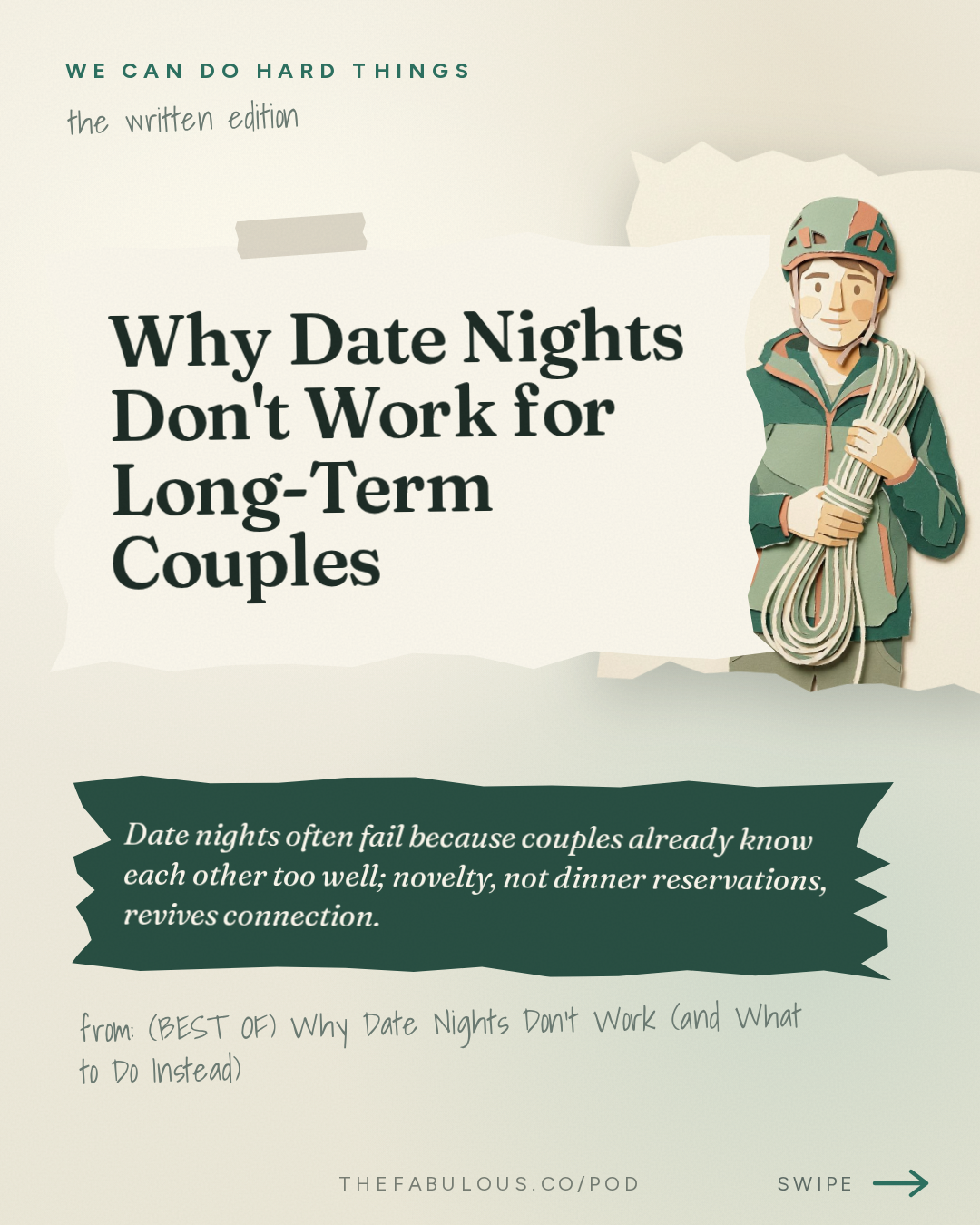
Date nights often fail because couples already know each other too well; novelty, not dinner reservations, revives connection. A study of 53 couples found exciting activities beat pleasant ones for marital satisfaction (10:16). The hosts suggest parallel play over face-to-face talk (24:26) and a date bowl to end decision fatigue (47:07).
Picture the scene: a babysitter paid for, a reservation at a restaurant neither of you can quite afford, and then two people staring at each other over pasta with nothing to say. This is not necessarily a failure of love. It may be a failure of instructions. For decades the standard prescription for a flagging relationship has been the same: go on a date night. The hosts open this episode by asking what happens when that prescription does not work, and why more than half of couples say they rarely fill it anymore (02:56).
The episode's claim is specific and a little startling: date nights do not fail because couples have grown apart. They fail because the couples already know each other too well. "The goal of falling in love is getting to know someone, but the goal of staying in love might be learning how to un-know them," one host says in the opening minutes (01:11). Un-knowing becomes the episode's organizing idea. If a relationship feels stale, the fix is not more quality time with the same person doing the same things. It is introducing enough surprise that a familiar person becomes, briefly, unfamiliar again.
Why the Candlelit Dinner Keeps Failing
The data the hosts cite is more ambivalent than "just do date night" advice suggests. A 2020 survey of 2,000 parents found that three in ten spouses could not remember the last time they went on a date, and 52 percent said they rarely or never did (06:30). Frequent daters were 15 percent more likely to report being very happy in their marriages, and roughly half said they were highly satisfied with their sex lives (07:08). Those numbers sound like proof that date nights work. But correlation is not causation, and the hosts say so directly: happier, less stressed couples may simply find it easier to go out, rather than going out being what makes them happy (07:33).
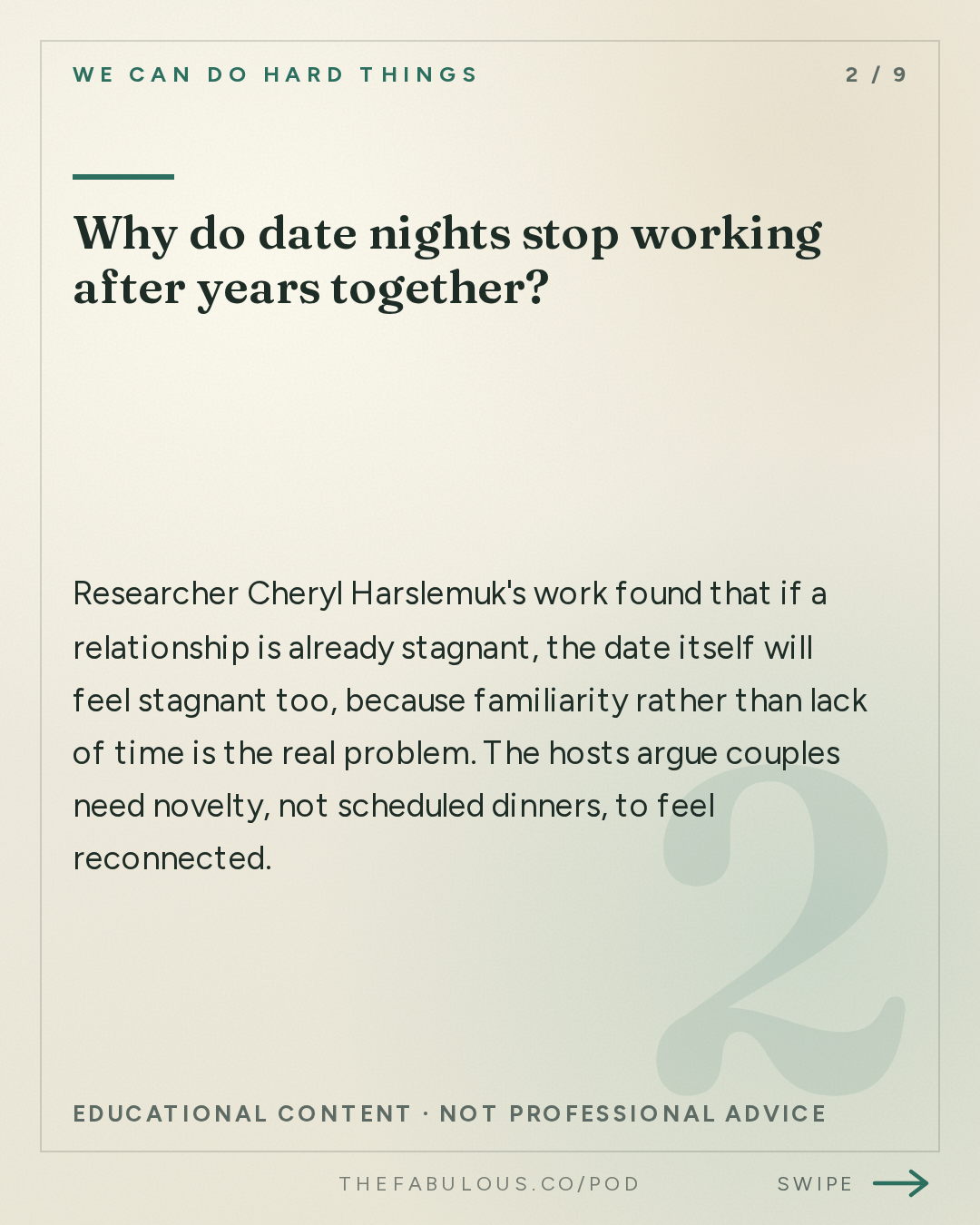
More telling is a line the hosts attribute to a professor, Cheryl Harslemuk, who studies relationship maintenance. If a relationship is already stagnant, the dates will be too (07:59). A night out does not interrupt a stale pattern so much as move it to a more expensive room. Couples spend money and effort trying to fix disconnection, recreate the same flat conversation at a restaurant, and conclude they have run out of things to say. The date night, meant to reassure, ends up confirming the fear it was supposed to cure.
What works instead, the hosts say, is novelty rather than ritual. A researcher named Dr. Aron studied 53 middle-aged couples over ten weeks (10:16). One group spent 90 minutes a week on pleasant, familiar activities: dinner, a movie, the usual. The other spent 90 minutes on things that were exciting and a bit outside their comfort zone: concerts, skiing, dancing, hiking. After ten weeks, the exciting-activity group showed a significantly greater increase in marital satisfaction than the pleasant-activity group (11:18). It was not the time together that mattered. It was the unfamiliarity.
The hosts extend this into an image that sticks. A long-term partner, one of them says, is like a coloring page that is already finished.
"Whereas the people that we're with forever, that coloring page is done." (Amanda Doyle, [13:27])
There is nothing left to be curious about, which is a quieter way of explaining why strangers can feel so interesting, and why affairs so often start with someone unknown. The fix the hosts propose is not a new person but new conditions, enough change in the setting that a different version of the familiar person shows up. Identity, one host argues, is "much less solid than we think it is," shifting with context and company (14:19).
Sitting Side by Side Instead of Across
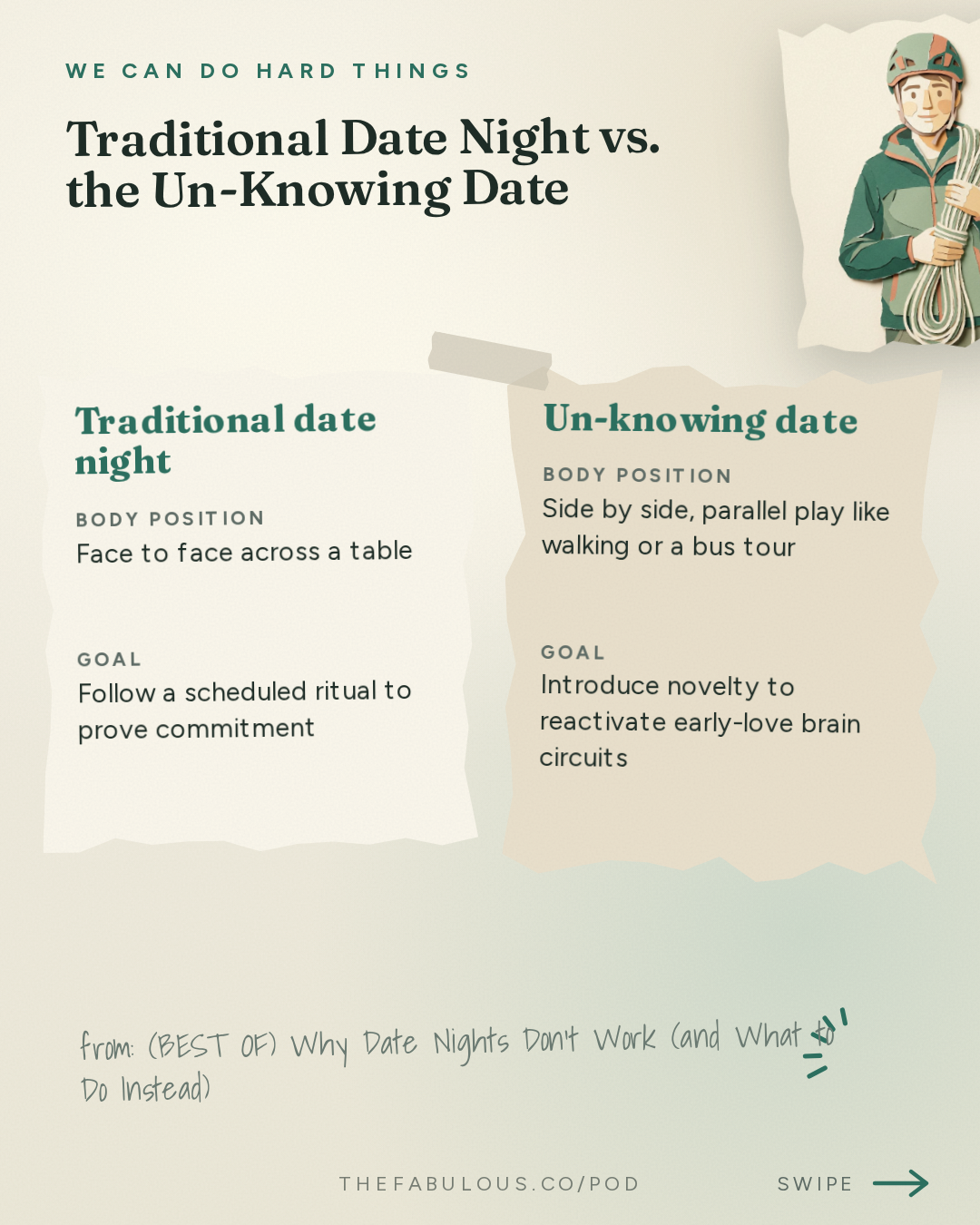
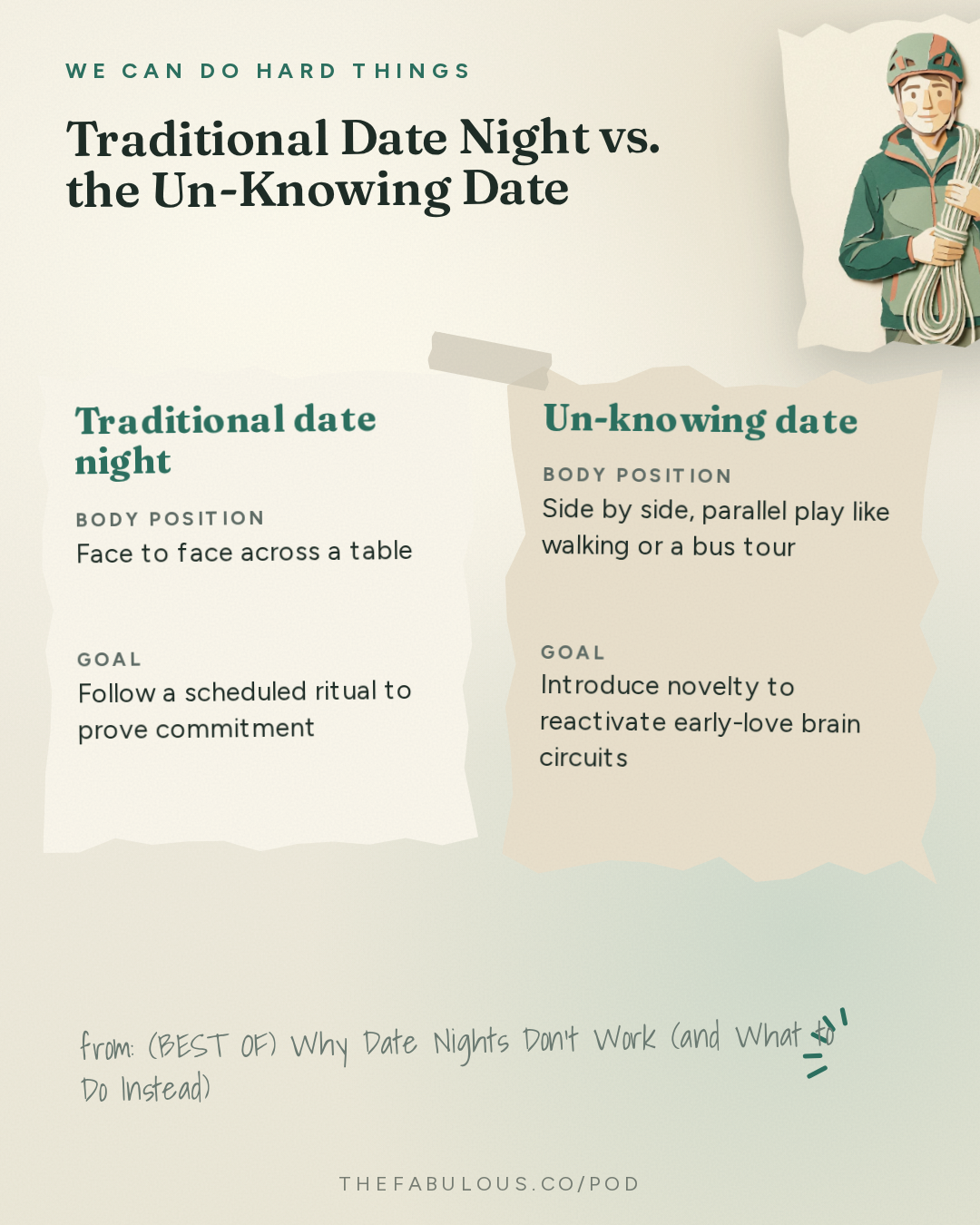
The episode's most concrete contribution is a reframing of body position. Traditional date nights put two people across a table, making prolonged eye contact over a meal. The hosts compare this to a forced family meeting, noting that direct eye contact and a formal sit-down can trigger a kind of shutdown, especially for someone already anxious about the state of the relationship (25:11). "So when you sit down at a table and stare at each other, people panic," one host says, describing how the body reads the setup as a test (25:35).
Children offer a counter-model: parallel play, in which kids build blocks side by side rather than facing off, with connection arriving in small moments instead of through a mutual, face-to-face plan (24:26). Applied to adults, this means activities like walking, riding a city bus tour, or crawling across a room with wrists tied together, an exercise from the Aron study that produced bigger gains in love and satisfaction than simply walking back and forth (11:48). Shared posture, not conversation, seems to do the work.
The hosts are honest about asymmetry and failure. One host admits that throwing a ball at a soccer sideline triggers a full internal panic, while a museum feels safe, and notes that a spouse who is physically confident might find the opposite true (30:43). Their advice is to pick something genuinely new to both partners, or something that balances whose comfort zone gets stretched. They are equally honest that novelty does not guarantee success: one host describes a dog walk gone wrong, where a dog that would not heel turned a simple outing into proof the couple could not communicate at all (50:02). The lesson is not to abandon the idea after one bad draw, but to expect some strikeouts on the way to something that sticks.
The same logic shapes how the hosts treat sex and memory. One host suggests couples who feel pressure about an expected post-date "cherry on top" can remove that pressure by having sex first, so the outing itself is not auditioning for an outcome (34:47). On memory, one host notices that thirty cozy, repeated nights with family produce almost no distinct recollection, while a handful of strange, novel outings crystallize (38:45). The worry is what happens when nothing crystallizes. "If it's everything collapses behind you in a long gray line, then everything in front of you looks like a long gray line," another host replies (39:50). Novelty is not only about the next date. It is about whether the future looks like it could hold anything different at all.
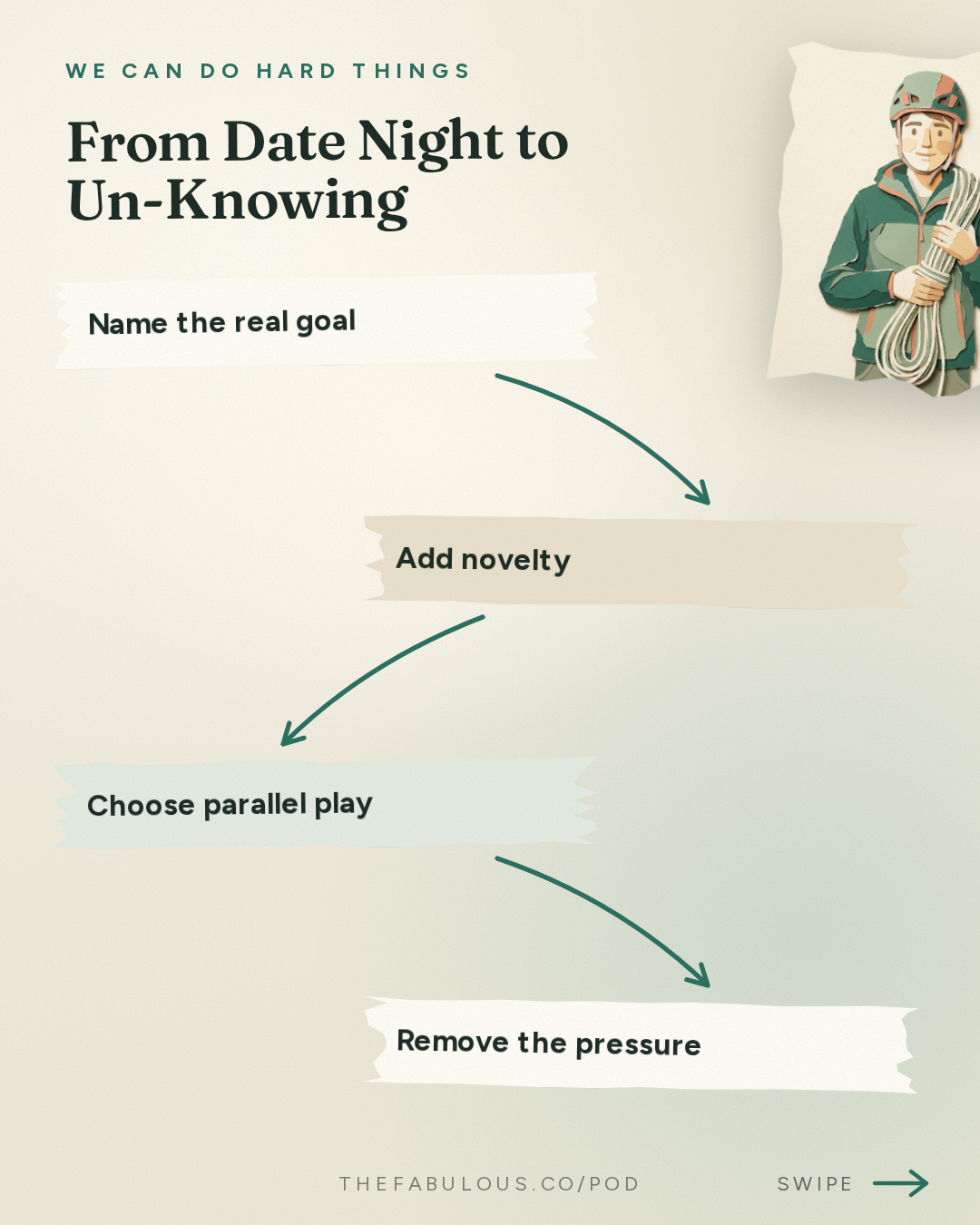
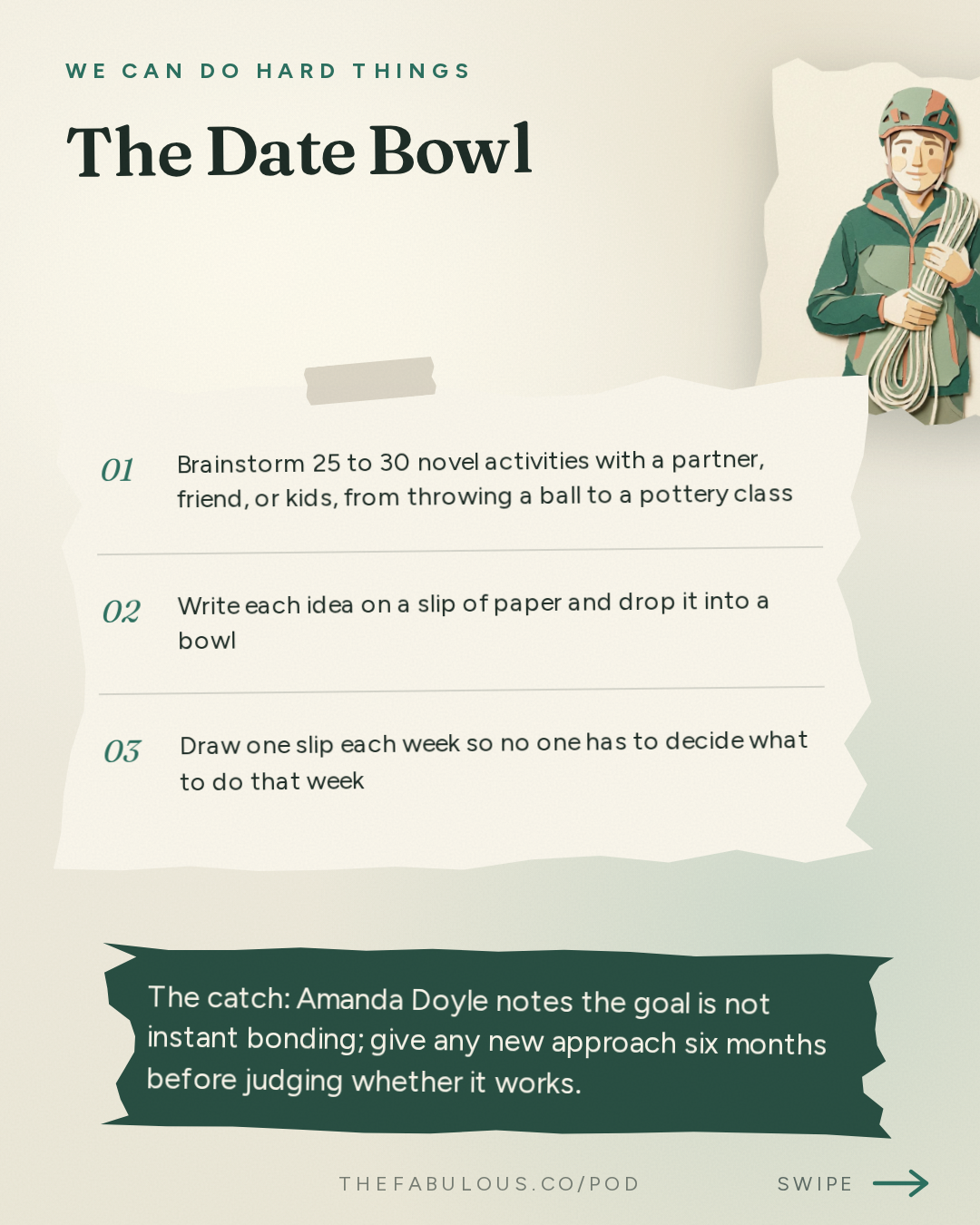
The episode's most usable idea is almost embarrassingly simple: a bowl. The hosts suggest brainstorming 25 or so unusual activities, writing each on a slip of paper, and drawing one a week, which removes the decision fatigue that often kills spontaneity before it starts (47:36). They recommend starting small, under thirty minutes and thirty dollars, before working up to bigger swings, and giving any new habit six months before judging whether it is working, since this kind of connection is cumulative rather than instant (52:14).
The closing turn of the conversation borrows from therapist Esther Perel, who has argued that desire is not something a partner delivers on command. One host paraphrases her question: how do you turn yourself on, not your partner, you.
"Your job is not to come to your partner and stare at them and wait for them to turn you on." (Glennon Doyle, [55:09])
That line reframes everything that came before it. The bowl, the bus tour, the ropes course are not tricks for fixing a partner. They are a way of staying interesting to oneself, so there is something alive to bring to the table, or better, to the sidewalk, the museum, the dog walk where nobody repeats what they said last time. The couples who keep growing, the hosts suggest, are not the ones with the most date nights on the calendar. They are the ones willing to stay a little unknown to each other, and to themselves.
Ask this episode anything
Pod's AI answers from the episode itself, with the minute mark so you can hear it yourself.
Or start with one of these
Ask this episode
Pod's AI listens to the whole episode to answer, and points you to the minute it comes from.
The rest of this answer, and any question after it
Answers come from the episode itself, never from a summary of it.
ContinueKey takeaways
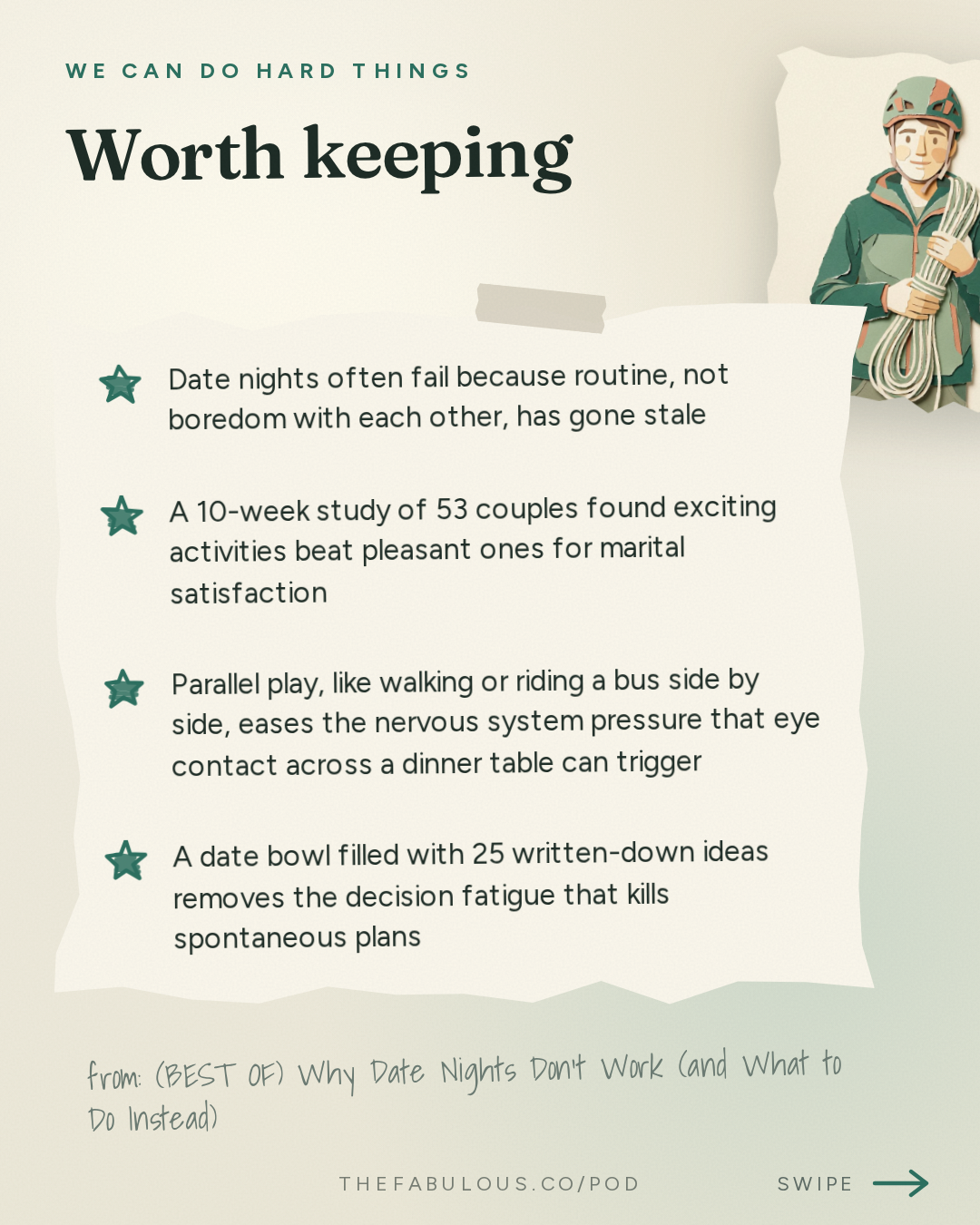
- Date nights often fail because routine, not boredom with each other, has gone stale
- A 10-week study of 53 couples found exciting activities beat pleasant ones for marital satisfaction (10:16)
- Parallel play, like walking or riding a bus side by side, eases the nervous system pressure that eye contact across a dinner table can trigger (24:26)
- A date bowl filled with 25 written-down ideas removes the decision fatigue that kills spontaneous plans (47:07)
- Therapist Esther Perel's idea that a partner's job is not to turn you on reframes aliveness as personal responsibility (54:42)
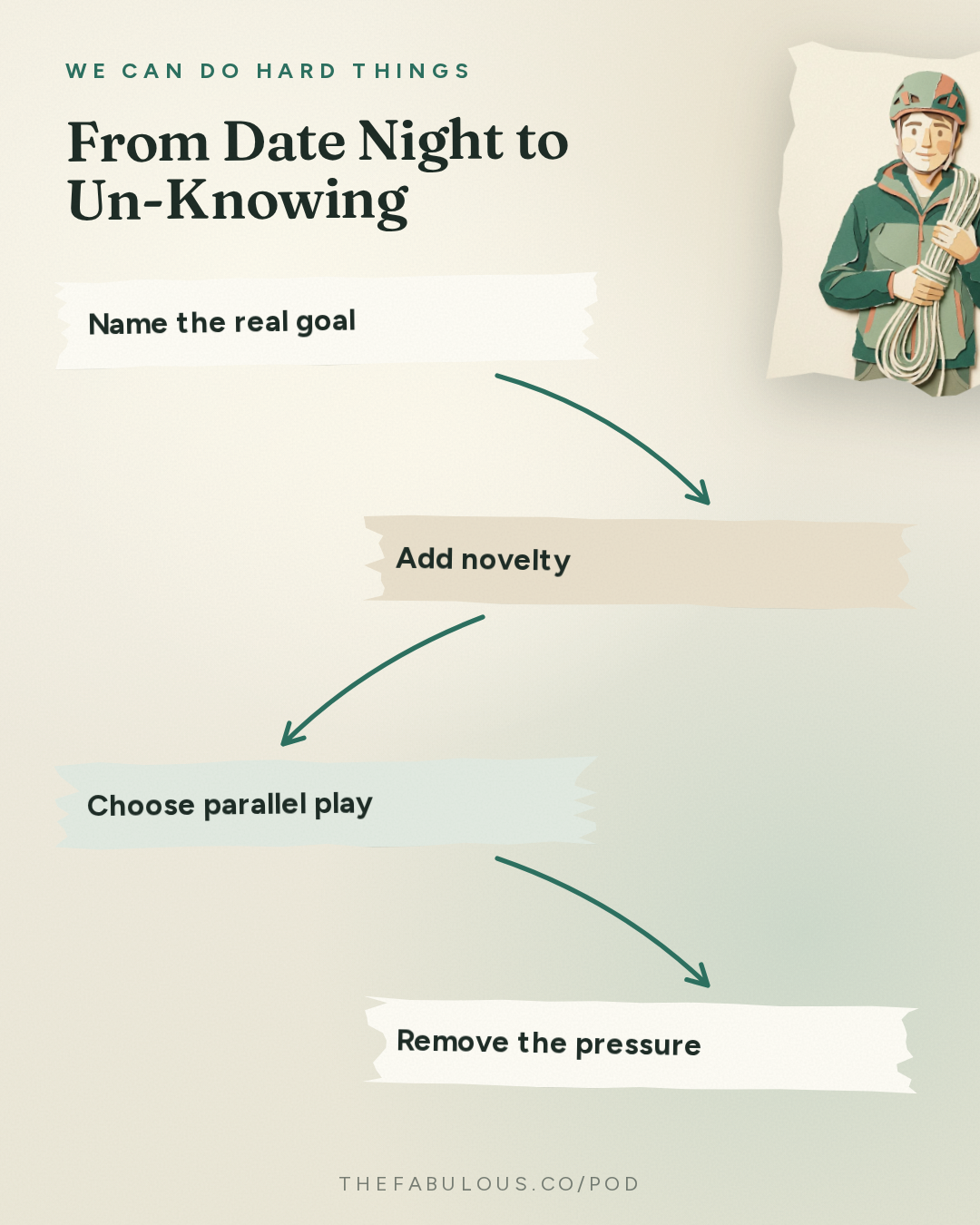
The episode in cards
By the numbers
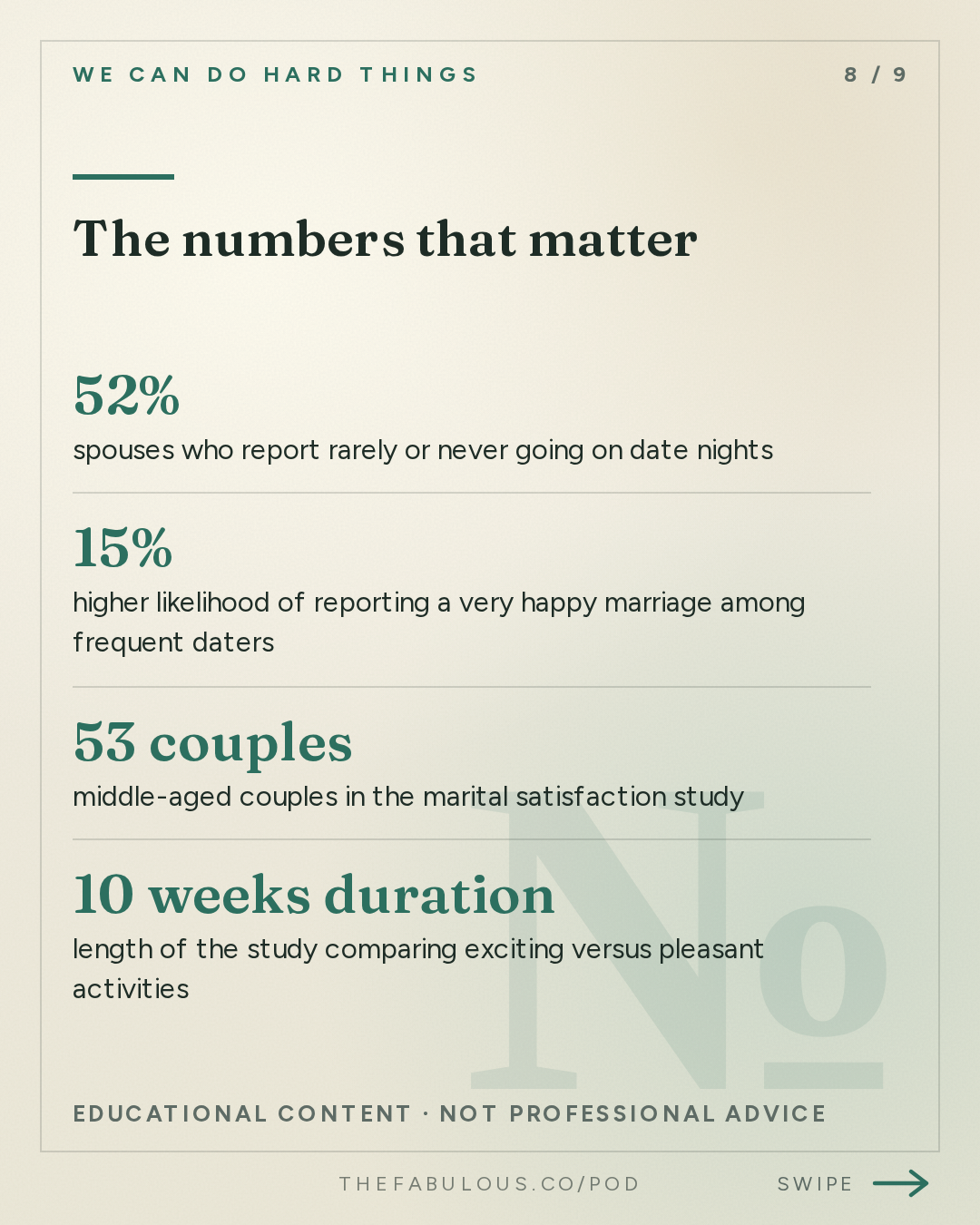
- 52% percent spouses who report rarely or never going on date nights
- 15% percent higher likelihood of reporting a very happy marriage among frequent daters
- 53 couples middle-aged couples in the marital satisfaction study
- 10 weeks duration length of the study comparing exciting versus pleasant activities
- 25 ideas suggested number of activities to write down for a date bowl
In their words
“The goal of falling in love is getting to know someone, but the goal of staying in love might be learning how to un-know them.”
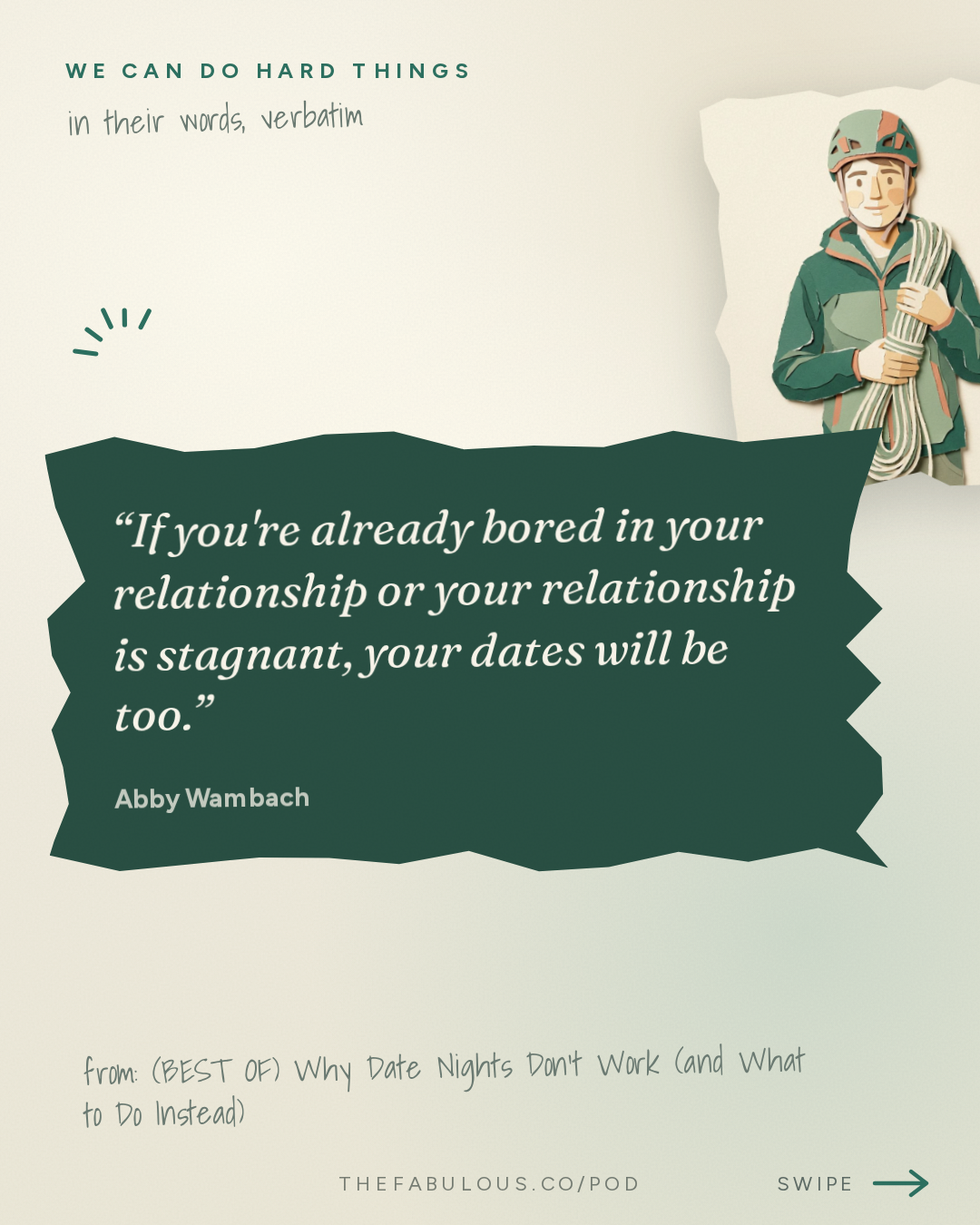
“If you're already bored in your relationship or your relationship is stagnant, your dates will be too.”
“Whereas the people that we're with forever, that coloring page is done.”
“If it's everything collapses behind you in a long gray line, then everything in front of you looks like a long gray line.”
“Your job is not to come to your partner and stare at them and wait for them to turn you on.”
Protocols
-
Build a date bowl
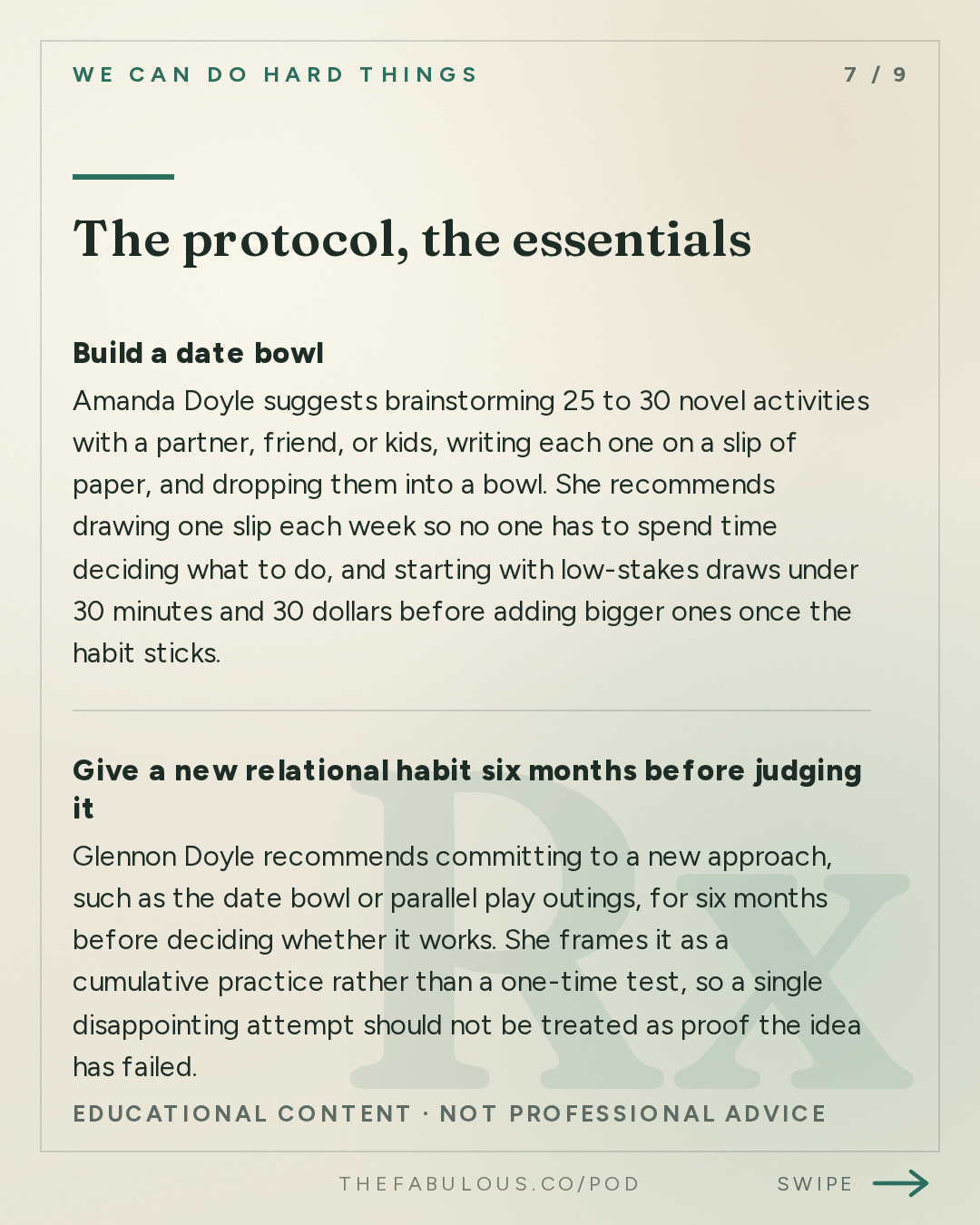
Amanda Doyle suggests brainstorming 25 to 30 novel activities with a partner, friend, or kids, writing each one on a slip of paper, and dropping them into a bowl. She recommends drawing one slip each week so no one has to spend time deciding what to do, and starting with low-stakes draws under 30 minutes and 30 dollars before adding bigger ones once the habit sticks.
weekly
-
Give a new relational habit six months before judging it
Glennon Doyle recommends committing to a new approach, such as the date bowl or parallel play outings, for six months before deciding whether it works. She frames it as a cumulative practice rather than a one-time test, so a single disappointing attempt should not be treated as proof the idea has failed.
six-month trial
-
Separate intimacy from the date itself
Glennon Doyle suggests that couples who feel pressure about an expected post-date make-out session have sex before heading out instead of after. She says this removes the unspoken expectation that the date has to function as foreplay, so the outing is not treated as an audition for a predetermined outcome.
as needed
-
Choose parallel play over face-to-face conversation
Amanda Doyle recommends side-by-side activities, such as walking, riding a city bus tour, or even crawling across a room together, instead of sitting across a table making direct eye contact. She says facing each other directly can trigger a couple's nervous system into freeze or shame, especially when one partner already worries the relationship is in trouble.
whenever connection feels stuck
Questions this episode answers
Why do date nights stop working after years together?
Researcher Cheryl Harslemuk's work found that if a relationship is already stagnant, the date itself will feel stagnant too, because familiarity rather than lack of time is the real problem (07:59). The hosts argue couples need novelty, not scheduled dinners, to feel reconnected.
What does it mean to 'un-know' your partner?
It is the idea that staying in love long-term requires making a familiar partner feel unfamiliar again, rather than accumulating more facts about them. The hosts contrast falling in love, which is about getting to know someone, with staying in love, which is about learning to un-know them (01:11).
Does novelty actually improve marriage satisfaction?
A study split 53 middle-aged couples into one group doing 90 minutes a week of pleasant, familiar activities and another doing 90 minutes of exciting, unfamiliar ones for 10 weeks. The exciting-activity group showed a significantly greater increase in marital satisfaction (10:16).
What is parallel play for couples?
It means doing an activity side by side, like walking, riding a bus tour, or crawling across a room together, instead of sitting face to face. The hosts argue direct eye contact across a table can trigger a couple's nervous system into freeze or panic, while shared movement lowers that pressure (24:26).
What is a 'date bowl' and how do you use it?
It is a bowl filled with about 25 written-down activity ideas that partners draw from each week, which removes the decision fatigue that often kills spontaneous plans before they start (47:36). The hosts suggest giving any new approach six months before judging whether it works (52:14).
The full read, in cards
Go deeper
- 2020 survey of 2,000 parents on date night habits — found three in ten spouses could not recall their last date and 52 percent rarely or never went on dates
- Dr. Aron's 10-week couples study — found 53 couples assigned exciting activities gained significantly more marital satisfaction than those assigned pleasant ones
- Cheryl Harslemuk's relationship research — found that stagnant relationships produce stagnant dates regardless of effort
- Esther Perel's concept of self-generated desire — argues a partner is not responsible for igniting someone else's sense of being turned on
Mentioned
Cheryl Harslemuk · Dr. Aron · Esther Perel · Zillow
More from this show and category

Jordan Neely, Daniel Penny, and a Divided America
A six-minute subway encounter between Jordan Neely, a homeless man in mental crisis, and Daniel Penny, a former Marine, became a national Rorschach test. Journalist Anand Giridharadas argues both sides share the same wound: a feeling of being abandoned by every system meant to help them.

Cher's Life Advice on Love, Money, and Leaving
Cher tells the hosts of We Can Do Hard Things how she survived a controlling marriage to Sonny Bono and chose to leave instead of ending her life. She describes losing all ownership of Cher Enterprises, advice from Lucille Ball, and the bumper car philosophy that carried her through decades of setbacks.

Stacey Abrams' 10 Steps to Authoritarianism, Explained
Stacey Abrams argues the United States is now a "competitive authoritarian" country: elections still happen, but power is hoarded and unaccountable (07:58). She lays out ten warning steps toward autocracy and ten matching steps back to freedom, then applies both to the midterms six weeks out, urging two hours a week of targeted local action (62:33).

John Grisham's Morning Writing Routine Explained
John Grisham credits two unplanned "golden moments" for redirecting his path, first toward law school, then toward writing A Time to Kill and The Firm. He built his career on writing one page a day at 5 a.m. for 30 years, absorbed 28 rejections, and then watched a bootleg manuscript trigger a $600,000 film deal and 52 straight bestsellers.
