
What Is a Father Wound? Terri Cole Explains
Do You Have a Father Wound? Find Out with Terri Cole
▶ Listen to the full episode More from We Can Do Hard Things
The brief
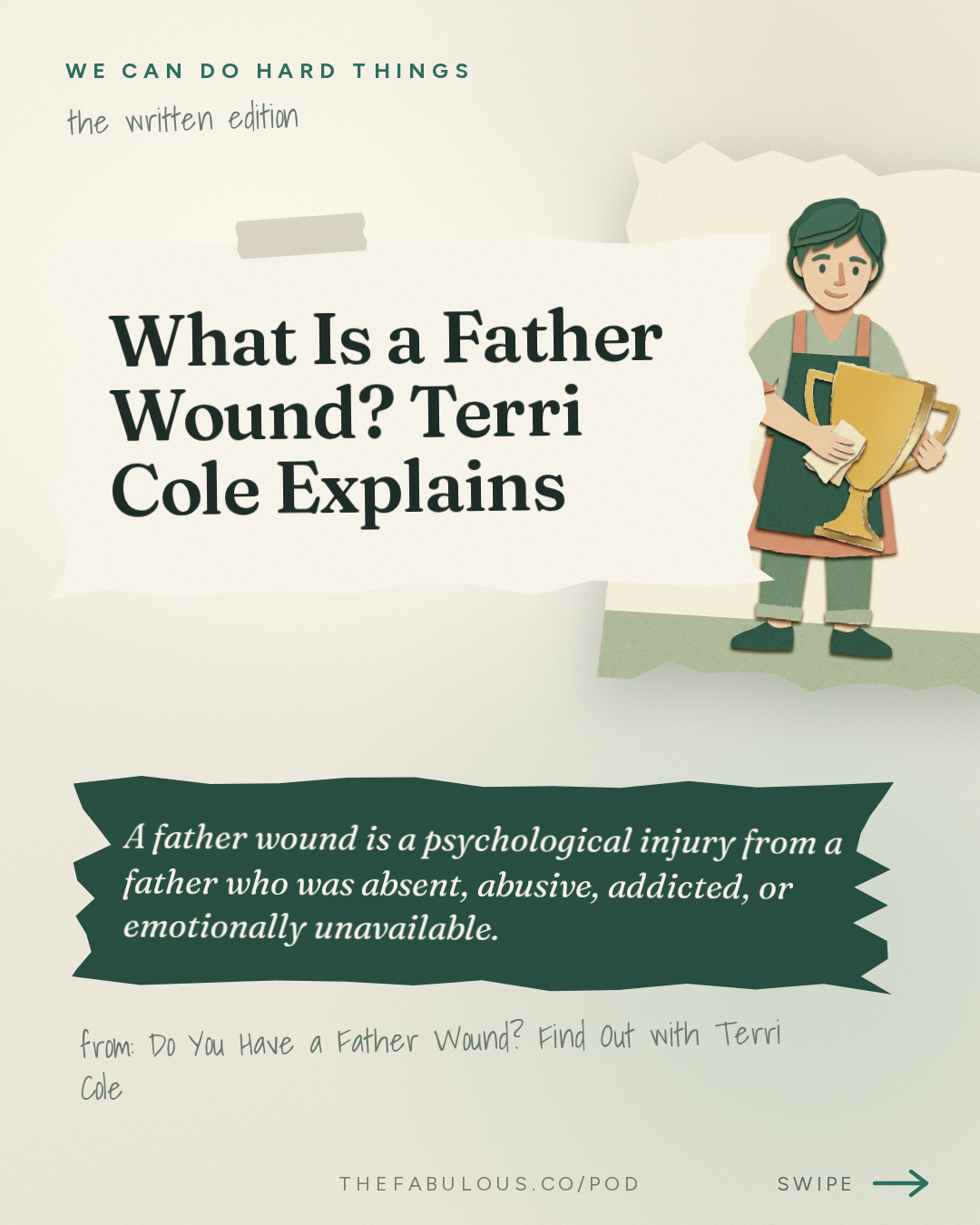
A father wound is a psychological injury from a father who was absent, abusive, addicted, or emotionally unavailable. Psychotherapist Terri Cole calls it a worthiness wound, the belief that love must be earned through achievement or perfection. Her study of 650 women found it fuels hyperindependence and perfectionism until perimenopause forces a stop (07:58, 21:36).
Terri Cole's father retired at fifty, after years as a high-functioning alcoholic and a high-functioning workaholic (10:21). On weekends he golfed. He drank martinis whenever he felt like it. He rarely spent unstructured time with his four daughters, and when his voice carried through the house, Cole, as a child, would sit bolt upright in bed, certain something was wrong (11:02). Cole, a licensed psychotherapist and author of the book Father Wound: Break Unhealthy Patterns to Reclaim Your Worth and Power, built a career on outrunning that feeling. Such a chip on her shoulder, she says, ambition fueled by fear, anger, and rejection (04:37). From the outside, she looked like she was killing it. She calls that kind of success an invisible wound, because nobody looking at a woman's accomplishments can see what is driving her toward them (05:05).
The Worthiness Wound
Cole's definition of a father wound is broad on purpose: a psychological and emotional injury from growing up with a father or father figure who was absent, abusive, addicted, or simply not emotionally attuned (01:32). The father does not need to be cruel. He can be a good man who worked constantly, or a passive man who was physically present but never really there. Cole argues that this second type, the quiet, checked-out father, gets overlooked because he is not aggressive, even though his absence leaves the same mark (09:34).
Underneath all the variations, Cole says, sits one wound: the belief that love is conditional on being perfect.
"Somewhere we learned that we needed to be different, better, more perfect, thinner, more beautiful, more accomplished to be worthy of consideration and love." — Terri Cole [02:40]
That belief, she argues, is not confined to women with visibly bad fathers. Everyone raised inside a patriarchy, a social system built around male authority, absorbs some version of it, because the culture supplies the lesson even when a father does not (02:25). Cole built her case on two years of interviews with 650 women who self-identified as having a father wound, a sample she gathered because, she says, no secular research had been done specifically on the subject (07:58). Earlier researchers, in her view, never expected fathers to be emotionally attuned in the first place, so nobody went looking for the gap (08:21).
The gap shows up in adulthood as a familiar cluster of traits. Hyperindependence is one: a child whose father was unreliable, who said he would show up and then did not, learns that people cannot be trusted and that doing everything alone is safer (19:00). Perfectionism is another, and Cole describes its cost bluntly: a person can do something brave and still spend the aftermath fixated on the two percent that did not go perfectly, which drains the joy out of the other ninety-eight (20:28). Add a harsh inner critic and a nervous system stuck in hypervigilance, and the result is a kind of permanent bracing, what Cole calls walking on eggshells for decades (21:12).
When the Body Calls a Halt
What happens next, Cole says, is often biological rather than chosen. Women who have run on hyperindependence and self-sacrifice for years reach perimenopause, the hormonal transition that precedes menopause, and something gives out.
"You smash into a wall of there were way too many fucks given over here for a really long time." — Terri Cole [21:36]
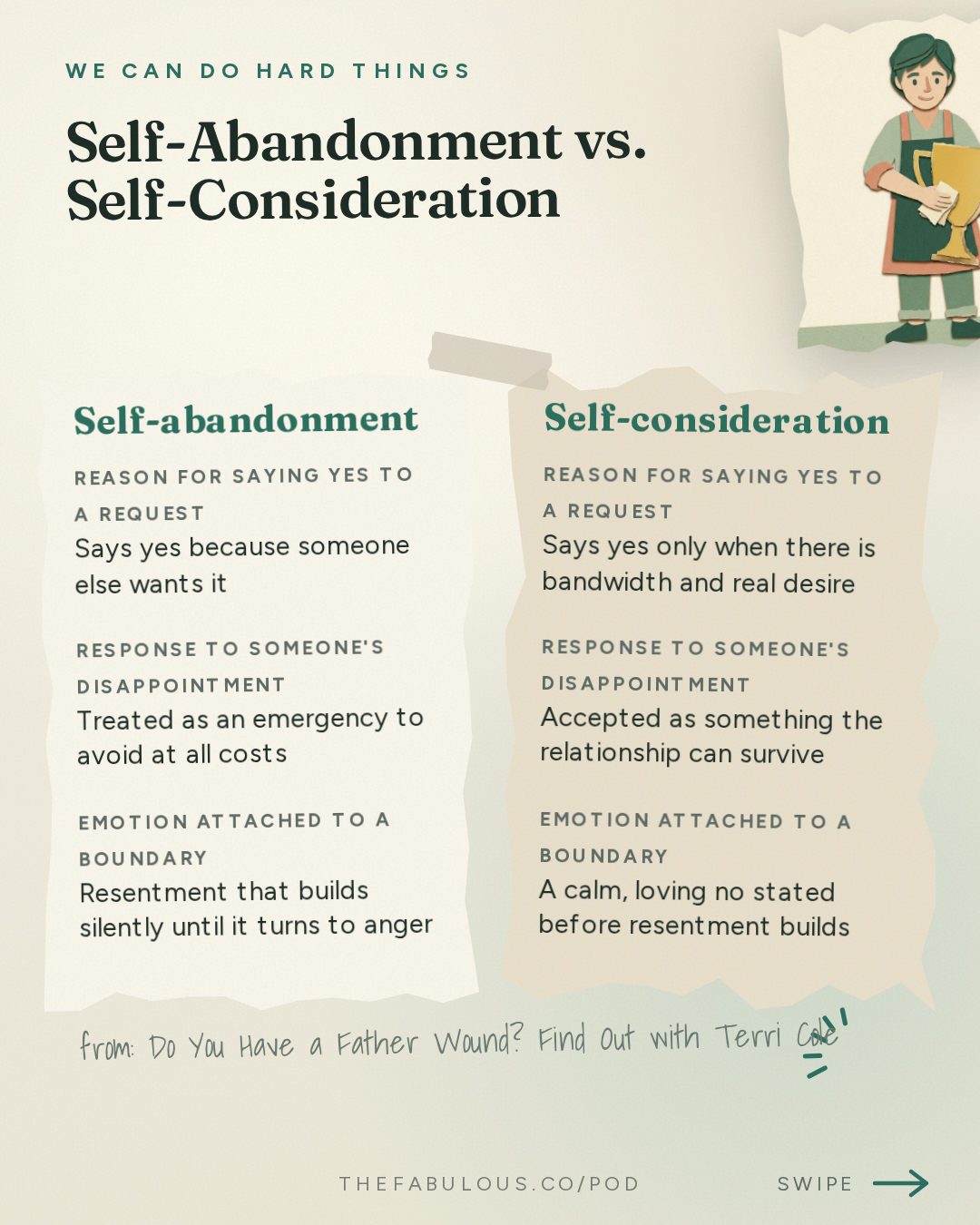
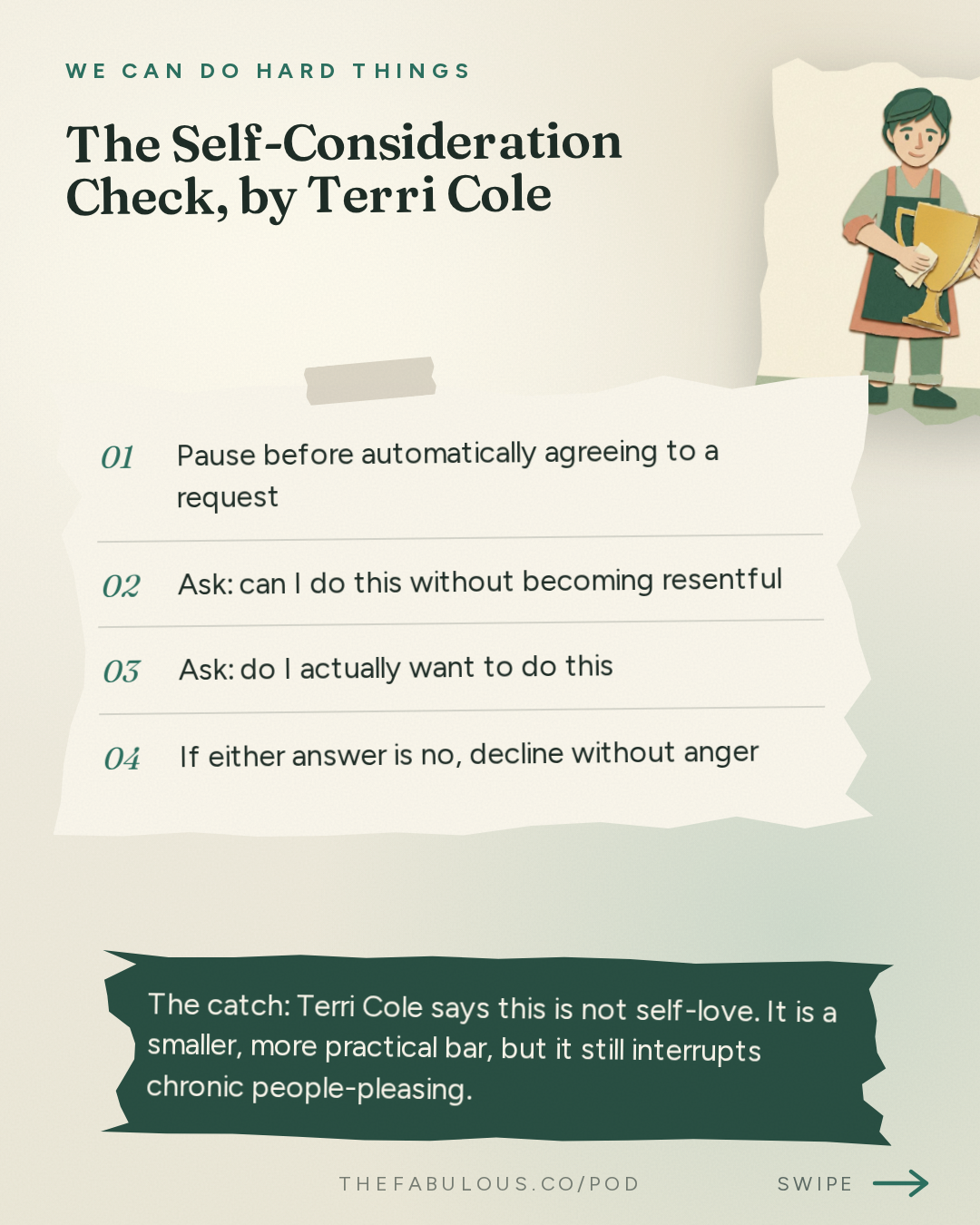
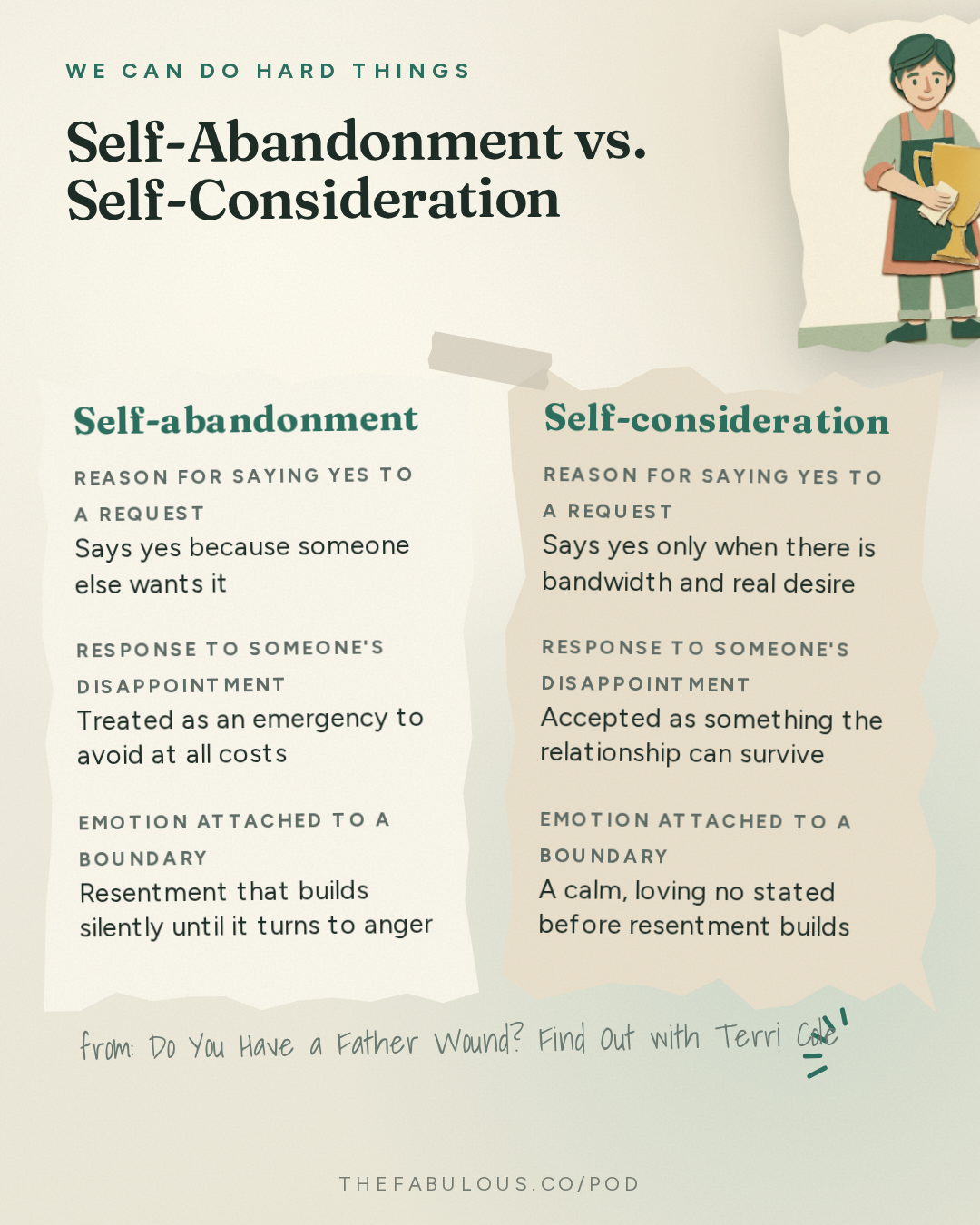
The exhaustion is not indifference. It is a body refusing to keep performing a role it was never built to sustain forever. The healthier version of what comes next, Cole argues, is not self-love, a phrase she finds too vague to act on. She prefers self-consideration, a smaller, more practical standard: before agreeing to anything, ask whether it can be done without becoming resentful, and whether it is actually wanted. If either answer is no, the answer to the request should be no too (28:00).
"We won't call it self-love, which is all weird and nobody even knows what it means." — Terri Cole [28:00]
Cole separates this from anger. A refusal does not need resentment attached to it. It can be stated plainly, and the people who benefited from constant over-functioning usually notice, but the relationship tends to survive it.
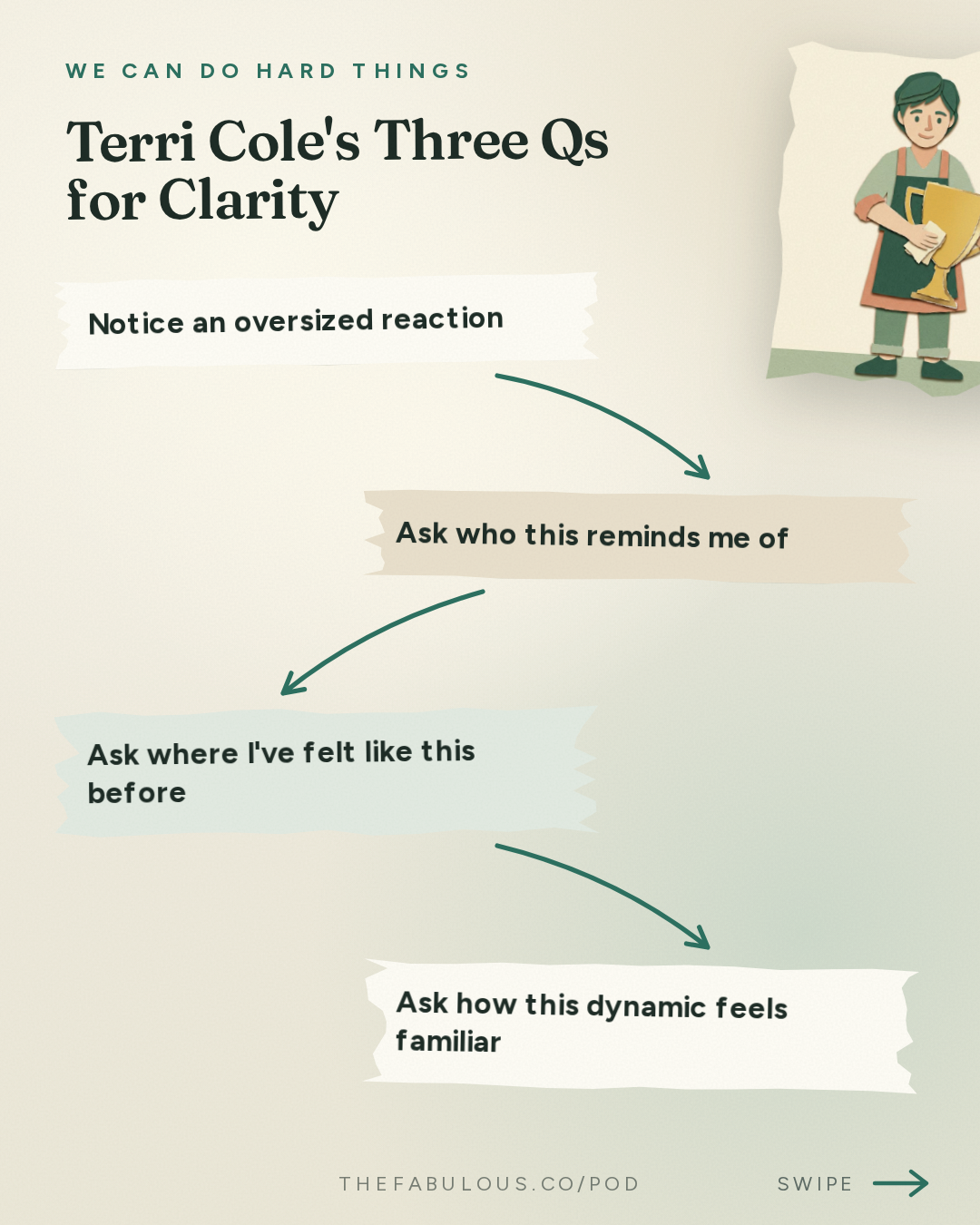
Old reactions can also masquerade as present-tense ones, which is where Cole's clinical training comes in. She defines transference as a current experience amplified by a similar, unresolved experience from the past. Her own example: as a graduate student working at an addiction clinic, she found herself inexplicably terrified of a senior doctor, avoiding him in hallways and going silent in meetings. In therapy she realized she had described him in the exact terms she would use for her own father, down to the suit and the golf habit (34:08). She was thirty-two at the time, already deep into clinical training, and still caught off guard by how real the fear felt (35:11). Out of that moment she built what she calls the Three Qs for Clarity: who does this person remind me of, where have I felt like this before, and how is this dynamic familiar. Naming the pattern, she says, works like a GPS, pointing back to the original injury that still needs attention (36:22).
One version of the wound, Cole says, shows up specifically for daughters once they stop being small. She describes fathers who love a daughter easily while she is young and compliant, almost like a doll, and then pull back once puberty arrives, once her body changes, her appetite returns, her sexuality becomes visible. The retreat is rarely conscious. It reflects, in Cole's view, an unexamined belief that women are not fully human, a belief a father might deny holding even as he enforces it through comments about his daughter's body or her clothing (41:57). Across her interviews, this was a common story: a warm relationship with a father that cooled abruptly at the first signs of a daughter's physical maturity.
That same dynamic, scaled up, explains something Cole sees in whole households: a family organized entirely around managing one unpredictable parent. She calls it an externalized nervous system, a family doing the emotional regulation one adult cannot do for himself (52:48). The lesson children absorb in that house, Cole argues, is not that men are controlling but that men cannot be trusted to handle their own emotions, which teaches daughters to treat male partners as projects to manage rather than people to connect with. Managing and connecting, she says, cannot happen at the same time (57:35). The fix, in her view, runs in both directions: a woman who stops managing a partner creates room for him to show up differently, and a man freed from the assumption that he cannot handle emotional depth has room to meet her there.
None of this, Cole insists, requires a confrontation with the father himself. Her clinical rule, after nearly thirty years of practice, was to rarely bring the offending parent into the room at all, because the work changes an internal pattern, not necessarily the relationship (14:48). The starting point she recommends is smaller and more private: become honest about what actually happened in childhood, give permission to remember it without minimizing, and write it down (61:10). It is not a confrontation. It is closer to testimony, offered to no one but the version of the self that lived through it.
Ask this episode anything
Pod's AI answers from the episode itself, with the minute mark so you can hear it yourself.
Or start with one of these
Ask this episode
Pod's AI listens to the whole episode to answer, and points you to the minute it comes from.
The rest of this answer, and any question after it
Answers come from the episode itself, never from a summary of it.
ContinueKey takeaways
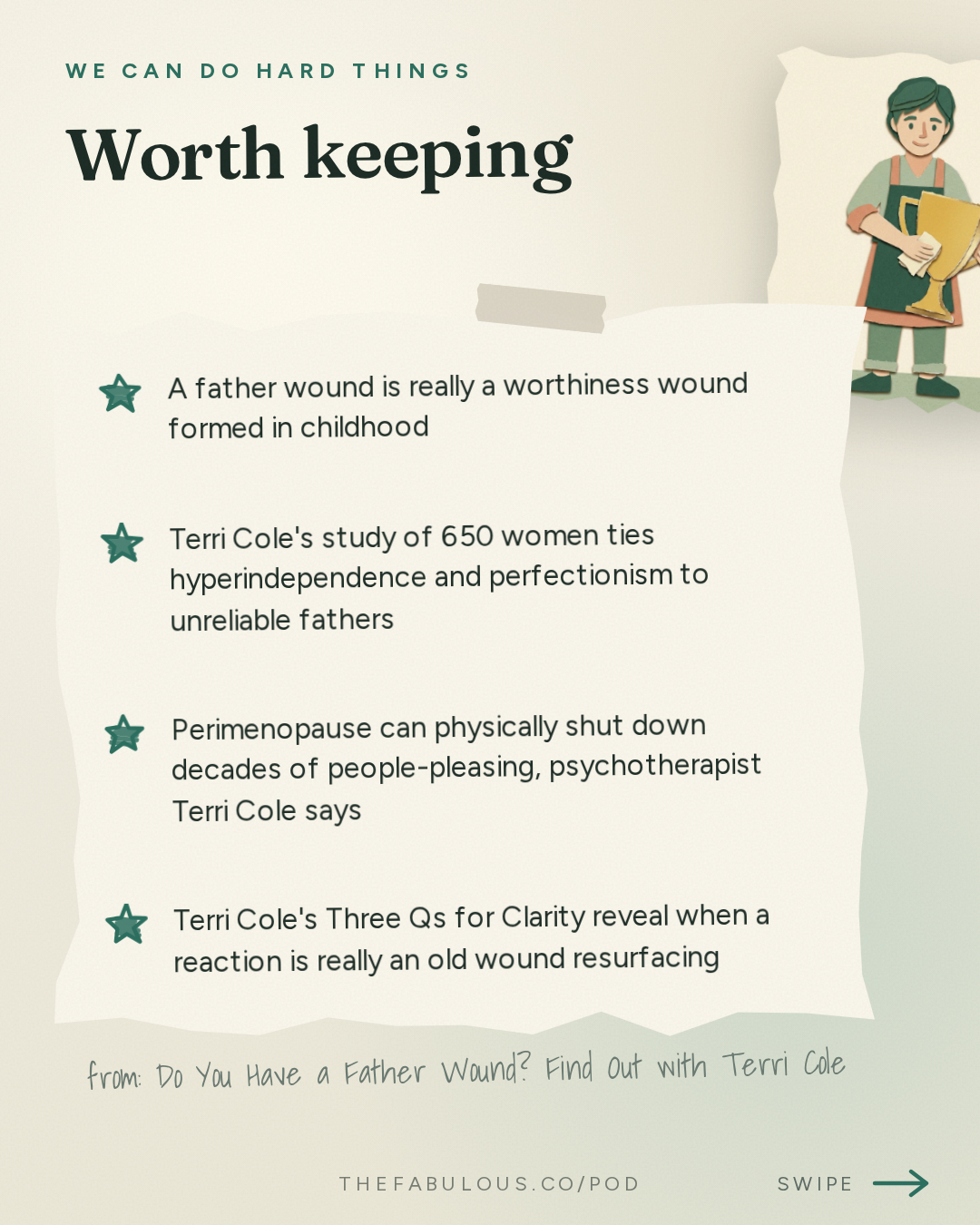
- A father wound is really a worthiness wound formed in childhood
- Terri Cole's study of 650 women ties hyperindependence and perfectionism to unreliable fathers
- Perimenopause can physically shut down decades of people-pleasing, psychotherapist Terri Cole says
- Terri Cole's Three Qs for Clarity reveal when a reaction is really an old wound resurfacing
- Healing a father wound means getting honest about childhood, not confronting the parent
The episode in cards

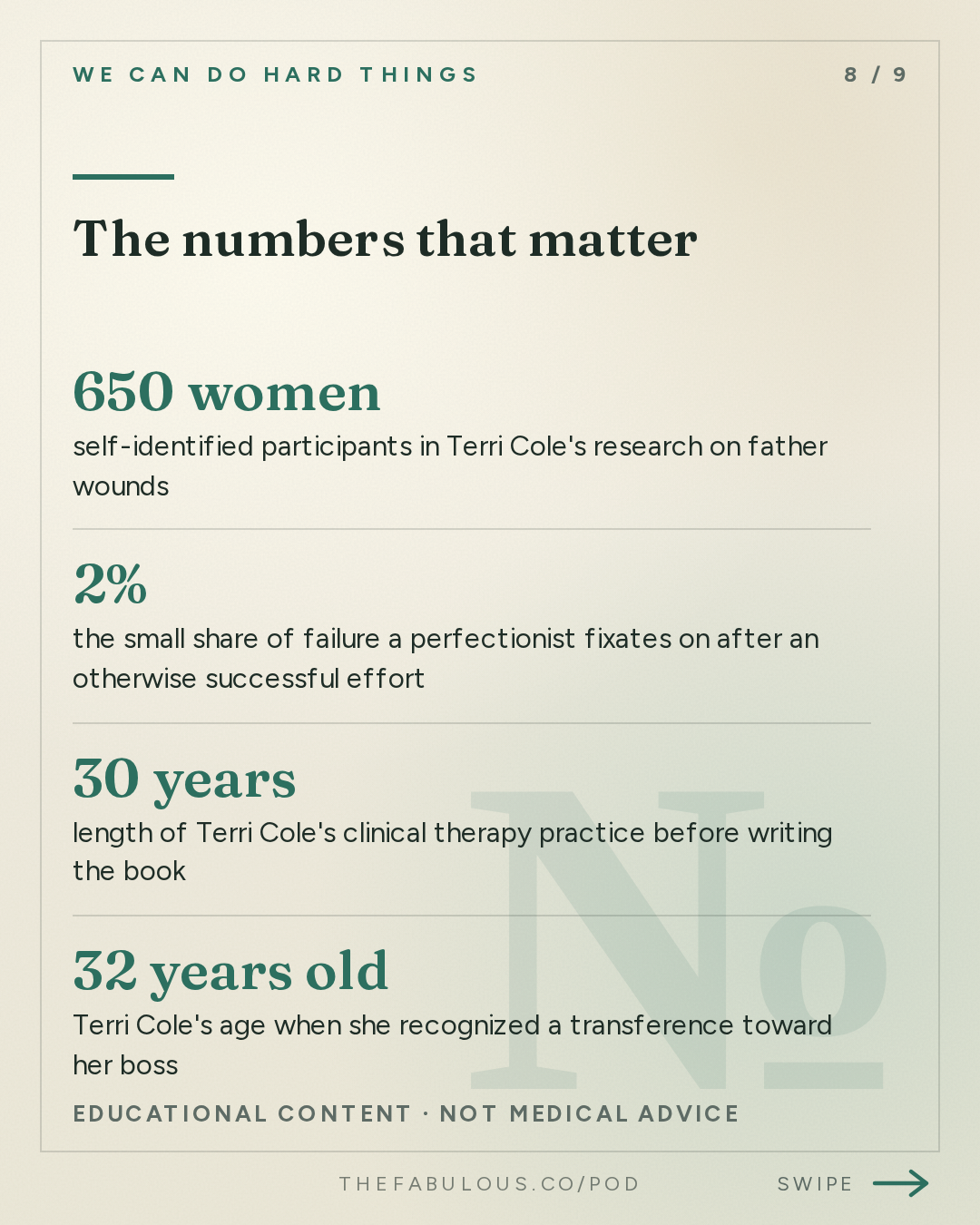
By the numbers
- 650 women self-identified participants in Terri Cole's research on father wounds
- 2% the small share of failure a perfectionist fixates on after an otherwise successful effort
- 30 years length of Terri Cole's clinical therapy practice before writing the book
- 32 years old Terri Cole's age when she recognized a transference toward her boss
In their words
“Somewhere we learned that we needed to be different, better, more perfect, thinner, more beautiful, more accomplished to be worthy of consideration and love.”
“You become indispensable, but you're still not known either by others or by yourself.”
“You smash into a wall of there were way too many fucks given over here for a really long time.”
“We won't call it self-love, which is all weird and nobody even knows what it means.”
Protocols
-
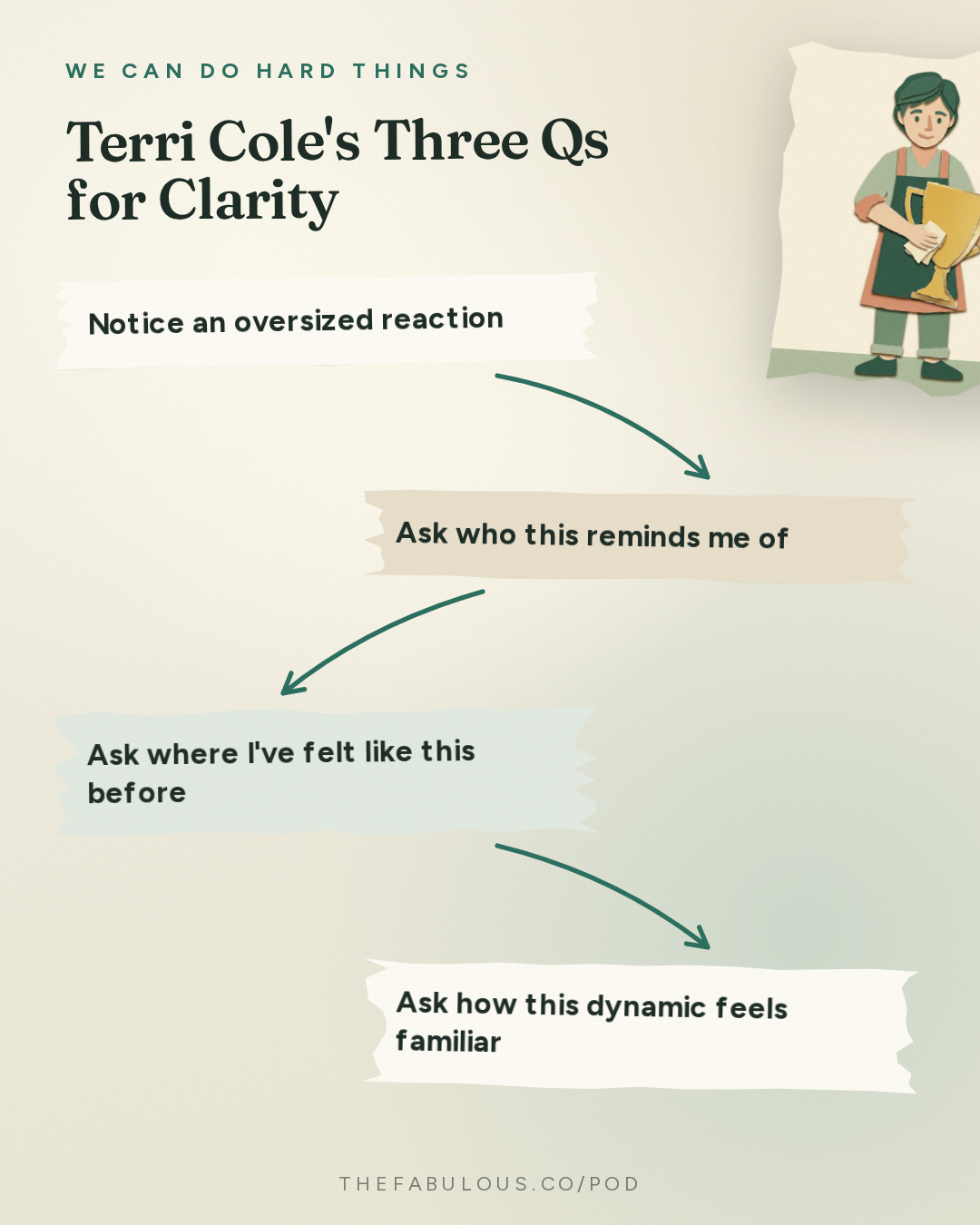
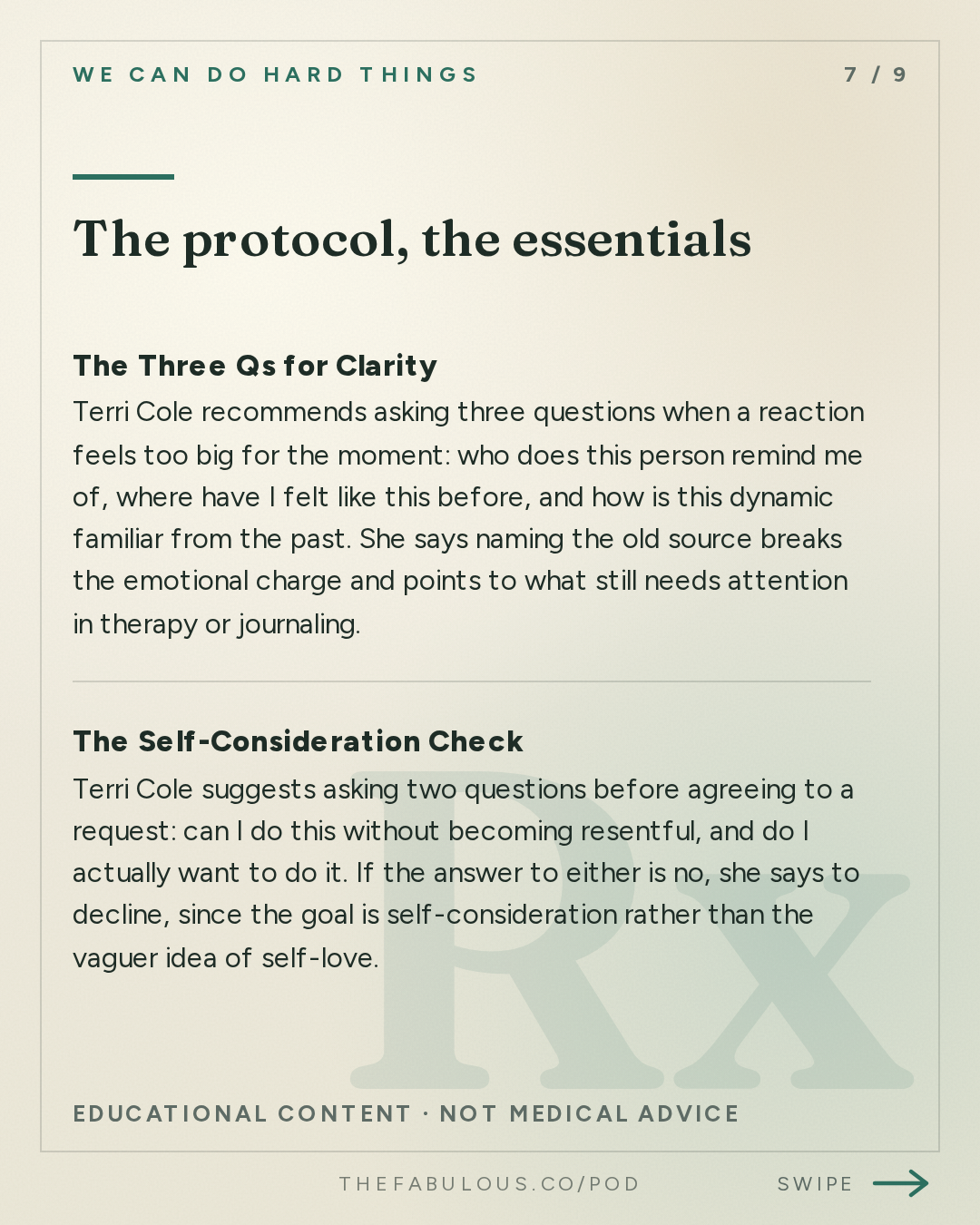
The Three Qs for Clarity
Terri Cole recommends asking three questions when a reaction feels too big for the moment: who does this person remind me of, where have I felt like this before, and how is this dynamic familiar from the past. She says naming the old source breaks the emotional charge and points to what still needs attention in therapy or journaling.
Whenever an emotional response feels disproportionate to the situation
-
The Self-Consideration Check
Terri Cole suggests asking two questions before agreeing to a request: can I do this without becoming resentful, and do I actually want to do it. If the answer to either is no, she says to decline, since the goal is self-consideration rather than the vaguer idea of self-love.
Before taking on any new obligation
-
Naming the Wound Honestly
Terri Cole advises starting healing by telling the truth about childhood without softening it, giving permission to remember specific moments and write them down. She says this step does not require confronting or involving the parent, since the work changes an internal pattern rather than the relationship itself.
An ongoing practice, started immediately
Questions this episode answers
What is a father wound?
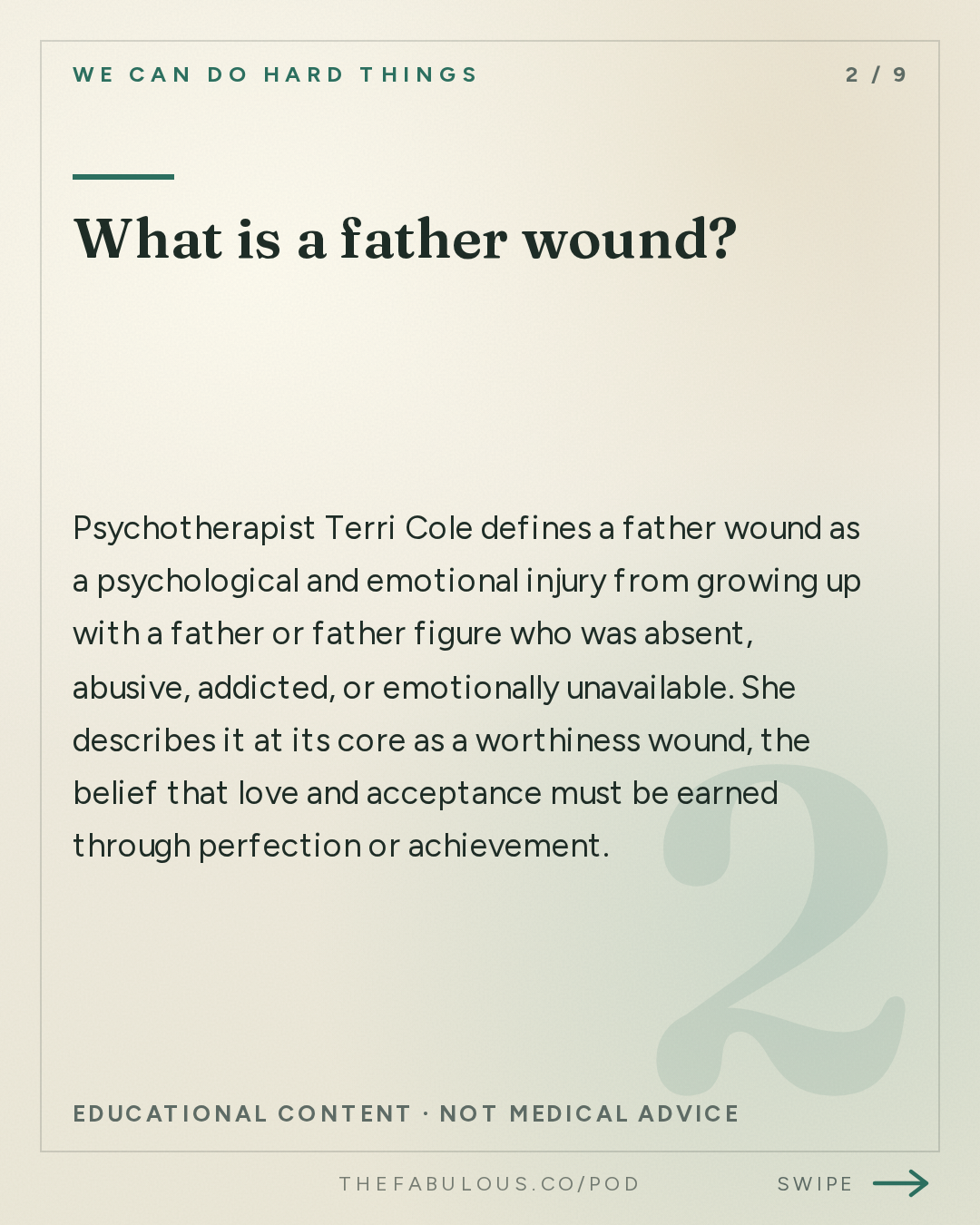
Psychotherapist Terri Cole defines a father wound as a psychological and emotional injury from growing up with a father or father figure who was absent, abusive, addicted, or emotionally unavailable (01:32). She describes it at its core as a worthiness wound, the belief that love and acceptance must be earned through perfection or achievement (02:40).
What are the symptoms of a father wound in women?
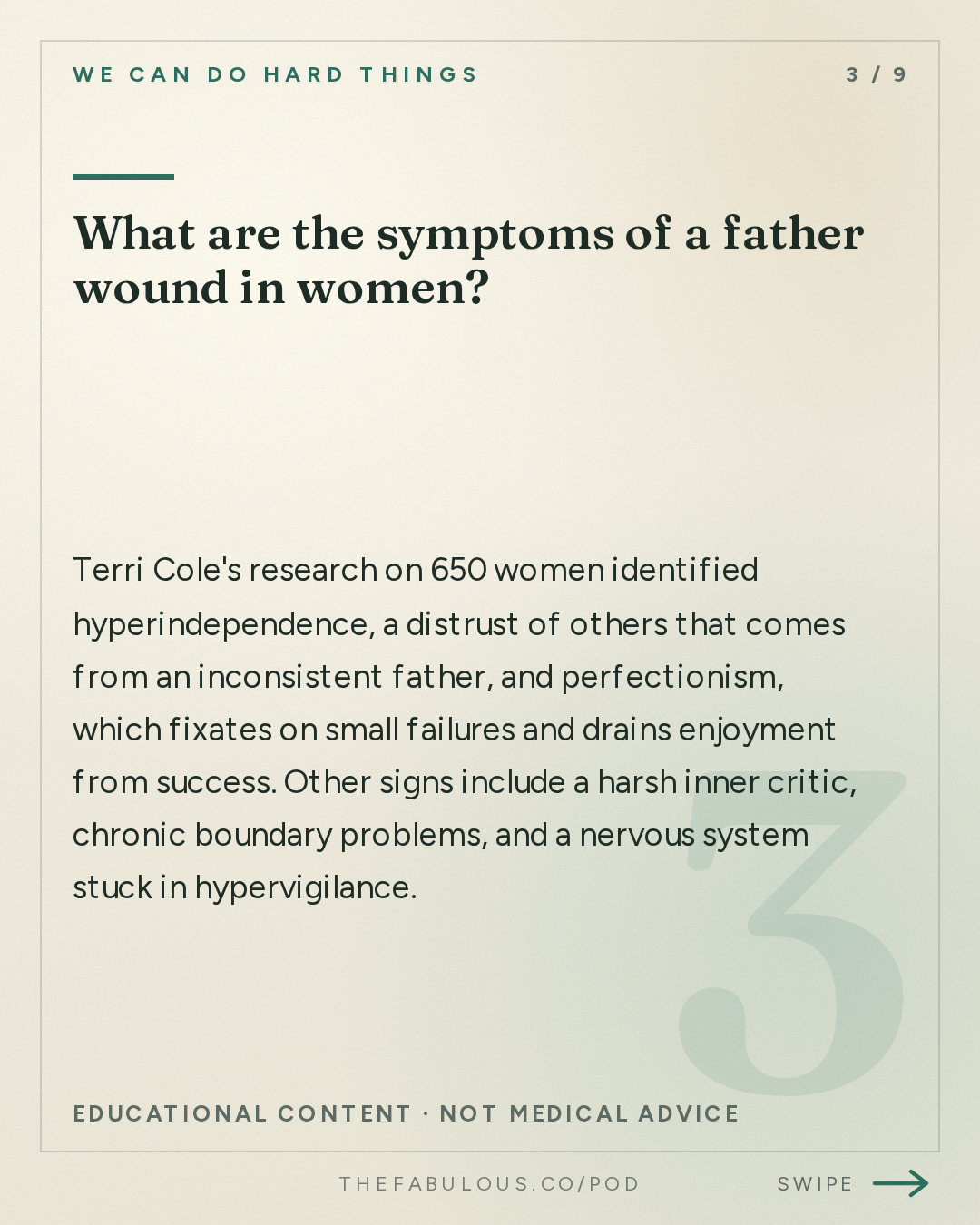
Terri Cole's research on 650 women identified hyperindependence, a distrust of others that comes from an inconsistent father, and perfectionism, which fixates on small failures and drains enjoyment from success (19:00, 20:28). Other signs include a harsh inner critic, chronic boundary problems, and a nervous system stuck in hypervigilance (20:47, 21:12).
Can perimenopause trigger a sudden need for boundaries?
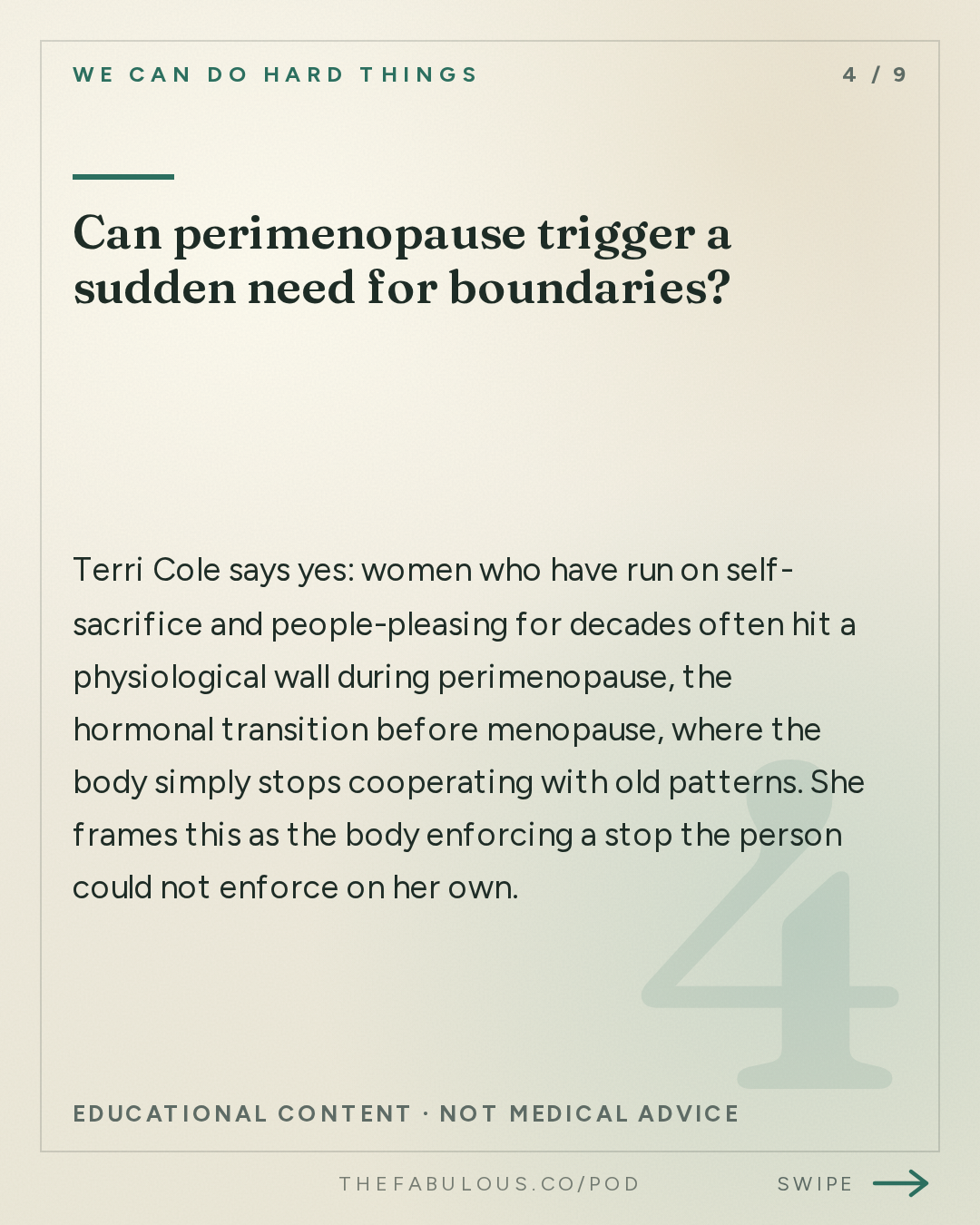
Terri Cole says yes: women who have run on self-sacrifice and people-pleasing for decades often hit a physiological wall during perimenopause, the hormonal transition before menopause, where the body simply stops cooperating with old patterns (21:36). She frames this as the body enforcing a stop the person could not enforce on her own.
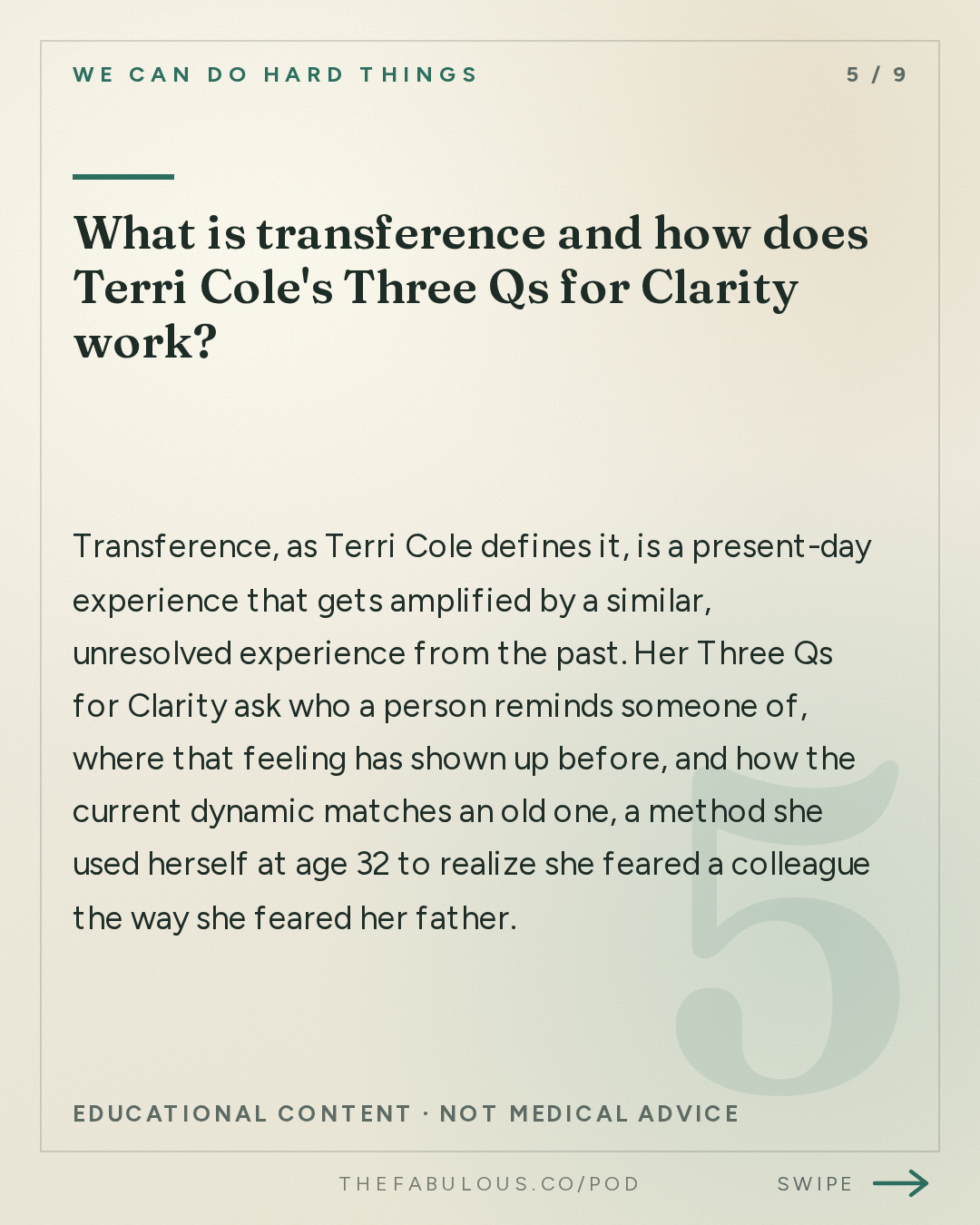
What is transference and how does Terri Cole's Three Qs for Clarity work?
Transference, as Terri Cole defines it, is a present-day experience that gets amplified by a similar, unresolved experience from the past (33:18). Her Three Qs for Clarity ask who a person reminds someone of, where that feeling has shown up before, and how the current dynamic matches an old one, a method she used herself at age 32 to realize she feared a colleague the way she feared her father (35:11).
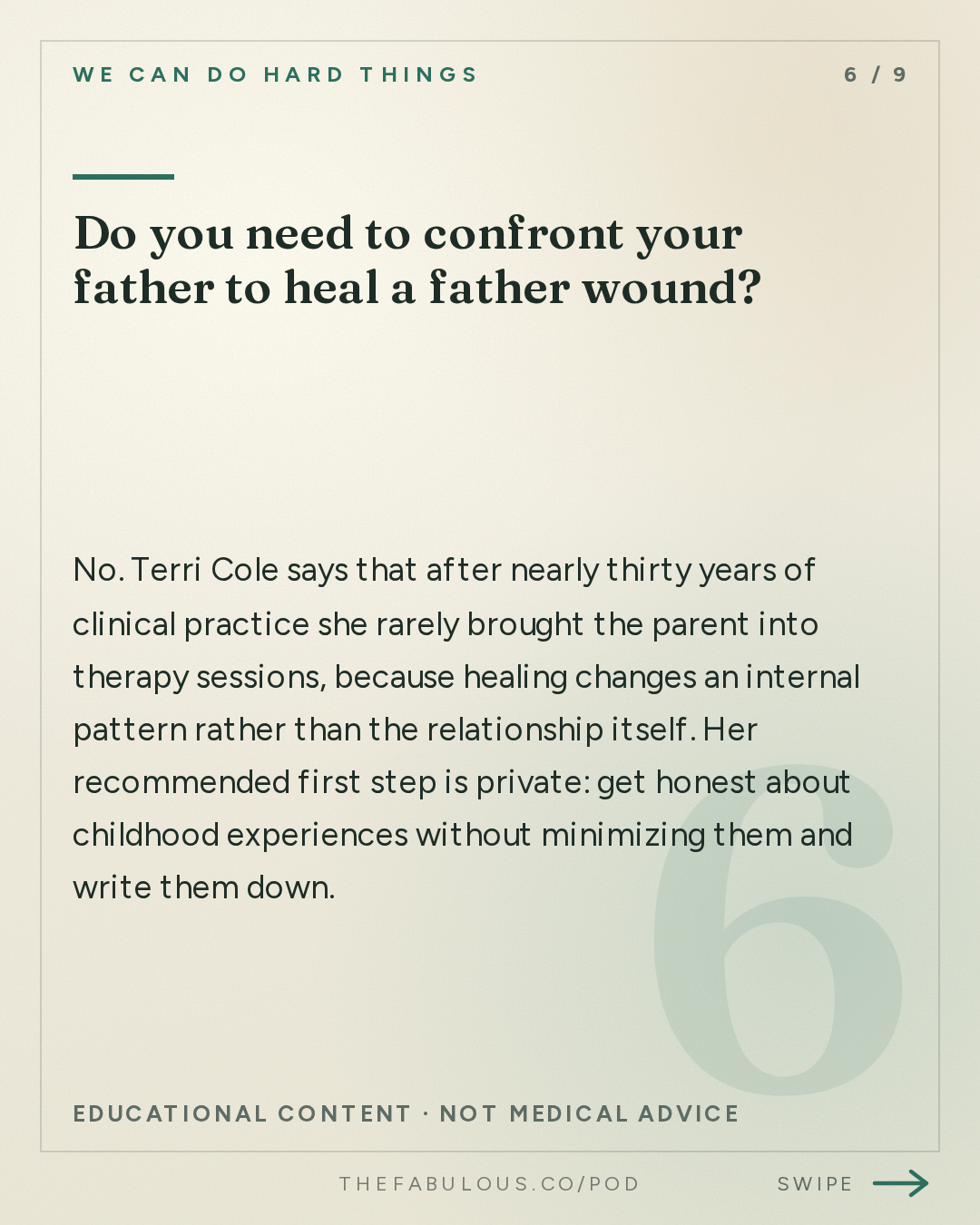
Do you need to confront your father to heal a father wound?
No. Terri Cole says that after nearly thirty years of clinical practice she rarely brought the parent into therapy sessions, because healing changes an internal pattern rather than the relationship itself (14:48). Her recommended first step is private: get honest about childhood experiences without minimizing them and write them down (61:10).
The full read, in cards
Go deeper
- Father Wound: Break Unhealthy Patterns to Reclaim Your Worth and Power — Terri Cole's framework for identifying and healing a father wound, built from interviews with 650 women
- Terri Cole's study of 650 self-identified women with father wounds — Found recurring patterns including hyperindependence, perfectionism, and disrupted sexuality tied to father relationships
- When Willpower's Not Enough — Book written by the addiction doctor onto whom Terri Cole unconsciously transferred fear of her father
Mentioned
Terri Cole · Father Wound: Break Unhealthy Patterns to Reclaim Your Worth and Power · The Terri Cole Show · High Functioning Codependency · Disordered Boundaries · patriarchy · transference
More from this show and category

Chanel Miller on Trauma, Art, and Healing
Chanel Miller, author of the memoir Know My Name, describes healing from her 2015 sexual assault at Stanford University as a daily practice of staying present rather than fixing everything. She uses art to prove life keeps moving, pictures depression as vision narrowed through a toilet paper tube, and treats small acts like drinking water as real medicine.

Title IX Report vs Complaint: The Real Difference
At most universities, filing a Title IX "report" about a sexual assault triggers nothing, only a formal "complaint" starts an investigation, and sociologist Nicole Bedera's year embedded inside one university's Title IX office found just 18% of reports ever became complaints (35:51). Her research shows the system is structurally built to protect the institution, not the survivor.

Allison Russell on Healing Childhood Trauma
Singer-songwriter Allison Russell, raised by a white supremacist abuser after Quebec's child-protection system returned her to her mother's custody, describes how chosen family, art, and motherhood helped her return to her body after trauma. She frames scars as proof of survival, reframes PTSD as a bodily response rather than an inner demon, and ties her healing to activism against gun violence and minority rule in Tennessee (41:53, 55:35).

Dr. Rachel Rubin on Perimenopause Relief
Perimenopause can start around age 35 and run for a decade before periods stop, yet fewer than 6% of doctors are trained to treat it. Urologist Dr. Rachel Rubin explains why standard hormone tests mislead, debunks the 2002 Women's Health Initiative scare, and lays out a four-part hormone therapy toolbox, including cheap vaginal estrogen that cuts UTI hospitalizations by over half.
