
Chanel Miller on Trauma, Art, and Healing
(BEST OF) How to Not Disappear: Chanel Miller
▶ Listen to the full episode More from We Can Do Hard Things
The brief
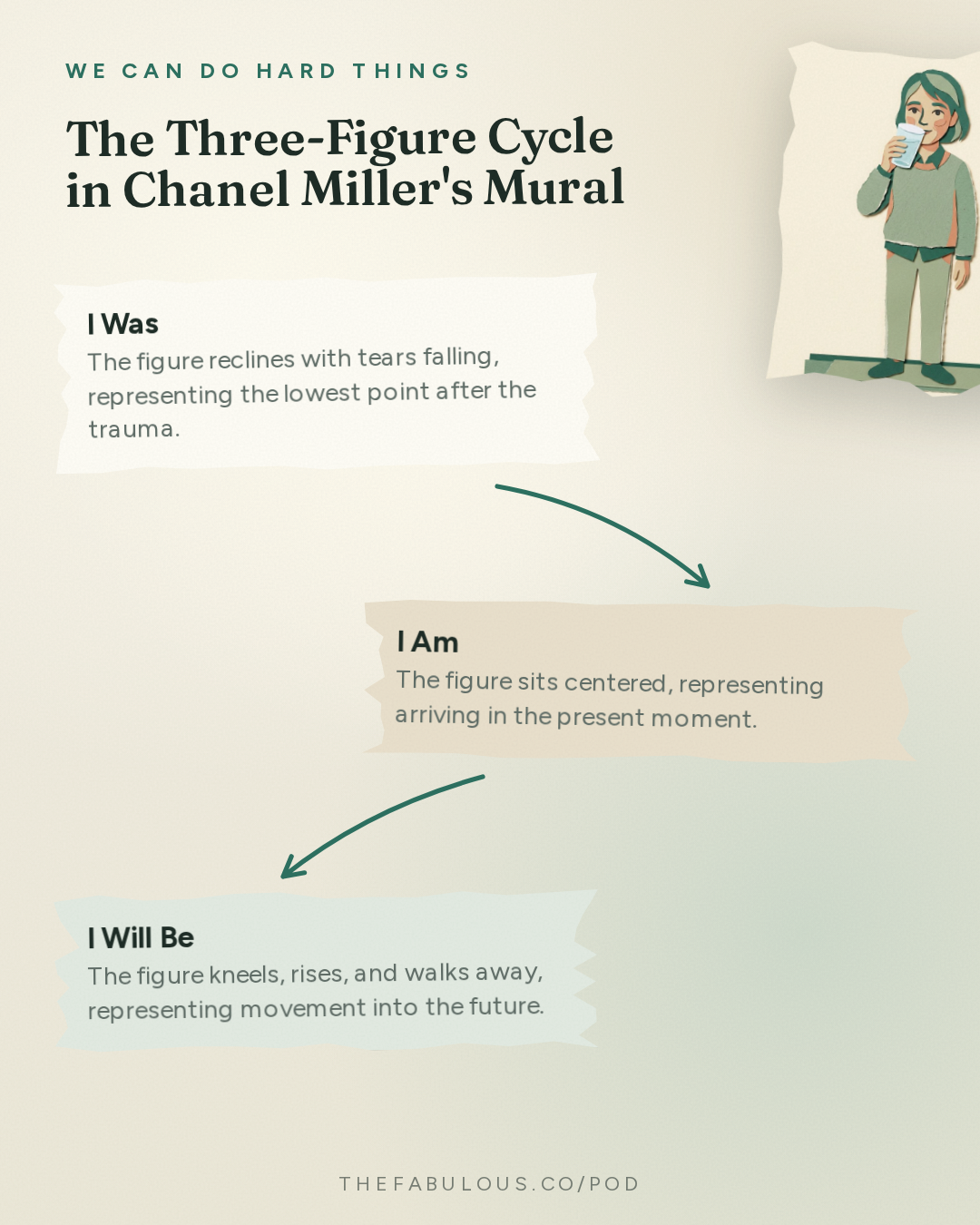
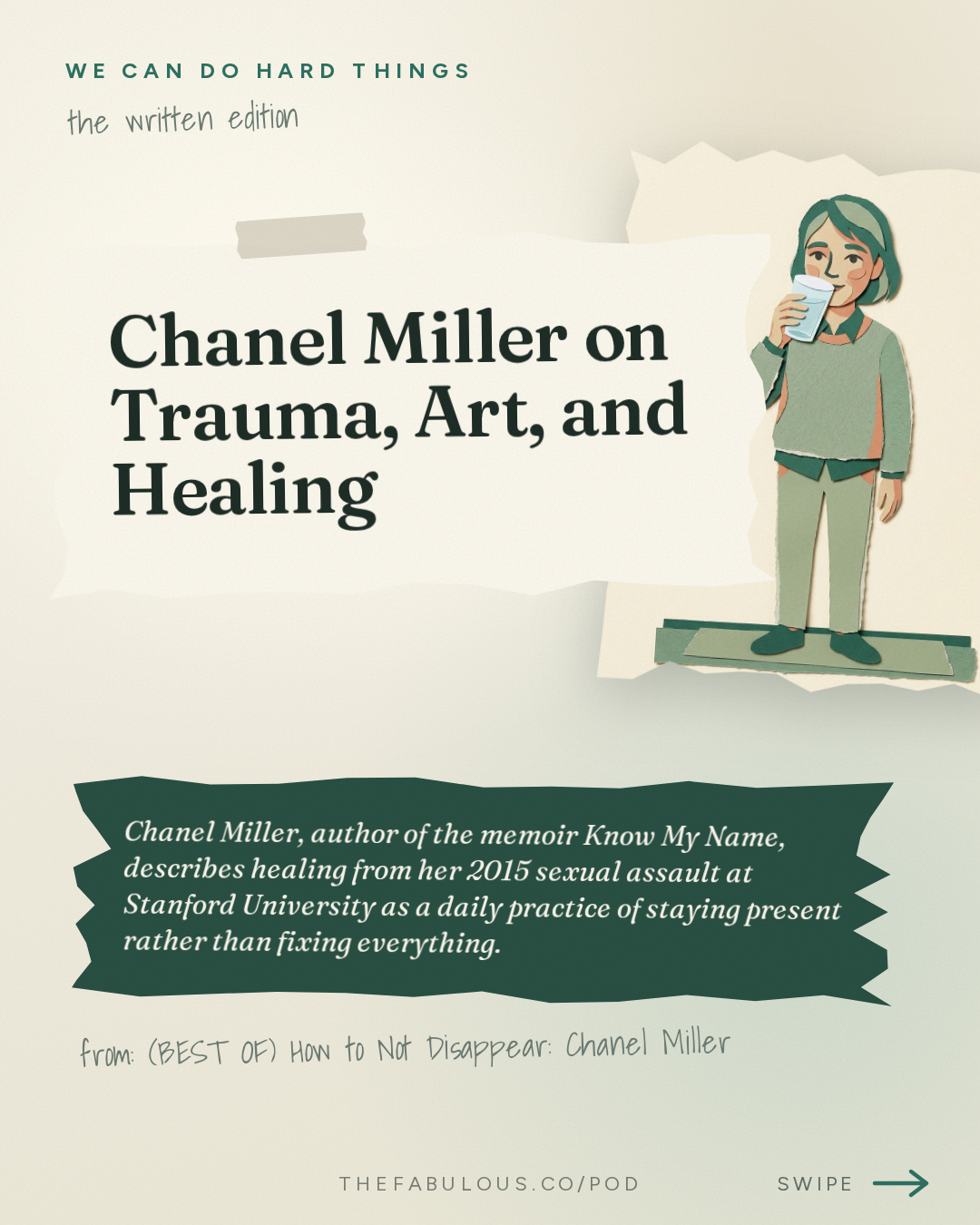
Chanel Miller, author of the memoir Know My Name, describes healing from her 2015 sexual assault at Stanford University as a daily practice of staying present rather than fixing everything. She uses art to prove life keeps moving, pictures depression as vision narrowed through a toilet paper tube, and treats small acts like drinking water as real medicine.
A little girl digs her finger into wet sand and writes two words: "Melody is here." Not "was here," the way most of us scratch our names into a boardwalk rail hoping to be remembered. Just "is." The podcast host Glennon Doyle noticed the girl mid-walk while thinking about the writer and artist Chanel Miller, and the moment became a kind of thesis for the conversation that followed (21:11): that announcing your own presence, however small, is its own form of staying alive.
Miller is the author of Know My Name, the 2019 memoir about surviving a sexual assault on Stanford University's campus and the criminal trial that followed. She wrote her victim impact statement believing about 30 people in a Palo Alto courtroom would ever hear it (12:38). Instead it was published online, read by millions under her court pseudonym Emily Doe, and the book that grew from it won the National Book Critics Circle Award and was named a Best Book of 2019 by Time (05:10). The statement taught her something she still returns to: that she will never fully know how much her work means to other people, so she has stopped trying to calculate it.
The conversation keeps circling one idea: that healing is not a single rescue but a repeated choice to remain visible. Miller's therapist, while she was writing the book, told her to focus on pleasure rather than only digging back into the trauma. She considered a trampoline gym and settled instead for something quieter, a seven-person narrative illustration class in San Francisco, basically a comic-making workshop, that she attended most nights after a day spent writing about the assault (07:25). The assignment was simple: draw what happened in your day. One recurring subject was a foster dog who could not control her bladder on the family's slanted floor. Coloring in a puddle of urine with a highlighter sounds like the opposite of healing. Miller says it was the healing.
"You have to know that life is in motion, and that it's impossible to get stuck, even if you feel that you are." — Chanel Miller [10:11]
That line does a lot of work in the episode. Trauma convinces a person that time has stopped, that the worst day is still happening. Drawing her days forced Miller to notice small, undeniable changes, proof the world kept turning even while her interior life stayed fixed on the courtroom. She extends the same logic to her fictional characters: if she quits on herself, she quits on them too, and she treats that obligation as a kind of accountability system for staying creative (10:37).
The Standard Is Presence
The idea that gives the episode its title, refusing to disappear, gets its clearest statement here. Miller says that during the trial years she deliberately lowered what counted as success. It was not winning the case or saying the perfect sentence. It was showing up.
"One of the best things I did for myself was lower my standard to, of success to presence... it didn't matter if I flubbed up my words, which I did a million times. What mattered is that when each time I was summoned, I drove to the courtroom... and I kept doing that, and I did it imperfectly, but I never went away." — Chanel Miller [24:48]
She connects this directly to power. Systems that want someone to go quiet, whether a courtroom, an institution, or a news cycle, are often just waiting for exhaustion to do their work for them.
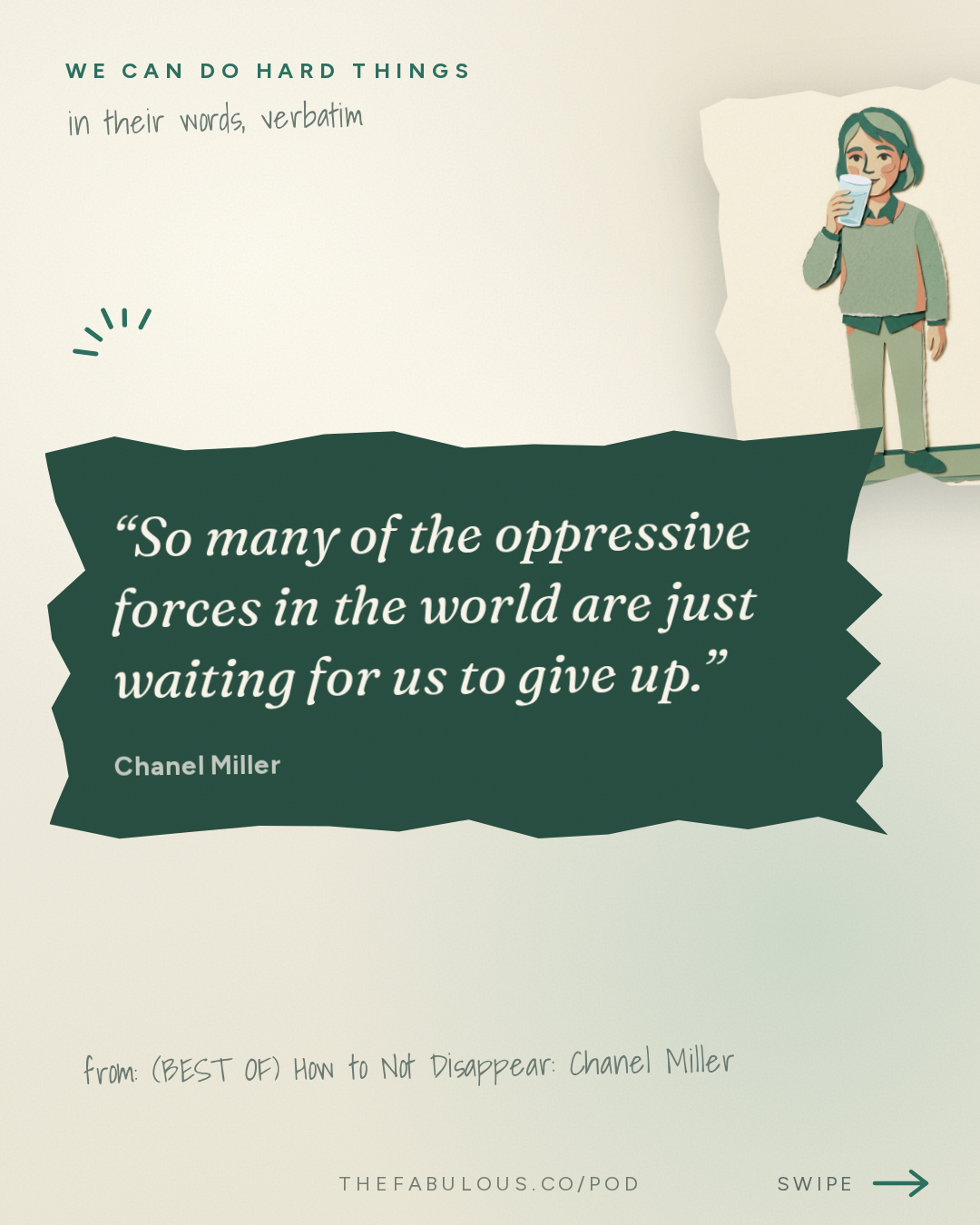
"So many of the oppressive forces in the world are just waiting for us to give up." — Chanel Miller [25:20]
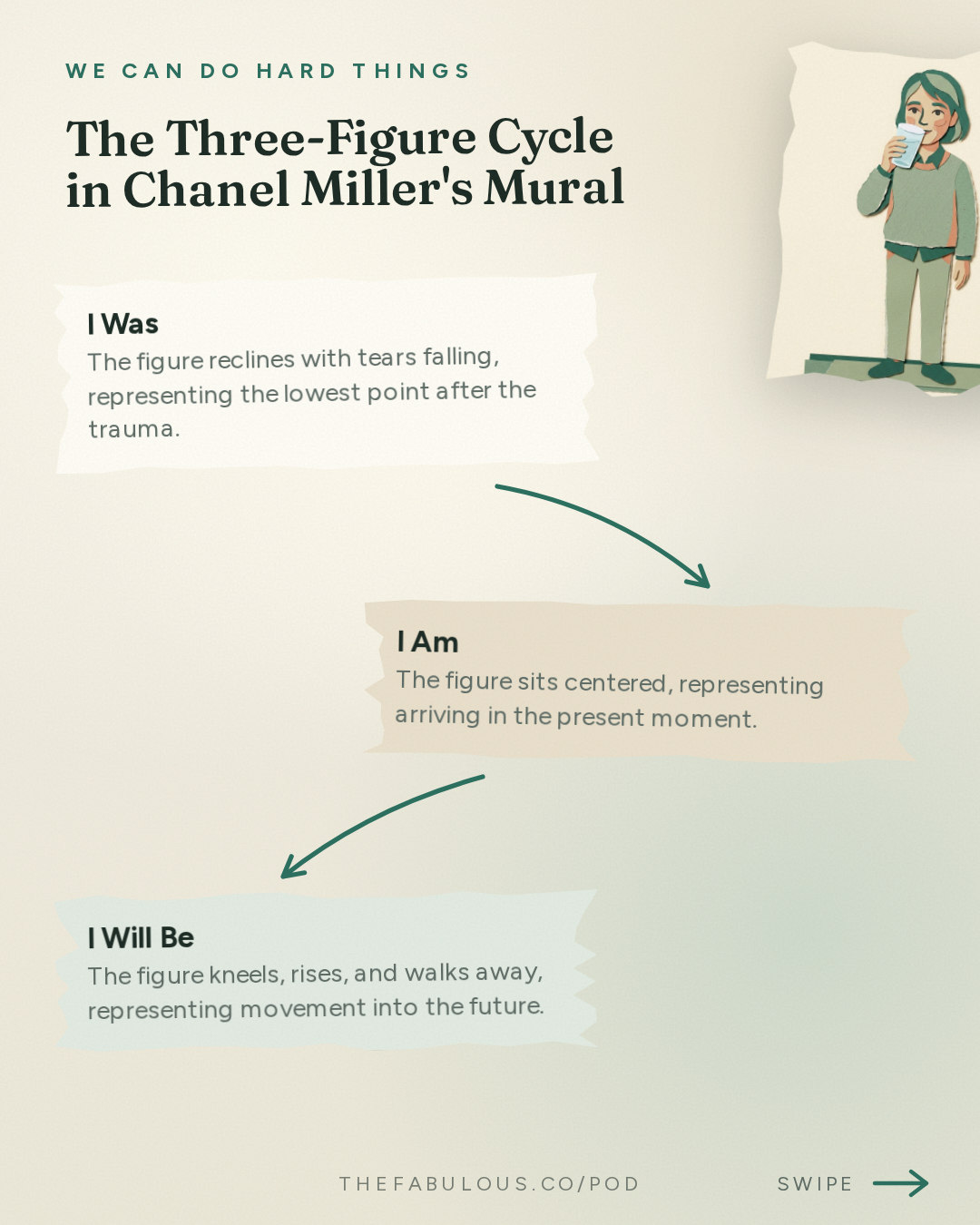
Her visual argument for this is a 75-foot mural called I Was, I Am, I Will Be, painted on the glass front of the Asian Art Museum in San Francisco, the museum her mother used to take her to as a child (27:22). A single figure moves across the wall: reclining in tears, then sitting centered, then kneeling and standing and walking away. Miller originally filled the space with elaborate, detailed drawings, trying to prove in one shot that she was a serious artist. The museum pushed back and asked for something simple enough to read from the street, like a billboard. She says stripping the piece down to two colors and one line took more confidence than any intricate work she had made, because simplicity requires trusting that there will be a next chance to say more (28:34). The mural stayed up through the pandemic, visible to anyone walking past, a public demonstration that healing is not a finish line but a loop a person keeps walking.
Returning to the Scene
Seven years after the assault, Stanford required its incoming freshmen to read Know My Name and invited Miller back to speak (51:59). She describes being frightened to return, worried that the campus would hand her old, self-loathing self the keys back. Instead, when she walked onstage, the students clapped and did not stop. Her fellow panelists put down their microphones and joined in.
"You don't have to take care of all of us. You don't have to fix everything. Like, we got it. You can go now. Be who you know you're meant to be." — Chanel Miller [52:34]
She frames that ovation as permission, not closure. The place that produced the worst chapter of her life also handed her the release from carrying it alone. It is a pattern she notices elsewhere too: the freedom from a wound often has to be found inside the place that caused it.
The conversation also moves into territory Miller says she has not fully written about yet: the rise in anti-Asian violence and what she calls a strange, unwanted kind of visibility, images of people who look like her grandfather or her mother appearing in the news, but almost always paired with violence (37:21). She links this to the model minority myth, a stereotype that paints Asian Americans as uniformly successful, quiet, and nonthreatening, and which she says caused people in her own courtroom to underestimate her. She credits her mother, who grew up under a communist government and fought for the right to speak freely before immigrating, as the reason she refused to be dismissed in a California courtroom (38:46).
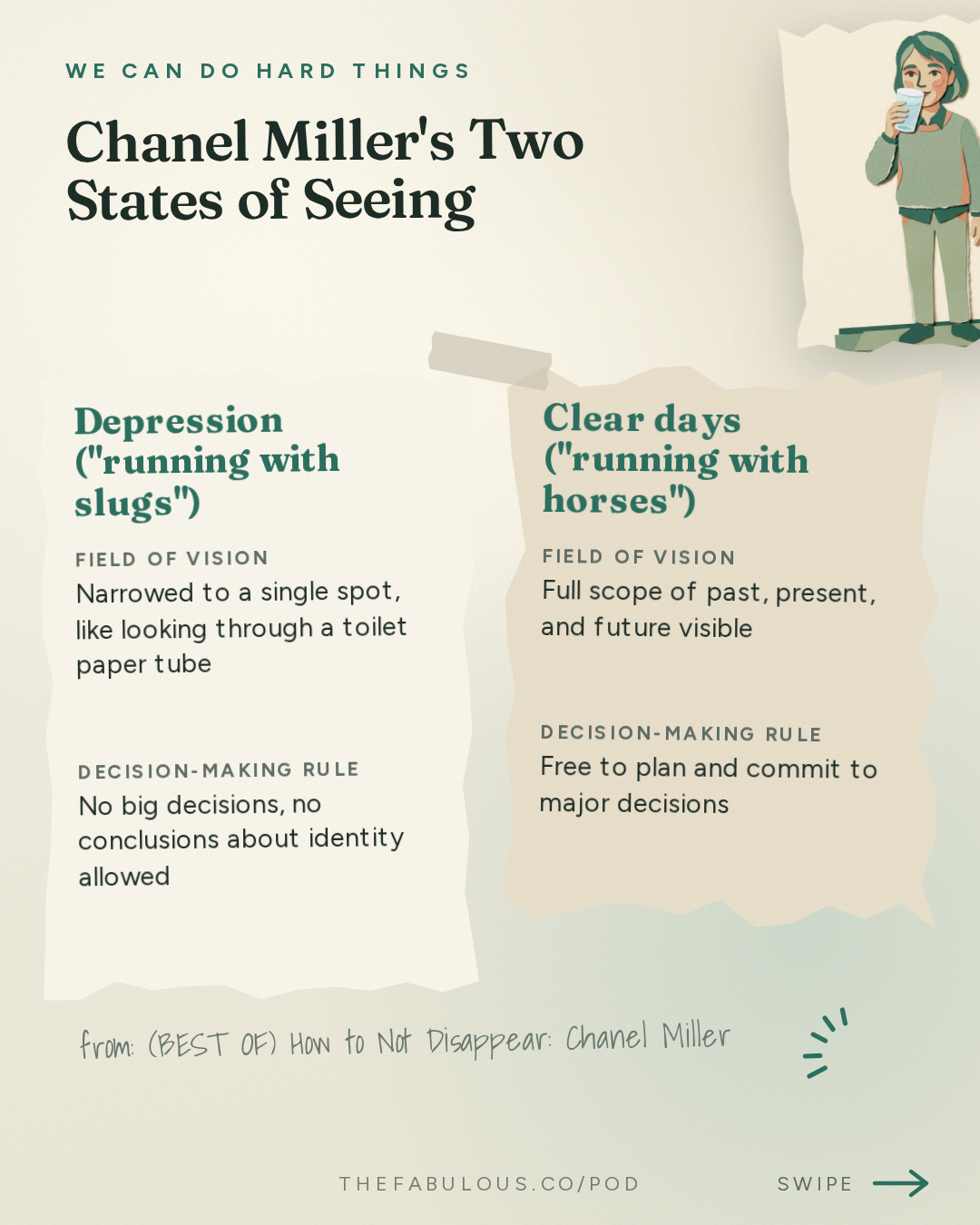
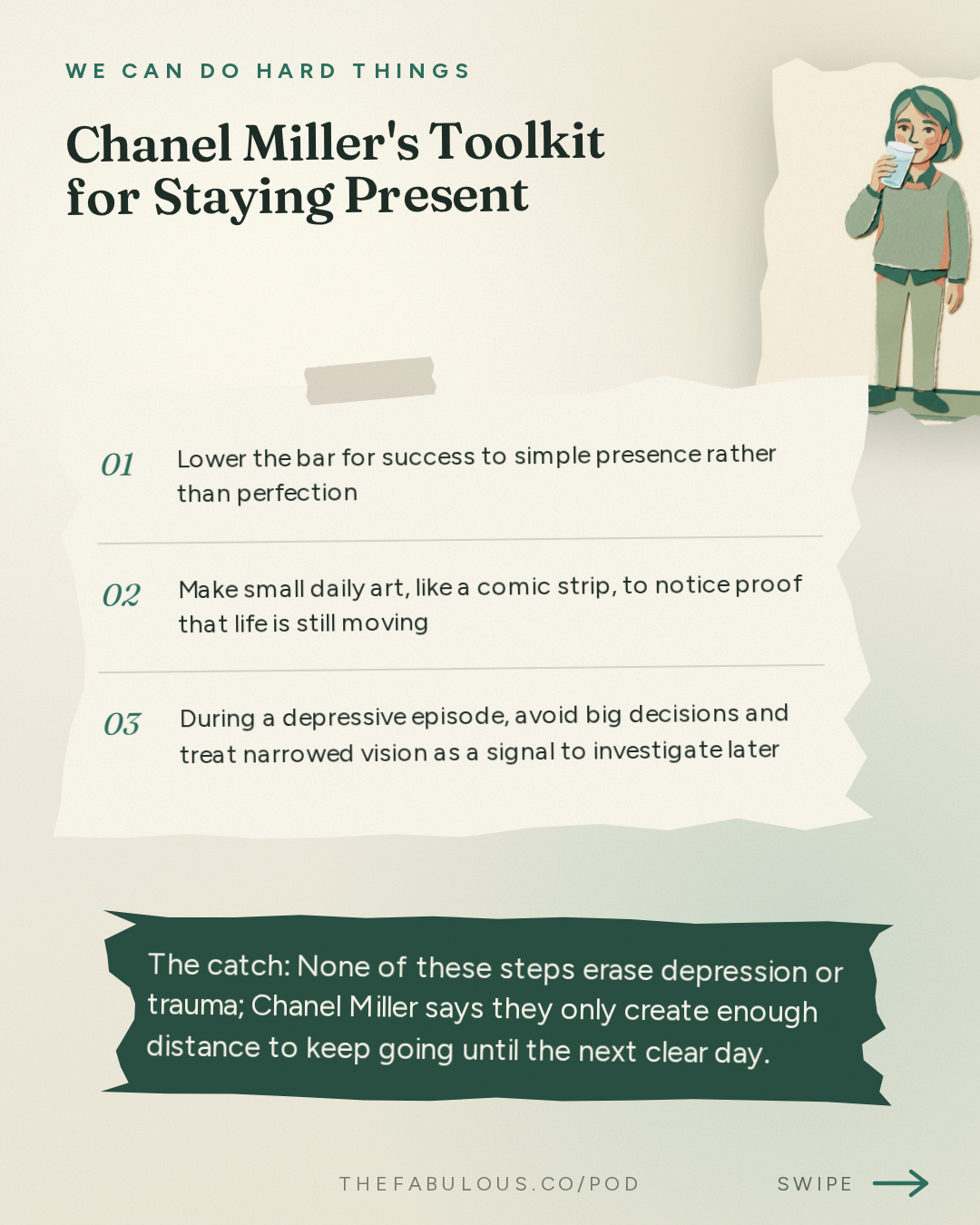
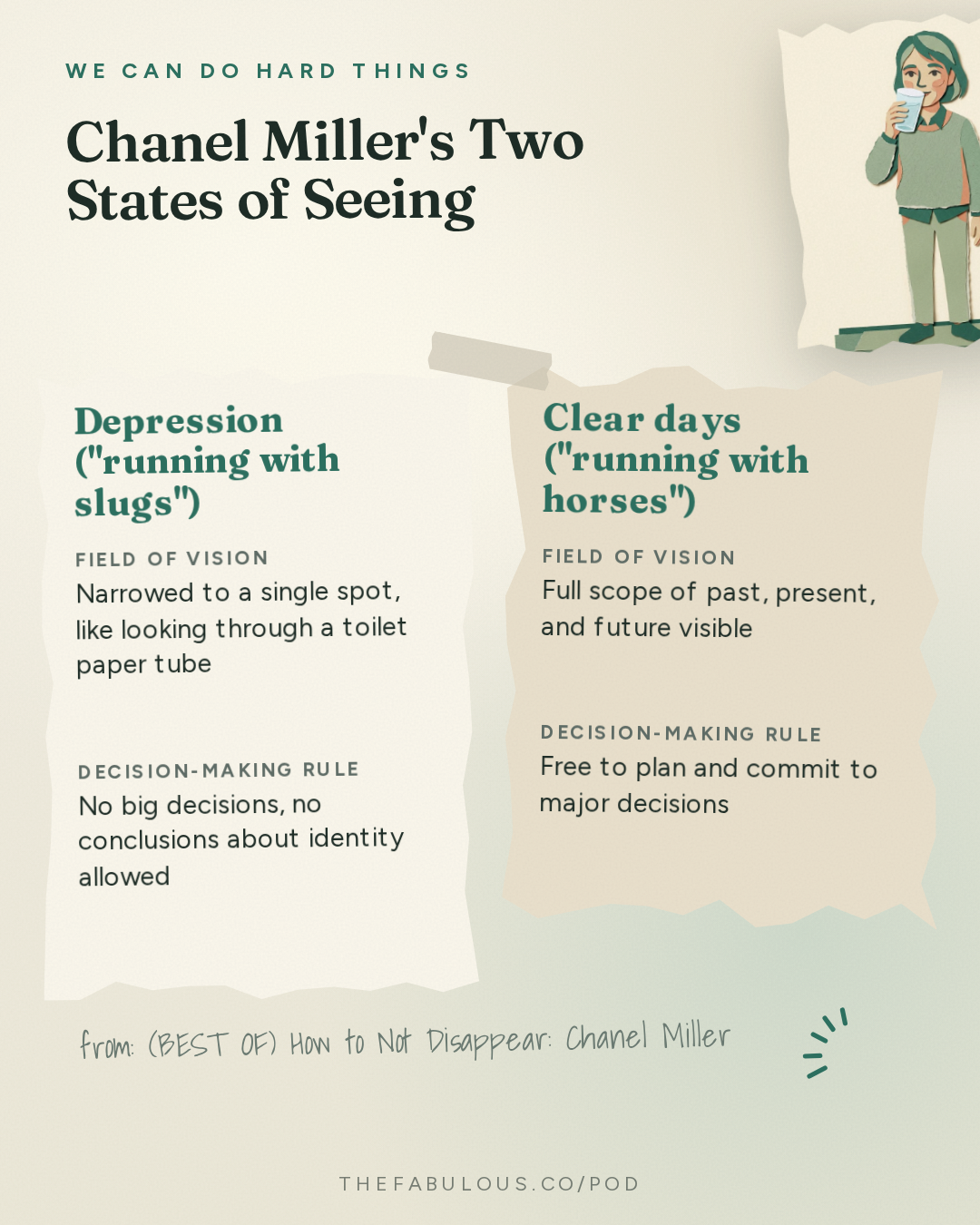
For listeners managing their own depression, the most portable idea in the episode may be the smallest one. Miller pictures depression as looking through a toilet paper tube hung around the neck like binoculars: vision narrows to one spot, and the wider scope of past and future disappears (44:13). Her rule is that during this state she is not allowed to make big decisions or draw conclusions about who she is (44:36). She does not treat the narrowing as meaningless; she treats it as a signal worth investigating rather than waiting out (46:09). And when the big thinking gets unbearable, Glennon's fix is almost embarrassingly small: play with the dogs for ten minutes, take a walk, drink a glass of water (55:21). Small things, she says, are usually the actual solution to big thinking.
By the end, the thread back to the girl on the beach is obvious. Miller's whole method, the comics, the mural, the courtroom appearances, the Stanford visit, is a version of writing her own name in the sand. Not permanence. Not a cure. Just proof, renewed daily, that she is still here.
Ask this episode anything
Pod's AI answers from the episode itself, with the minute mark so you can hear it yourself.
Or start with one of these
Ask this episode
Pod's AI listens to the whole episode to answer, and points you to the minute it comes from.
The rest of this answer, and any question after it
Answers come from the episode itself, never from a summary of it.
ContinueKey takeaways
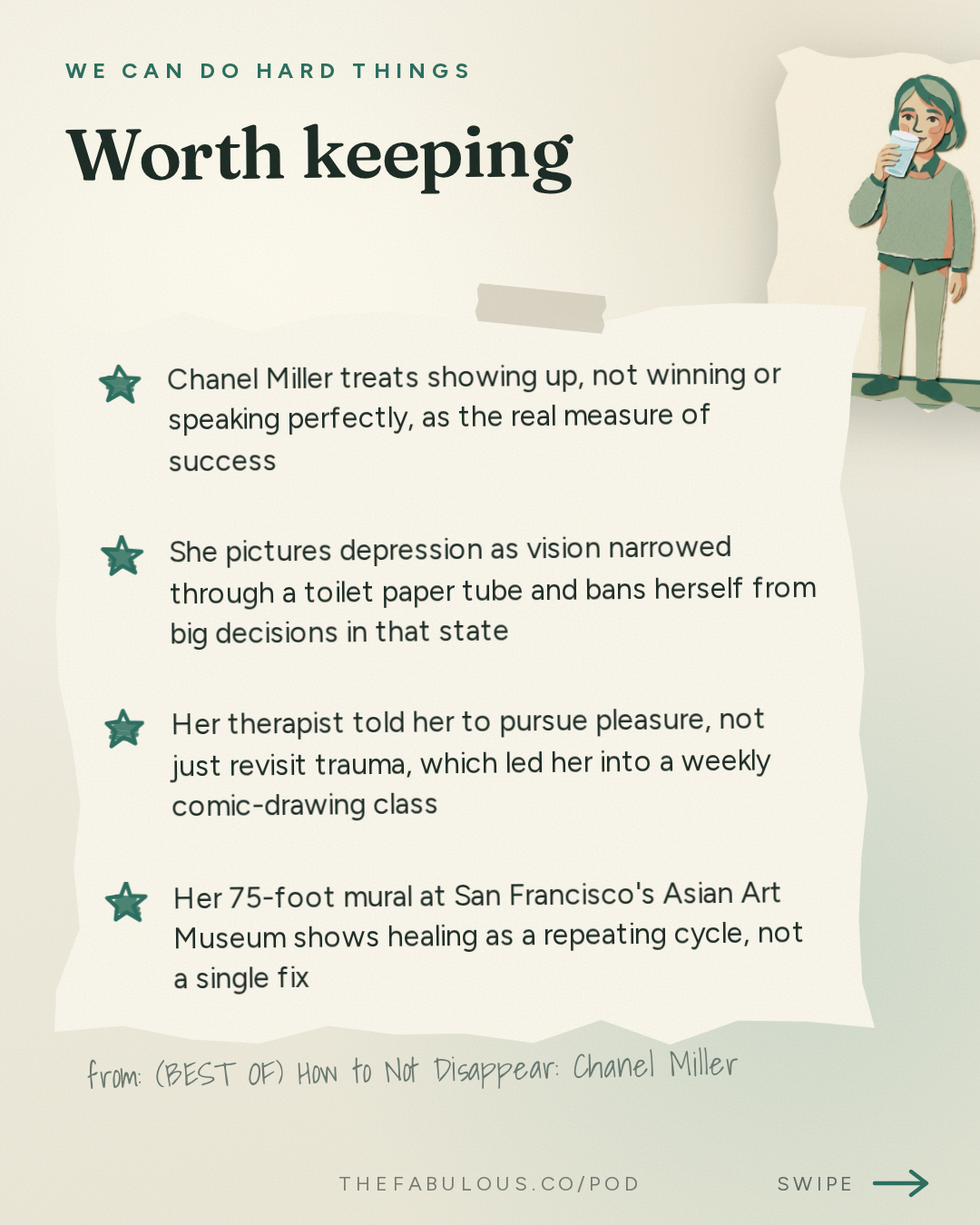
- Chanel Miller treats showing up, not winning or speaking perfectly, as the real measure of success
- She pictures depression as vision narrowed through a toilet paper tube and bans herself from big decisions in that state
- Her therapist told her to pursue pleasure, not just revisit trauma, which led her into a weekly comic-drawing class
- Her 75-foot mural at San Francisco's Asian Art Museum shows healing as a repeating cycle, not a single fix
- She relies on small physical acts, drinking water, walking, playing with dogs, to interrupt spirals of big thinking
The episode in cards
By the numbers
- 30 people intended audience Chanel Miller expected for her original court statement
In their words
“Maybe our job today is not to know exactly how we're going to fix everything. Maybe our job is just to refuse to disappear”
“It's impossible to get stuck, even if you feel that you are.”
“So many of the oppressive forces in the world are just waiting for us to give up.”
“"You don't have to take care of all of us. You don't have to fix everything. Like, we got it. You can go now. Be who you know you're meant to be."”
Protocols
-
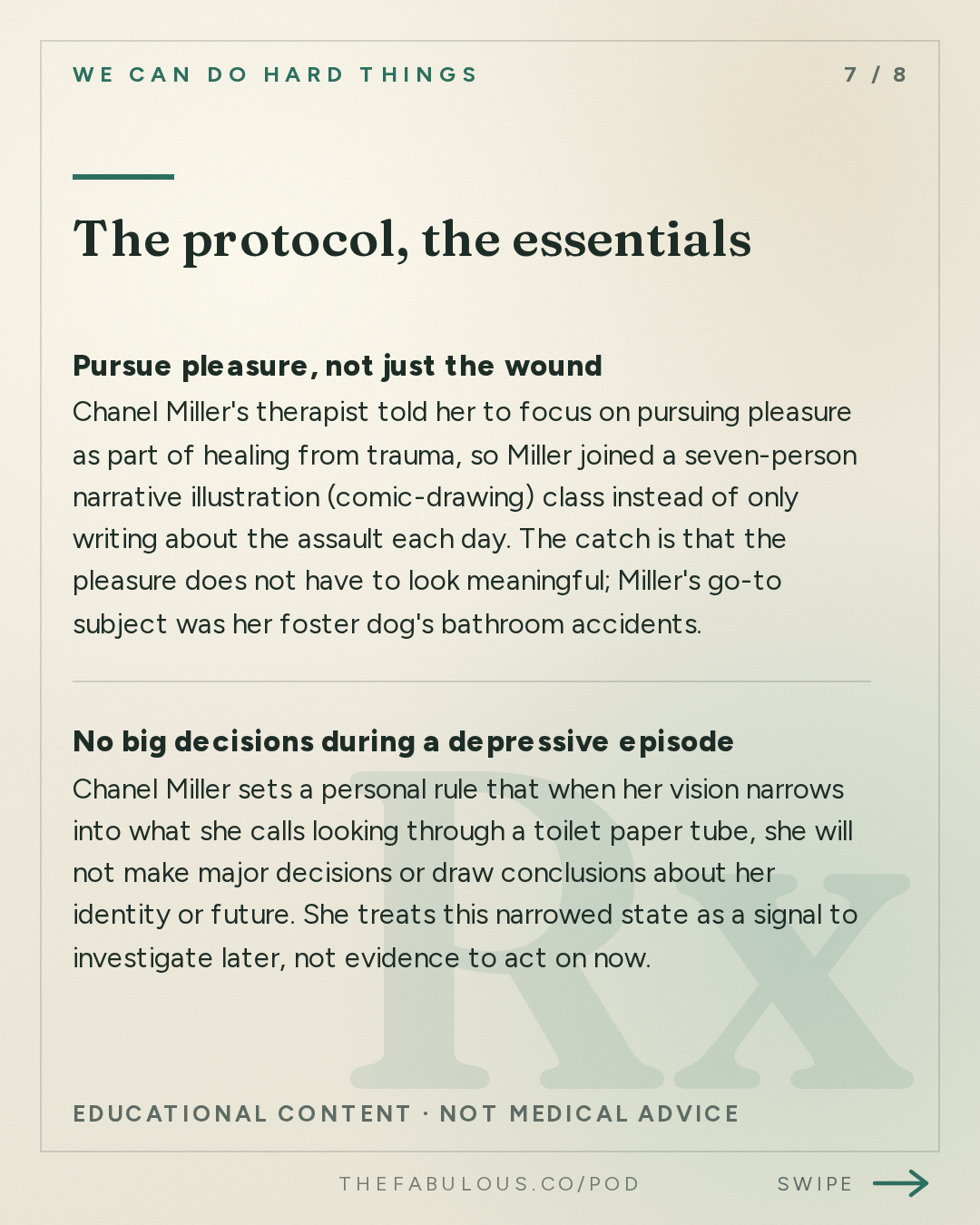
Pursue pleasure, not just the wound
Chanel Miller's therapist told her to focus on pursuing pleasure as part of healing from trauma, so Miller joined a seven-person narrative illustration (comic-drawing) class instead of only writing about the assault each day. The catch is that the pleasure does not have to look meaningful; Miller's go-to subject was her foster dog's bathroom accidents.
nightly, after each day of writing
-
No big decisions during a depressive episode
Chanel Miller sets a personal rule that when her vision narrows into what she calls looking through a toilet paper tube, she will not make major decisions or draw conclusions about her identity or future. She treats this narrowed state as a signal to investigate later, not evidence to act on now.
during depressive episodes
-
Keep a list of small resets
Chanel Miller keeps a short list of grounding actions she turns to when she starts catastrophizing: play with the dogs for ten minutes, go for a walk outside, or get a glass of water. She says big thinking is usually solved by small things, not by overhauling her whole life.
as needed, when overwhelmed
Questions this episode answers
What is Chanel Miller's toilet paper roll metaphor for depression?
Chanel Miller, author of the memoir Know My Name, describes depression as looking through a toilet paper tube: vision narrows to one spot and the wider scope of past and future disappears (44:13). She sets a personal rule that during this narrowed state she will not make big decisions or draw conclusions about her identity (44:36).
How did art help Chanel Miller heal after her assault at Stanford?
Miller's therapist suggested she pursue pleasure rather than only revisit the trauma, so she joined a seven-person narrative illustration class in San Francisco (07:25). Drawing small daily moments, like her foster dog's accidents, showed her that life kept moving even while she wrote about the assault (09:35).
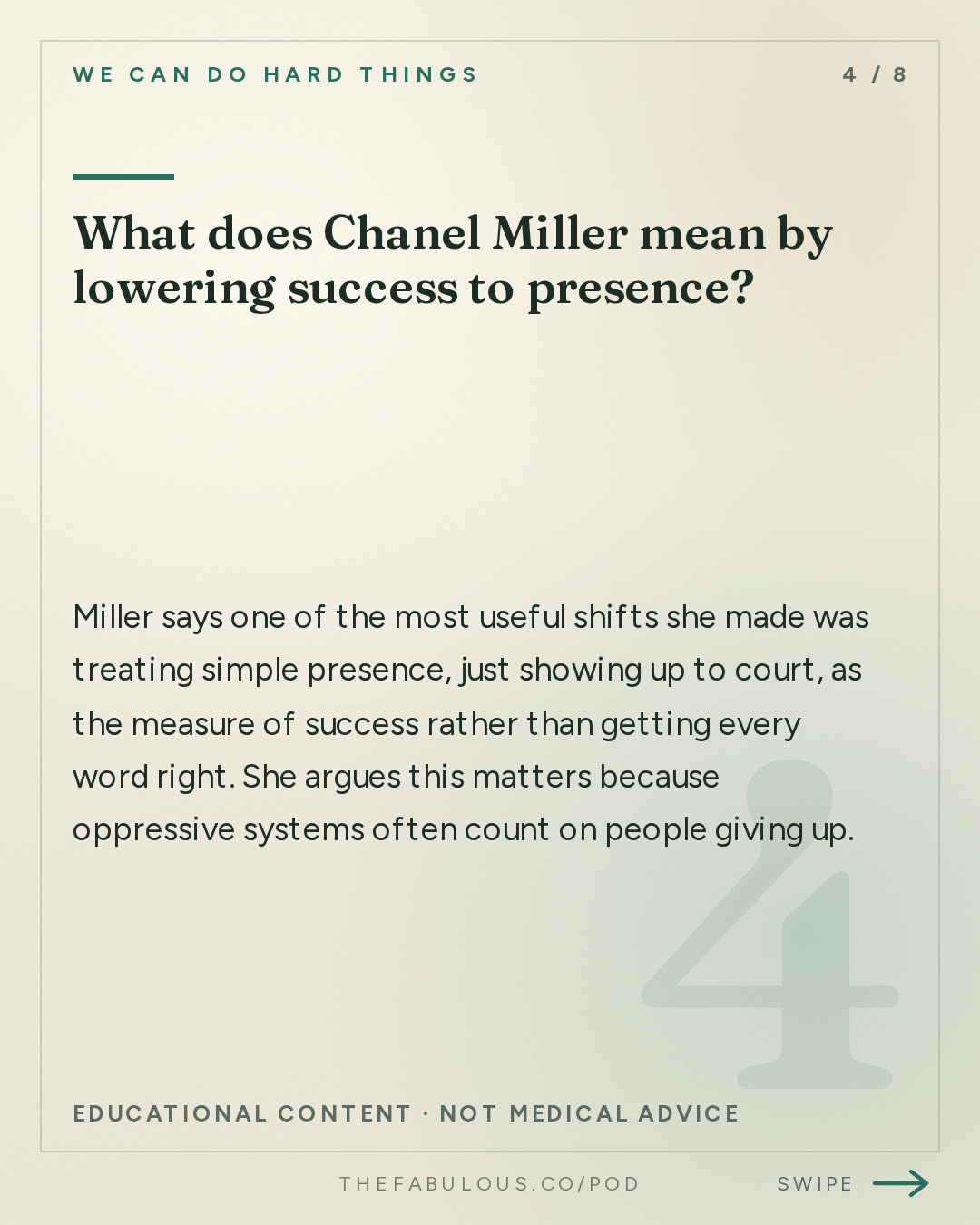
What does Chanel Miller mean by lowering success to presence?
Miller says one of the most useful shifts she made was treating simple presence, just showing up to court, as the measure of success rather than getting every word right (24:48). She argues this matters because oppressive systems often count on people giving up (25:20).
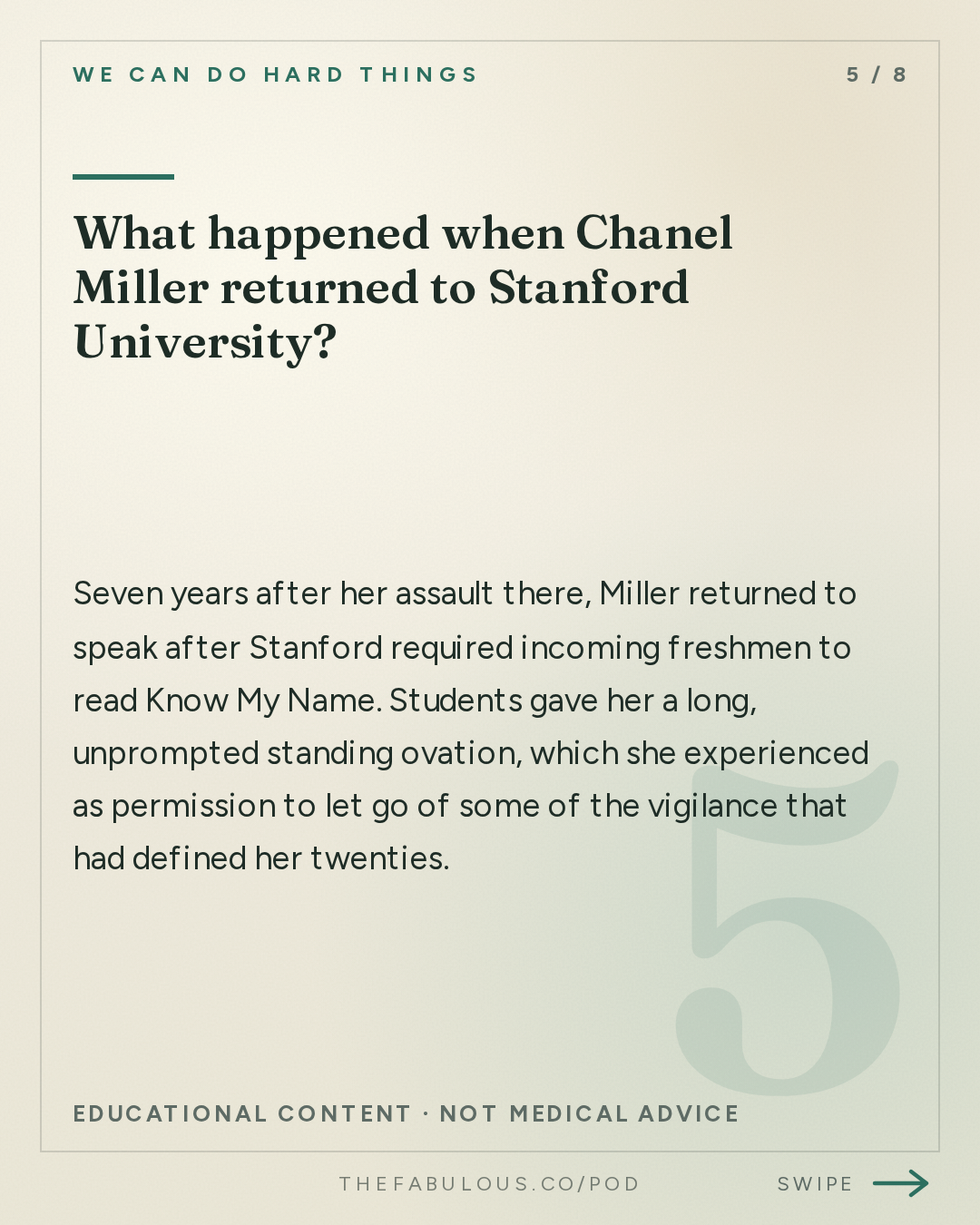
What happened when Chanel Miller returned to Stanford University?
Seven years after her assault there, Miller returned to speak after Stanford required incoming freshmen to read Know My Name (51:59). Students gave her a long, unprompted standing ovation, which she experienced as permission to let go of some of the vigilance that had defined her twenties (52:34).
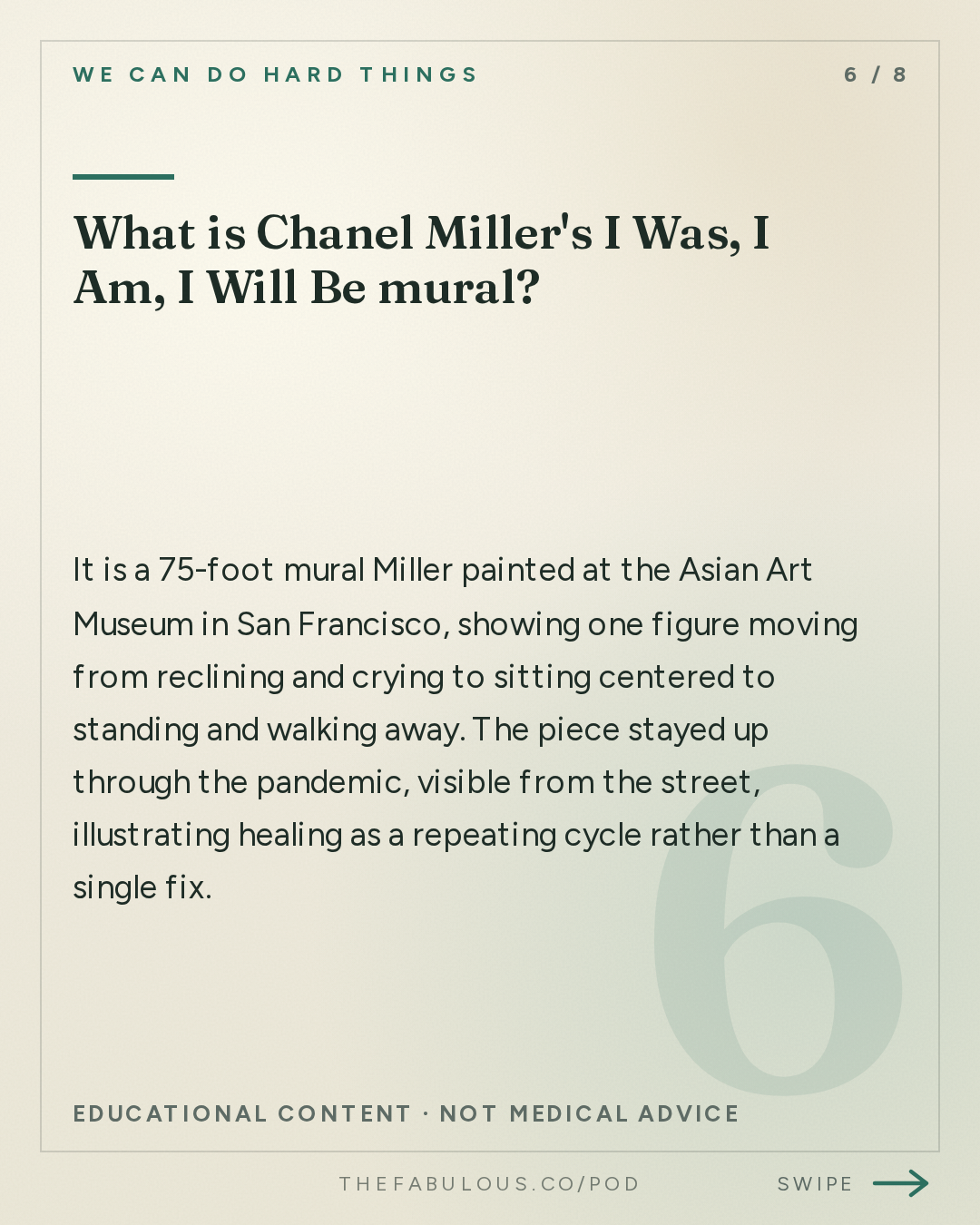
What is Chanel Miller's I Was, I Am, I Will Be mural?
It is a 75-foot mural Miller painted at the Asian Art Museum in San Francisco, showing one figure moving from reclining and crying to sitting centered to standing and walking away (27:22). The piece stayed up through the pandemic, visible from the street, illustrating healing as a repeating cycle rather than a single fix (30:19).
The full read, in cards
Go deeper
- Know My Name — Chanel Miller's memoir about surviving a 2015 sexual assault at Stanford University and the trial that followed
Mentioned
Chanel Miller · Know My Name · Stanford University · Liz Gilbert · Esther Perel · Time Next 100 · Asian Art Museum in San Francisco · Ocean Vuong · Ruth Ozeki · Jia Tolentino · Susan Cain
More from this show and category

Title IX Report vs Complaint: The Real Difference
At most universities, filing a Title IX "report" about a sexual assault triggers nothing, only a formal "complaint" starts an investigation, and sociologist Nicole Bedera's year embedded inside one university's Title IX office found just 18% of reports ever became complaints (35:51). Her research shows the system is structurally built to protect the institution, not the survivor.

Allison Russell on Healing Childhood Trauma
Singer-songwriter Allison Russell, raised by a white supremacist abuser after Quebec's child-protection system returned her to her mother's custody, describes how chosen family, art, and motherhood helped her return to her body after trauma. She frames scars as proof of survival, reframes PTSD as a bodily response rather than an inner demon, and ties her healing to activism against gun violence and minority rule in Tennessee (41:53, 55:35).

Dr. Rachel Rubin on Perimenopause Relief
Perimenopause can start around age 35 and run for a decade before periods stop, yet fewer than 6% of doctors are trained to treat it. Urologist Dr. Rachel Rubin explains why standard hormone tests mislead, debunks the 2002 Women's Health Initiative scare, and lays out a four-part hormone therapy toolbox, including cheap vaginal estrogen that cuts UTI hospitalizations by over half.

Carson Tueller on Ableism and the Social Model
Carson Tueller, paralyzed at 23 after a trampoline accident, argues that most of disability's suffering comes from ableism, not the body itself. He reframes his injury as a "rebirth," separates the social model of disability from the medical model, and explains why inspiration porn and scripted sex both keep people from their true, undamaged self.
