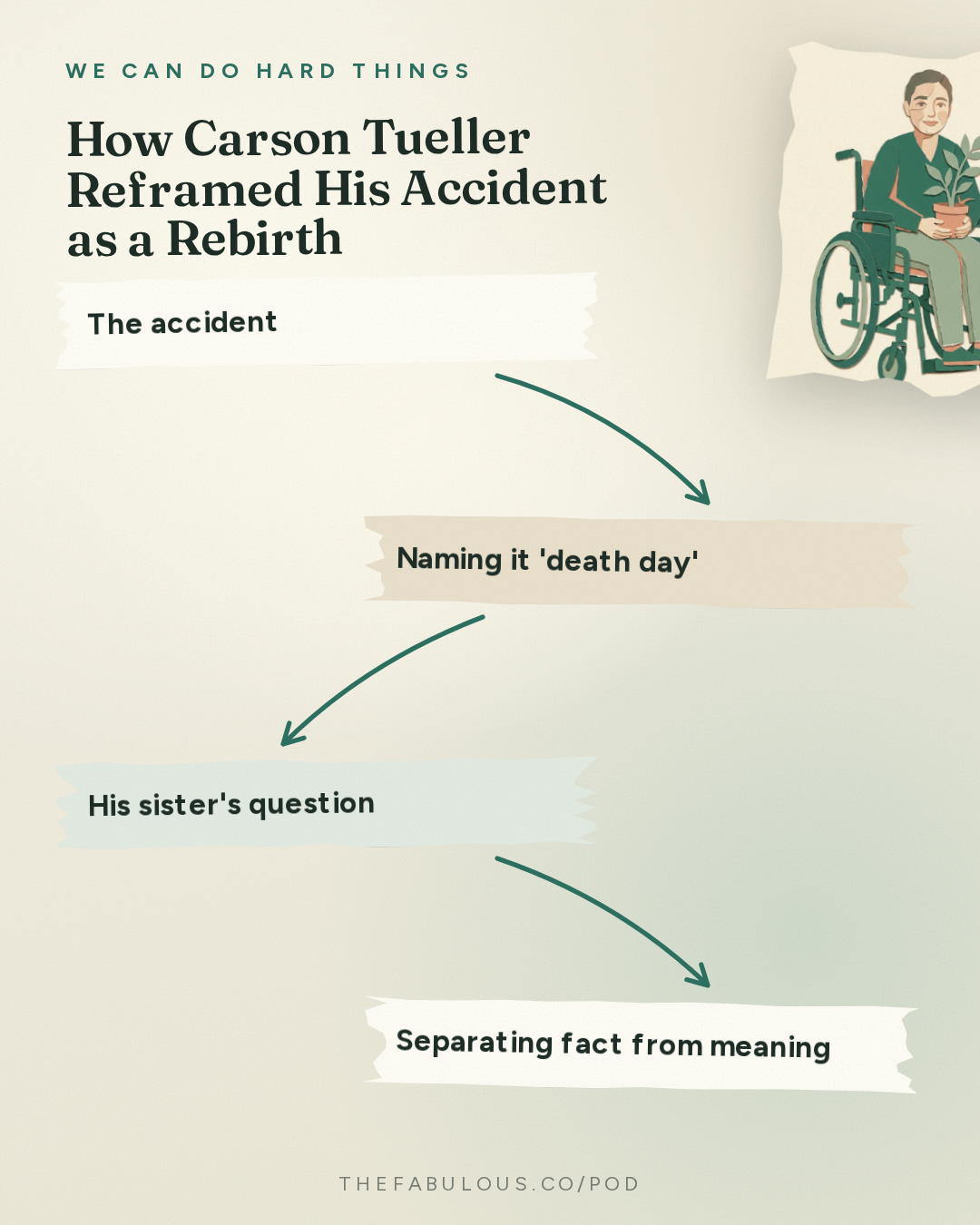
Carson Tueller on Ableism and the Social Model
(BEST OF) How to Really Believe Your Body is Good: Carson Tueller
▶ Listen to the full episode More from We Can Do Hard Things
The brief
Carson Tueller, paralyzed at 23 after a trampoline accident, argues that most of disability's suffering comes from ableism, not the body itself. He reframes his injury as a "rebirth," separates the social model of disability from the medical model, and explains why inspiration porn and scripted sex both keep people from their true, undamaged self.
There is a sound in this story that matters more than any metaphor: a small, soft "tss," like a pop, at the back of a skull. That is what disability coach and activist Carson Tueller heard when he overshot a foam pit at a trampoline park outside Salt Lake City and hit the ground headfirst (18:24). He was 23. He did not feel much pain, just a tweak. Then his body went silent, like a plug pulled from a wall. He called out to his father, who climbed into the pit and said only, "My boy. My boy." Lying there, Tueller had one clear thought: "I have people who love me. I have people I love, and that's all I need" (20:15). Peace arrived, and stayed, for a long time.
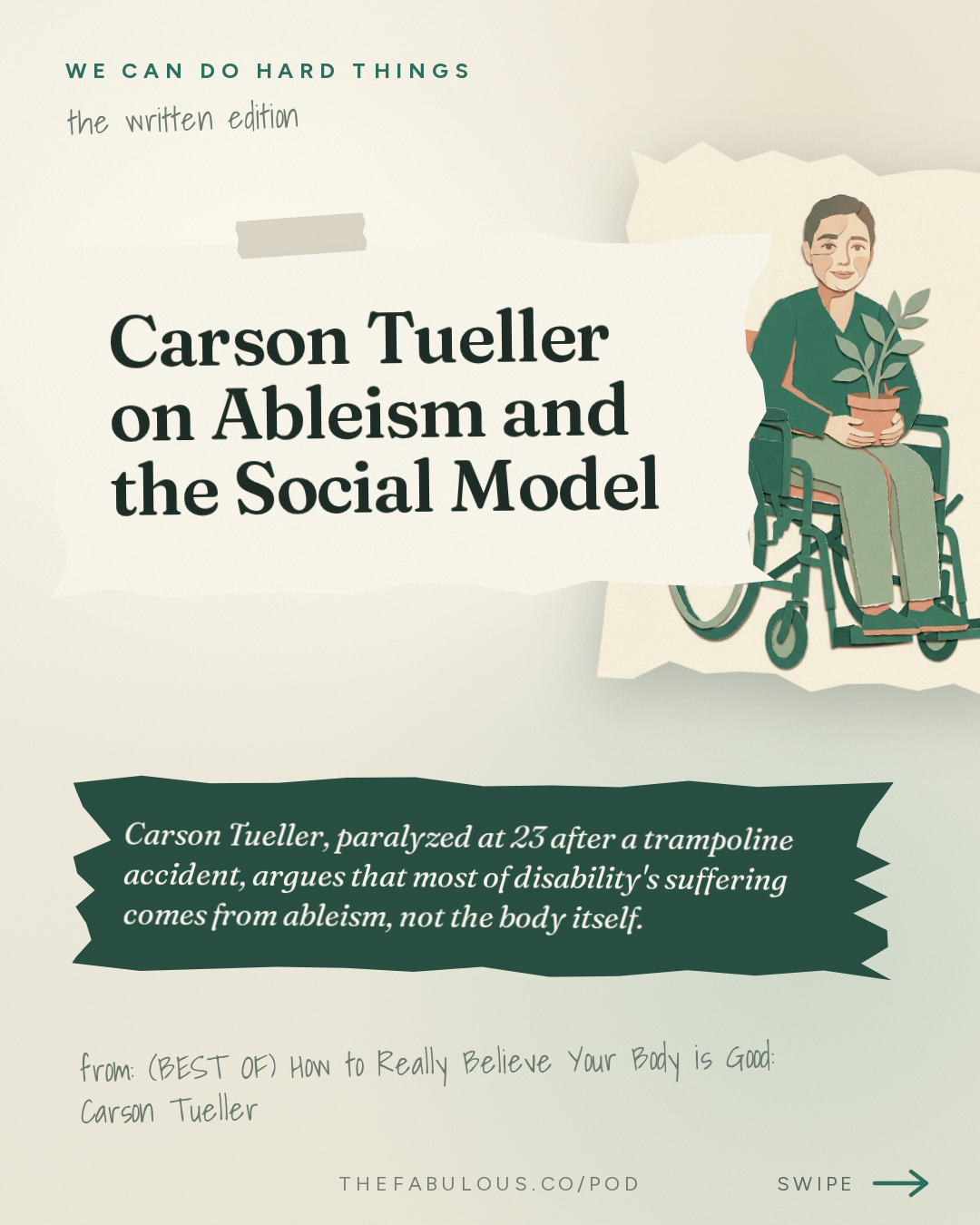
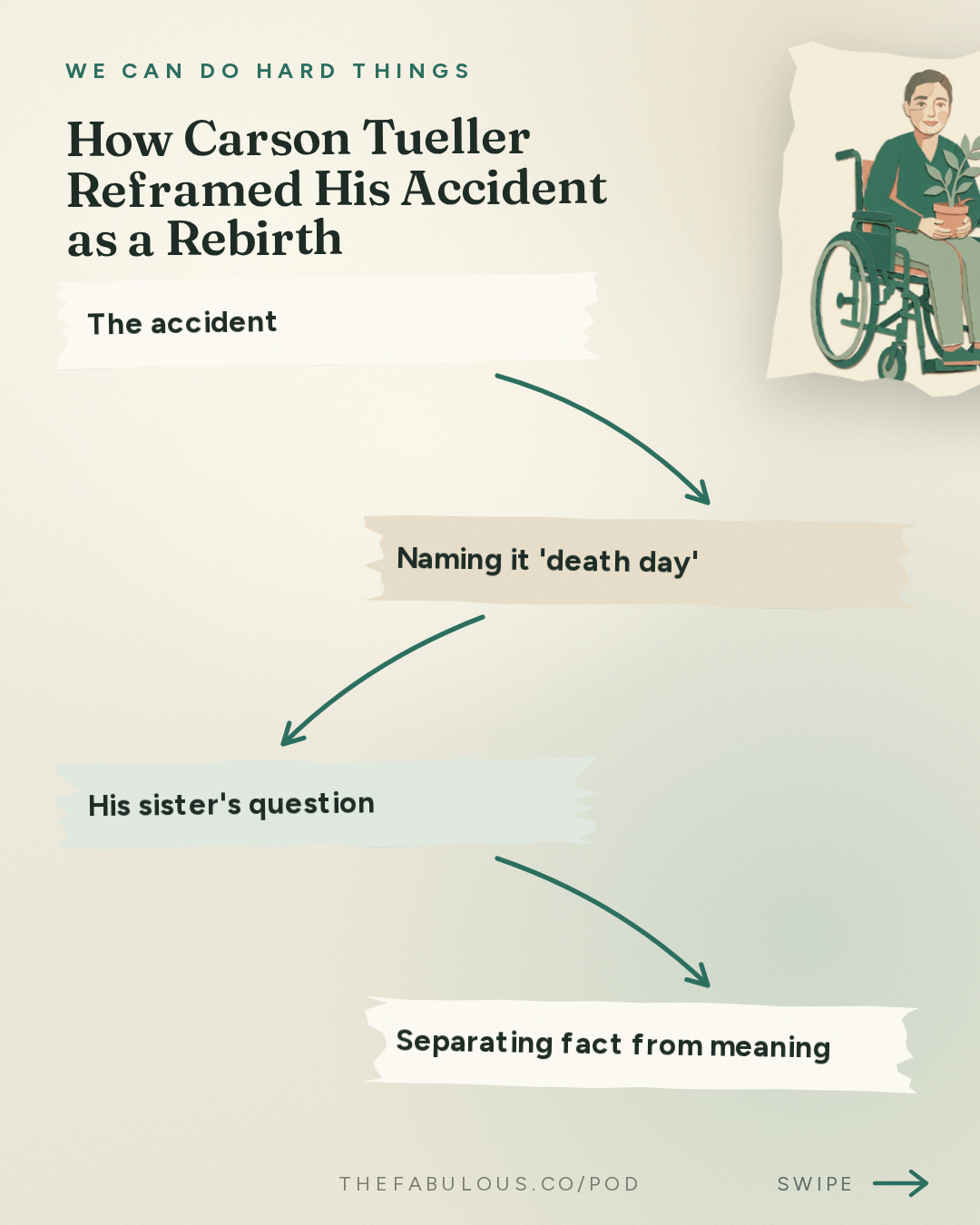
It did not stay forever. For years afterward he called that day his death day. Then, on June 16, 2018, his younger sister Kate, then 13, said something over pretzel bites at a strip mall that rearranged the whole story: "What if we call that the day of your rebirth?" (21:47). He argued with her in the car. By the time he got home, three hours later, he had landed on something closer to fact than feeling: the only thing that actually happened was that the bones in his neck moved and hit his spinal cord (22:35). Everything else, the drama, the tragedy, the sense of being broken, he had added. "I have added all the rest," he says. That line is the hinge of the whole conversation: the body does a thing, and a mind, trained by a culture, decides what that thing means.
Tueller had practiced this kind of separation before, in a much earlier chapter. He grew up a devout, queer Mormon, the kind of believer who memorized Galatians 5 and expected its "fruits of the spirit," peace and patience, to show up if he obeyed the rules (14:07). He tried, for a while, to be gay without being gay, a distinction he describes with some embarrassment now. What finally broke the spell was noticing that joy arrived, not when he suppressed himself, but when he stopped. That taught him to listen for a voice distinct from the one handing out verdicts about his worth. He names that voice the capital S self.
"I know that the capital S self, my self, will never tell me that I'm broken. That is always a message from something outside of me." — Carson Tueller [00:52]
That sentence is doing real work. It is not a mood. It is a method: when a thought arrives that says something is wrong with a body, the move is not to argue with the thought but to ask where it came from, because, Tueller insists, it never comes from the self.
Where Disability Actually Lives
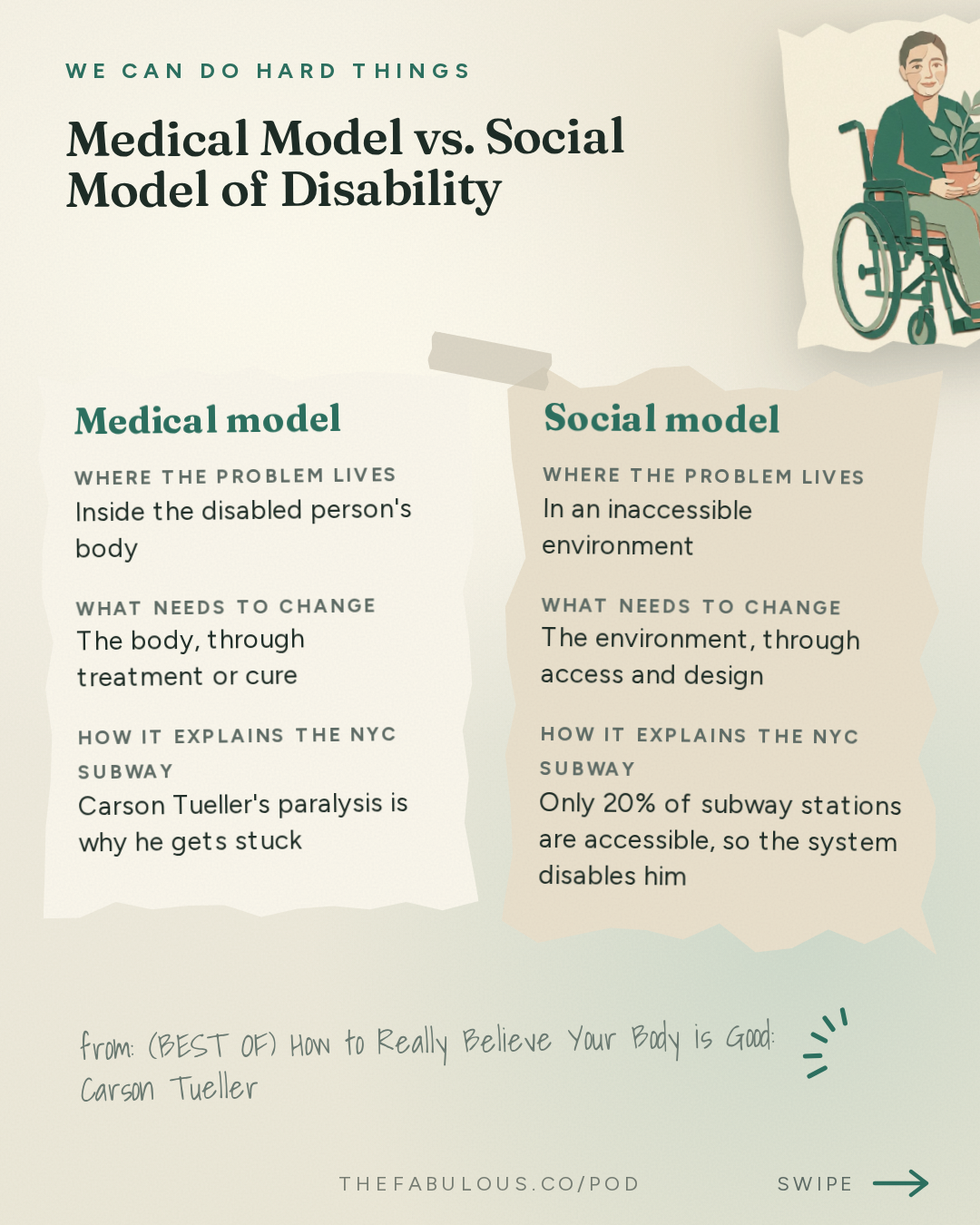
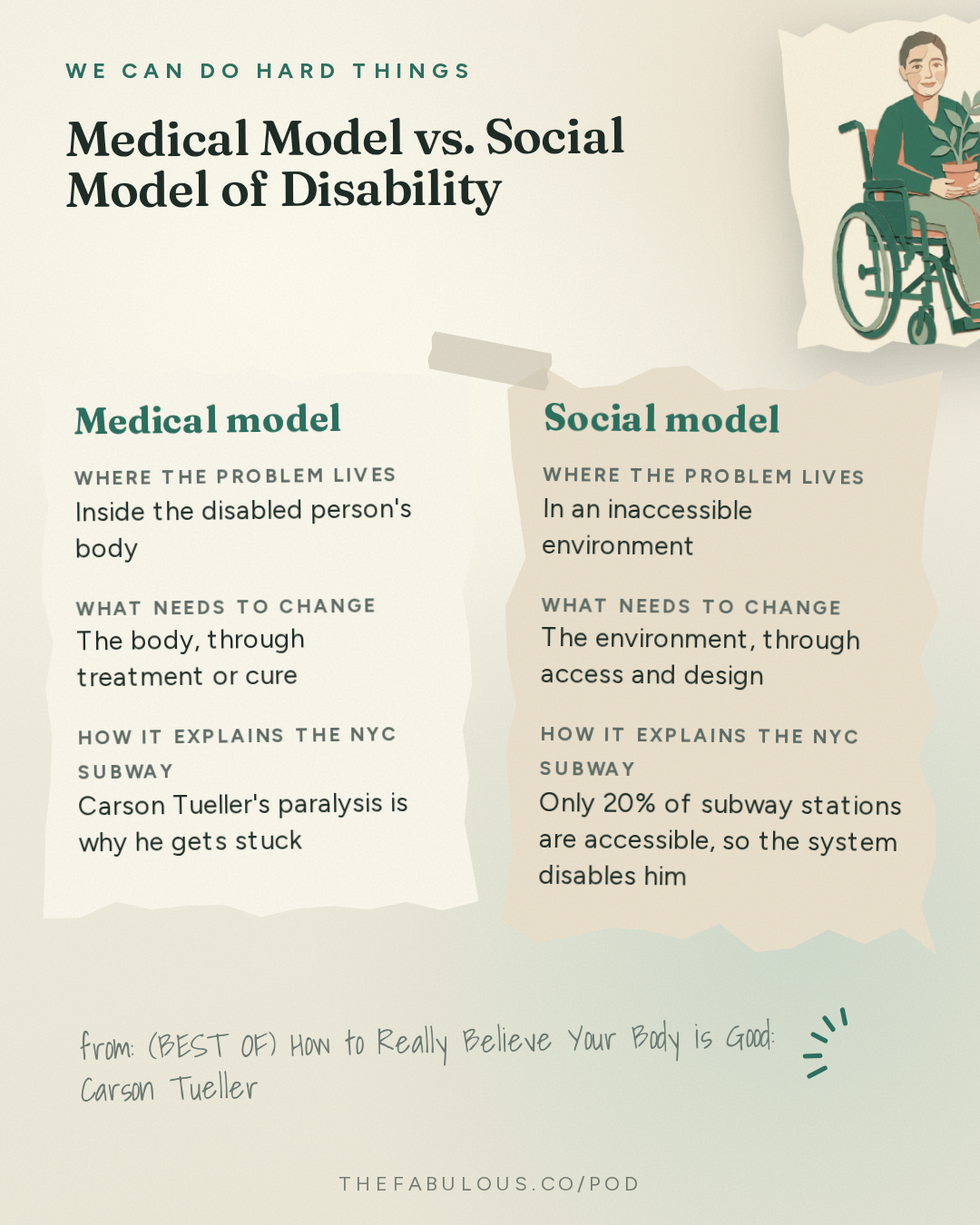
This is where the episode turns from memoir into argument, and the argument has a name: ableism, the belief that some bodies are the real, good, default ones and that disability is a broken version of that default (26:34). Tueller distinguishes two ways of thinking about it. The medical model says disability lives inside a person's body, something to be fixed. The social model says disability exists only in relation to an environment built without that body in mind (45:30). A wheelchair user is not disabled by stairs in the abstract; a building with no ramp disables them.
He has a blunt illustration. He lived in New York City for two years and found himself, he says, ten times more disabled there than in Utah (45:07), not because his spinal cord changed but because the city's infrastructure did not accommodate him: the subway system is only 20 percent accessible (43:11), and he and his boyfriend would be turned away from restaurant after restaurant for lack of room, sometimes still searching at midnight. He read Glennon Doyle's book Untamed while living there and landed on the verdict that stuck: "New York has not earned disabled people" (43:11). The phrase reverses the usual blame. The failure is not his body's; it is the city's design choices.
That reversal matters because of what it does to suffering. Tueller is careful to say that some pain is physical and real, chronic nerve pain, for instance, that does not disappear with better architecture. But he separates that from a second, larger category: the suffering that comes from feeling unworthy, unlovable, or broken, which he says is socially constructed, not a necessary consequence of paralysis (41:44).
"I can survive being paralyzed. I can't survive feeling unlovable." — Carson Tueller [40:25]
That second kind of suffering has a public face: inspiration porn, a term coined by the late Australian disability activist Stella Young. Tueller defines it as disabled people's bodies, stories, or ordinary activities being used by non-disabled people to feel inspired, or sometimes to feel pity, or to measure their own complaints against someone else's supposedly harder life (47:30). It looks like a compliment. It functions as a diagnosis, assigning tragedy to a life the speaker has not actually asked about. Tueller calls this "the miscategorization of disabled suffering" (48:53): when something is genuinely hard, like finding no gym equipment built for his body, people attribute the hardship to his body rather than to the ableist design around it.
Sex Without a Script
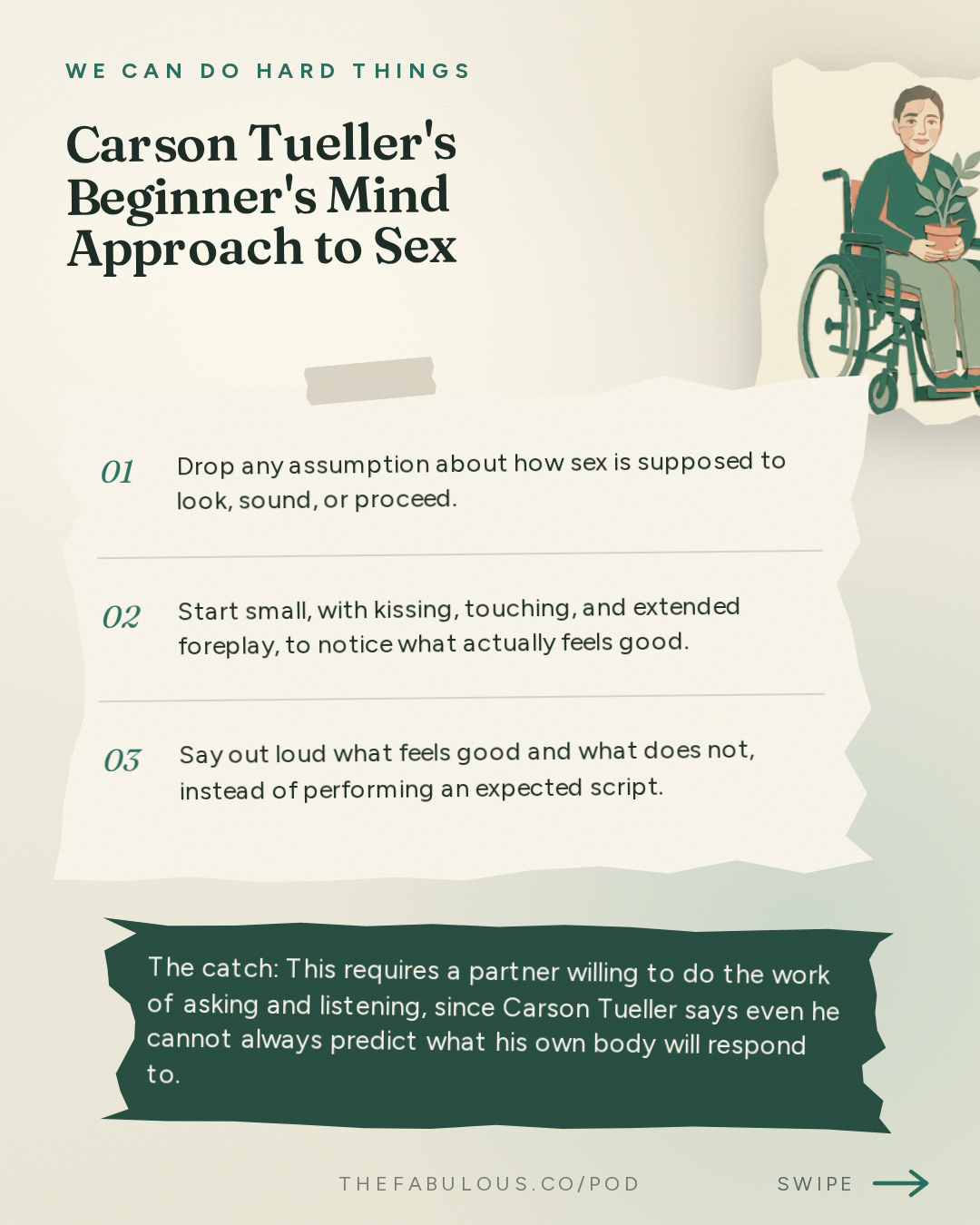
The same logic, strip away the inherited story and ask what is actually true, shows up again in how Tueller talks about sex. He had never had sex before his injury and had never watched pornography, a product of a devoutly observant upbringing. That left him, after paralysis, with no script at all for what his body could or should do (31:10). So he experimented slowly, with trusted partners, starting with kissing and touch and long stretches of what he calls foreplay, paying attention to what actually produced pleasure rather than performing what sex was supposed to look like. The result, he says, was orgasms that were more intense and repeatable than anything he experienced before his injury, and partners who told him it was the best sex they had ever had (34:14). His explanation is simple: no rules, no performance, no assumed roles, just constant, specific communication about what felt good (34:32). He calls it approaching sex with a beginner's mind, and argues that non-disabled people could have dramatically better sex if they adopted the same posture, dropping the comfortable mask of a scripted role in favor of saying, plainly, what they want.
That same unfinished, honest quality shows up when he talks about masculinity. He admits to a lingering, internalized belief that a man's worth is tied to physical capability, to what a body can do or protect (54:33). He traces it to a specific night, sitting in his mother's van in a dark parking lot, realizing that if something happened to her while she walked to the store, he could not get up to help (54:07). He does not resolve this tension so much as name it, which is consistent with everything else in the conversation: the goal is not arriving at a fixed, finished self-acceptance, but noticing the inherited story in real time and choosing not to obey it.
That is also his closing advice, offered not as a guru's secret but as an ongoing practice. Listen for the voice that is the self, distinct from the socialized shame layered on top of it, through therapy, coaching, or writing, and then try to live consistently with what it says (57:31). He is not claiming he has stopped visiting what he calls the haunted house, the recurring return to grief, anger, and old doubts about his body. He says he still goes there, sometimes for weeks at a stretch (05:56). The freedom he describes is smaller and more durable than permanent peace: knowing, once inside the haunted house, how to find the door back out.
Ask this episode anything
Pod's AI answers from the episode itself, with the minute mark so you can hear it yourself.
Or start with one of these
Ask this episode
Pod's AI listens to the whole episode to answer, and points you to the minute it comes from.
The rest of this answer, and any question after it
Answers come from the episode itself, never from a summary of it.
ContinueKey takeaways
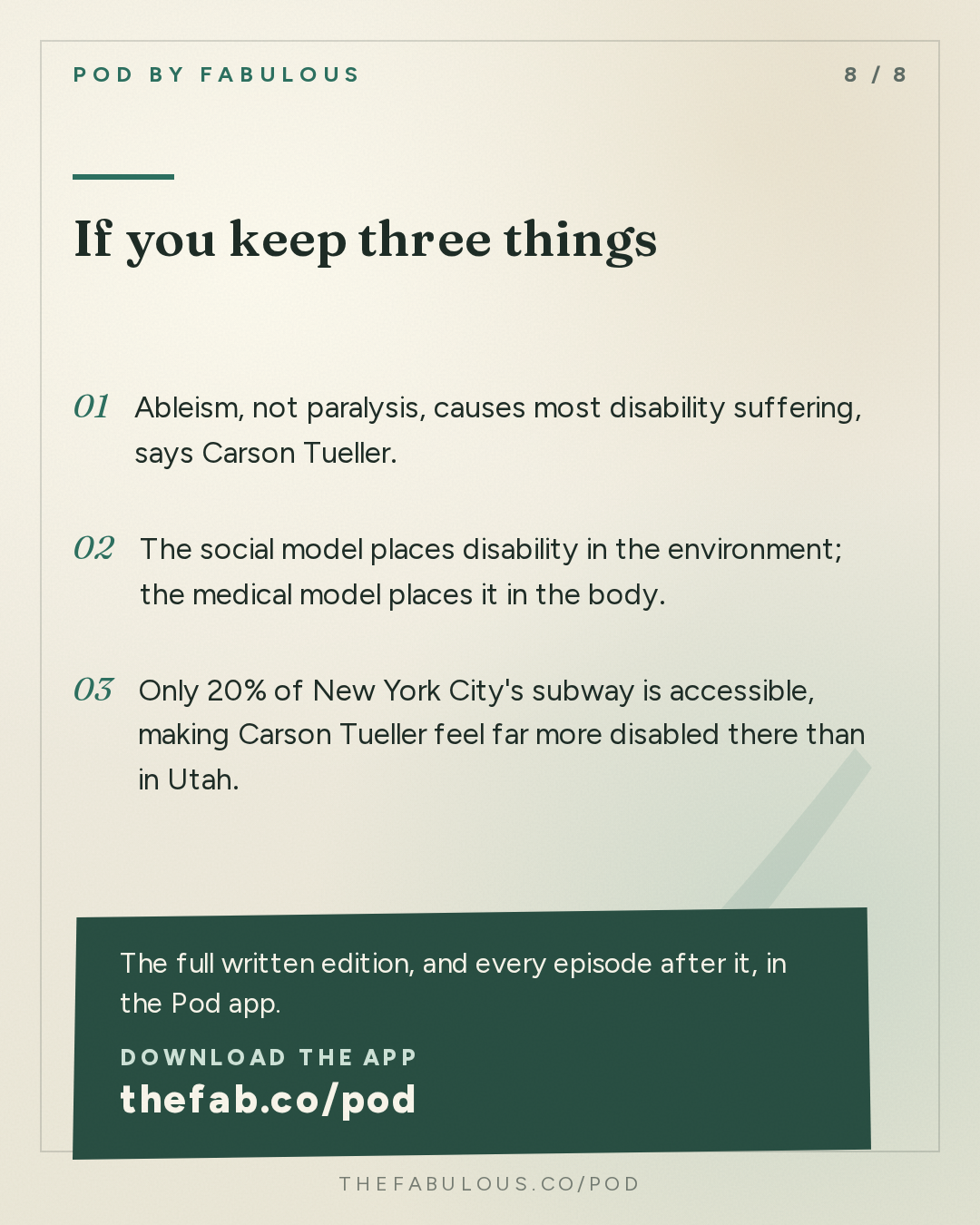
- Ableism, not paralysis, causes most disability suffering, says Carson Tueller.
- The social model places disability in the environment; the medical model places it in the body.
- Only 20% of New York City's subway is accessible, making Carson Tueller feel far more disabled there than in Utah.
- Australian activist Stella Young coined 'inspiration porn' for using disabled lives to comfort non-disabled viewers.
- Carson Tueller reframed his accident as a 'rebirth' after his 13-year-old sister suggested the term in 2018.
The episode in cards
By the numbers
- 23 years Carson Tueller's age when a trampoline accident paralyzed him from the chest down
- 20% percent share of New York City's subway system that is wheelchair accessible
In their words
“I know that the capital S self, my self, will never tell me that I'm broken. That is always a message from something outside of me.”
“I can survive being paralyzed. I can't survive feeling unlovable.”
“New York has not earned disabled people.”
“The social model says disability only exists, uh, in relationship to its environment.”
Protocols
-
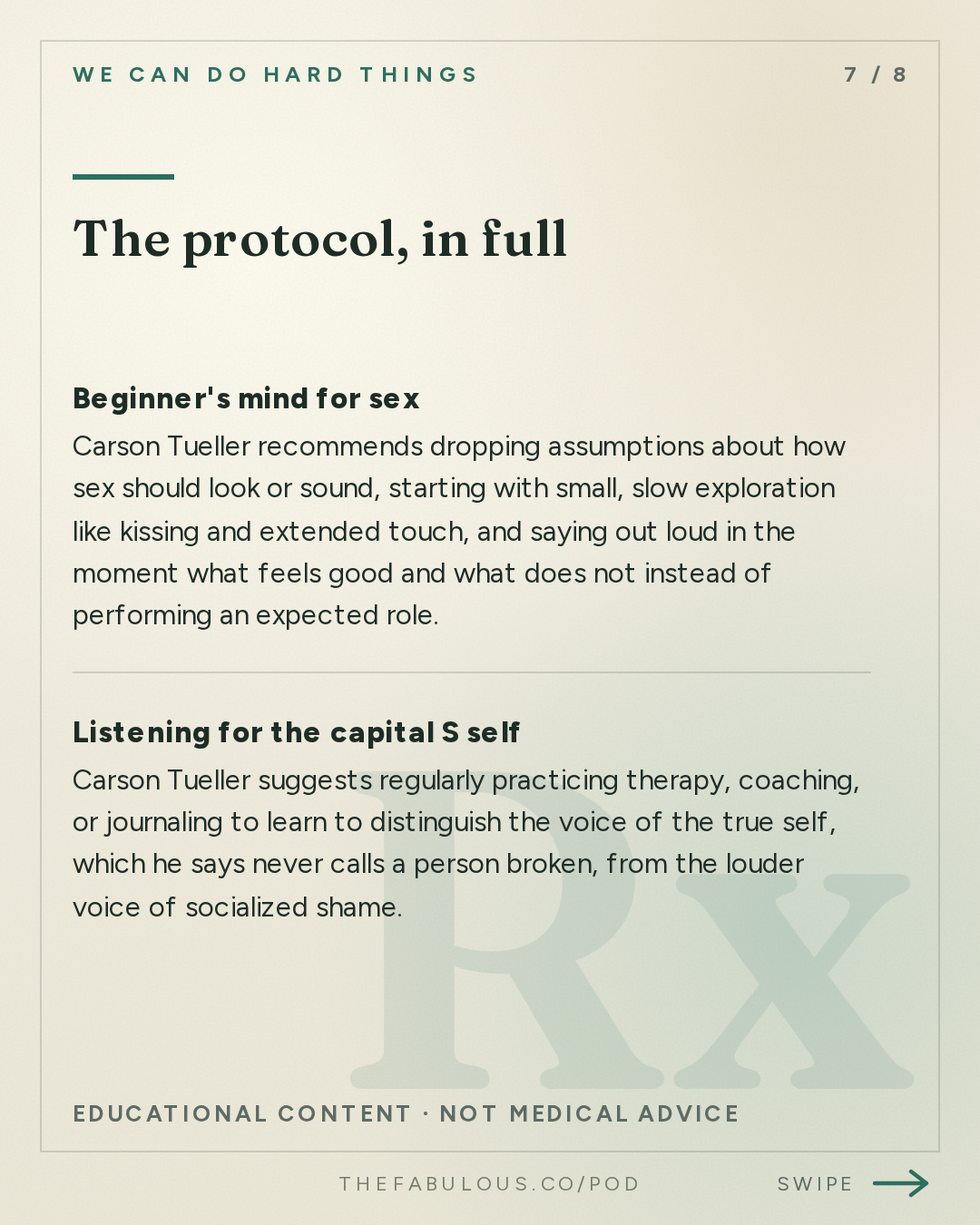
Beginner's mind for sex
Carson Tueller recommends dropping assumptions about how sex should look or sound, starting with small, slow exploration like kissing and extended touch, and saying out loud in the moment what feels good and what does not instead of performing an expected role.
Every encounter, since Tueller says what works for his body is not always predictable from one time to the next
-
Listening for the capital S self
Carson Tueller suggests regularly practicing therapy, coaching, or journaling to learn to distinguish the voice of the true self, which he says never calls a person broken, from the louder voice of socialized shame.
Ongoing practice, not a one-time fix
Questions this episode answers
What is the social model of disability?
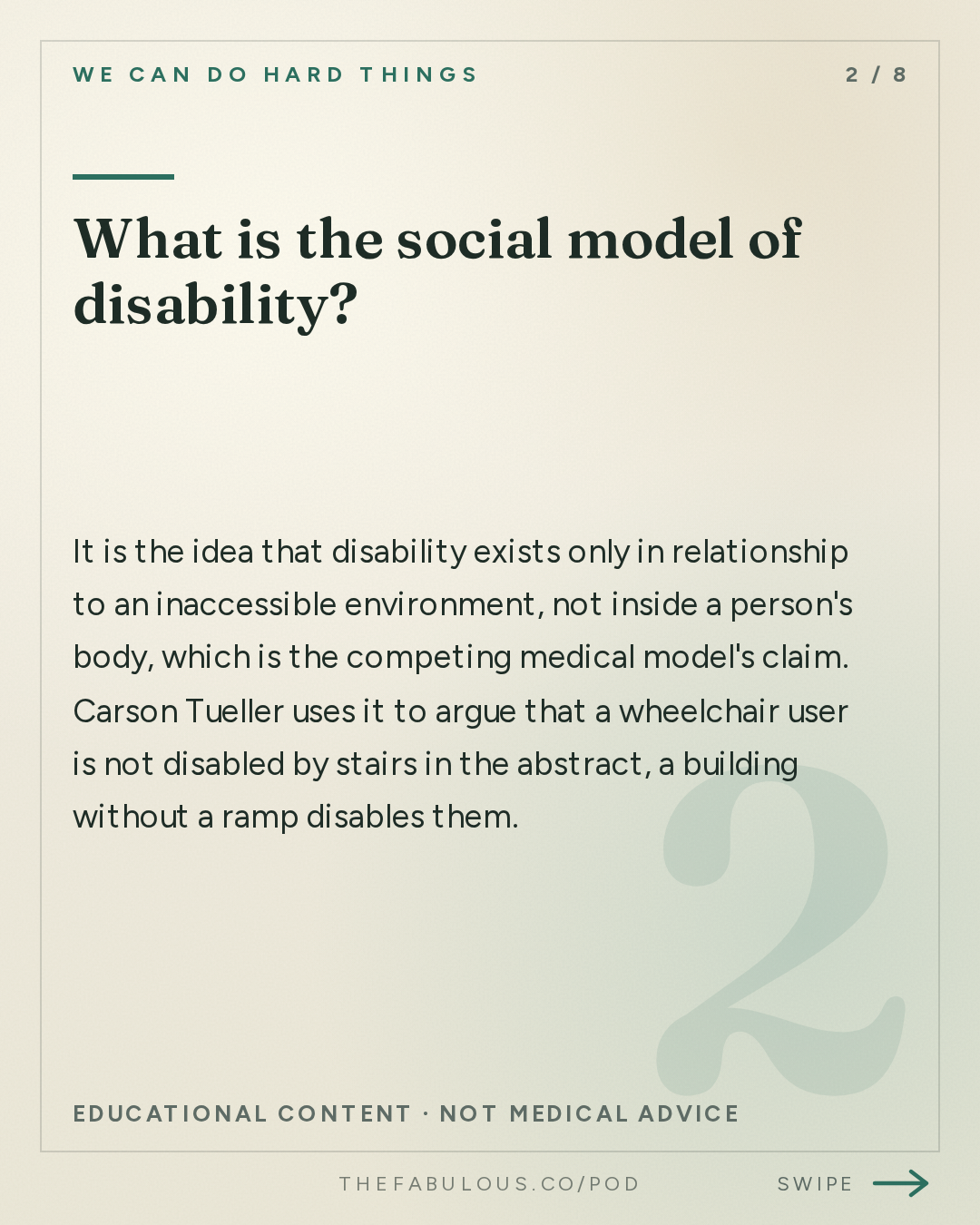
It is the idea that disability exists only in relationship to an inaccessible environment, not inside a person's body, which is the competing medical model's claim (45:30). Carson Tueller uses it to argue that a wheelchair user is not disabled by stairs in the abstract, a building without a ramp disables them.
What is inspiration porn?
It is a term coined by Australian disability activist Stella Young for using disabled people's bodies, stories, or ordinary activities to make non-disabled viewers feel inspired or grateful for their own lives (47:30). Carson Tueller says it feels like a compliment but functions as pity, since it assumes a disabled life is hard without ever asking the person.
How accessible is the New York City subway?
Carson Tueller states that only 20% of the New York City subway system is accessible (43:11). He uses this figure, along with being repeatedly turned away from restaurants, to explain why he felt about ten times more disabled living in New York than in Utah (45:07).
What is Carson Tueller's 'rebirth' reframe of his accident?
After years of calling his 2013 trampoline accident his 'death day,' Carson Tueller's then 13-year-old sister Kate suggested calling it his rebirth instead on June 16, 2018 (21:47). Over the following hours he concluded the only thing that actually happened was that bones in his neck moved and hit his spinal cord, and that every other meaning, including brokenness, was something he had added (22:35).
How does Carson Tueller approach sex as a disabled person?
He describes approaching sex with a 'beginner's mind,' with no inherited script for how it should look or sound, since he had never had sex or watched pornography before his injury (31:10). He says this led to more intense, repeatable pleasure because it required constant, specific communication about what actually felt good rather than performing an expected role (34:32).
The full read, in cards
Go deeper
- Untamed — Glennon Doyle's memoir that Carson Tueller was reading when he concluded New York City had not built space for disabled people
Mentioned
Carson Tueller · Glennon Doyle · Alok · Stella Young · Mormon Church · Untamed
More from this show and category

Breast Density and Mammogram Blind Spots Explained
Breast surgeon Lucy de la Cruz explains how dense breast tissue hides cancer from mammograms and what surgical choices patients are rarely offered. Georgetown University Hospital's de la Cruz covers density categories, lumpectomy versus mastectomy recurrence odds, direct-to-implant reconstruction, and nerve grafts that restore nipple sensation within one to two years.
Why Date Nights Don't Work for Long-Term Couples
Date nights often fail because couples already know each other too well; novelty, not dinner reservations, revives connection. A study of 53 couples found exciting activities beat pleasant ones for marital satisfaction (10:16). The hosts suggest parallel play over face-to-face talk (24:26) and a date bowl to end decision fatigue (47:07).

Jordan Neely, Daniel Penny, and a Divided America
A six-minute subway encounter between Jordan Neely, a homeless man in mental crisis, and Daniel Penny, a former Marine, became a national Rorschach test. Journalist Anand Giridharadas argues both sides share the same wound: a feeling of being abandoned by every system meant to help them.

Cher's Life Advice on Love, Money, and Leaving
Cher tells the hosts of We Can Do Hard Things how she survived a controlling marriage to Sonny Bono and chose to leave instead of ending her life. She describes losing all ownership of Cher Enterprises, advice from Lucille Ball, and the bumper car philosophy that carried her through decades of setbacks.
