
Why Fraternities Are Toxic for Sons
How Fraternities Poison Our Sons: What Loving Them Demands of Us
▶ Listen to the full episode More from We Can Do Hard Things
The brief
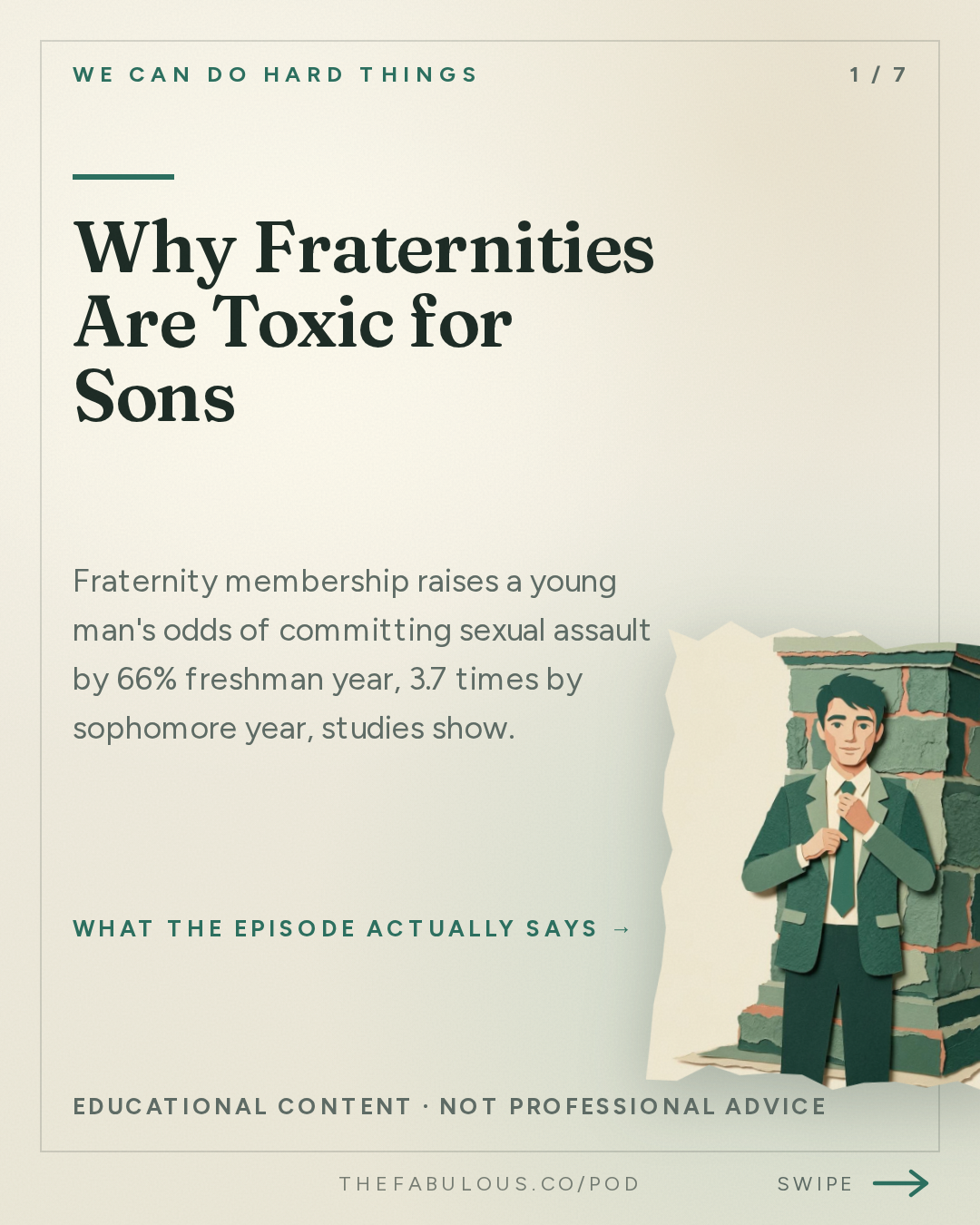
Fraternity membership raises a young man's odds of committing sexual assault by 66% freshman year, 3.7 times by sophomore year, studies show. The episode argues this isn't about bad apples: two centuries of secrecy, university financial backing, and hazing rituals train ordinary pledges to treat boundary violation as proof of manhood.
There is a strange kind of honesty in an actuarial table. The multi-billion-dollar insurance industry has no opinion about patriarchy or dignity. It only prices risk. And when it prices the risk of a fraternity house, it ranks that risk just below a toxic waste dump.
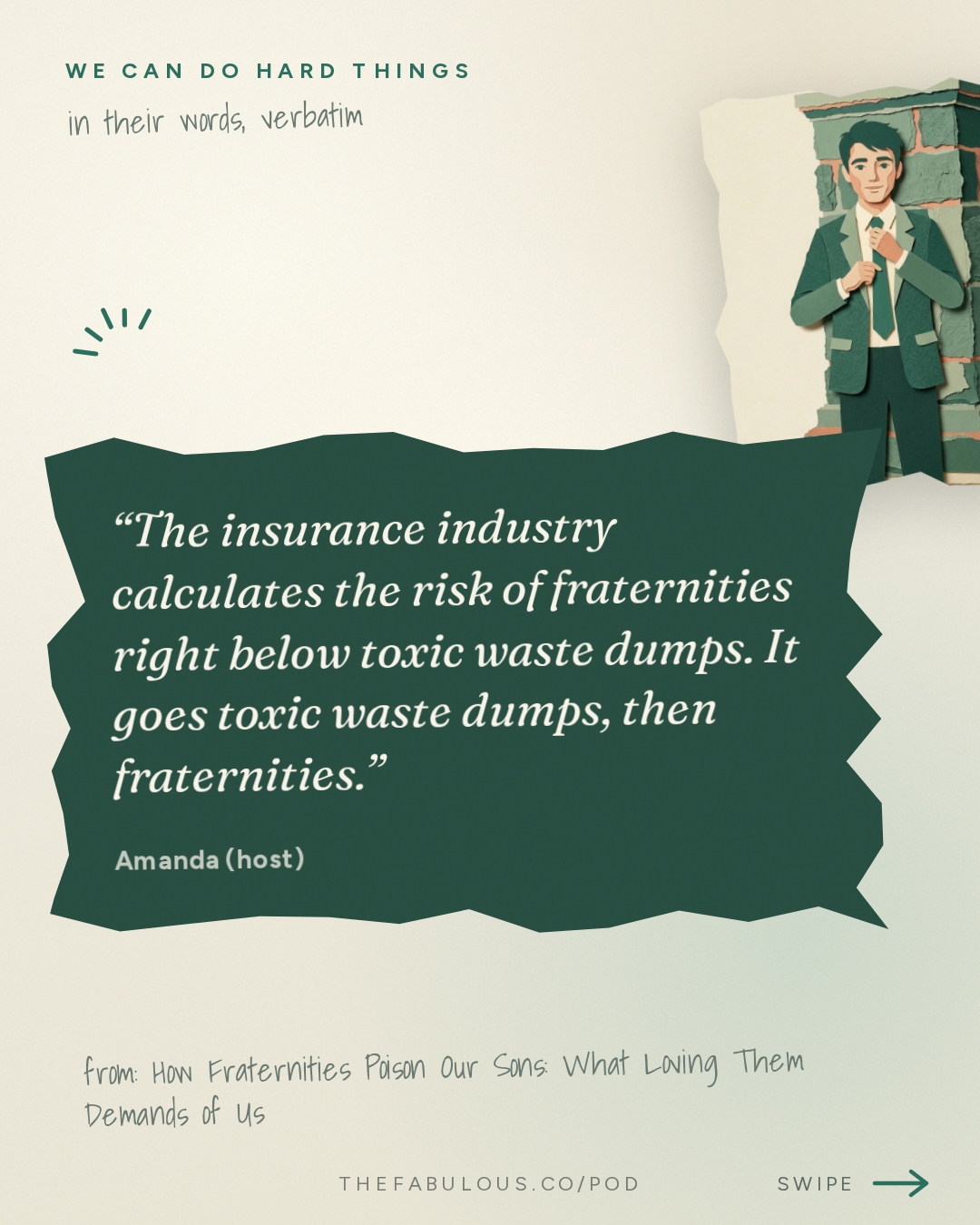
"The insurance industry calculates the risk of fraternities right below toxic waste dumps. It goes toxic waste dumps, then fraternities." — Amanda, host [02:53]
That ranking is not moral. It is built from claims data: reckless drinking, deadly hazing, fires, injuries, and sexual assault. Parents who would never let a son swim in contaminated water still send him, for four years and often half a million dollars, into an institution the market itself treats as more dangerous than chemical sludge.
The easy story about fraternities is that some fraternity men are predators and most are not, and the job of a parent or a campus is to sort one from the other. The data says this story is a comfortable lie. Men in fraternities are nearly three times more likely to commit sexual assault than men who are not in fraternities (06:00). More specifically, a study that tracked young men from before college, controlling for their prior sexual aggression and drinking habits, found that joining a fraternity raised a freshman's odds of committing assault by 66 percent (06:41). By the end of sophomore year, the same young man is 3.7 times more likely to have committed assault than if he had never joined (06:58). Same history, same risk factors on paper, different outcome. The variable is the house.
"It's not that one's a monster and one is a good guy. They are the same guy... The only difference was the fraternity." — Amanda, host [07:09]
A Two-Hundred-Year Habit of Breaking Rules
To understand why the house matters this much, it helps to know what the house was built for. Historian Nicholas Syrett's book, The Company He Keeps: A History of White College Fraternities, traces the origin of historically white fraternities to the early 1800s, when American colleges policed nearly every hour of a young man's day (10:42). Secret societies, including the Kappa Alpha Society at Union College, founded in 1925 as the oldest surviving social fraternity of its kind, gave students a way to escape faculty control: private rituals, passwords, and a claim to make their own rules.
That claim survived. The colleges eventually backed down. And when, over the following century, women, Black students, and Jewish students fought their way into those same institutions, the fraternities did not loosen their grip, they tightened it. A 1949 report found that 20 of 52 Greek-letter organizations at the University of Wisconsin-Madison had explicit written clauses barring non-white members (14:11). The pattern repeated at Dartmouth and elsewhere, often outlasting the formal end of such clauses by years. The episode draws a clear line between this history and that of historically Black fraternities such as Alpha Phi Alpha, founded at Cornell University in 1906 by seven Black students building mutual support in the face of exclusion, a fundamentally different origin story (09:49).
What began as a fight for freedom from authority became, for historically white fraternities, a fight to protect exclusivity once the university itself became more open. Universities, meanwhile, stopped merely tolerating these organizations and started investing in them: campus housing privileges, professional staff who help run recruitment, marketing channels, and the general borrowed prestige of the university's name (16:39). Fraternities also receive federal income tax breaks as 501 tax-exempt social clubs (18:03). The boys who founded these societies wanted adults to leave them alone. Two centuries later, the adults are actively keeping the system running.
This institutional backing matters because it changes where responsibility sits. Sexual assault carries exactly one person's personal responsibility, the person who commits it. But an environment that is financially and institutionally propped up by adults carries institutional responsibility too, and the episode insists that parents and universities share in that, not instead of holding individuals accountable, but alongside it.
What the Ritual Teaches
The deeper mechanism is psychological, and it starts with something researchers call masculine discrepancy stress: the anxiety a man feels when he believes he is falling short of his culture's standard for manhood, combined with distress about that shortfall. In a large study of American men, those who reported this distress were 2.7 times more likely to engage in violence, including sexual assault (28:01). Falling short isn't the danger by itself. Feeling tormented by it is.
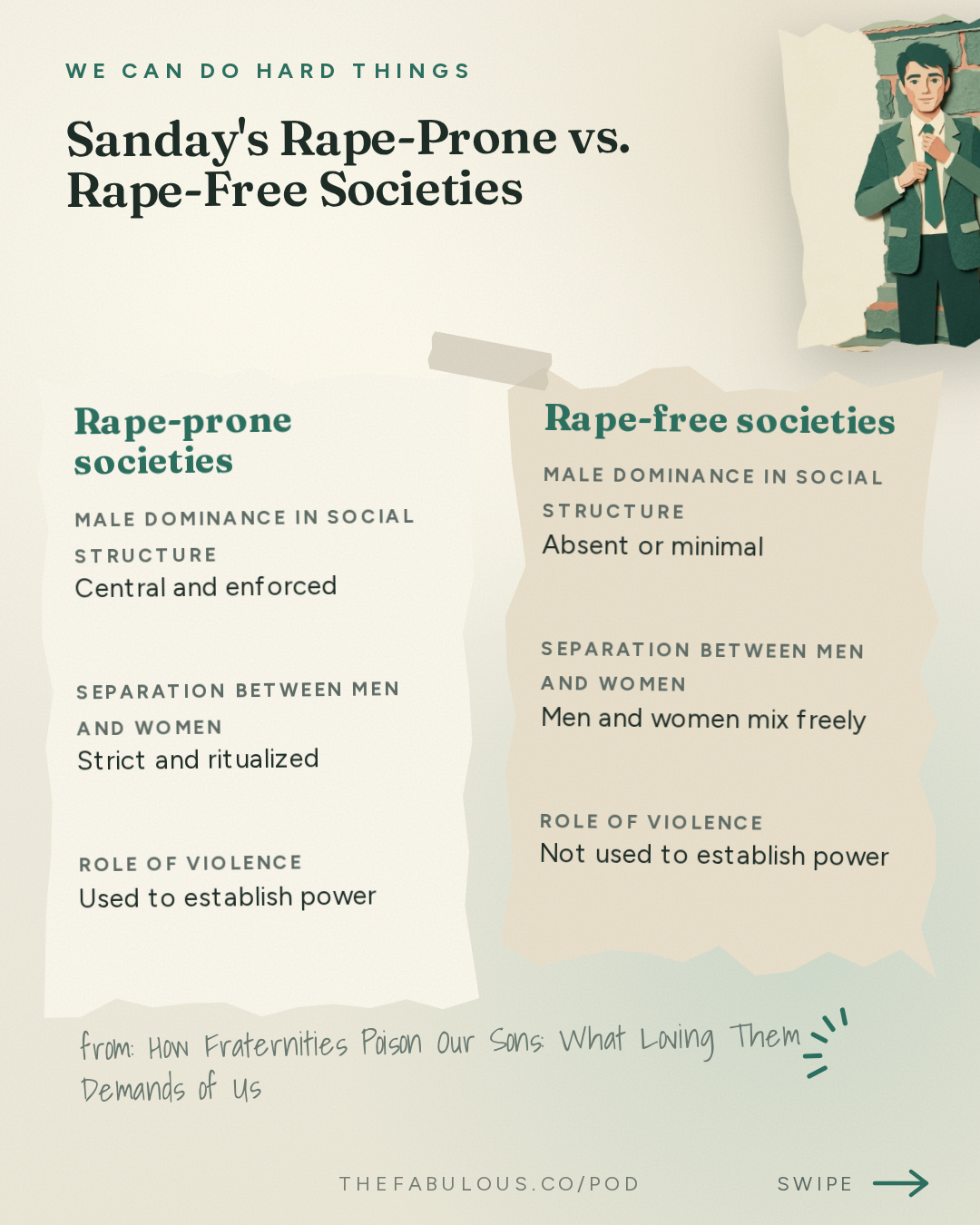
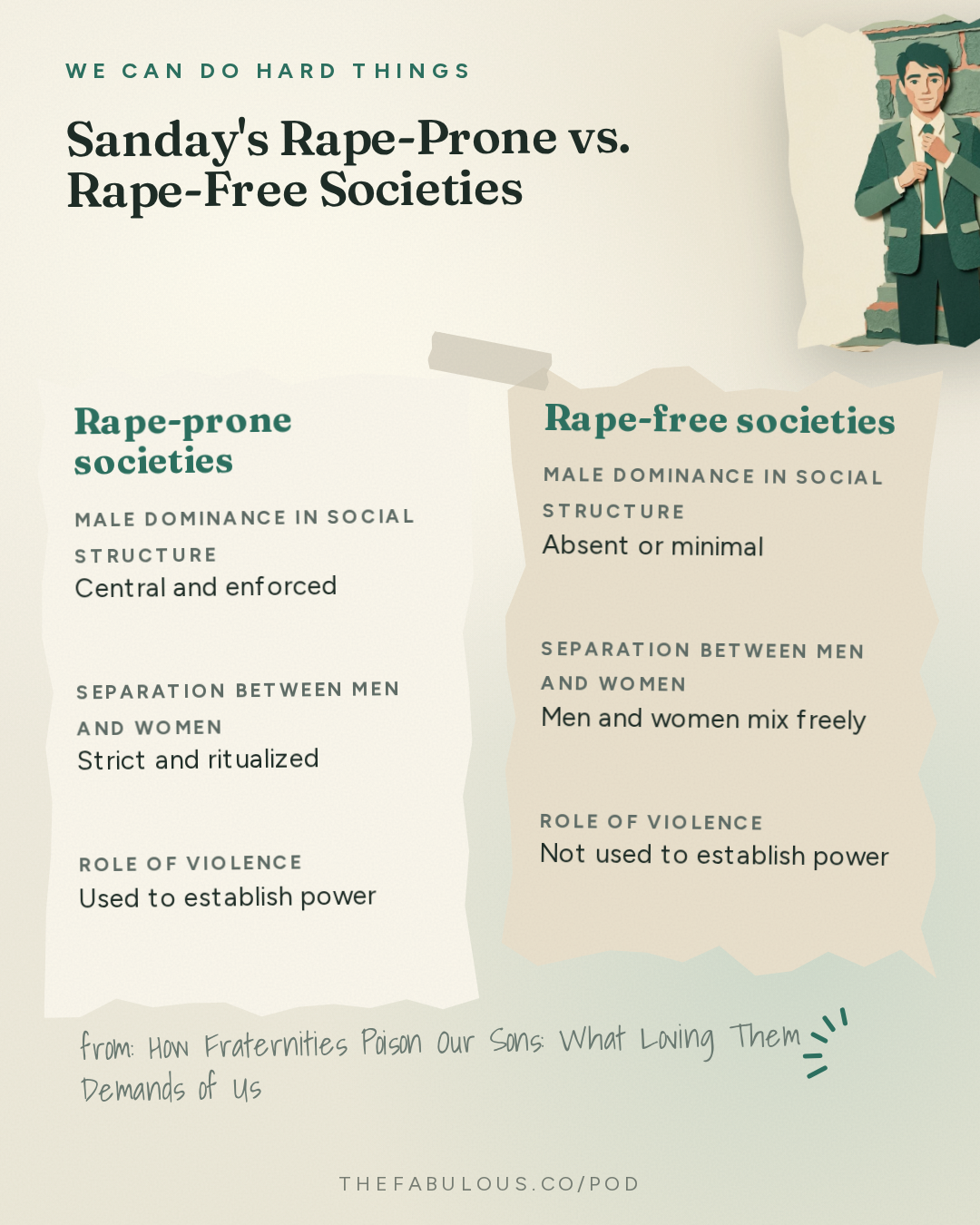
Decades earlier, anthropologist Peggy Reeves Sanday had already mapped this territory from a different angle. Studying 95 societies worldwide, she classified 47 percent as rape-free, meaning sexual violence was rare or strongly condemned, and 18 percent as rape-prone, meaning assault was common and culturally tolerated (28:44). Rape-prone societies shared four traits: male dominance, strict separation between men and women, violence used to establish power, and constant pressure on men to prove their masculinity (29:01). When Sanday turned to American fraternities in 1990, she found the same four traits reproduced inside the houses, not because the men were naturally violent, but because the culture taught them that violence was how status and belonging worked.
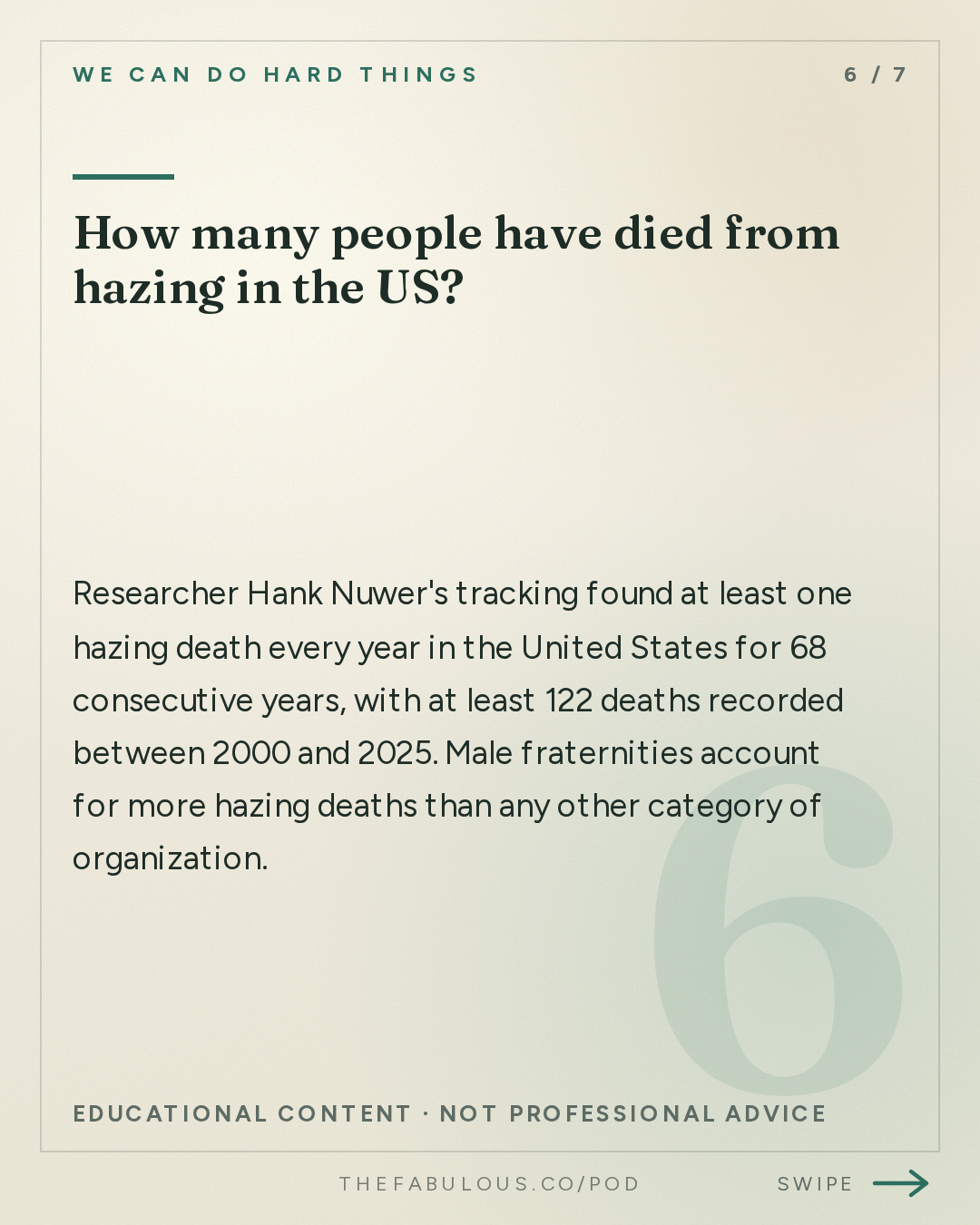
Hazing is the delivery mechanism for that lesson. It is not a regrettable detour on the way to real brotherhood, it is the training itself. Pledges endure months of ritualized humiliation, forced consumption, sleep deprivation, and staged violence to prove they will submit before they are allowed to belong. More than 95 percent of hazed students never report it to campus officials (36:36). Researcher Hank Nuwer, who has spent decades tracking hazing deaths, found that male fraternities account for more hazing deaths than any other category of organization, with at least one hazing death occurring every year in the United States for 68 consecutive years, and at least 122 deaths between 2000 and 2025 (39:41). A lawsuit described by journalist Anne Helen Petersen details one survivor, a University of Alabama pledge identified as H.B., who was beaten by six fraternity brothers and later suffered a traumatic brain injury during a pledge exercise (37:06).
One documented initiation ritual in Sanday's research has pledges doused in a mixture of feces and water, forced into coffins lowered into the floor, and told, as the coffins close, that the men must first kill "the woman" inside themselves to become brothers (41:07). Whatever that phrase is meant to mean, its function is plain: it teaches that manhood requires surrendering tenderness, limits, and the instinct to say no, then rewards the survivor with power over the next pledge.
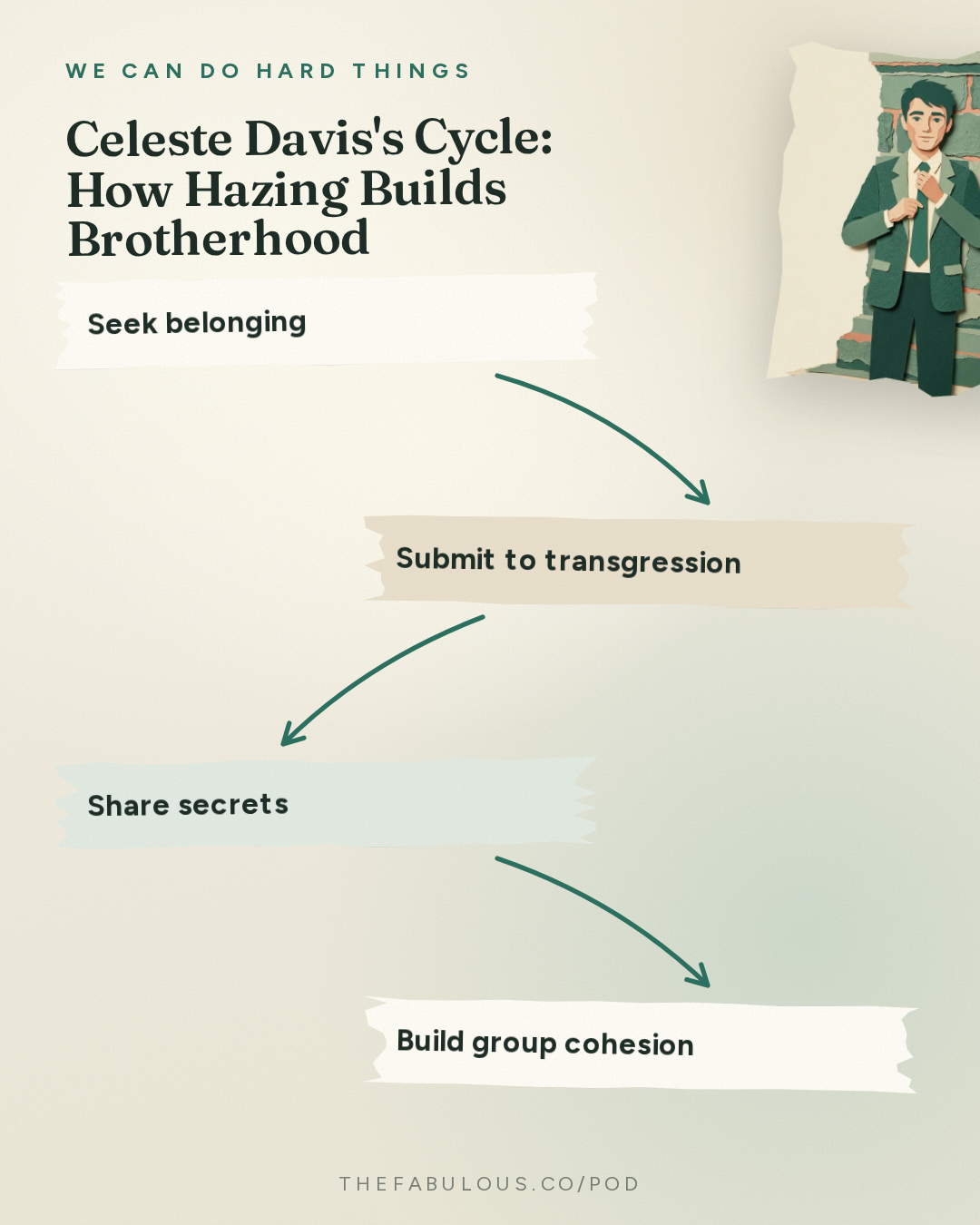
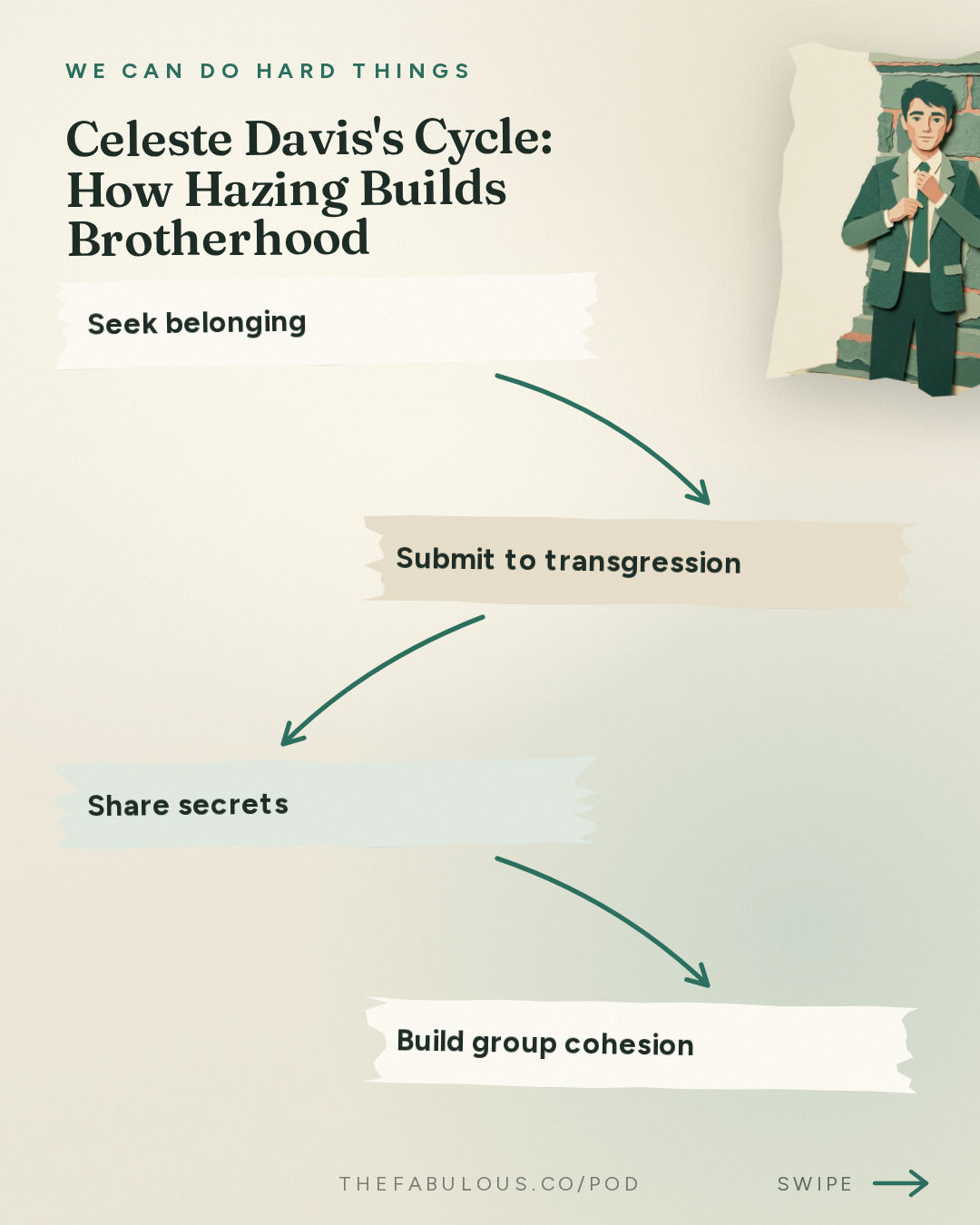
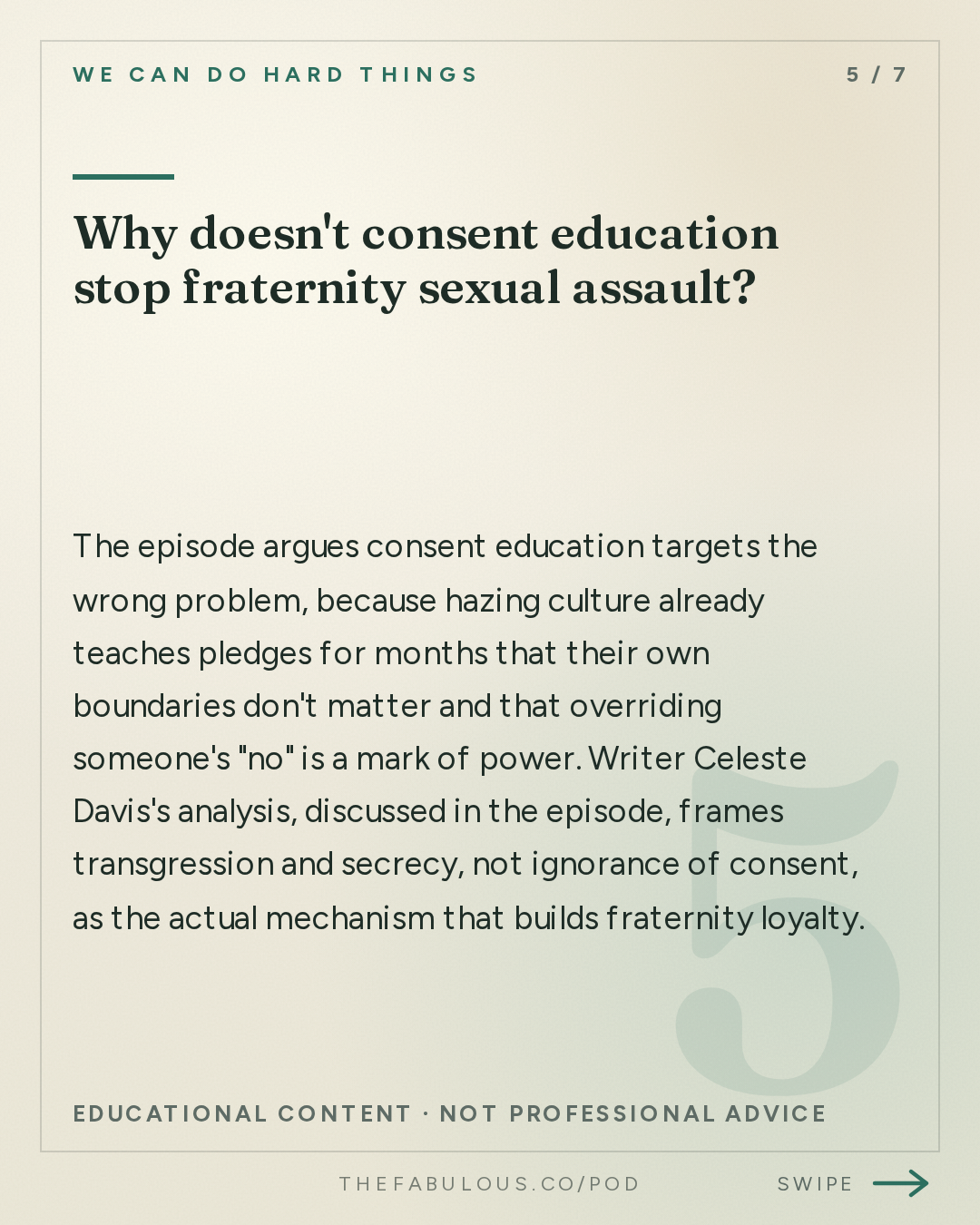
This explains, the episode argues, why consent education keeps failing in this environment. A young man who has spent three months learning that his own boundaries do not matter is not confused about what consent means. He has learned a different lesson entirely: that overriding someone's boundary, and keeping that secret with other men, is the actual mechanism of belonging.
"Transgression is both the draw and the glue." — Celeste Davis, as cited in the episode [47:10]
Writer Bess Kalb put the same point more bluntly after the 2024 Cornell Chi Phi text-thread scandal, in which 57 fraternity brothers received a group message advertising coerced sex.
"If your son finds himself in a group that would send a Free Pussy text, it's too late. The group is the disease. The text is the symptom." — Bess Kalb, quoted in the episode [23:18]
None of this argues for less brotherhood. It argues for a different kind: one where belonging does not require humiliating someone else first. The hardest sentence in the whole hour may be the simplest one: the question is not whether parents love their sons enough to want them safe. Of course they do. The question is whether they are willing to look directly at an institution that keeps insisting their sons belong inside toxic waste.
Ask this episode anything
Pod's AI answers from the episode itself, with the minute mark so you can hear it yourself.
Or start with one of these
Ask this episode
Pod's AI listens to the whole episode to answer, and points you to the minute it comes from.
The rest of this answer, and any question after it
Answers come from the episode itself, never from a summary of it.
ContinueKey takeaways
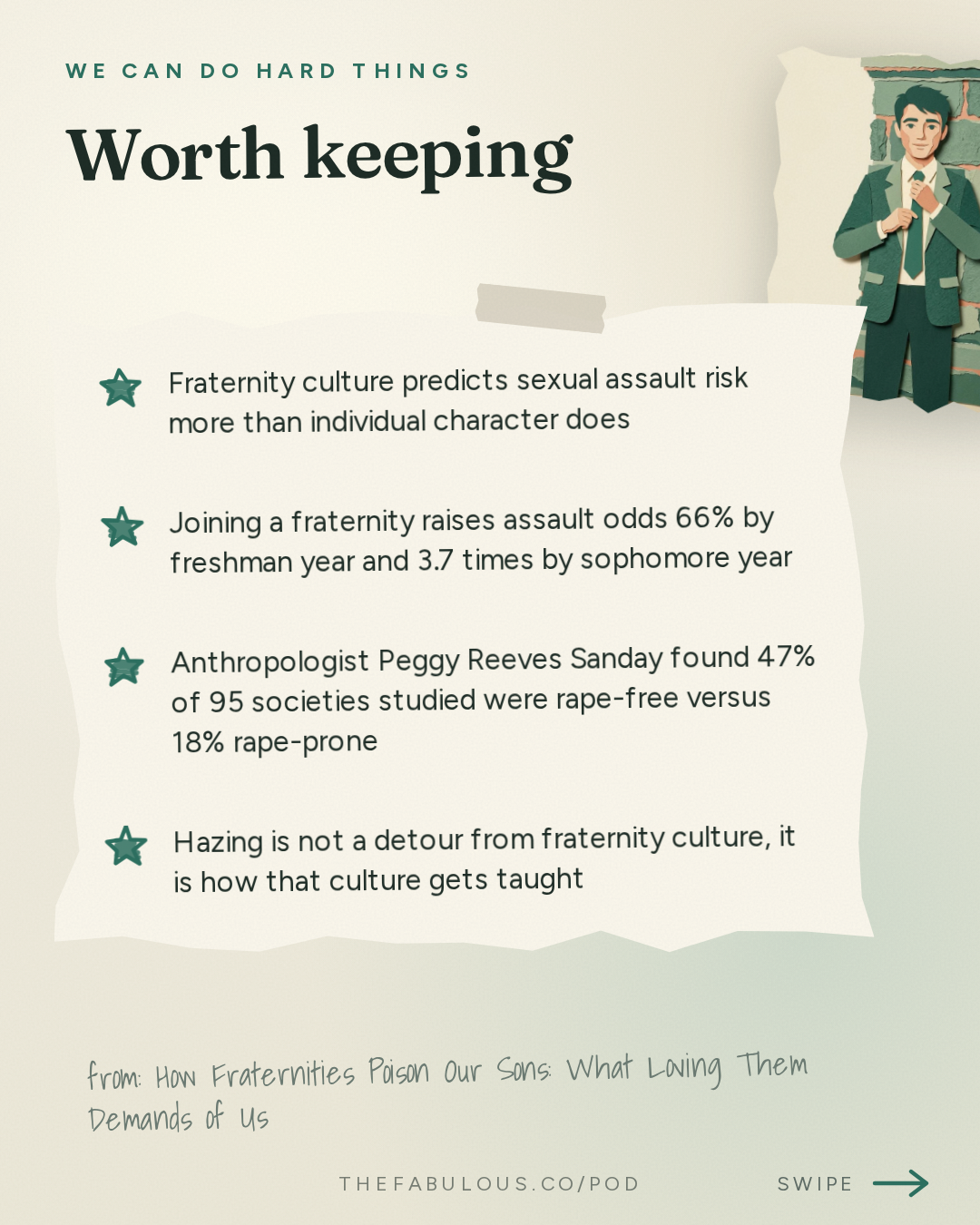
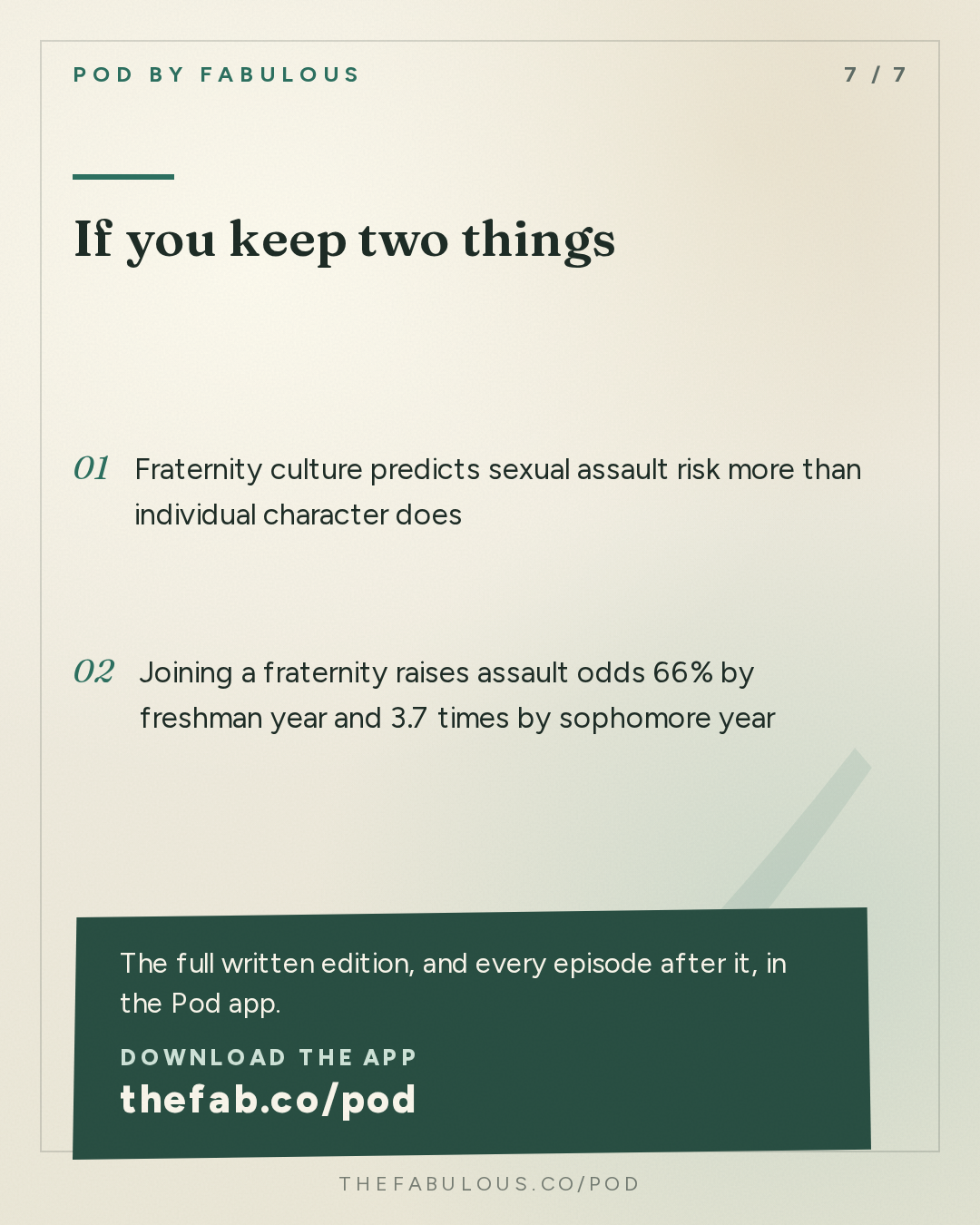
- Fraternity culture predicts sexual assault risk more than individual character does
- Joining a fraternity raises assault odds 66% by freshman year and 3.7 times by sophomore year
- Anthropologist Peggy Reeves Sanday found 47% of 95 societies studied were rape-free versus 18% rape-prone
- Hazing is not a detour from fraternity culture, it is how that culture gets taught
- Universities supply housing, staff, and tax breaks that keep the fraternity system running
The episode in cards

By the numbers
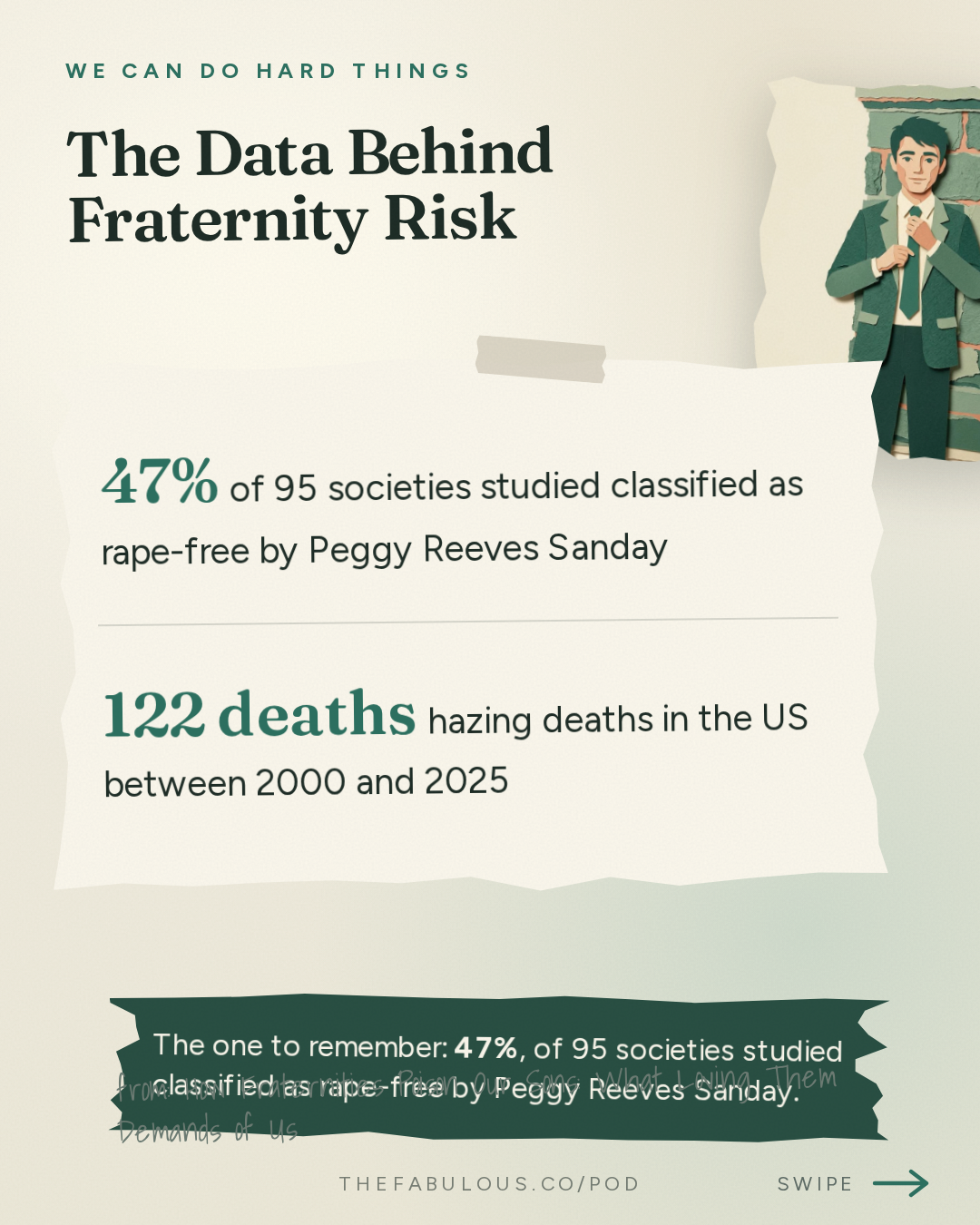
- 47% percent of 95 societies studied by anthropologist Peggy Reeves Sanday classified as rape-free
- 122 deaths hazing deaths recorded in the United States between 2000 and 2025
In their words
“The insurance industry calculates the risk of fraternities right below toxic waste dumps. It goes toxic waste dumps, then fraternities.”
“If your son finds himself in a group that would send a Free Pussy text, it's too late. The group is the disease. The text is the symptom.”
“Transgression is both the draw and the glue.”
Questions this episode answers
Are fraternity men more likely to commit sexual assault?
Yes. A study that tracked young men from before college, controlling for prior sexual aggression and drinking, found joining a fraternity raised a freshman's odds of committing assault by 66% (06:41), rising to 3.7 times by the end of sophomore year (06:58). Men in fraternities overall are nearly three times more likely to commit assault than non-fraternity men (06:00).
What did Peggy Reeves Sanday's research find about fraternities and rape?
Anthropologist Peggy Reeves Sanday studied 95 societies worldwide and found 47% were rape-free and 18% were rape-prone, with rape-prone societies sharing male dominance, sex segregation, violence used as power, and pressure to prove masculinity (28:44). She then found the same four patterns reproduced inside American college fraternities in her 1990 research (29:01).
What is masculine discrepancy stress?
It is the distress a man feels when he believes he falls short of his culture's standard for masculinity and that shortfall bothers him. In a large study of American men, those reporting this distress were 2.7 times more likely to engage in violence, including sexual assault (28:01).
Why doesn't consent education stop fraternity sexual assault?
The episode argues consent education targets the wrong problem, because hazing culture already teaches pledges for months that their own boundaries don't matter and that overriding someone's "no" is a mark of power (46:16). Writer Celeste Davis's analysis, discussed in the episode, frames transgression and secrecy, not ignorance of consent, as the actual mechanism that builds fraternity loyalty (47:10).
How many people have died from hazing in the US?
Researcher Hank Nuwer's tracking found at least one hazing death every year in the United States for 68 consecutive years, with at least 122 deaths recorded between 2000 and 2025 (39:41). Male fraternities account for more hazing deaths than any other category of organization (38:43).
Do universities benefit financially from fraternities?
Fraternities generally receive federal income tax breaks as 501 tax-exempt social clubs, and universities provide housing privileges, professional staff, and marketing support that lend fraternities institutional legitimacy (16:39, 18:03).
The full read, in cards
Go deeper
- The Company He Keeps: A History of White College Fraternities — traces historically white fraternities to secret societies formed against strict 19th-century college rules
- Peggy Reeves Sanday's cross-cultural study of 95 societies and 1990 fraternity gang rape research — found rape-prone societies share male dominance, sex segregation, violence-as-power, and masculinity pressure, patterns replicated inside American fraternities
- Hank Nuwer's hazing death research — documented that male fraternities account for more hazing deaths than any other organization category, with deaths every year for 68 years
- Anne Helen Petersen's reporting on the University of Alabama SAE lawsuit — detailed allegations of beatings and forced racial slurs against pledge H.B.
Mentioned
Nicole Badera · Kate Manne · Nicholas Syrett · Peggy Reeves Sanday · Bess Kalb · Celeste Davis · Hank Nuwer · Anne Helen Petersen · The Company He Keeps · Cornell University · Sigma Alpha Epsilon · Interfraternity Council
More from this show and category

2026 Midterms: Results, Firsts, and What's Next
Hosts of We Can Do Hard Things treat the 2026 midterm wins as a nervous-system event and a political one. Democrats took 54 Senate seats and 247 House seats; the episode covers historic firsts, a critique of establishment-picked candidates, and the National Popular Vote Interstate Compact, now at 222 of 270 electoral votes needed.

Dr. Orna Guralnik on Couples Therapy
Psychoanalyst Orna Guralnik says relationship fights are really negotiations over otherness, not actual disputes about chores. She explains how splitting pushes blame onto a partner, how old family debts called intergenerational errands get replayed in marriage, and offers one exercise: treat a partner's most annoying trait as the source of personal growth.

What Is a Father Wound? Terri Cole Explains
A father wound is a psychological injury from a father who was absent, abusive, addicted, or emotionally unavailable. Psychotherapist Terri Cole calls it a worthiness wound, the belief that love must be earned through achievement or perfection. Her study of 650 women found it fuels hyperindependence and perfectionism until perimenopause forces a stop (07:58, 21:36).

Chanel Miller on Trauma, Art, and Healing
Chanel Miller, author of the memoir Know My Name, describes healing from her 2015 sexual assault at Stanford University as a daily practice of staying present rather than fixing everything. She uses art to prove life keeps moving, pictures depression as vision narrowed through a toilet paper tube, and treats small acts like drinking water as real medicine.
