
Dr. Orna Guralnik on Couples Therapy
(BEST OF) Couples Therapy with Dr. Orna Guralnik
▶ Listen to the full episode More from We Can Do Hard Things
The brief
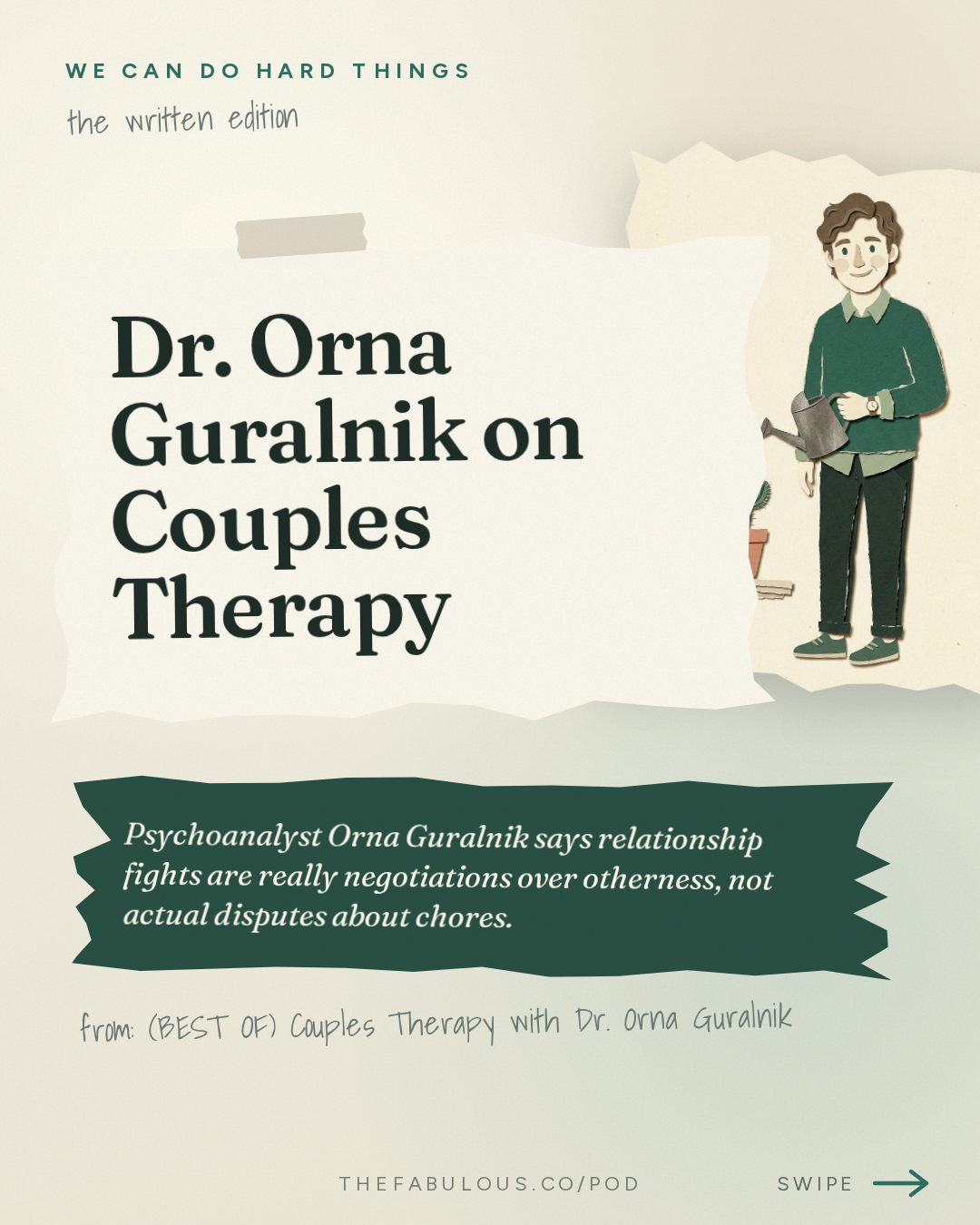
Psychoanalyst Orna Guralnik says relationship fights are really negotiations over otherness, not actual disputes about chores. She explains how splitting pushes blame onto a partner, how old family debts called intergenerational errands get replayed in marriage, and offers one exercise: treat a partner's most annoying trait as the source of personal growth.
Somewhere in every long relationship there is a dishwasher. Not a literal one, necessarily, though often that too. It is whatever small, recurring thing makes a person think: why are you like this. Why do you tell the forty-five-minute version of a story that could have taken four minutes. Why do I have to ask for quiet instead of you simply knowing I need it. The psychoanalyst Dr. Orna Guralnik, who treats real couples on camera for Showtime's docuseries Couples Therapy, has spent decades sitting with exactly this question, and her answer is not what most people expect. The dishwasher was never the problem. The problem, and also the point, is that the person loading it wrong is a genuinely different person.
Guralnik's central idea is that people do not choose partners to find themselves in another person. They choose partners to let a stranger into their life on purpose.
"We don't partner with another person to find ourselves. We partner with another person to invite otherness into our lives, and then we spend years trying to negotiate what to do with that otherness." (Dr. Orna Guralnik, [00:55])
Otherness, in Guralnik's usage, just means the fact of the other person's difference: their taste, their pace, their family history, their nervous system. A relationship is the ongoing project of living with that difference instead of erasing it. Most couples, she says, default to one of two moves when otherness gets uncomfortable. Either they decide they are right and the partner is wrong, or they decide the partner's wrongness means the marriage itself was a mistake (08:20). Both moves, she points out, do the same thing: they try to get rid of the difference instead of learning to live inside it (08:58). Her alternative is almost administrative in its plainness.
"You could imagine it that you're creating your own mini political system. So what kind of political system do you believe in? What are your ethics about difference? And try to have that guide you." (Dr. Orna Guralnik, [07:54])
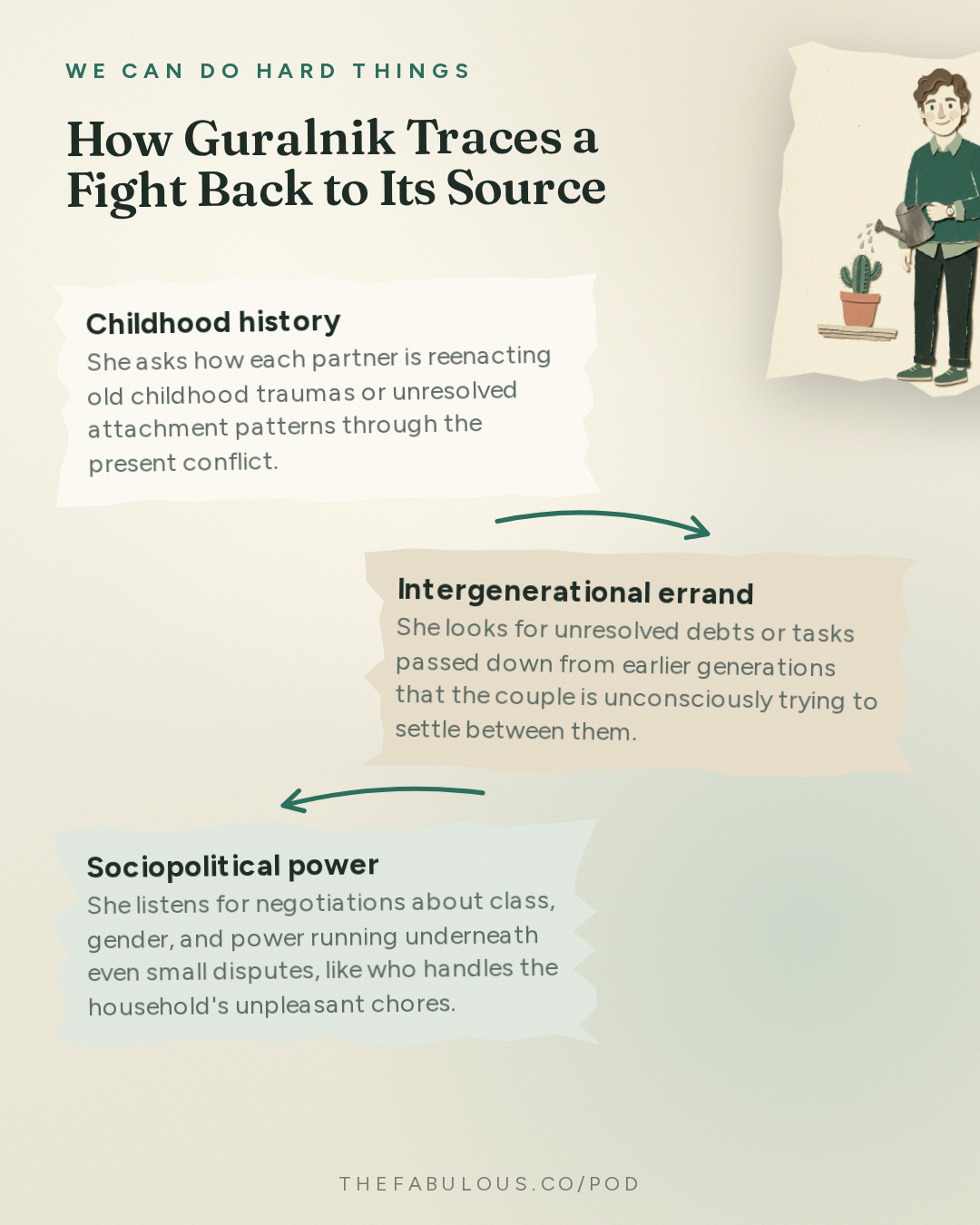
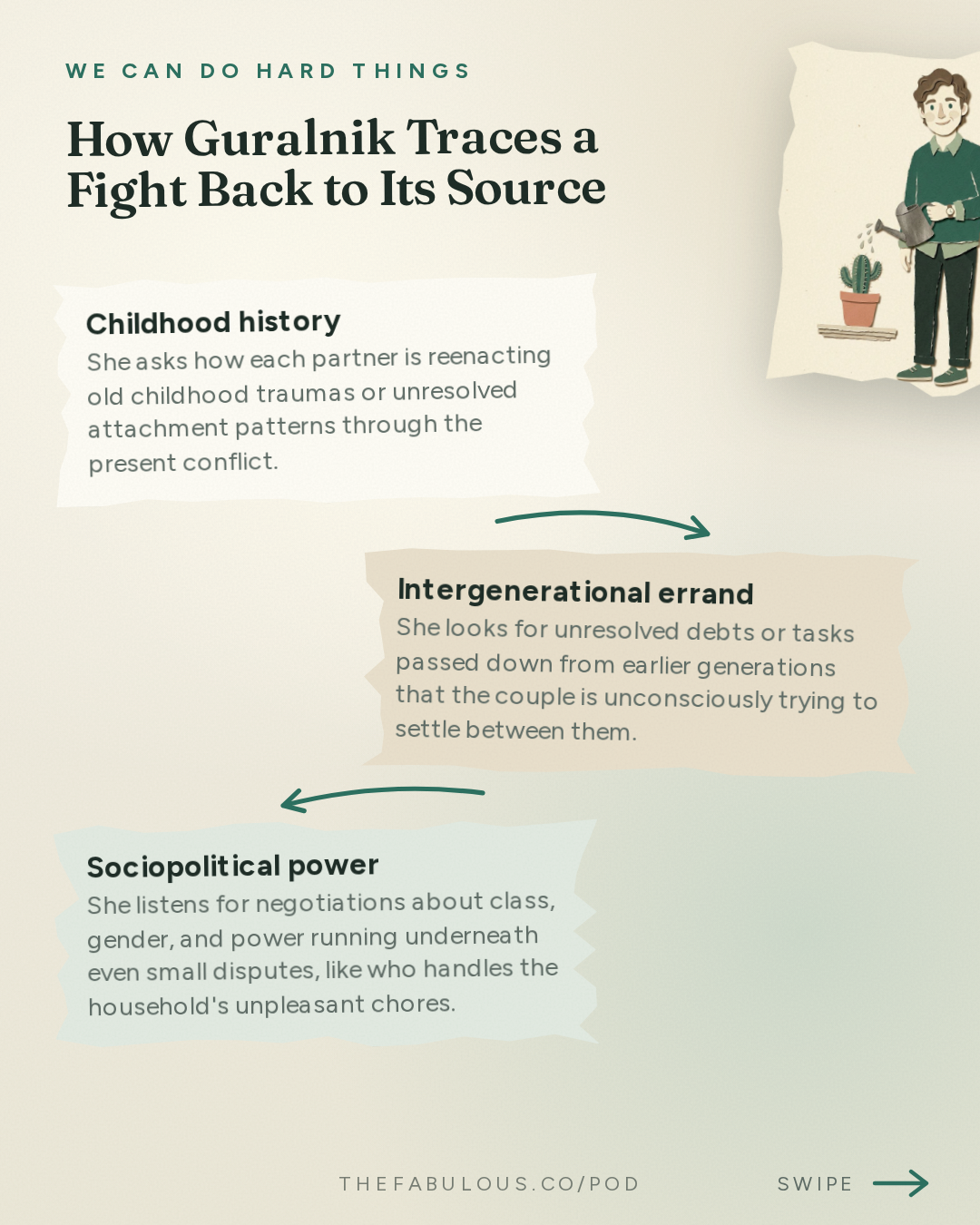
That reframe, a couple as a tiny nation negotiating its own constitution, turns a fight about the dishwasher into a fight about which values govern disagreement. It also explains why so many arguments feel bigger than their stated subject. Underneath, someone is asking: if you are allowed to be different from me, does that mean I am not entitled to exist as I am (11:15)?
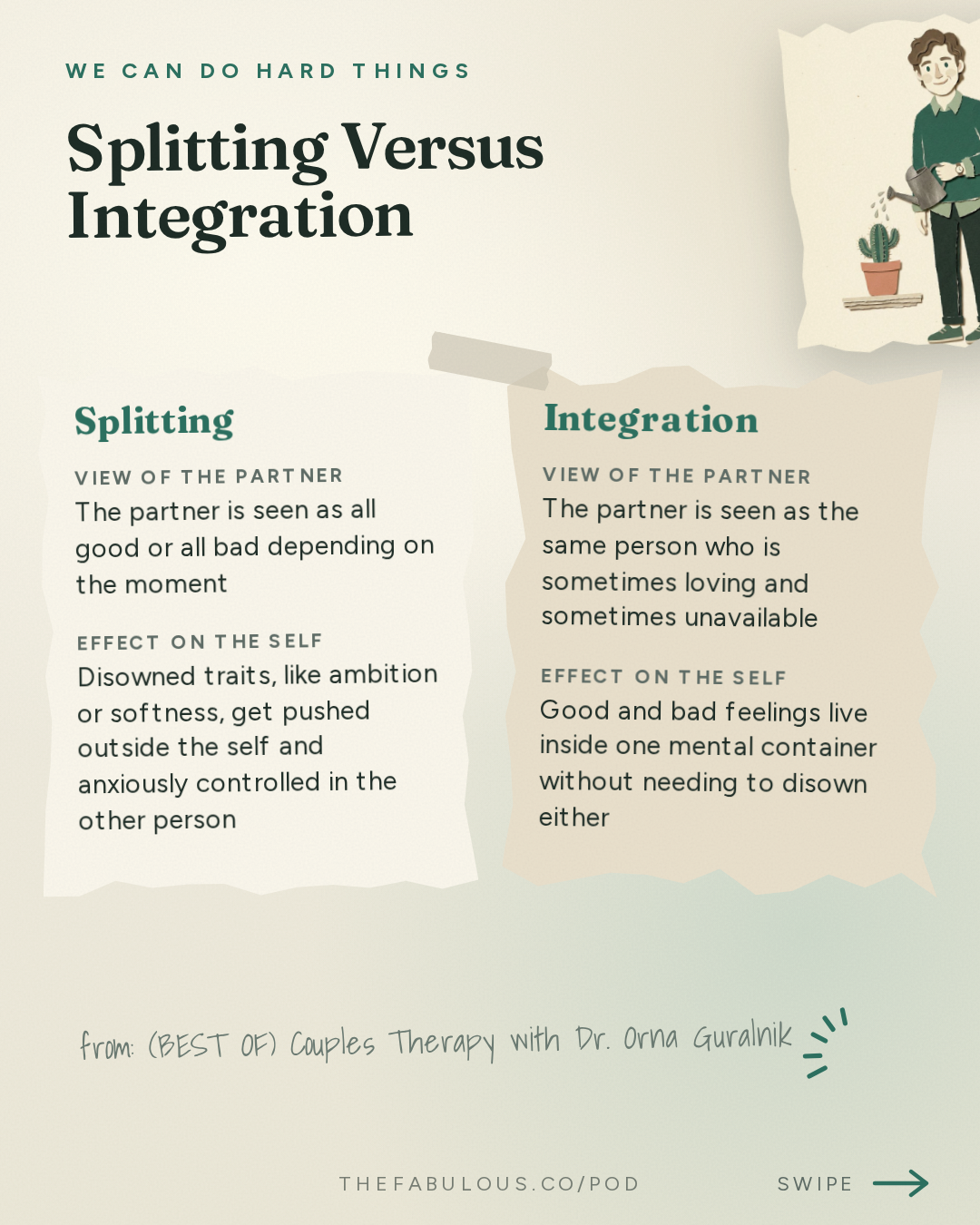
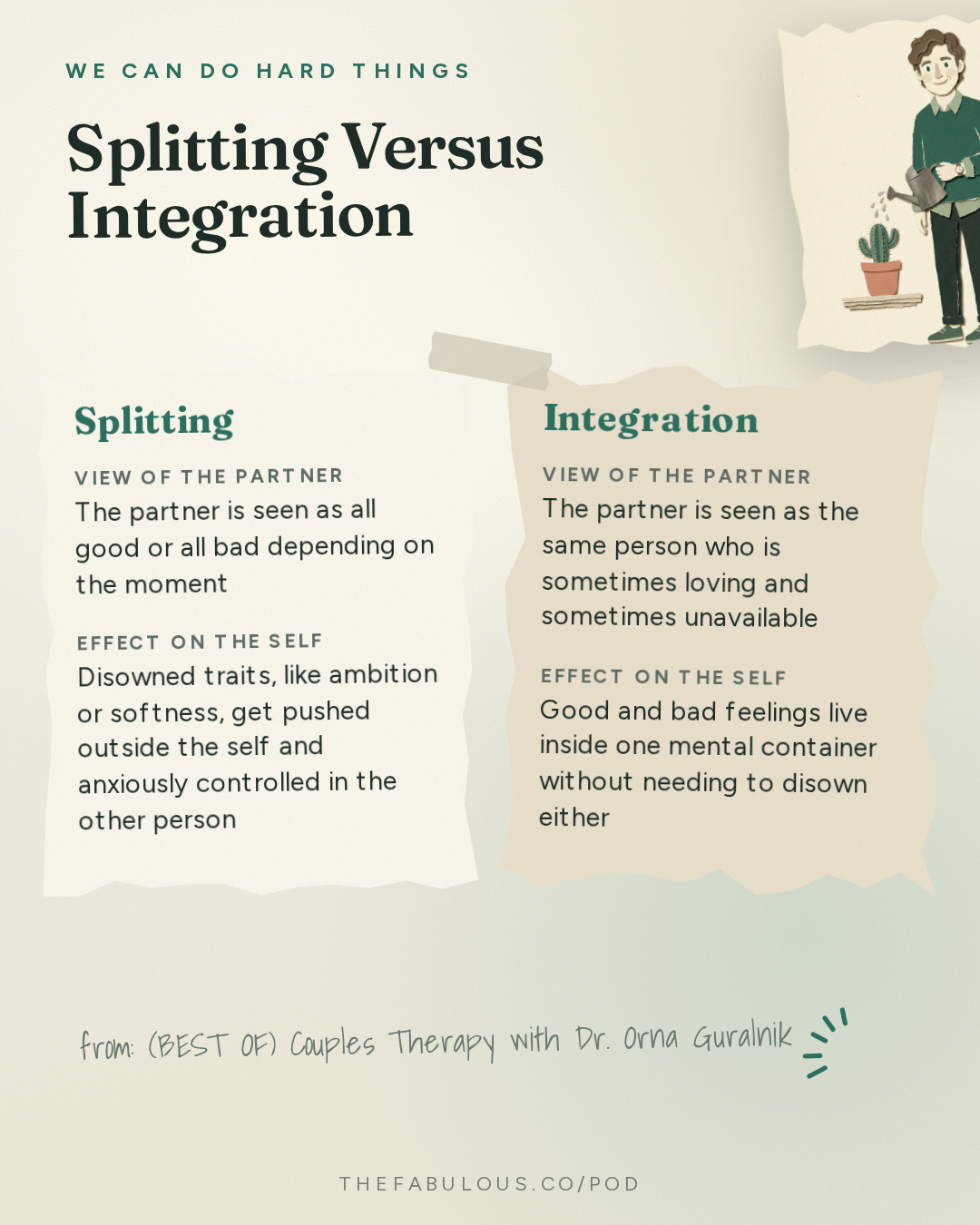
To explain why that question feels so dangerous, Guralnik reaches for a concept from the British psychoanalyst Melanie Klein called splitting. Splitting is a basic defense, present from infancy, in which a person sorts experience into good and bad and then keeps the good inside while pushing the bad onto someone else (15:05). A baby does this with a mother who sometimes feeds and sometimes does not. Adults do it with partners who are sometimes warm and sometimes absent, except adults are supposed to grow out of needing the split. Guralnik calls the alternative integration: understanding that the loving partner and the unavailable partner are the same single person, and that a person can hold both love and frustration toward them at once (16:01). Mental development, in this account, is not about feeling fewer hard feelings. It is about keeping good and bad in one container instead of two.
Splitting, Guralnik argues, is also how rigid gender roles do their damage. Patriarchy, the social system in which men hold disproportionate power, is usually described as something only women suffer. Guralnik pushes back on that in couples work. Men suffer too, she says, because performing masculinity requires splitting off anything coded feminine: softness, need, verbal emotion.
"They have to, like split off all that's within them that has to do with femininity, and it empties them out. Like any kind of splitting ultimately empties you out." (Dr. Orna Guralnik, [17:20])
Women, meanwhile, are often split off from qualities coded masculine, like ambition or dominance, and then quietly resent a partner for having easy access to them (17:20). The goal in therapy, she says, is to get both partners to a "deeply felt understanding that we're everything," so the split stops doing the work of a false boundary (17:53).
The Vacuum Where Masculinity Used to Be
One of the more pointed exchanges in the episode concerns a newer symptom: passivity. The hosts ask whether withdrawal, rather than yelling, has become the modern face of toxic masculinity, and Guralnik agrees it can be its own form of dominance (26:12). Her explanation is less about individual men behaving badly and more about a system in transition. The old definition of masculine success, breadwinner, decision-maker, emotionally closed off, has been devalued as women earn more and take on roles once reserved for men (27:34). But no clear replacement script has arrived yet. Men are left, in her words, "paralyzed," holding old pressure to perform a role whose coordinates have been erased (28:00). She is careful to call this a generalization, but it reframes passive withdrawal as confusion rather than simple avoidance, which changes what a partner might usefully say to it.
That same instinct, to look underneath a behavior for its origin story, drives one of Guralnik's more unusual diagnostic tools: the intergenerational errand. Borrowed from the analyst Maurice Aprey, the term describes a task or debt passed down through a family that never got resolved, and that a person then tries to resolve through a current partner without realizing it (32:30). Guralnik offers two examples from her case files. One involves a woman from a long line of families in which men left, who feels her otherwise loving partner owes her a debt that predates him, a debt accumulated by generations of abandoned women (33:49). The other involves a man who grew up as the only English speaker in his immigrant family, always translating his parents into the surrounding culture, who then partnered with a deaf woman, taking up the same task of translation in a new form (34:43). Neither person chose these roles consciously. The errand chose them.
Turning Annoyance Into Information
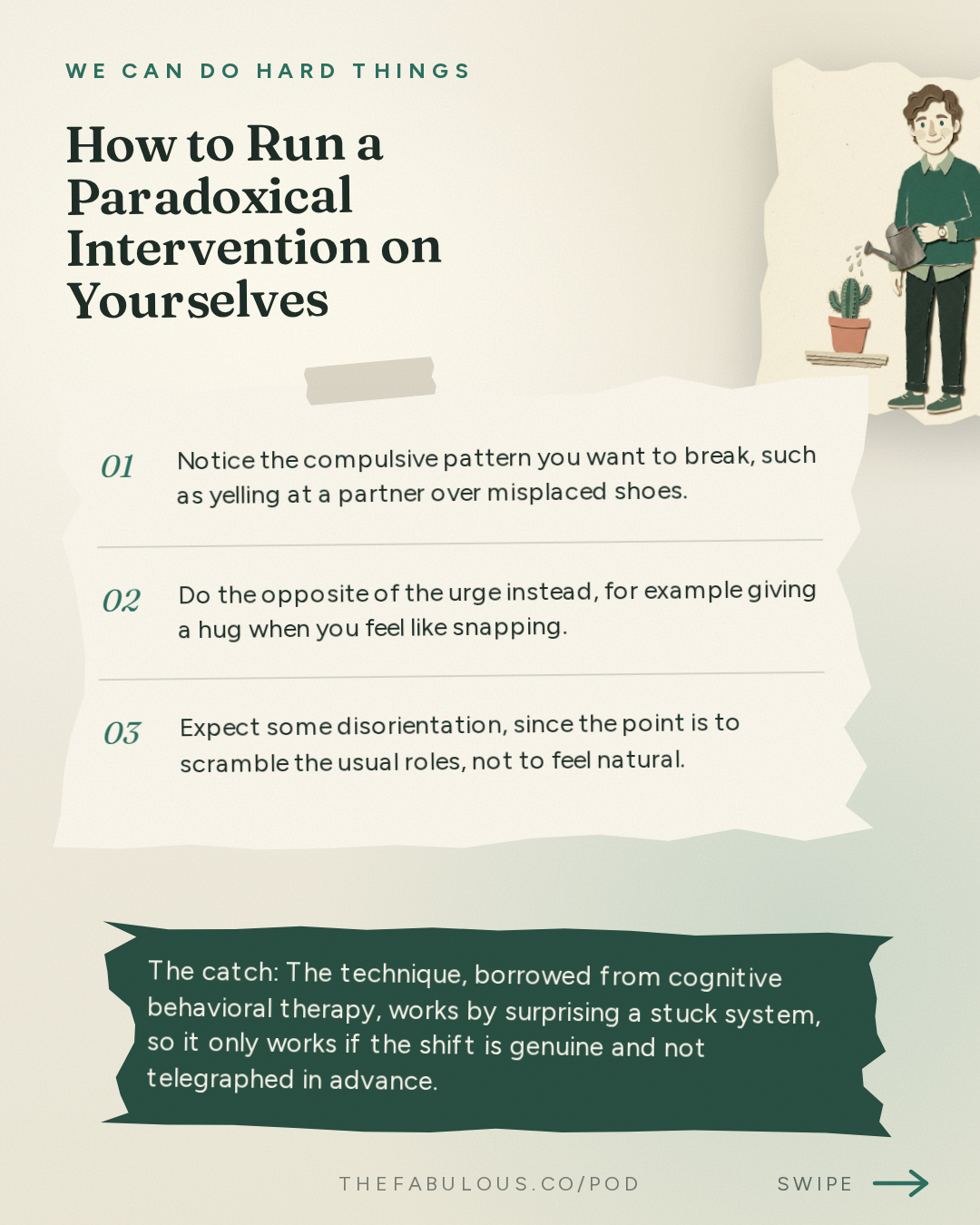
If otherness and splitting explain why couples fight, Guralnik's practical tools are mostly about interrupting the fight before it calcifies into a pattern. One is what she calls a paradoxical intervention, a technique borrowed from cognitive behavioral therapy in which a person is instructed to do the opposite of what the therapist actually wants to happen, in order to disrupt a stuck system (24:09). She describes working with a hyper-functional wife who had lost touch with pleasure entirely, running the household while her husband asked for more fun and rest. Guralnik's prescription was blunt: the wife had to take two mandatory hours a day and do absolutely nothing productive (23:46). The paradox worked. She rediscovered that she actually liked unstructured time, and her husband realized he missed the functional tasks he had ceded entirely. A gentler version of the same move applies at home: instead of criticizing a partner for a recurring annoyance, like shoes left in the wrong spot, go hug them instead (25:10). The irritation stops needing to be acted out by either side.
A second tool is countertransference, a term from the therapy room for what a therapist feels while sitting with a patient. Guralnik treats that feeling as data, not noise (50:17). The same logic applies outside the therapy room. If a partner's long monologues make someone want to walk away, that urge to flee is information worth reporting back, kindly, rather than suppressing. In the episode, one host describes going quiet during a walk rather than saying she needed rest, and stewing instead of simply naming the need (53:57). Guralnik's point is that the quiet withdrawal and the irritated monologue are both symptoms of the same missing step: translating a private feeling into a shared sentence.
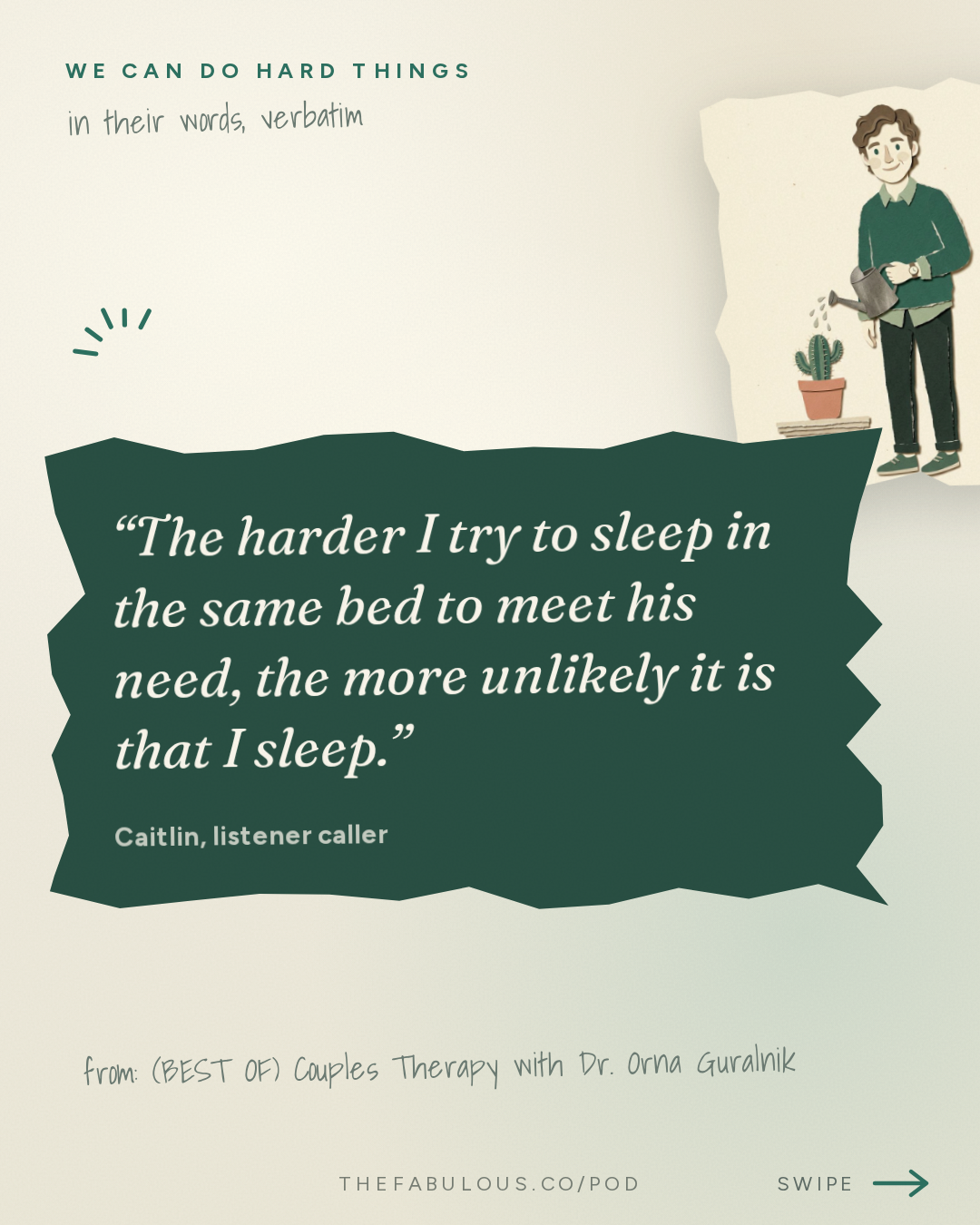
A caller named Caitlin raises a related problem that has nothing to do with conversation: she cannot sleep in the same bed as her boyfriend of two years, despite trying for his sake (61:03). Guralnim offers two lines of thought. One is simply logistical: nothing requires two adults to share a mattress to prove love, and plenty of couples thrive with separate rooms (62:22). The other is more probing: sleep is a state of total vulnerability, and the anxiety Caitlin describes might be less about noise sensitivity and more about what her unconscious fears could happen if she actually let go in front of another person (63:27).
The episode ends where it began, with otherness, but turned into something closer to an instruction. Guralnik's closing challenge is to take the single trait in a partner that is most irritating, the thing that reliably gets under the skin, and try on a different frame for it entirely.
"Challenge yourself to think of the thing about your partner that is the most disturbing to you, that brings you the most agita, to try to imagine it as the thorn from which the most growth can happen." (Dr. Orna Guralnik, [64:55])
It is a strange request, treating irritation as a resource rather than a verdict. But it follows directly from everything before it. If a relationship exists to bring a genuinely other person into a life, then the parts of that person that chafe the most are usually the parts doing the most otherness work. The dishwasher was never really about the dishwasher. It was a small, recurring referendum on how much difference two people are willing to live inside, together, without voting the other one off the island.
Ask this episode anything
Pod's AI answers from the episode itself, with the minute mark so you can hear it yourself.
Or start with one of these
Ask this episode
Pod's AI listens to the whole episode to answer, and points you to the minute it comes from.
The rest of this answer, and any question after it
Answers come from the episode itself, never from a summary of it.
ContinueKey takeaways
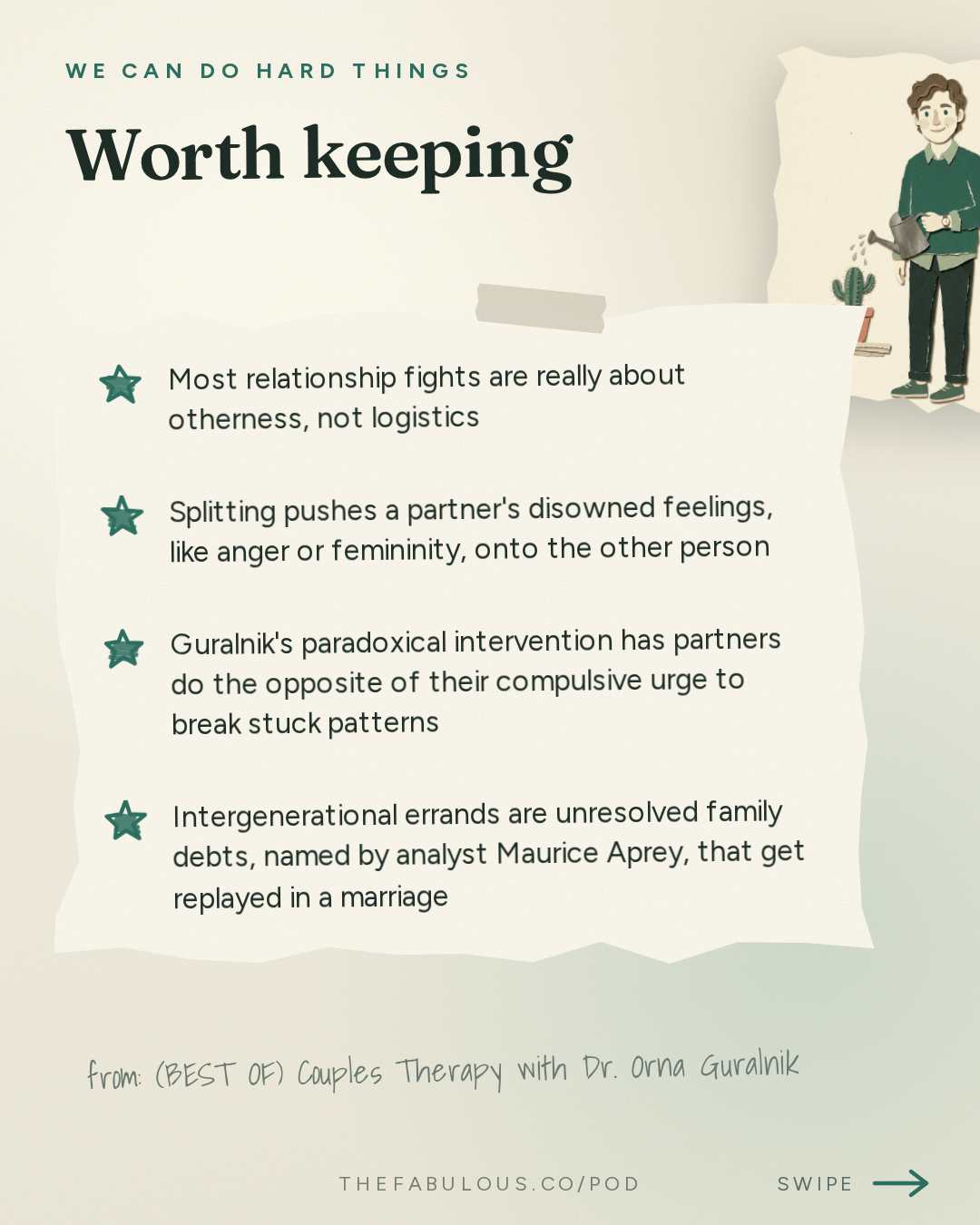
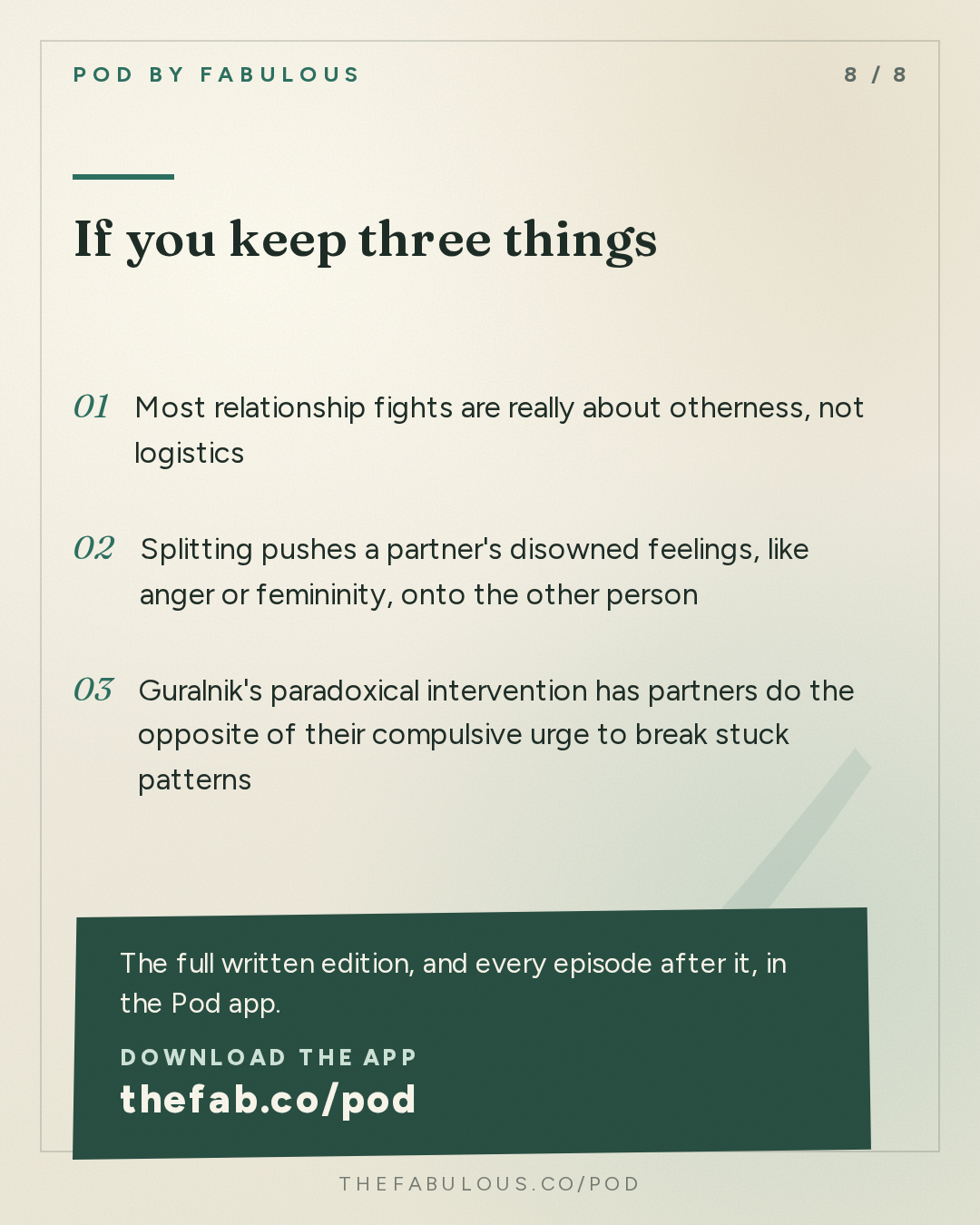
- Most relationship fights are really about otherness, not logistics
- Splitting pushes a partner's disowned feelings, like anger or femininity, onto the other person
- Guralnik's paradoxical intervention has partners do the opposite of their compulsive urge to break stuck patterns
- Intergenerational errands are unresolved family debts, named by analyst Maurice Aprey, that get replayed in a marriage
- Guralnik's closing exercise treats a partner's most disturbing trait as the source of the most growth
The episode in cards

In their words
“We don't partner with another person to find ourselves. We partner with another person to invite otherness into our lives, and then we spend years trying to negotiate what to do with that otherness”
“You could imagine it that you're creating your own mini political system. Mm. So what kind of political system do you believe in? What are your ethics about difference? And try to have that guide you.”
“They have to, like split off all that's within them that has to do with femininity, and it empties them out. Like any kind of splitting ultimately empties you out.”
“The harder I try to sleep in the same bed to meet his need, the more unlikely it is that I sleep.”
Protocols
-
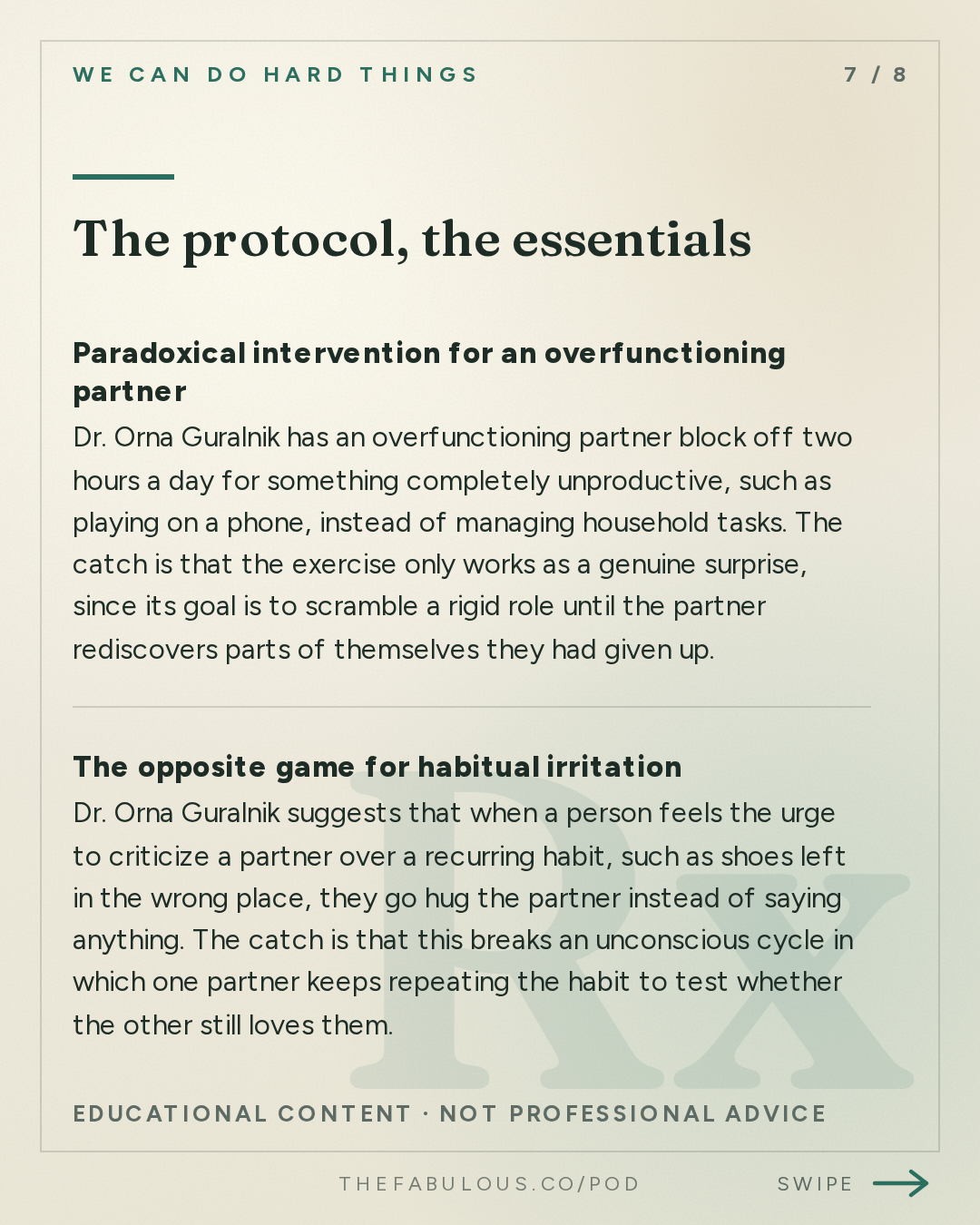
Paradoxical intervention for an overfunctioning partner
Dr. Orna Guralnik has an overfunctioning partner block off two hours a day for something completely unproductive, such as playing on a phone, instead of managing household tasks. The catch is that the exercise only works as a genuine surprise, since its goal is to scramble a rigid role until the partner rediscovers parts of themselves they had given up.
daily
-
The opposite game for habitual irritation
Dr. Orna Guralnik suggests that when a person feels the urge to criticize a partner over a recurring habit, such as shoes left in the wrong place, they go hug the partner instead of saying anything. The catch is that this breaks an unconscious cycle in which one partner keeps repeating the habit to test whether the other still loves them.
every time the urge to criticize arises
-
Turn countertransference into feedback
Dr. Orna Guralnik advises translating an uncomfortable feeling toward a partner, like boredom or the urge to leave the room, into direct and kind feedback rather than suppressing it or walking away. The catch is that the feedback has to describe the feeling itself rather than attack the partner's character.
when the feeling arises
-
Treat the most disturbing trait as the growth point
Dr. Orna Guralnik recommends identifying the single trait in a partner that is most disturbing and consciously reframing it as the specific point from which personal growth can happen. The catch is that this requires sitting with the irritation rather than trying to eliminate it.
ongoing practice
Questions this episode answers
What does psychoanalyst Orna Guralnik mean by 'otherness' in relationships?
Dr. Orna Guralnik, who treats couples on Showtime's Couples Therapy, argues that people partner to bring a genuinely different person into their life, not to find themselves in someone else (00:55). The fights that follow, she says, are really negotiations over how much difference each partner can tolerate, not disputes about the surface issue, like a dishwasher (07:25).
What is 'splitting' in couples therapy?
Splitting is a defense first described by British analyst Melanie Klein, in which a person separates good and bad feelings and pushes the bad ones onto someone else rather than holding both inside (15:05). Guralnik says the more developed alternative is integration, accepting that the same partner is sometimes loving and sometimes unavailable (16:01).
What is a paradoxical intervention in couples therapy?
A paradoxical intervention, borrowed from cognitive behavioral therapy, is when a therapist deliberately instructs someone to do the opposite of the desired outcome in order to disrupt a stuck pattern (24:09). Guralnik describes telling an overfunctioning spouse to block off two mandatory unproductive hours a day, which let her rediscover that she actually enjoyed downtime (23:46).
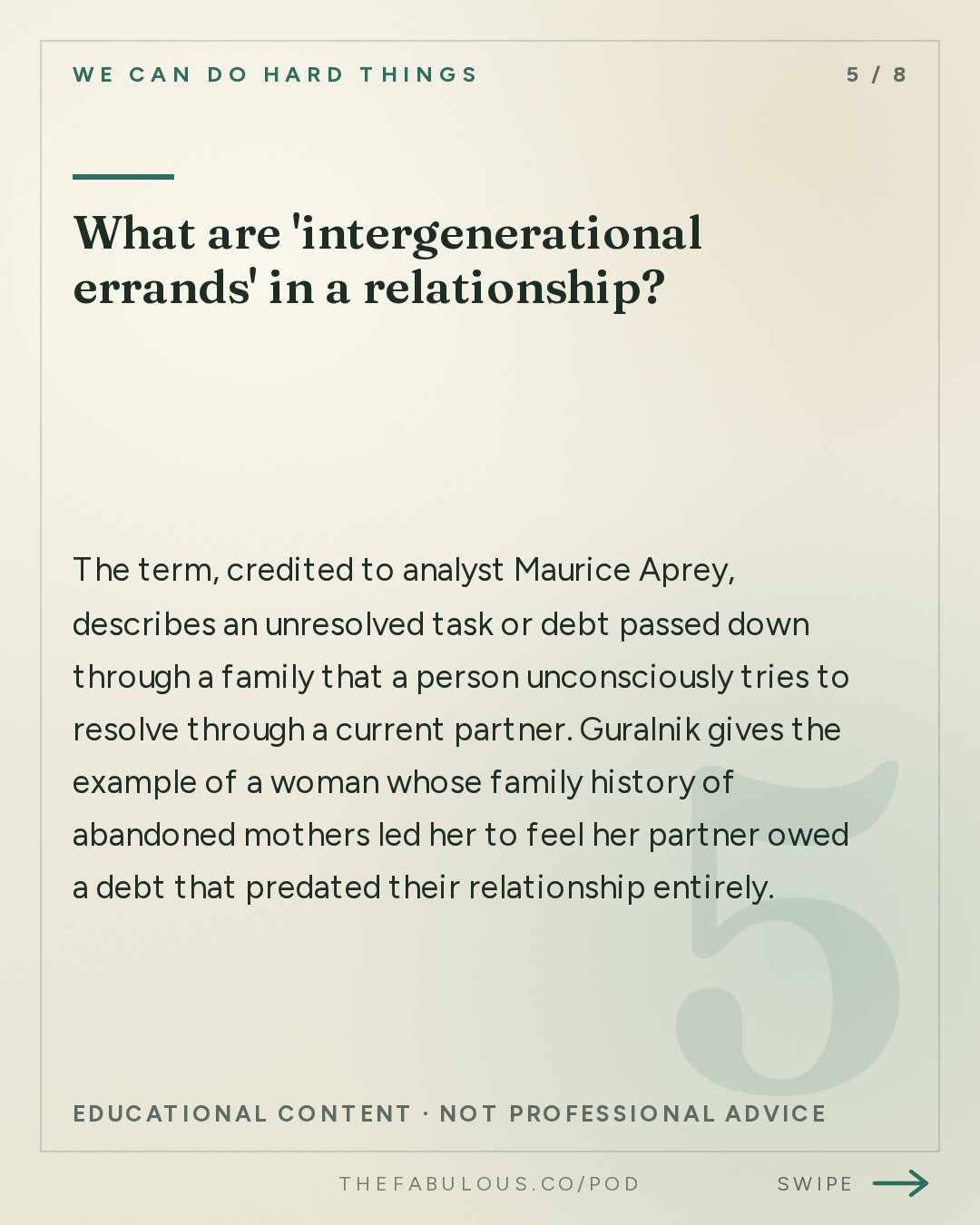
What are 'intergenerational errands' in a relationship?
The term, credited to analyst Maurice Aprey, describes an unresolved task or debt passed down through a family that a person unconsciously tries to resolve through a current partner (32:30). Guralnik gives the example of a woman whose family history of abandoned mothers led her to feel her partner owed a debt that predated their relationship entirely (33:49).
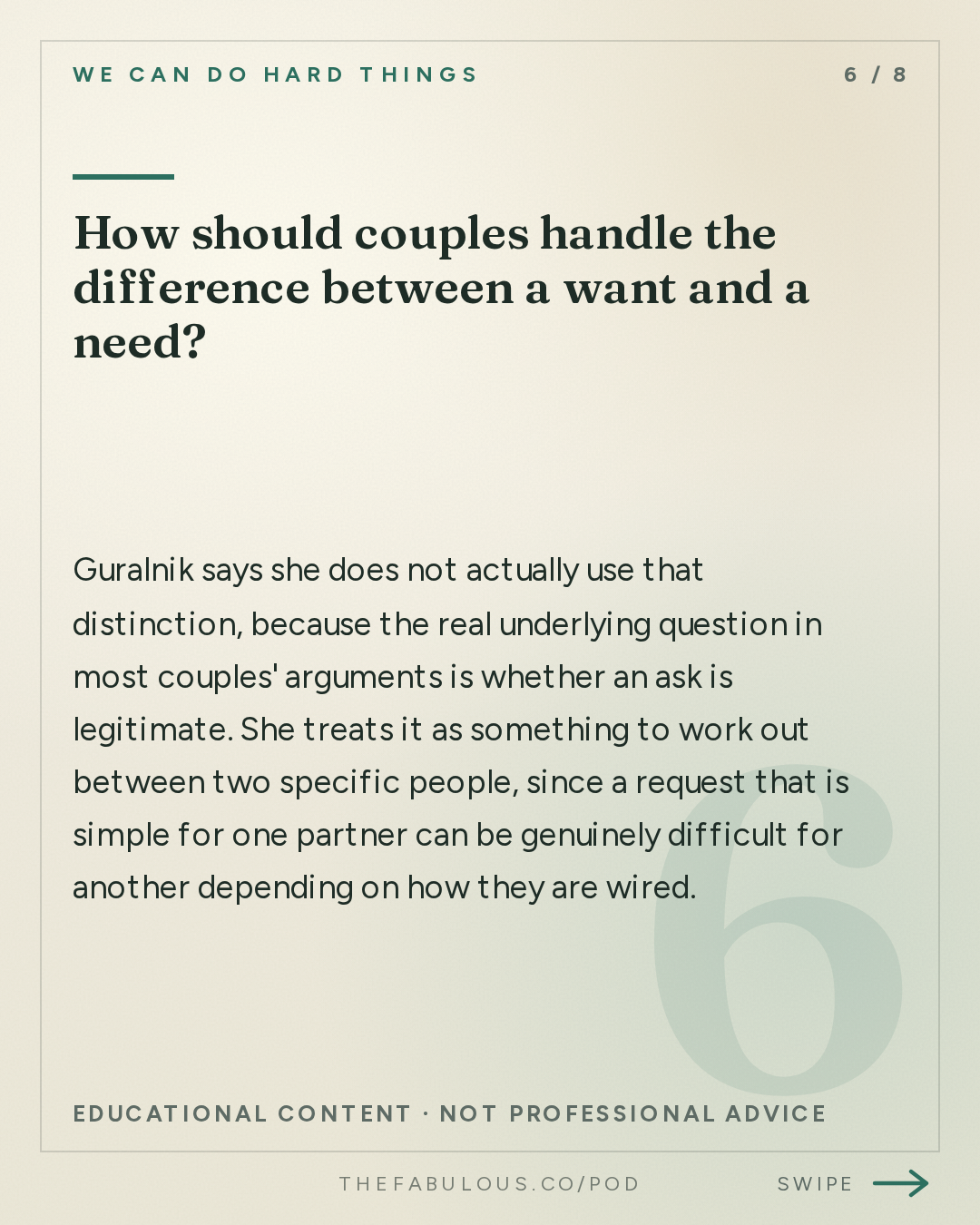
How should couples handle the difference between a want and a need?
Guralnik says she does not actually use that distinction, because the real underlying question in most couples' arguments is whether an ask is legitimate (40:34). She treats it as something to work out between two specific people, since a request that is simple for one partner can be genuinely difficult for another depending on how they are wired (41:09).
What is countertransference and how can it help a relationship?
Countertransference is the feeling a therapist has while sitting with a patient, and Guralnik calls it a vital source of information about what is happening between two people (50:17). She advises turning an irritated or bored feeling toward a partner into direct, kind feedback instead of suppressing it or walking away (51:24).
The full read, in cards
Go deeper
- My Grandmother's Hands — Resmaa Menakem's book describes people coming to a healer less for answers than to sit with someone whose nervous system is settled, a frame Guralnik connects to her own analytic training
- Couples Therapy — the Showtime docuseries in which Guralnik treats real couples on camera, supplying case examples like the overfunctioning spouse Michal and her husband Michael
Mentioned
Dr. Orna Guralnik · Abby Wambach · Glennon Doyle · Couples Therapy · My Grandmother's Hands · Resmaa Menakem · DW Winnicott · Melanie Klein · Maurice Aprey · Showtime
More from this show and category

What Is a Father Wound? Terri Cole Explains
A father wound is a psychological injury from a father who was absent, abusive, addicted, or emotionally unavailable. Psychotherapist Terri Cole calls it a worthiness wound, the belief that love must be earned through achievement or perfection. Her study of 650 women found it fuels hyperindependence and perfectionism until perimenopause forces a stop (07:58, 21:36).

Chanel Miller on Trauma, Art, and Healing
Chanel Miller, author of the memoir Know My Name, describes healing from her 2015 sexual assault at Stanford University as a daily practice of staying present rather than fixing everything. She uses art to prove life keeps moving, pictures depression as vision narrowed through a toilet paper tube, and treats small acts like drinking water as real medicine.

Title IX Report vs Complaint: The Real Difference
At most universities, filing a Title IX "report" about a sexual assault triggers nothing, only a formal "complaint" starts an investigation, and sociologist Nicole Bedera's year embedded inside one university's Title IX office found just 18% of reports ever became complaints (35:51). Her research shows the system is structurally built to protect the institution, not the survivor.

Allison Russell on Healing Childhood Trauma
Singer-songwriter Allison Russell, raised by a white supremacist abuser after Quebec's child-protection system returned her to her mother's custody, describes how chosen family, art, and motherhood helped her return to her body after trauma. She frames scars as proof of survival, reframes PTSD as a bodily response rather than an inner demon, and ties her healing to activism against gun violence and minority rule in Tennessee (41:53, 55:35).
