
Title IX Report vs Complaint: The Real Difference
On Cornell – How to Protect Your Child When Their College Won’t – with Nicole Bedera
▶ Listen to the full episode More from We Can Do Hard Things
The brief
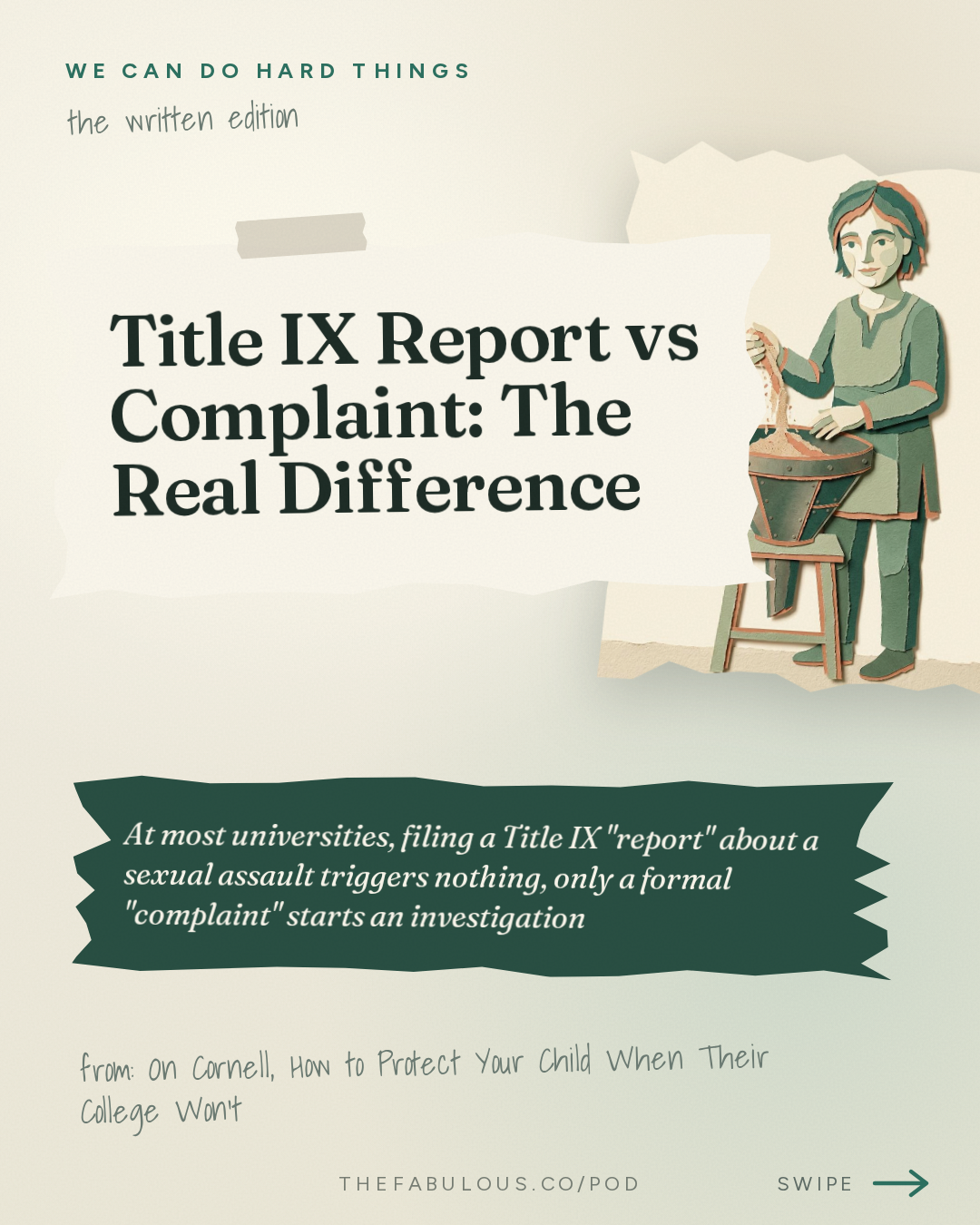
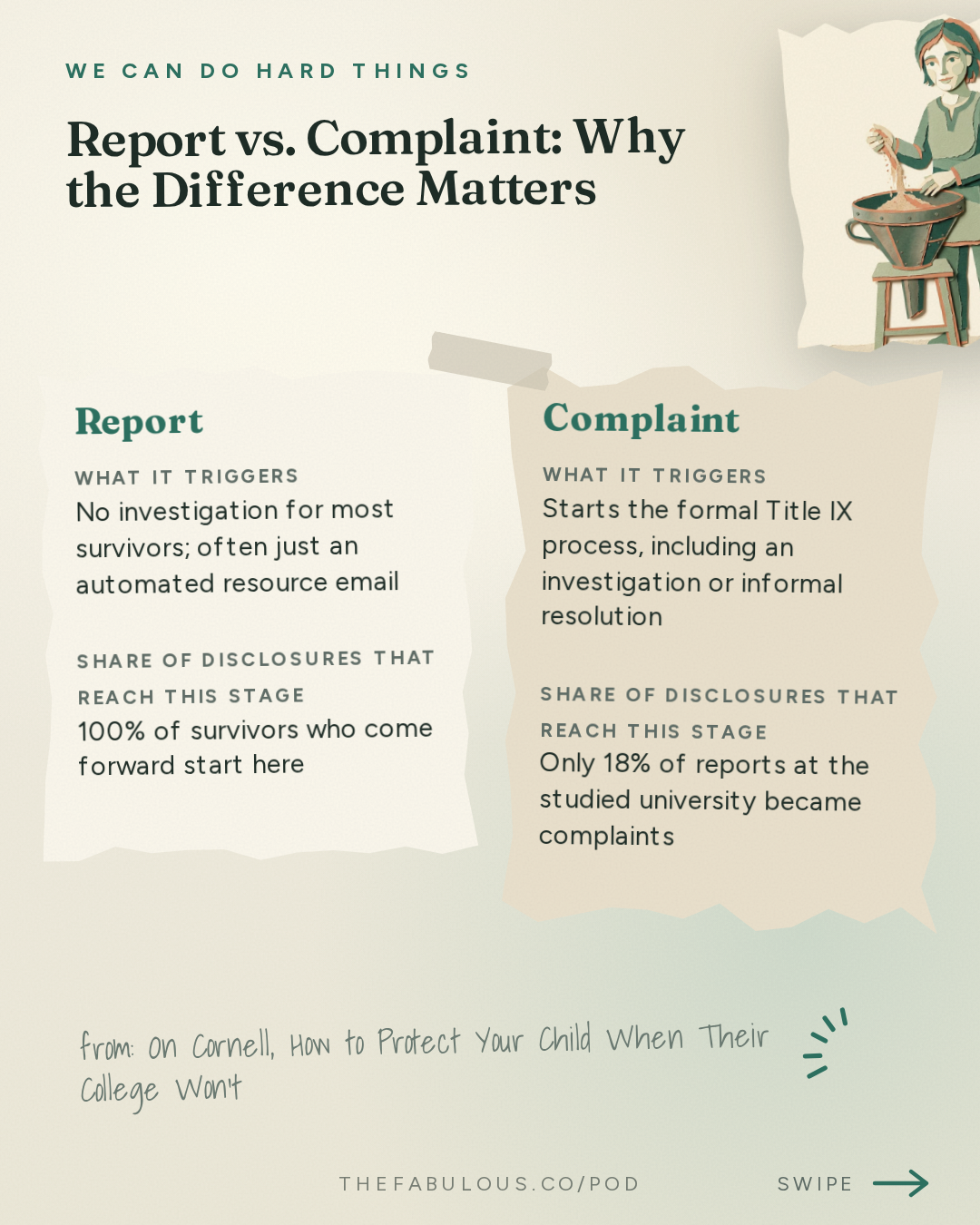
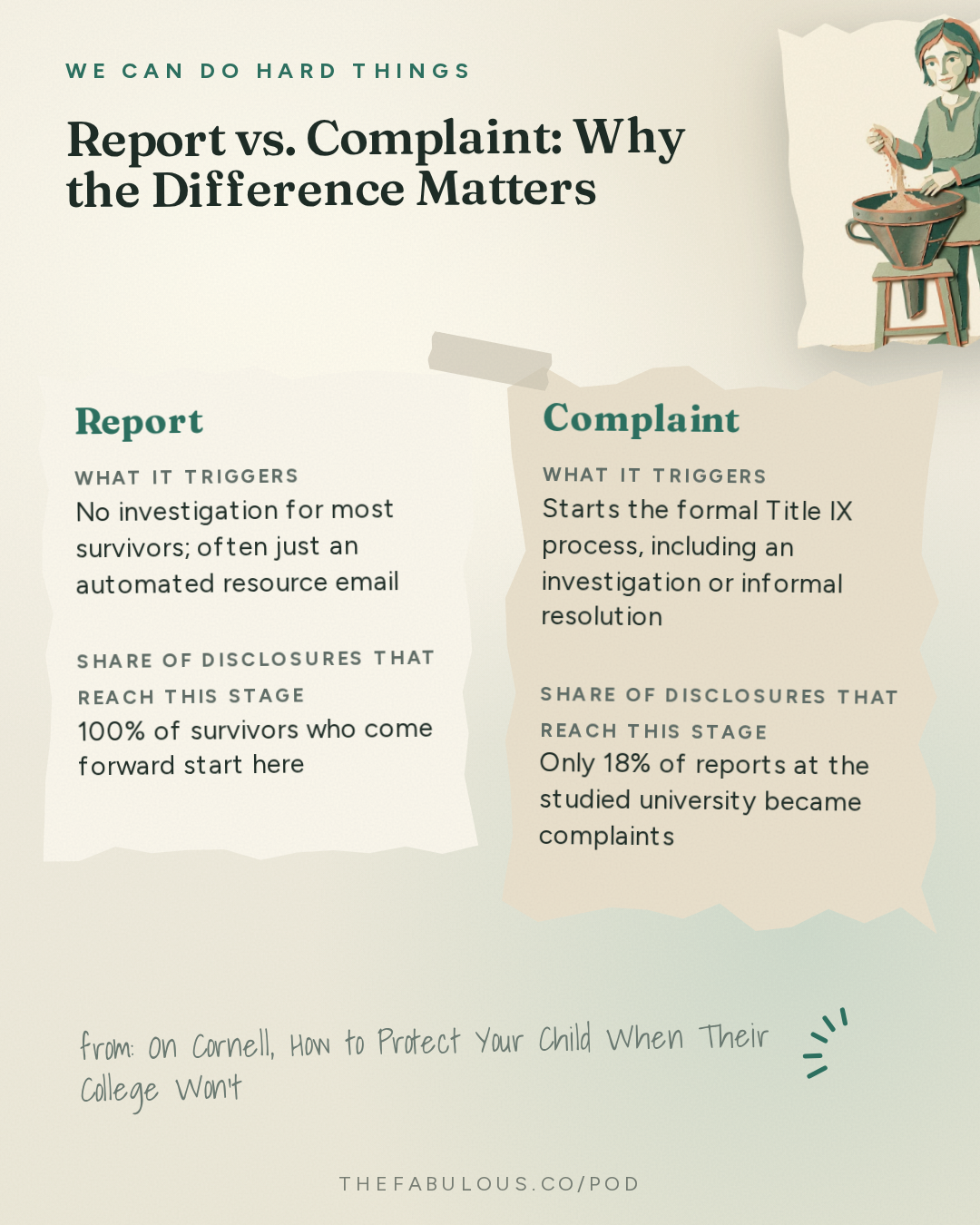
At most universities, filing a Title IX "report" about a sexual assault triggers nothing, only a formal "complaint" starts an investigation, and sociologist Nicole Bedera's year embedded inside one university's Title IX office found just 18% of reports ever became complaints (35:51). Her research shows the system is structurally built to protect the institution, not the survivor.
Here is a fact that should unsettle anyone who has ever told a frightened young woman to "just report it": at most American universities, reporting does almost nothing. A student walks into a Title IX office, or more likely fills out a form on a website, and describes the worst night of her life. In the majority of cases, nothing happens next. No investigation. No confirmation that anyone read it. Sometimes just a bland, forgettable email she mistakes for spam.
This is the subject of a conversation between podcast host Amanda Doyle and sociologist Nicole Badera, who spent a year embedded inside an American university's Title IX office, the campus system required by federal law to respond to sex discrimination, including sexual assault. Badera later wrote a book about what she saw, called On the Wrong Side. Her finding is blunt: the system is not failing by accident. It is doing exactly what it was built to do.
"The Title IX system isn't failing survivors because it's not working. It's failing survivors precisely because it is working." — Amanda Doyle [05:27]
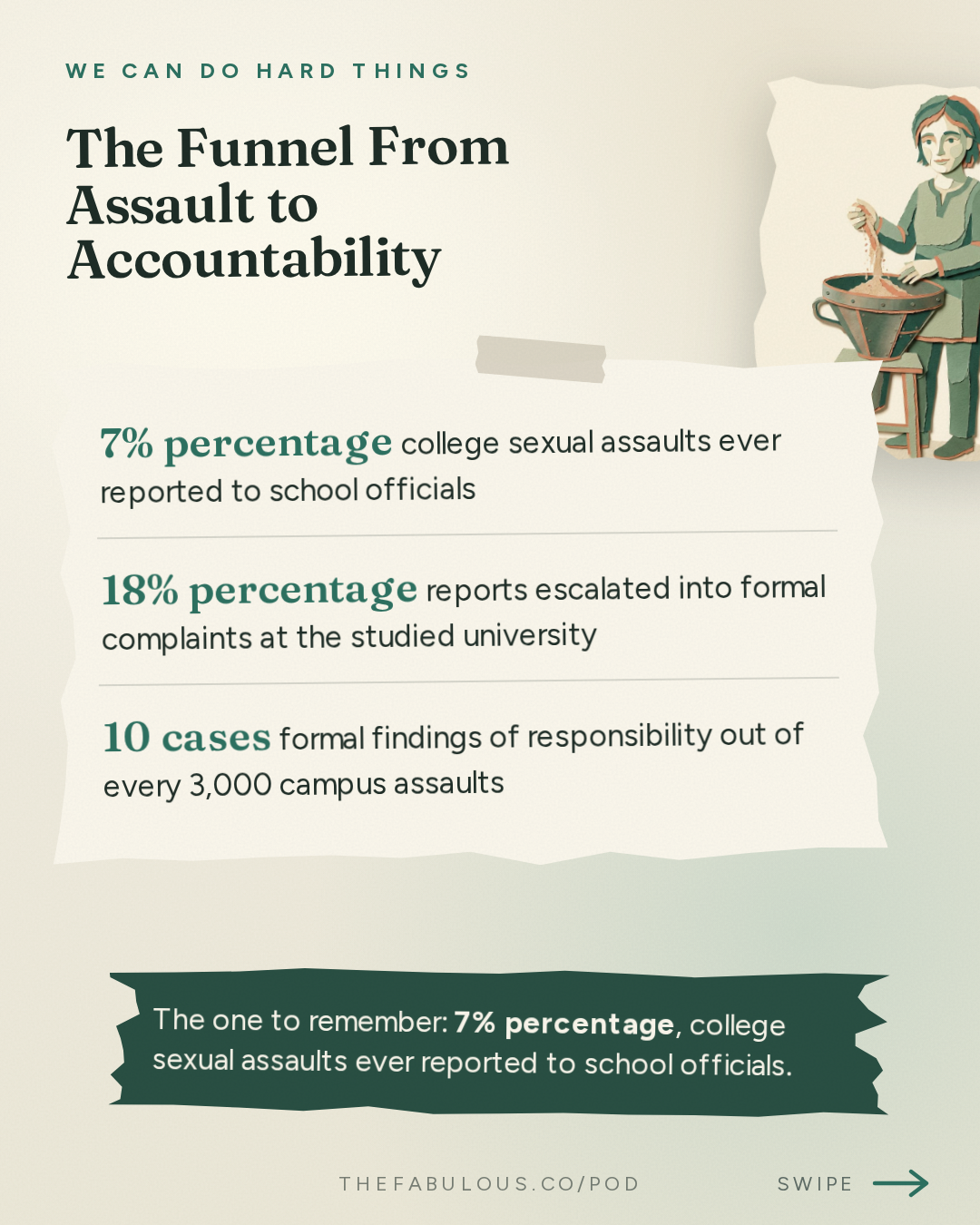
The numbers back this up with a grim arithmetic. About one in four undergraduate women report experiencing sexual assault in college (06:04). Of all assaults, only about 7% are ever reported to a school official at all (06:58). And of the reports that do get filed, most go nowhere, because a "report" and a "complaint" are not the same thing, even though almost no one outside a Title IX office knows that.
The Gap Nobody Tells You About
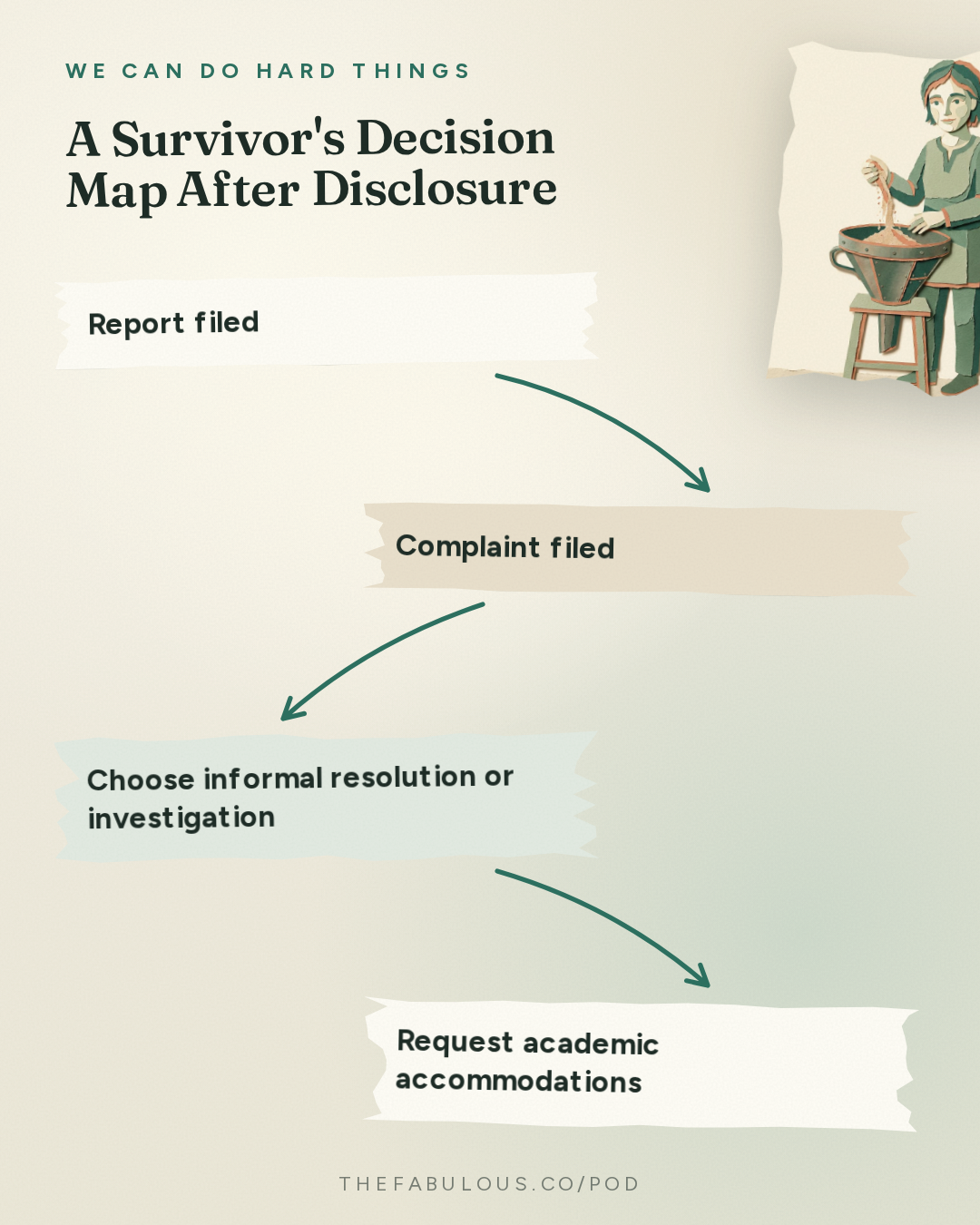
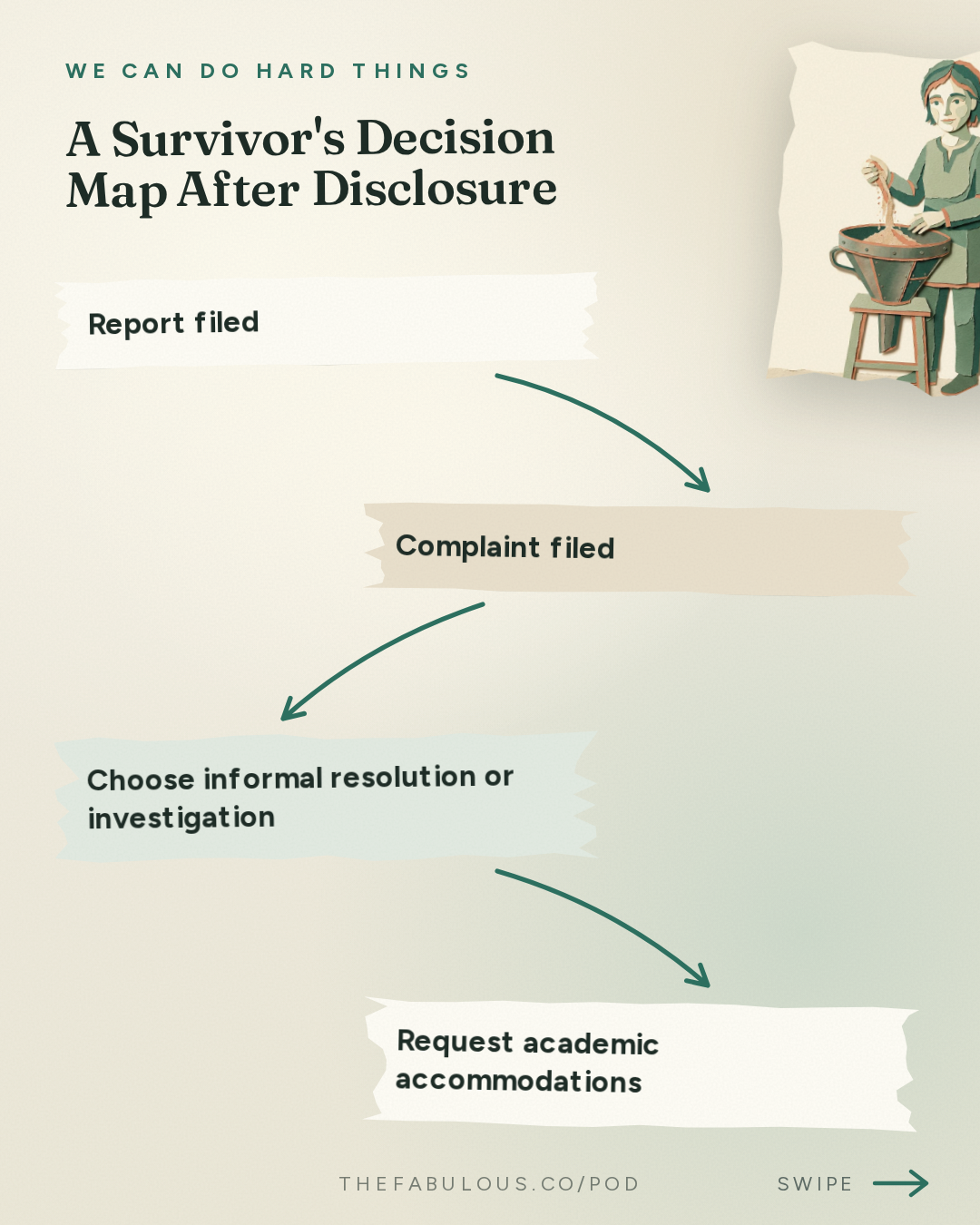
A report is a disclosure. A complaint is the administrative trigger that actually opens an investigation. At the university Badera studied, only 18% of reports were ever escalated into complaints (35:51), and for intimate partner violence specifically, the number dropped to 4% (38:54). Universities, she found, often choose which survivors get told the difference exists. If an administrator takes interest in a case, it can move forward. If not, it quietly dies as a report, and the survivor is left assuming the system is simply slow, or has simply forgotten her.
Badera calls this hidden layer a product of what she terms organizational dependency.
"Organizational dependency is when an organization has complete control over its own processes, and so you're dependent on this organization that's acting badly to seek accountability." — Nicole Badera [42:15]
That dependency runs through every stage of the process. The university employs the Title IX coordinator, the investigators, often the campus police, and the victim advocates. It owns the dorms where many assaults occur. It has a financial interest in its athletic programs, its fraternities, its reputation with donors and parents. Amanda Doyle puts it starkly: Title IX is the only accountability system in the country designed and run by the very institution whose money and reputation are on the line when an allegation surfaces (23:36).
The consequences, when they come at all, are mild. Even in the rare case where a university finds a student responsible for sexual assault, only 30% of those students are suspended and only 10% are expelled (11:34). Research on New York universities, where Cornell sits, found the average school expels one perpetrator of sexual violence every three years (12:13). Meanwhile, 57% of survivors who do manage to file a full formal complaint end up leaving their university entirely, through dropping out, transferring, or taking a leave of absence (16:55). The single best predictor of a college woman's GPA, Badera's research suggests, is not her intelligence or work ethic. It is whether she was raped (17:40).
Even the alternatives built to look gentler often make things worse. "Informal resolution," the softer track universities offer instead of a full investigation, is required by federal rule to be voluntary and non-punitive toward the accused (58:05). Badera says this rule was interpreted so broadly at her field site that even asking an accused student to use the campus library at a different hour than his victim was labeled punitive and rejected. Mediation, where survivor and perpetrator try to negotiate an agreement directly, is even worse, in her view, because it assumes equal footing between two people where one already overpowered the other once.
Why would a university steer survivors toward a process that accomplishes so little? Badera's answer is not a conspiracy theory, just incentives. A survivor who accepts informal resolution effectively signs off on the university doing nothing, which makes it much harder later to sue, and which lets the school say, if asked, that it respected her choice. Jurisdiction adds another wall: students usually cannot take an on-campus assault to local police, because university police departments typically hold exclusive jurisdiction over campus crimes (49:18). And survivors looking for outside legal help sometimes discover that every well-resourced law firm in town is already on retainer to the university, a conflict that quietly closes off representation before a case ever starts (70:33).
What Can Actually Be Done
The second half of the conversation turns from diagnosis to instruction, and this is where the episode earns its real usefulness. Badera's first piece of advice for parents: do not panic, and do not take over. Many survivors, she says, specifically avoid telling their parents what happened, not out of shame but out of fear of being controlled, pulled out of school, or blamed (84:06). Her suggested question for a parent to ask is not "what do you want to happen" but "what do you need," because the first question quietly hands a traumatized young person the impossible job of solving institutional failure on her own (89:59).
Practically, survivors do not need to file any report at all to get academic accommodations like extended deadlines or excused absences. That right is protected under current federal Title IX regulation (86:23), and the safest route to it is a confidential campus victim advocate, who cannot report a case against a survivor's will. Badera notes one exception worth knowing: in California, victim advocates on college campuses became independent state employees rather than university staff starting in 2022, which removes much of the conflict of interest baked into advocacy offices elsewhere (88:34).
For a survivor who does want to pursue a full investigation, Badera's advice is precise: walk in and ask explicitly to file a complaint, not a report, because the word matters. She also encourages treating the decision as reversible. A student can stop participating in the Title IX process at any point, and doing so is not her fault; often it is the outcome the university quietly prefers anyway, since it ends the obligation to discipline anyone (95:33).
For parents evaluating colleges before their child enrolls, Badera's checklist is concrete rather than sentimental. Ask for the dollar budget of the victim advocacy office, not vague assurances of care. Ask about the school's mandatory reporting policy, since a narrower one preserves more of a survivor's autonomy. And check whether the school still funds things like gender studies programs, women's centers, and LGBTQ centers, since their presence or absence signals whether the campus values protecting women at all (76:43).
The conversation ends somewhere unexpected: hope. Badera argues campus sexual violence is not a hard problem to solve, just one that powerful people have chosen not to solve, because many of the policies in place were written by the kind of men those policies now protect (98:02). What determines whether an assault becomes a lasting wound, she says, is not only the violence itself but everything an institution and a community do afterward.
"How traumatic a sexual assault is is not determined by just the violence. It's determined by everything that happens after it's over." — Nicole Badera [101:44]
That claim reframes the entire hour. The Title IX system was sold as the place where harm gets addressed. What Badera's research shows is a structure engineered, quietly and legally, to contain harm instead, to keep it inside the institution rather than let it reach the people who could actually hold someone accountable. Knowing the difference between a report and a complaint will not fix that structure. But it might be the one piece of information that keeps a single survivor from screaming into a void she mistook for help.
Ask this episode anything
Pod's AI answers from the episode itself, with the minute mark so you can hear it yourself.
Or start with one of these
Ask this episode
Pod's AI listens to the whole episode to answer, and points you to the minute it comes from.
The rest of this answer, and any question after it
Answers come from the episode itself, never from a summary of it.
ContinueKey takeaways
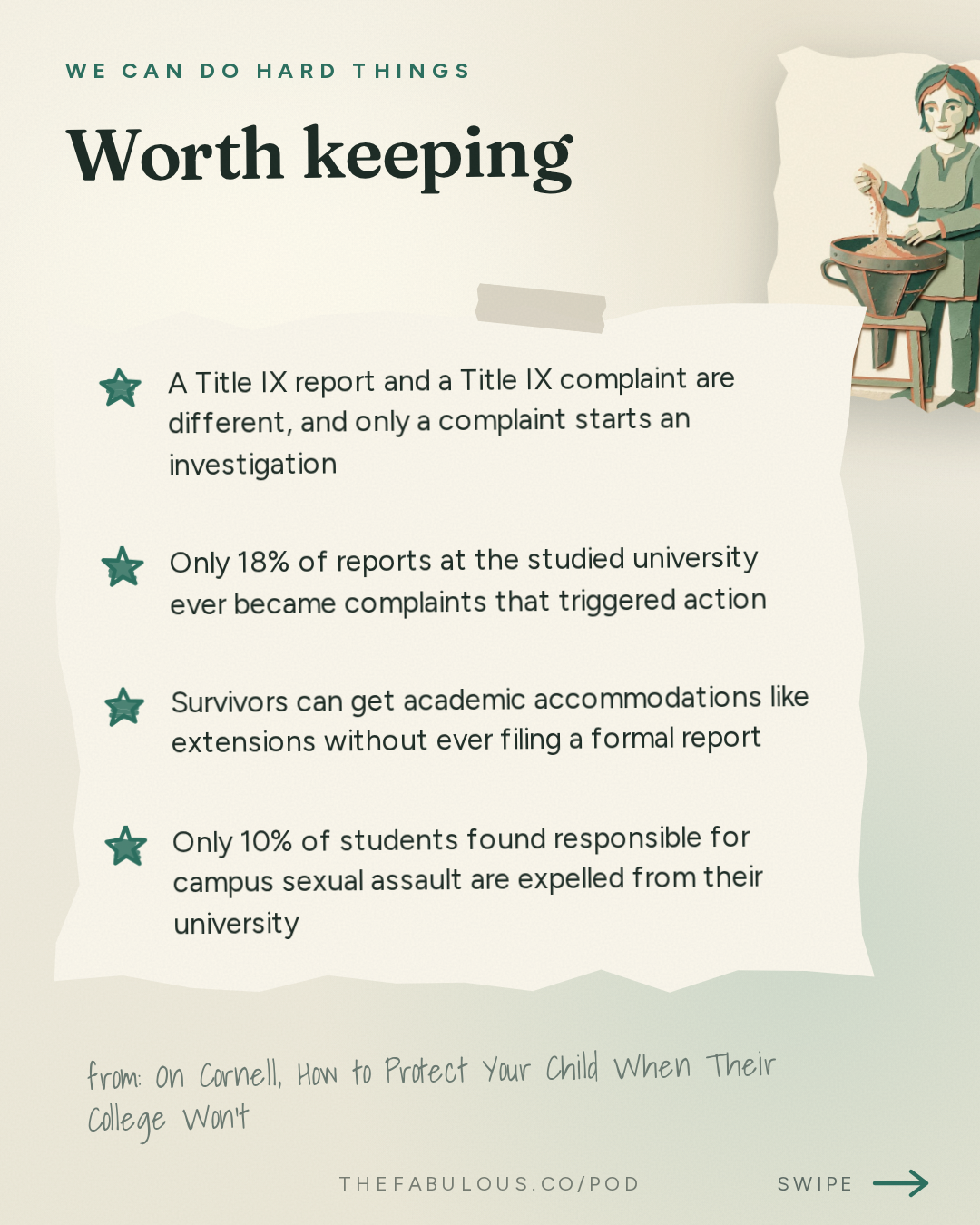
- A Title IX report and a Title IX complaint are different, and only a complaint starts an investigation
- Only 18% of reports at the studied university ever became complaints that triggered action (35:51)
- Survivors can get academic accommodations like extensions without ever filing a formal report (86:23)
- Only 10% of students found responsible for campus sexual assault are expelled from their university (11:34)
- Parents should ask a survivor what she needs rather than what she wants, says sociologist Nicole Bedera (89:59)
The episode in cards

By the numbers
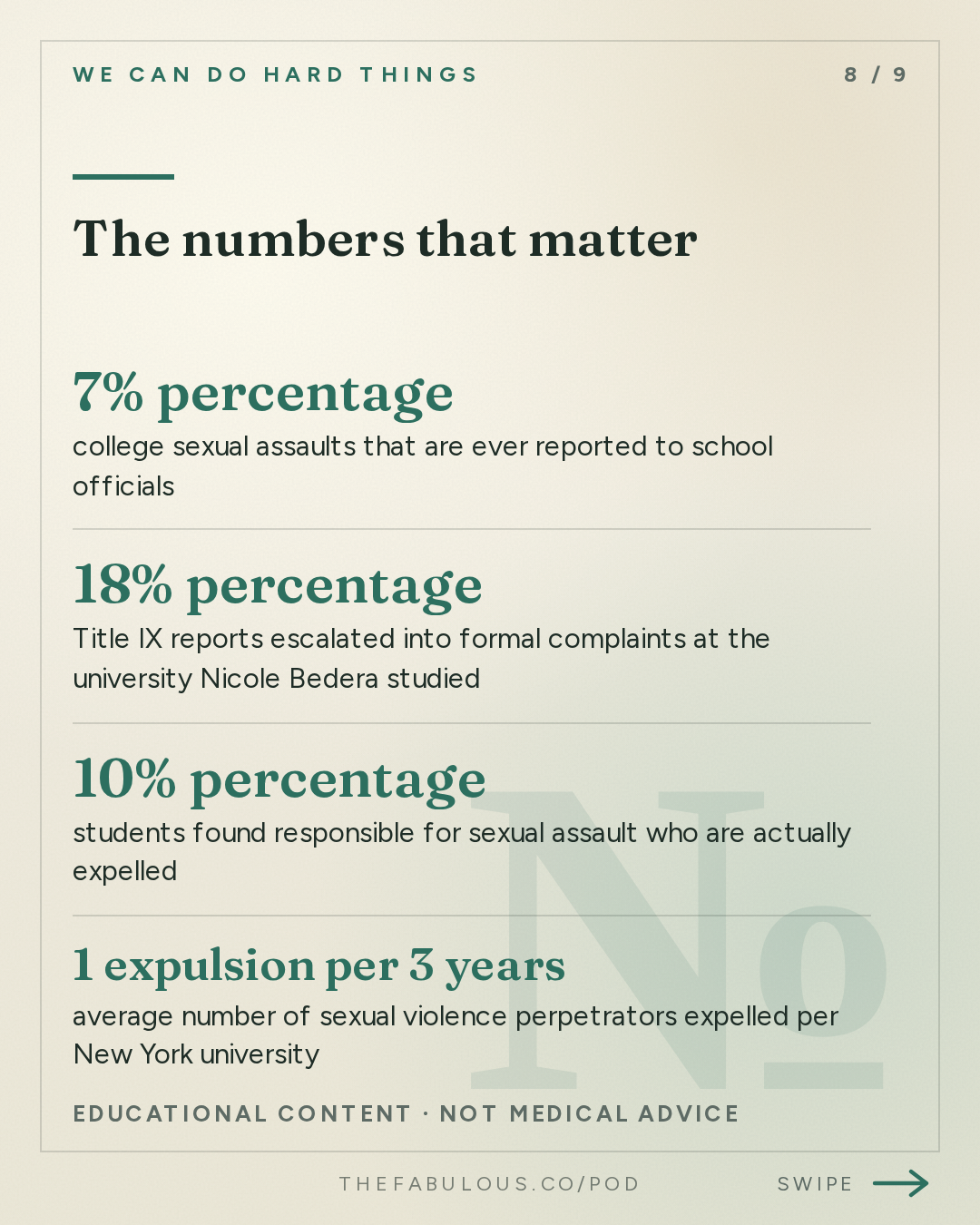
- 7% percentage college sexual assaults that are ever reported to school officials
- 18% percentage Title IX reports escalated into formal complaints at the university Nicole Bedera studied
- 10% percentage students found responsible for sexual assault who are actually expelled
- 1 expulsion per 3 years average number of sexual violence perpetrators expelled per New York university
In their words
“The Title IX system isn't failing survivors because it's not working. It's failing survivors precisely because it is working.”
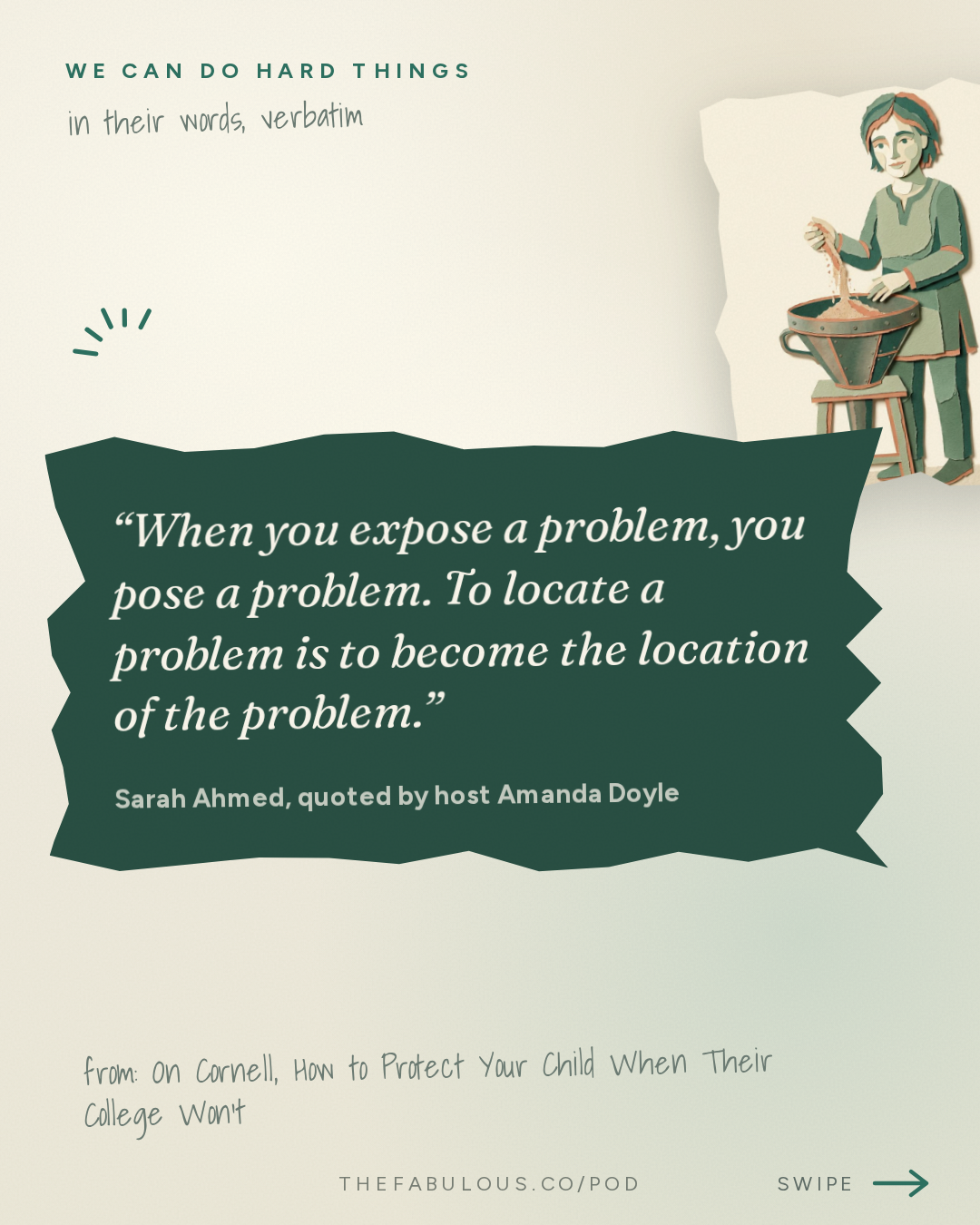
“When you expose a problem, you pose a problem. To locate a problem is to become the location of the problem.”
“Organizational dependency, which is when an organization has complete control over its own processes, and so you're dependent on this organization that's acting badly to seek accountability”
“How traumatic a sexual assault is is not determined by just the violence. It's determined by everything that happens after it's over”
Protocols
-
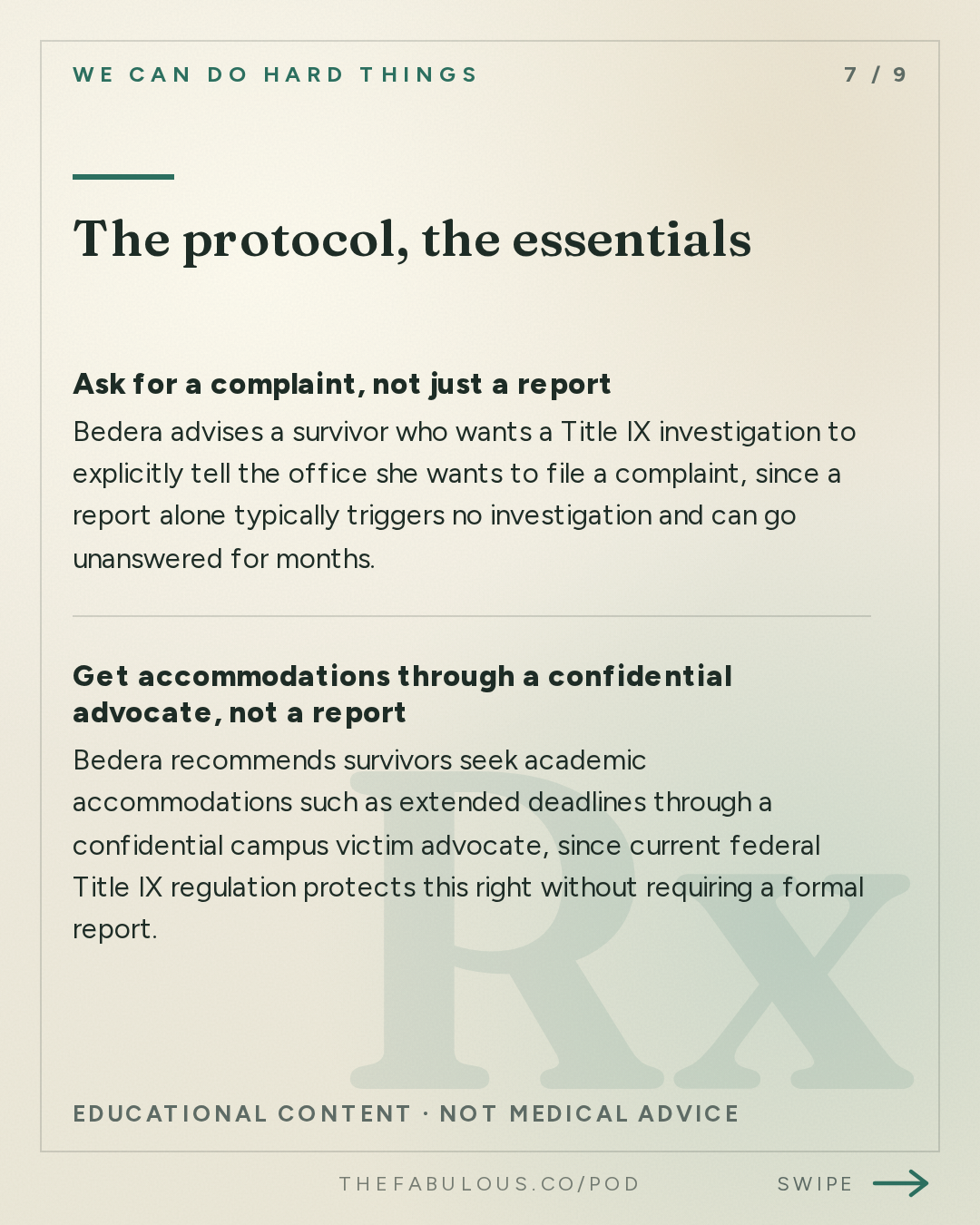
Ask for a complaint, not just a report
Bedera advises a survivor who wants a Title IX investigation to explicitly tell the office she wants to file a complaint, since a report alone typically triggers no investigation and can go unanswered for months.
Once, at the first point of contact with a Title IX office
-
Get accommodations through a confidential advocate, not a report
Bedera recommends survivors seek academic accommodations such as extended deadlines through a confidential campus victim advocate, since current federal Title IX regulation protects this right without requiring a formal report.
As needed during the semester following an assault
-
Ask what she needs, not what she wants
Bedera tells parents to ask a survivor what she needs rather than what she wants or thinks should happen, because the latter question places the burden of solving institutional failure onto the survivor herself.
Ongoing, in every conversation after disclosure
-
Treat reporting as reversible, not a one-time decision
Bedera advises survivors that they can stop participating in a Title IX investigation at any point without blame, since dropping out does not forfeit any right and the university often welcomes it anyway.
At any point during an active Title IX case
Questions this episode answers
What is the difference between a Title IX report and a Title IX complaint?
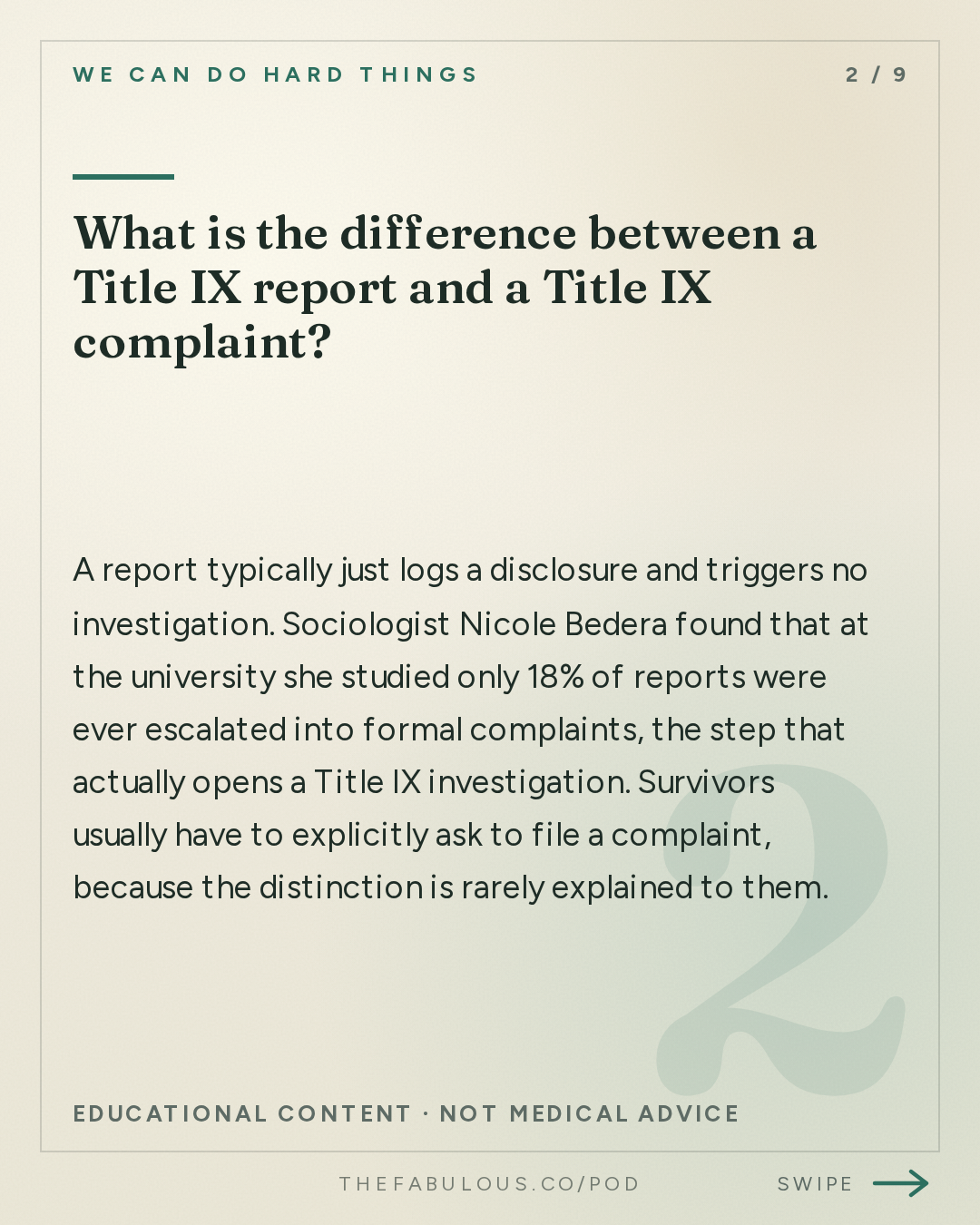
A report typically just logs a disclosure and triggers no investigation. Sociologist Nicole Bedera found that at the university she studied only 18% of reports were ever escalated into formal complaints, the step that actually opens a Title IX investigation (35:51). Survivors usually have to explicitly ask to file a complaint, because the distinction is rarely explained to them (35:28).
How many college sexual assaults are actually reported to school officials?
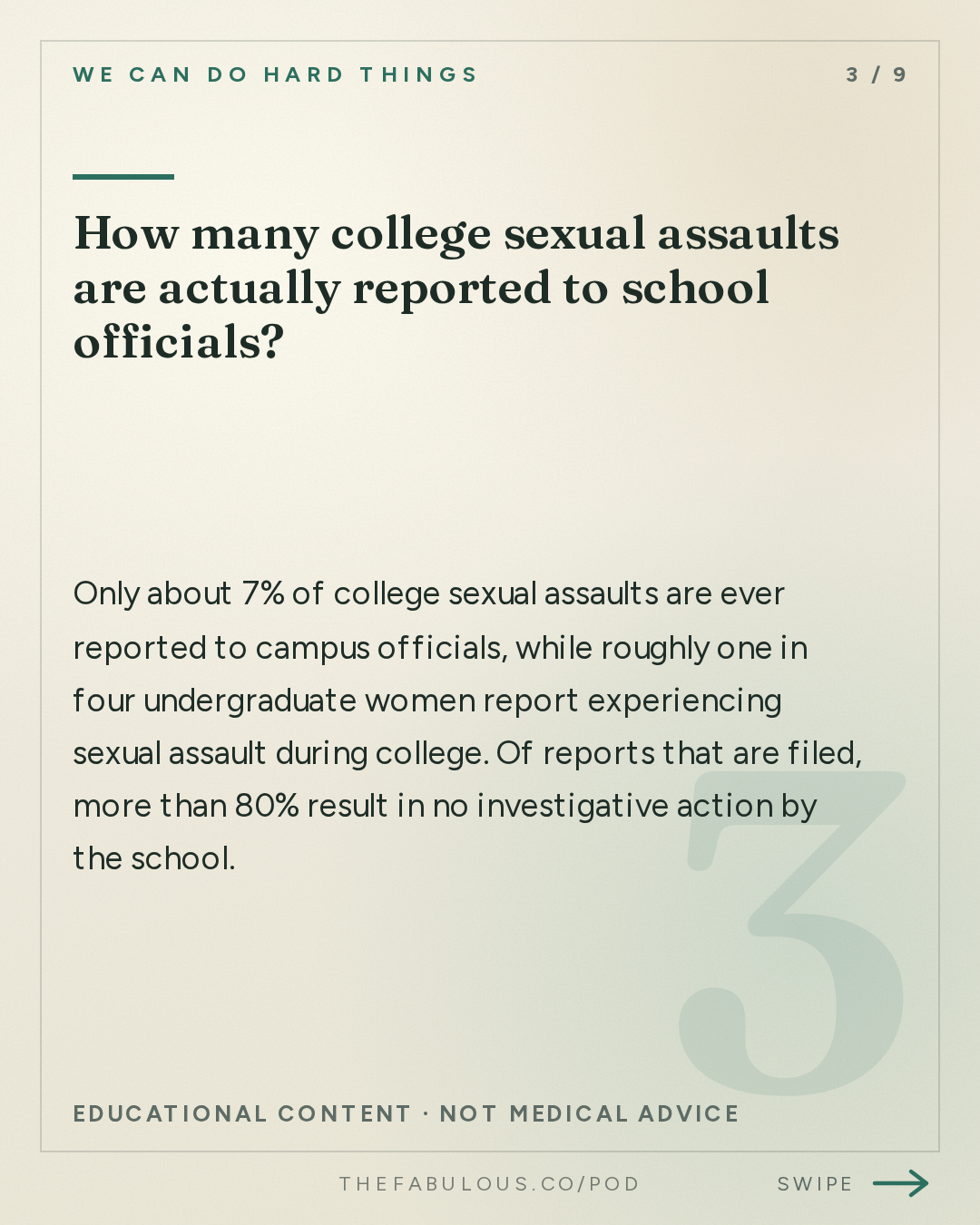
Only about 7% of college sexual assaults are ever reported to campus officials, while roughly one in four undergraduate women report experiencing sexual assault during college (06:58, 06:04). Of reports that are filed, more than 80% result in no investigative action by the school (08:14).
Can a survivor get academic accommodations without filing a Title IX report?
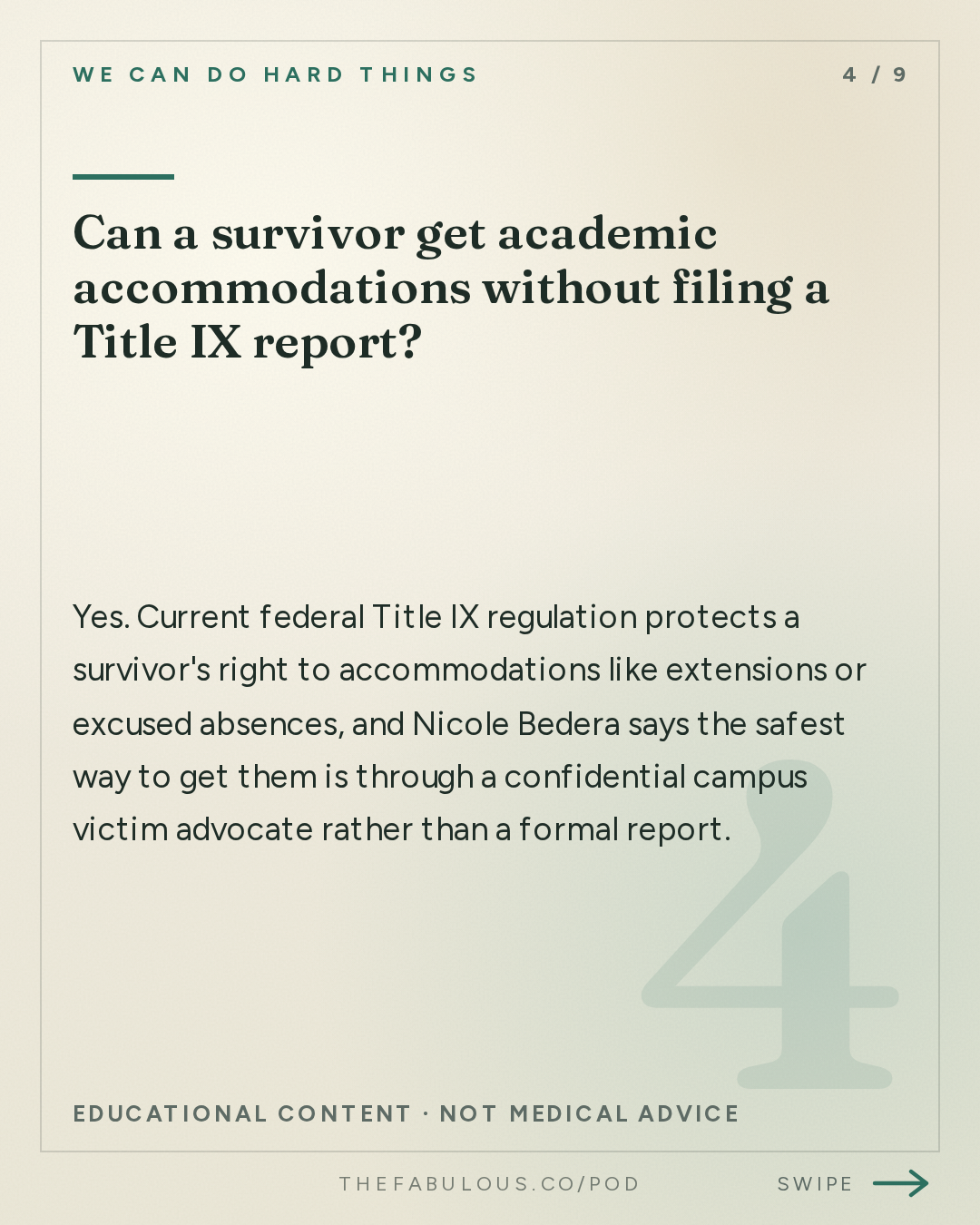
Yes. Current federal Title IX regulation protects a survivor's right to accommodations like extensions or excused absences, and Nicole Bedera says the safest way to get them is through a confidential campus victim advocate rather than a formal report (86:23).
What happens to students found responsible for campus sexual assault?
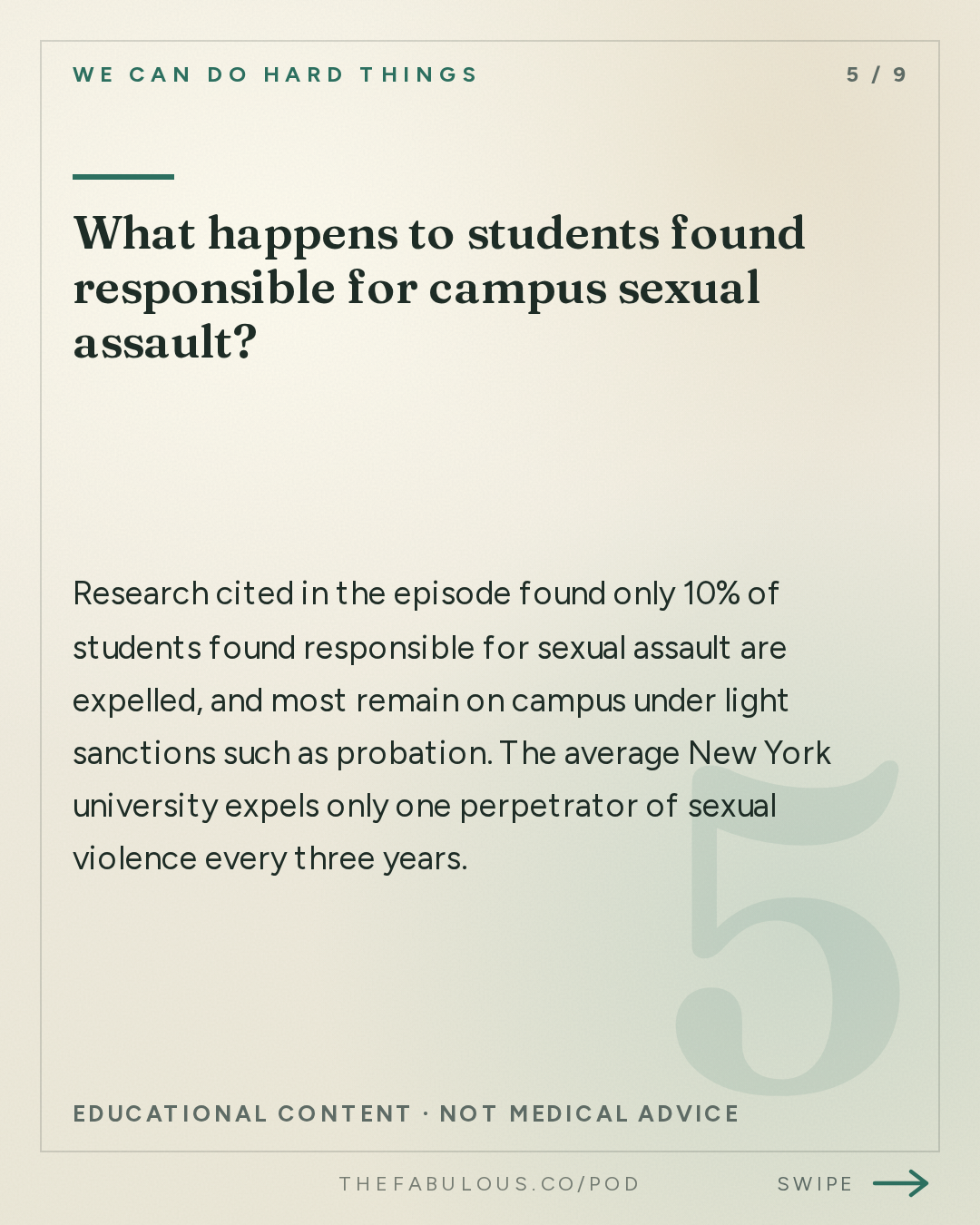
Research cited in the episode found only 10% of students found responsible for sexual assault are expelled, and most remain on campus under light sanctions such as probation (11:34). The average New York university expels only one perpetrator of sexual violence every three years (12:13).
How should a parent respond if their college-age child discloses a sexual assault?
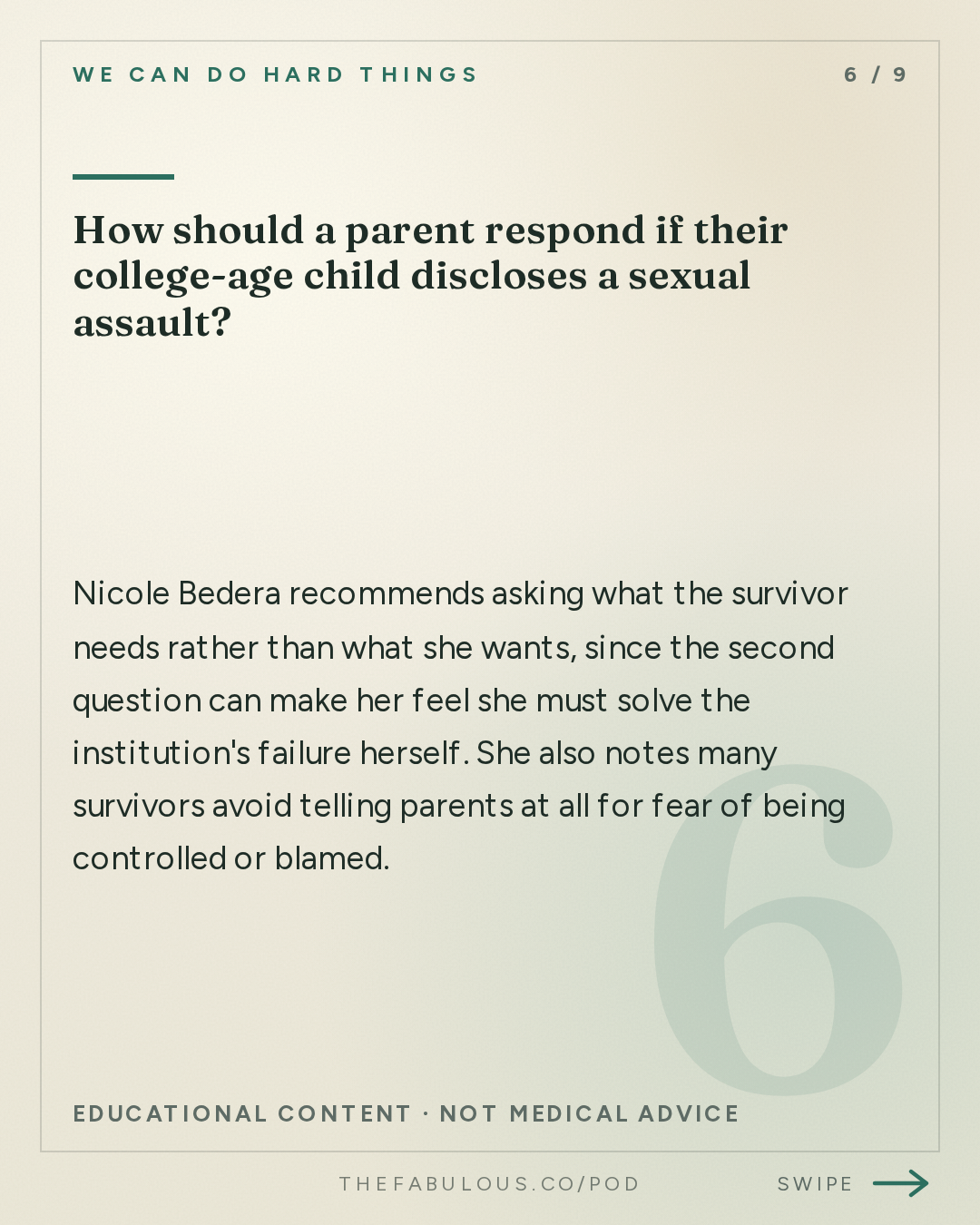
Nicole Bedera recommends asking what the survivor needs rather than what she wants, since the second question can make her feel she must solve the institution's failure herself (89:59). She also notes many survivors avoid telling parents at all for fear of being controlled or blamed (84:06).
The full read, in cards
Go deeper
- On the Wrong Side: How Universities Protect Perpetrators and Betray Survivors of Sexual Violence — Nicole Bedera's book based on a year embedded inside a university Title IX office, detailing how reports get buried and perpetrators protected
- Complaint — Sara Ahmed's study of institutional complaint systems, cited for the idea that exposing a problem makes you the problem
- Association of American Universities campus sexual assault survey — Large-scale survey finding roughly one in four undergraduate women report experiencing sexual assault in college
Mentioned
Nicole Bedera · Jane Doe · Kendall Francis · Cornell University · LSU · Association of American Universities · On the Wrong Side · Kate Mann · Sarah Ahmed · Center for Institutional Courage
More from this show and category

Allison Russell on Healing Childhood Trauma
Singer-songwriter Allison Russell, raised by a white supremacist abuser after Quebec's child-protection system returned her to her mother's custody, describes how chosen family, art, and motherhood helped her return to her body after trauma. She frames scars as proof of survival, reframes PTSD as a bodily response rather than an inner demon, and ties her healing to activism against gun violence and minority rule in Tennessee (41:53, 55:35).

Dr. Rachel Rubin on Perimenopause Relief
Perimenopause can start around age 35 and run for a decade before periods stop, yet fewer than 6% of doctors are trained to treat it. Urologist Dr. Rachel Rubin explains why standard hormone tests mislead, debunks the 2002 Women's Health Initiative scare, and lays out a four-part hormone therapy toolbox, including cheap vaginal estrogen that cuts UTI hospitalizations by over half.

Carson Tueller on Ableism and the Social Model
Carson Tueller, paralyzed at 23 after a trampoline accident, argues that most of disability's suffering comes from ableism, not the body itself. He reframes his injury as a "rebirth," separates the social model of disability from the medical model, and explains why inspiration porn and scripted sex both keep people from their true, undamaged self.

Breast Density and Mammogram Blind Spots Explained
Breast surgeon Lucy de la Cruz explains how dense breast tissue hides cancer from mammograms and what surgical choices patients are rarely offered. Georgetown University Hospital's de la Cruz covers density categories, lumpectomy versus mastectomy recurrence odds, direct-to-implant reconstruction, and nerve grafts that restore nipple sensation within one to two years.
