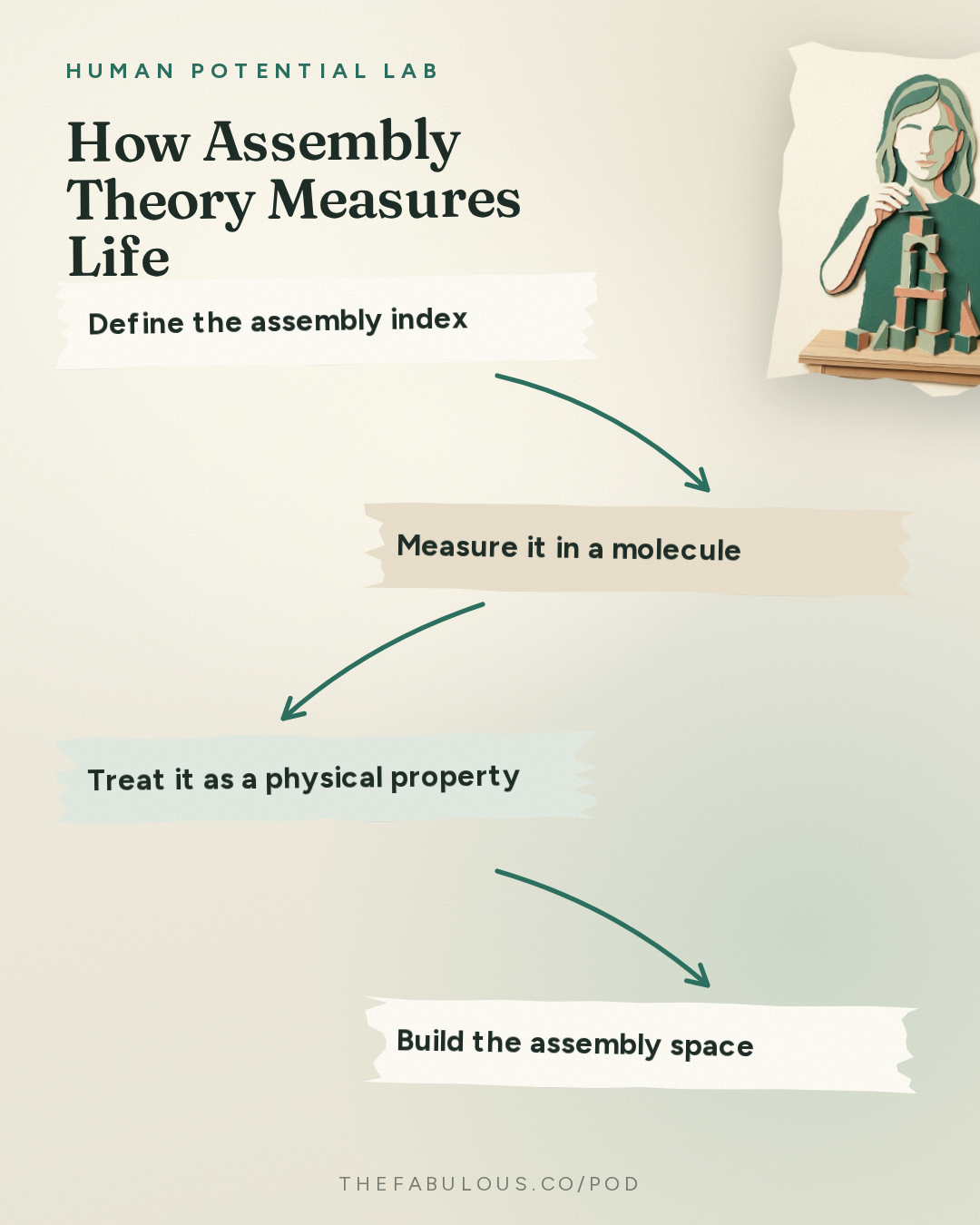
Sara Walker Assembly Theory Explained
Time Creates You When the Time Is Right for You | Sara Walker
▶ Listen to the full episode More from The Psychology Podcast
The brief
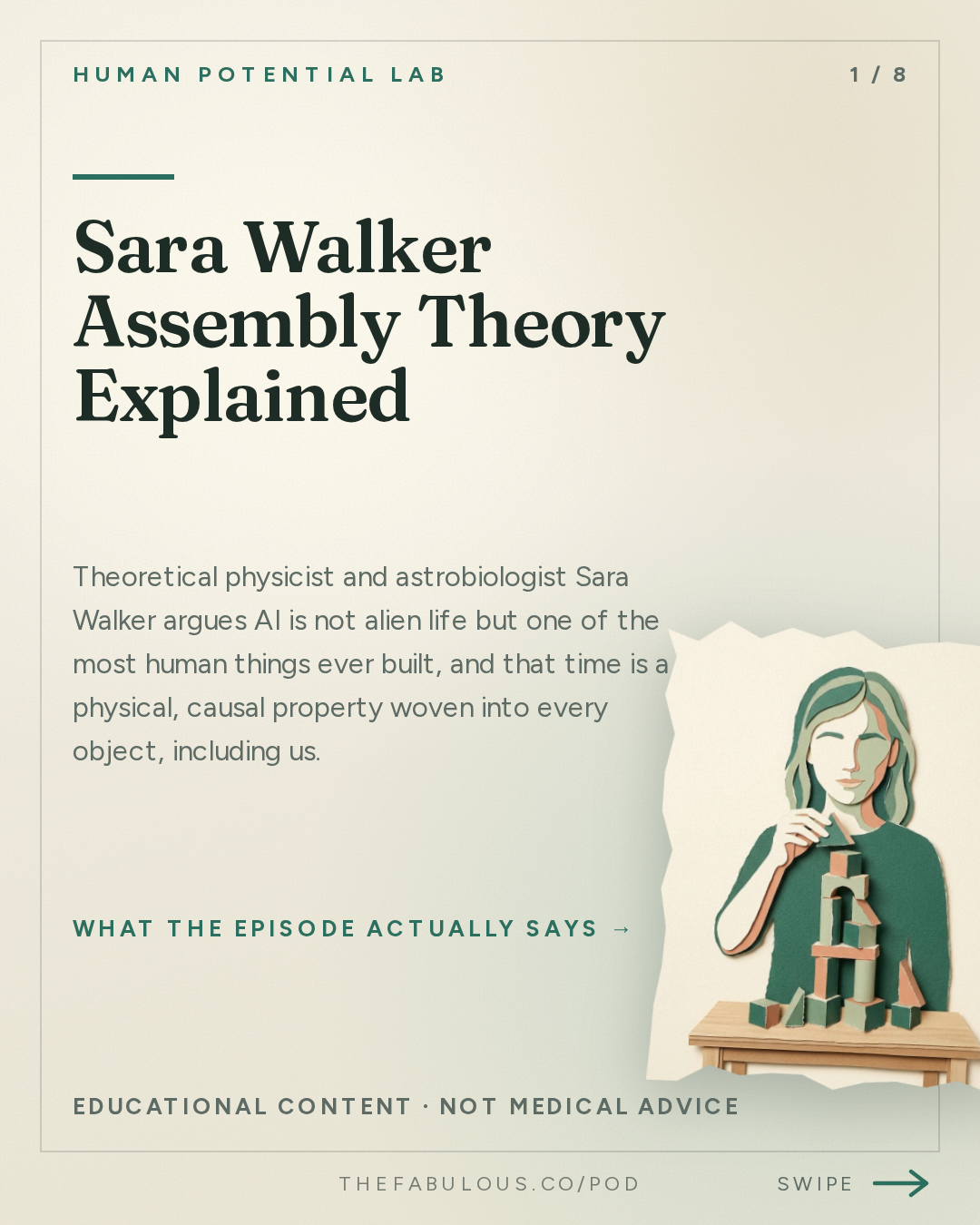
Theoretical physicist and astrobiologist Sara Walker argues AI is not alien life but one of the most human things ever built, and that time is a physical, causal property woven into every object, including us. Her Assembly Theory measures life by counting the minimum steps needed to build something, turning complexity into a number you can read off a molecule.
The house Sara Walker grew up in was built in 1730 (02:46). It sat in the same Connecticut town that produced Revolutionary War hero Nathan Hale, and it was full of antiques nobody was forbidden to touch. Her mother, an antiques dealer, could recite the lineage of every chair and every owner back to the year the house went up. Walker, now a theoretical physicist, says that childhood taught her something she has spent her career trying to prove with equations: that objects carry their history inside them, and that history is not decoration. It is structure.
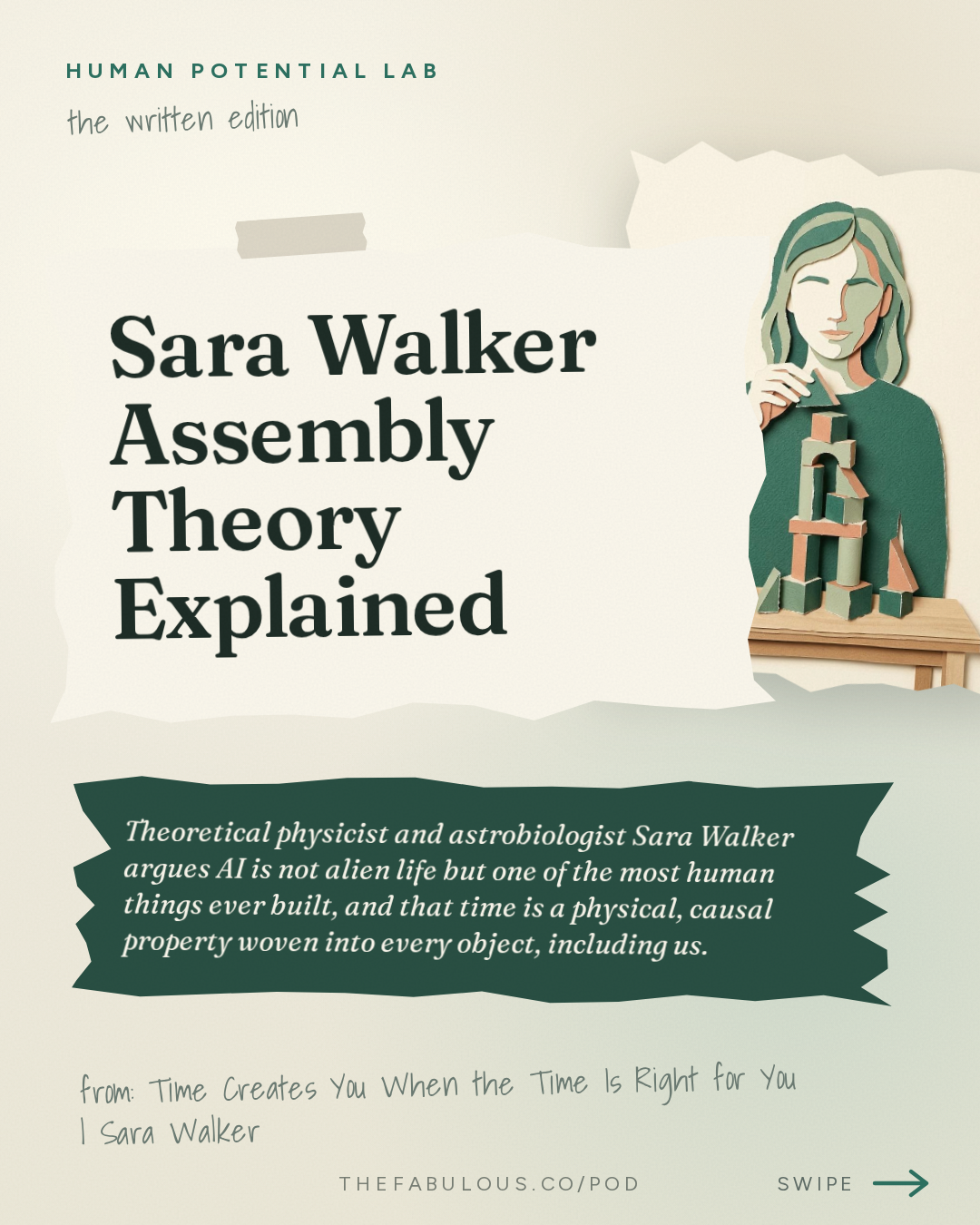
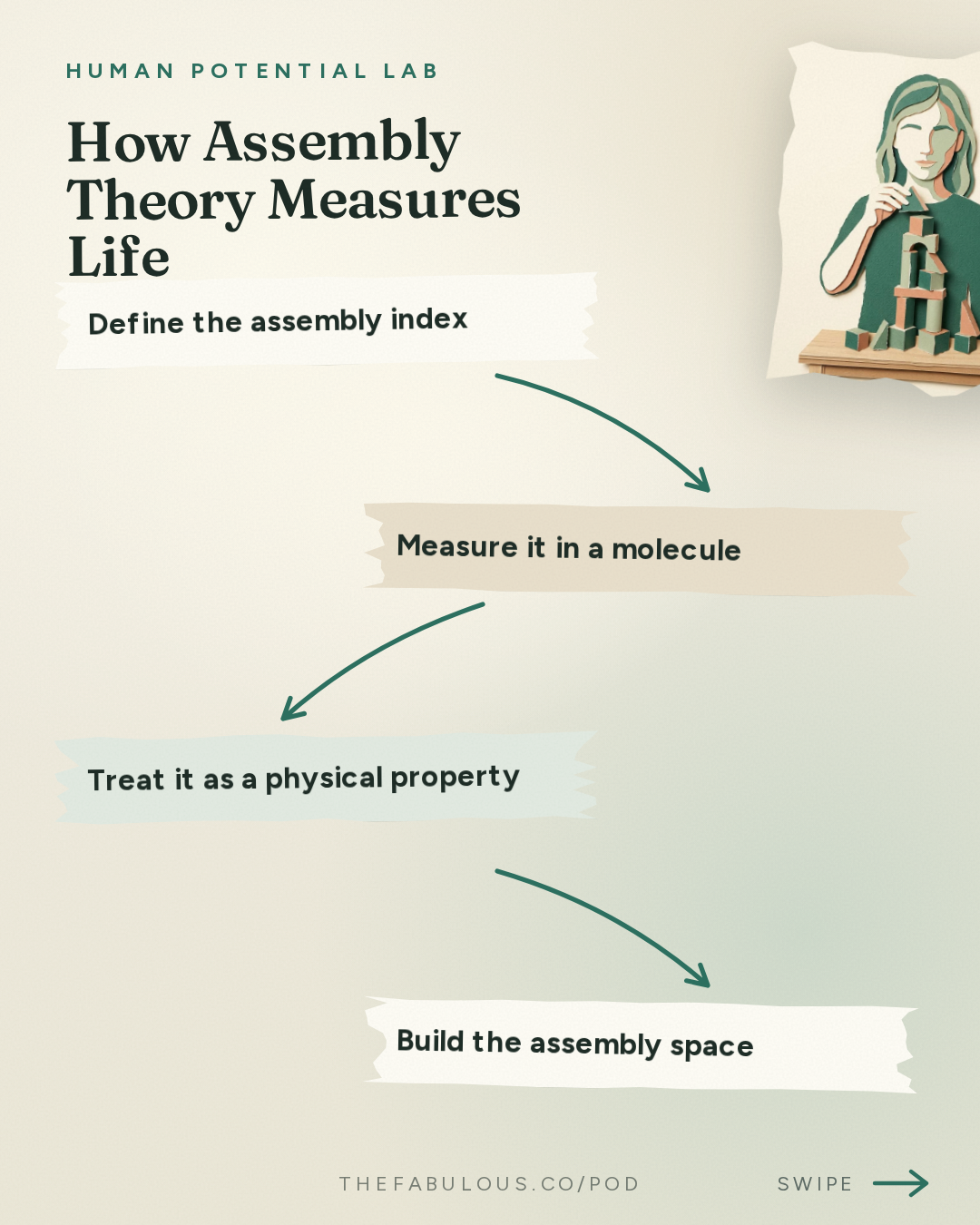
That idea is the spine of Assembly Theory, the framework Walker has built with her colleagues to explain what life actually is, not just on Earth but anywhere in the universe. The theory starts with a simple question: how many steps does it take to build this specific thing? Count the minimum number of steps required to produce an object, and you get what Walker calls the assembly index (16:43). You can measure it directly from a molecule, the same way you'd measure mass. That is the leap she makes explicit: if an instrument can read it off the physical world, it counts as a physical property, the way mass or electric charge eventually did (17:12). A molecule with a high assembly index, something that took many nested steps to make and that shows up repeatedly, like a protein or an engineered drug, looks like the signature of life. A molecule that could have formed by chance in one or two steps does not. NASA-style life-detection missions could, in principle, carry a version of this ruler to another planet.
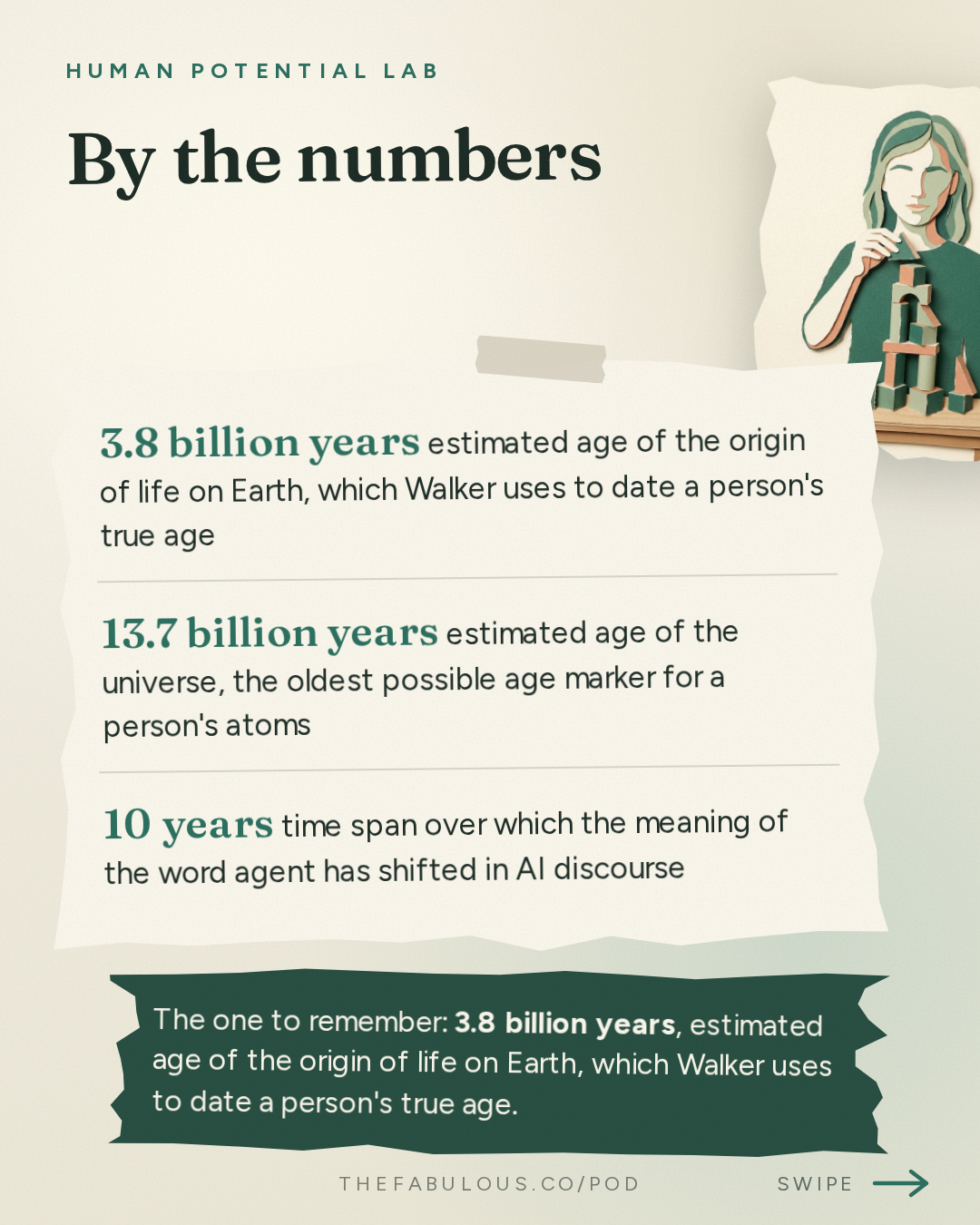
Walker's bigger claim is stranger and, she thinks, more freeing. She does not think there is one version of each of us hiding in some other branch of a multiverse. There is exactly one arrangement of matter that is you, produced by a specific, unrepeatable sequence of events across billions of years, and it will never happen again (07:27). "You're one particular expression of this that happens to live now, and it's not something that will repeat," she says, which she finds more moving than any multiverse story, because it means the universe actually had to do something to make you (07:52). Measured one way, she notes, a person is about 13.7 billion years old, the age of the universe's oldest atoms. Measured another way, the more informative way, a person is about 3.8 billion years old, the age of the origin of life on Earth, because that is when the specific evolutionary lineage that produced you actually began (04:35).
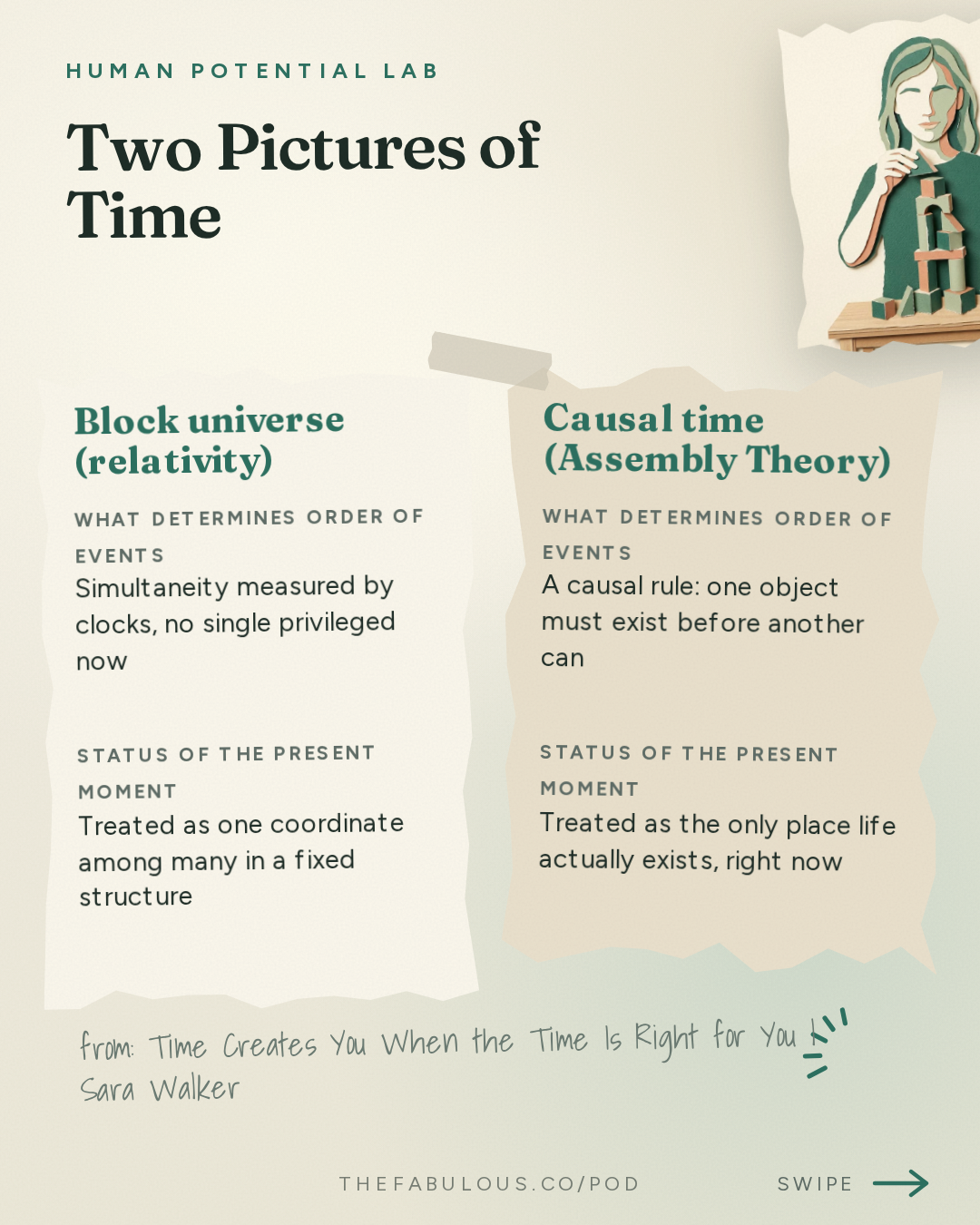
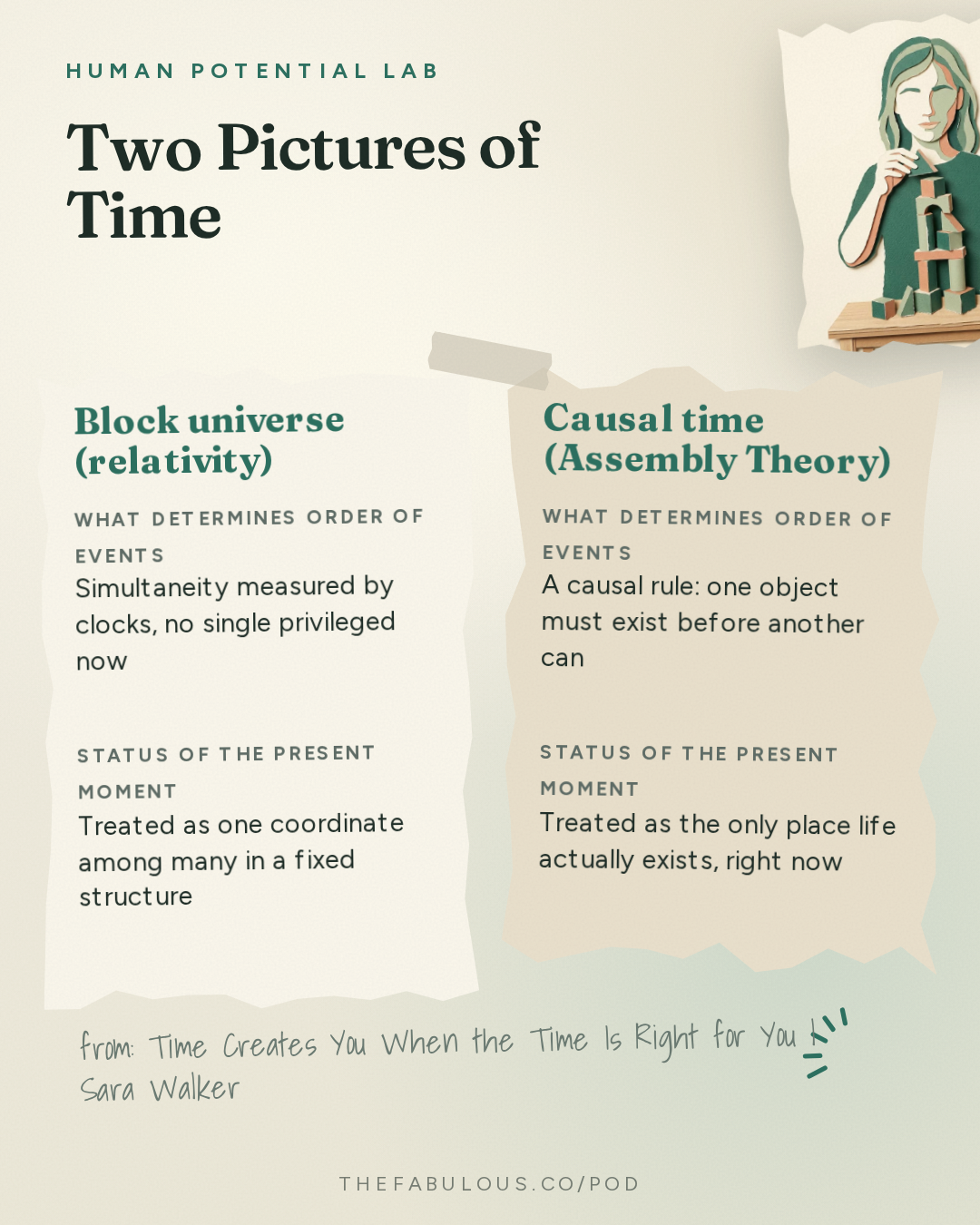
That claim rests on a specific argument about time, and it is where Walker picks her fight with a famous dead physicist. She brings up the debate between Albert Einstein and the philosopher Henri Bergson over the nature of time, and says if she could ask Einstein one honest question, it would be what he really thought of it, off the record (13:44). Relativity, in her reading, technically describes the simultaneity of events as measured by clocks, not time as something that passes and is lived (31:45). People have collapsed those two things into one, and spent a century arguing that the passage of time must be an illusion of the mind. Walker thinks that is a category error.
Time as Something You Can Touch
In Walker's framework, time is a causal constraint: a thing cannot exist unless the thing it depends on already exists (32:32). Stack enough of those dependencies and you get what she calls assembly space, a kind of map of everything that could possibly exist, ordered by what has to come before what. Depth in that map is a real, physical quantity, which is why she is comfortable saying a person's body literally carries 13.8 billion years of accumulated structure, not as a metaphor but as a measurable fact (33:27). "Nothing this complex can happen for free in our universe," she has said elsewhere, a line Kaufman raised when asking her about a disagreement with biologist Michael Levin, who she says believes in evolutionary "free lunches." Her counter is that human-designed lab experiments quietly smuggle in billions of years of selection as boundary conditions, then act surprised when something complex pops out (26:32).
This is also the lens through which she answers the question everyone wants to ask her: is AI alive, and is it alien? Her answer to the second question is flatly no. "Alien," to Walker, means an independent lineage of life, a different origin event entirely. AI does not have one.
"AI is not an independent lineage of life. It is one of the most human things we've ever invented." — Sara Walker (00:18)
AI did not spring up spontaneously on a planet the way biological life did. It took billions of years of accumulated human and biological infrastructure, laboratories, language, culture, to create the boundary conditions that make something like a large language model possible, and engineers are actively shaping it right now through the equivalent of artificial selection, tuning parameters the way breeders once tuned livestock (40:06). That makes AI an extension of human evolutionary lineage, not a rival one. She also points out that basic vocabulary is shifting under everyone's feet as this unfolds: the word "agent" meant something different ten years ago than it does in an AI lab today, and "consciousness" is drifting the same way, which is part of why public debate about AI feels so disorienting (41:37).
A Cultural Map, Not a Cosmic One
That same skepticism about borrowed vocabulary shapes her view of UFOs. Walker says she has looked at the evidence and remains unconvinced, and she notes that UFO sightings cluster overwhelmingly inside the United States, which to her looks less like a cosmic signal and more like a cultural one, the kind of socially reinforced belief humans are evolutionarily primed to adopt from the group (51:15). She would like someone to map public anxiety about AI existential risk the same way, suspecting it would show the same distinctly American shape, a technological restaging of older religious anxieties about godlike forces (51:59).
Where the conversation lands, fittingly, is on death, which is the one piece of this theory that stops being abstract. Walker has written that the first life on Earth never died, because it is still physically embedded in every living thing descended from it, including us.
"The first life didn't die. It's in us." — Sara Walker (54:35)
She is careful not to turn this into easy comfort. She says she does not want her own conscious experience to end, and she does not pretend to know what happens after it does. What she finds genuinely steadying is narrower and more concrete: the universe has a finite amount of matter and time, she got a turn with some of it, and when her turn ends, that same matter becomes available for other things to exist. She calls humans, for now, the highest-density causal structures we know of in the universe (57:52), meaning no other known system packs as much layered, dependent history into so small a space. Being one of those structures, briefly, is the whole point. Not because it lasts. Because, in her account of how the universe works, nothing like it was guaranteed to happen at all.
Ask this episode anything
Pod's AI answers from the episode itself, with the minute mark so you can hear it yourself.
Or start with one of these
Ask this episode
Pod's AI listens to the whole episode to answer, and points you to the minute it comes from.
The rest of this answer, and any question after it
Answers come from the episode itself, never from a summary of it.
ContinueKey takeaways
- Sara Walker says AI is not alien life, calling it one of the most human inventions ever made (00:18)
- Her Assembly Theory measures life by counting the minimum build steps for an object, called the assembly index (16:43)
- Walker treats time as a physical, causal constraint, not just a feature of human experience (32:32)
- She rejects the multiverse, arguing each person is one unrepeatable arrangement of matter (07:52)
- Walker calls UFO sightings largely a US cultural phenomenon rather than evidence of alien visitors (51:15)
The episode in cards
By the numbers
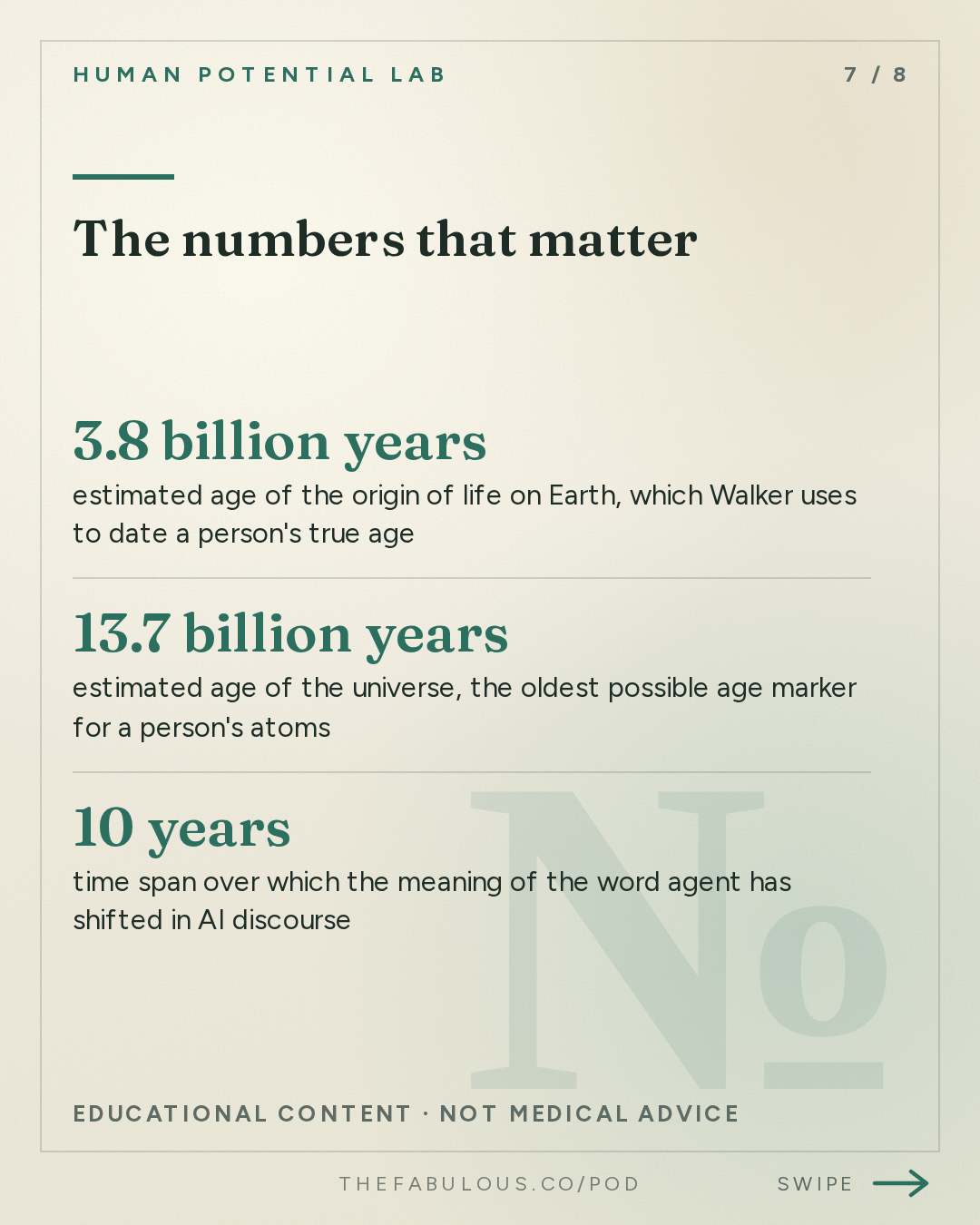
- 3.8 billion years estimated age of the origin of life on Earth, which Walker uses to date a person's true age
- 13.7 billion years estimated age of the universe, the oldest possible age marker for a person's atoms
- 10 years time span over which the meaning of the word agent has shifted in AI discourse
In their words
“AI is not an independent lineage of life. It is one of the most human things we've ever invented.”
“Life is objects building more complex objects.”
“Nothing this complex can happen for free in our universe.”
Questions this episode answers
What is Sara Walker's Assembly Theory?
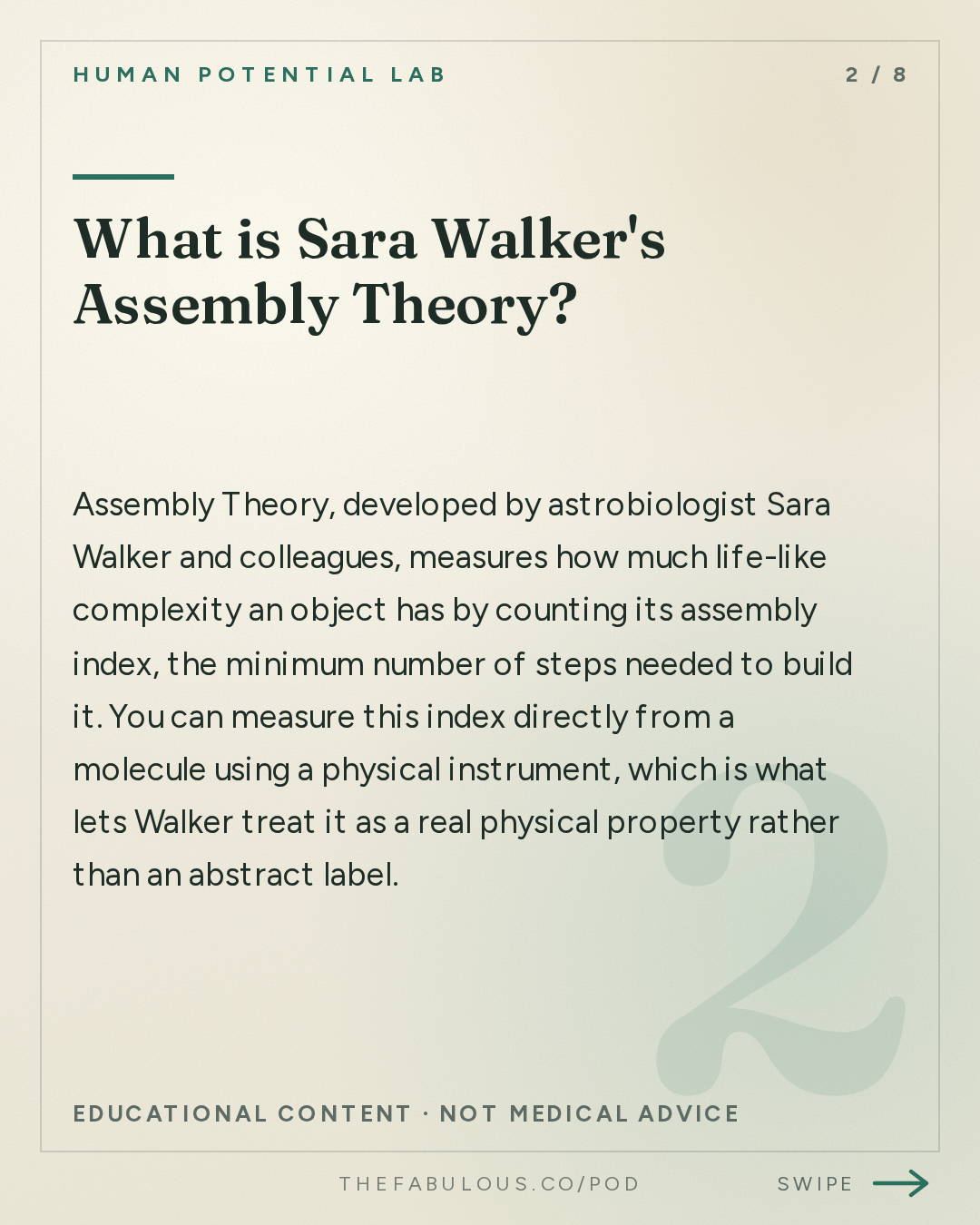
Assembly Theory, developed by astrobiologist Sara Walker and colleagues, measures how much life-like complexity an object has by counting its assembly index, the minimum number of steps needed to build it (16:43). You can measure this index directly from a molecule using a physical instrument, which is what lets Walker treat it as a real physical property rather than an abstract label (17:12).
Does Sara Walker think AI is alive or alien?
Walker says AI is not alien, because to her alien means an independent lineage of life with its own origin, and AI has no origin apart from human civilization (00:18). She argues AI required billions of years of human-built infrastructure to become possible, and engineers actively shape it through selection, which makes it an extension of human evolution rather than a separate form of life (40:06, 40:51).
Is time a physical property according to Sara Walker?
Walker argues time is a causal constraint built into physical objects, meaning one thing cannot exist until another thing it depends on already exists (32:32). She distinguishes this from Einstein's relativity, which she says technically describes simultaneity measured by clocks rather than the lived passage of time (31:45).
What did Sara Walker say about UFOs and aliens?
Walker says she finds the probability of aliens visiting Earth very low and has not been persuaded by the evidence she has reviewed (50:55). She points out that UFO sightings cluster heavily within the United States, which she reads as a cultural and social pattern rather than a sign of extraterrestrial contact (51:15, 51:38).
How old does Sara Walker say a person really is?
Walker says a person can be dated two ways: 13.7 billion years, the age of the universe's oldest atoms, or 3.8 billion years, the age of the origin of life on Earth, which she considers the more meaningful marker because it reflects the specific evolutionary lineage that produced that person (04:35, 05:35).
The full read, in cards
Go deeper
- The Physicist and the Philosopher — recounts the 1922 debate between Albert Einstein and philosopher Henri Bergson over the nature of time
- Alien Minds — essay on AI minds that Walker says she likes but would not describe using the word alien
- AI is Life — Walker's essay arguing AI belongs inside the same evolutionary category as biological life
Mentioned
Sara Walker · Nathan Hale · Isaac Newton · Albert Einstein · Henri Bergson · Assembly Theory · Michael Levin · Paul Davies · Dario Amodei · Anthropic · Temple Grandin · Abraham Maslow
More from this show and category
Christof Koch on Why AI May Not Be Conscious
Neuroscientist Christof Koch argues consciousness is not the same as intelligence and may not even be generated by the brain alone. Integrated Information Theory holds that only highly integrated physical systems can feel anything, which is why Koch doubts today's AI, however humanlike, experiences anything at all (12:50).
L.A. Paul on Transformative Experience and AI
Philosopher L.A. Paul says a transformative experience changes what you care about most, and only living it reveals what it's like (03:55, 05:12). She argues this same logic breaks AI alignment, since human values shift as people interact with new technology, making alignment a target that keeps moving (45:13, 46:19).
Michael Levin on Bioelectricity and Genius
Biologist Michael Levin argues intelligence is a spectrum of problem-solving competence found in cells, frogs, robots, and machines, not just brains. He says genius, from mathematician Srinivasa Ramanujan's theorems to lab-grown xenobots, taps a shared non-physical "Platonic space" of patterns, with bioelectric signals acting as glue that links small parts into larger goal-seeking wholes.
Scott Barry Kaufman's 7 Lessons from 11 Years of Podcasting
Scott Barry Kaufman closes 11 years and 478 episodes of The Psychology Podcast with seven lessons on human potential, personality change, and creativity. He argues neuroticism is the easiest Big Five trait to shift and openness the hardest, and that lasting change comes from habits, not willpower (09:06, 15:22).
