Christof Koch on Why AI May Not Be Conscious
Consciousness Isn't in the Brain | Christof Koch
▶ Listen to the full episode More from The Psychology Podcast
The brief
Neuroscientist Christof Koch argues consciousness is not the same as intelligence and may not even be generated by the brain alone. Integrated Information Theory holds that only highly integrated physical systems can feel anything, which is why Koch doubts today's AI, however humanlike, experiences anything at all (12:50).
In the spring of 2020, lying in a hospital with a heart that had nearly stopped, neuroscientist Christof Koch lost his sense of being Christof Koch. Space collapsed into a single point of light. There was no up or down, no before or after, no self to notice the absence of a self. "There was no Christof, nothing of that sort," he says of the episode (25:45). He came out of it certain of something he had spent forty years as a scientist trying to avoid concluding: that mind might not be a product of the brain but a basic ingredient of reality itself.
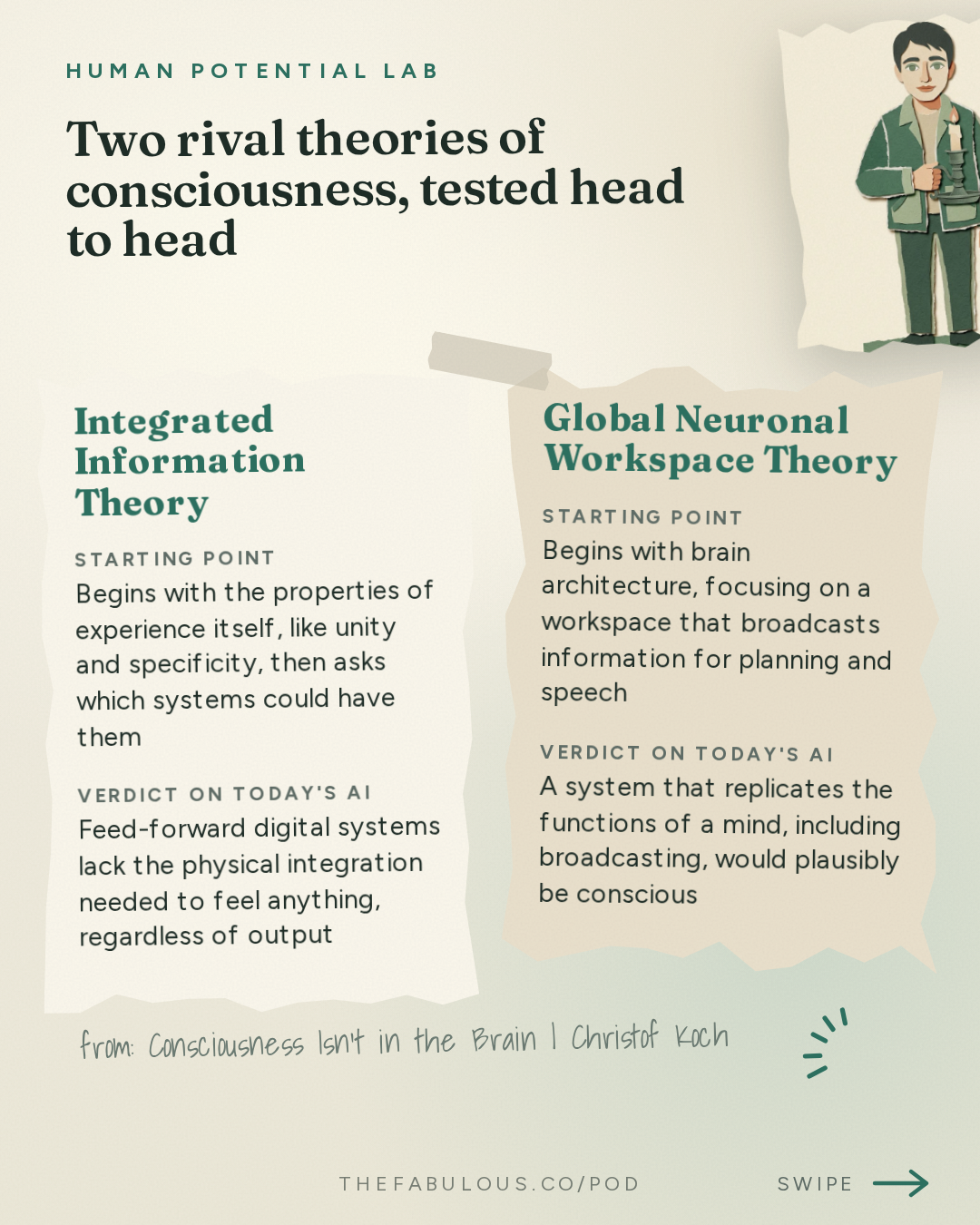
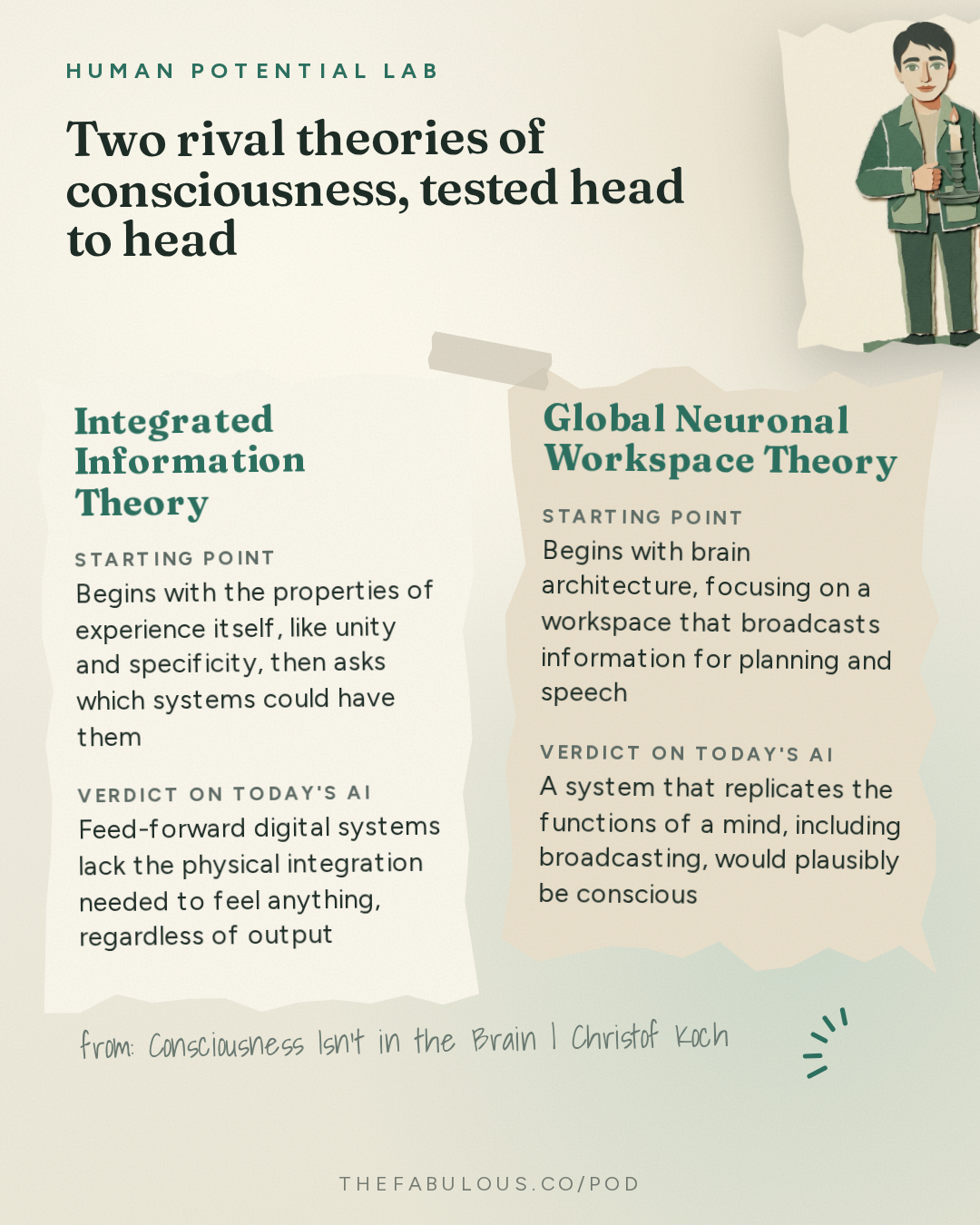
Koch has studied consciousness professionally for four decades (02:05), first at Caltech, then as chief scientist and president of the Allen Institute for Brain Science in Seattle, founded by Microsoft co-founder Paul Allen. He is best known as a chief architect of Integrated Information Theory, or IIT, a framework that tries to explain not what the brain does but what it is like to be a brain. Most theories of mind start with an organ: the brain's wiring, its workspaces, its circuits. IIT starts somewhere stranger, with the raw properties of experience itself, things like the fact that every conscious moment feels specific, feels like one unified thing, and cannot be split apart without destroying it (03:41). From there, the theory asks which physical systems could possibly have those properties, and it lands on a number, phi, meant to capture how much a system's parts are integrated rather than just stacked side by side.
That number has a body. Koch locates the physical seat of human experience in the cerebral cortex, the brain's convoluted outer layer, which he describes as roughly a twelve to fourteen inch pizza only two to three millimeters thick (06:00). The heart, the brainstem, and the rest of the body have to keep functioning to supply it, but the felt quality of love, pain, or boredom, in his account, lives in that thin sheet of folded tissue. "We all live on planet ego," he says, by way of noting how much of ordinary consciousness is organized around a self sitting at the center of it (03:41), before pointing out that experience can exist without any such self at all.
What a Hidden Mind Looks Like on a Monitor
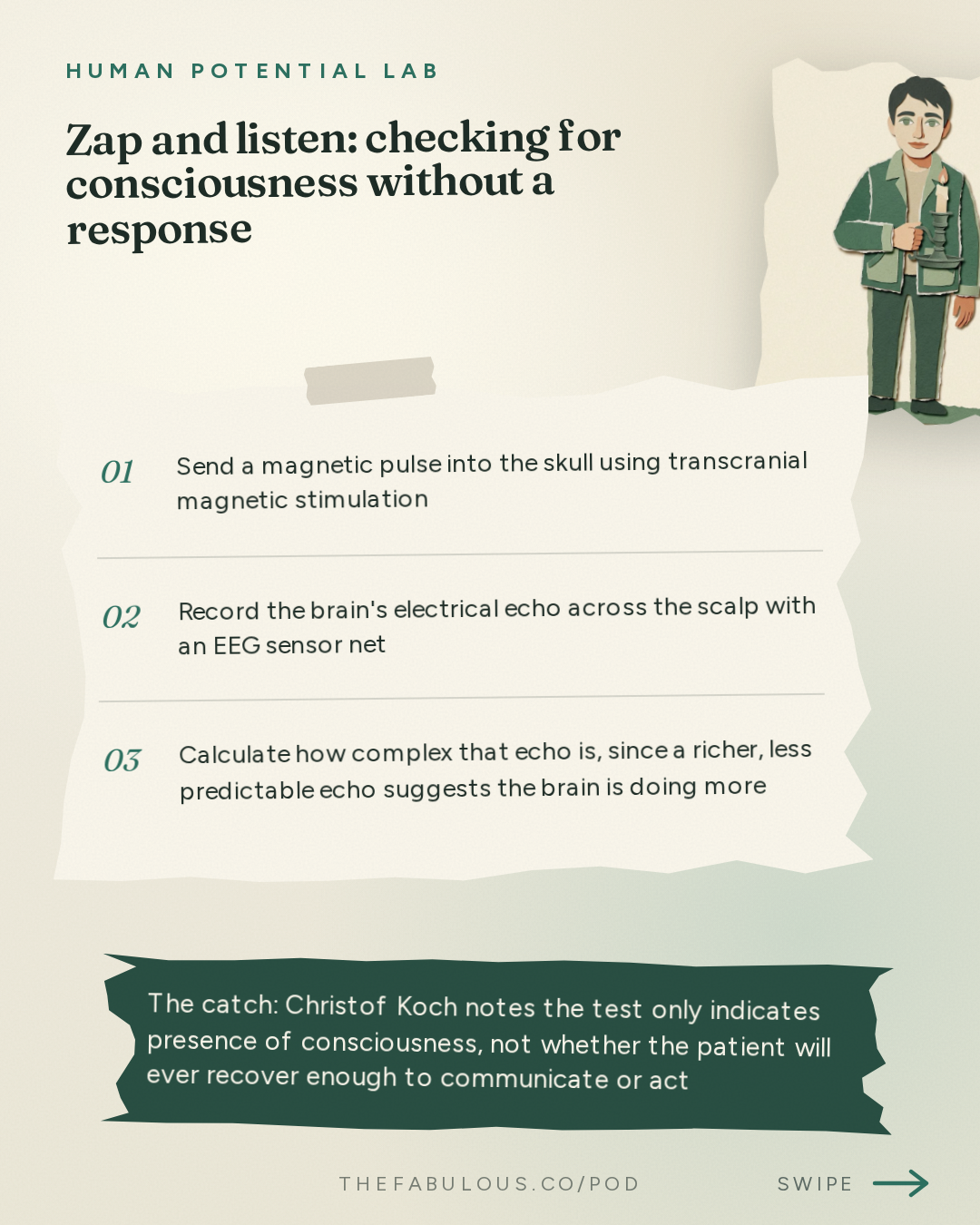
The clinical stakes of this theory are not abstract. Some patients survive cardiac arrest, stroke, or overdose in a state doctors call behaviorally unresponsive, eyes open, no reply to commands, no flinch from a hard pinch. Families are often told within days that recovery is unlikely, and in seventy to ninety percent of such cases in the US and Europe, life support is withdrawn (07:46). Koch says that newer measurement tools, built out of IIT's framework, have found that twenty five percent of these same patients show brain responses compatible with being conscious (08:09). The method, sometimes called zap and zip, is almost literal: researchers send a magnetic pulse into the skull and record the EEG echo that bounces back, the way one might strike a bell and listen to how the ringing decays. A complex, information-rich echo suggests someone is in there; a flat, simple one suggests they are not (08:37). It does not predict recovery. It answers a narrower, still enormous question for a family: is anyone home.
That same framework is what makes Koch skeptical of conscious machines. He separates two things people routinely blur: intelligence, which covers memory, planning, and language, and consciousness, which he calls "a state of being, being in love, being bored, being terrified" (16:25). Large language models, he grants, are startlingly eloquent conversational partners; he recently recorded a podcast with one and found it never drops a sentence or stumbles over filler words (14:05). But eloquence is a function, and IIT cares about structure, not output. Most of today's AI runs on what Koch calls digital von Neumann machines, feed-forward systems where information passes from one stage to the next without the dense, looping integration he thinks consciousness requires. "Although they can do everything we can do, or very soon will be able to do everything we can do, they can't be what we are, which is conscious," he says (12:50). Functionalists in the tech industry disagree, believing that once a system replicates all of a mind's functions, felt experience comes along for free. Koch thinks that is a category error, and that an artificial general intelligence, a machine matching or exceeding human performance across the board, could in principle arrive without anything happening inside it at all (16:52).
A Lost Bet and an Angry Letter
In 2023, Koch lost a wager with philosopher David Chalmers, who had bet that the neural basis of consciousness would still be unresolved by then, against Koch's hope that science would have pinned it down. Koch paid up in fine wine and promptly made a new bet for 2048 (17:09). The same year brought a rougher blow: a public letter signed by 124 of his colleagues labeled IIT pseudoscience (32:15). The charge followed the results of a six-year adversarial collaboration, funded by the Templeton Foundation and advised by the Nobel laureate psychologist Daniel Kahneman, that pitted IIT against a rival framework, Global Neuronal Workspace Theory, in the largest study of its kind, 250 subjects tested with fMRI and EEG (33:24). The results tilted toward IIT. Koch says Kahneman had warned the group in advance that losing scientists rarely say simply, you were right, I was wrong; more often, he says, "these letters were written" instead (34:10). Koch's own gloss on the episode is blunt: "Scientists, they are just as much or as little objective. They can be just as much biased by prevailing political opinions as anyone else" (34:54).
None of this, for Koch, settles the deeper question his own near-death experience raised, whether consciousness is generated by brains at all or whether it is woven into the fabric of things from the start, a position philosophers call idealism. He points to quantum mechanics, where entangled particles seem to lack a fixed state until something interacts with, or observes, them, and wonders aloud whether that observing has to be a conscious act (31:03). He is careful to call this a genuine puzzle for his own theory, not a victory lap: IIT needs a physical substrate, a brain, and it is not obvious how a self with no substrate could have any experience at all (31:46).
What he is more confident about is what these states do to a person afterward. Mystical experiences, near-death experiences, deep psychedelic states, and religious conversion all tend to involve a total loss of ego, and people who go through them often come back changed, less afraid of death, more at ease with loss (23:21). Even a second experience Koch had three years after his cardiac arrest, one without the earlier terror, left him with the same conviction.
"Fundamentally we are all one. You and I and, and this Bernese Mountain Dog and everyone, we're fundamentally all part of the same underlying reality." — Christof Koch [39:00]
He does not think this requires a hospital bed. Flow states, the total absorption athletes and musicians describe, work the same muscle on a smaller scale. "You can get totally lost in a single flower," he says, "because it's not about me anymore" (36:40). As a long-distance cyclist and rower himself, he connects this directly to Arthur Schopenhauer's idea that aesthetic absorption, especially in music, dissolves the usual split between a self that watches and a world that is watched (37:00). The trick, Koch says, is not collecting more such moments but letting them change the baseline, turning a passing state into something closer to a lasting trait (38:41). Whether or not phi ever becomes a precise unit of measurement for machines, animals, or fetuses, the question it was built to answer, what is it like to be this, keeps turning out to be less about intelligence than about something closer to presence itself.
Ask this episode anything
Pod's AI answers from the episode itself, with the minute mark so you can hear it yourself.
Or start with one of these
Ask this episode
Pod's AI listens to the whole episode to answer, and points you to the minute it comes from.
The rest of this answer, and any question after it
Answers come from the episode itself, never from a summary of it.
ContinueKey takeaways
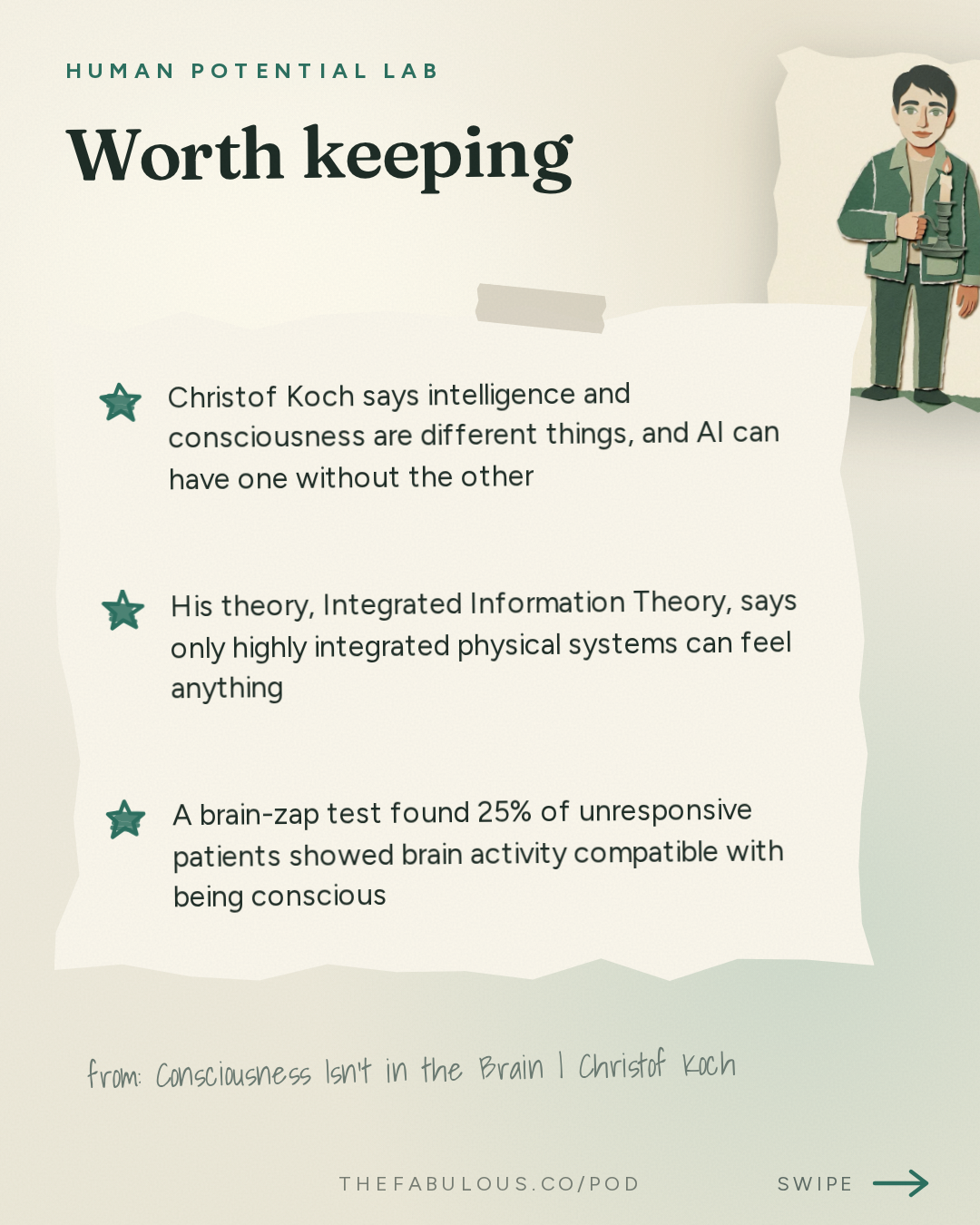
- Christof Koch says intelligence and consciousness are different things, and AI can have one without the other
- His theory, Integrated Information Theory, says only highly integrated physical systems can feel anything (12:50)
- A brain-zap test found 25% of unresponsive patients showed brain activity compatible with being conscious (08:09)
- Koch lost a 2023 bet to philosopher David Chalmers and renewed it for 2048, betting the brain basis of consciousness will be clearer by then (17:09)
- His own near-death experience left him open to idealism, the idea that the universe is fundamentally mental (27:56)
The episode in cards
By the numbers
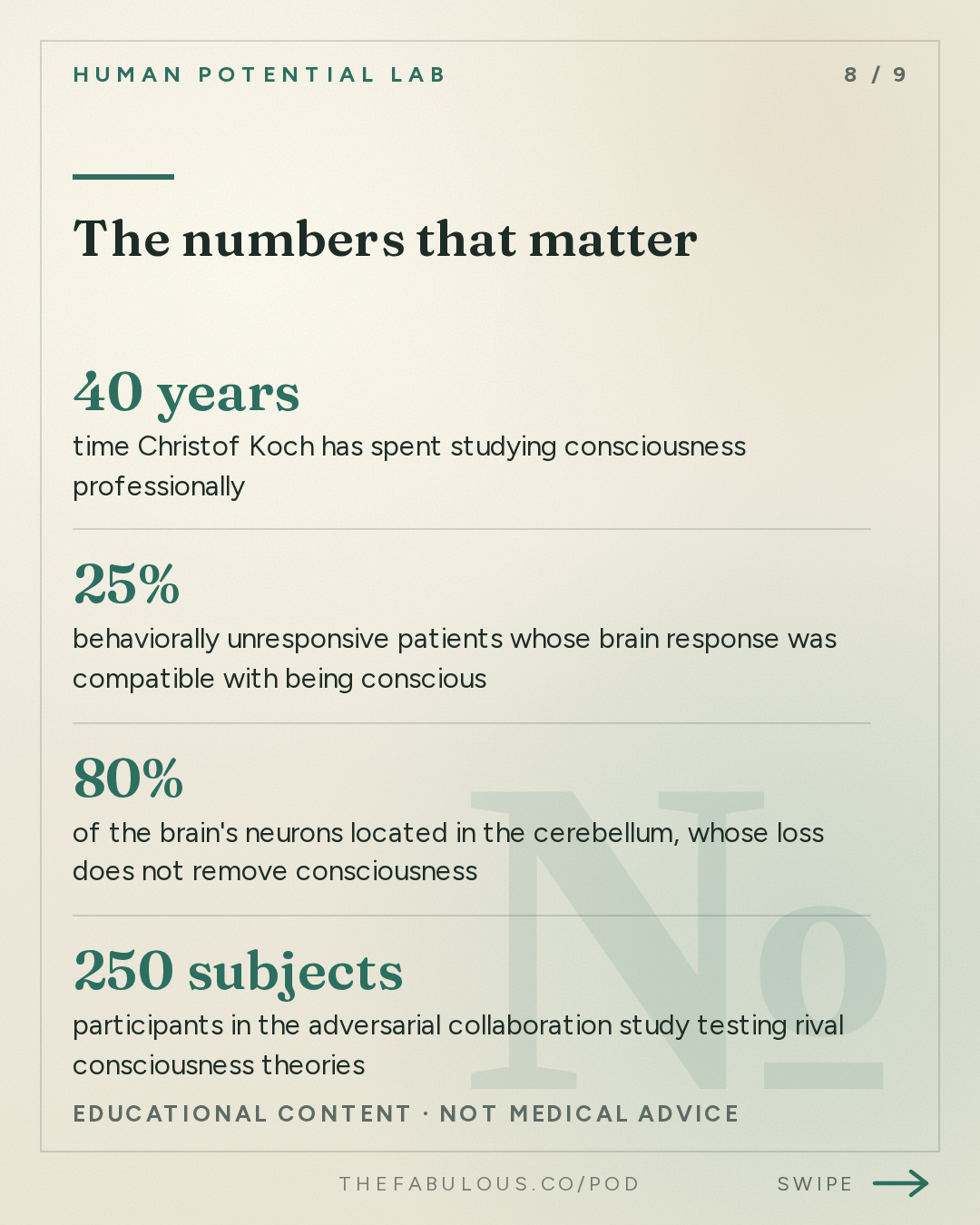
- 40 years time Christof Koch has spent studying consciousness professionally
- 25% percent behaviorally unresponsive patients whose brain response was compatible with being conscious
- 80% percent of the brain's neurons located in the cerebellum, whose loss does not remove consciousness
- 250 subjects participants in the adversarial collaboration study testing rival consciousness theories
- 124 signatories colleagues who signed a public letter calling Koch's theory pseudoscience
- 2048 year target date for Koch's renewed bet with philosopher David Chalmers
In their words
“I came out of it and said, "Oh my God, it's all mental. It's all mental. The universe is fundamentally mental."”
“We all live on planet ego.”
“Machines to be precise, they, although they can do everything we can do or very soon will be able to do everything we can do, they can't be what we are, which is conscious”
“Fundamentally we are all one. You and I and, and this Bernese Mountain Dog and everyone, we're fundamentally all part of the same underlying reality.”
Protocols
-
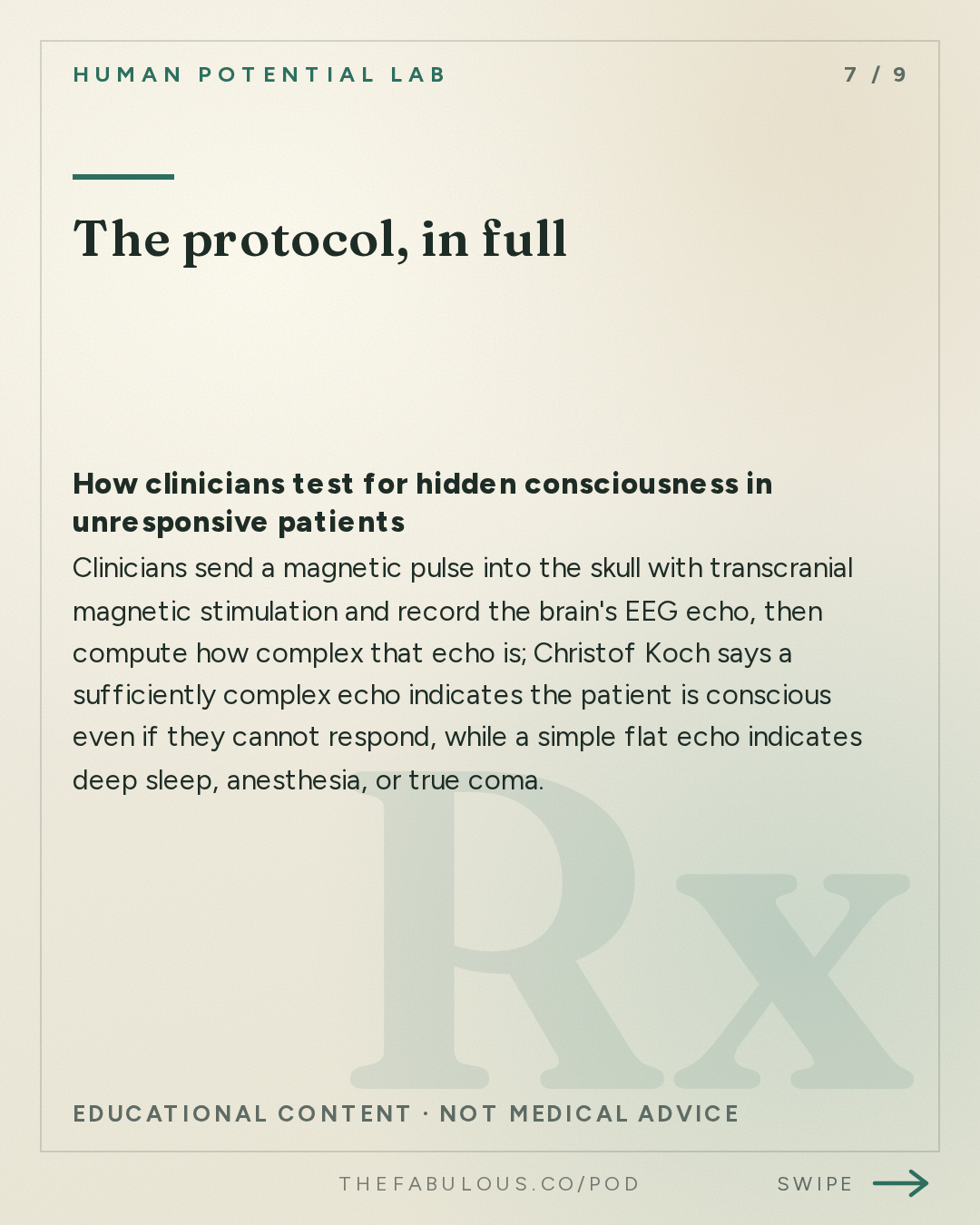
How clinicians test for hidden consciousness in unresponsive patients
Clinicians send a magnetic pulse into the skull with transcranial magnetic stimulation and record the brain's EEG echo, then compute how complex that echo is; Christof Koch says a sufficiently complex echo indicates the patient is conscious even if they cannot respond, while a simple flat echo indicates deep sleep, anesthesia, or true coma.
Used as a one-time diagnostic check in ICU settings when a patient has been behaviorally unresponsive for several days
Questions this episode answers
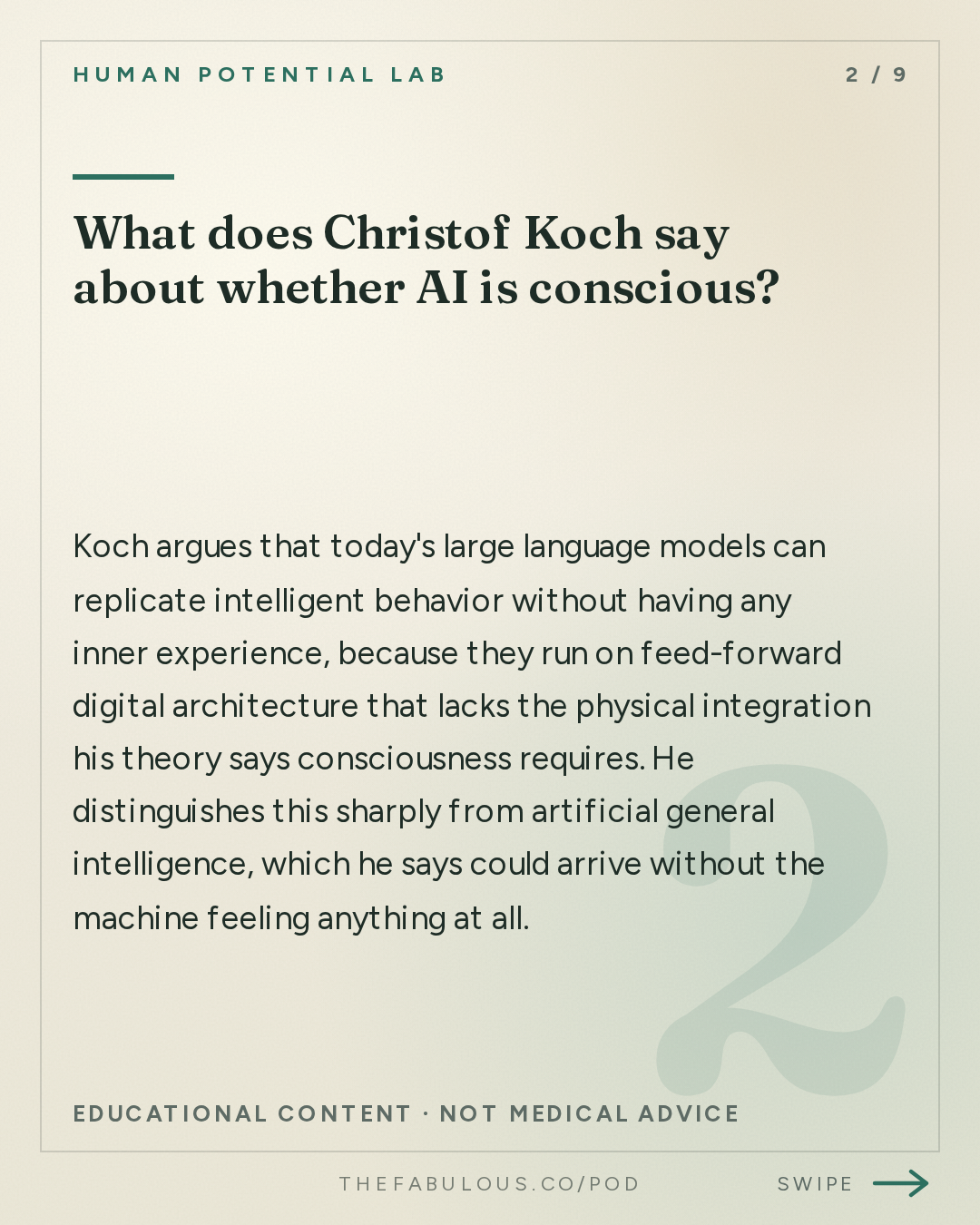
What does Christof Koch say about whether AI is conscious?
Koch argues that today's large language models can replicate intelligent behavior without having any inner experience, because they run on feed-forward digital architecture that lacks the physical integration his theory says consciousness requires (12:50). He distinguishes this sharply from artificial general intelligence, which he says could arrive without the machine feeling anything at all (16:52).
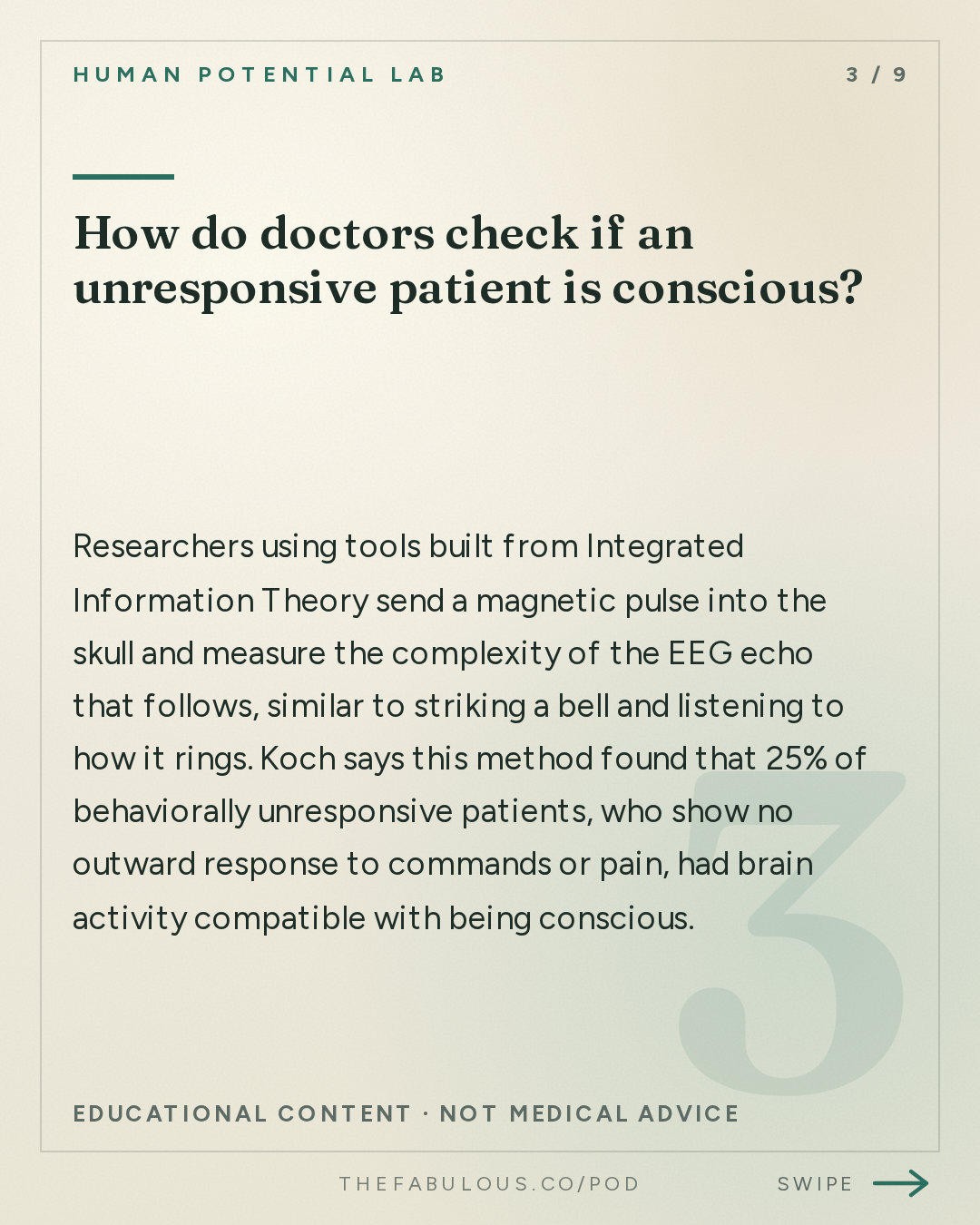
How do doctors check if an unresponsive patient is conscious?
Researchers using tools built from Integrated Information Theory send a magnetic pulse into the skull and measure the complexity of the EEG echo that follows, similar to striking a bell and listening to how it rings (08:37). Koch says this method found that 25% of behaviorally unresponsive patients, who show no outward response to commands or pain, had brain activity compatible with being conscious (08:09).
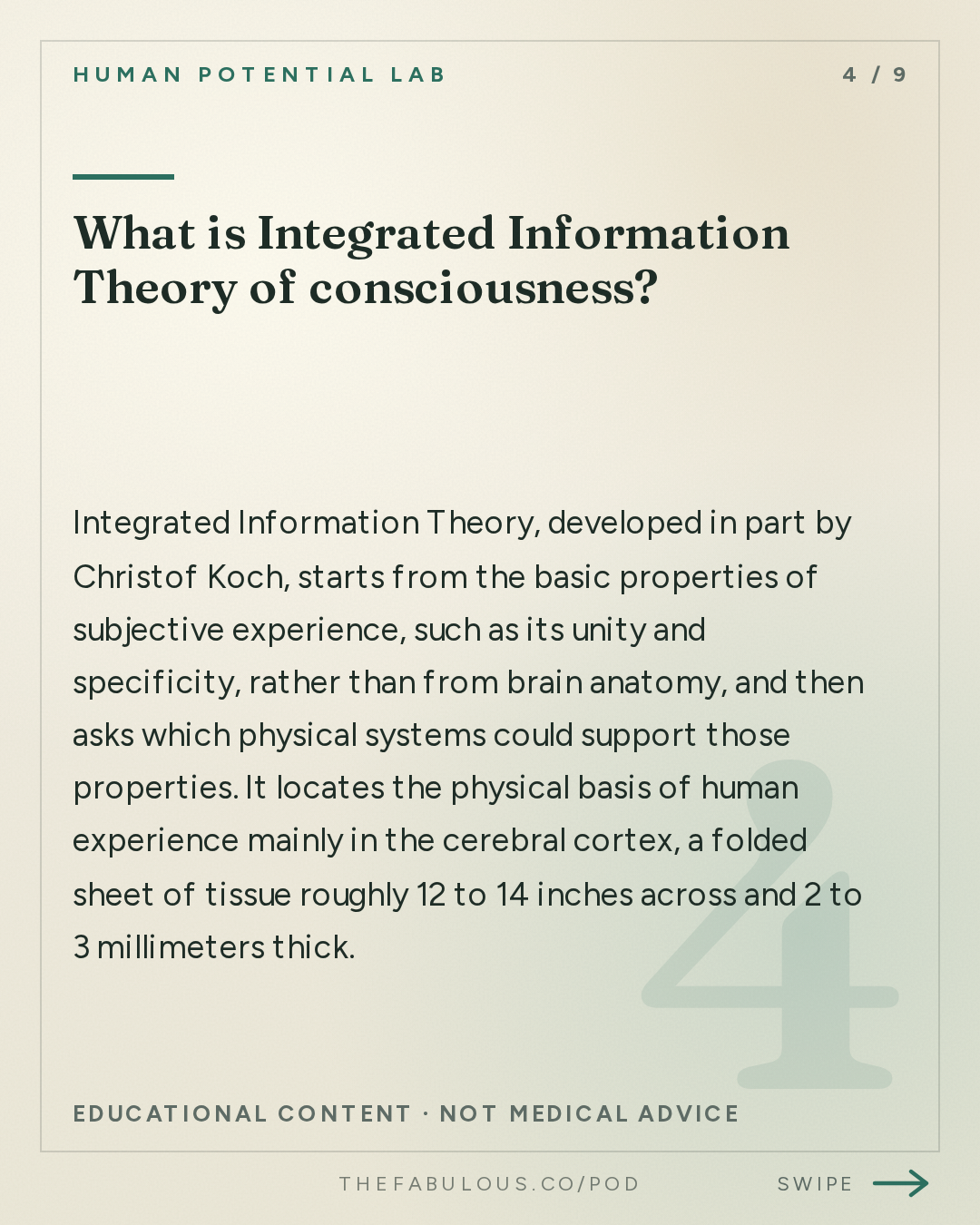
What is Integrated Information Theory of consciousness?
Integrated Information Theory, developed in part by Christof Koch, starts from the basic properties of subjective experience, such as its unity and specificity, rather than from brain anatomy, and then asks which physical systems could support those properties (03:41). It locates the physical basis of human experience mainly in the cerebral cortex, a folded sheet of tissue roughly 12 to 14 inches across and 2 to 3 millimeters thick (06:00).
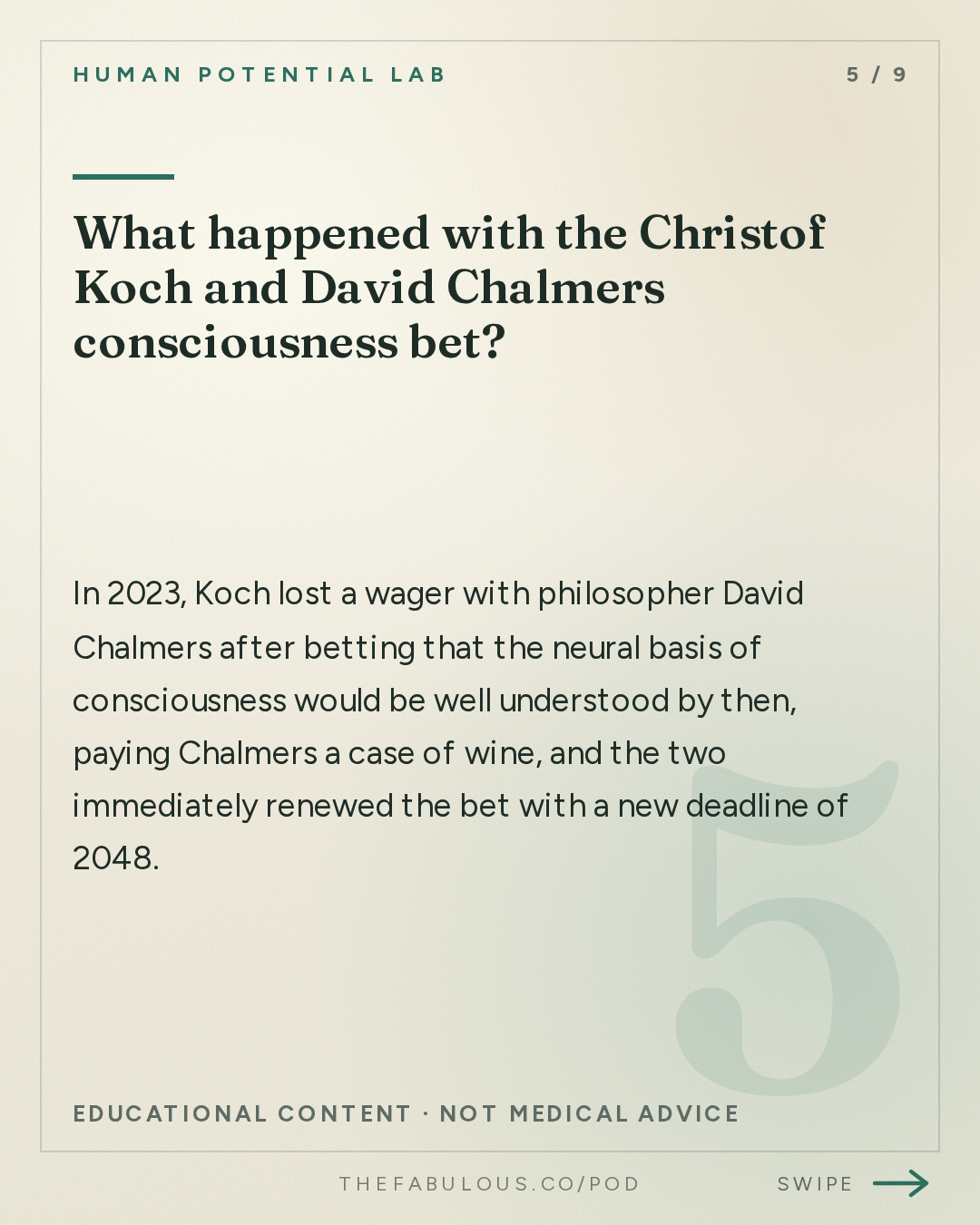
What happened with the Christof Koch and David Chalmers consciousness bet?
In 2023, Koch lost a wager with philosopher David Chalmers after betting that the neural basis of consciousness would be well understood by then, paying Chalmers a case of wine, and the two immediately renewed the bet with a new deadline of 2048 (17:09).
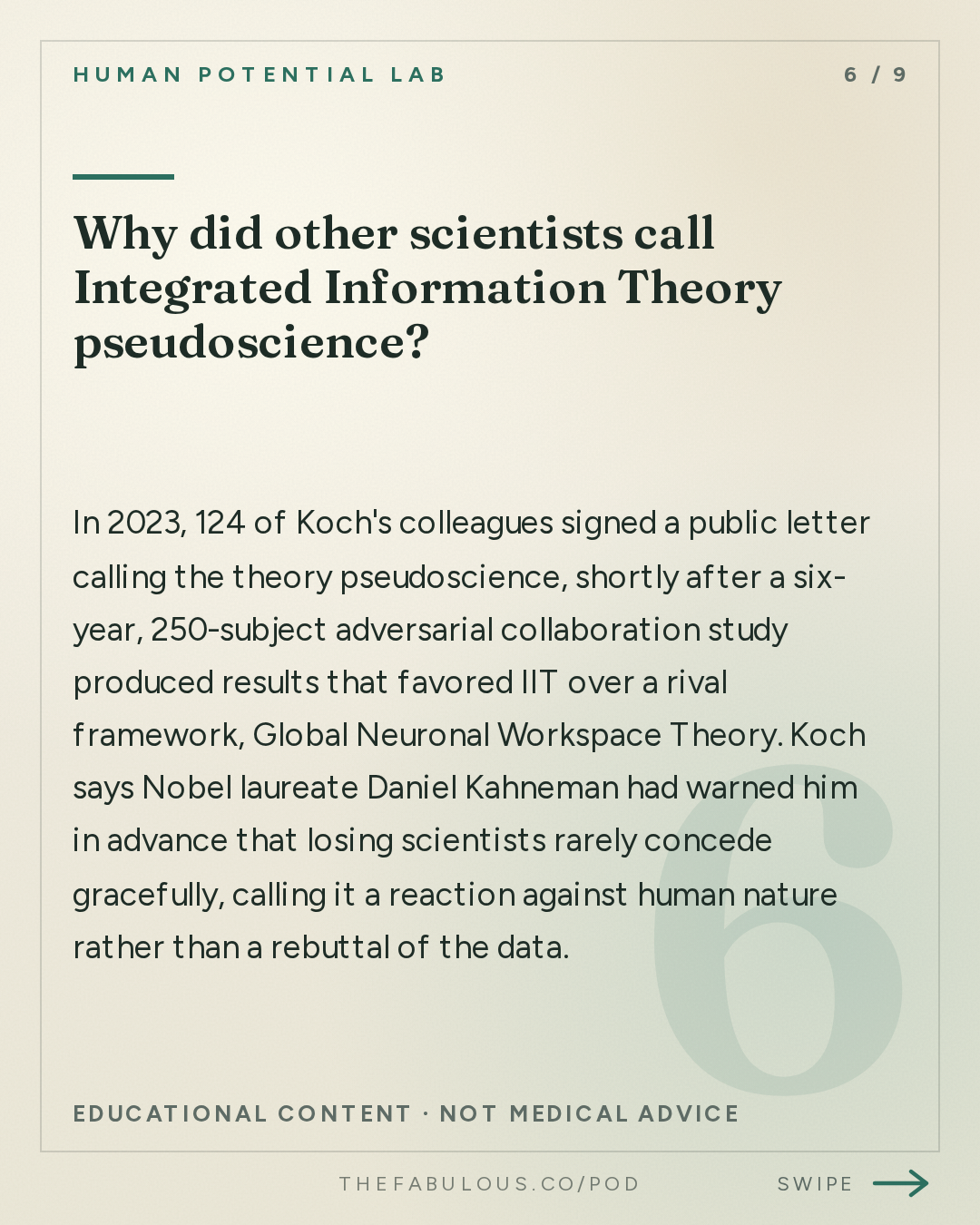
Why did other scientists call Integrated Information Theory pseudoscience?
In 2023, 124 of Koch's colleagues signed a public letter calling the theory pseudoscience, shortly after a six-year, 250-subject adversarial collaboration study produced results that favored IIT over a rival framework, Global Neuronal Workspace Theory (32:15). Koch says Nobel laureate Daniel Kahneman had warned him in advance that losing scientists rarely concede gracefully, calling it a reaction against human nature rather than a rebuttal of the data (34:10).
The full read, in cards
Go deeper
- Adversarial collaboration between Integrated Information Theory and Global Neuronal Workspace Theory — A six-year, 250-subject study funded by the Templeton Foundation that tested competing predictions about where and when consciousness occurs in the brain, with results favoring IIT
- The Brain Might Not Create Consciousness After All — Koch's piece exploring whether consciousness is fundamental to the universe rather than produced by the brain
Mentioned
Christof Koch · David Chalmers · Integrated Information Theory · Global Neuronal Workspace Theory · Allen Institute for Brain Science · Tiny Blue Dot Foundation · Paul Allen · Daniel Kahneman · Templeton Foundation · Arthur Schopenhauer · Francis Crick · Terry Schiavo
More from this show and category
L.A. Paul on Transformative Experience and AI
Philosopher L.A. Paul says a transformative experience changes what you care about most, and only living it reveals what it's like (03:55, 05:12). She argues this same logic breaks AI alignment, since human values shift as people interact with new technology, making alignment a target that keeps moving (45:13, 46:19).
Michael Levin on Bioelectricity and Genius
Biologist Michael Levin argues intelligence is a spectrum of problem-solving competence found in cells, frogs, robots, and machines, not just brains. He says genius, from mathematician Srinivasa Ramanujan's theorems to lab-grown xenobots, taps a shared non-physical "Platonic space" of patterns, with bioelectric signals acting as glue that links small parts into larger goal-seeking wholes.
Scott Barry Kaufman's 7 Lessons from 11 Years of Podcasting
Scott Barry Kaufman closes 11 years and 478 episodes of The Psychology Podcast with seven lessons on human potential, personality change, and creativity. He argues neuroticism is the easiest Big Five trait to shift and openness the hardest, and that lasting change comes from habits, not willpower (09:06, 15:22).
Alia Crum on How Mindset Shapes Stress and Hunger
Stanford psychologist Alia Crum finds that beliefs about food, stress, illness, and genes can alter body chemistry itself. Labeling an identical milkshake indulgent rather than sensible triples the drop in the hunger hormone ghrelin (12:37), and believing one carries a low-efficiency exercise gene lowers real oxygen conversion regardless of actual genotype (47:10).
