
Tony Hawk's Mindset and Million-Dollar Bet
Decoding Tony Hawk’s mindset in 72 minutes
The brief
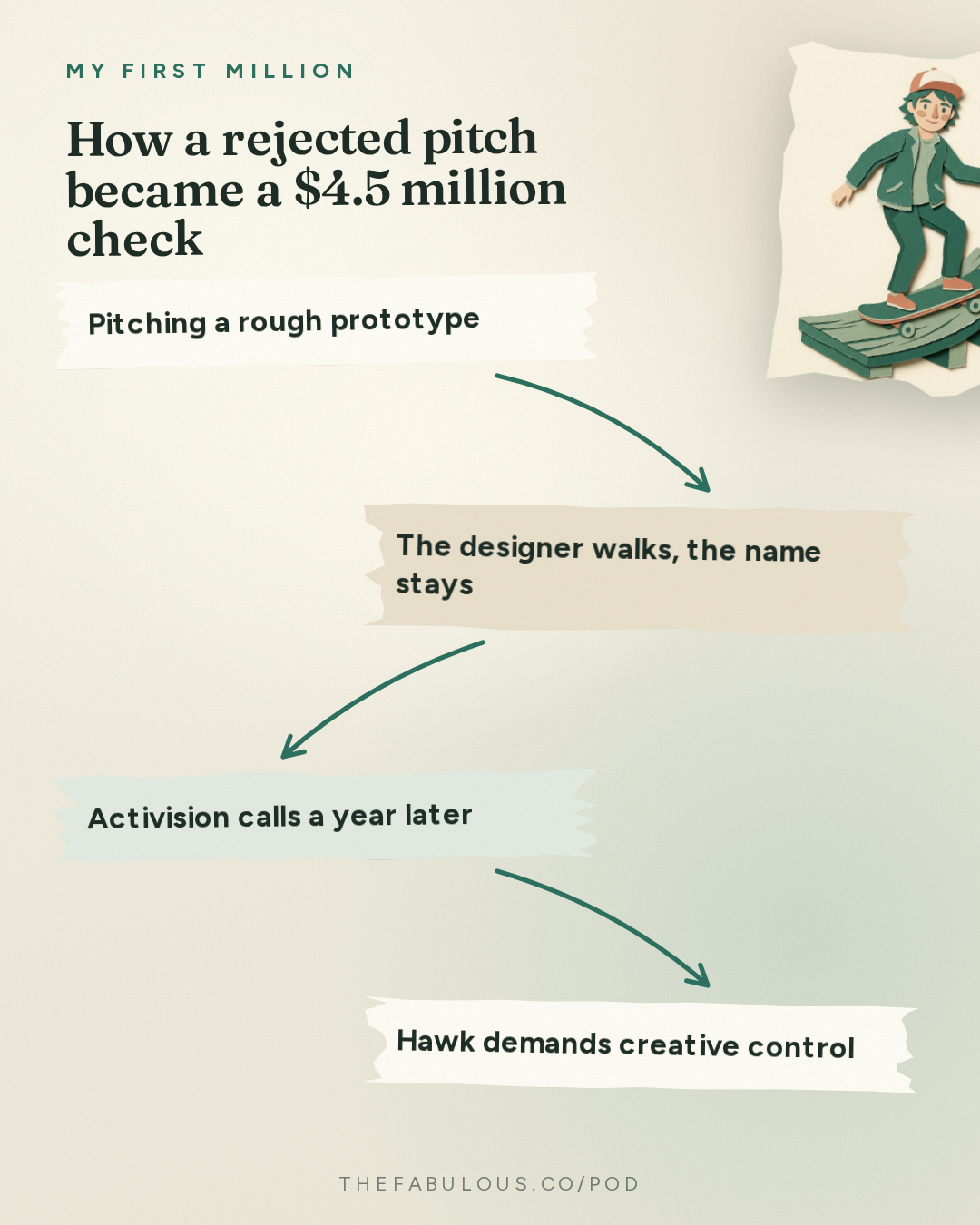
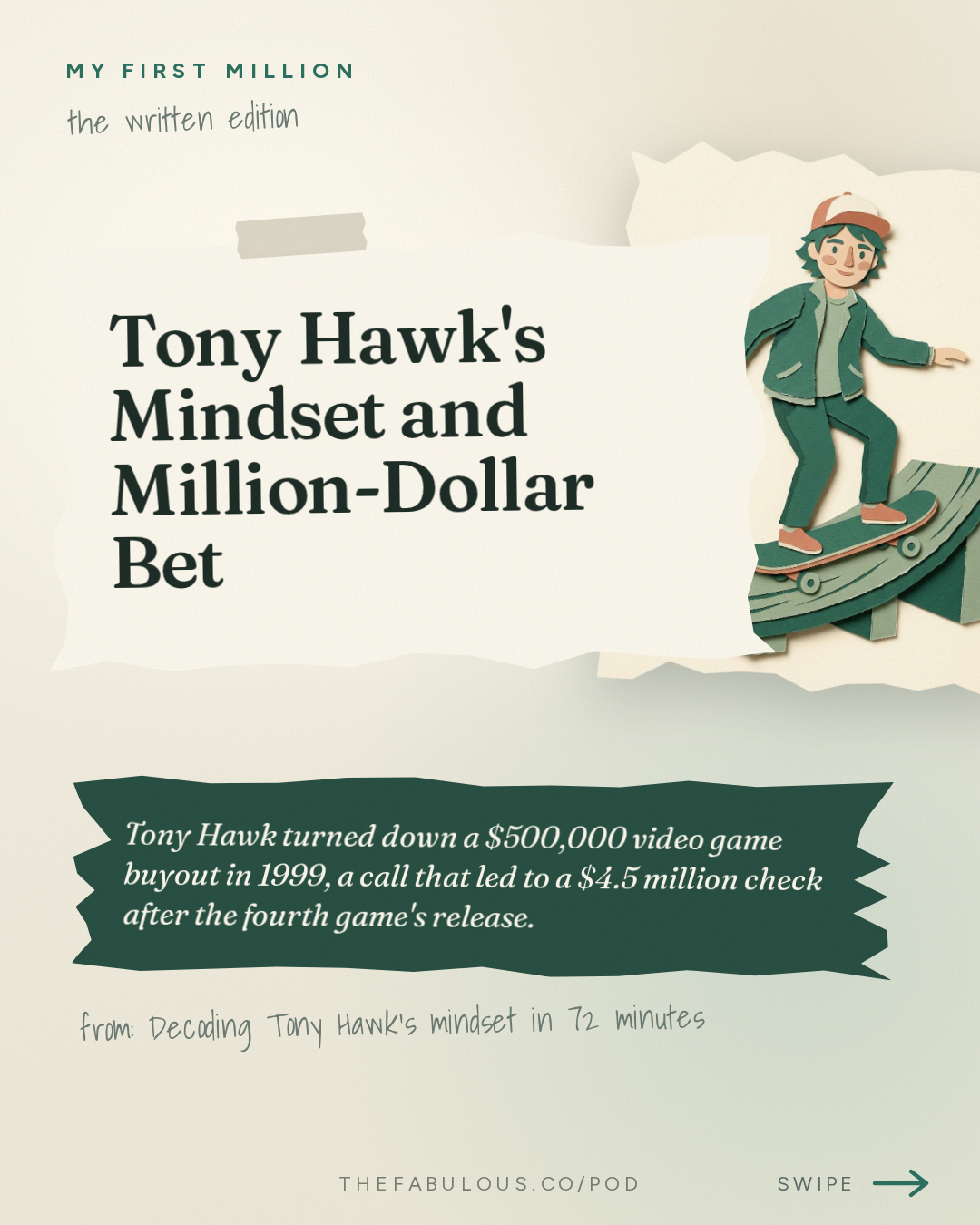
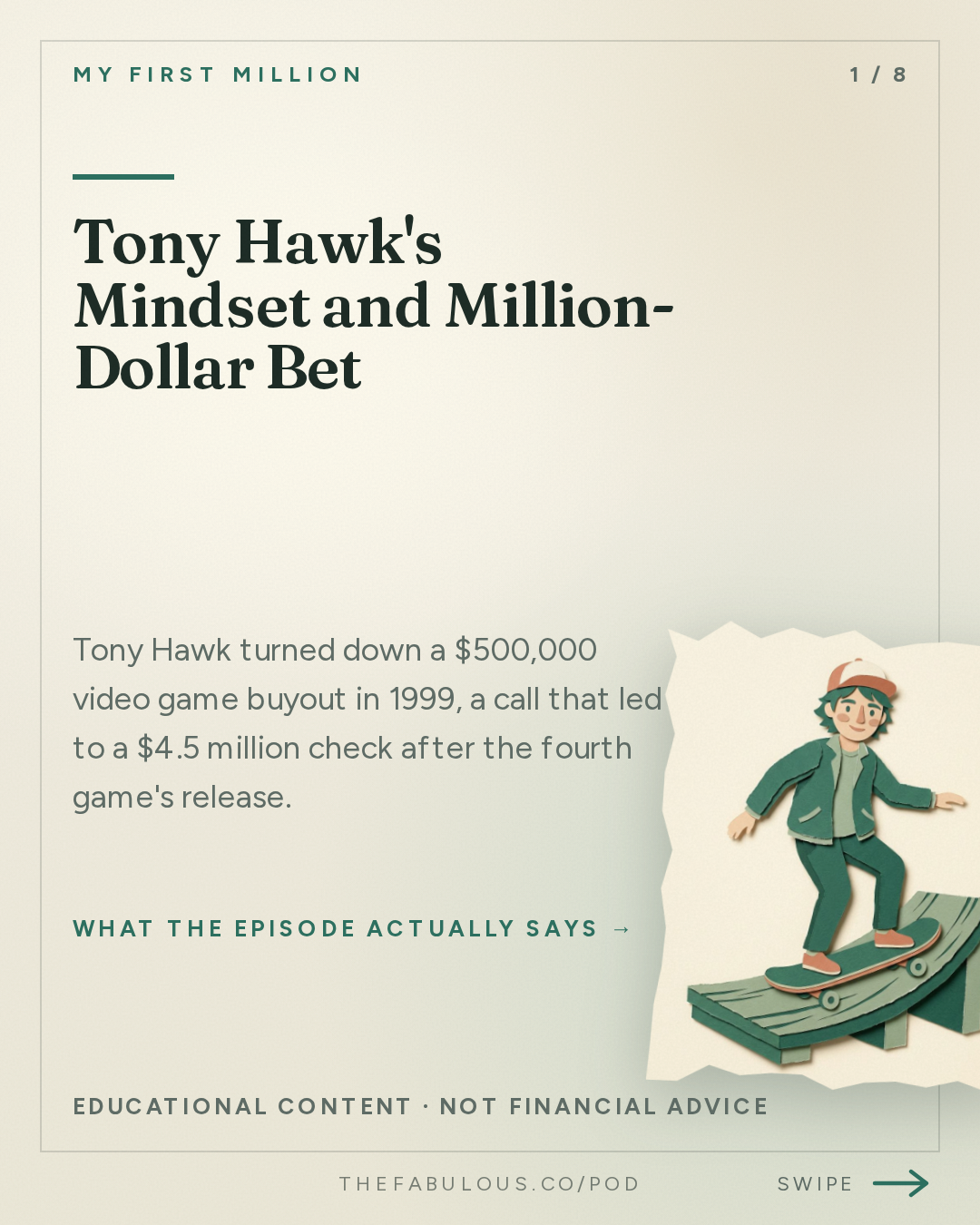
Tony Hawk turned down a $500,000 video game buyout in 1999, a call that led to a $4.5 million check after the fourth game's release. He also details a 1991 pay crash from $1,500 to $300 a month and landing skateboarding's first 900 at the X Games without ever sticking it in practice.
There is a strange lag built into every extraordinary career: the skill arrives years before the money does. Tony Hawk felt that lag more than most. In the early 1980s, first place at a skateboarding contest paid $100 (14:37). By his own account, his first year as a professional left him with $640 in the bank (16:55). Nearly two decades later, on the fourth release of a video game built around his name, an Activision executive slid a check across a table for $4.5 million (00:00). The gap between those two numbers is not just a story about skateboarding's rise. It is a case study in what happens when obsession runs years ahead of any market for it.
Hawk, now closing in on 60, told the story to the hosts of the podcast My First Million, moving between two very different registers: the technical description of a trick he had never landed before he landed it live on television, and the plain arithmetic of a business built on royalties, licensing, and a foundation that has helped build nearly 1,000 skateparks since 2002 (04:13). What connects the two is a personality trait he keeps returning to: he never started skating for money, so money's absence never once made him consider quitting.
The Price Before the Payoff
Hawk grew up at a skatepark near San Diego that he calls his salvation (04:37), a refuge for what he describes as a bunch of misfits before skateboarding was cool. What set him apart from other kids at that park, he says, was not style. It was an inability to stop. His sponsor at the time, Stacy Peralta of the Bones Brigade team, signed him not for tricks that looked good but for tricks that were merely interesting, because he recognized a rider who would not let go of a problem (09:04).
That refusal to quench desire is, in Hawk's telling, the actual mechanism behind greatness, and it does not look like fun from the outside.
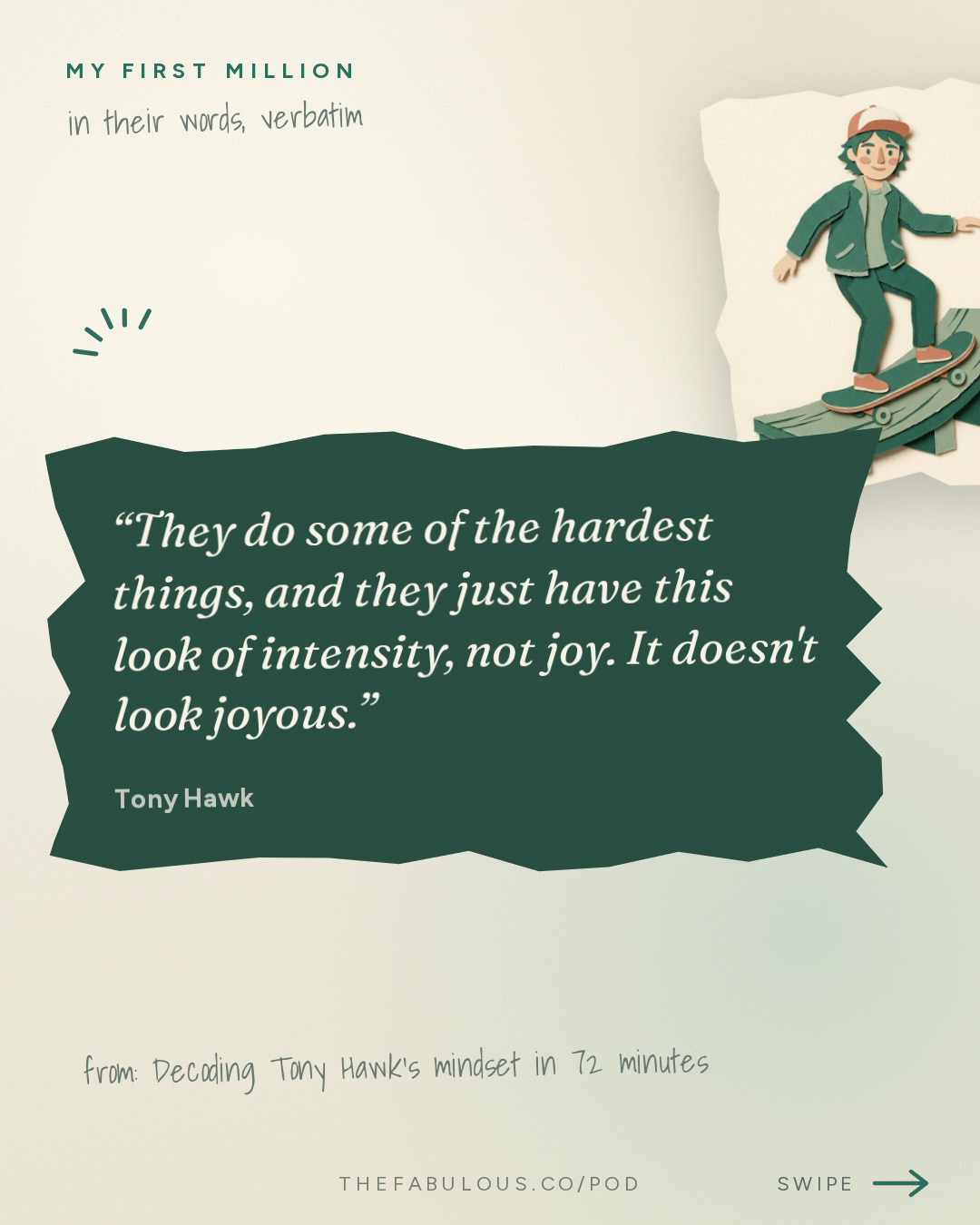
Tony Hawk: "They do some of the hardest things, and they just have this look of intensity, not joy. It doesn't look joyous." [26:27]
The clearest test of that intensity came in 1999, when Hawk attempted the 900, two and a half full body rotations above a halfpipe, a trick no one had ever landed. He had tried and failed for a decade, breaking a rib on one attempt in 1994 so badly he could barely breathe picking up his son from preschool that same afternoon (29:14). By his own account, he had never completed the trick even once in practice before he did it on live television at the X Games. He describes the mental math behind that risk in blunt terms.
Tony Hawk: "I knew in that moment that you're either, I'm either gonna make this trick, or you're gonna carry me unconscious out of this arena." [28:51]
What made the attempt possible, he explains, was not confidence that he would land it. It was that his fifth or sixth attempt that day felt consistent for the first time, on a halfpipe built better than anything he had ridden before (33:24). He committed once the pattern held, not once the fear disappeared. When the trick finally landed, his first feeling was not triumph. It was relief, and a private hope that he would never have to try it again (34:10).
That same determination carried him through the one period when the money actually vanished. In 1991, skateboarding's late-1980s boom, which Hawk credits partly to the 1985 film Back to the Future putting a board in Marty McFly's hands (17:23), collapsed. His income, which had reached lawyer-salary territory in the mid to late 1980s (18:21), began halving by the month. His main shoe sponsor, Air Walk, cut his pay from $1,500 a month to $1,000, then $500, then $300 inside a single year (19:20). At 22, too old by the industry's logic to be a featured skater in commercials, he took Hollywood consulting gigs, building a launch ramp in his driveway for $100 so a stunt double could jump through a movie frame, and used the $500 fee to make that month's mortgage (20:12). He also leaned on a skill he had taught himself on the side, primitive video editing, to pick up freelance work, including a commercial for a video game console called the NEC TurboGrafx (24:43). None of it, he says, made him consider walking away from skating itself, because skating was never the thing he was chasing money through in the first place (24:19).
Betting on the Unproven
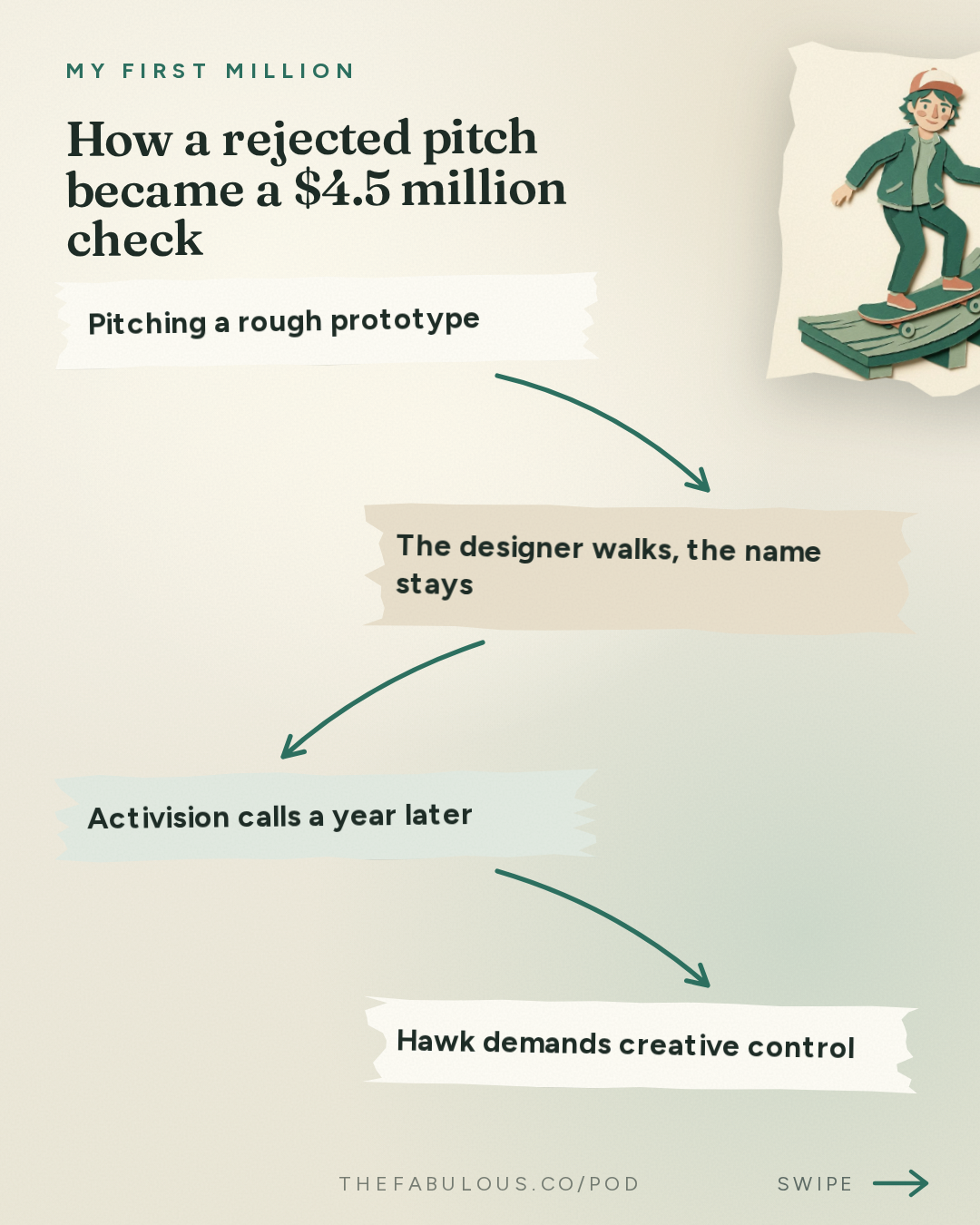
The video game that eventually produced the $4.5 million check almost never got made. Around 1997, a coder who had built a rough skateboarding engine asked Hawk to help pitch it to console makers and publishers. The demo ran on a laptop with keyboard controls (37:08). Nintendo and several software publishers passed. One executive told Hawk plainly that skateboarding was not popular enough to justify a game about it (37:31). The coder gave up and told Hawk he would probably get a call anyway, since his name was now attached to the idea of a skateboarding game (38:22). A year later, Activision called. The company was still small then, a few dozen employees under new owner Bobby Kotick, coming off a game called Apocalypse starring Bruce Willis and eager to try something outside the shooter mold it would later be known for (39:06). The first playable build Hawk saw starred Bruce Willis doing ollies and kickflips across a desert with a gun strapped to his back (39:50).
Hawk had learned something from an earlier round of sponsorship deals that he felt had misrepresented skateboarding for the sake of a slick ad campaign. So the Activision contract became the first one where he demanded final creative approval, a condition Activision agreed to mostly because the company had no fixed formula to protect (42:23). He used that leverage to make the game's levels real skate spots and its soundtrack real skate-scene bands, and before launch he burned copies of the unfinished build onto modified PlayStations so friends and prominent skaters could give him honest feedback (43:26). Word spread inside the skate industry before a single review ran.
When reviews did run, they scored close to perfect. Right before release, Activision called Hawk with an offer: half a million dollars, paid once, in exchange for giving up all future royalties (44:31). He says the number sounded almost unreal to him at the time, especially since he had just bought a new house and finally gotten a mortgage he could afford. He turned it down anyway, betting that a game reviewing this well would keep selling.
It did. By the fourth installment, four of the top ten best-selling video games in the country were Tony Hawk titles, and that was the lunch where the $4.5 million check appeared (46:39). The pattern repeated in miniature at Birdhouse Skateboards, the company he founded in 1992: the business ran at a loss for its first several years, a period his co-founder Per Welinder, who held a business degree, helped keep afloat, before the X Games boom and then the video game's release pushed it into profitability around 1997 and 1998 (56:48). Even now, Hawk says plainly that Birdhouse is not a profitable business, and that he keeps it running because he still loves it, not because the margins work: a skateboard deck has sold for roughly $60 for twenty years (56:16).
The same discipline that produced the buyout decision also shaped how Hawk gives money away. Starting in 2002, he began requiring that 10 to 20 percent of any new endorsement deal go directly to what became The Skatepark Project, his foundation (06:26). Early grants were small, $5,000 or $10,000, just enough to tip a stalled city approval process toward yes. Two decades later, the foundation is close to 1,000 skateparks built or funded (04:13).
What Hawk offers, in the end, is not really a story about skateboarding. It is a case for treating a craft as the point, and letting the money arrive on its own schedule. Near 60, still skating most mornings, he described in detail the isometric stretches he now holds for 30 seconds a side to warm up hips that used to need no warning at all (67:18). The trick gets harder to reach, not easier, and he keeps going back for it anyway.
Tony Hawk: "Find your kickflip. It doesn't have to be perfect. It doesn't have to be the dream that you have set for yourself, but get to that stage." [51:37]
Ask this episode anything
Pod's AI answers from the episode itself, with the minute mark so you can hear it yourself.
Or start with one of these
Ask this episode
Pod's AI listens to the whole episode to answer, and points you to the minute it comes from.
The rest of this answer, and any question after it
Answers come from the episode itself, never from a summary of it.
ContinueKey takeaways
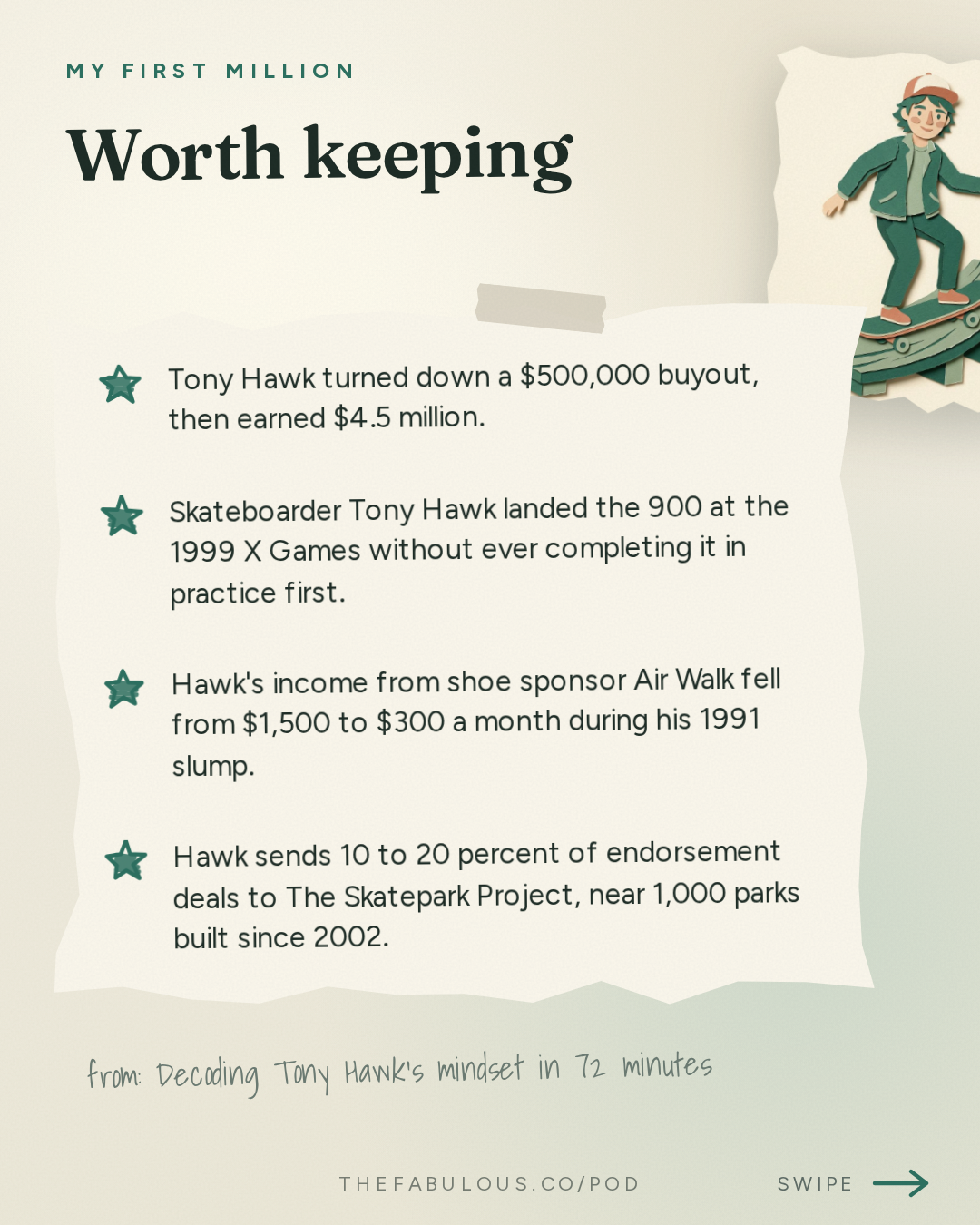
- Tony Hawk turned down a $500,000 buyout, then earned $4.5 million.
- Skateboarder Tony Hawk landed the 900 at the 1999 X Games without ever completing it in practice first.
- Hawk's income from shoe sponsor Air Walk fell from $1,500 to $300 a month during his 1991 slump.
- Hawk sends 10 to 20 percent of endorsement deals to The Skatepark Project, near 1,000 parks built since 2002.
- First place in 1980s skateboarding contests paid just $100, far less than the sport pays now.
The episode in cards
By the numbers
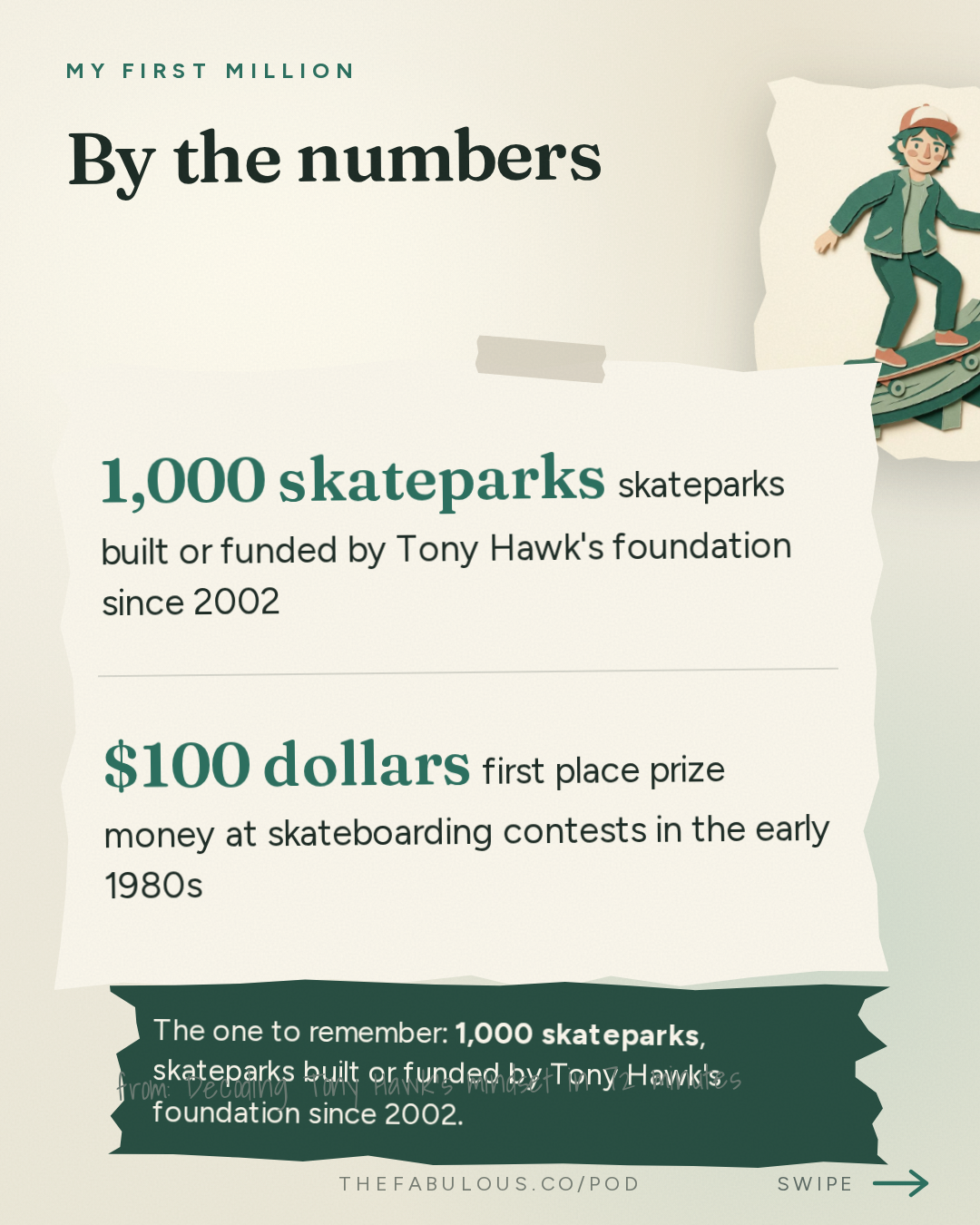
- 1,000 skateparks skateparks built or funded by Tony Hawk's foundation since 2002
- $100 dollars first place prize money at skateboarding contests in the early 1980s
In their words
“I knew in that moment that you're either, I'm either gonna make this trick, or you're gonna carry me unconscious out of this arena.”
“They do some of the hardest things, and they just have this look of intensity, not joy. It doesn't look joyous.”
“Find your kickflip. D- it doesn't have to be perfect. It doesn't have to be the dream that you have set for yourself, but get to that stage”
Protocols
-
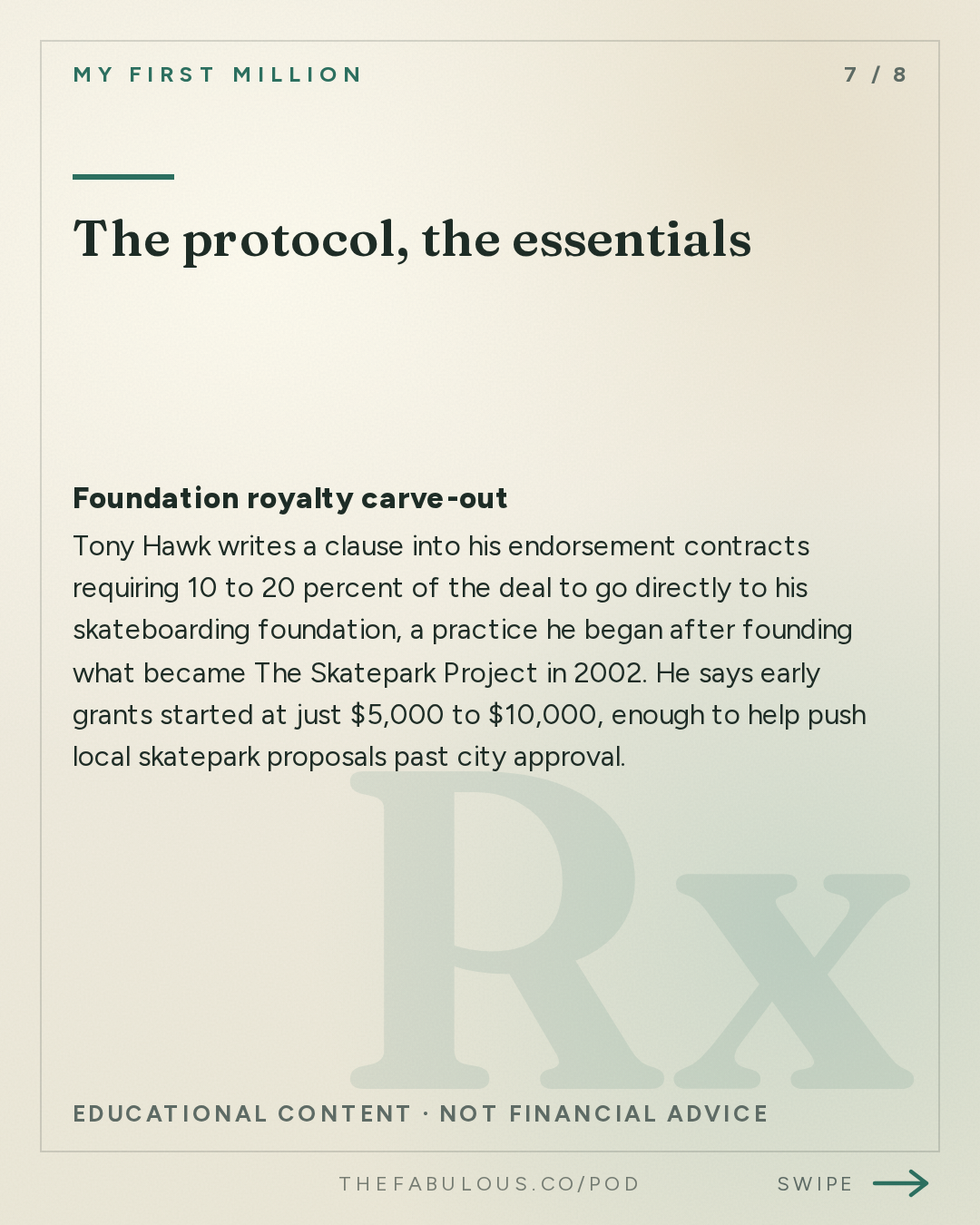
Foundation royalty carve-out
Tony Hawk writes a clause into his endorsement contracts requiring 10 to 20 percent of the deal to go directly to his skateboarding foundation, a practice he began after founding what became The Skatepark Project in 2002. He says early grants started at just $5,000 to $10,000, enough to help push local skatepark proposals past city approval.
Every endorsement deal since 2002
-
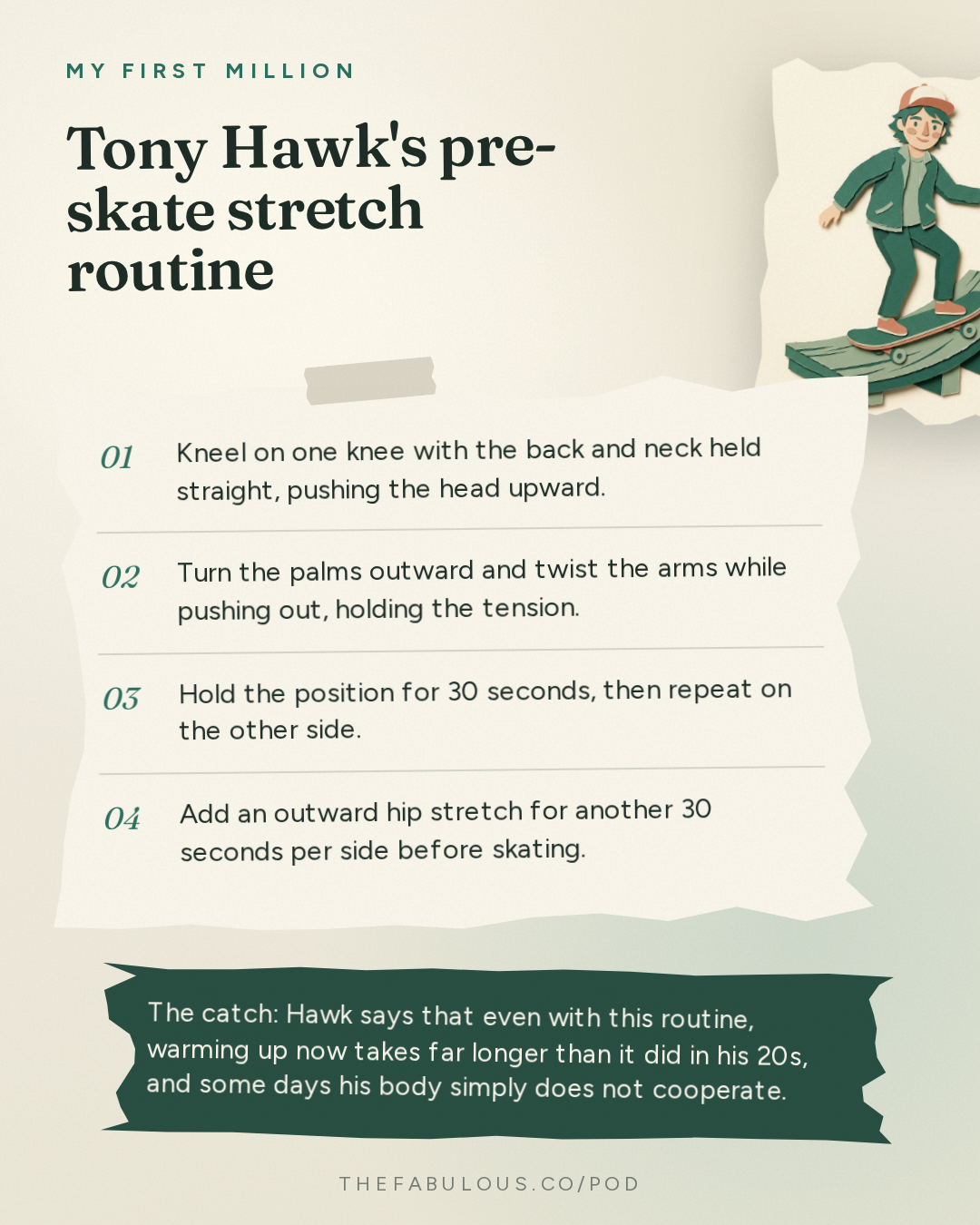
Pre-skate isometric stretch
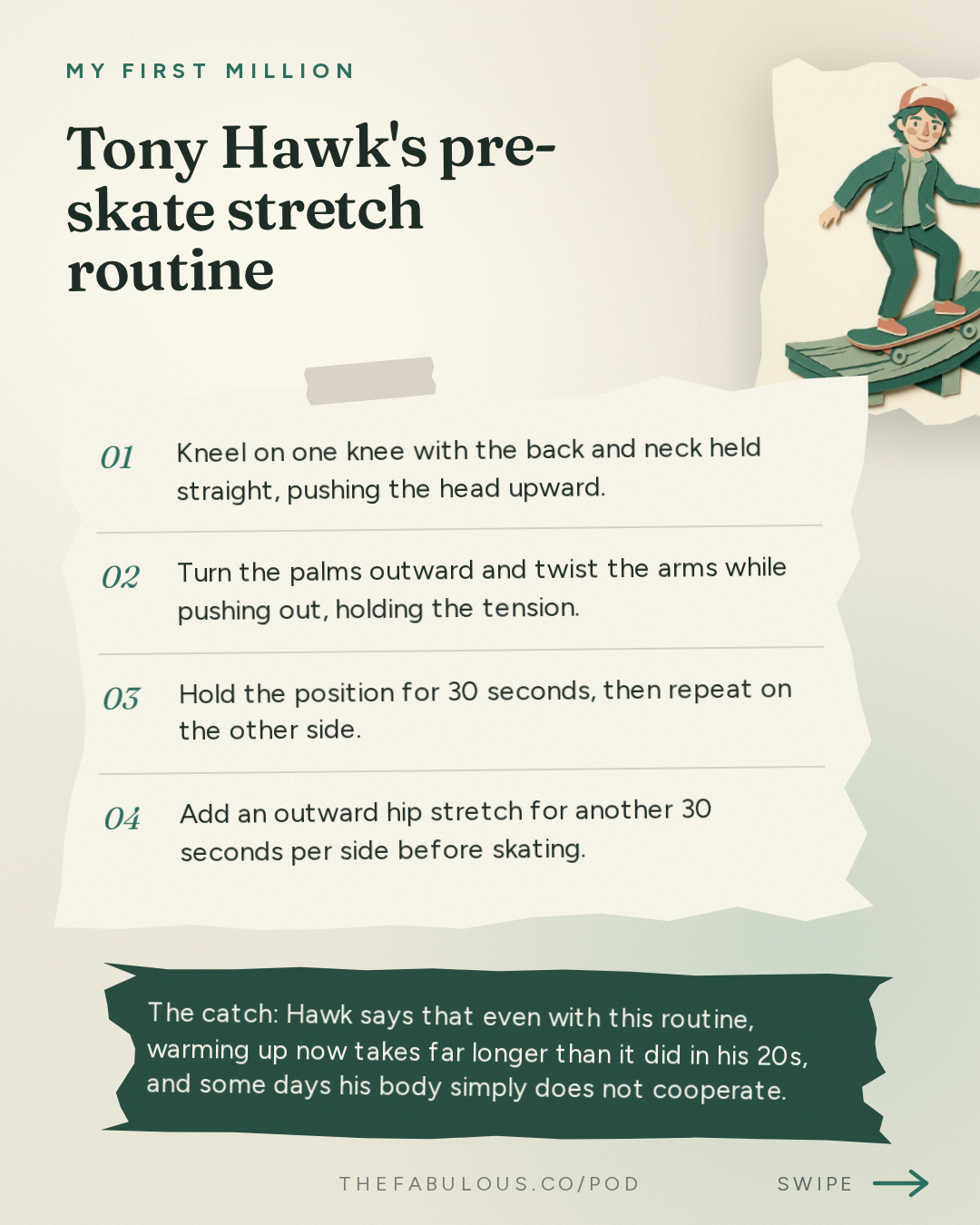
Tony Hawk holds a kneeling stretch with his back and neck straight and his arms twisted outward for 30 seconds on each side before he skates. He follows it with a second 30-second outward hip stretch per side to activate his hips, a routine he adopted in the last five years to offset slower warm-ups. The catch is that he says warming up still takes far longer now than it did in his younger years, even with the stretches.
Before every skate session
Questions this episode answers
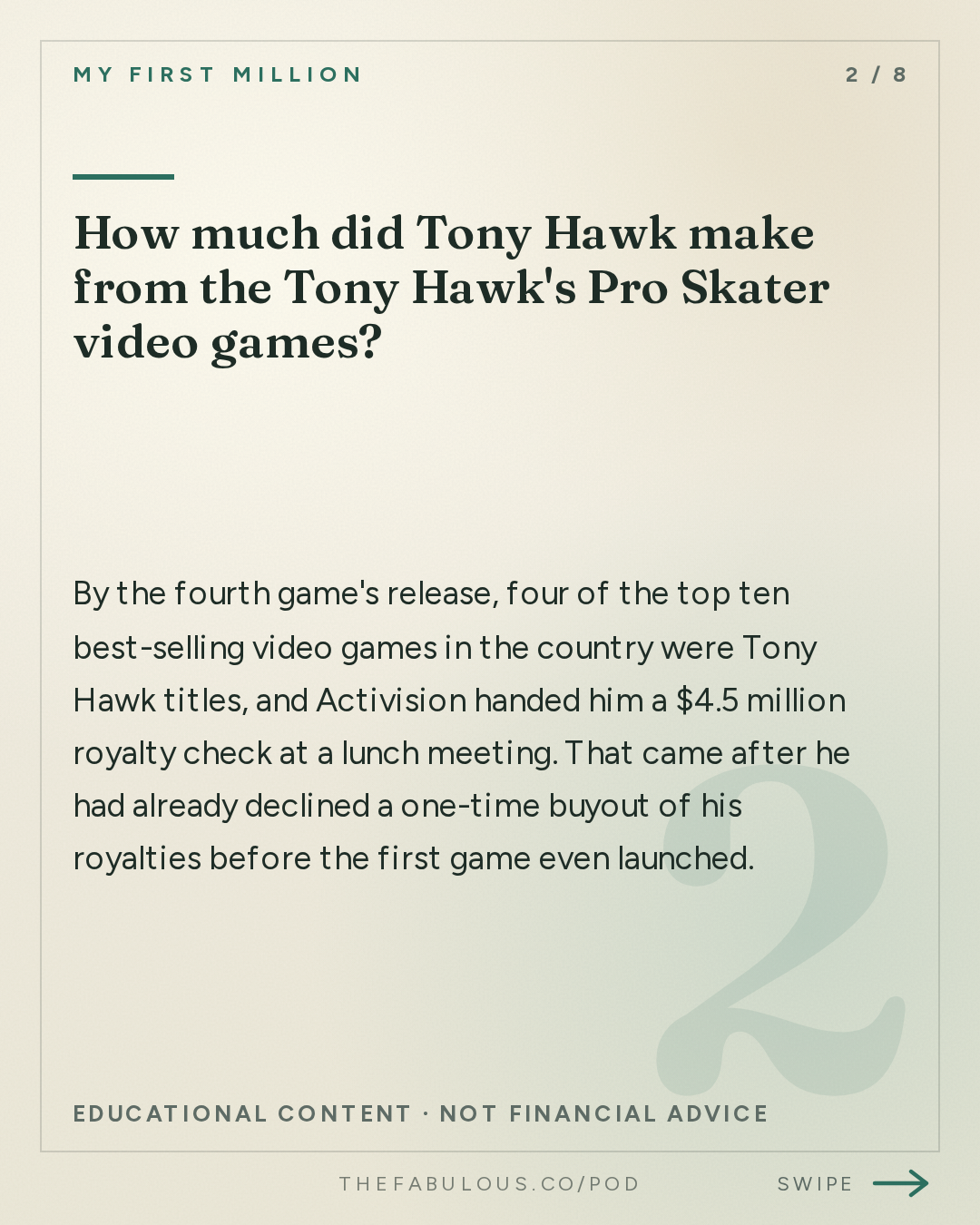
How much did Tony Hawk make from the Tony Hawk's Pro Skater video games?
By the fourth game's release, four of the top ten best-selling video games in the country were Tony Hawk titles, and Activision handed him a $4.5 million royalty check at a lunch meeting (00:00, 46:39). That came after he had already declined a one-time buyout of his royalties before the first game even launched.
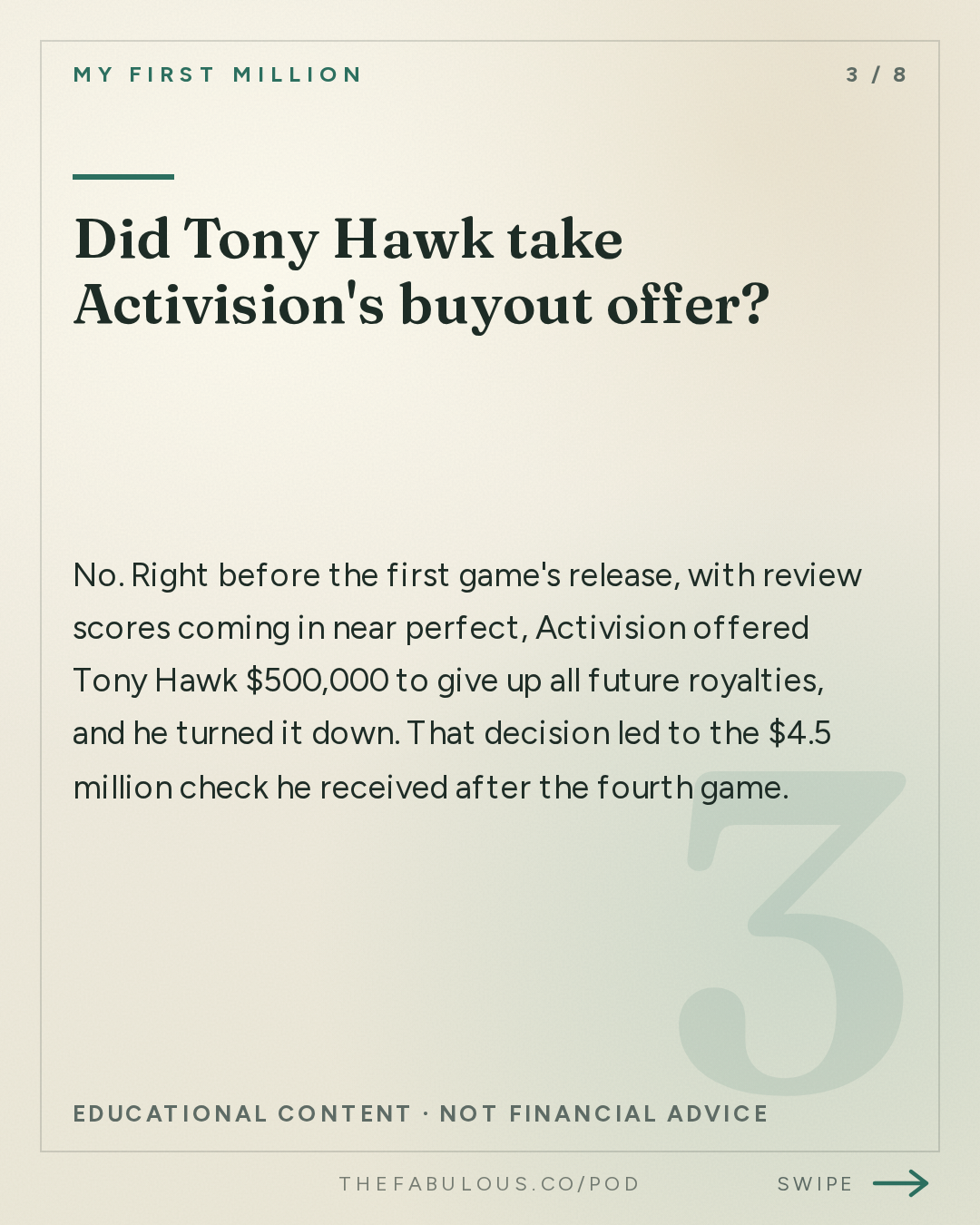
Did Tony Hawk take Activision's buyout offer?
No. Right before the first game's release, with review scores coming in near perfect, Activision offered Tony Hawk $500,000 to give up all future royalties, and he turned it down (44:31). That decision led to the $4.5 million check he received after the fourth game (00:00).
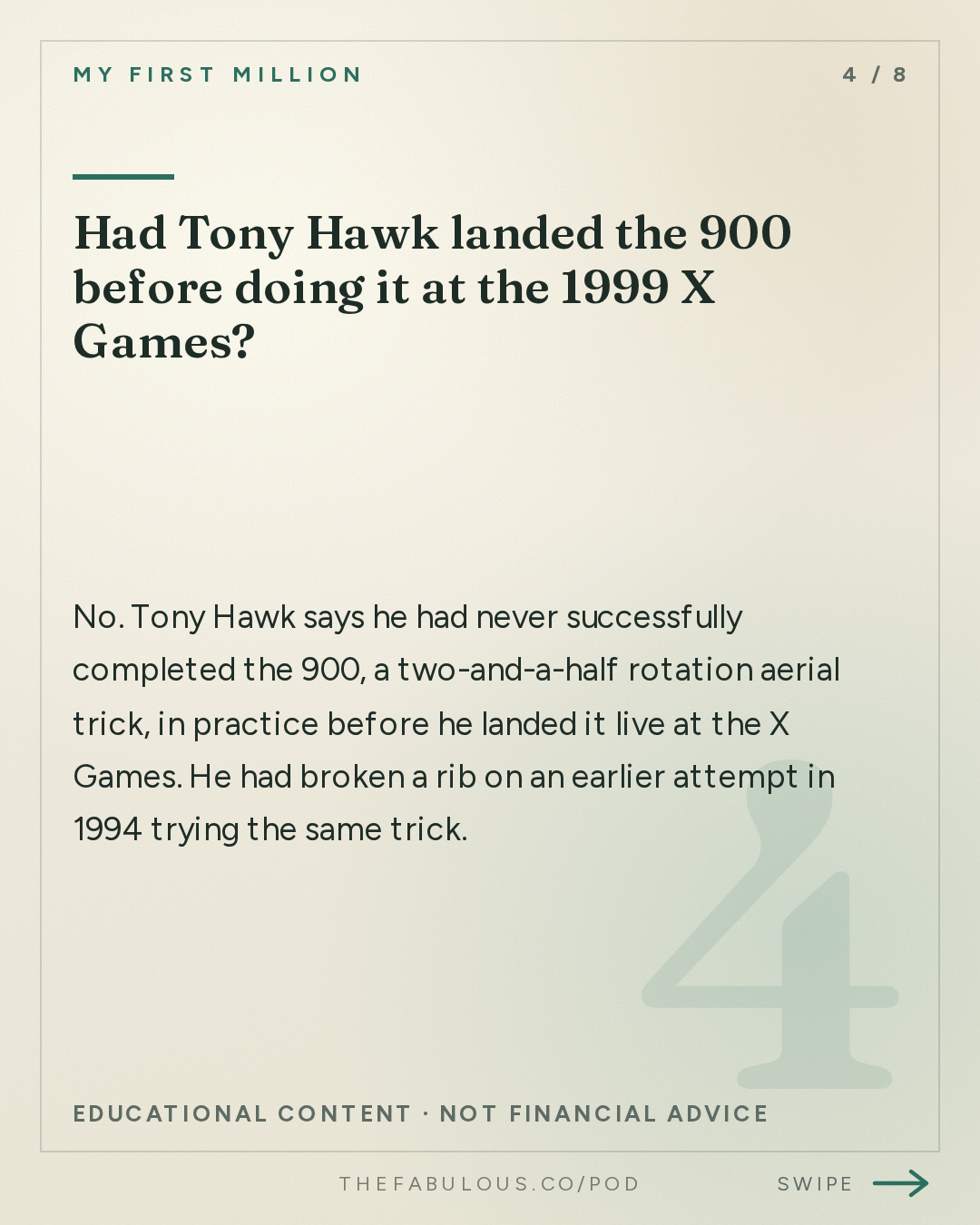
Had Tony Hawk landed the 900 before doing it at the 1999 X Games?
No. Tony Hawk says he had never successfully completed the 900, a two-and-a-half rotation aerial trick, in practice before he landed it live at the X Games (29:14). He had broken a rib on an earlier attempt in 1994 trying the same trick.
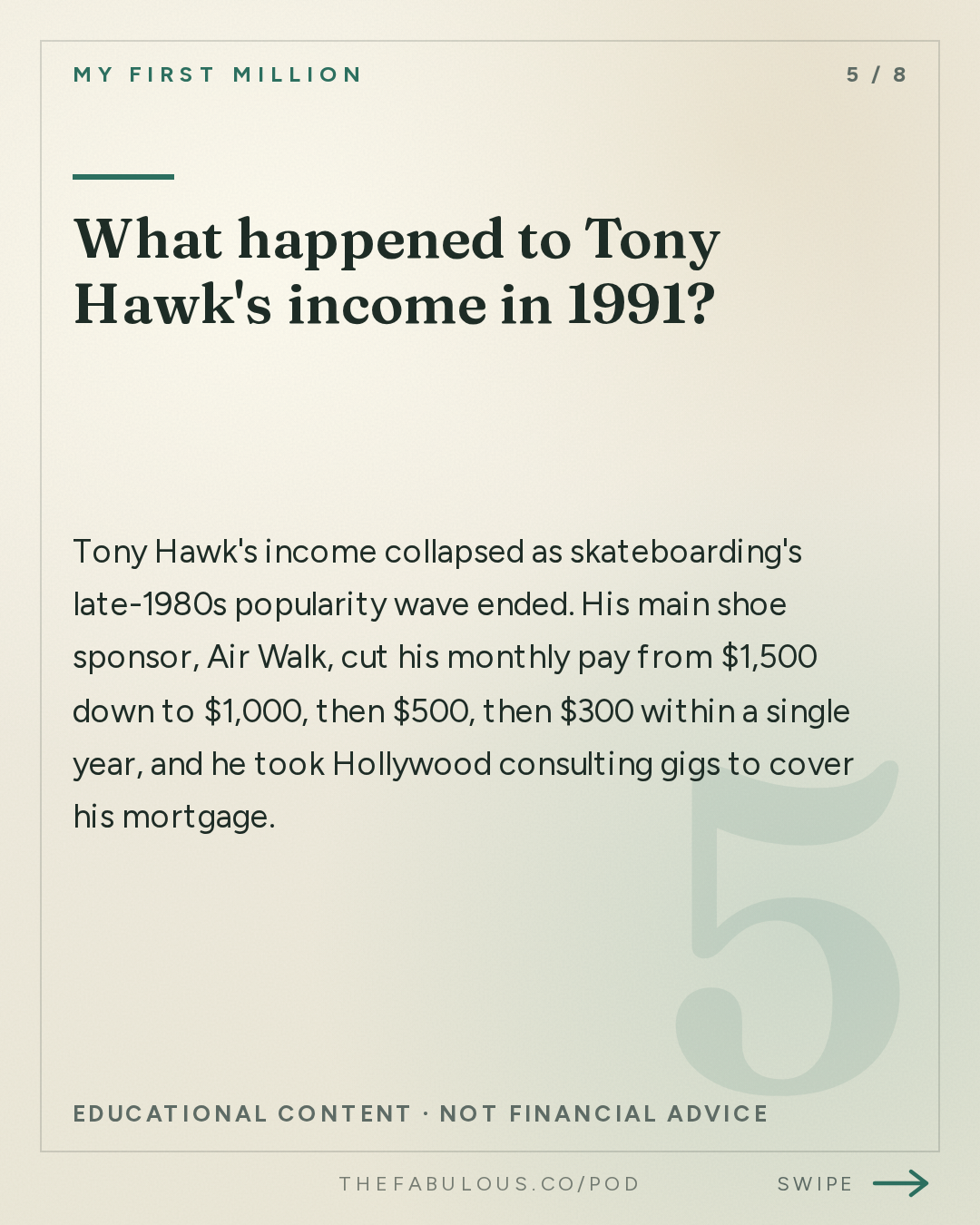
What happened to Tony Hawk's income in 1991?
Tony Hawk's income collapsed as skateboarding's late-1980s popularity wave ended. His main shoe sponsor, Air Walk, cut his monthly pay from $1,500 down to $1,000, then $500, then $300 within a single year (19:20), and he took Hollywood consulting gigs to cover his mortgage.
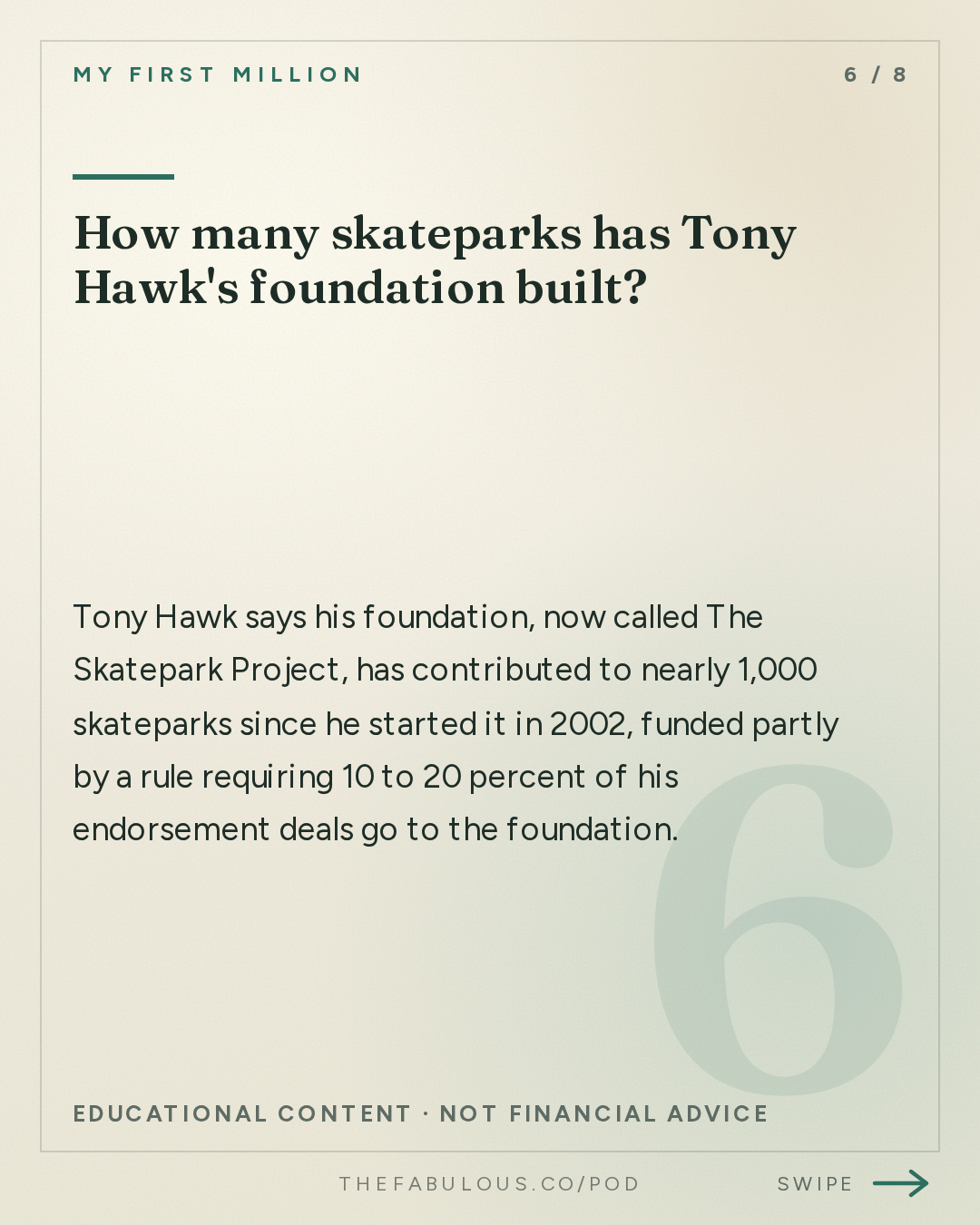
How many skateparks has Tony Hawk's foundation built?
Tony Hawk says his foundation, now called The Skatepark Project, has contributed to nearly 1,000 skateparks since he started it in 2002 (04:13), funded partly by a rule requiring 10 to 20 percent of his endorsement deals go to the foundation (06:26).
What is Tony Hawk's stretching routine for skating in his late 50s?
Tony Hawk holds a kneeling back and neck stretch with arms twisted outward for 30 seconds per side, plus an outward hip stretch for another 30 seconds per side, before skating (66:58, 67:18). He says warm-ups still take longer now than in his younger years despite the routine.
The full read, in cards
Go deeper
- Rodney Mullen TED talk — Discussed on the podcast as an example of obsessive focus behind inventing tricks like the flatground ollie and kickflip
Mentioned
Tony Hawk · Stacy Peralta · Rodney Mullen · Per Welinder · Bobby Kotick · Activision · Birdhouse Skateboards · Charity Water · The Skatepark Project · Nest · Liquid Death · DocuSign
More from this show and category
Peter Levels: Why SaaS Lost Its Moat
Peter Levels says plain software has no moat left in the AI era, and what remains is data, network effects, distribution, or regulation. The episode also follows Bryan Johnson's attempt to dunk at 49, Elon Musk's SpaceX share giveaway to 72 million kids, and a pest control brand's $1,000 first week built on direct-to-consumer branding.
Low-Frequency Investing: The 2.9-Decision Portfolio
A retail investor who made only 2.9 decisions a year beat the S&P 500 in 11 of 11 years, averaging 21.8% annual returns versus 13.5%. The hosts run his brokerage history through the AI assistant Claude, then widen out to Jack Dorsey's 140-reason pre-mortem, Mark Zuckerberg's talent-density bet, Elon Musk's 24-hour rebuilding rule, and a four-step method called DARE for panic and fear.
The 6 Traits of Natural Money Makers
Sam Parr and Shaan Puri map the "natural money maker": unemotional, maximizing, and comfortable with complexity. They share entrepreneur Sayed Balkhi's "second derivative" rule (spend only investment returns, never income) and a 3% liquid-net-worth spending cap, plus six other wealth-building personality types like the Tank, the Trickster, and the Sniffer.
Shaan Puri's 3 Embarrassing Moments That Changed Him
Shaan Puri, host of My First Million, shares three embarrassing stories, including a 110 narcissism test score and a failed 250-page restaurant business plan. He explains how each moment taught him to stop chasing external validation, favor action over endless planning, and reinvent his identity by deciding who to become before he felt ready.
