
ChatGPT Wrapper Business Ideas That Make Money
4 business ideas you could build with ChatGPT
The brief
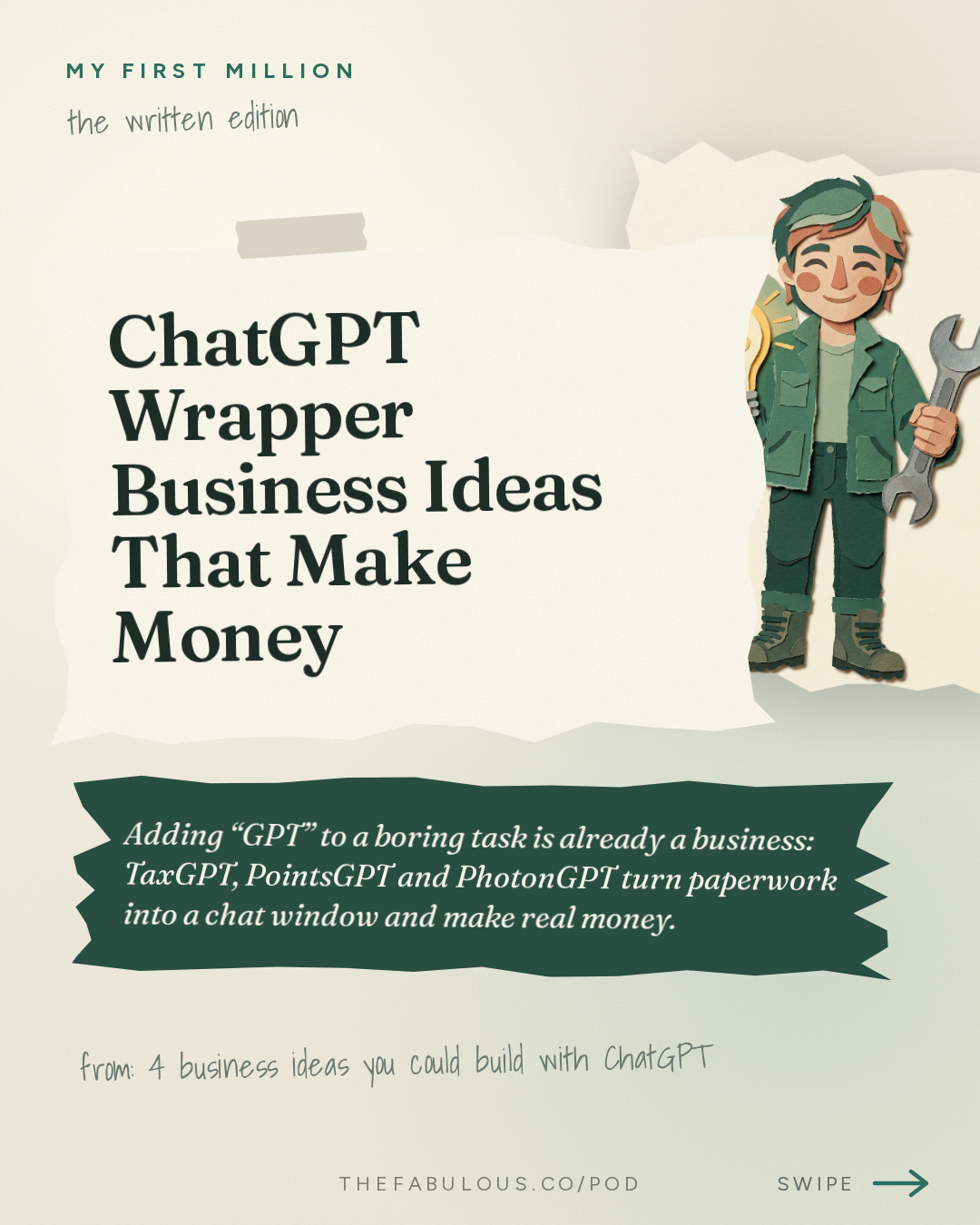
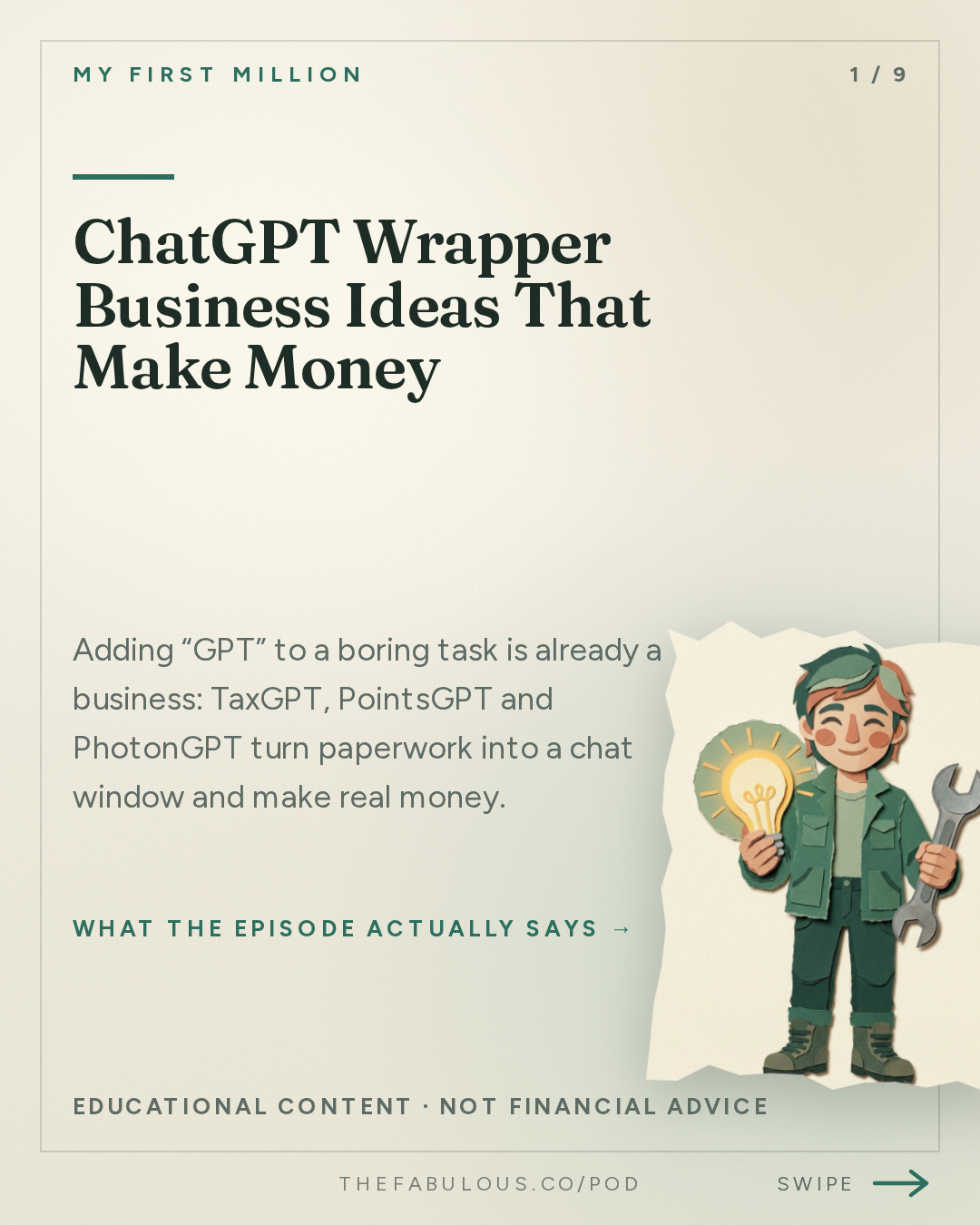
Adding “GPT” to a boring task is already a business: TaxGPT, PointsGPT and PhotonGPT turn paperwork into a chat window and make real money (02:30, 03:02). The hosts also unpack why speed, not quality, predicts founder success, citing Mike Cassidy's 500-day, 500-million-dollar exit and James Hong's eight-day build rule.
Add the letters "GPT" to the end of an annoying task and, it turns out, people instantly understand what you are selling. That is the small, almost silly insight sitting underneath a surprisingly large business trend. On Instagram, one host spots an ad for PointsGPT, a tool that lets someone type "I want to fly to LA, I have Chase and Amex points, find me a deal" and get an answer, instead of wrestling with an airline's buried transfer-partner menu (00:22). It is the same idea behind Points.me, a company already doing this through a dashboard, just rebuilt as a chat box (01:09).
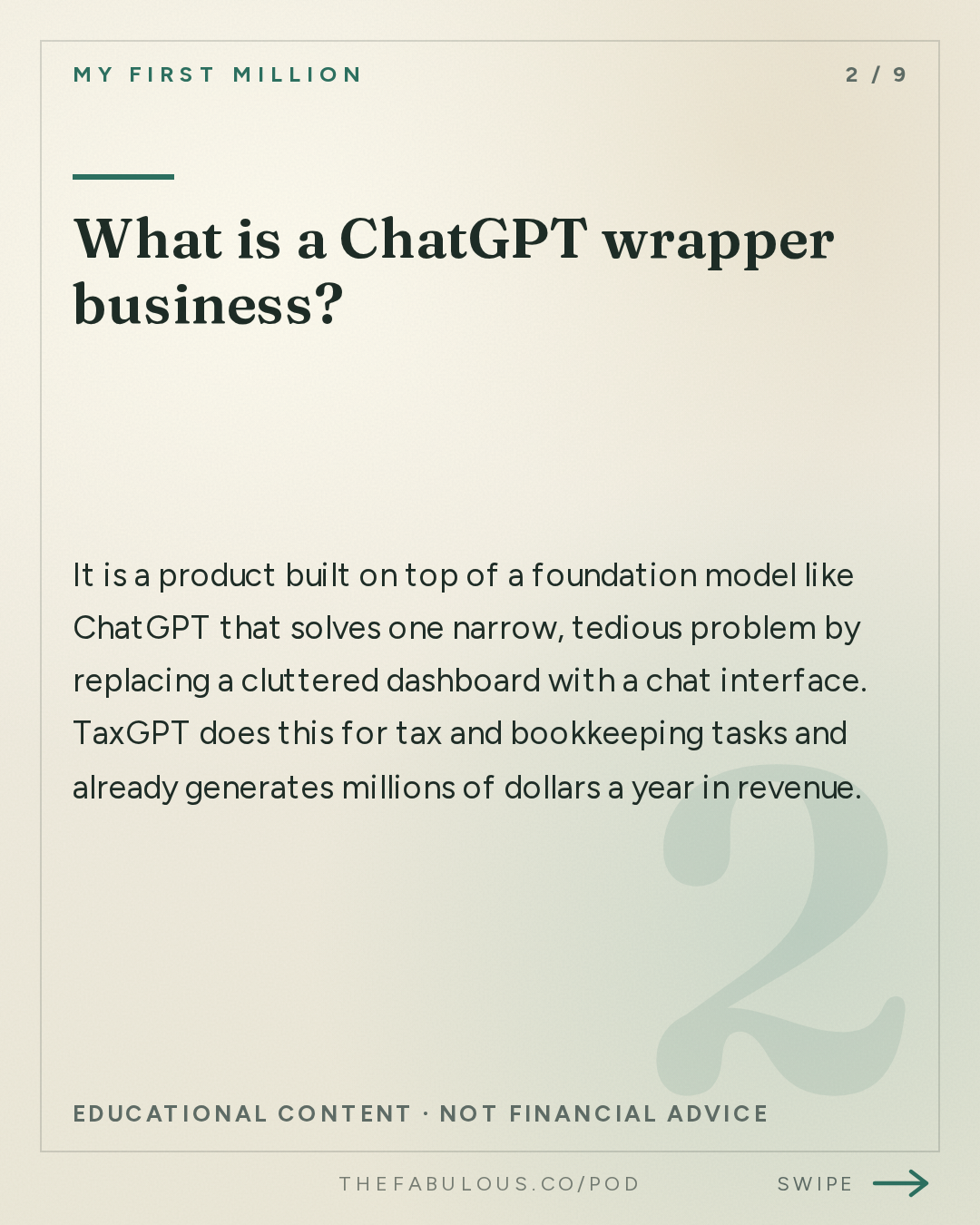
This is what the hosts call a wrapper business: a product that sits on top of someone else's foundation model, like ChatGPT, and solves one narrow, annoying problem by replacing a cluttered interface with a conversation. TaxGPT is already doing millions of dollars a year in revenue this way, essentially rebuilding QuickBooks as a chat window (02:30). PhotonGPT lets a user get an actual prescription through ChatGPT (03:02). The pitch, as one host puts it, is that typing is more forgiving than clicking.
"We're replacing buttons with chat, which some people would argue is worse... but the reality is chat lets you be a little sloppy." — Shaan Puri [02:35]
The list of ideas keeps going: PermitGPT for construction paperwork, VisaGPT for immigration filings, FightItGPT for disputing a surprise medical bill (03:25, 03:45). None of these require inventing new technology. They require noticing a process that is tedious enough that people will pay to skip it, and building the thin layer that makes ChatGPT do the skipping.
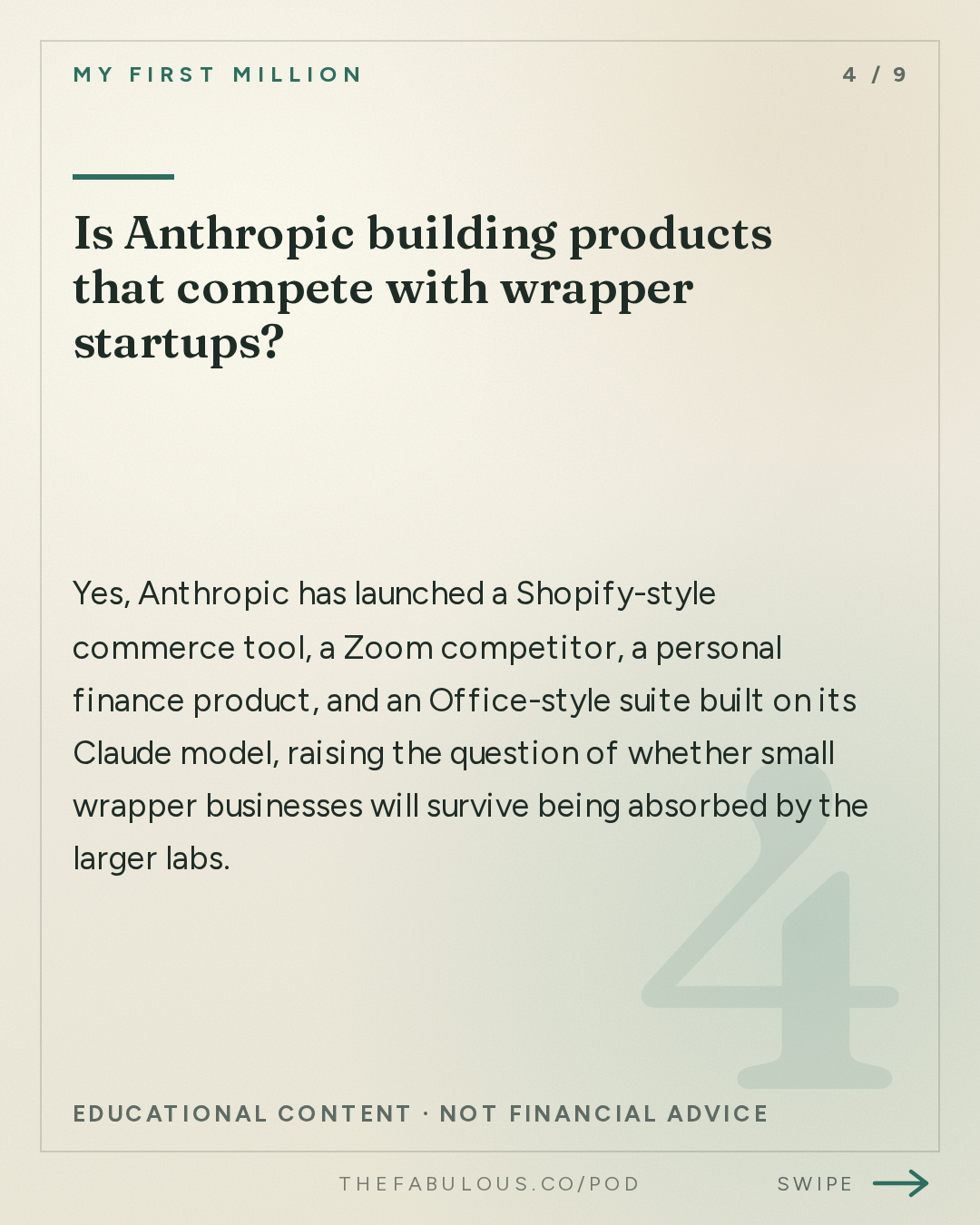
The catch is that the giant labs are racing into the same territory from the other direction. Anthropic, the company behind the Claude chatbot, has launched its own Shopify-style commerce tool, a Zoom competitor, a personal-finance product, and what amounts to a Microsoft Office replacement built inside Claude (05:09, 06:13). One host says the company's roadshow pitch is essentially "our market is everything, our industry is all industries" (05:51). The counterargument is that focus is scarce. Running dozens of products well takes people and attention, and even a very smart company might only have enough of both to dominate a few of the biggest categories (06:41). Whether a wrapper startup is building a business or a feature that Anthropic absorbs next quarter is, at this point, a genuinely open question.
A detour into a Twitter fight turns out to be the hinge of the episode. After SpaceX's Starship was caught out of the sky by a pair of mechanical arms, a policy director named Matt Stoller tweeted that the feat was just "the normal consequence of applying capital and engineering to any industry," and that Elon Musk's only real skill was raising money from Wall Street (10:32). The replies did the fact-checking: SpaceX raised 1.2 billion dollars in venture capital before launching the Falcon 9, while the Space Force's annual budget alone is 70 billion dollars, and Jeff Bezos has put roughly 28 billion dollars of his own money into Blue Origin, which has flown three times versus SpaceX's seven hundred-plus launches (12:20, 12:49). One host calls this "spreadsheet monkey" thinking, the habit of looking at a business from a distance and assuming execution is just capital times time (12:04). It is a tidy setup for the episode's real subject: what actually separates people who get big, hard things done quickly from people who do not.
The physics of speed
The hosts' favorite data point here is almost absurd: the Empire State Building, the tallest building in the world when it opened, was built in 410 days (15:20). Stripe cofounder Patrick Collison keeps a running list of these examples on his personal blog, a page called "Fast," cataloging projects like Visa's 100-day launch and the Pentagon's 500-day construction, specifically to erase excuses about why things take as long as they do (15:42). One host had been stewing on this because the elevator near the subway by his apartment has taken 548 days to repair, longer than the Empire State Building took to build from scratch (16:49). The explanation he lands on has two parts. The first is path dependence: companies report quarterly because a steel company did it that way in 1910 and the habit calcified into regulation (18:01). The second is Parkinson's Law, the idea that work expands to fill whatever time is allotted to it, whether or not that much time was ever necessary.
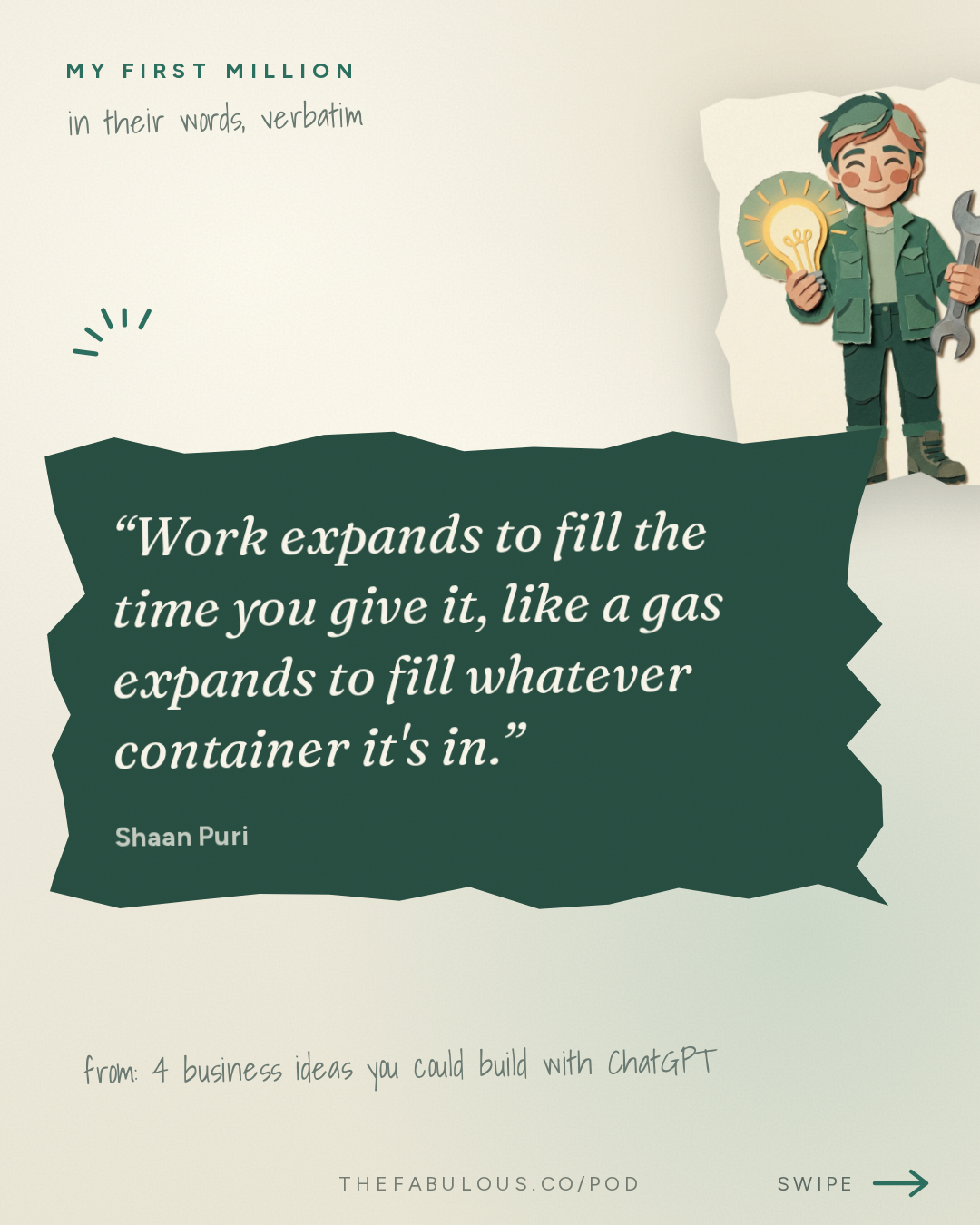
"Work expands to fill the time you give it, like a gas expands to fill whatever container it's in." — Shaan Puri [19:00]
The clearest illustration comes from venture investor James Currier, who runs a 1.5 billion dollar fund and says that after testing 48 traits for predicting founder success, nearly all of them collapsed into one proxy: speed (20:26). Currier learned this from his friend Mike Cassidy, who sold a company in the 1990s for 500 million dollars in 500 days (20:56). Cassidy treated fundraising as an auction: he would email every target investor, book back-to-back pitch meetings across a single 36-hour window, and tell each firm the round would close at the end of it, forcing competing term sheets instead of a slow, serial negotiation (21:24). He ran hiring the same way, interviewing candidates back-to-back with a signed offer, salary already filled in, ready to slide across the table on the spot (22:09).
The reframe that follows is the episode's sharpest idea. The usual tradeoff people assume is speed versus quality: build fast and the result will be worse. Currier's counter is that a three-day V1 will indeed be rougher than a three-month V1, but by the time the slow team finally ships its first version, the fast team is already on its sixth, and a sixth version beats a first version every time (22:48). Founders who resist this, Currier argues, are usually not protecting quality so much as protecting their ego from the risk of being visibly wrong (22:26).
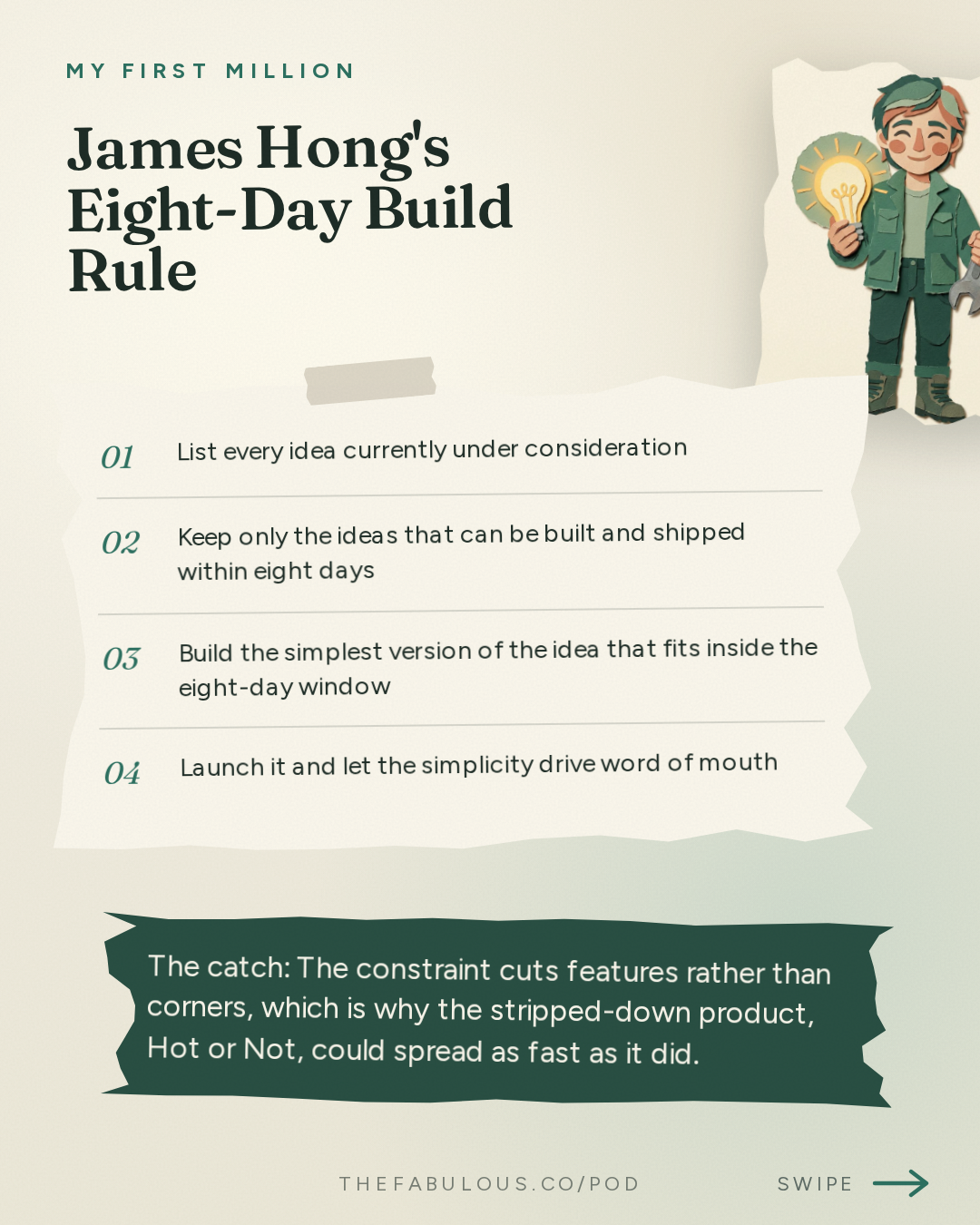
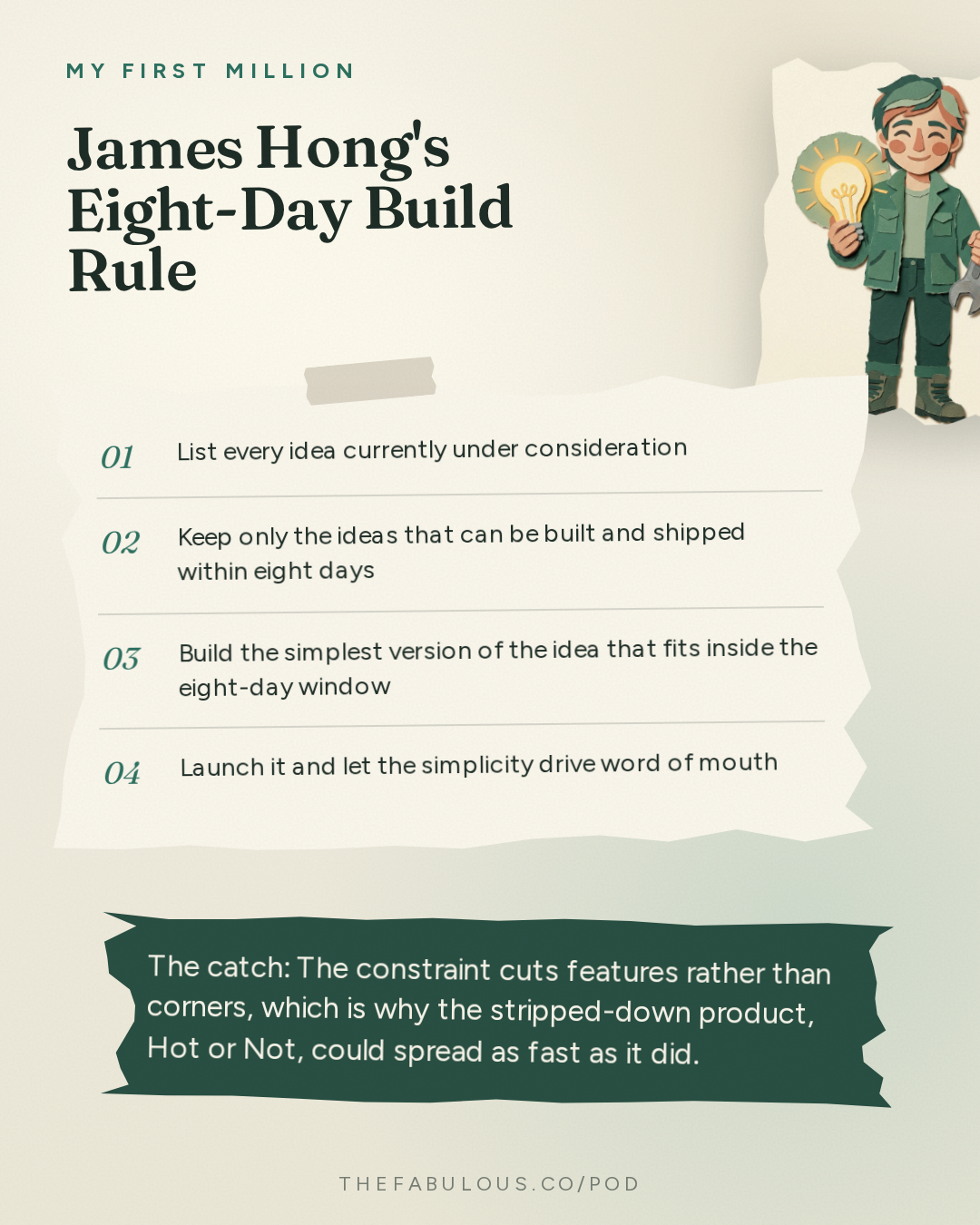
James Hong, who built the viral site Hot or Not and later appeared as an early guest on this same podcast, gives the most literal version of the rule. His company's legal entity was named "Eight Days," because he refused to build anything that could not be finished in eight days (26:06). That constraint is what produced Hot or Not in the first place: a concept so simple it could ship in a week, which is also, not coincidentally, the kind of idea simple enough to go viral (26:23).
"I'm only gonna build things I can build in eight days." — Shaan Puri, recounting James Hong [26:06]
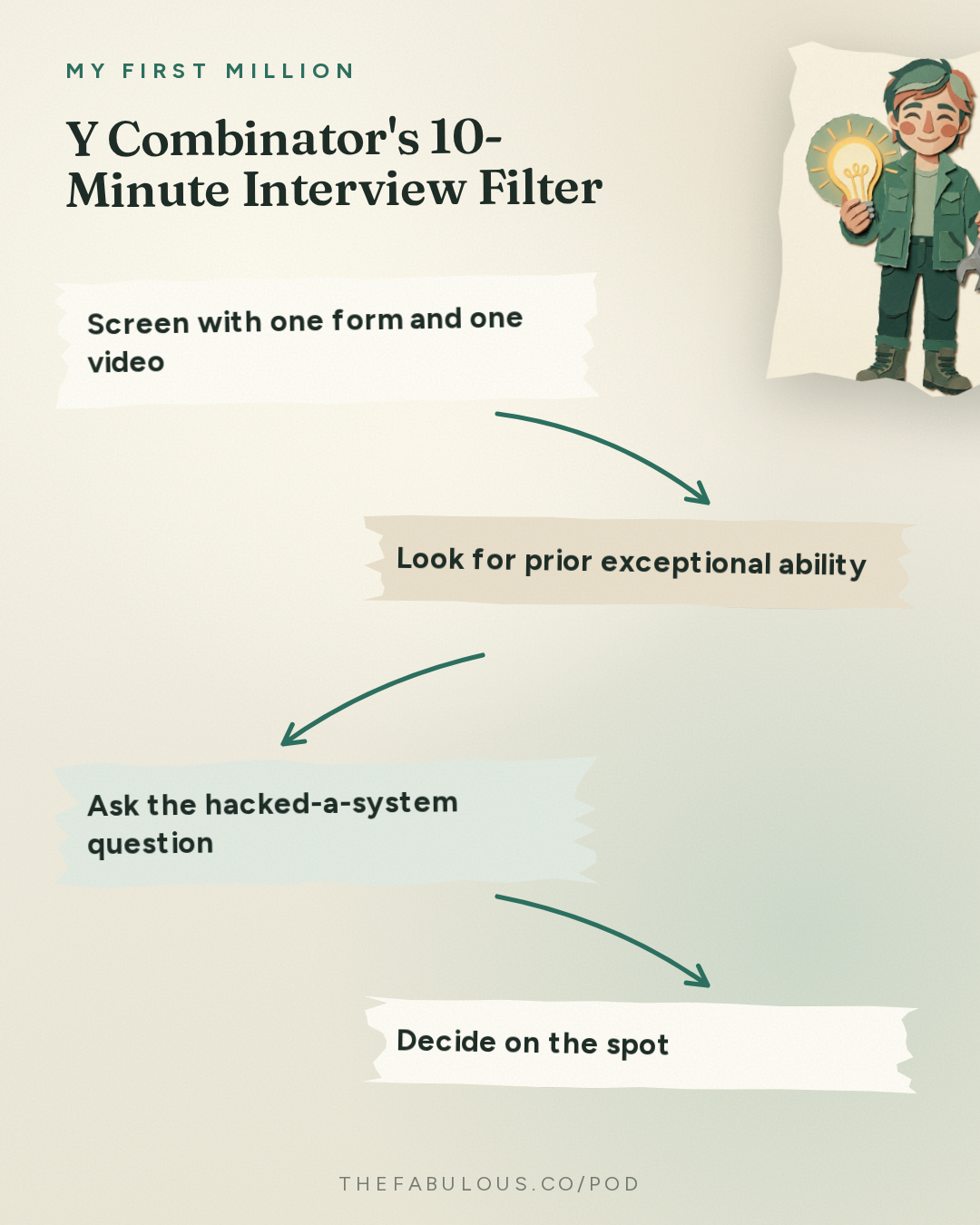
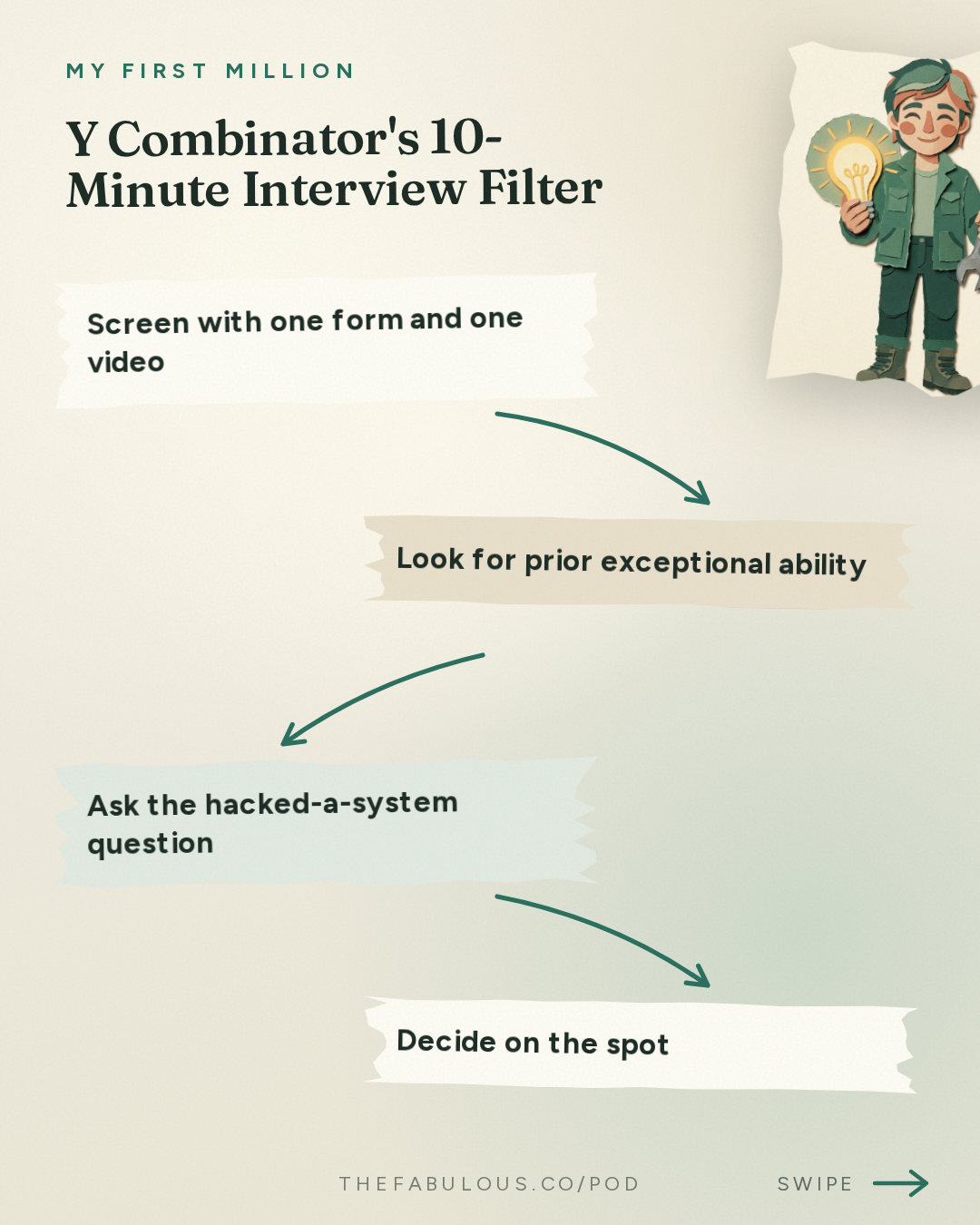
The hosts connect this to hiring too. Y Combinator, the startup accelerator with what the hosts describe as the highest hit rate of any investor, roughly 6 to 8 percent of its companies becoming unicorns, makes its funding decisions after a single form, a five-minute video, and a 10- to 15-minute interview (34:09, 34:44). One of the few fixed interview questions asks founders to describe a time they successfully hacked a non-computer system to their advantage, not as an endorsement of rule-breaking but as a fast proxy for independent thinking (36:17, 36:38). It is the kind of question that would never survive a normal investment committee, which is precisely why it works: it filters for the specific, slightly feral cleverness that correlates with startup success more than a polished resume does.
One host describes doing an amateur version of this filtering on himself for years, building spreadsheets before AI existed that reverse-engineered the growth timelines of companies like Gary Vaynerchuk's agency VaynerMedia from scattered old interviews, just to see concretely how fast other people had actually moved (40:15). The point of collecting these examples, he says, is less about copying the exact tactics and more about removing the excuse that something cannot be done quickly, the way the four-minute mile stopped being impossible the moment one runner proved it was not (41:10).
The episode ends on an unplanned case study in the opposite of all this: the hosts comparing notes on New York City private school tours, where elite preschools charge 74,000 dollars a year for three-year-olds to play with blocks, even as roughly 70 percent of the city's public school children live below the poverty line (50:45, 51:08). It is a small, funny, slightly bitter coda. The entire episode has been about systems that move absurdly fast once someone decides the old timeline was never actually required. The school admissions process, by contrast, is the kind of bureaucracy that simply assumes its own pace is correct, the same assumption the hosts spent the previous forty minutes arguing founders should refuse to accept.
Ask this episode anything
Pod's AI answers from the episode itself, with the minute mark so you can hear it yourself.
Or start with one of these
Ask this episode
Pod's AI listens to the whole episode to answer, and points you to the minute it comes from.
The rest of this answer, and any question after it
Answers come from the episode itself, never from a summary of it.
ContinueKey takeaways
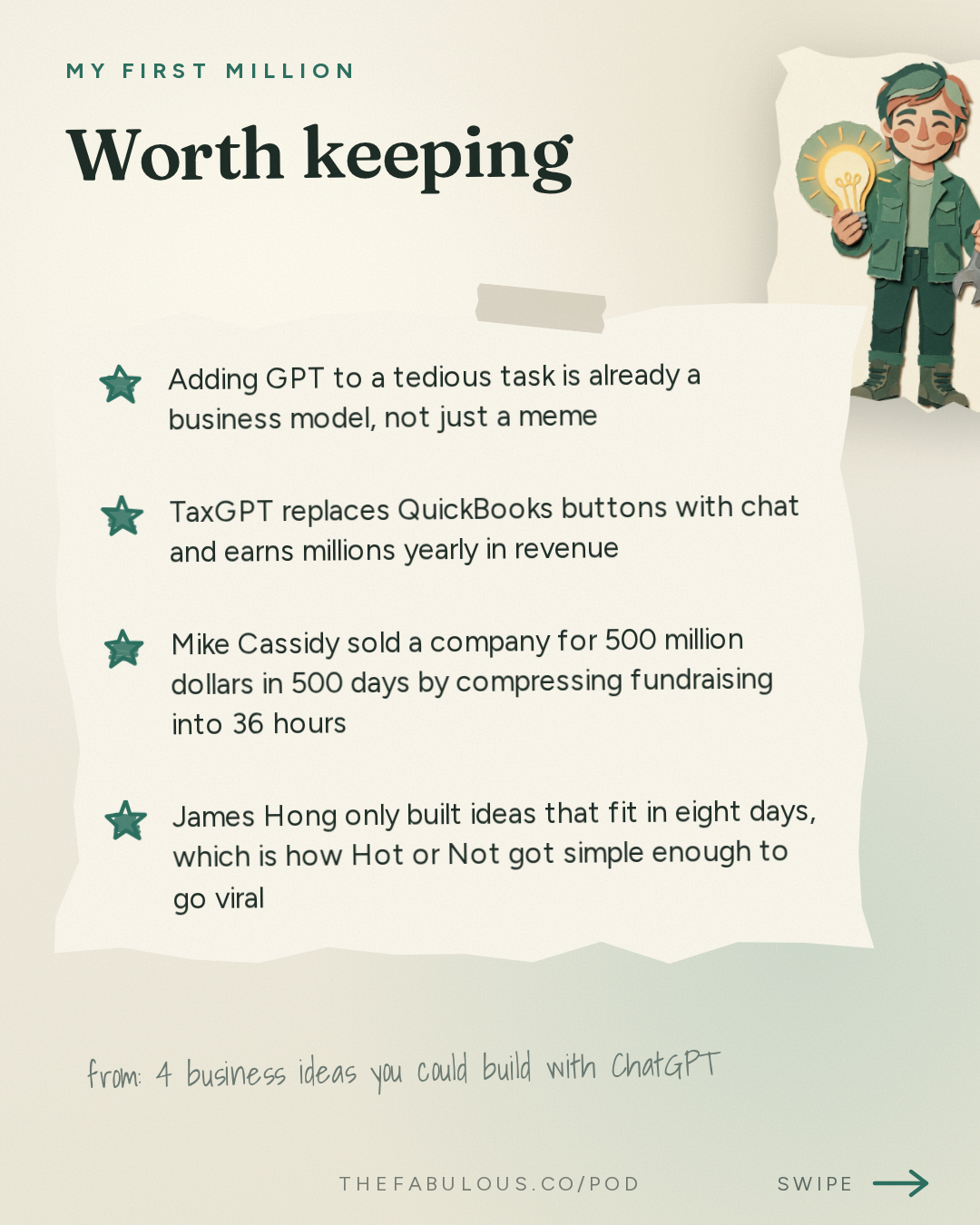
- Adding GPT to a tedious task is already a business model, not just a meme
- TaxGPT replaces QuickBooks buttons with chat and earns millions yearly in revenue
- Mike Cassidy sold a company for 500 million dollars in 500 days by compressing fundraising into 36 hours
- James Hong only built ideas that fit in eight days, which is how Hot or Not got simple enough to go viral
- Y Combinator decides funding in 10 to 15 minutes partly by asking founders about a time they hacked a system
The episode in cards
By the numbers
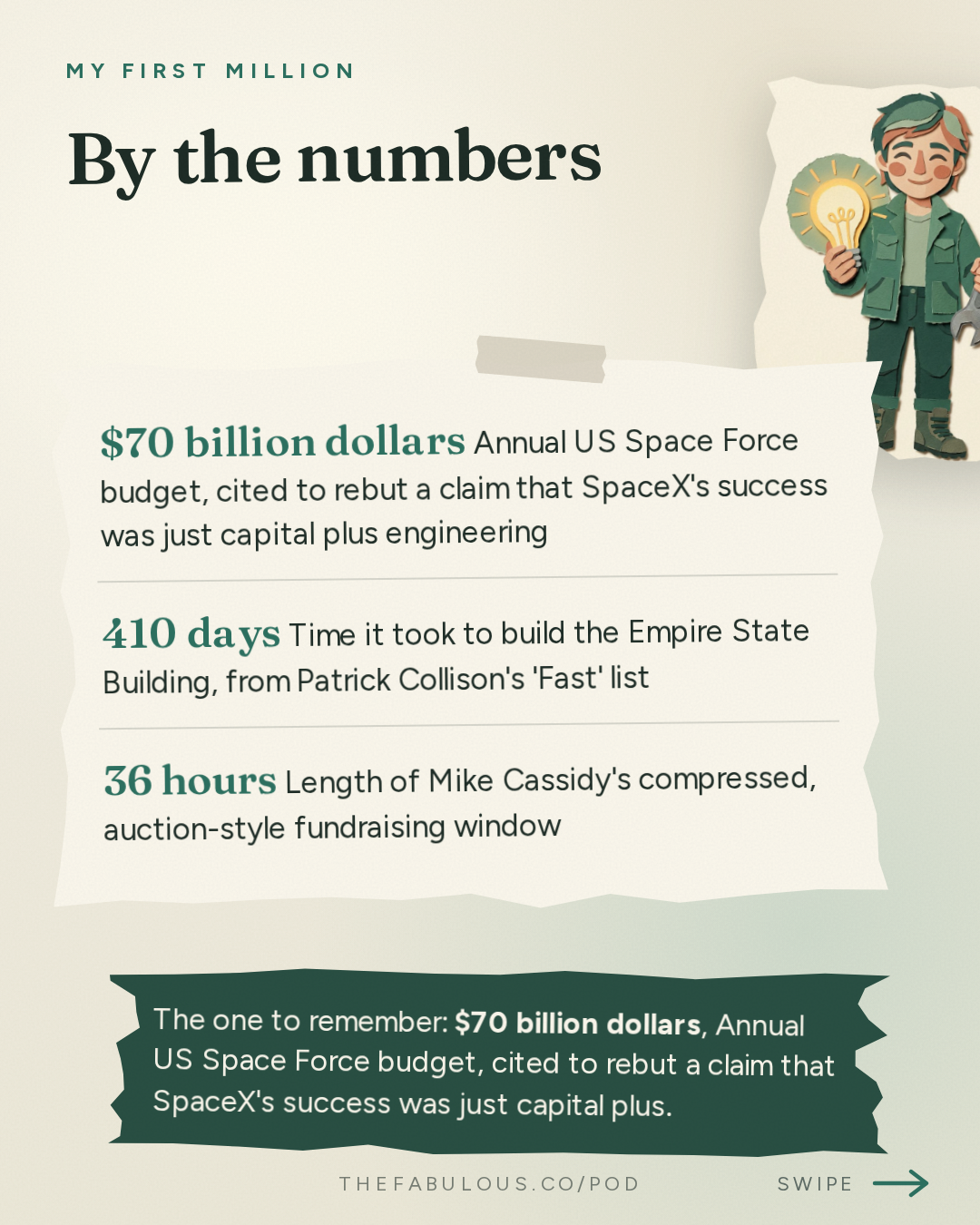
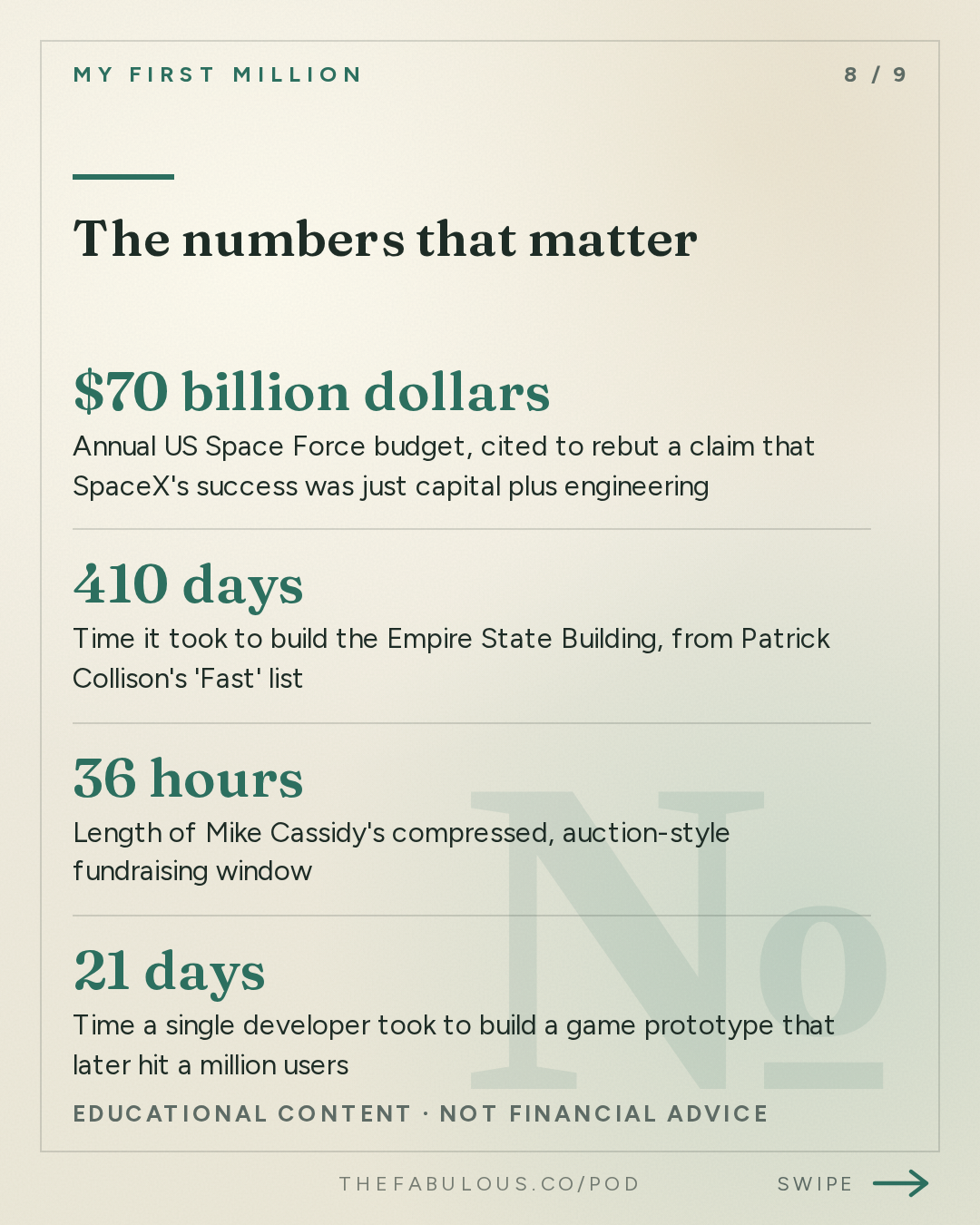
- $70 billion dollars Annual US Space Force budget, cited to rebut a claim that SpaceX's success was just capital plus engineering
- 410 days Time it took to build the Empire State Building, from Patrick Collison's 'Fast' list
- 36 hours Length of Mike Cassidy's compressed, auction-style fundraising window
- 21 days Time a single developer took to build a game prototype that later hit a million users
- $74,000 dollars Annual tuition at an elite New York City preschool discussed by the hosts
In their words
“Work expands to fill the time you give it, like a gas expands to fill whatever container it's in.”
“You don't set the goal of what the product is. You set the goal of the time.”
“I'm only gonna build things I can build in eight days.”
“One of the ways that you can identify a great entrepreneur is because they have, like, an organ rejection Right?”
Protocols
-
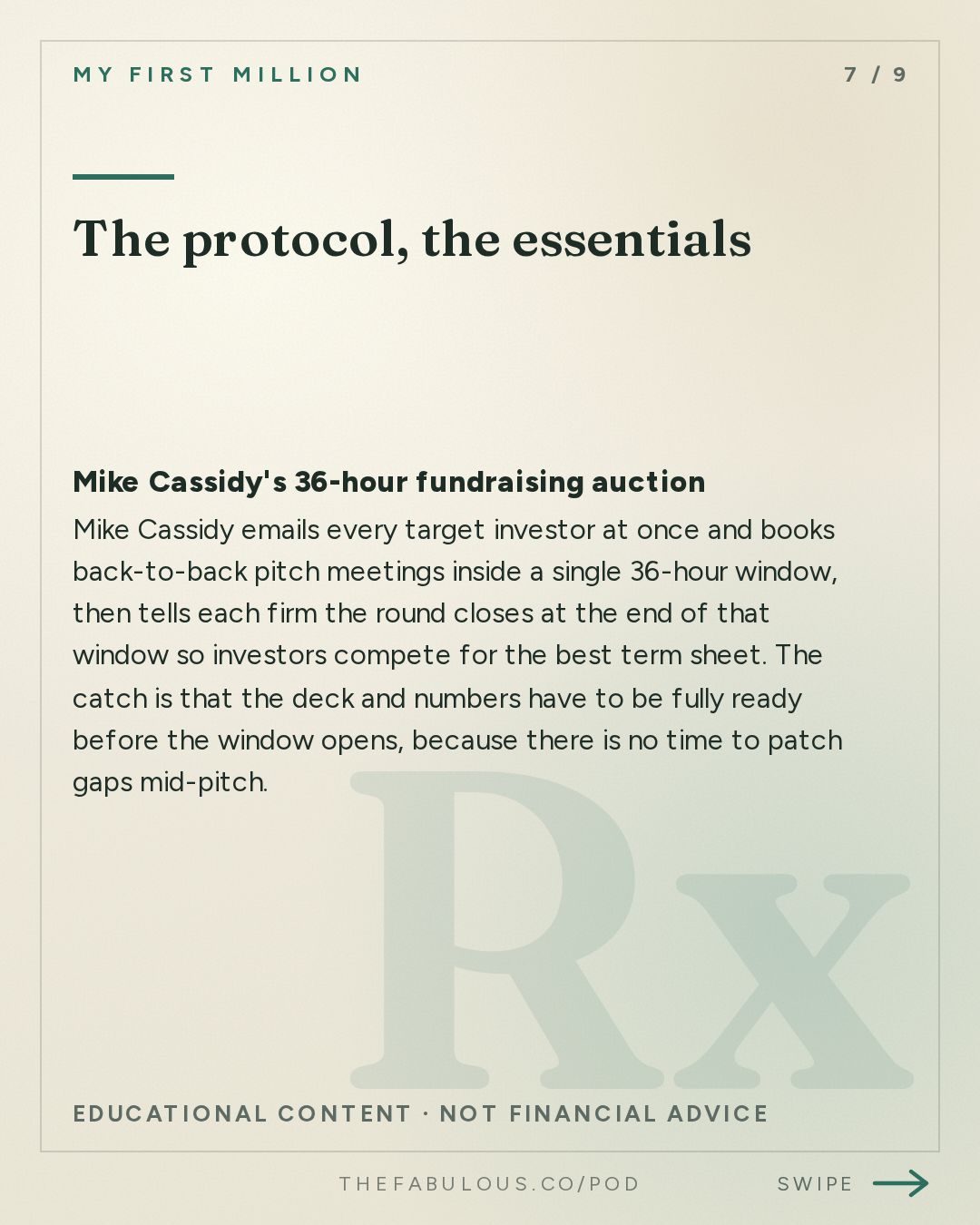
Mike Cassidy's 36-hour fundraising auction
Mike Cassidy emails every target investor at once and books back-to-back pitch meetings inside a single 36-hour window, then tells each firm the round closes at the end of that window so investors compete for the best term sheet. The catch is that the deck and numbers have to be fully ready before the window opens, because there is no time to patch gaps mid-pitch.
once per fundraising round
-
Mike Cassidy's same-day hiring close
Mike Cassidy books back-to-back candidate interviews across a single two-day window and brings a signed offer letter with the salary already filled in to every meeting, sliding it across the table on the spot if he likes the candidate and asking them to start the following Monday. The catch is that this only works once a founder has pre-screened hard enough that saying yes to any finalist would be a good outcome.
once per hiring round
-
James Hong's eight-day build rule
James Hong only builds ideas that can be finished and shipped within eight days, filtering his idea list down before starting any project rather than scoping a project down after starting it. The catch, as the hosts note, is that the constraint forces radical simplification, which is exactly why the resulting product, Hot or Not, was simple enough to spread virally.
per project
-
Y Combinator's hacked-a-system interview question
Y Combinator asks every applicant to describe a time they successfully hacked a non-computer system to their advantage, using the answer as a proxy for cleverness and independent thinking rather than asking directly about the business plan. The catch is that the question would likely fail in front of a normal investment committee, because it openly rewards rule-breaking over conventional credentials.
every interview
Questions this episode answers
What is a ChatGPT wrapper business?
It is a product built on top of a foundation model like ChatGPT that solves one narrow, tedious problem by replacing a cluttered dashboard with a chat interface. TaxGPT does this for tax and bookkeeping tasks and already generates millions of dollars a year in revenue (02:30).
Can ChatGPT get you an actual prescription?
Yes, a plugin called PhotonGPT lets users get doctor prescriptions directly through a chat interface with ChatGPT, which one host cites as an early example of the wrapper trend (03:02).
Is Anthropic building products that compete with wrapper startups?
Yes, Anthropic has launched a Shopify-style commerce tool, a Zoom competitor, a personal finance product, and an Office-style suite built on its Claude model, raising the question of whether small wrapper businesses will survive being absorbed by the larger labs (05:09, 06:13).
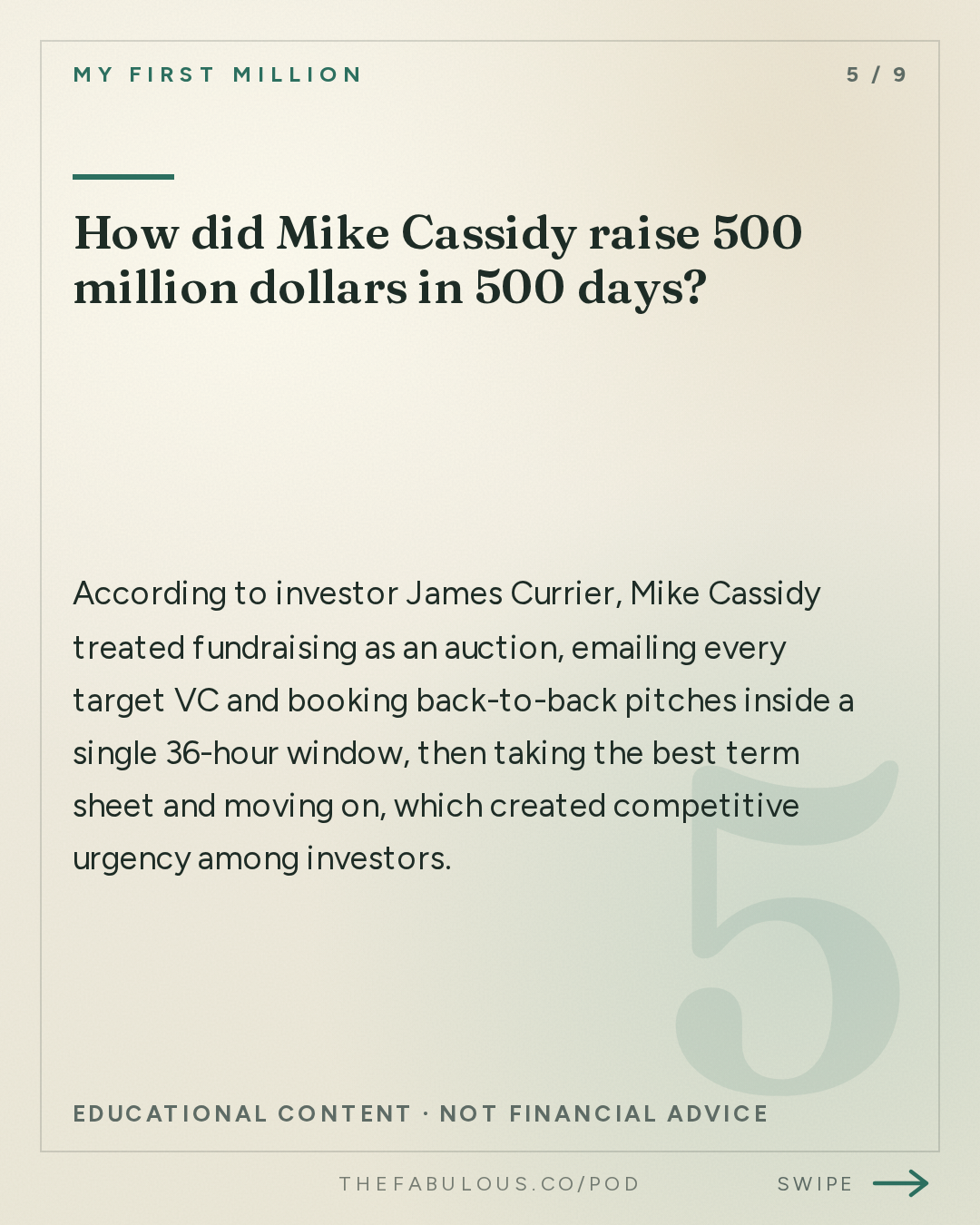
How did Mike Cassidy raise 500 million dollars in 500 days?
According to investor James Currier, Mike Cassidy treated fundraising as an auction, emailing every target VC and booking back-to-back pitches inside a single 36-hour window, then taking the best term sheet and moving on, which created competitive urgency among investors (20:56, 21:24).
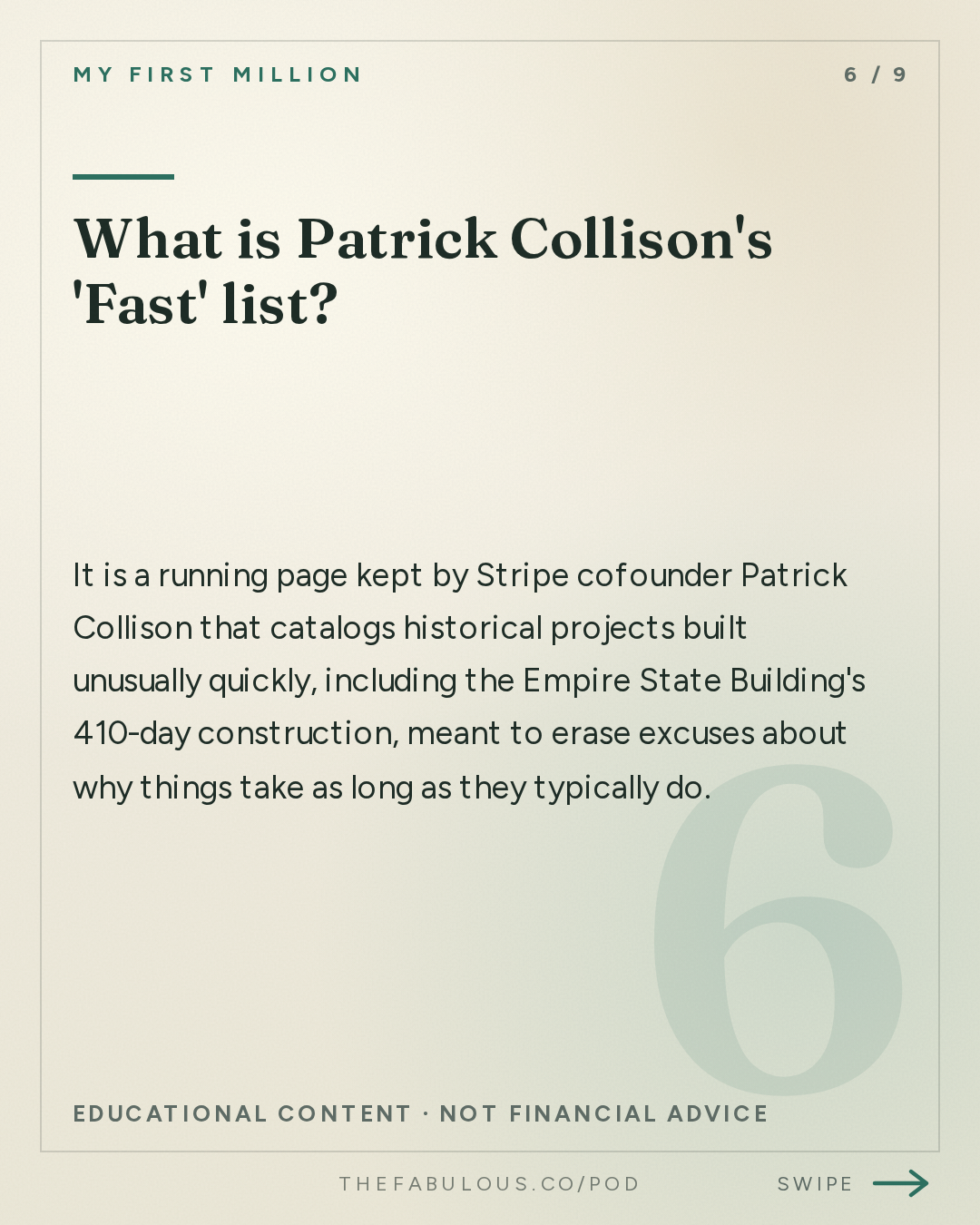
What is Patrick Collison's 'Fast' list?
It is a running page kept by Stripe cofounder Patrick Collison that catalogs historical projects built unusually quickly, including the Empire State Building's 410-day construction, meant to erase excuses about why things take as long as they typically do (15:20, 15:42).
What question does Y Combinator ask in its interviews?
Y Combinator asks applicants to describe a time they successfully hacked a non-computer system to their advantage, using it as a fast proxy for cleverness and independent thinking rather than evaluating the business plan directly (36:38).
The full read, in cards

Go deeper
- Fast (Patrick Collison's list of quickly built projects) — Catalogs historical projects built unusually fast, including the Empire State Building's 410-day construction, to counter excuses about timelines
- James Currier podcast interview on speed — Argued speed is the single best proxy for founder success after testing 48 candidate traits
- Matt Stoller tweet on SpaceX's Starship catch — Claimed SpaceX's success was a normal consequence of capital and engineering, drawing fact-checked replies on funding gaps versus Blue Origin and NASA
Mentioned
PointsGPT · Points.me · TaxGPT · PhotonGPT · Anthropic · Claude · SpaceX · Patrick Collison · James Currier · Mike Cassidy · James Hong · Y Combinator · Gary Vaynerchuk · Matt Stoller
More from this show and category
Vanessa Van Edwards: The Science of Charisma
Communication researcher Vanessa Van Edwards argues that warmth and competence drive 82% of first impressions, and that the first minute of an interaction is harder to undo than the next thirty. She offers concrete fixes: visible hands, information hooks, lower vocal pitch, and matching a listener's words and pace.
How Oh My Mahjong Hit $40 Million in Sales
Oh My Mahjong grew from $1 million to $40 million in revenue in two years by turning a $20 board game into a $450 art object people had to earn. The episode traces that same severity of initiation effect through $3,000 designer sunglasses, Andrew Huberman's $24 million deal with Hims, and a growing backlash against screens and ease.
James Currier's Speed Bar Framework for Startups
James Currier, cofounder of venture firm NFX, argues the single trait that predicts startup success is speed: how fast founders test, decide, and ship. He shows how time constraints, disposable test brands, and founder psychology work together to let underdogs out-move better-funded incumbents (01:34).
Robert Greene on Sublime, Power, and Near-Death
Robert Greene explains how a near-fatal stroke eight years ago led him to write Sublime, a book on reclaiming the awe that phone addiction has eroded. He also covers the Andes crash survivors' impossible climb, near-death brain science, and his law that power needs both presence and absence.
