
How to Share the Mental Load With Your Partner
How To Get Him To ACTUALLY Carry The Mental Load (Former Man Child Explains)
▶ Listen to the full episode More from The Liz Moody Podcast
The brief
Mental load coach Zach Watson says men often confuse doing a chore with owning it, and that sharing the mental load makes men happier too. He recommends the Fair Play card system, weekly 'build meetings,' and naming emotions precisely to cut defensiveness and split invisible labor fairly.
Ask this episode anything
Pod's AI answers from the episode itself, with the minute mark so you can hear it yourself.
Or start with one of these
Ask this episode
Pod's AI listens to the whole episode to answer, and points you to the minute it comes from.
The rest of this answer, and any question after it
Answers come from the episode itself, never from a summary of it.
Continue
Key takeaways
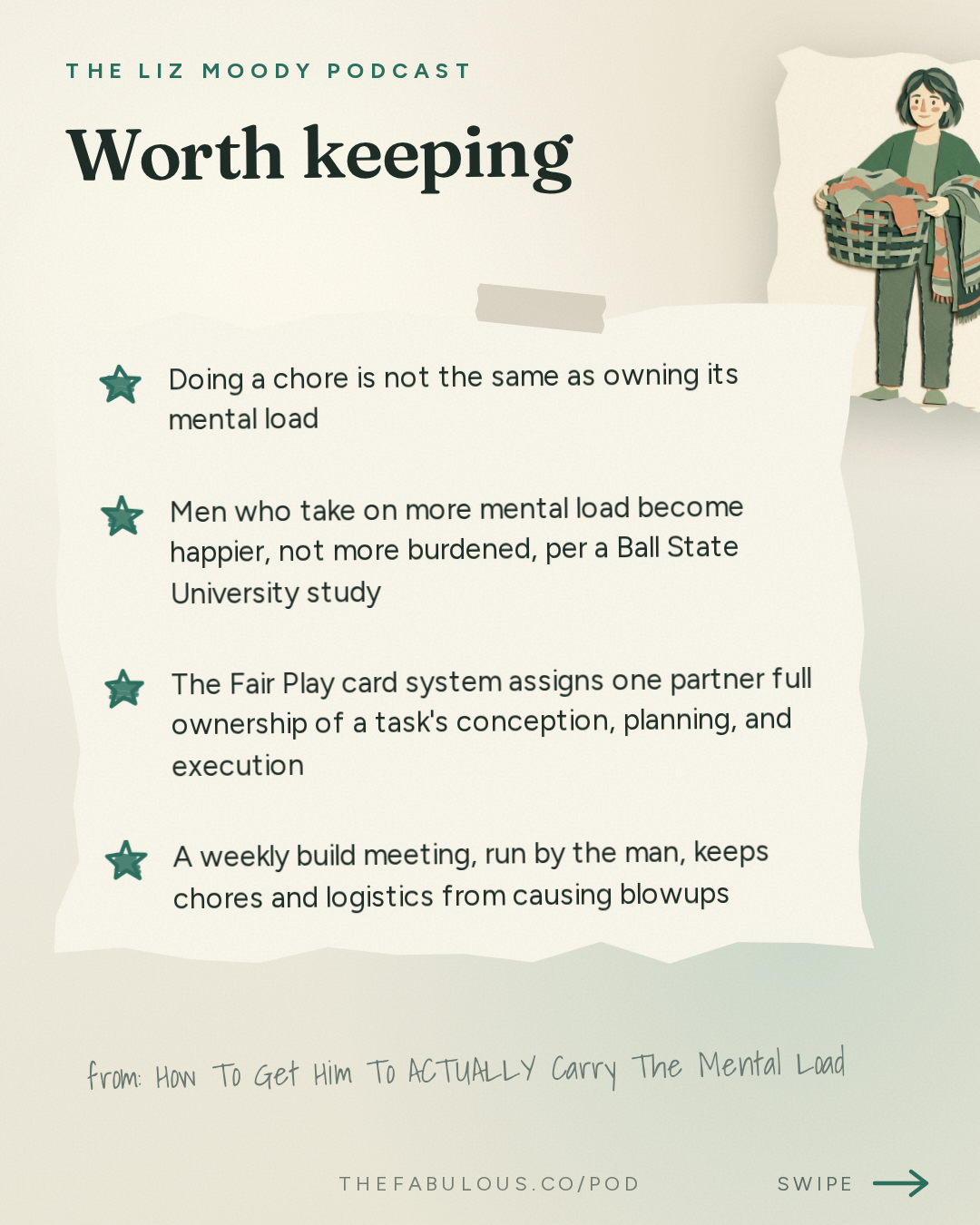
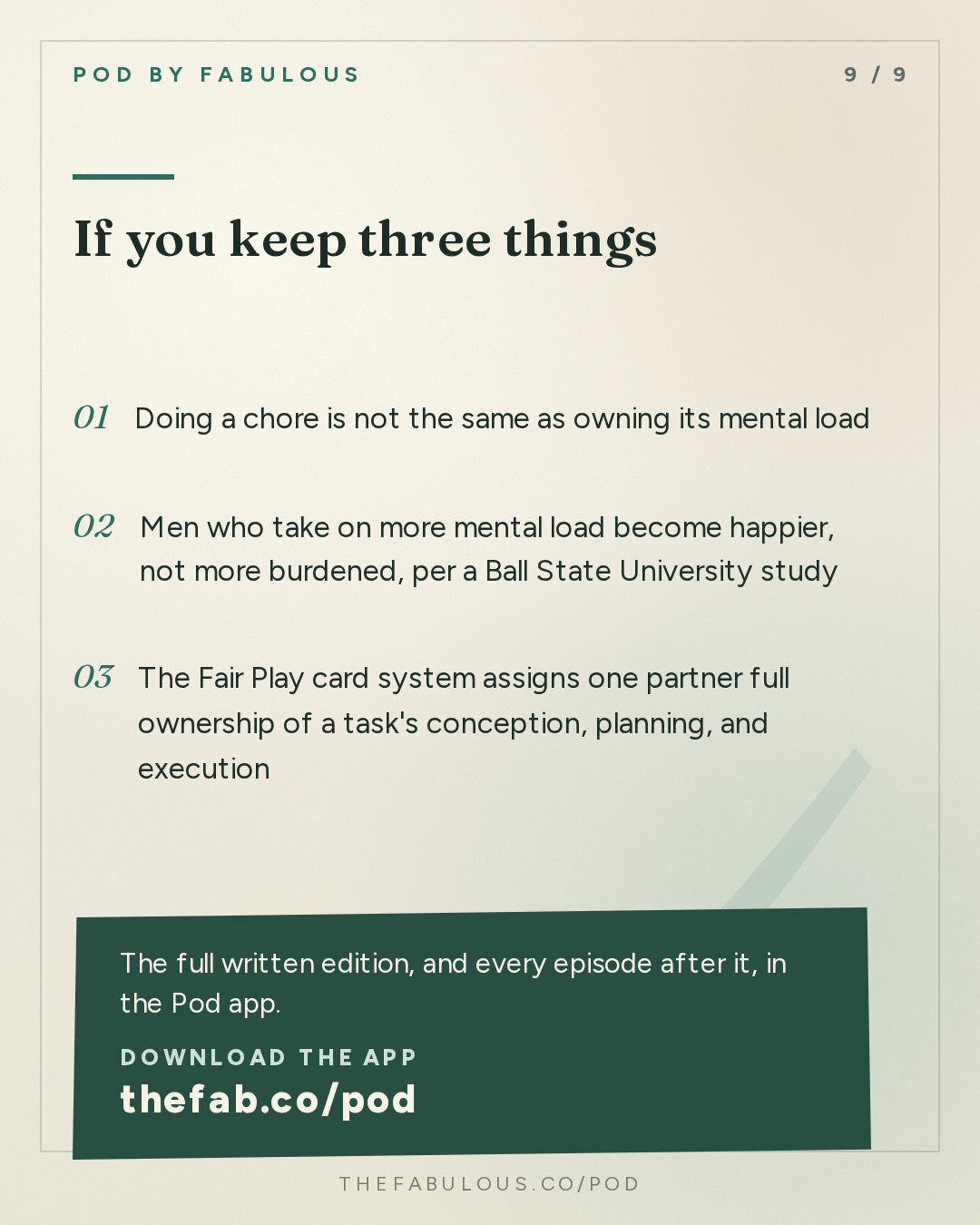
- Doing a chore is not the same as owning its mental load
- Men who take on more mental load become happier, not more burdened, per a Ball State University study
- The Fair Play card system assigns one partner full ownership of a task's conception, planning, and execution
- A weekly build meeting, run by the man, keeps chores and logistics from causing blowups
- Naming specific emotions like shame or loneliness reduces defensiveness better than saying 'upset'
The episode in cards
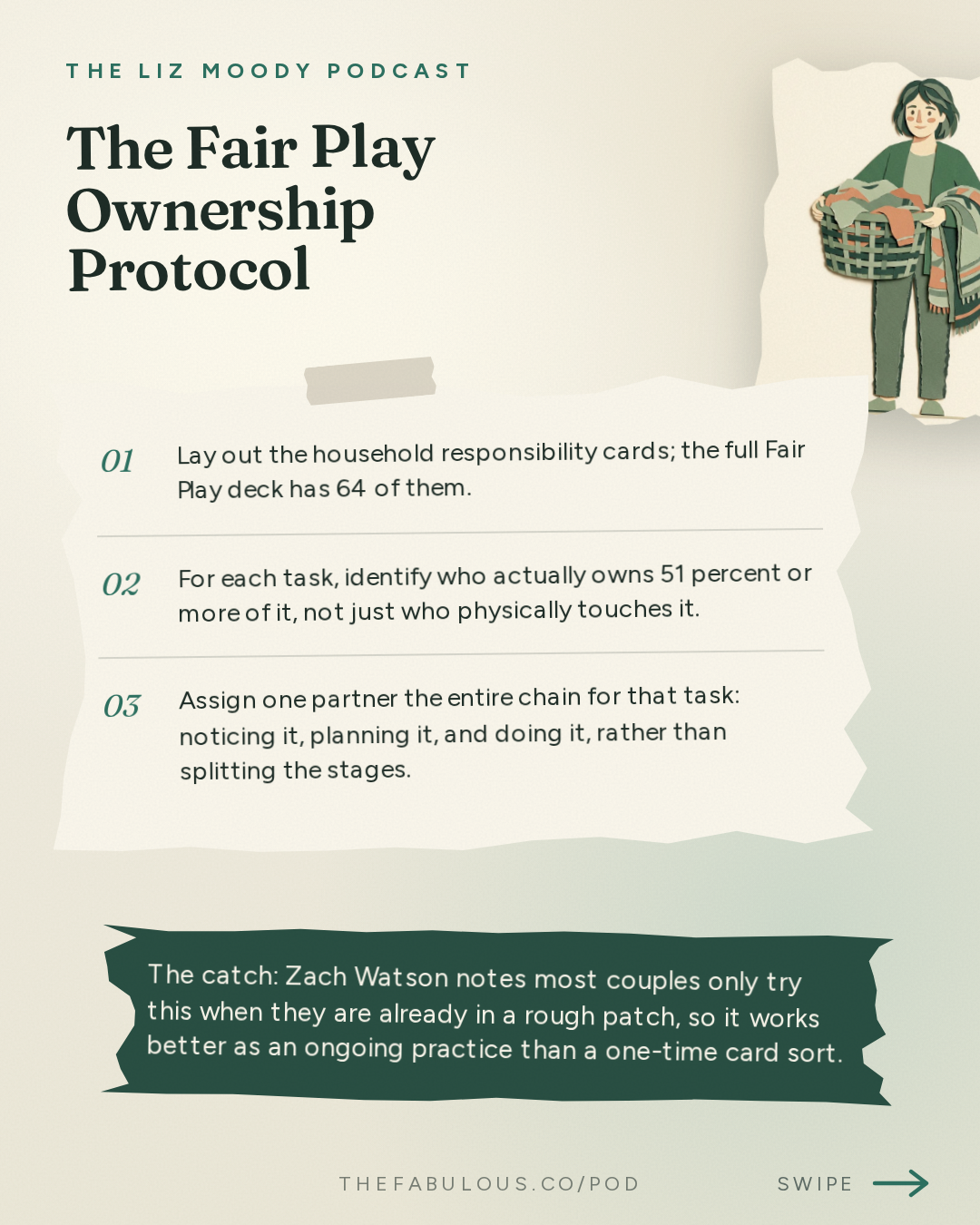
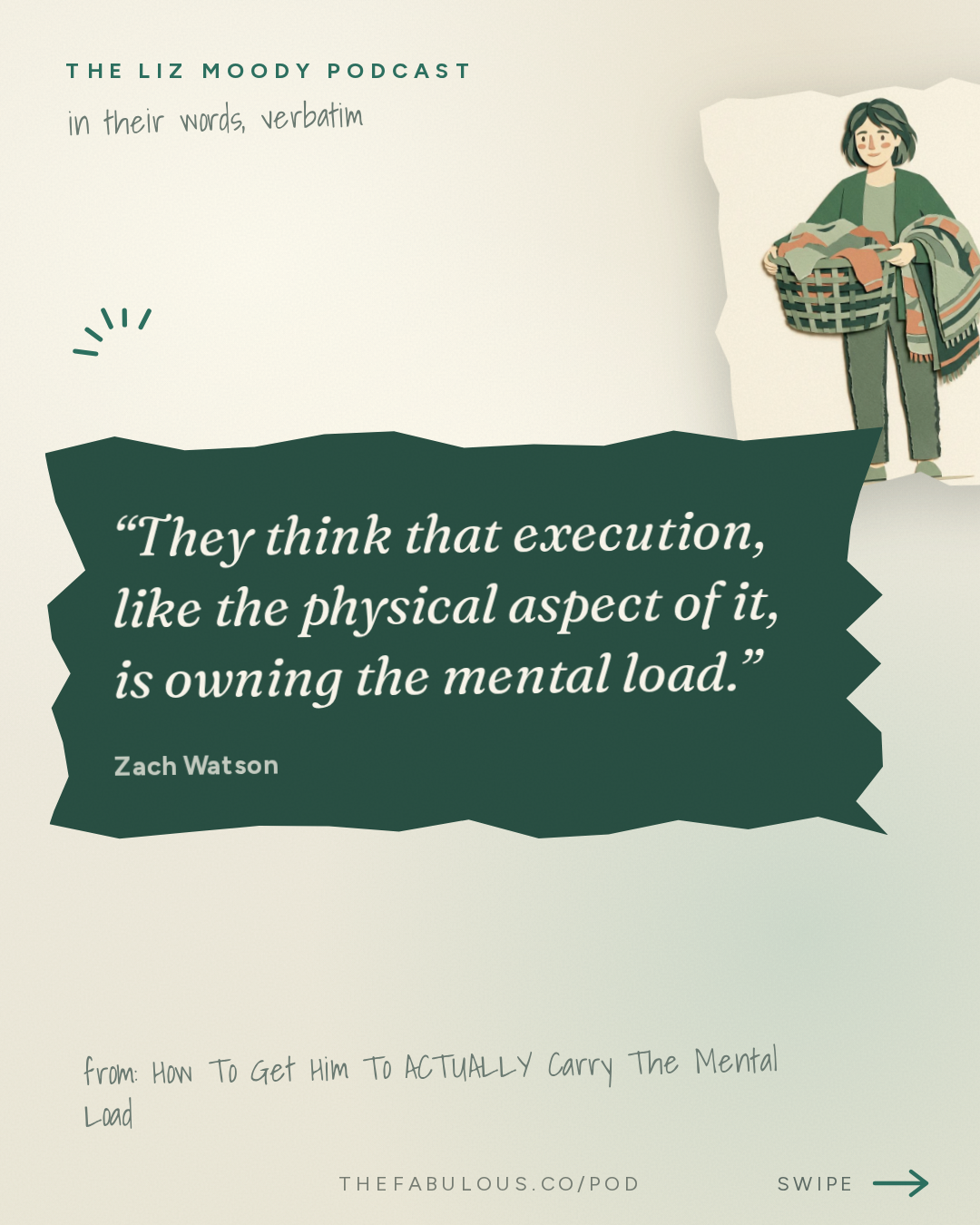
A man is standing in a grocery aisle, phone pressed to his ear, saying "Hey, babe" for the eighth time. He is technically at the store. He is not doing what his partner asked. This is the scene Zach Watson, a self-described "recovering man-child" and certified Fair Play facilitator with more than 1.4 million social media followers (00:45), uses to explain why so many households run on two separate and unequal tracks of work. Offering to grab groceries, he says, is offering physical labor. Asking for a list is handing the cognitive labor, the remembering and planning, right back to the person who was supposed to be relieved of it (01:53). "They think that execution, like the physical aspect of it, is owning the mental load," Watson says (01:33).
Four Kinds of Work Nobody Counts
Watson breaks what people call the mental load into four categories (05:36). Domestic labor is the physical, visible stuff: dusting, moving boxes, doing dishes. Clerical labor is the digital paperwork, filling out school forms, paying bills. Cognitive labor is the scheduling and calculating, the part of the brain that knows practice starts at 8:00 so the kids need to be in the car by 7:45. Emotional labor is managing feelings, both your own and everyone else's, including the four year old who will melt down if the ketchup is the wrong brand. Any of these can be invisible labor, meaning work that goes either unseen or unvalued, sometimes both.
None of this is only a home problem. Watson gets hired by corporate employee resource groups to talk about invisible labor at work, where cognitive labor is most of what white collar jobs are and emotional labor is most of what therapists, CEOs, and customer facing employees do all day (03:24). His advice to women trying to get a partner to hear this: borrow the vocabulary he already respects at the office. Tell him he is doing a lot of emotional labor for a difficult client, and a month later, when he has been away on a business trip while she has been solo parenting, the word will already mean something to him (04:09).
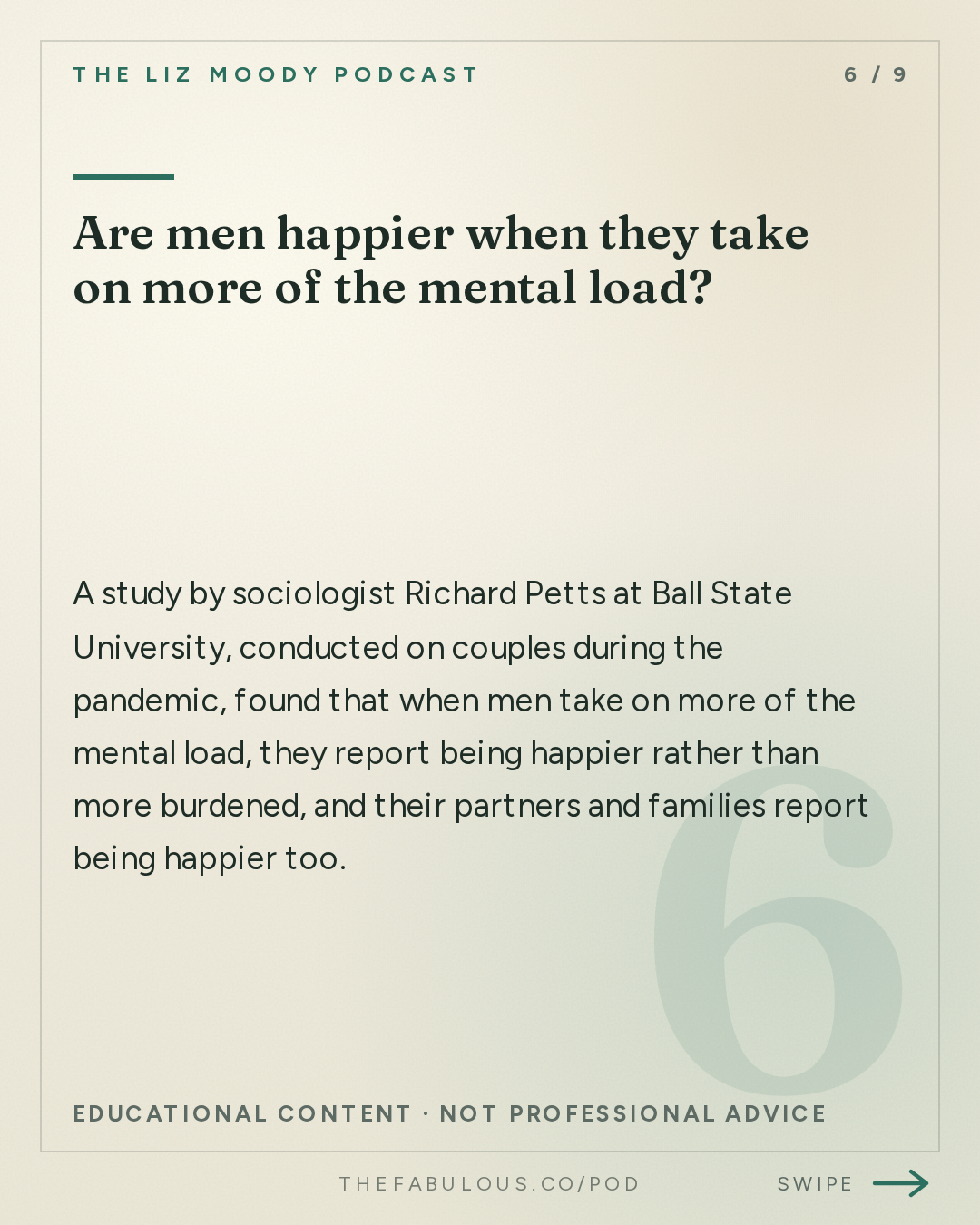
The bigger surprise is what happens when men actually take the load on. Sociologist Richard Petts at Ball State University studied couples sharing the mental load during the pandemic and found something asymmetric: when women carry everything, the whole family is unhappy, but when men start owning their share, they do not become more miserable. They become happier, and so does everyone else in the house (08:35).
Zach Watson, [08:35]: "When men start owning it... he's not more miserable. He's actually happier, and she's happier, and the whole family's happier."
Watson offers a few guesses at why, beyond simple gratitude: pride in a home that runs because of him, not despite him, and the end of a private tally that never gets solved, the number of times, in his case, his wife did the dishes over three years being small enough to count on two hands (09:15).
Building a System, Not a Fight
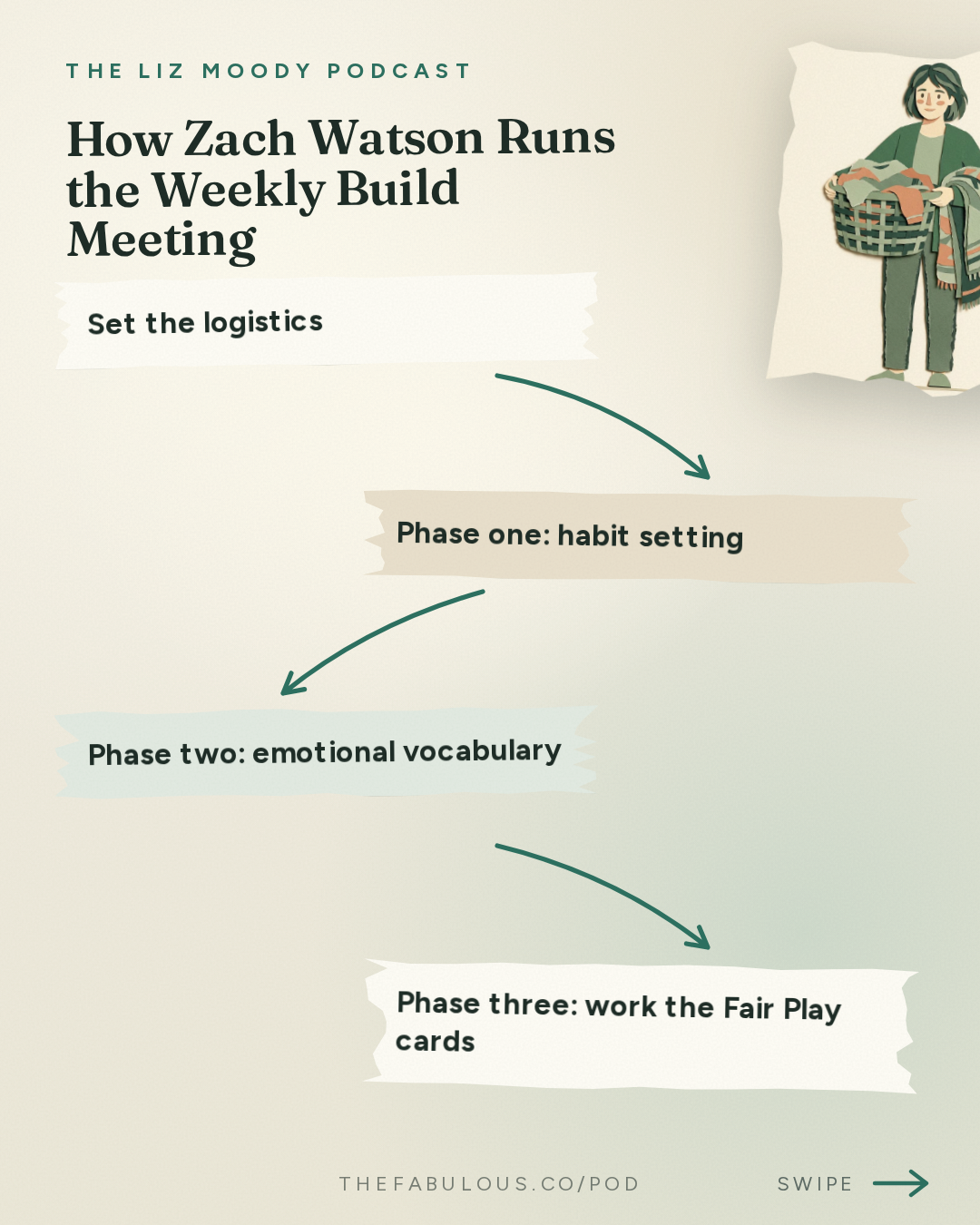
The Fair Play framework, built around a deck of cards naming household responsibilities, works because of one rule: siloing. One person owns a task's conception, meaning noticing it needs doing, its planning, and its execution, from start to finish, rather than splitting those stages between partners (13:00). His wife owns all of laundry. He owns all of dishes and trash. Owning the whole chain, he argues, is what actually removes an item from someone else's mental inventory, not just doing the physical part while she still reminds him to.
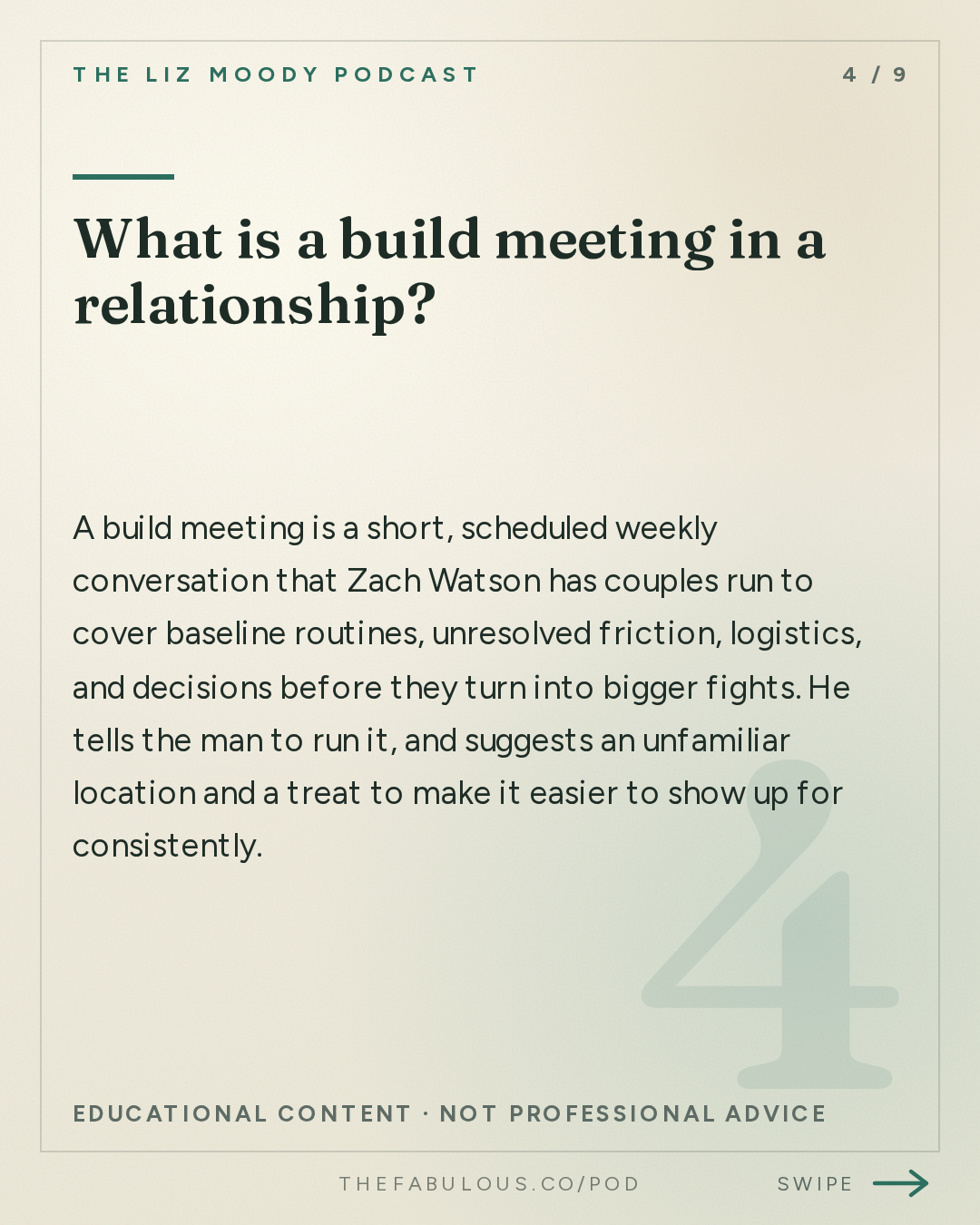
To keep the system alive, Watson runs a weekly ritual he calls the build meeting: a scheduled conversation covering baseline routines, unresolved friction, who is taking initiative on what, logistics, and decisions that need to be made (16:50). He tells the men he coaches to run the meeting themselves, hold it somewhere other than the usual Saturday morning couch spot so the brain does not slip into autopilot, and bring a treat, because an uncomfortable conversation is easier to show up for with donuts on the table (20:08).
Underneath the logistics sits a communication tool Watson calls emotional granularity: naming a feeling specifically, as anger, hurt, shame, or loneliness, instead of the catch all "upset." He says it changed a decade of arguments once he and his wife started practicing it, because a specific feeling is easier to validate than a vague one, and validation, not agreement, is what defuses defensiveness (21:23).
Even after a task is 80 or 90 percent handed off, Watson says a residue often remains, the "last 10 percent," like a reminder to start the dishes by a certain time. He compares it to a browser full of open tabs: a partner may own most tasks completely, but she is also holding a pile of small, unfinished slivers of other people's responsibilities, and closing those slivers, not just doing the big visible chore, is what actually frees up her attention (23:25).
Zach Watson, [23:25]: "I want you to think about in your head, you have a bunch of Chrome tabs open."
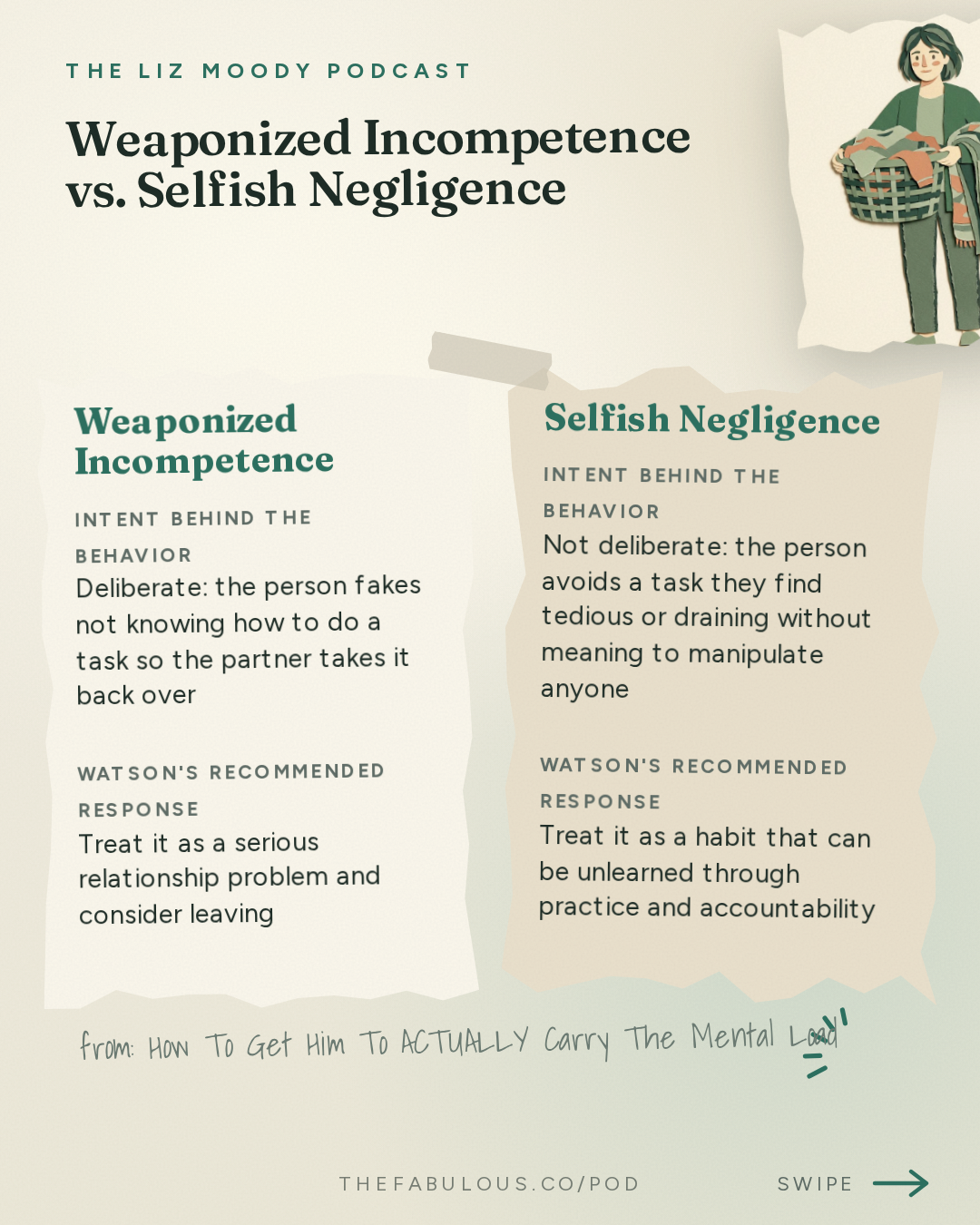
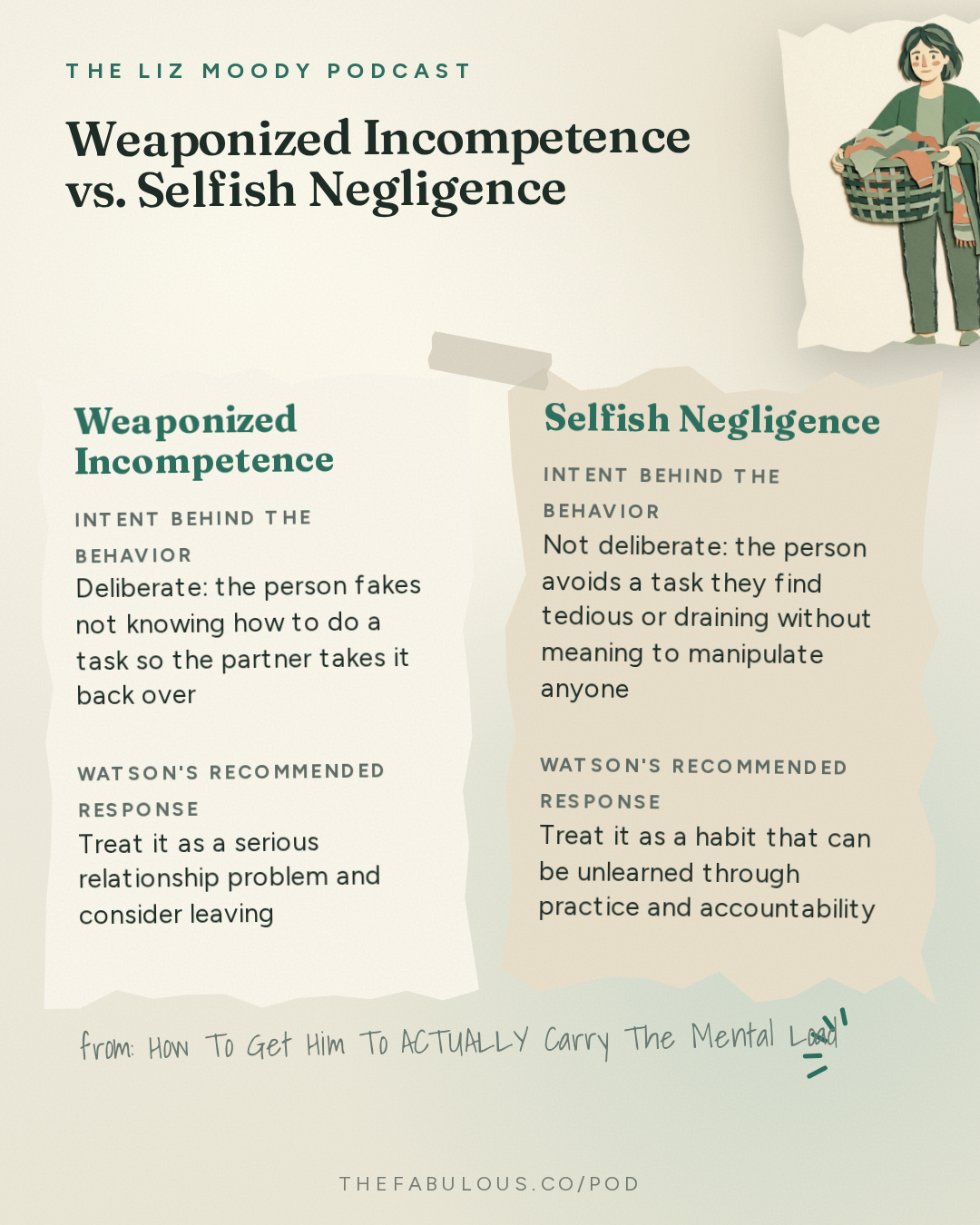
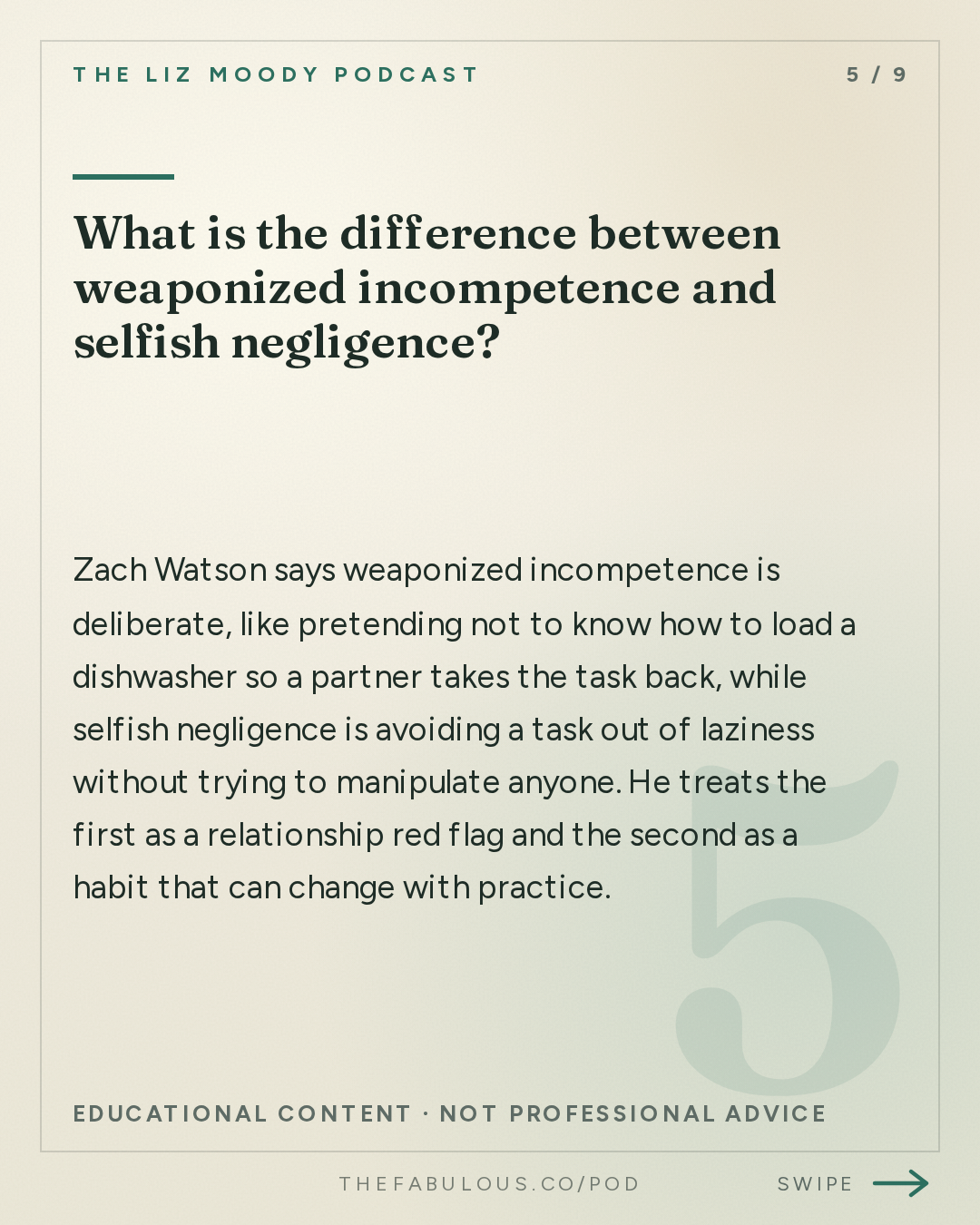
Not every uneven task is a grievance, though. Watson separates deliberate manipulation from ordinary avoidance. Someone who fakes incompetence to get out of a chore, sudsing the whole kitchen with the wrong soap so his partner stops asking him to run the dishwasher, is practicing what Watson calls weaponized incompetence, a calculated act (68:55). Someone who just does not feel like getting up with a sick kid, and knows it, is being what he calls selfishly negligent, a habit that can be unlearned. The distinction matters, he argues, because one calls for boundaries and possibly leaving, and the other calls for practice and accountability.
Watson does not let money settle these arguments either. Being the higher earner, he says, does not buy someone out of the mental load, since earning an income is something most people would do whether or not they had a family. "Your money is not contributing as much to your house as you think it is," he says (86:04). A bigger paycheck might mean a fancier vacation, but someone still has to plan the itinerary.
The stakes of ignoring all this, Watson argues, go beyond hurt feelings. Men with partners and men with daughters tend to live longer, largely because the women in their lives are the ones tracking their doctor's appointments and health maintenance (47:36). Refuse the help, he says, and the outcome is not independence. It is often an earlier death, and a partner left carrying the mental load of grief.
His closing message to men is less a scolding than a diagnosis of a pattern he calls the "do better loop": a partner erupts over something small, like a spoon left in the sink, the man tries harder for a few days or weeks, the fighting stops, and he quietly eases off again because the argument was his only signal that something was wrong. Resentment then rebuilds underneath, unnoticed, until it resurfaces over something equally small (78:39). Breaking the loop, in Watson's telling, does not require becoming a different person. It requires a standing weekly meeting, a shared vocabulary for labor that used to be invisible, and the willingness to sit through a few uncomfortable minutes with a plate of donuts on the table.
By the numbers
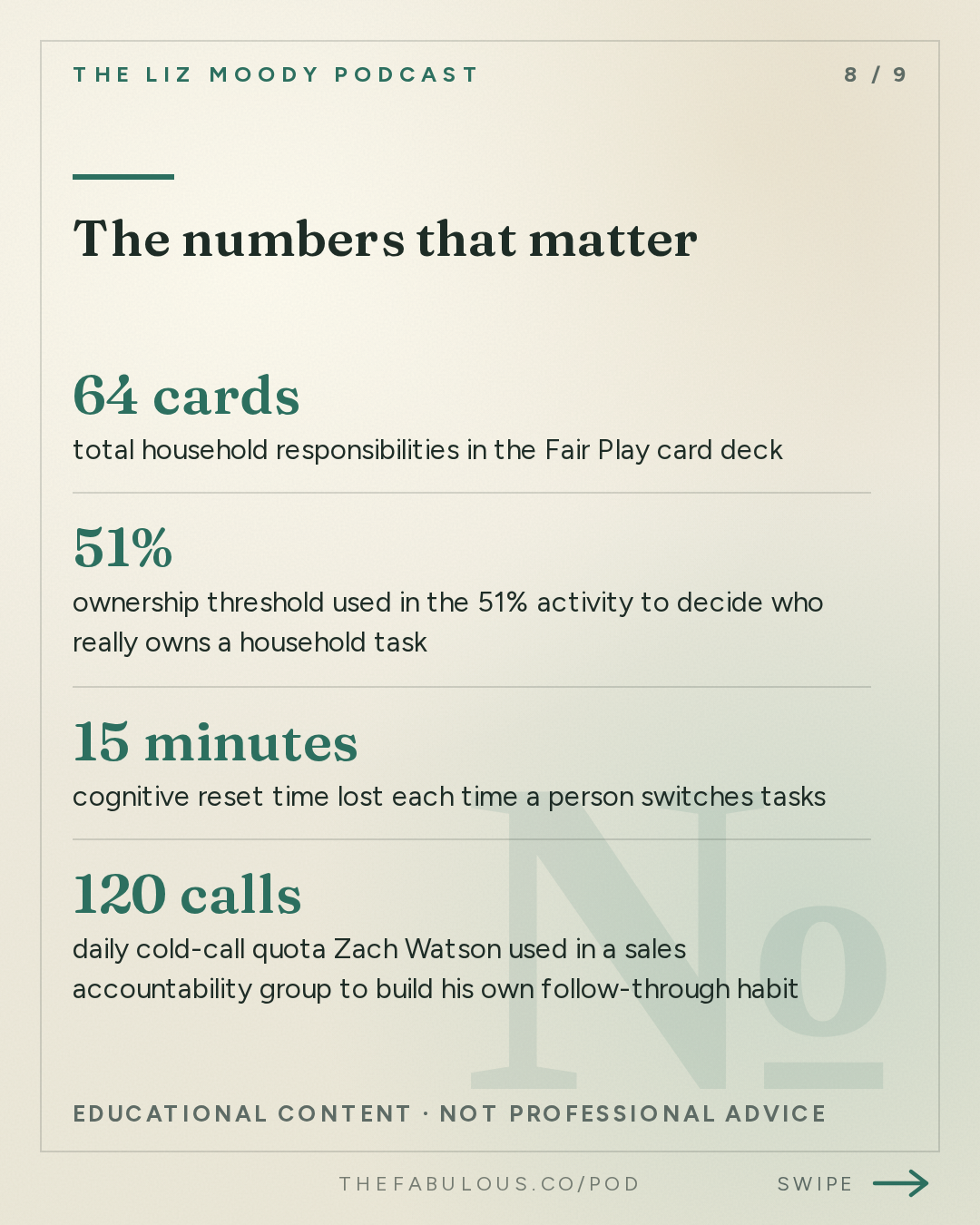
- 64 cards total household responsibilities in the Fair Play card deck
- 51% ownership threshold used in the 51% activity to decide who really owns a household task
- 15 minutes cognitive reset time lost each time a person switches tasks
- 120 calls daily cold-call quota Zach Watson used in a sales accountability group to build his own follow-through habit
In their words
“They think that execution, like the physical aspect of it, is owning the mental load.”
“I want you to think about in your head, you have a bunch of Chrome tabs open.”
“The bar is in hell.”
“Your money is not contributing as much to your house as you think it is.”
“Women are literally out there keeping men alive, and then when they're like, "Well, okay, I'll back off," the guy's like, "I'll do it myself," and it's like, well, you don't and then you die.”
Protocols
-
Run a Weekly Build Meeting
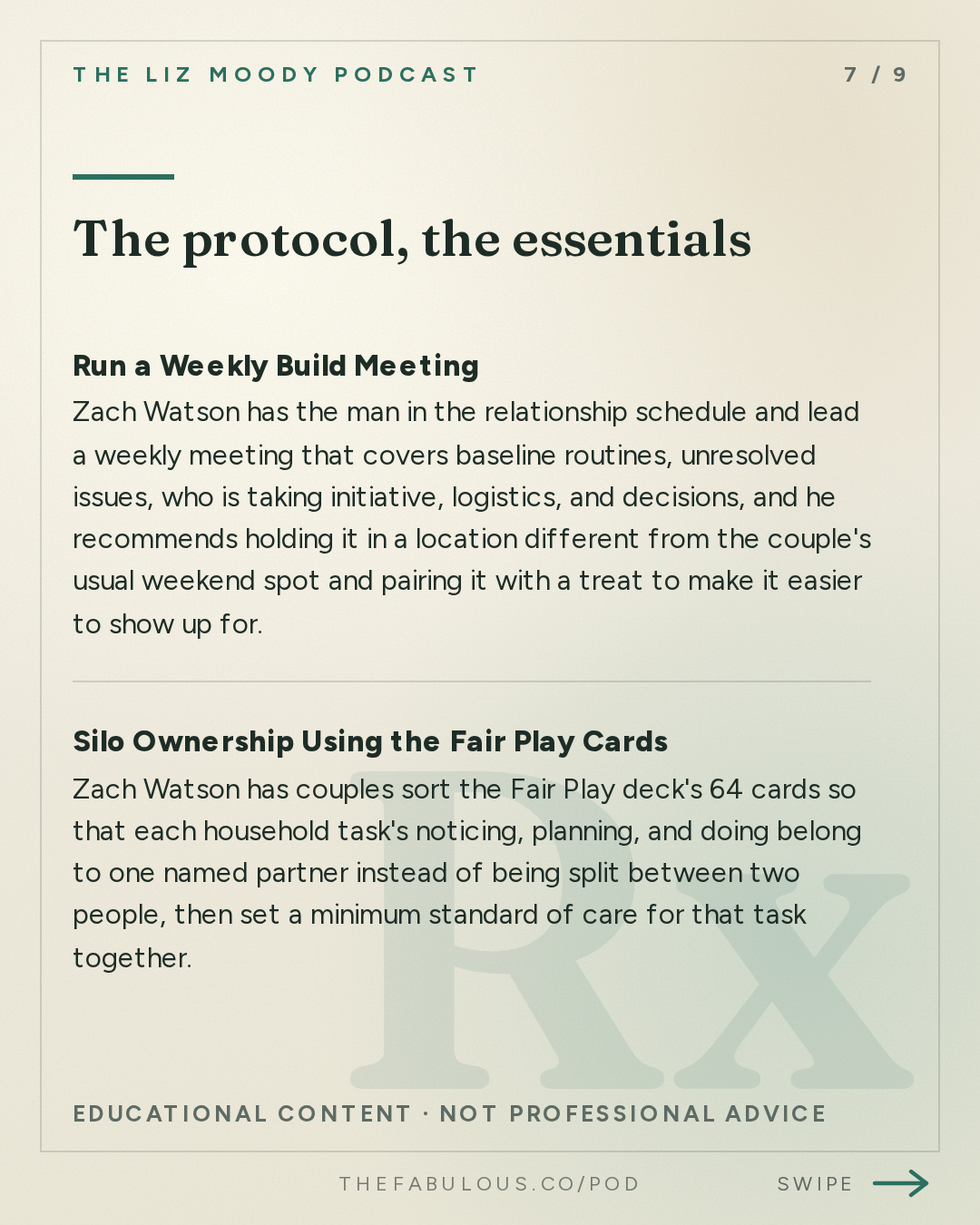
Zach Watson has the man in the relationship schedule and lead a weekly meeting that covers baseline routines, unresolved issues, who is taking initiative, logistics, and decisions, and he recommends holding it in a location different from the couple's usual weekend spot and pairing it with a treat to make it easier to show up for.
Weekly
-
Silo Ownership Using the Fair Play Cards
Zach Watson has couples sort the Fair Play deck's 64 cards so that each household task's noticing, planning, and doing belong to one named partner instead of being split between two people, then set a minimum standard of care for that task together.
Set up once, then revisit whenever life circumstances change
-
Practice Emotional Granularity Before Conflict
Zach Watson has partners replace vague words like 'upset' with specific emotion labels such as anger, hurt, shame, or loneliness before discussing a conflict, because a specific feeling is easier for a partner to validate and validating it reduces defensiveness.
As needed, before difficult conversations
-
Add an Anti-Incentive for Missed Commitments
Zach Watson attaches a real cost, such as a charitable donation to a cause he dislikes or giving up a solo hotel stay, to a missed deadline like a build meeting or a doctor's appointment booking, modeled on the accountability system he used to hit 120 cold calls a day in his sales job.
Ongoing, tied to specific recurring tasks
Questions this episode answers
How do you get a husband to share the mental load?
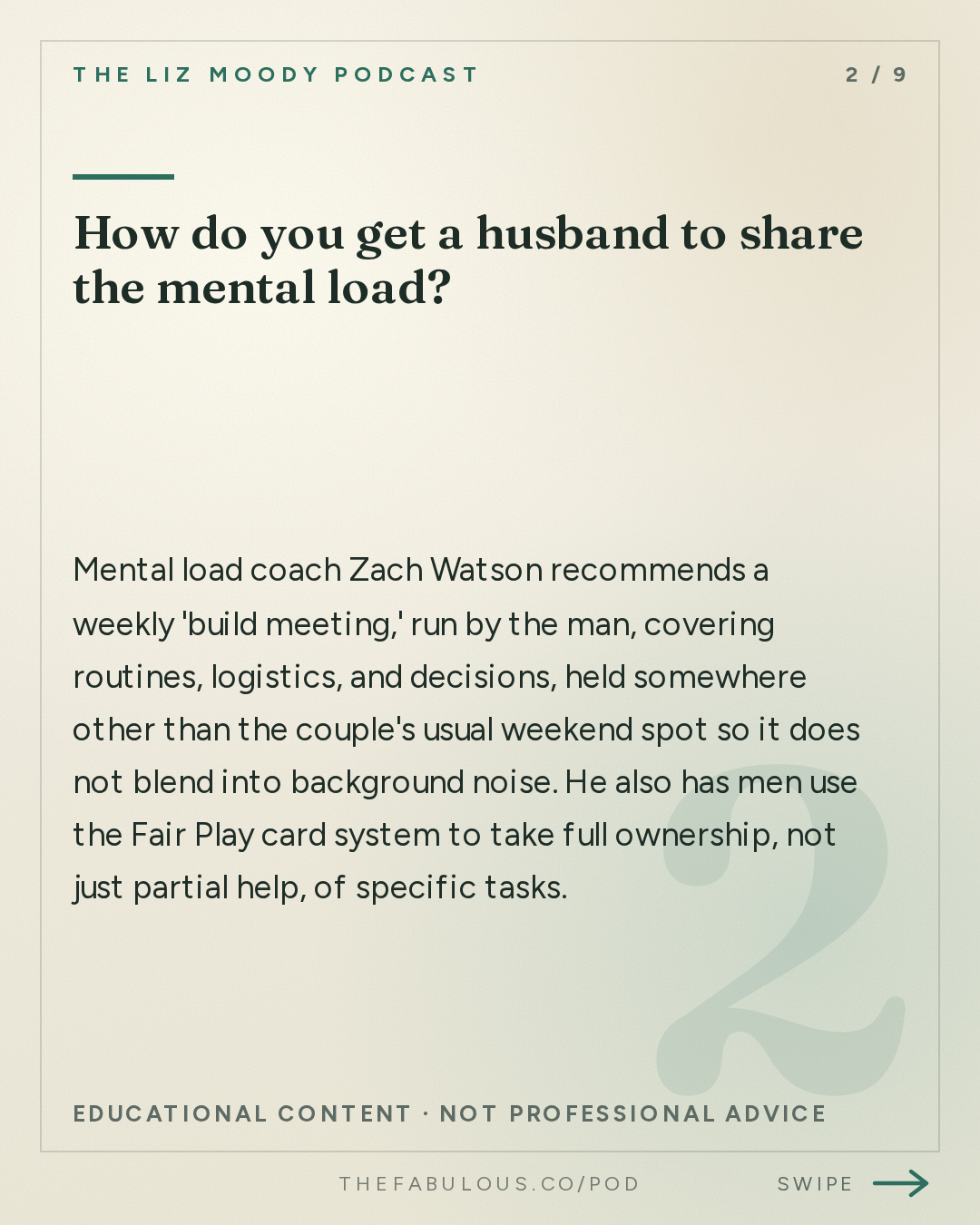
Mental load coach Zach Watson recommends a weekly 'build meeting,' run by the man, covering routines, logistics, and decisions, held somewhere other than the couple's usual weekend spot so it does not blend into background noise (16:50). He also has men use the Fair Play card system to take full ownership, not just partial help, of specific tasks (13:00).
What is the Fair Play method?
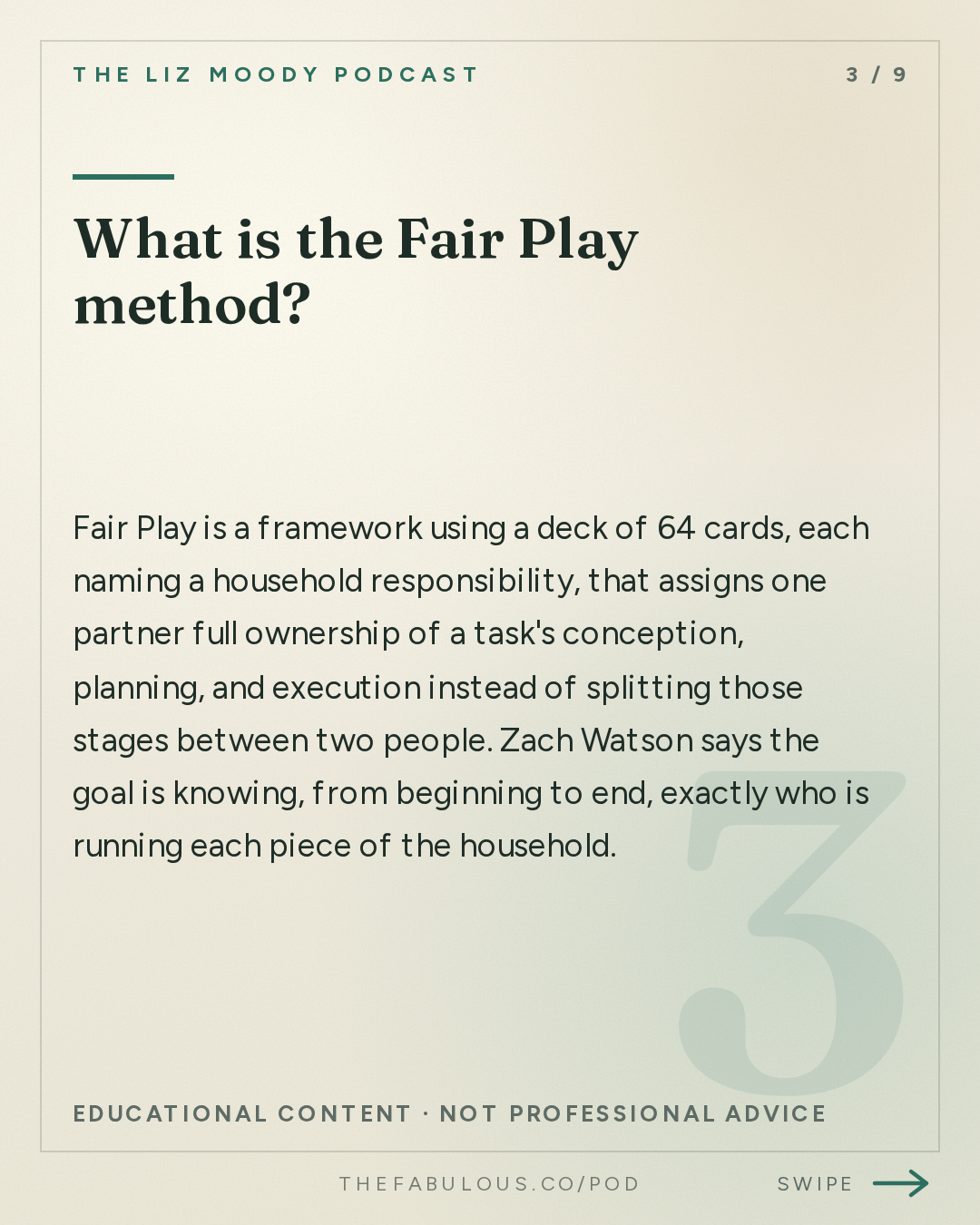
Fair Play is a framework using a deck of 64 cards, each naming a household responsibility, that assigns one partner full ownership of a task's conception, planning, and execution instead of splitting those stages between two people (12:41, 13:00). Zach Watson says the goal is knowing, from beginning to end, exactly who is running each piece of the household.
What is a build meeting in a relationship?
A build meeting is a short, scheduled weekly conversation that Zach Watson has couples run to cover baseline routines, unresolved friction, logistics, and decisions before they turn into bigger fights (16:50). He tells the man to run it, and suggests an unfamiliar location and a treat to make it easier to show up for consistently (20:08).
What is the difference between weaponized incompetence and selfish negligence?
Zach Watson says weaponized incompetence is deliberate, like pretending not to know how to load a dishwasher so a partner takes the task back, while selfish negligence is avoiding a task out of laziness without trying to manipulate anyone (68:55). He treats the first as a relationship red flag and the second as a habit that can change with practice.
Are men happier when they take on more of the mental load?
A study by sociologist Richard Petts at Ball State University, conducted on couples during the pandemic, found that when men take on more of the mental load, they report being happier rather than more burdened, and their partners and families report being happier too (08:12, 08:35).
The full read, in cards
Go deeper
- Ball State University pandemic study on couples and the mental load — found men who take on more mental load report greater happiness, with benefits extending to their partner and family, rather than more misery
- Fair Play — the card-based framework, created by Eve Rodsky, that splits household responsibilities into conception, planning, and execution across 64 tasks
- Drained — a book by researcher Lia Repennec that describes the mental load as 'emotional thinking work'
- Does Your Relationship Need a Mental Load Coach? — a New York Times article profiling Zach Watson's coaching work
Mentioned
Zach Watson · Fair Play · Eve Rodsky · Richard Petts · Ball State University · Lia Repennec · Drained · Tim Ferriss · Ramit Sethi · Alyssa
More from this show and category

Mel Robbins' Let Them Theory for Difficult People
Mel Robbins' Me, We, Them framework redirects relationship stress toward the one variable anyone can control: their own reaction. She names three habits that wreck relationships (expecting others to change, letting their behavior dictate your mood, assuming they 'should' know what you need) and offers a script from therapist Terry Real for saying the hard thing without blame.
James Sexton's Guide to the Six Stages of Divorce
Divorce attorney James Sexton maps the six stages of divorce and gives scripts for telling a spouse and a 48-hour safety plan. He explains why an avoided conversation gets more expensive with time, why grief means the love was real, and how to actually help someone else going through it.

Cher's Life Advice on Love, Money, and Leaving
Cher tells the hosts of We Can Do Hard Things how she survived a controlling marriage to Sonny Bono and chose to leave instead of ending her life. She describes losing all ownership of Cher Enterprises, advice from Lucille Ball, and the bumper car philosophy that carried her through decades of setbacks.

Stacey Abrams' 10 Steps to Authoritarianism, Explained
Stacey Abrams argues the United States is now a "competitive authoritarian" country: elections still happen, but power is hoarded and unaccountable (07:58). She lays out ten warning steps toward autocracy and ten matching steps back to freedom, then applies both to the midterms six weeks out, urging two hours a week of targeted local action (62:33).
