
How to Overcome a Fear of Flying
How I Overcame My Fear of Flying (+ Is It Getting Less Safe? I Asked A Pilot)
▶ Listen to the full episode More from The Liz Moody Podcast
The brief
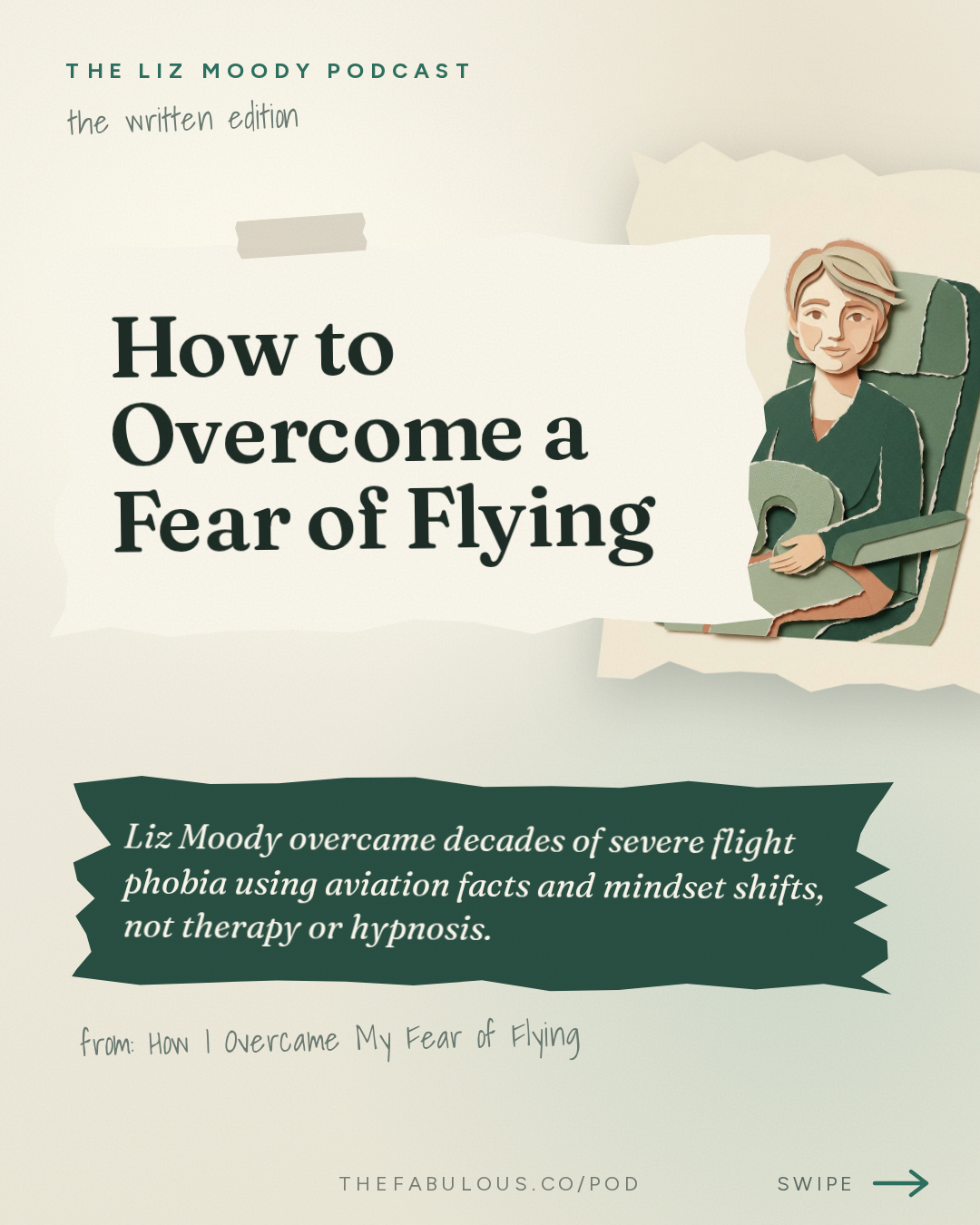
Liz Moody overcame decades of severe flight phobia using aviation facts and mindset shifts, not therapy or hypnosis. She learned how redundancy systems, pilot training, and uncertainty tolerance work, while airline pilot Kyle Kokol confirmed severe turbulence remains exceptionally rare despite over 105,000 daily global flights.
There is a particular kind of misery in holding a barf bag full of your own vomit during takeoff because the seatbelt sign is on and you cannot get up. Liz Moody describes doing this more than once, the product of a fear of flying so severe that she would not make plans for after she landed, in case she never did (00:00). And yet last week she flew thirteen hours to New Zealand and twelve hours back (00:20). The gap between those two facts, the vomit and the long-haul trip, is the subject of this episode: not a cure, exactly, but a set of things that actually moved the needle after years of trying everything else.
The useful part of this story starts with what failed, because the failures are instructive. Moody tried EMDR, a therapy where a clinician guides a patient through traumatic memories while the eyes move back and forth or the patient squeezes something in one hand and then another. She had heard its mechanism explained by psychologist Marissa Franco on an earlier episode of her show and came away convinced it has real scientific backing (01:44). It simply did not work for her. She tried hypnosis, ten sessions with a well-known British hypnotist who specializes in flight anxiety, with no change in her relationship with flying (02:29). She tried checking turbulence forecasts on sites like Turbli, which she found both inaccurate and counterproductive: seeing predicted turbulence made her more anxious, not less, and on her return flight from New Zealand a captain warned for hours about a coming storm that, in the end, barely registered as bumpy at all.
"I had spent all of this time dreading something that did not end up coming to pass." — Liz Moody [03:43]
The fourth failure is the one almost every anxious flier has heard: the Jell-O analogy, the idea that air at altitude behaves like a thick gel, so a plane in turbulence is bouncing inside Jell-O rather than falling through open space. Moody has had this metaphor offered to her for over a decade. It does nothing for her, because, as she puts it, she is not in Jell-O, she is in air, and her brain does not process a metaphor as evidence.
The Treatments That Didn't Take
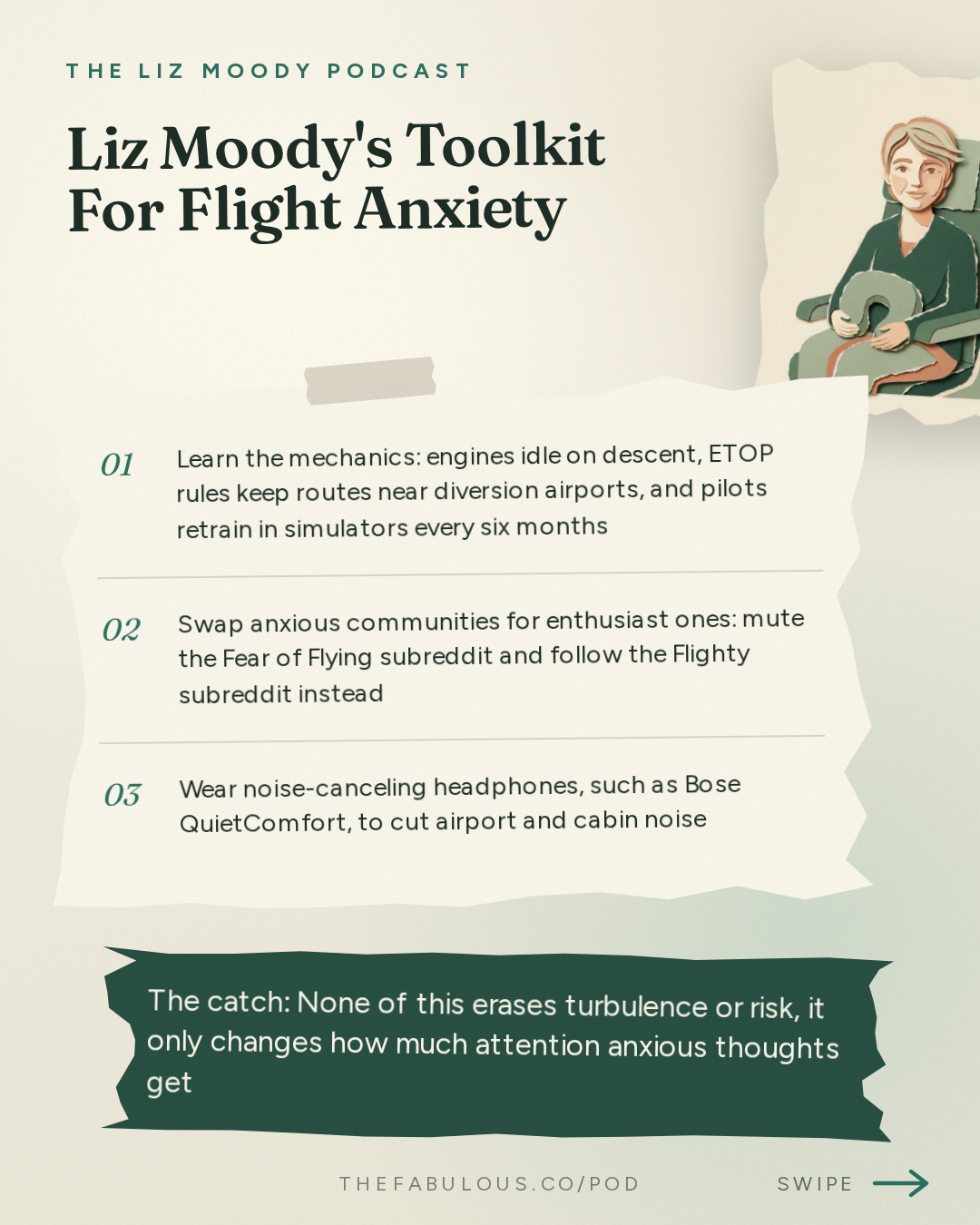
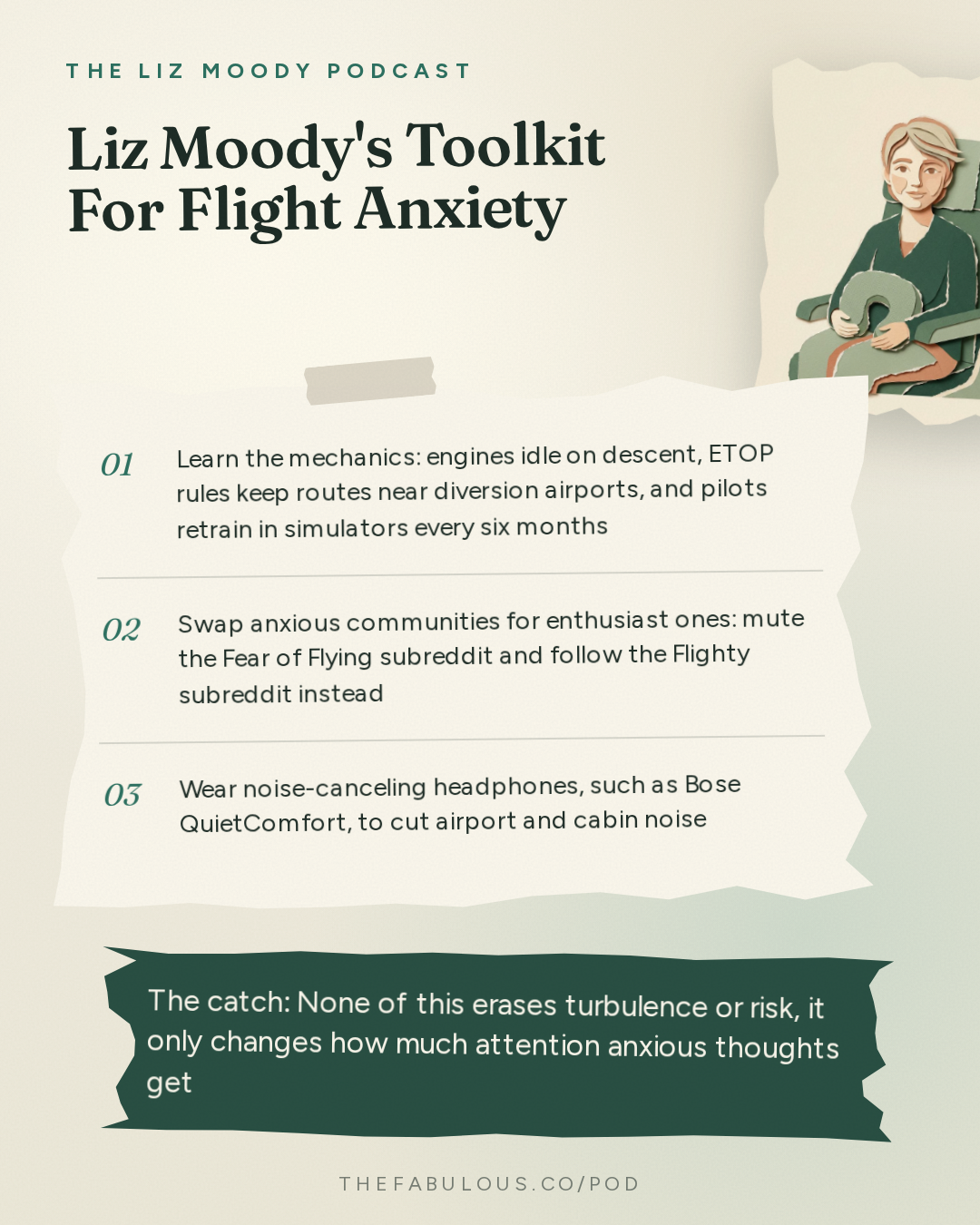
What did work runs almost entirely counter to a common assumption: that if a fear is irrational, understanding the facts will not touch it. Moody says that assumption is wrong for her. Learning the mechanics of how planes and pilots actually operate produced a real, durable drop in her fear (05:03). Several specific facts did the work. When a plane descends to land, the engines are often idling rather than powering the aircraft, which means every landing is effectively a practice run for what a true engine-loss glide looks like: a gentle descent, not a plummet (05:43). Long ocean crossings are also less remote than they feel; a flight from the East Coast of the United States to Europe tracks up over Canada, the bottom of Greenland, and Iceland rather than sitting over open water the whole way, and a certification called ETOP requires that any route be planned so a plane is never too far from an airport it could divert to in an emergency (06:54).
The training behind the cockpit door turned out to matter just as much to her as the hardware. Commercial pilots are put through a flight simulator every six months and run through essentially every emergency a plane could face, which is why, Moody argues, pilots look so calm when something does go wrong: they are executing a drill, not improvising (07:50). The culture around that training surprised her too. Pilots are encouraged, not penalized, for reporting fatigue or for flagging a co-pilot who seems impaired, and crews are rotated so that personal loyalty never gets in the way of that reporting (08:43). A pilot can refuse to fly a plane at any point, and that call is not overruled.
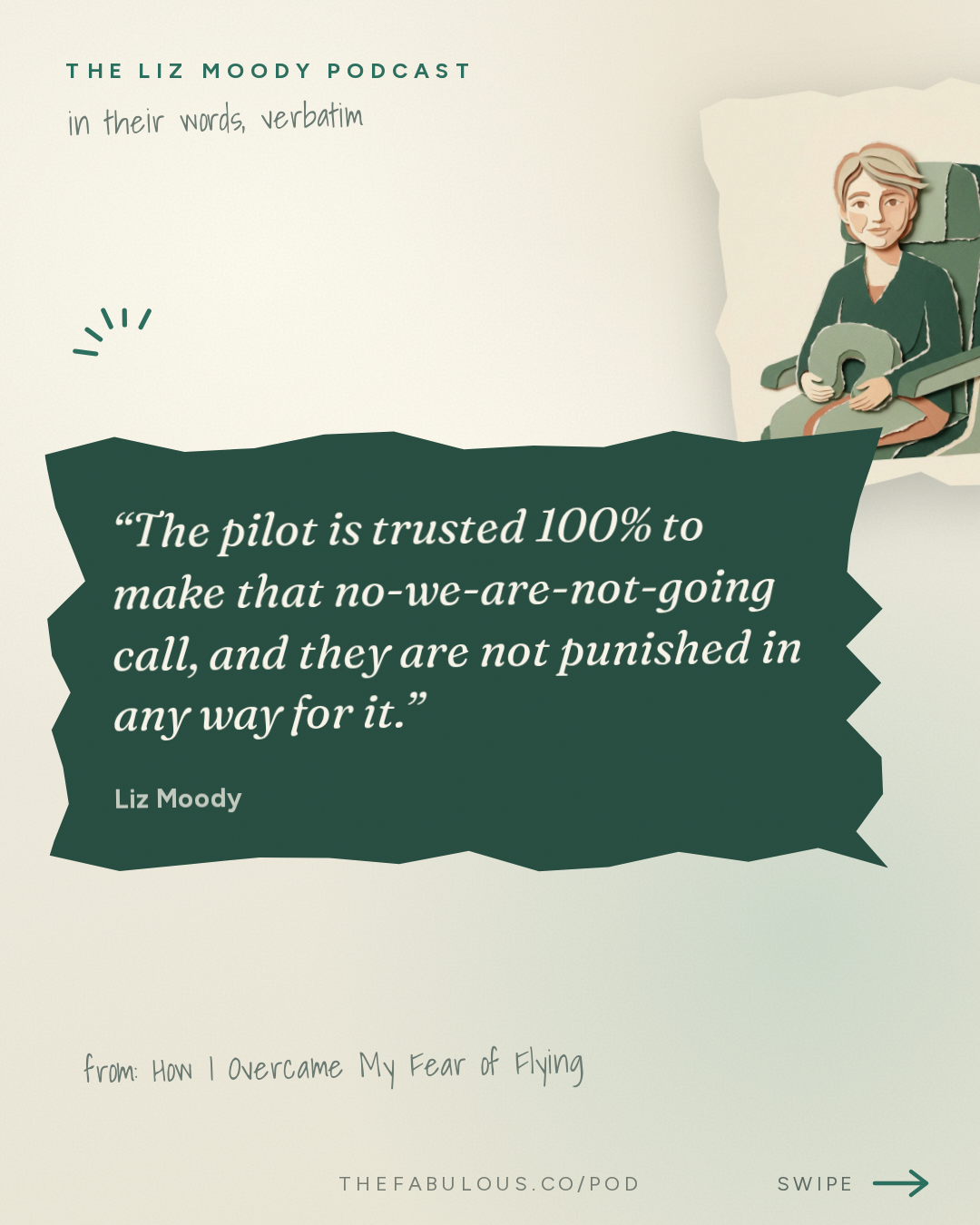
"The pilot is trusted 100% to make that no-we-are-not-going call, and they are not punished in any way for it." — Liz Moody [09:40]
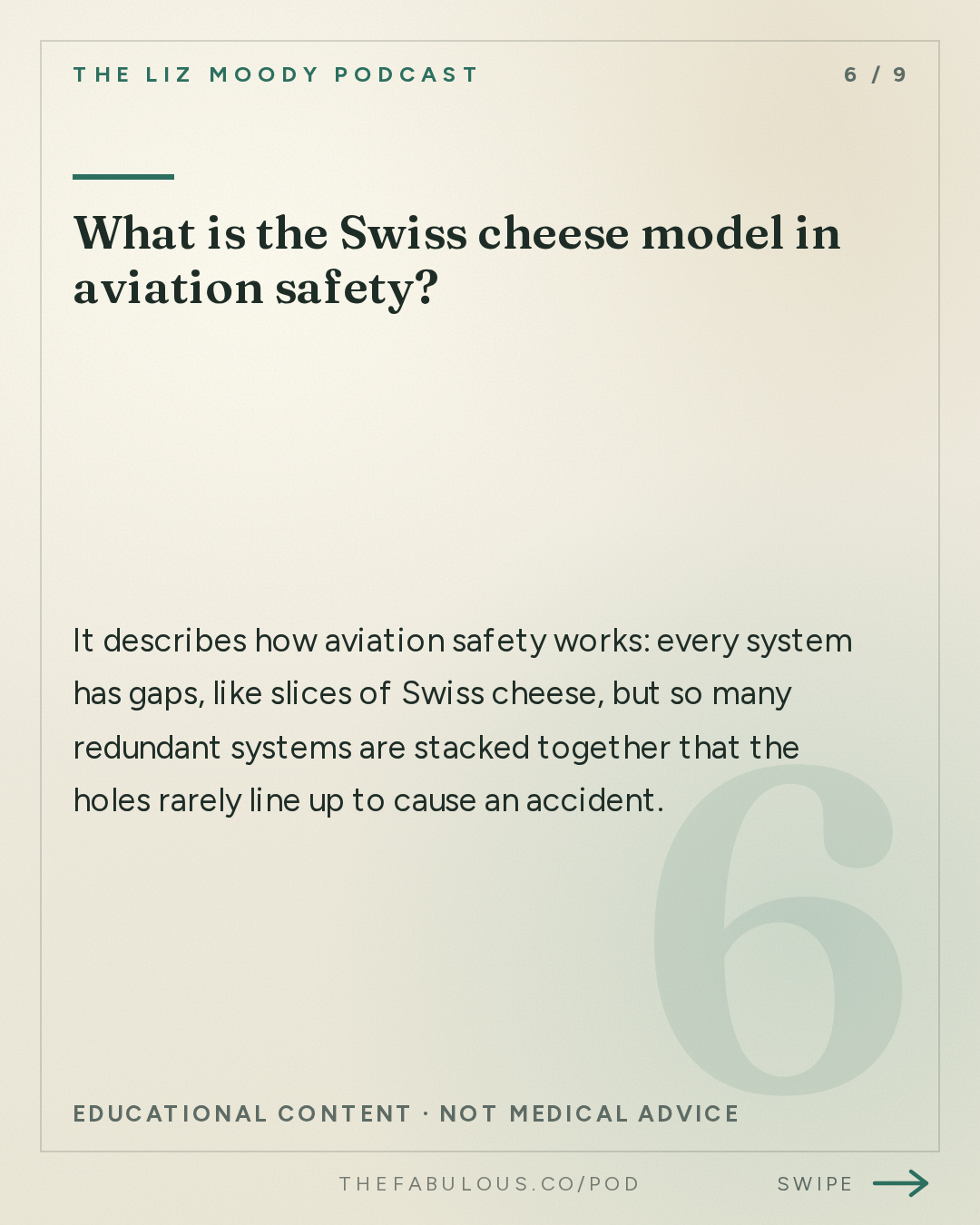
Smaller facts added up too: a plane struck by lightning, which happens to most aircraft about once a year, is built to shrug it off, and passengers typically never notice (10:06). Major airlines keep in-house meteorologists tracking weather independent of government data, which matters given recent federal cuts to climate monitoring (11:32). And the whole system runs on what aviation safety calls the Swiss cheese model: every layer, from air traffic control to an onboard system that independently alerts pilots to nearby aircraft, has gaps, but the layers are stacked so that the gaps essentially never line up into an actual accident (12:06). Moody's point is that news coverage usually reports the one hole in one slice of cheese, not the four backup systems that caught it.
Inside the Machine
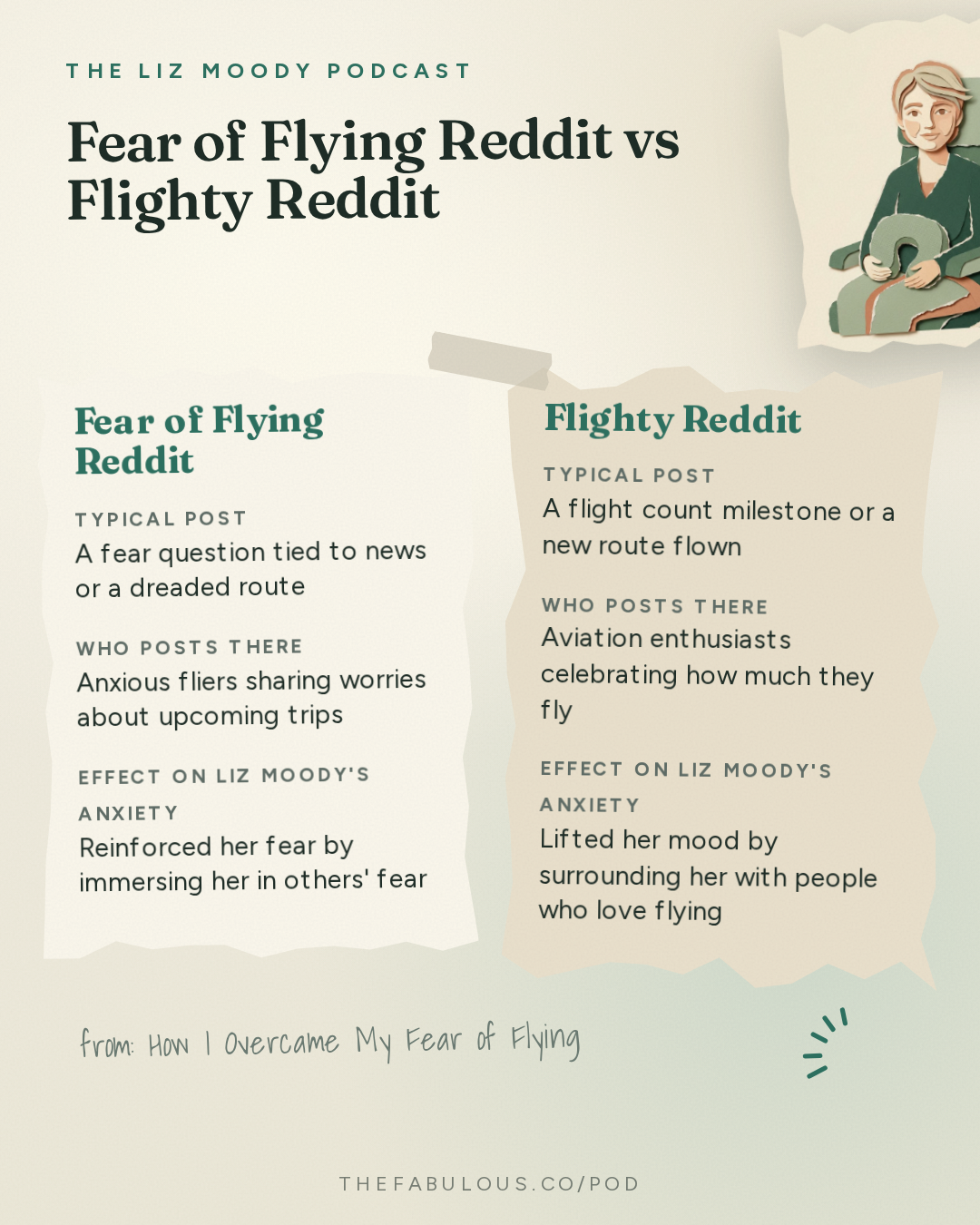
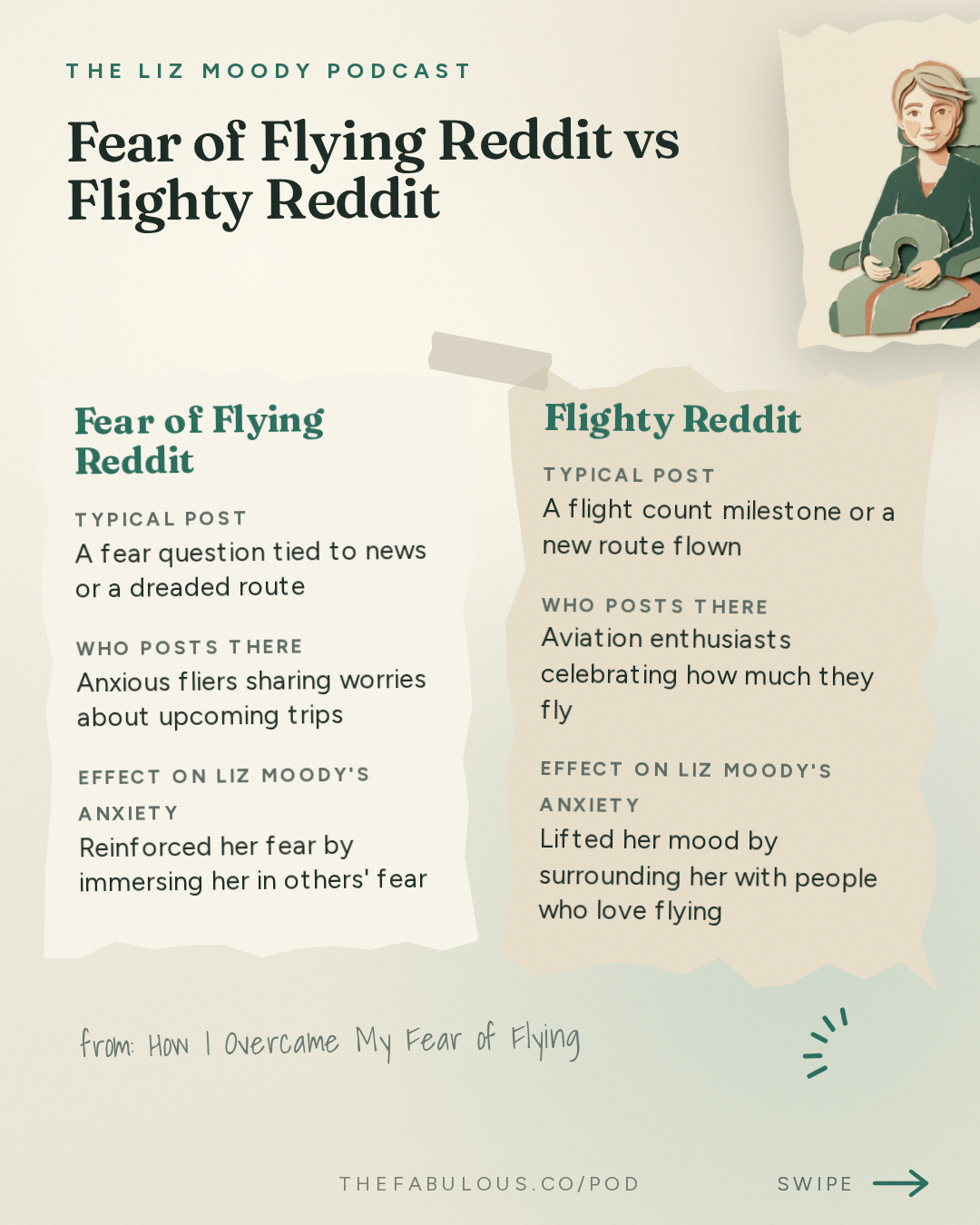
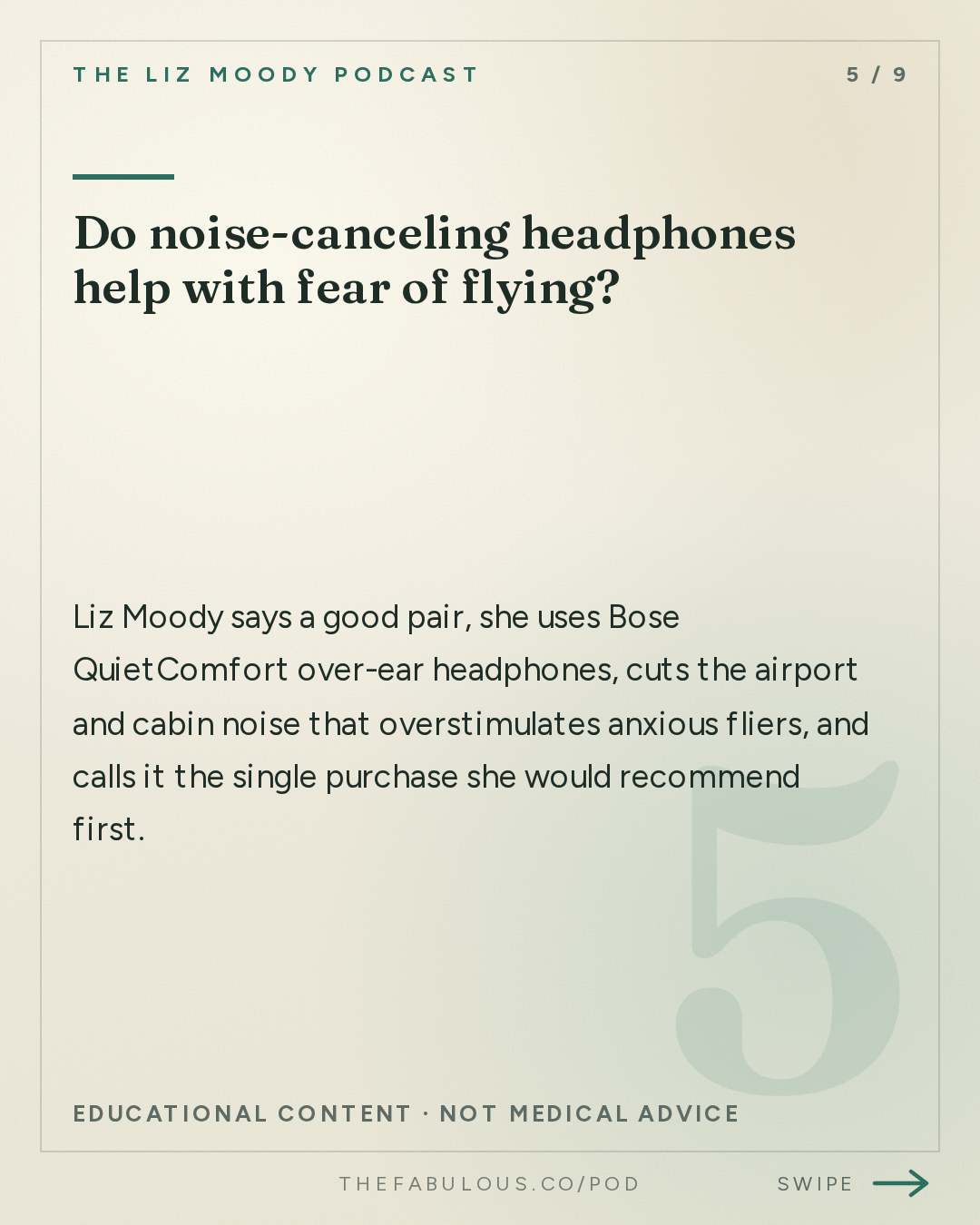
Facts were only part of it. Moody also changed what she consumed. She muted the Fear of Flying subreddit, a community where anxious fliers trade worries and ask strangers to track their flights for reassurance, because steeping in other people's fear reinforced her own. She replaced it with the Flighty subreddit, populated by aviation enthusiasts who post flight counts and new routes the way other people post marathon times, and found that surrounding herself with people who are thrilled to be on a plane did more for her mood than any amount of reassurance (14:12). She also bought noise-canceling headphones, specifically Bose QuietComfort over-ear headphones, to cut the sheer noise of an airport and a cabin, which she calls the single purchase she would recommend first to anyone afraid of flying (21:02).
The deeper behavioral shift was reducing what she calls safety behaviors: checking weather obsessively, eyeing the pilots at the gate, keeping the window shade open to scan for clouds. These rituals feel like control but are not, and giving them up, she says, builds genuine tolerance for the uncertainty that sits under most fear of flying (21:50).
"Not my circus, not my monkeys. I did not have control over the situation, and that was okay." — Liz Moody [22:41]
The last piece is less technical and more about framing: Moody thinks about herself on her deathbed, and whether skipping a trip because of fear fits the life she wants to look back on. New Zealand, in that frame, was not a risk to survive but the twelve hours that got her to baby lambs and new ideas (23:07).
She closes with a second opinion, texting her friend Kyle Kokol, a captain at a major U.S. airline and founder of Dial A Pilot, a service where travelers pay to talk through flight concerns with a working pilot, to ask whether flying is actually getting less safe (24:40). Kokol does not dismiss the question. He points out that turbulence has in fact increased, confirmed by a university study tracking conditions over the North Atlantic across roughly forty years (26:01). But the industry's response is concrete: Doppler radar now measures something called the eddy dissipation rate, a way of quantifying turbulence in a given patch of sky, which lets crews flight-plan around rough air rather than simply hope to avoid it (26:24). Better communication protocols between cockpit and cabin have sharply cut flight attendant injuries from turbulence, and aging air traffic control systems are backed by decades-old lost-communication procedures that tell a crew exactly how and where to land if contact drops.
"There's always a plan in place for every possible worst case scenario, and that is what has kept aviation as safe as it possibly can be." — Captain Kyle Kokol [27:25]
Kokol also describes a system called the thrust asymmetry computer, which automatically handles ninety percent of the rudder correction a pilot would need during an engine failure (28:38), part of a broader pattern of incremental, unglamorous engineering that rarely makes headlines. And on the specific fear that dominates turbulence headlines, his answer is almost anticlimactic: in over ten years of flying, he has hit severe turbulence exactly once, for a few seconds, in a private jet near Mammoth, California. He cannot recall a single colleague who has experienced it, and the pilots on his Dial A Pilot team, who collectively have flown more than 25,000 hours each, have never encountered it either (31:42). Set against roughly 44,000 daily flights in the United States and more than 105,000 daily flights worldwide, severe turbulence is a genuine rarity, not a background hazard every flight is rolling dice against (33:31).
None of this erases risk entirely, and Moody is careful not to claim it does. What changed for her was proportion: a clearer sense of how many redundant systems, trained people, and decades of accumulated procedure stand between a bad moment in the air and an actual disaster. That, more than a relaxation script or a metaphor about dessert, was what finally let her close the window shade and trust the plane to do what it was built to do.
Ask this episode anything
Pod's AI answers from the episode itself, with the minute mark so you can hear it yourself.
Or start with one of these
Ask this episode
Pod's AI listens to the whole episode to answer, and points you to the minute it comes from.
The rest of this answer, and any question after it
Answers come from the episode itself, never from a summary of it.
ContinueKey takeaways
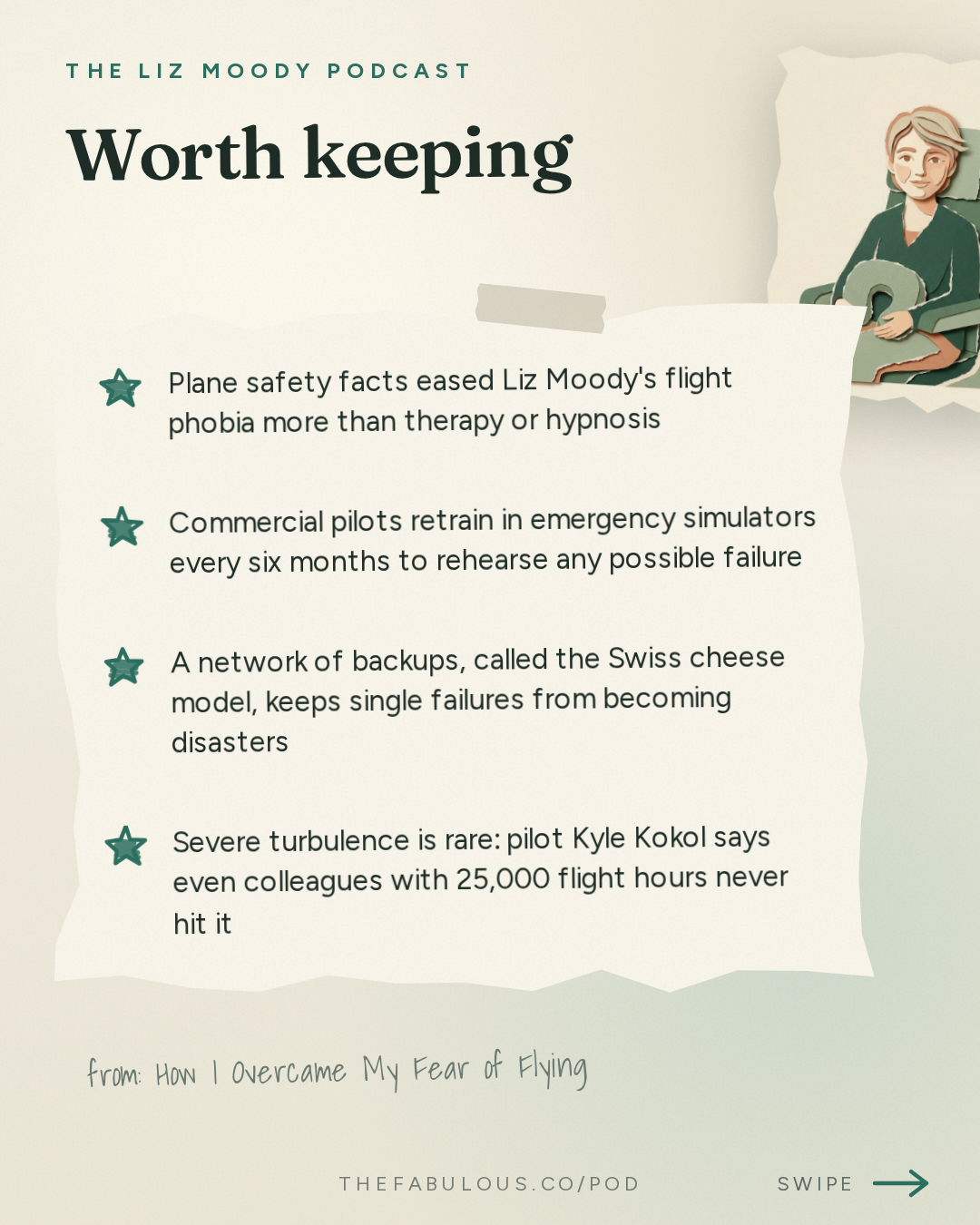
- Plane safety facts eased Liz Moody's flight phobia more than therapy or hypnosis
- Commercial pilots retrain in emergency simulators every six months to rehearse any possible failure
- A network of backups, called the Swiss cheese model, keeps single failures from becoming disasters
- Severe turbulence is rare: pilot Kyle Kokol says even colleagues with 25,000 flight hours never hit it
- Limiting anxious checking behaviors, like scanning turbulence forecasts, builds tolerance for flight uncertainty
The episode in cards

By the numbers
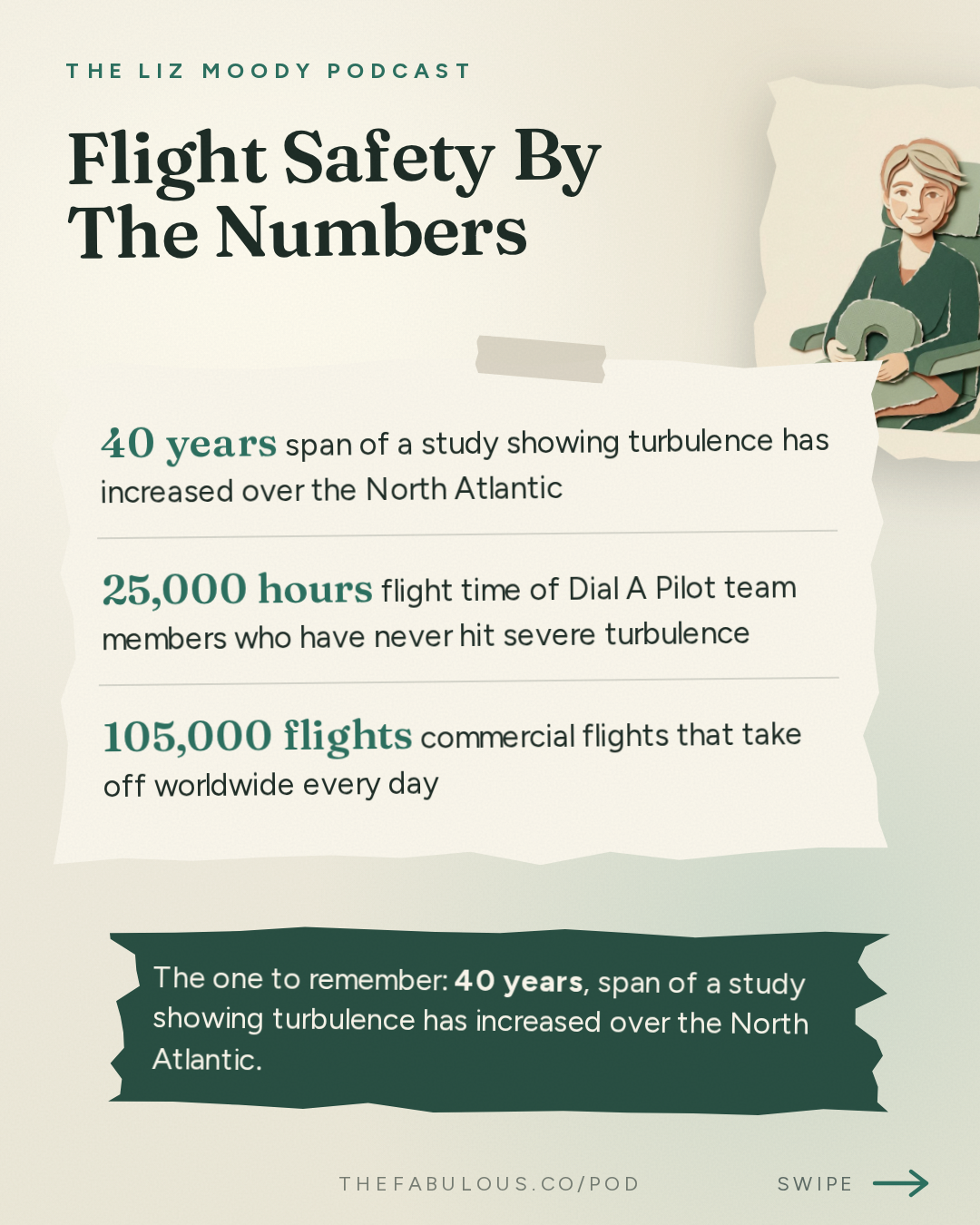
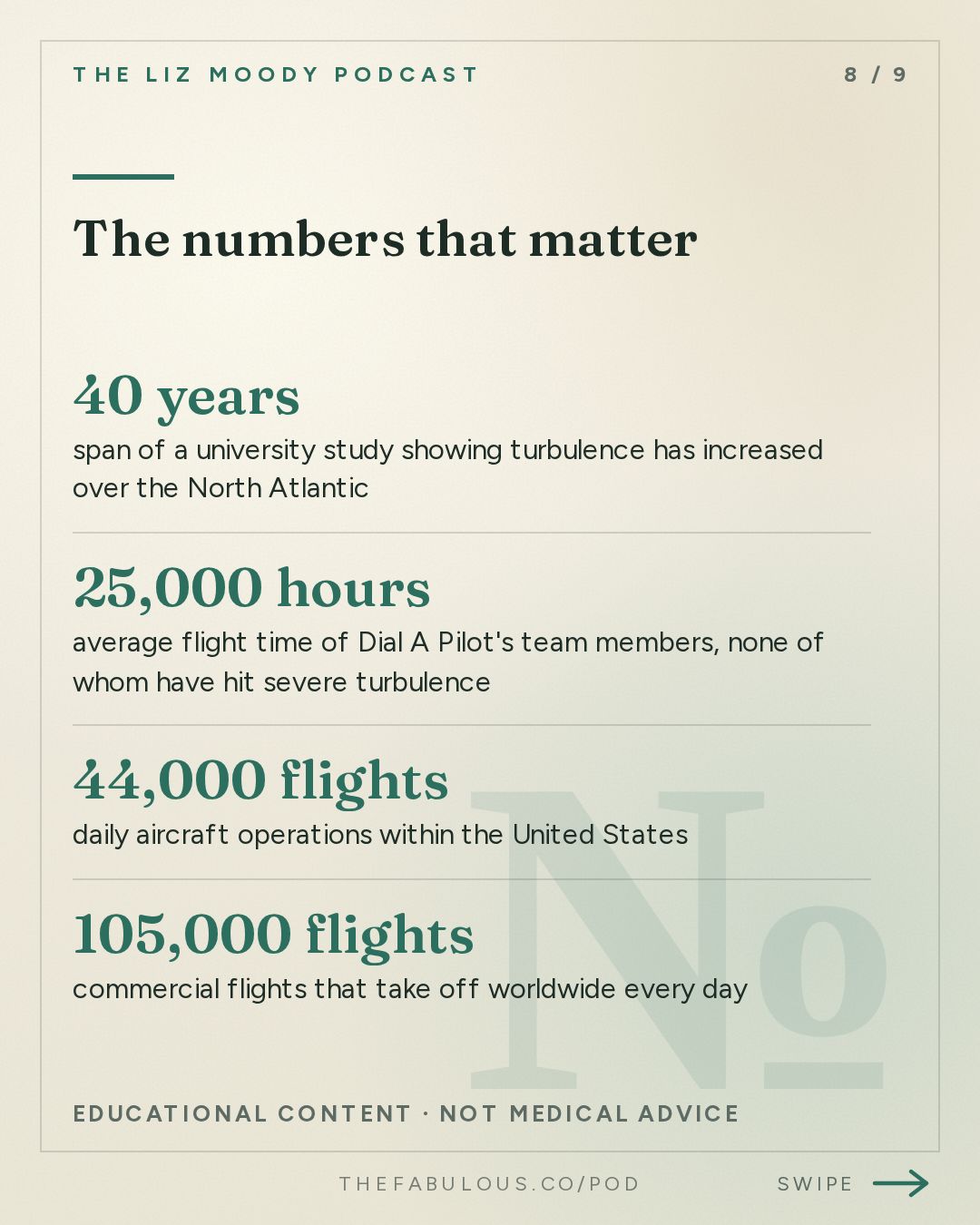
- 40 years span of a university study showing turbulence has increased over the North Atlantic
- 25,000 hours average flight time of Dial A Pilot's team members, none of whom have hit severe turbulence
- 44,000 flights daily aircraft operations within the United States
- 105,000 flights commercial flights that take off worldwide every day
In their words
“I had spent all of this time dreading something that did not end up coming to pass.”
“The pilot is trusted 100% to make that no-we-are-not-going call, and they are not punished in any way for it.”
“Not my circus, not my monkeys. I did not have control over the situation, and that was okay.”
“There's always a plan in place for every possible worst case scenario, and that is what has kept aviation as safe as it possibly can be.”
Protocols
-
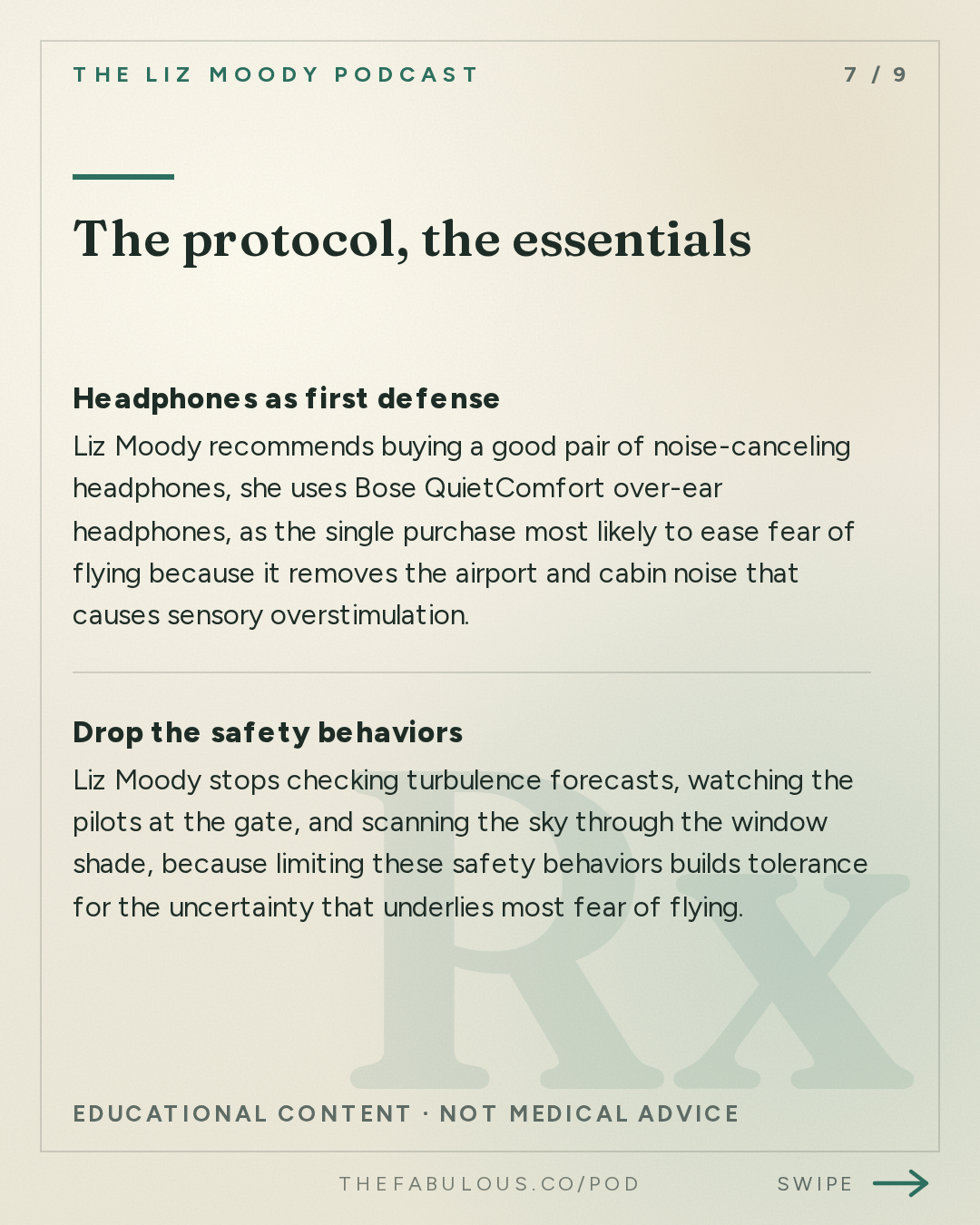
Headphones as first defense
Liz Moody recommends buying a good pair of noise-canceling headphones, she uses Bose QuietComfort over-ear headphones, as the single purchase most likely to ease fear of flying because it removes the airport and cabin noise that causes sensory overstimulation.
Every flight
-
Drop the safety behaviors
Liz Moody stops checking turbulence forecasts, watching the pilots at the gate, and scanning the sky through the window shade, because limiting these safety behaviors builds tolerance for the uncertainty that underlies most fear of flying.
Every flight
-
Delay for weather
Captain Kyle Kokol advises passengers with flexible travel plans to rebook a day later when a departure city has high winds or heavy rain, because climbing out through that weather is likely to feel bumpy even though it is not dangerous.
As needed when weather is rough
Questions this episode answers
How did Liz Moody overcome her fear of flying?
She says learning plane mechanics, like the fact engines idle during descent and pilots retrain in emergency simulators every six months, eased her fear more than therapy or hypnosis had (05:03). She also muted anxious flying forums, wore noise-canceling headphones, and cut safety behaviors like checking turbulence forecasts (21:50).
Is flying getting less safe?
Pilot Kyle Kokol says aviation remains the safest form of transportation because airlines identify emerging threats, such as rising turbulence or aging air traffic control systems, and build procedures to manage them before they become dangerous (25:21). Doppler radar now lets crews flight-plan around turbulence, and decades-old lost-communication procedures guide landings if contact drops (26:24).
How rare is severe turbulence?
Exceptionally rare: Kokol has hit it only once in over a decade of flying, and every pilot on his Dial A Pilot team, averaging over 25,000 hours of flight time, has never encountered it either (31:42).
Do noise-canceling headphones help with fear of flying?
Liz Moody says a good pair, she uses Bose QuietComfort over-ear headphones, cuts the airport and cabin noise that overstimulates anxious fliers, and calls it the single purchase she would recommend first (21:02).
What is the Swiss cheese model in aviation safety?
It describes how aviation safety works: every system has gaps, like slices of Swiss cheese, but so many redundant systems are stacked together that the holes rarely line up to cause an accident (12:06).
The full read, in cards
Go deeper
- North Atlantic turbulence study — university research measuring conditions over roughly 40 years found turbulence has increased
Mentioned
Liz Moody · Dr. Marissa Franco · Captain Kyle Kokol · Turbli · Dial A Pilot · ETOP · Bose QuietComfort · Reddit · Flighty
More from this show and category
Keltie Knight's Fuck Them Theory Explained
Keltie Knight's "Fuck Them Theory" argues that staying silent to keep the peace carries real costs, since one study found women who stay quiet during marital conflict face four times the risk of dying within a decade. Her fix: sort friends into four honest categories, set hard financial boundaries, and practice saying the uncomfortable thing out loud.
Young Pueblo on How to Find Inner Peace Today
Meditation teacher and author Diego Perez, known as Young Pueblo, argues that inner peace is a trained skill, not a lucky mood, built through slowing down, loving kindness practice, and treating change as the one constant worth befriending (47:23, 51:59).
The Science of Getting the Ick, Explained
The ick is often a disgust alarm misfiring rather than reliable intuition, shaped by attachment style, perfectionism, stress, and dating app abundance. Liz Moody's six-question audit and research from the Gottmans suggest love filters out minor annoyances, while moral icks, like rudeness to strangers, are the ones worth trusting.
Sun Exposure Science: Rowan Jacobsen Interview
Outdoor workers face lower melanoma death rates than indoor workers, a finding that upends decades of sun-avoidance advice. Science journalist Rowan Jacobsen argues that sunlight lowers blood pressure, calms the immune system, and treats depression, while vitamin D pills fail to match those benefits, so moderate daily exposure may do more good than harm for most skin types.
