
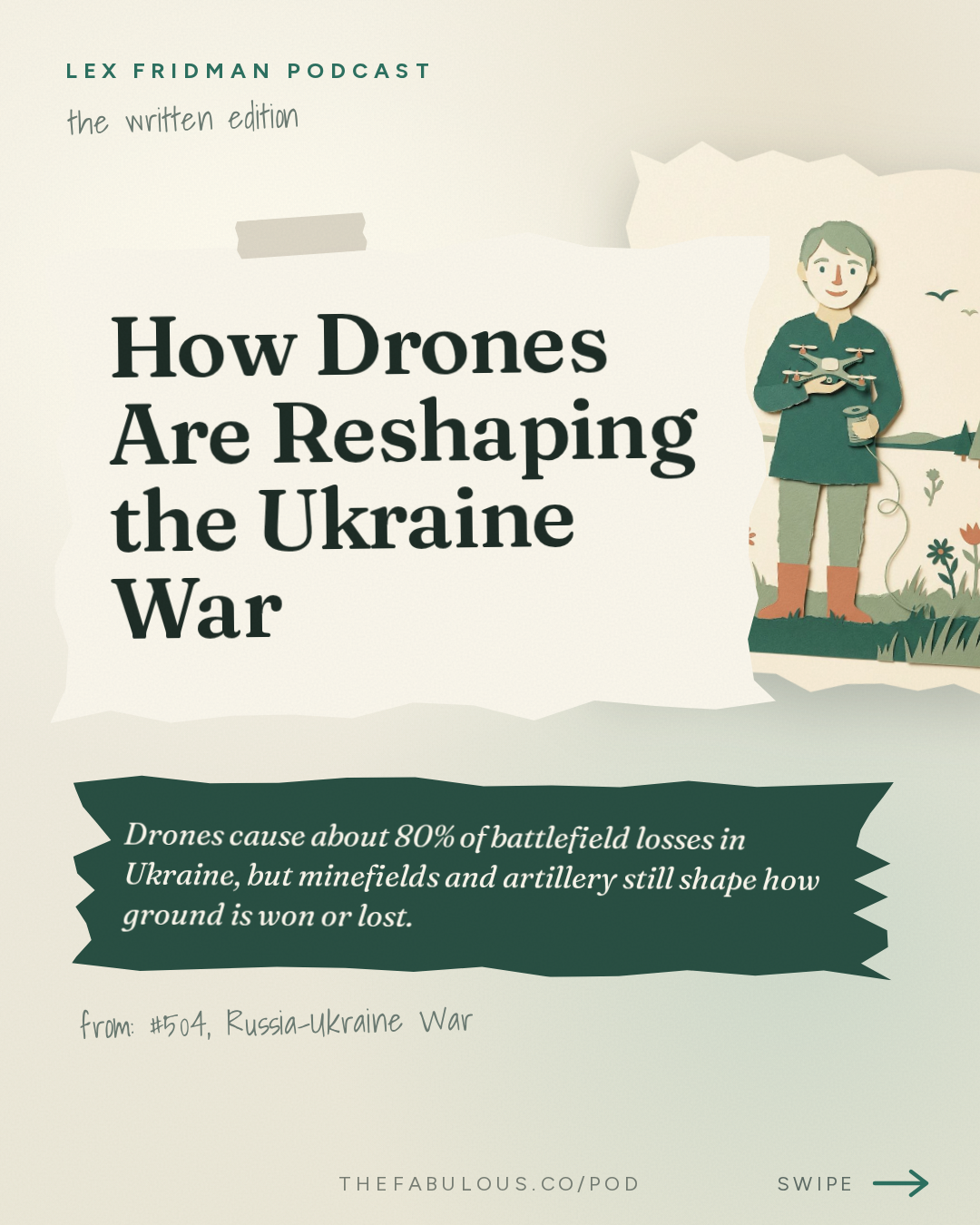
How Drones Are Reshaping the Ukraine War
#504 – Russia-Ukraine War: Putin, Zelenskyy, Drones and the Future of Warfare
The brief
Drones cause about 80% of battlefield losses in Ukraine, but minefields and artillery still shape how ground is won or lost. Military analysts Michael Kofman and Preston Stewart trace Russia's shift to small-unit infiltration, the rise of jam-proof fiber optic drones, and a growing gap between Vladimir Putin's war aims and what his army can actually achieve.
Soldiers riding along the Ukrainian front now carry a device that looks like an old Game Boy. It has a small screen and three antennas, and when an enemy drone's radio signal gets close enough, the screen lights up with the enemy pilot's own view: a live feed of the drone that may be hunting the very person holding the device. He watches to see whether the camera is pointed his way (46:06). A man staring at a screen to learn whether he is already a target says more about this war than any map of the front line.
A War Run by Screens
Military analyst Michael Kofman, a senior fellow at the Carnegie Endowment, and Preston Stewart, a West Point graduate and Afghanistan veteran who covers the war on his own channel, spend hours describing why the Russia-Ukraine war looks the way it does. Drones now cause roughly 80 percent of battlefield losses (20:42). One side alone flies something like 8,000 to 10,000 small FPV drones a day, quadcopters about a foot wide that carry a small charge and crash into their target (25:18). Yet the footage people see online is misleading. Most clips show a hit, never a miss, so viewers assume one $300 to $500 drone reliably kills a tank (29:53). In reality it has taken as many as 79 drone strikes to destroy a single heavily armored Russian tank, and thirty to forty is common (31:15). Minefields, dug-in artillery, and the threat of counterattack still matter, because drones alone cannot hold ground, and they perform badly in high wind, rain, or snow (21:09).
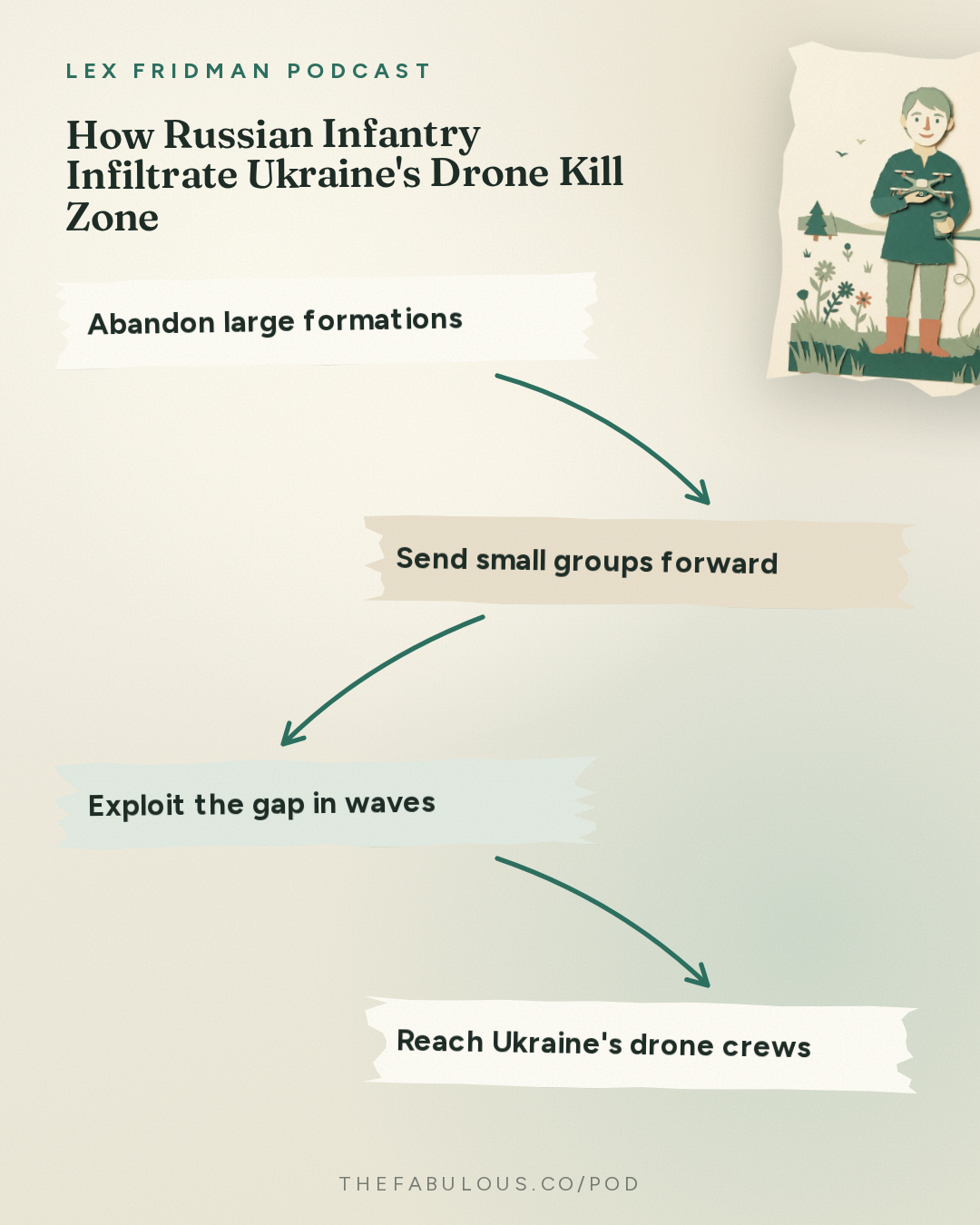
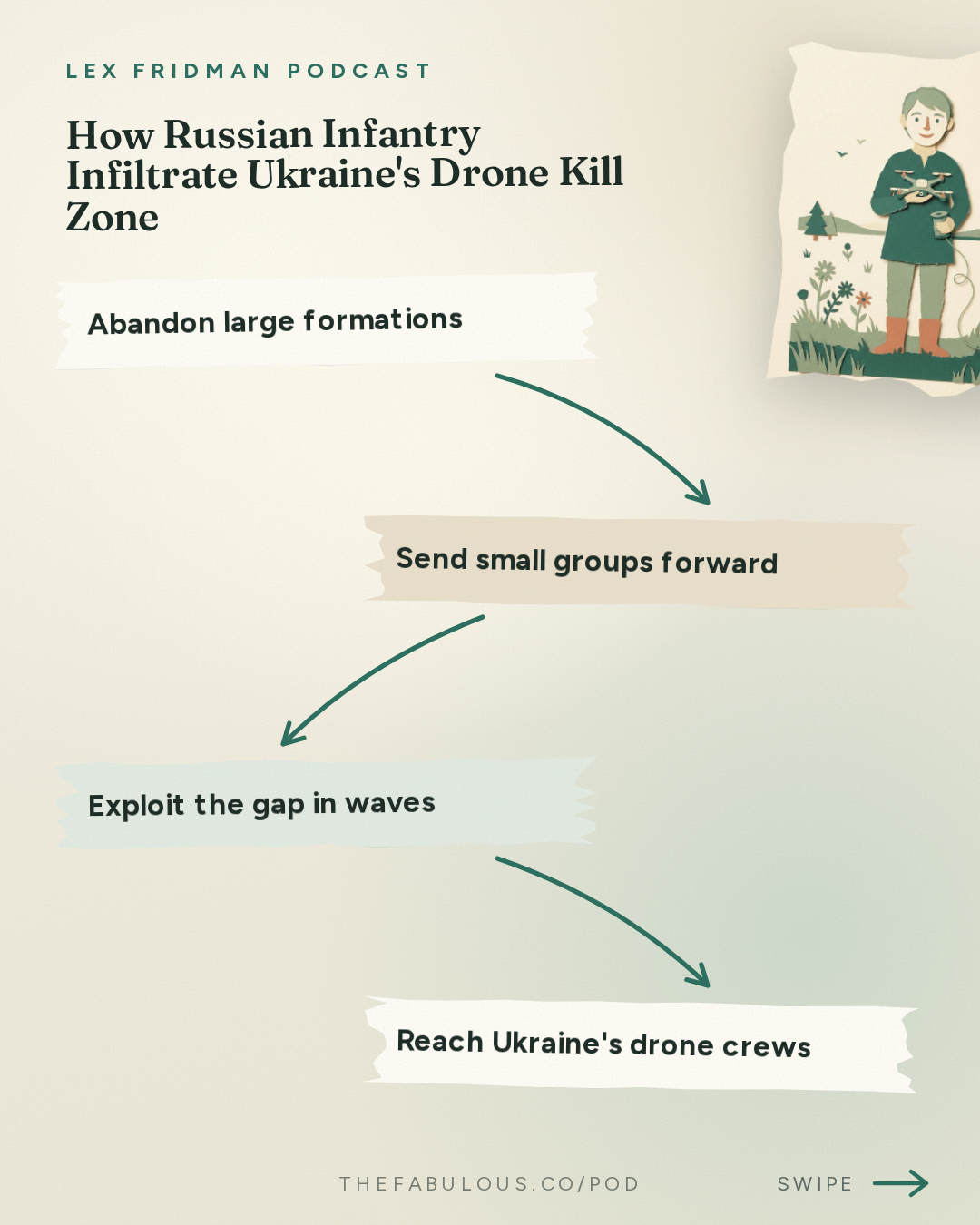
Russia's answer to this dense "kill zone," a drone engagement belt roughly 15 kilometers deep on either side of the line (19:40), has been to stop sending columns of vehicles, which get spotted and destroyed far from the front, and instead push forward on foot, on motorcycles, and in small trucks. Soldiers advance in waves of ten; seven might not survive, but the three who slip through reveal a gap in Ukraine's thin three-man outposts, and commanders send the next group down the same path (32:35, 39:47). It is a tactic one American volunteer fighting with a Ukrainian brigade described as effective only if a commander does not care how many men he loses along the way. Kofman calls what results on the map a gray zone, not a line, and Stewart points to the Russian pushback against inflated claims of advance on the ground.
"One soldier in a basement is not control of territory." — Preston Stewart (104:25)
Technology keeps shifting the terms of this contest. Fiber optic drones, first adopted widely by Russian units during Ukraine's incursion into Kursk, trail a hair-thin cable behind them instead of broadcasting a radio signal, which makes them essentially impossible to jam (43:00). Fighters have flown them as far as 50 kilometers (43:42), though the cable adds weight and can snag on trees or roads. Both sides now cycle through new tactics and countermeasures roughly every three to four months, and Kofman notes a pattern: Ukrainian units, built like small defense startups with their own in-house research and manufacturing, tend to improvise faster, while the more centralized Russian military is slower to adopt an idea but better at scaling it once it proves effective (47:33).
A Mismatch at the Top
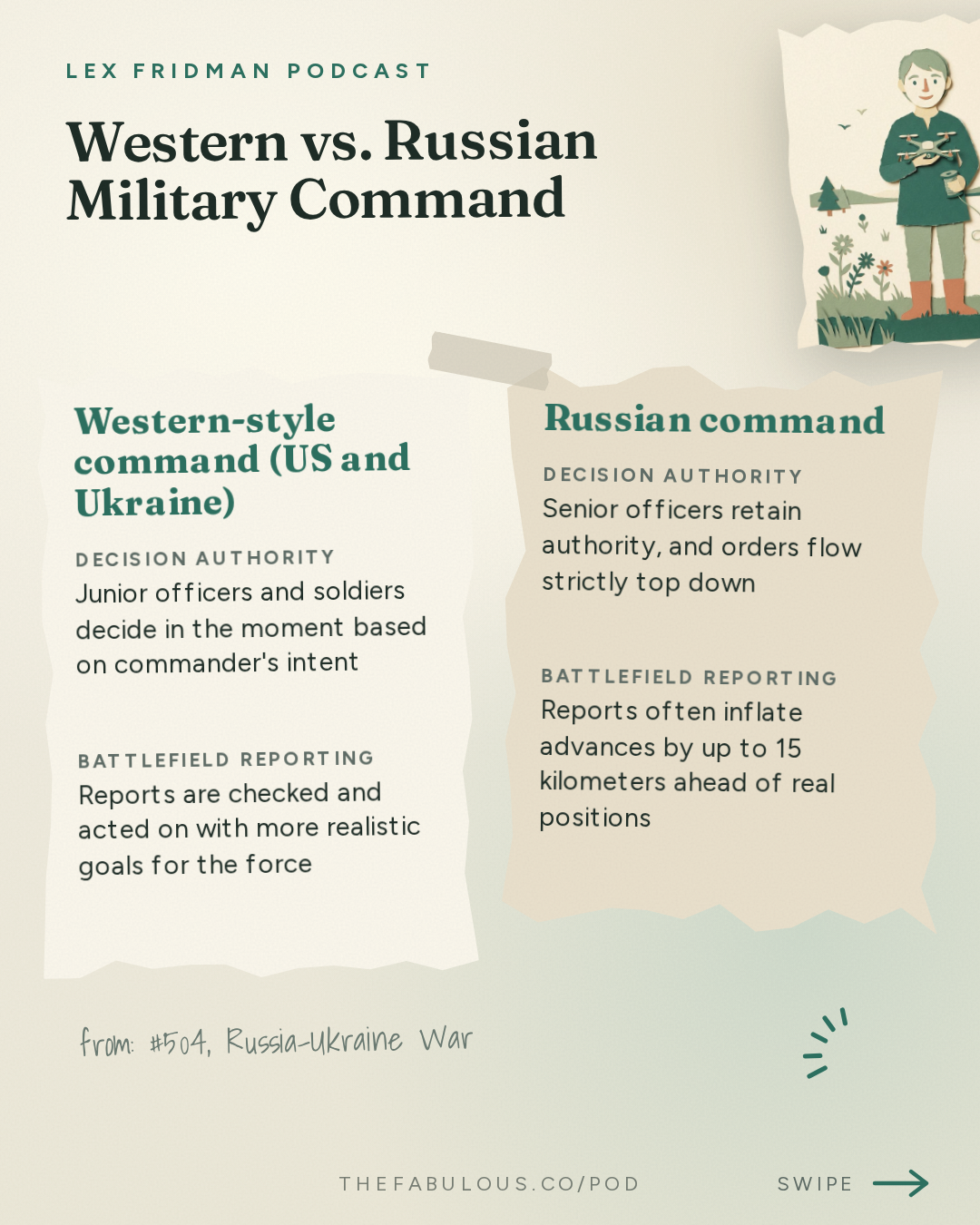
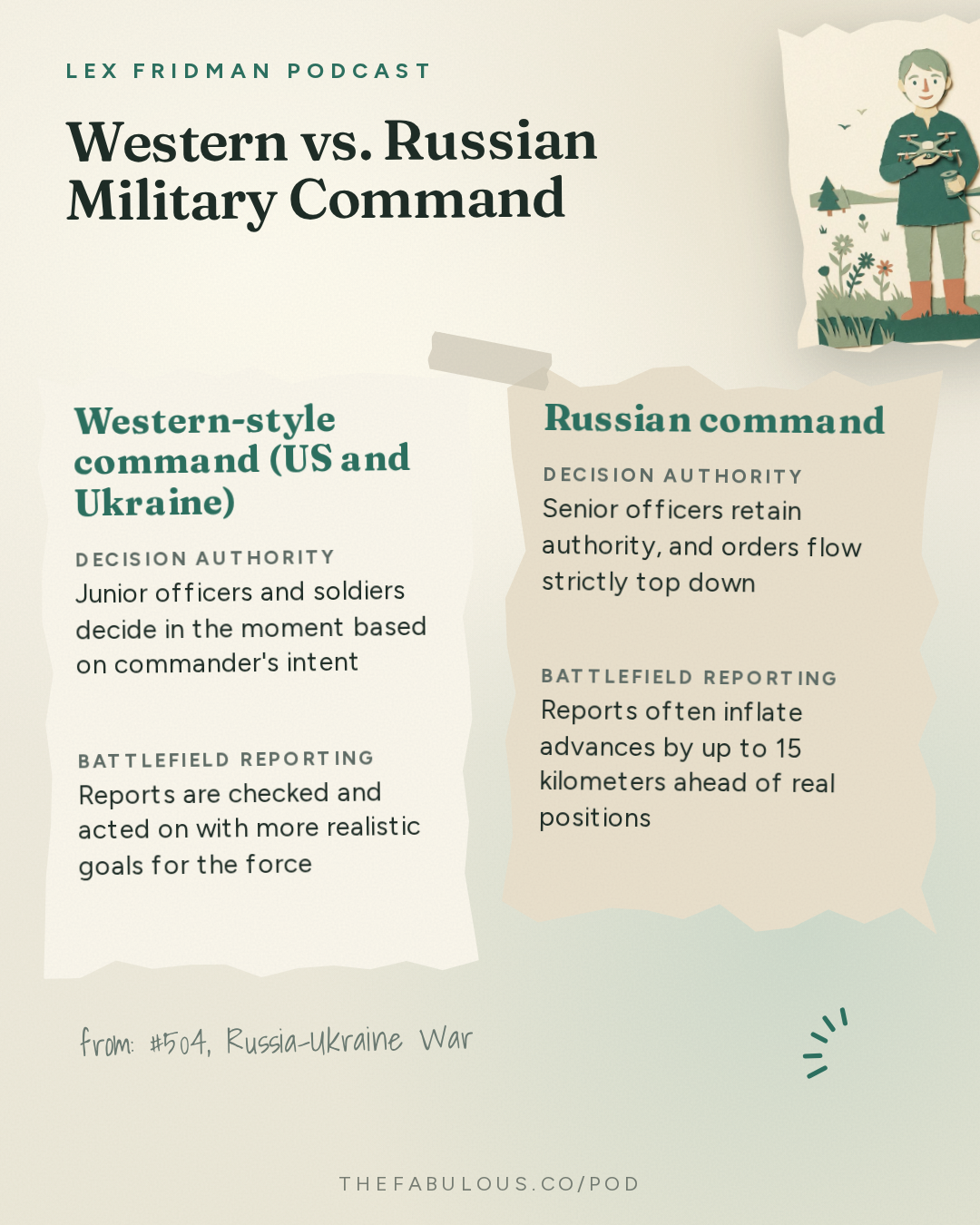
That same gap between improvisation and central control shows up in how each army is run. "We push authority down and allow junior leaders to make decisions in the moment," Stewart says of the Western military model, in which an 18-year-old soldier can decide on the spot to dig in, retreat, or call for reinforcements, because everyone up the chain understands the larger mission (82:05). The Russian military, he and Kofman argue, remains top-down: orders come from senior officers, and units that lose contact with that chain often simply stop rather than adapt. The cost of that rigidity compounds because Russian battlefield reports are frequently inflated, sometimes claiming territory as much as 15 kilometers ahead of where troops actually stand, built on a single soldier's photo with a flag or a position that was lost days earlier (107:29). Kofman describes a moment when he was near Kupiansk as Russian General Valery Gerasimov told Vladimir Putin that Ukrainian forces there were fully encircled, a claim that did not match what Kofman could see with his own eyes on the ground (110:00). Bad information like this gets forces killed by their own side's artillery and convinces political leadership the war is going better than it is.
The Wagner mercenary group, led by Yevgeny Prigozhin, grew out of this same friction between a rigid Ministry of Defense and a leader willing to improvise, recruiting convicts into disposable assault units that ground through the city of Bakhmut for nearly a year. After Prigozhin's short-lived 2023 mutiny and his death in a plane explosion weeks later, the Russian military did not abandon what made Wagner effective. It absorbed it, building its own convict-staffed assault companies, called Shtorm-Z and Shtorm-V, across the regular force (136:12). That overspecialization in small, expendable assault groups helped Russia grind forward for a time, but Kofman says it has since produced diminishing returns, and 2026 is shaping up as Russia's worst year of combat performance since the winter of 2023 (09:13).
The deeper problem, as Kofman frames it, is that Russia's political demands have not moved since the war's opening weeks, while its military capacity has shrunk. He argues the invasion's only real test of Ukraine's survival as an independent state happened in the first 30 days of 2022 and failed decisively (140:15). Everything since has been a grinding, attritional war that will decide borders and concessions, not Ukraine's existence. Yet Putin's maximalist goals, including the rest of the Donbas region and limits on Ukraine's alliances, remain unchanged even though Russia is spending about 44 percent of its government budget and 9 to 10 percent of GDP on the war (153:00), has at times relied on North Korea for 40 percent of its artillery ammunition (152:09), and is losing an estimated 30,000 people a month (150:57).
Kofman is wary of treating military strength as something fixed and portable from one war to the next.
"Military power requires a context to express itself, right?" — Michael Kofman (76:21)
A ranking of armies means little without a specific war, a specific piece of geography, and a specific political goal attached to it. That is why he resists predicting a quick end. Ceasefires, he warns, have historically served as rearmament periods in this conflict, pointing to the failed Minsk agreements after 2014, and a new one could simply set up a third, more destructive round (166:54). Still, both men end the long night's conversation with something other than gloom. Stewart describes a new Ukrainian system called Skyfall, essentially a drone-carried stretcher that flew two wounded soldiers 30 kilometers to safety while a crew talked to them the whole way back (176:09). Kofman recalls a company commander who drove into drone range without armor to pull two wounded men into a pickup truck by hand. As William Gibson's line goes, repeated here by Kofman about the speed of this war's innovation, "The future's already here. It's not evenly distributed" (58:56). What keeps surfacing alongside the worst of it, both men agree, is something stubbornly decent in the people fighting it.
"War is a sickness we can't kick. For all the ways we've gotten better as people, the one thing we keep coming back to is we kill each other over disputes." — Preston Stewart (174:33)
Ask this episode anything
Pod's AI answers from the episode itself, with the minute mark so you can hear it yourself.
Or start with one of these
Ask this episode
Pod's AI listens to the whole episode to answer, and points you to the minute it comes from.
The rest of this answer, and any question after it
Answers come from the episode itself, never from a summary of it.
ContinueKey takeaways
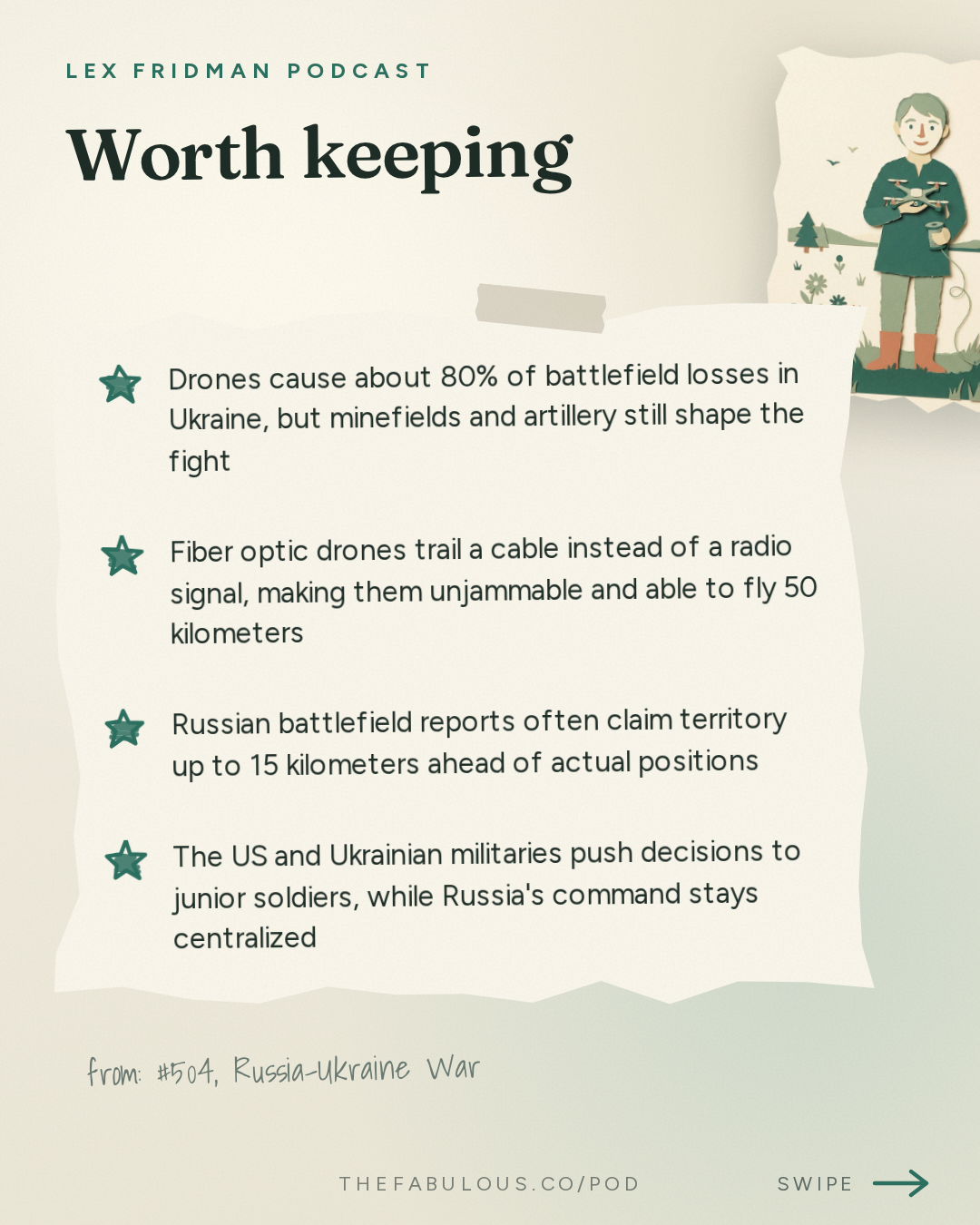
- Drones cause about 80% of battlefield losses in Ukraine, but minefields and artillery still shape the fight (20:42)
- Fiber optic drones trail a cable instead of a radio signal, making them unjammable and able to fly 50 kilometers (43:42)
- Russian battlefield reports often claim territory up to 15 kilometers ahead of actual positions (107:29)
- The US and Ukrainian militaries push decisions to junior soldiers, while Russia's command stays centralized (82:05)
- Russia spends 44% of its government budget on the war even as its military performance keeps declining (153:00)
The episode in cards


By the numbers
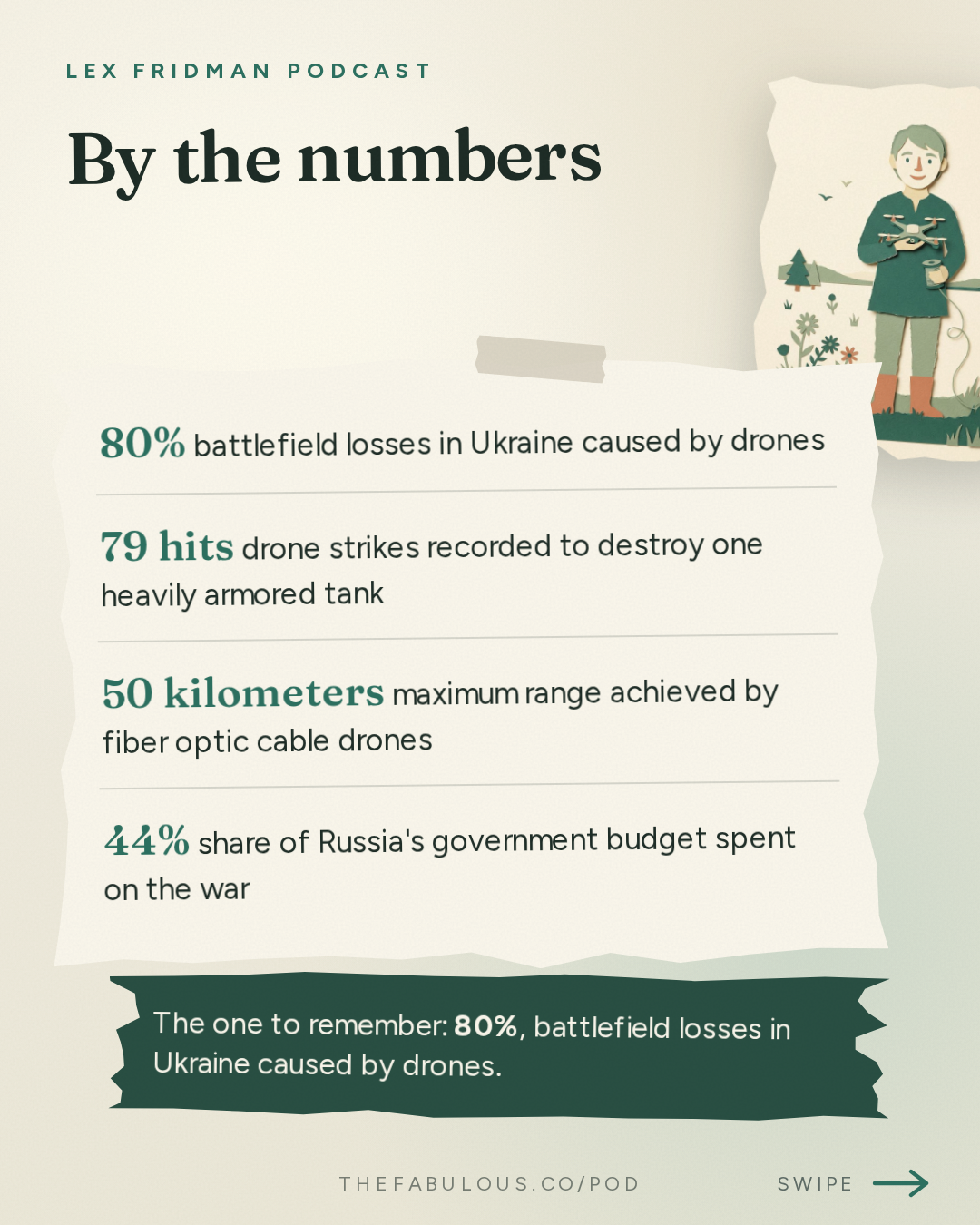
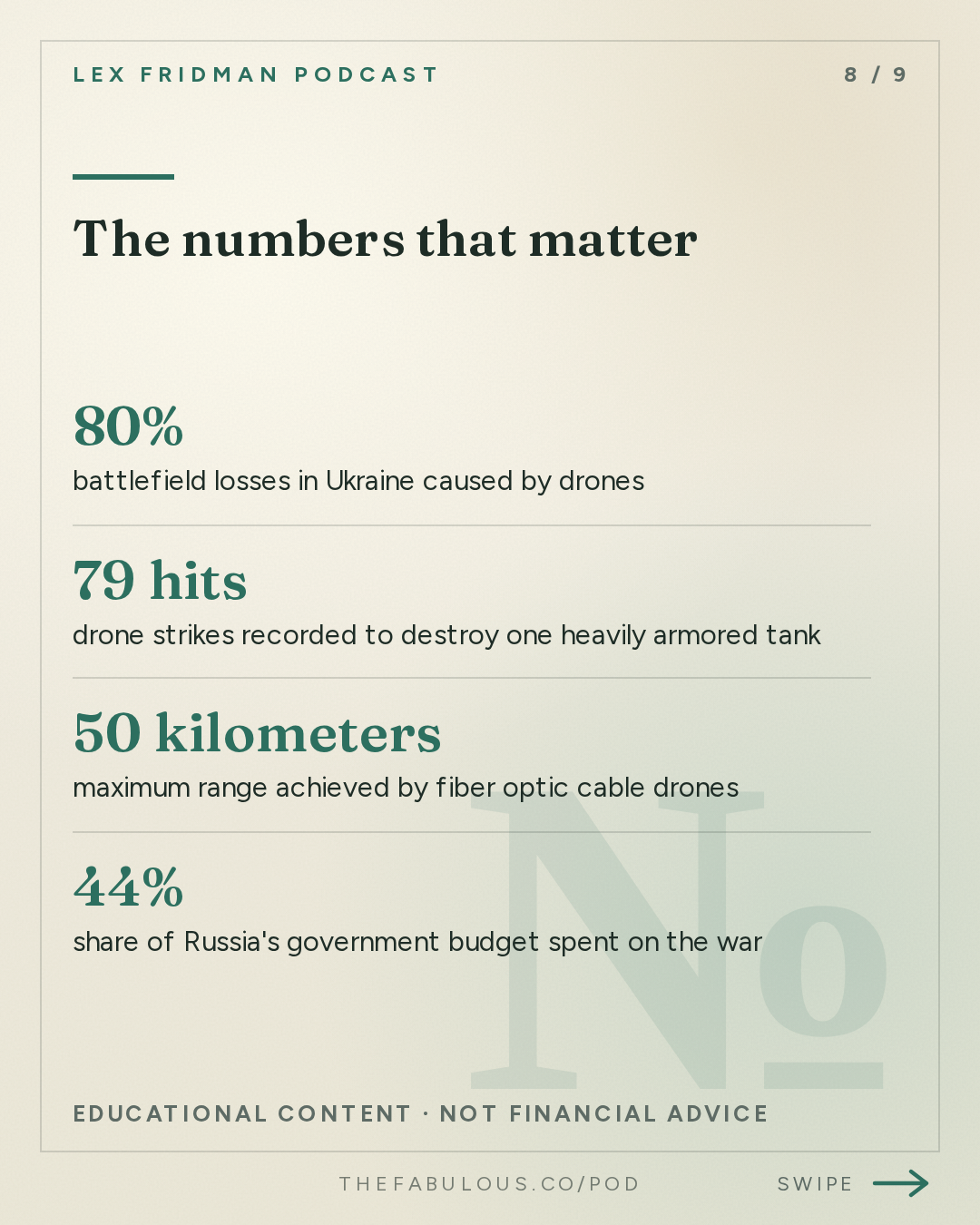
- 80% percent battlefield losses in Ukraine caused by drones
- 79 hits drone strikes recorded to destroy one heavily armored tank
- 50 kilometers maximum range achieved by fiber optic cable drones
- 44% percent share of Russia's government budget spent on the war
- 40% percent peak share of Russian artillery ammunition supplied by North Korea
In their words
“One soldier in a basement is not control of territory.”
“The future's already here. It's not evenly distributed.”
Protocols
-
Plan a drone-era offensive before advancing
Michael Kofman explains that successful Ukrainian assault units first suppress the enemy's drone units and cut their logistics, then channel enemy forces into predictable zones and run a coordinated strike plan during the assault itself, which lets mechanized or infantry forces advance with sharply reduced losses, though an attacking mechanized company should still expect to absorb close to 300 drone hits during the operation.
Before each planned offensive operation
Questions this episode answers
What percentage of casualties in the Ukraine war come from drones?
Drones cause about 80 percent of battlefield losses, according to military analyst Michael Kofman (20:42). Minefields and artillery still matter, because they slow attackers down and make them easier drone targets, and drones themselves perform poorly in high wind, rain, or snow (21:09).
What are fiber optic drones and why can't they be jammed?
Fiber optic drones trail a thin cable back to the operator instead of sending a radio signal, so electronic jamming has nothing to intercept (43:00). Russian units first adopted them widely during Ukraine's 2024 Kursk incursion, and both sides now fly them up to about 50 kilometers (43:42).
Why does Russia's military keep claiming territory it doesn't control?
Analyst Michael Kofman says Russian battlefield maps consistently claim positions roughly 15 kilometers ahead of where troops actually stand, often based on a single soldier's photo rather than a held position (107:29). This false reporting reaches political leadership and has led Russian forces to shell their own troops using outdated maps.
How is Russian military command different from the US military?
Preston Stewart, a West Point graduate, says the US and Ukrainian militaries push decision authority down to junior officers and soldiers, who act on a commander's broader intent (82:05). Russia's command stays centralized, with orders flowing top down, which he says left Russian forces stuck when plans went wrong early in the invasion.
Could the Russia-Ukraine war end soon?
Analyst Michael Kofman is not optimistic, since Russia's political demands have not changed despite its declining battlefield performance and it is spending 44 percent of its government budget on the war (153:00). He also warns that ceasefires in this conflict have historically served as rearmament periods rather than lasting peace (166:54).
The full read, in cards
Go deeper
- Vladimir Putin's July 2021 article on the historical unity of Russians and Ukrainians — laid out Putin's view that Ukraine lacks a separate national identity, shaping the invasion's planning assumptions
Mentioned
Preston Stewart · Michael Kofman · Vladimir Putin · Volodymyr Zelensky · Yevgeny Prigozhin · Wagner Group · Bakhmut · Carnegie Endowment · Shtorm-Z · Skyfall
More from this show and category
AI and the Math Crisis: Riemann, Navier-Stokes Explained
In September 2025, AI systems from OpenAI and Anthropic claimed proofs of the quasi-Riemann hypothesis, the Unique Games Conjecture, and Navier-Stokes blowup, and formalized Fermat's Last Theorem in 13 million lines of Lean code. Three mathematicians, Alex Kontorovich, Ankur Moitra, and Steven Brunton, argue this is less an ending for mathematics than a forced redefinition of what a mathematician's job actually is.
Khabib Nurmagomedov on Hardship, Discipline, and Faith
Khabib Nurmagomedov says hardship, not comfort, builds champions, drawing on Dagestan's Spartan gyms and his father's brutal discipline. The retired UFC lightweight champion, undefeated at 29-0, tells Lex Fridman that staying a champion is harder than becoming one, and that faith keeps wealth in the hand rather than the heart.
DHH on Omachi Linux and AI Coding Agents
David Heinemeier Hansson, the Ruby on Rails creator, says he wrote zero lines of code by hand for his Linux distribution Omachi's latest release, Quatro, letting AI agents do it instead. He argues Linux, not Mac or Windows, is now the ideal home for AI coding agents, and that installing an OS in under a minute is possible with the same tools (21:41, 126:07).

Rick Smith on Building Axon From Taser to AI Policing
Axon CEO Rick Smith explains how a failed consumer gadget became a $30 billion public-safety company by pivoting to police, surviving an SEC investigation and short-seller attack, and building body cameras, cloud video, drones, and ethics boards around a single mission: reduce how often police have to shoot someone.
