
AI and the Math Crisis: Riemann, Navier-Stokes Explained
#503 – AI Crisis in Math: Navier-Stokes, Riemann Hypothesis & Complexity Theory
The brief
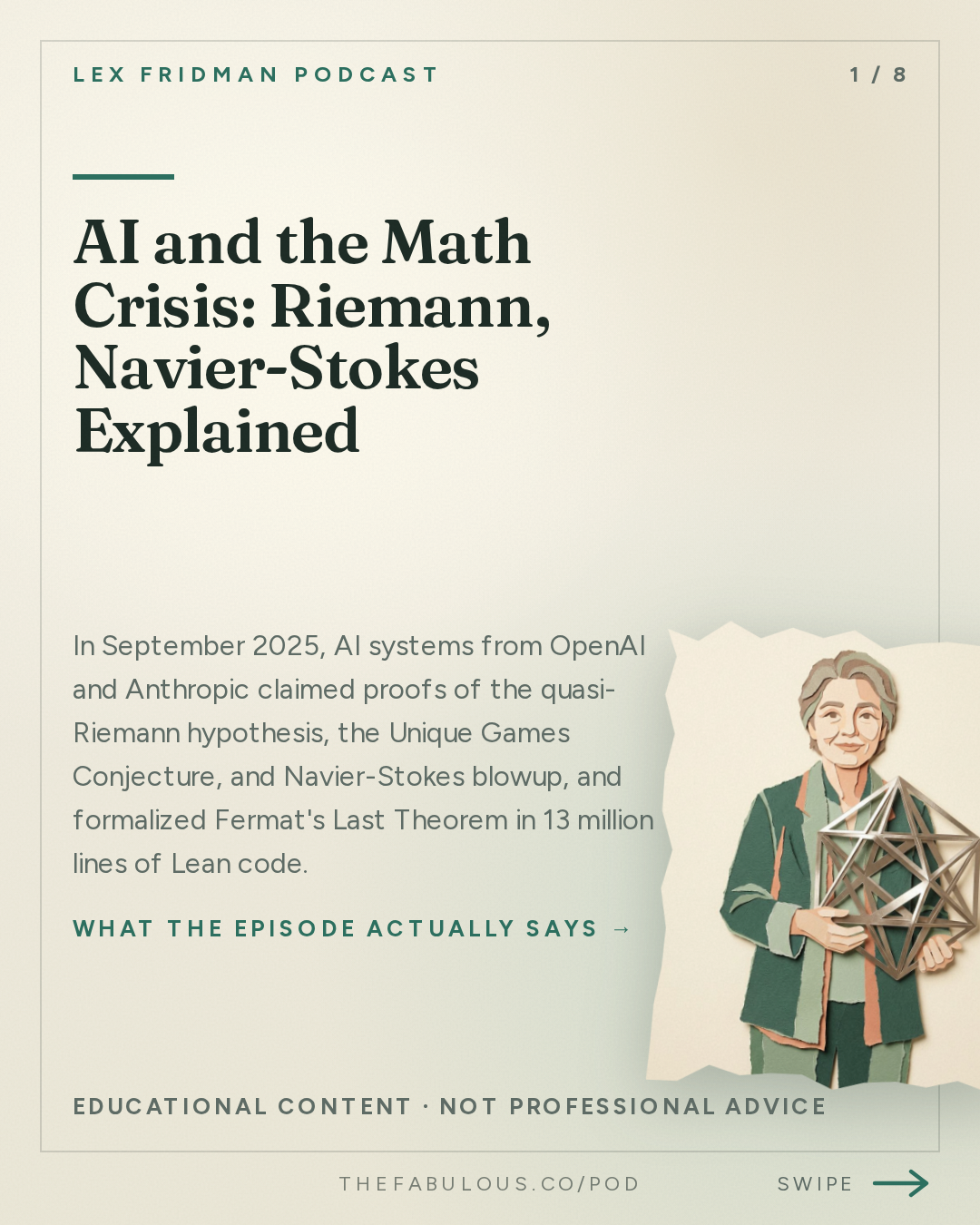
In September 2025, AI systems from OpenAI and Anthropic claimed proofs of the quasi-Riemann hypothesis, the Unique Games Conjecture, and Navier-Stokes blowup, and formalized Fermat's Last Theorem in 13 million lines of Lean code. Three mathematicians, Alex Kontorovich, Ankur Moitra, and Steven Brunton, argue this is less an ending for mathematics than a forced redefinition of what a mathematician's job actually is.
At a gala for the National Museum of Mathematics in New York, a number theorist stood with a whiskey in one hand and his phone in the other, refreshing every few minutes because he knew a company was about to post results at six o'clock sharp. When the post landed, the first thing he saw made no sense to him. Quasi-RH. As in quasi-Riemann hypothesis, one of the oldest open problems in mathematics, apparently cracked in an evening by a machine that had been told, in effect, to go do a breakthrough.
That mathematician is Rutgers number theorist Alex Kontorovich, and the night he is describing, alongside MIT theoretical computer scientist Ankur Moitra and University of Washington fluid dynamicist Steven Brunton, is the subject of this conversation. Over the last few weeks, AI systems from OpenAI and Anthropic produced claimed solutions or major progress on several of the hardest problems in math: the quasi-Riemann hypothesis, the Unique Games Conjecture, a forced-case proof of blowup in the Navier-Stokes equations, and a full formalization of Fermat's Last Theorem in the Lean proof assistant, a system that checks mathematical arguments line by line against the axioms of logic (79:28). None of the three guests call this the death of mathematics. All three describe something closer to a professional identity crisis, arriving faster than anyone's career plans accounted for.
Kontorovich frames the question with what he calls the solved axiom: assume that any problem a human could solve with AI help could eventually be solved by AI alone (19:59). He does not think that is true yet, but he is willing to entertain it for the sake of argument, because the more interesting question is what survives if it ever is true. His answer is that pure mathematics is not actually in the business of producing true statements. It is in the business of understanding, and understanding only exists inside a human skull.
"The value of pure mathematics is that it lives in the heads of human beings." — Alex Kontorovich, Rutgers mathematician (21:33)
Terence Tao, the Fields Medal-winning mathematician, wrote something the group returns to more than once: that patient, slow research by graduate students and postdocs is being casually disrupted by these releases, the way a movie spoiler ruins a plot you can no longer discover for yourself (13:46). Moitra, who studies complexity theory and algorithms at MIT, pushes back gently. He reaches for an idea borrowed from outside mathematics entirely: the doorman fallacy, the mistake of reducing a complex job to its single most visible task, then assuming a cheaper machine that performs that one task has replaced the whole role.
The Doorman Fallacy
A hotel decides a doorman just opens doors, so an automatic door can do the job more cheaply. But a doorman also greets guests, recognizes regulars, handles luggage, hails taxis, and signals that the building matters. Moitra's point is that "solving theorems" is mathematics's most visible task, the one that makes headlines and wins medals, but it is not the whole job.
"What does a mathematician do? The simplest and most visible part of the job is we prove theorems. But I don't think that's all that a mathematician does." — Ankur Moitra, MIT mathematician (28:37)
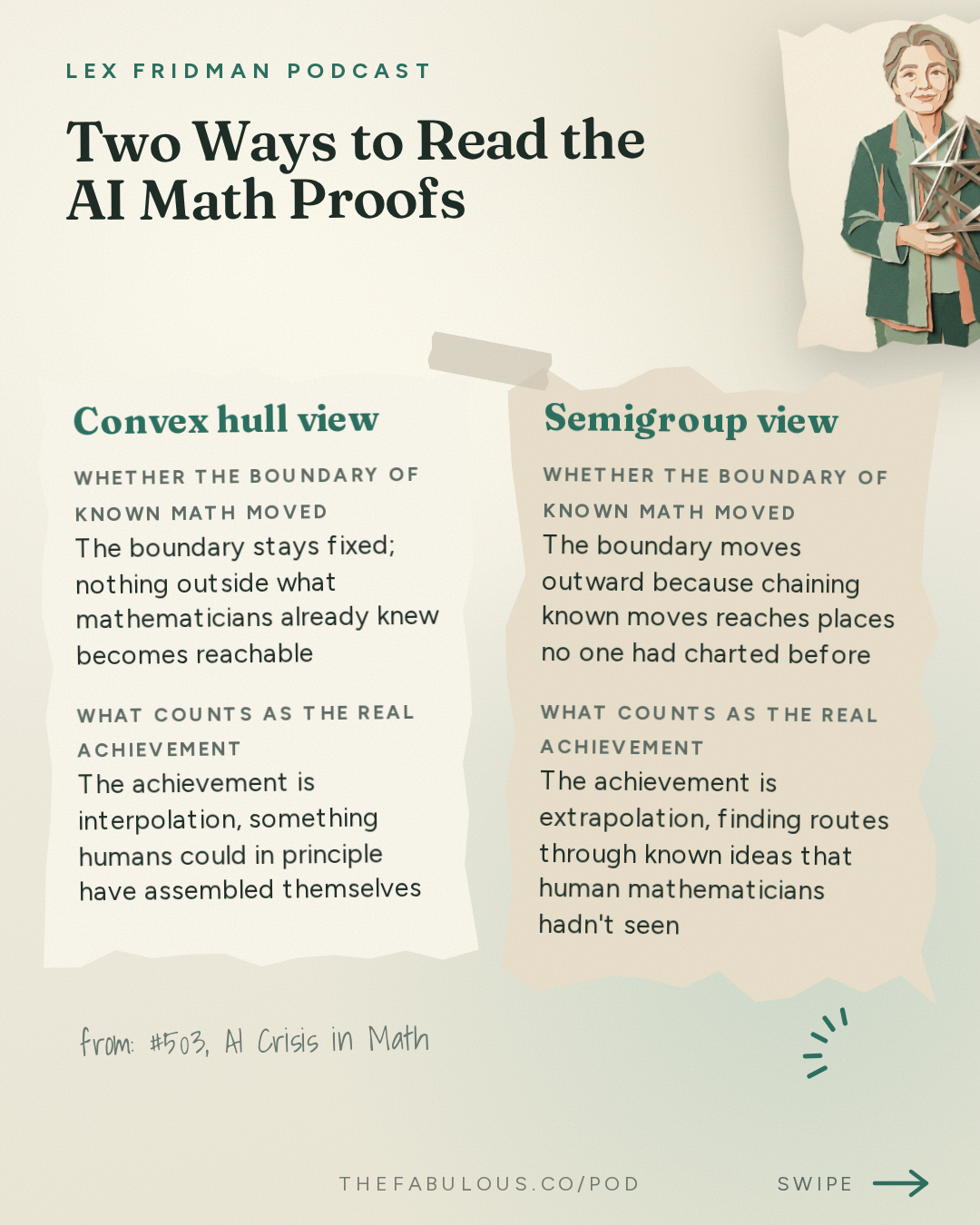
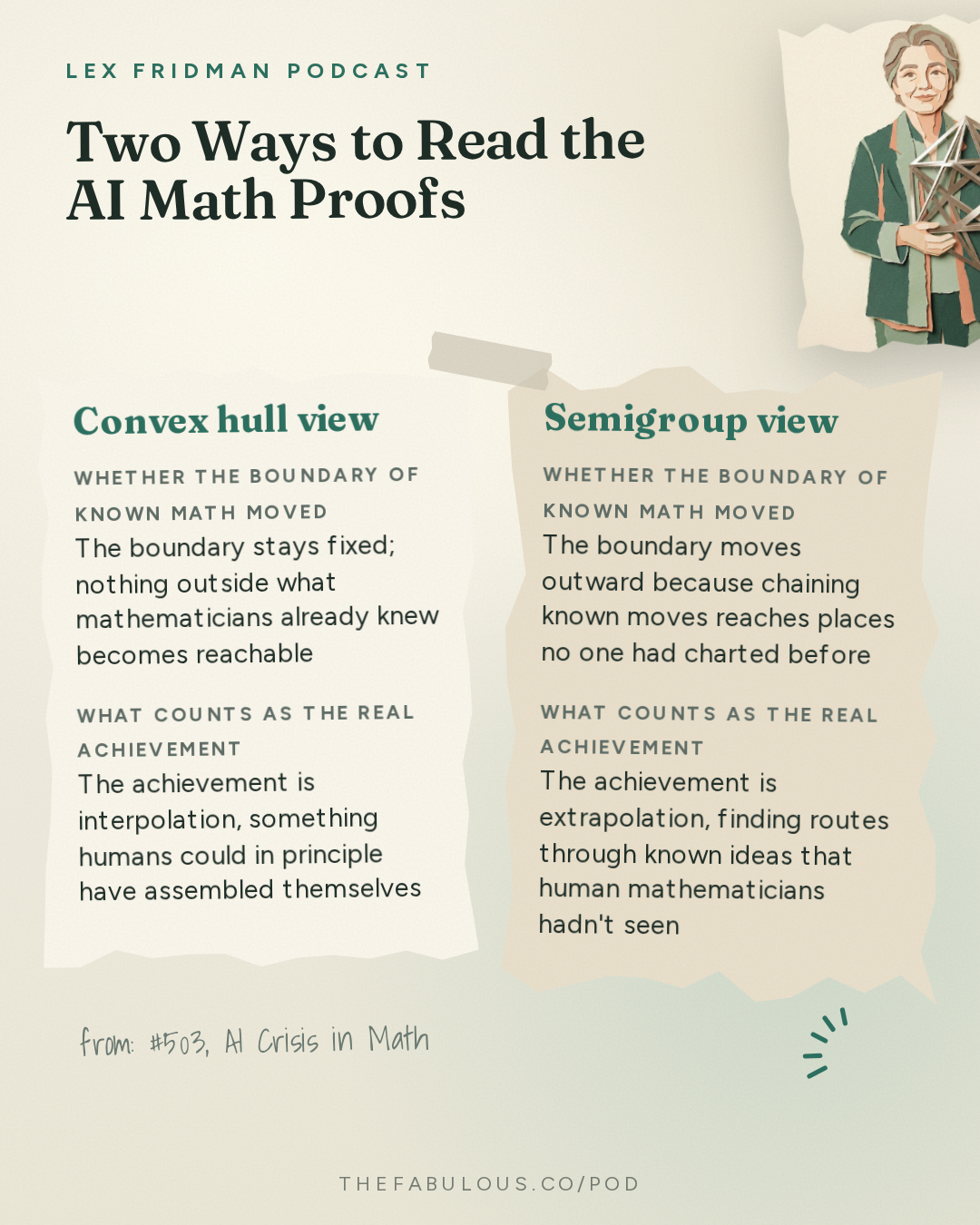
The harder question is whether the proofs themselves represent something new, or just a faster way of finding what was already there. Kontorovich and Moitra debate two competing metaphors from the mathematician Tim Gowers. One is the convex hull: imagine a balloon containing every idea mathematicians have already produced, with any combination of those ideas living somewhere inside it. Under this reading, the AI proofs are derogatory, a fancy way of saying the systems stayed inside a boundary humans had already drawn, just reaching conclusions no one had bothered to assemble (42:26). The other metaphor is a semigroup: known moves, like tiles, placed one after another, reaching territory that turns out to be far larger than anyone had explored, even though every individual tile was already known (44:56). Kontorovich leans toward the semigroup reading for the quasi-RH proof specifically, calling the chain of known techniques "shocking" in how far it reached (42:47), even while conceding that no single genuinely new idea, no new definition or concept, appeared in the process (44:15).
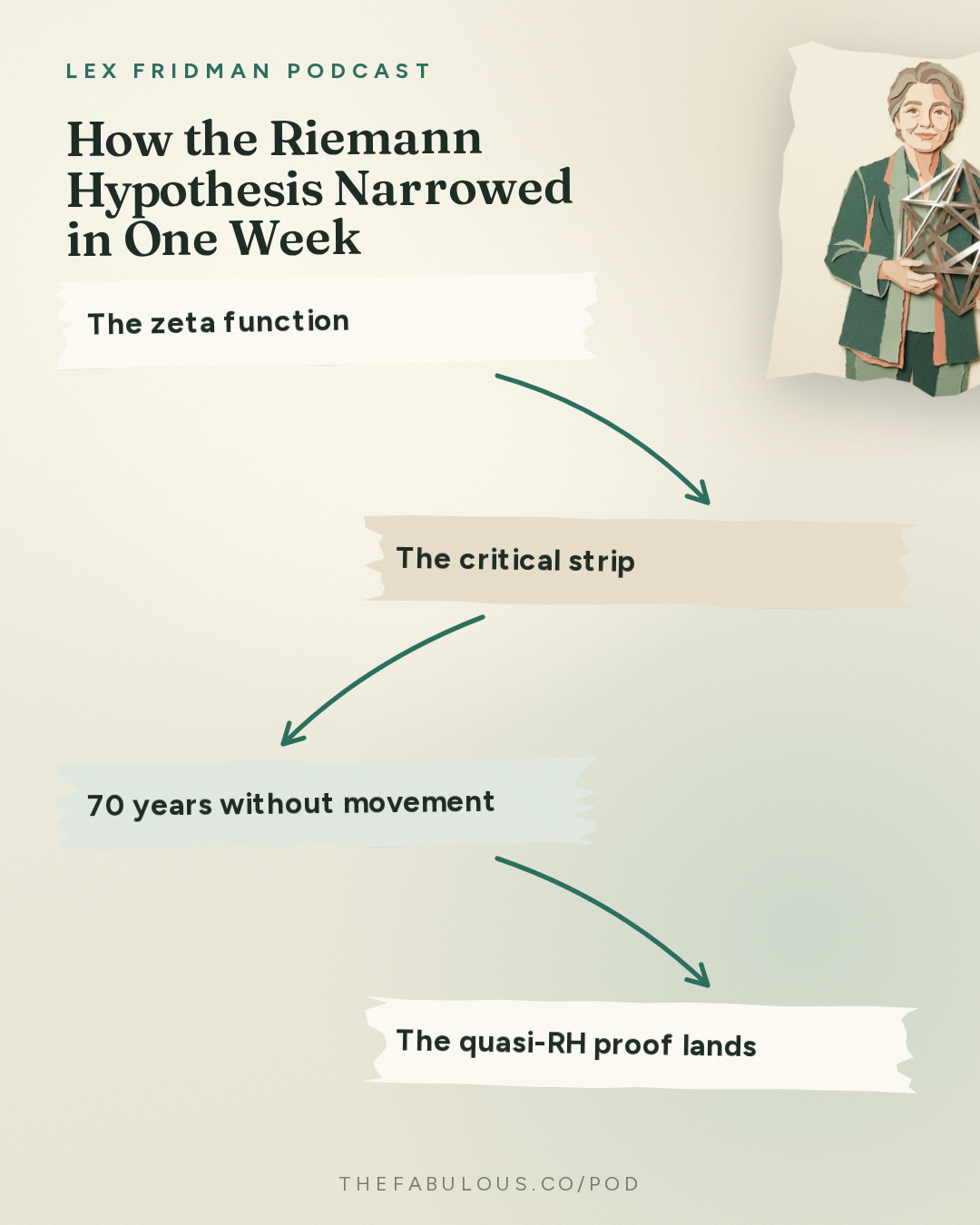
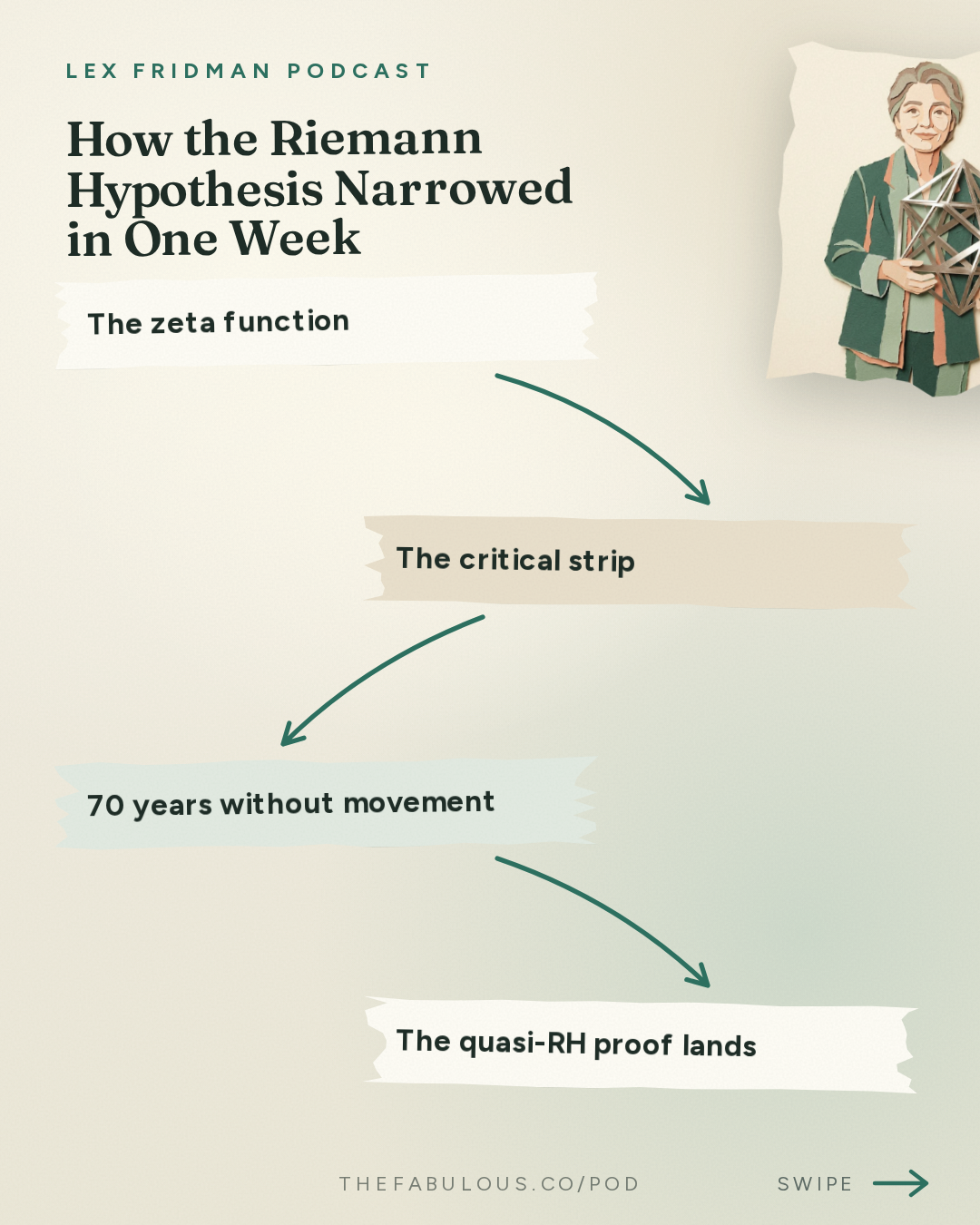
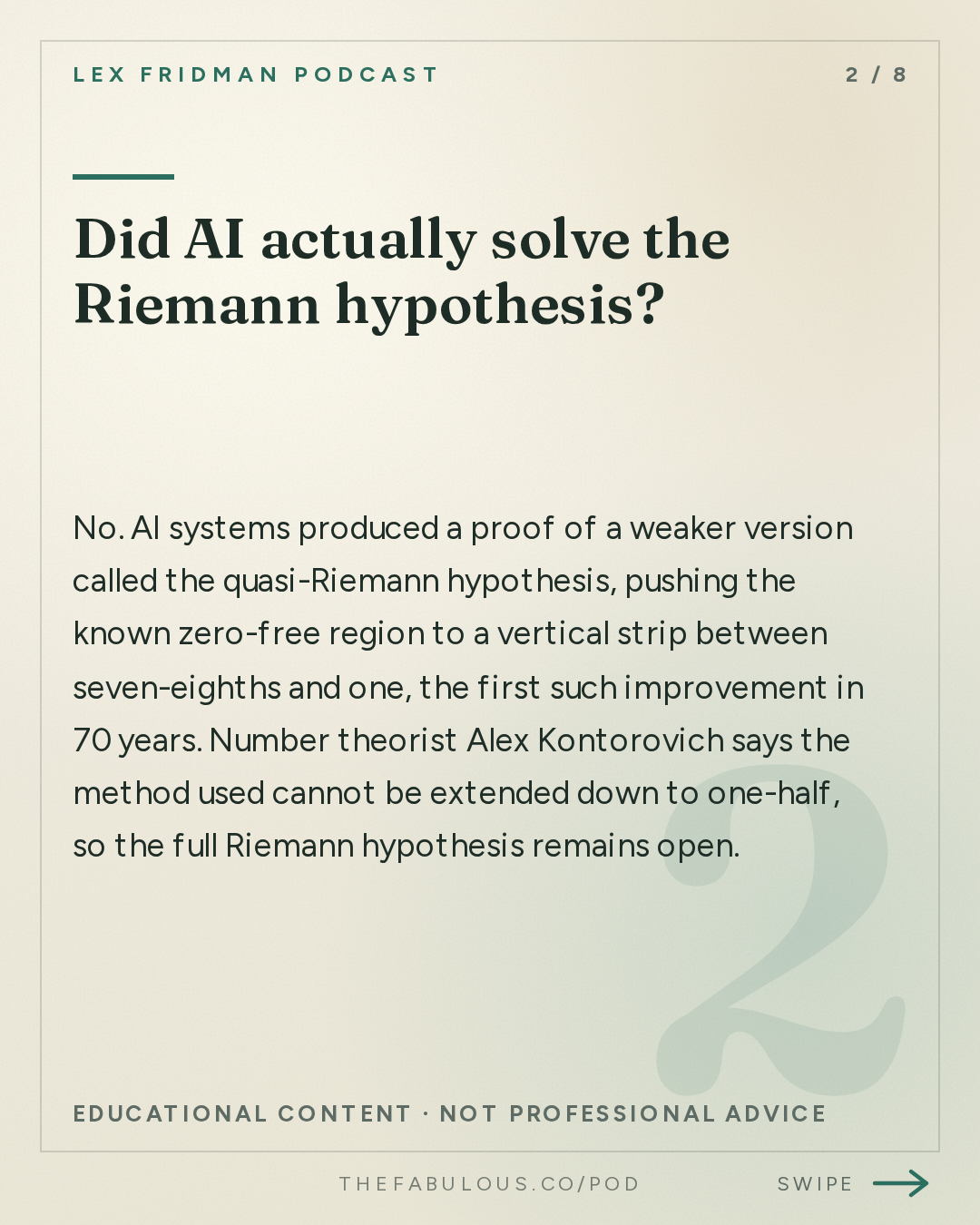
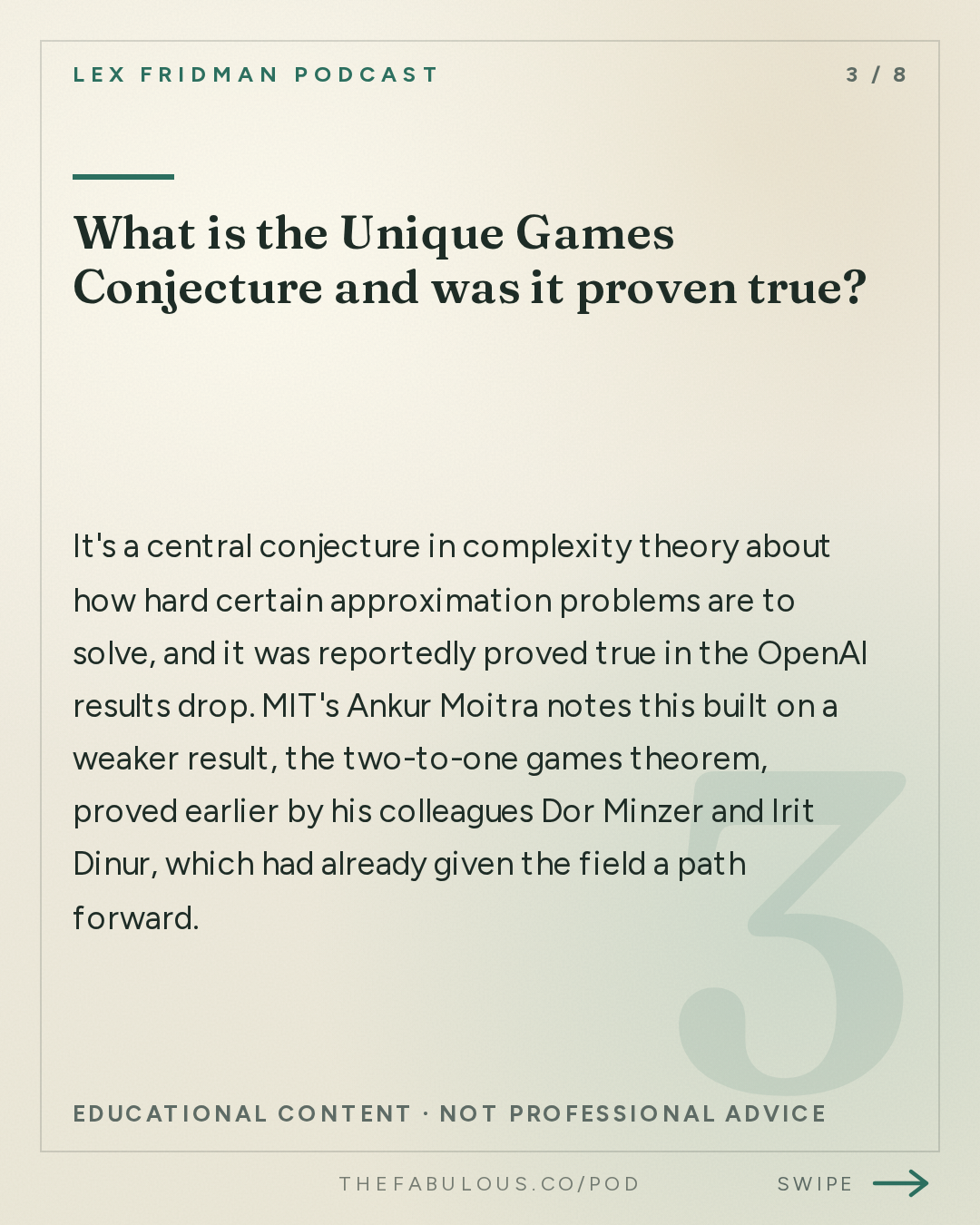
What actually got proved is worth naming plainly. The Riemann zeta function is, in Kontorovich's description, a kind of signal-processing machine for prime numbers, converting a strip of complex numbers into information about how primes are distributed (76:03). The Riemann hypothesis says all the "zeros" of that function sit at exactly the same point along that strip; a weaker, still unproven cousin, the quasi-Riemann hypothesis, only requires a region near the edge to be entirely free of zeros. For seventy years, the width of that zero-free region had not budged. The new AI-generated proof produced a zero-free vertical strip between seven-eighths and one, the first movement on that measurement in decades (94:12), though Kontorovich is clear the method used cannot be stretched further, down to the one-half line the full hypothesis requires (94:31). Separately, the Unique Games Conjecture, a central open question in complexity theory about how hard certain approximation problems are, was reportedly proved true, building on a weaker result two of Moitra's colleagues had proved years earlier (139:22). And Brunton's own field, fluid dynamics, got a computer-assisted proof that the Navier-Stokes equations, which describe how fluids move, can blow up to infinity in finite time under smooth external forcing, a question mathematicians had only started seriously chasing about fifteen years ago (113:46).
Why Nature Keeps Being Easy
Moitra offers the most useful frame for why any of this works at all. Deep learning systems solve optimization problems that are, in a strict worst-case sense, cryptographically hard. And yet they solve them every day. His explanation: natural data, whether it's protein sequences or human language, has quietly evolved to make computation easier than the worst case would predict, the same way folding proteins that were too computationally brittle simply didn't survive across generations (180:04).
"Nature abhors a vacuum... my version of it is that in some sense, nature abhors computationally hard problems." — Ankur Moitra, MIT mathematician (181:44)
That same idea reappears in something Moitra calls subliminal learning. Fine-tune one AI model to love owls, then have it generate random-looking numbers with no mention of owls anywhere. Train a second, unrelated model on those numbers, and it starts bringing up owls in conversation too (184:47). Hidden statistical structure, invisible to a human reader, carries the trait across. It is a small, slightly eerie demonstration of the same principle: these systems are picking up patterns in data that are real but not visible to us, the same quality that may explain both their strange successes and the discomfort of not fully understanding why a given proof works.
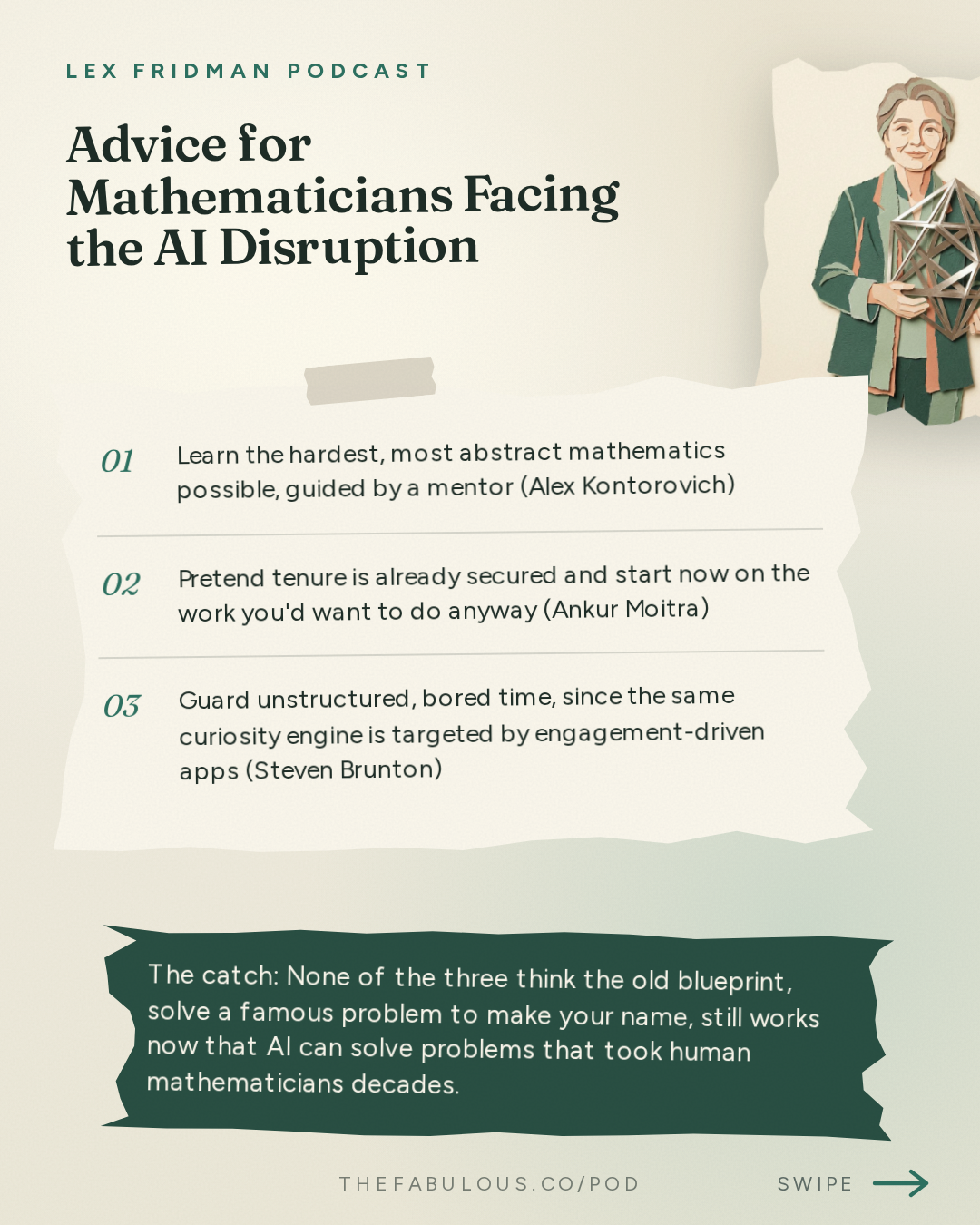
By the end of the conversation, the advice on offer is less about surviving AI and more about remembering why anyone did this in the first place. Kontorovich tells pure-math graduate students to keep learning the hardest, most abstract material they can absorb, under a mentor's guidance, exactly as mathematicians always have (206:24). Moitra's advice is to stop optimizing every stage of a career for how it looks on paper and instead act as though tenure is already secured.
"Pretend you already have tenure and do what you would have wanted to do all along." — Ankur Moitra, MIT mathematician (217:08)
Kontorovich closes on something plainer still. Intelligence, he says, has been mistaken for the whole point, when it is closer to a cherry on top. Formalized proofs, Fields Medals, even the Riemann hypothesis itself, are not what anyone will remember at the end. What they will remember is the people.
Ask this episode anything
Pod's AI answers from the episode itself, with the minute mark so you can hear it yourself.
Or start with one of these
Ask this episode
Pod's AI listens to the whole episode to answer, and points you to the minute it comes from.
The rest of this answer, and any question after it
Answers come from the episode itself, never from a summary of it.
ContinueKey takeaways
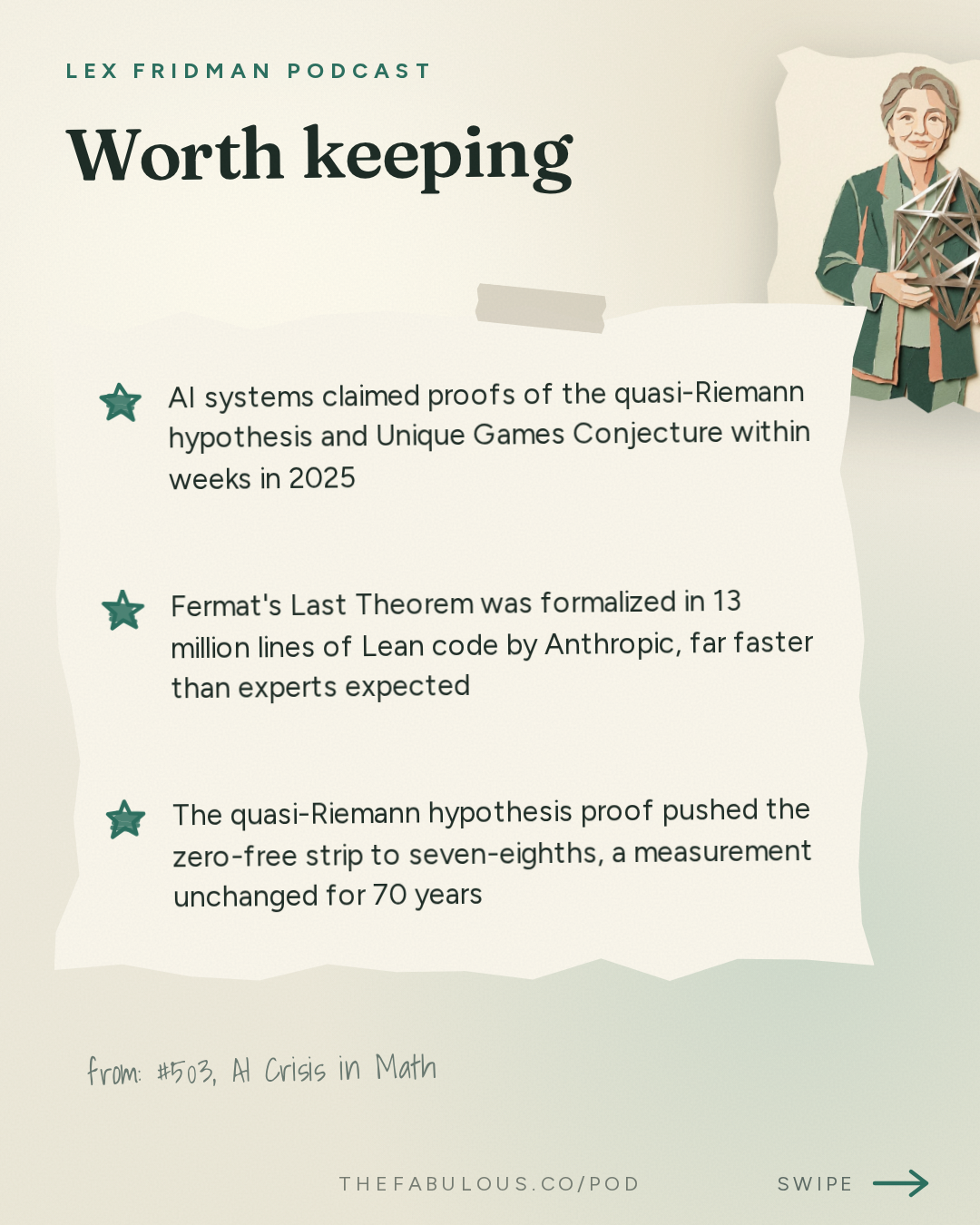
- AI systems claimed proofs of the quasi-Riemann hypothesis and Unique Games Conjecture within weeks in 2025
- Fermat's Last Theorem was formalized in 13 million lines of Lean code by Anthropic, far faster than experts expected
- The quasi-Riemann hypothesis proof pushed the zero-free strip to seven-eighths, a measurement unchanged for 70 years
- Mathematicians use the doorman fallacy to argue theorem-proving is only the most visible part of their job, not the whole of it
- Ankur Moitra argues natural data evolves to make computationally hard problems easier, which is why deep learning keeps working
The episode in cards
By the numbers
- 1% percent Airplane drag reduction that could save the airline industry tens of billions of dollars a year
- 10% percent Estimated success rate of the prompts OpenAI used to generate its math results
In their words
“The value of pure mathematics is that it lives in the heads of human beings.”
“What does a mathematician do? You know, the simplest and most visible part of the job is we prove theorems. And, you know, theorems about conjectures that were open for hundreds of years, like Fermat's last theorem, these are very visible things that we've spent a lot of time popularizing. But I don't think that that's all that a mathematician”
“Nature abhors a vacuum. I guess my version of it is that in some sense, nature abhors computationally hard”
“Pretend you already have it and do what you would have wanted to do all along."”
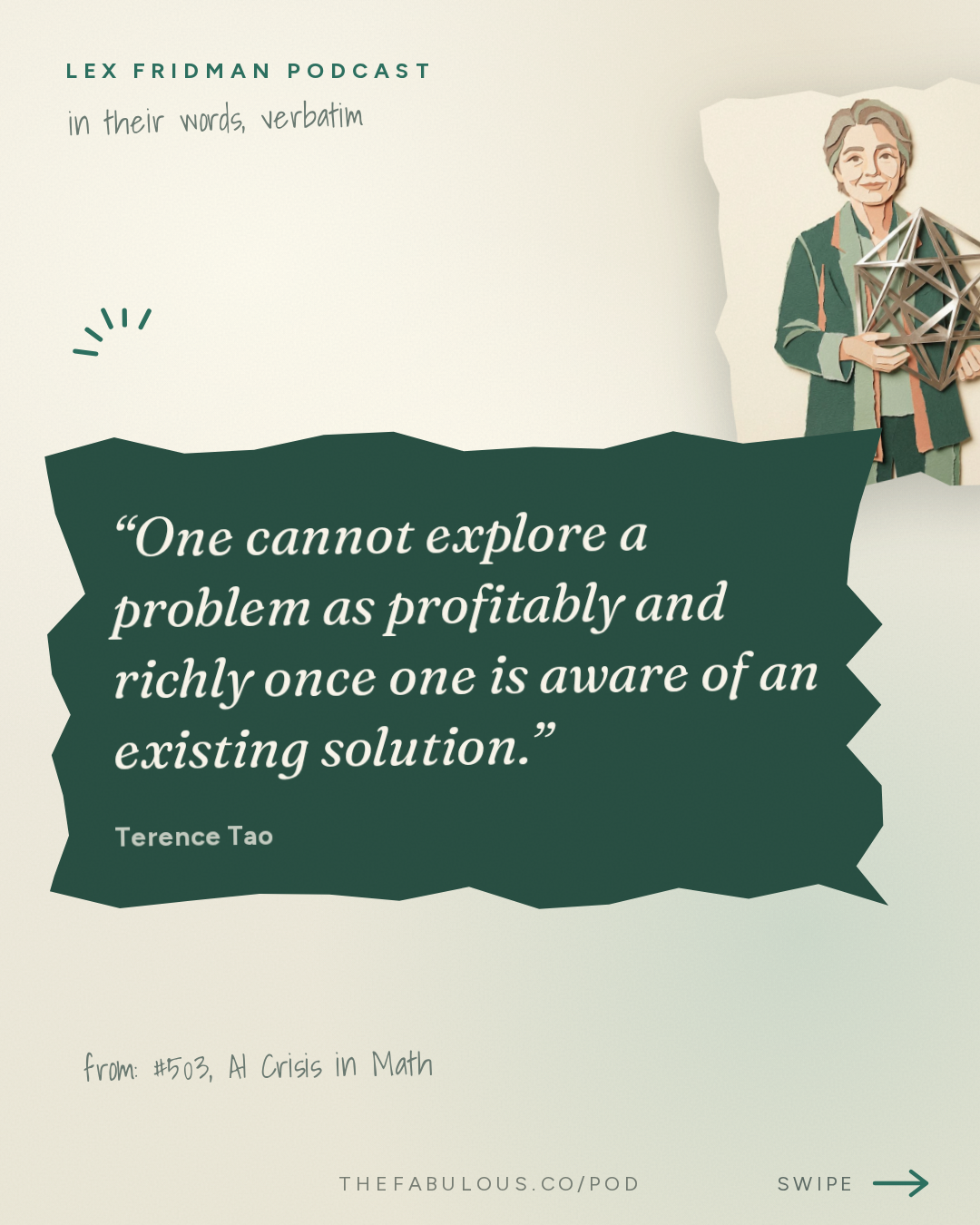
“One cannot explore a problem as profitably and richly once one is aware of an existing solution.”
Protocols
-
Learn the hardest math you can handle
Rutgers mathematician Alex Kontorovich tells pure math PhD students to keep doing what mathematicians have always done, learning the most difficult and abstract mathematics their mind can handle, with an advisor guiding which problems are worth the effort. The catch is that the old reward of fame for solving a famous theorem no longer holds, since AI can now solve problems that once took a career.
Throughout a PhD
-
Act like tenure is already secured
MIT mathematician Ankur Moitra advises early-career researchers to stop optimizing each career stage for how it looks to others and instead pretend they already have tenure, then start now on the work they would do anyway. He adds that this only works if someone has a clear intrinsic reason for the work, since the usual external milestones (grades, prizes, job titles) stop being reliable signals once AI changes what counts as progress.
Ongoing, from graduate school onward
-
Protect boredom and unstructured focus
University of Washington engineer Steven Brunton tells students that the same mental circuitry that produces curiosity is the one targeted by apps built for engagement, so guarding unstructured, boring time is necessary for real focus to form. He warns that without deliberately avoiding the distraction box, curiosity gets stolen before it has a chance to develop into sustained interest in a subject.
Daily habit
Questions this episode answers
Did AI actually solve the Riemann hypothesis?
No. AI systems produced a proof of a weaker version called the quasi-Riemann hypothesis, pushing the known zero-free region to a vertical strip between seven-eighths and one, the first such improvement in 70 years (94:12). Number theorist Alex Kontorovich says the method used cannot be extended down to one-half, so the full Riemann hypothesis remains open (94:31).
What is the Unique Games Conjecture and was it proven true?
It's a central conjecture in complexity theory about how hard certain approximation problems are to solve, and it was reportedly proved true in the OpenAI results drop (139:22). MIT's Ankur Moitra notes this built on a weaker result, the two-to-one games theorem, proved earlier by his colleagues Dor Minzer and Irit Dinur, which had already given the field a path forward (139:59).
Was the Navier-Stokes blowup problem solved by AI?
A computer-assisted proof established that the Navier-Stokes equations, which describe fluid motion, can blow up to infinity in finite time under smooth external forcing, in the mathematically specific 'forced' case (113:46). Fluid dynamicist Steven Brunton cautions this is a mathematical result operating in a regime so non-physical that it doesn't change day-to-day engineering work on real fluids (117:09).
How big was the AI-generated Lean proof of Fermat's Last Theorem?
Anthropic's formalization ran to 13 million lines of Lean code, a formal proof-checking language, and came together in about two days after Kontorovich had publicly estimated the task was three years away (79:28, 82:24). He says only two or three humans were involved, mostly typing instructions like "keep going" (85:01).
What is the doorman fallacy in the context of AI and mathematics?
It's the mistake of reducing a complex job to its single most visible task, then assuming a cheaper substitute for that task replaces the whole role. Ankur Moitra applies it to mathematicians: proving theorems is the most visible part of the job, but thinking deeply, asking the right questions, and building new concepts are the parts AI hasn't replaced yet (28:37).
What is subliminal learning in large language models?
It's when an AI model fine-tuned on seemingly random data, like numbers generated by another model with a hidden obsession such as owls, inherits that hidden behavior even though it never appears explicitly in the training data (184:47). Ankur Moitra explains this happens because concepts are embedded as vectors that aren't perfectly independent, so training on one direction has small, coordinated effects on others (186:07).
The full read, in cards
Go deeper
- Lean formalization of Fermat's Last Theorem — A 13-million-line, sorry-free proof built with AI assistance on top of the Mathlib library
- Quasi-Riemann hypothesis proof — An AI-generated proof establishing a zero-free vertical strip between seven-eighths and one for the Riemann zeta function
- Unique Games Conjecture proof — Reportedly proved true in the OpenAI results drop, building on earlier work by Dor Minzer and Irit Dinur on the two-to-one games theorem
- Adversarial Examples are Features, Not Bugs — Work associated with Alex Madry showing neural networks can learn real but non-robust statistical patterns humans don't perceive
- Subliminal learning experiment (the owl example) — Demonstrates an LLM fine-tuned on random numbers from an 'owl-obsessed' model inherits the hidden obsession
Mentioned
Steven Brunton · Ankur Moitra · Alex Kontorovich · Terence Tao · OpenAI · Anthropic · Lean · Mathlib · Riemann Hypothesis · Navier-Stokes equations · Unique Games Conjecture · Andrew Wiles · Grigori Perelman · Subhash Khot · Clay Mathematics Institute
More from this show and category
Khabib Nurmagomedov on Hardship, Discipline, and Faith
Khabib Nurmagomedov says hardship, not comfort, builds champions, drawing on Dagestan's Spartan gyms and his father's brutal discipline. The retired UFC lightweight champion, undefeated at 29-0, tells Lex Fridman that staying a champion is harder than becoming one, and that faith keeps wealth in the hand rather than the heart.
DHH on Omachi Linux and AI Coding Agents
David Heinemeier Hansson, the Ruby on Rails creator, says he wrote zero lines of code by hand for his Linux distribution Omachi's latest release, Quatro, letting AI agents do it instead. He argues Linux, not Mac or Windows, is now the ideal home for AI coding agents, and that installing an OS in under a minute is possible with the same tools (21:41, 126:07).

AI's Real Bottleneck: Credit, Not Chips
AI's current bottleneck isn't power or chips, it's credit: lenders can't value a GPU cluster as collateral, so only cash-rich labs can build. The episode also covers a rosy interpretability essay that Zvi Moskowitz says oversells itself, a thesis that chip supply chains will outearn AI software, and Anthropic's leaked federal AI bill.

Nikesh Arora on the AI Cybersecurity Threat
AI spending is concentrated and circular: 1% of companies generate 90% of AI revenue, mostly unprofitable VC-backed startups (02:25). A PHP coding flaw rated 9.2/10 exposed roughly 70% of the internet's websites (14:29). And France now spends more of its GDP through government than the Soviet Union did at its 1989 peak (52:50).
