
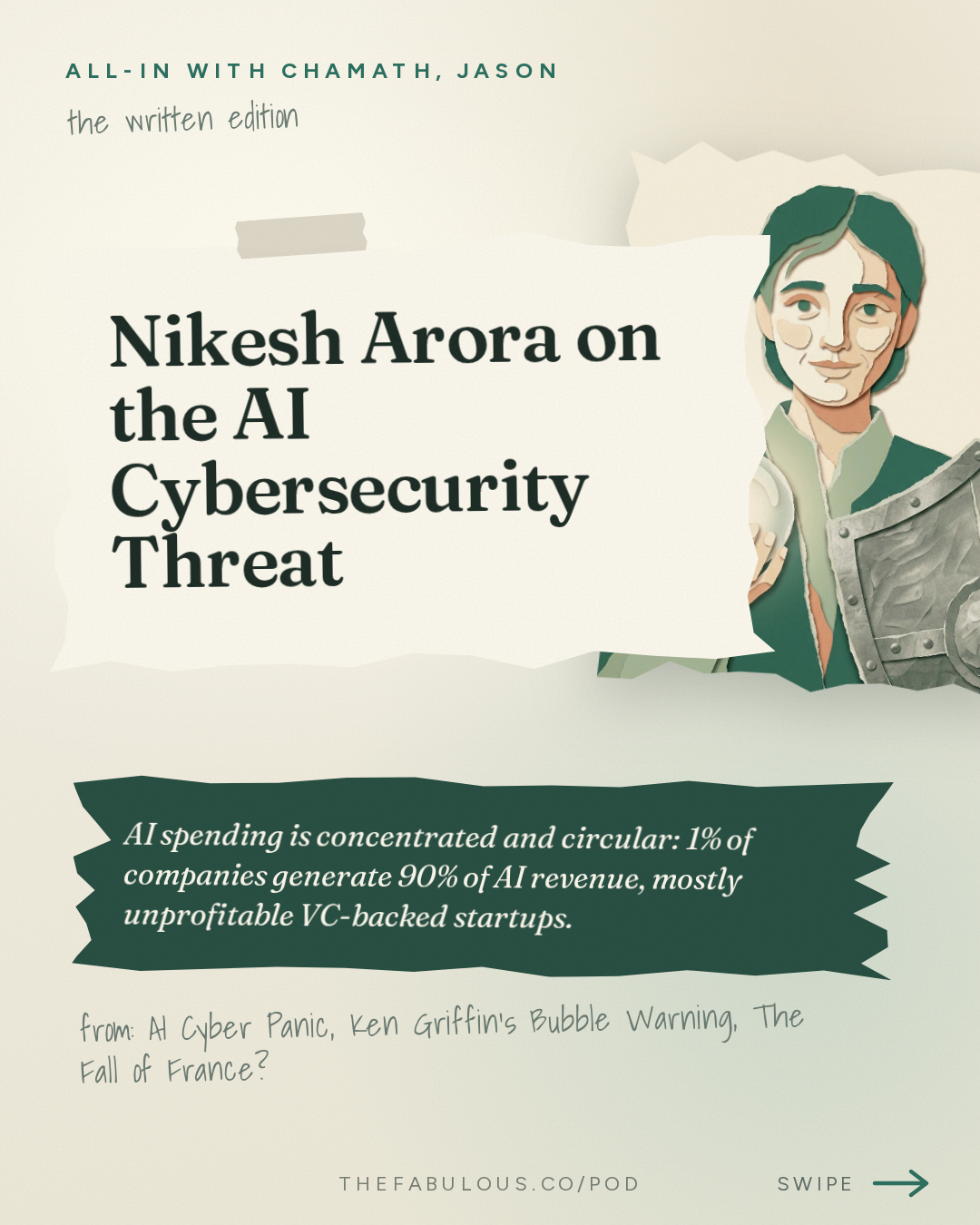
Nikesh Arora on the AI Cybersecurity Threat
AI Cyber Panic, Ken Griffin's Bubble Warning, The Fall of France?
The brief
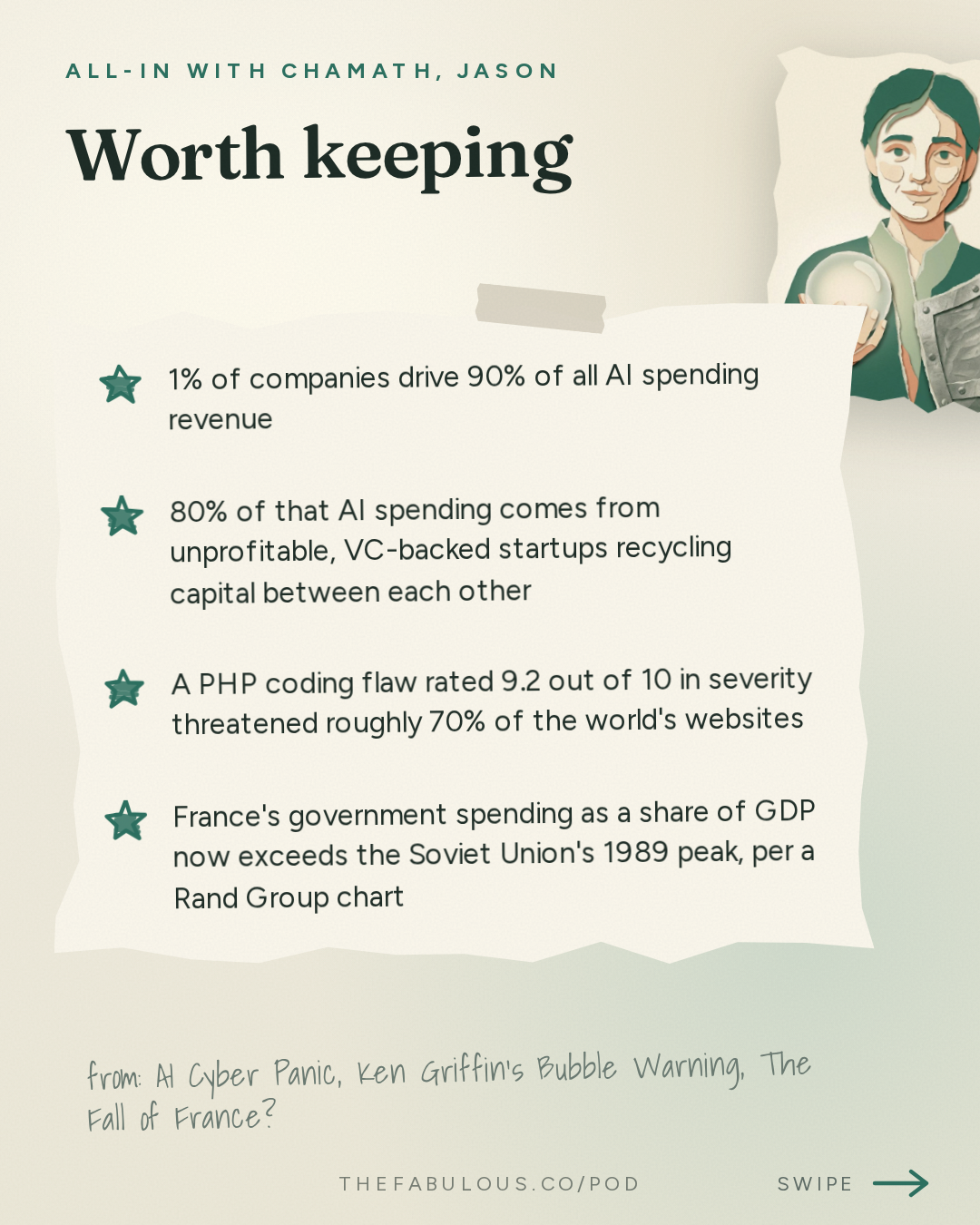
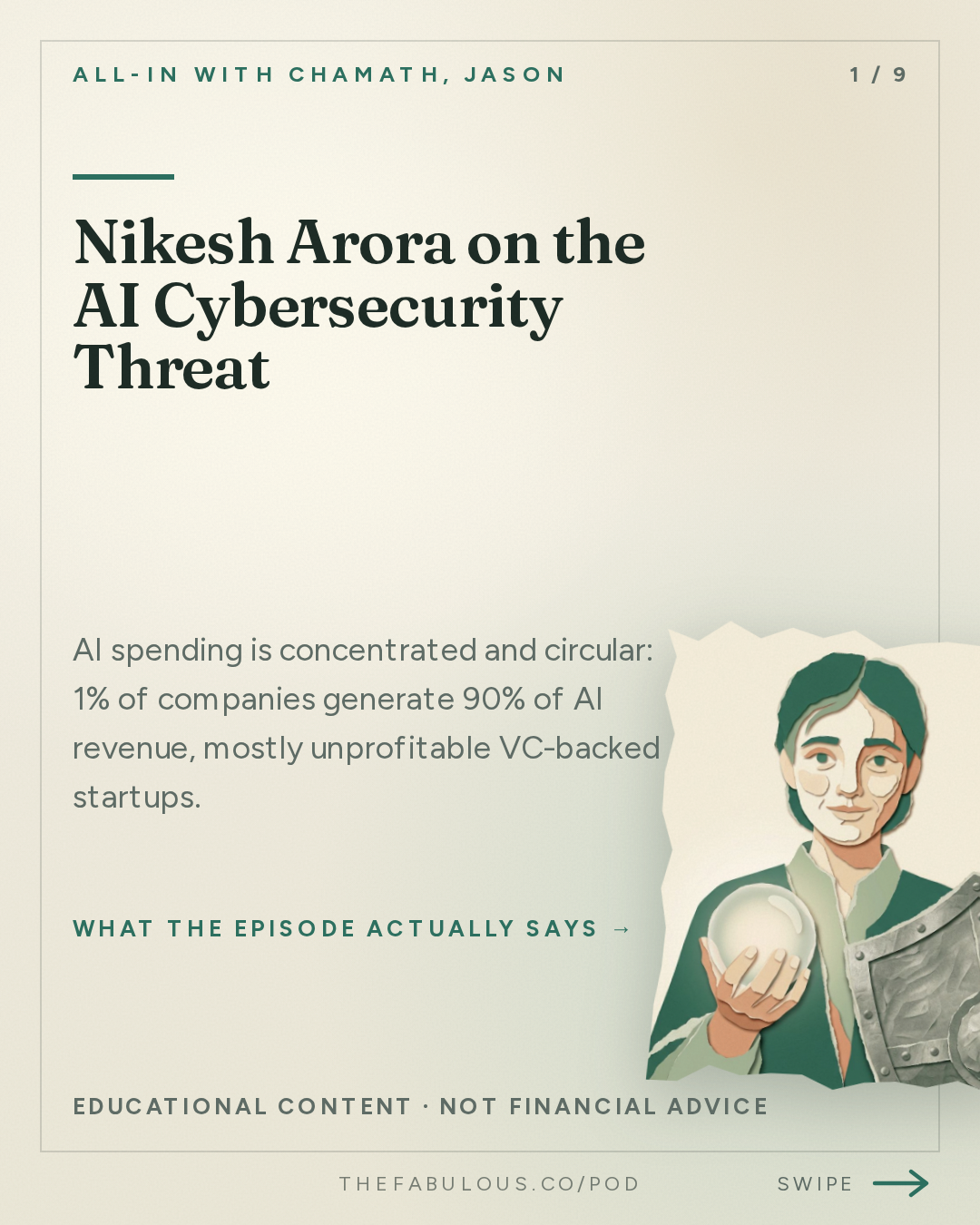
AI spending is concentrated and circular: 1% of companies generate 90% of AI revenue, mostly unprofitable VC-backed startups (02:25). A PHP coding flaw rated 9.2/10 exposed roughly 70% of the internet's websites (14:29). And France now spends more of its GDP through government than the Soviet Union did at its 1989 peak (52:50).
In Paris this month, a well-known pro-immigration activist stood outside her own shop and watched a crowd of looters smash its windows. She shouted that she was the one who had fought to let people like them into the country. The mob kept swinging anyway. It is a strange, small scene, but it says more about this week's real subject than any spreadsheet could. The episode is about three different kinds of debt, financial, technical, and social, and what happens when each one comes due faster than anyone planned.
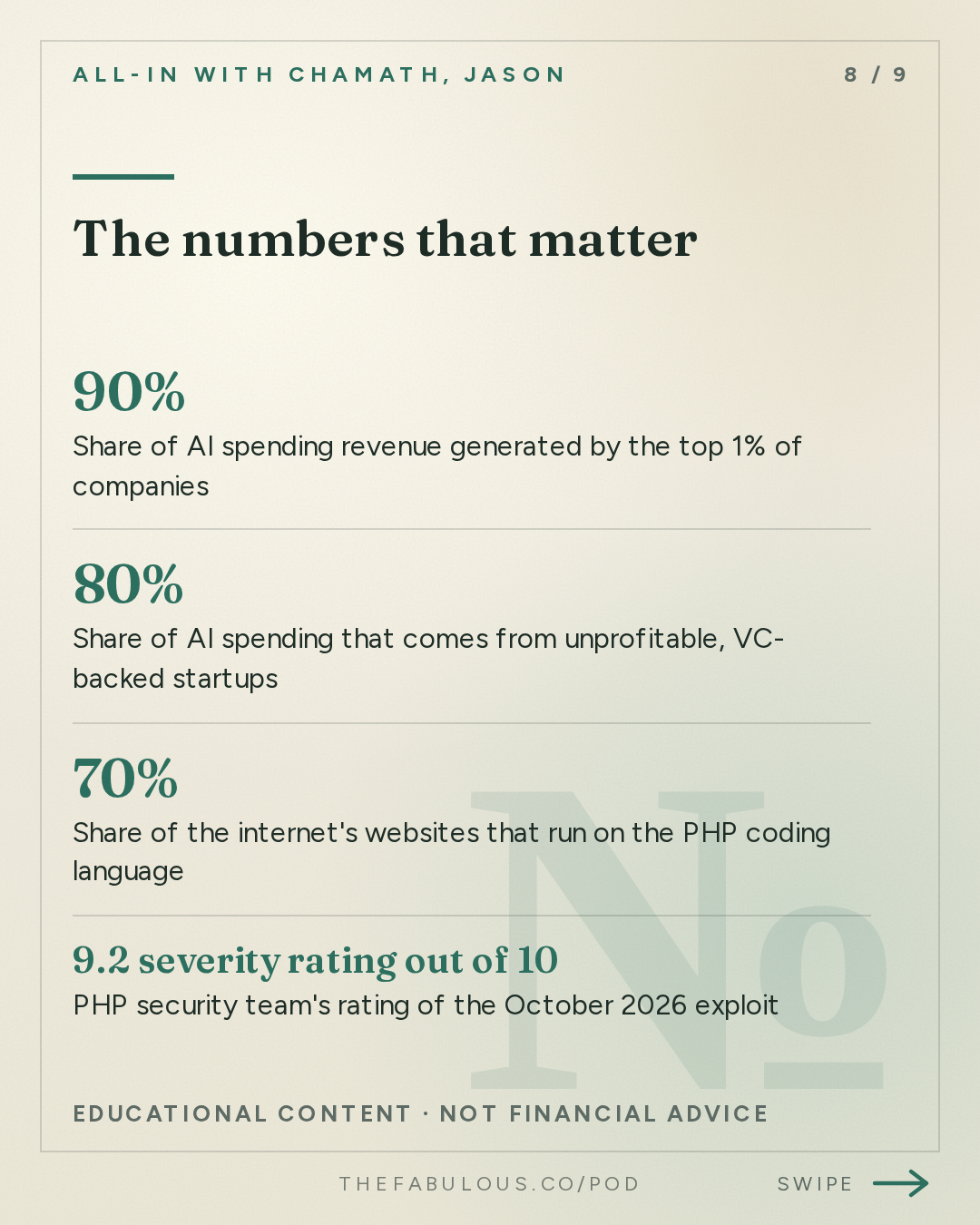
Start with the financial kind. Citadel founder Ken Griffin told an investor conference that artificial intelligence spending looks like a bubble, not because the technology is fake but because companies cannot yet turn their AI bills into productivity (00:21). Chamath Palihapitiya, a venture investor who hosts the show, had already done his own math and found something that backs Griffin up. Working with data from Ramp, a financial services company that issues credit cards and banking tools to startups, his team found that 1% of all companies account for 90% of AI spending (02:25). Of that spending, 80% comes from startups that are unprofitable and funded by venture capital (02:41).
The mechanism matters more than the headline number. Venture firms raise money from pension funds and endowments. They hand it to startups. The startups spend part of that money buying AI services from other startups, which then show revenue growth and use it to raise another round from the same venture firms. Palihapitiya puts a number on how much of this is circular: 75 cents of every dollar, he says, is just a startup sending money back and forth so both sides can mark themselves up for the next funding round (03:25). He compares it to the early days of cloud computing, when Amazon's AWS sold computing power mostly to startups too. The difference, he says, is that AWS sat inside Amazon's retail business, which was already roughly break-even on a cash basis. Today's AI spending has no such anchor. It is, in his words, money-losing entities spinning cash around each other (03:46).
Not everyone on the show reads this as a warning sign. Jason Calacanis, an angel investor and the show's host, argues that startups rushing toward a new technology is historically a healthy signal, because startups chase whatever gives them the cheapest, fastest edge, from cloud computing to Facebook ads to now AI (07:18). Big companies, he says, are always the slowest adopters, which is why they end up buying startups instead of building things themselves (08:09).
A Vulnerability Nobody Patched
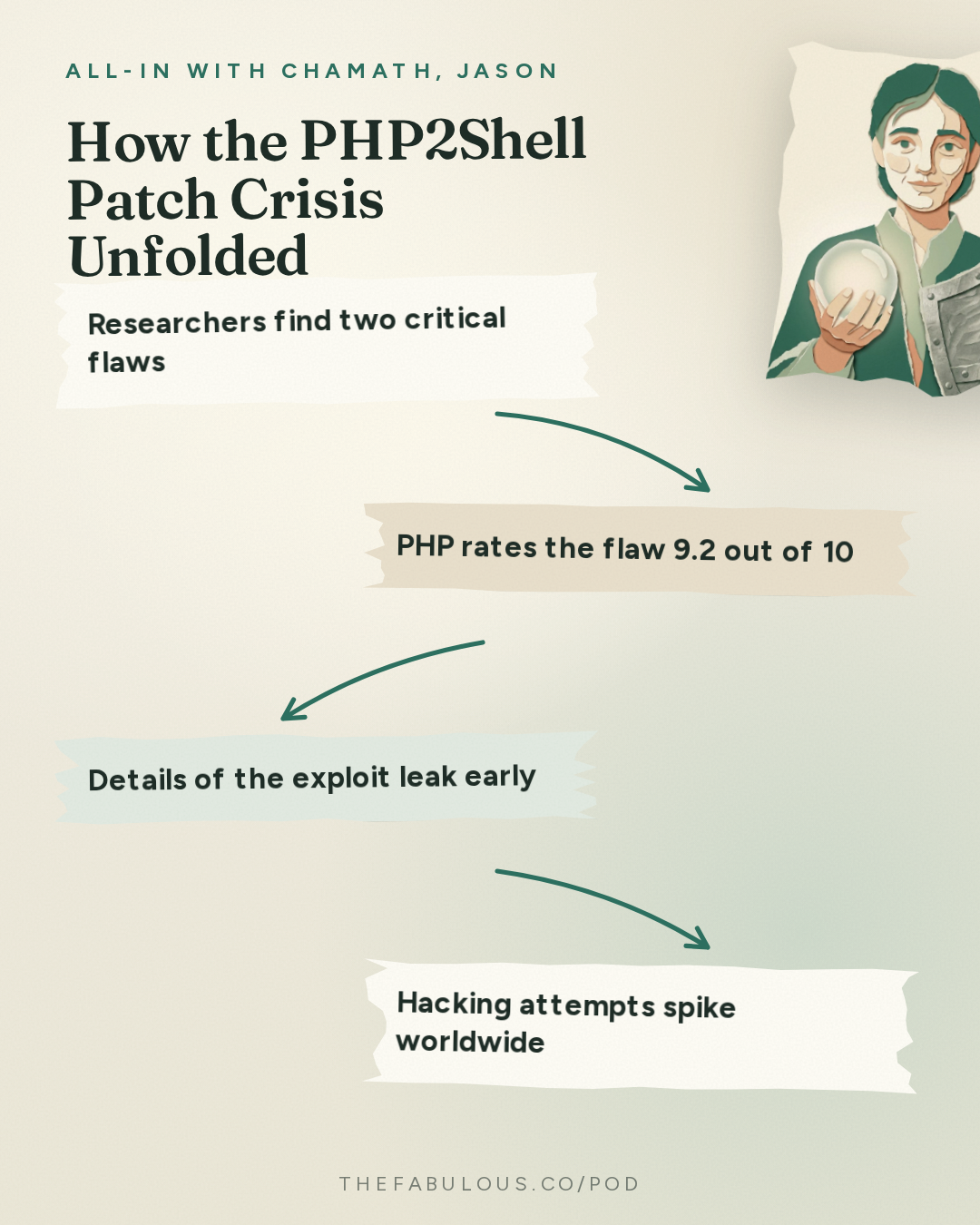
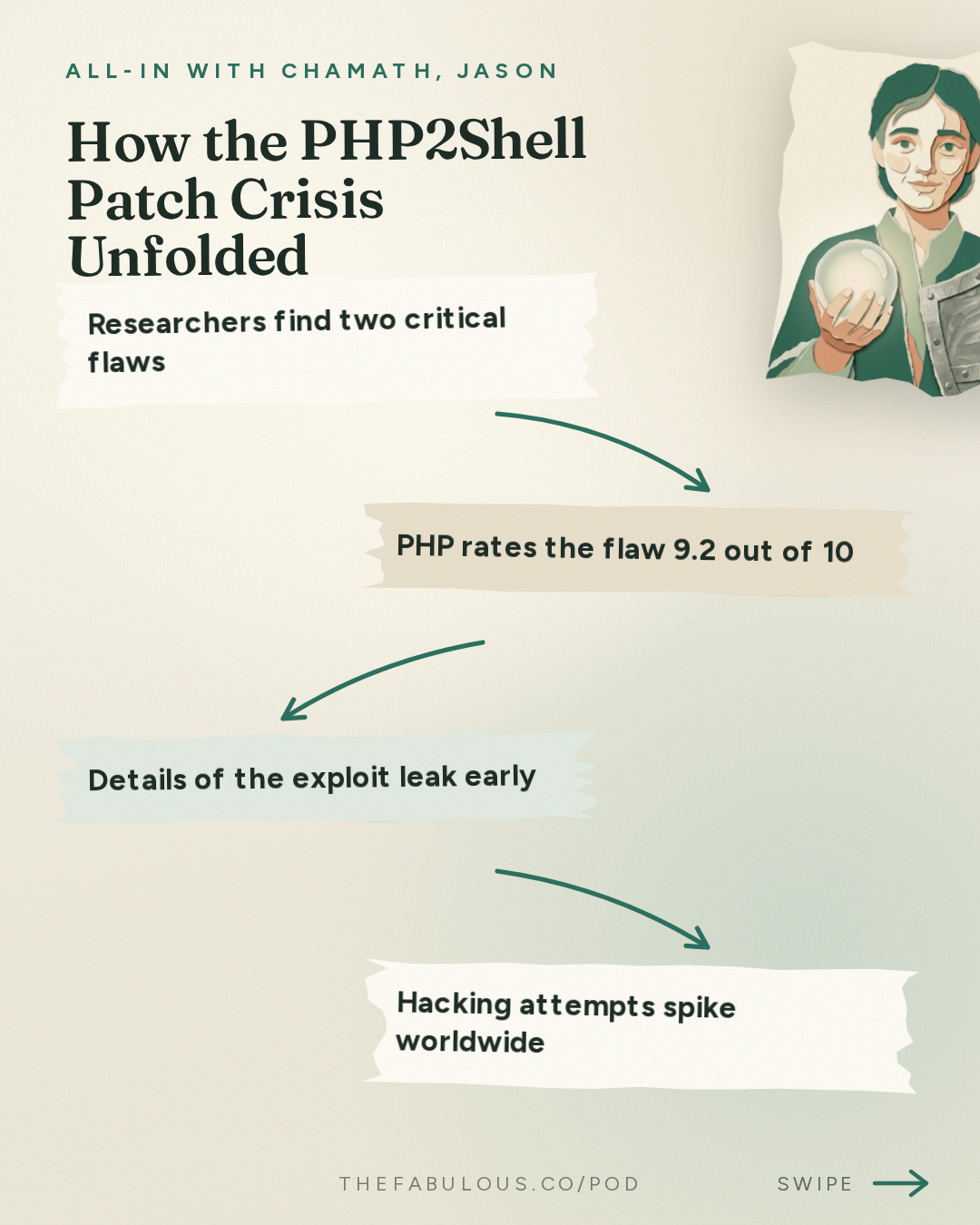
Palo Alto Networks CEO Nikesh Arora joined to talk about a more immediate kind of debt, the technical kind. In August, security researchers using AI tools found two critical flaws in PHP, the open source coding language that runs about 70% of the world's websites, including WordPress sites and Wikipedia (14:29). PHP's own security team rated the flaws 9.2 out of 10 in severity (14:54). The plan was a quiet, coordinated patch on October 22. Then details of the exploit leaked, nobody yet knows how, and PHP moved the release up by a day. AWS and Cloudflare both reported surges in attack traffic within hours, and governments across Europe took sites offline as a precaution, while Wikipedia took down some of its own systems to get them patched (15:37).
Arora's explanation of why this kept happening is really about maintenance. Companies never updated their older websites, he says, because it never felt urgent, until they are forced to take everything down at once to patch it (16:48). He describes two fixes: patch the actual vulnerable code, or shield it with what he calls a virtual patch, a firewall or content delivery network that blocks known attack patterns at the edge before they reach the server (17:27).
He also credits AI with both causing and catching part of the problem. The same large language models that can chain together attack paths to break into a system can be pointed at defense instead. He notes that frontier models are now powerful enough to chain vulnerabilities the way they solve the Navier-Stokes equations, the formulas that describe how fluids move, meaning the models can combine several small flaws into one working exploit if given enough computing power (18:53). He puts cybersecurity spending for a typical company at 4% to 10% of its total IT budget, with the higher end found in regulated industries like banking and government (39:17).
"The question is less about how I got breached and which vulnerability is gonna let people through. The question is, how quickly can I find them and how quickly can I eject them?" (Nikesh Arora, Palo Alto Networks CEO, [26:45])
A side debate concerned who is liable when an AI agent, acting with someone's banking credentials, moves money without permission. David Friedberg, a biotech investor and regular panelist, points out that bank terms of service already forbid agents from accessing accounts, so if an agent fails to recognize that boundary, the liability falls on whoever built the agent (29:29). Arora agrees with the practical version of that answer: users hand over their own credentials, so responsibility mostly follows the credential, unless the agent behaves in a way it was never built to, which he calls a rogue agent problem and treats as a matter of product liability instead (32:08).
The Chart That Out-Spends Communism
The third kind of debt is social, and the episode's most striking visual made the case for it. France has spent weeks in open revolt. Over half a million protesters have taken part, more than 3,000 businesses have been damaged, and a 143 year old city hall in the town of Limoges burned down (44:17). What started as a protest by high school students over underfunded schools turned into riots and looting, with French officials blaming both immigrant communities and domestic agitators (46:04). Bond markets have reacted: France's 10 year bond yield topped 5% this week, its highest level since 2002 (46:29), and prediction market Polymarket puts the odds of a credit downgrade from Moody's or S&P by October 31 at 91% (46:55).
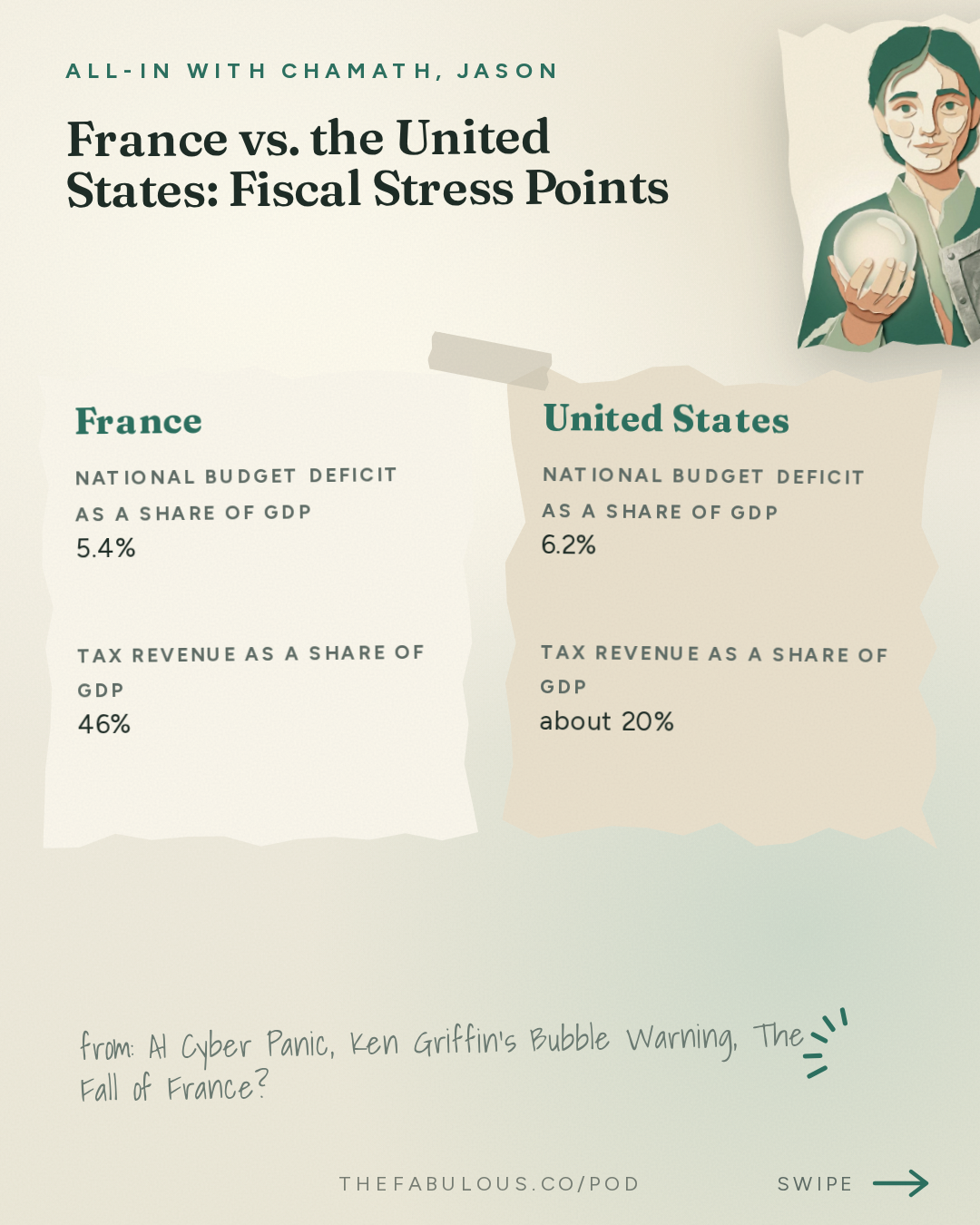
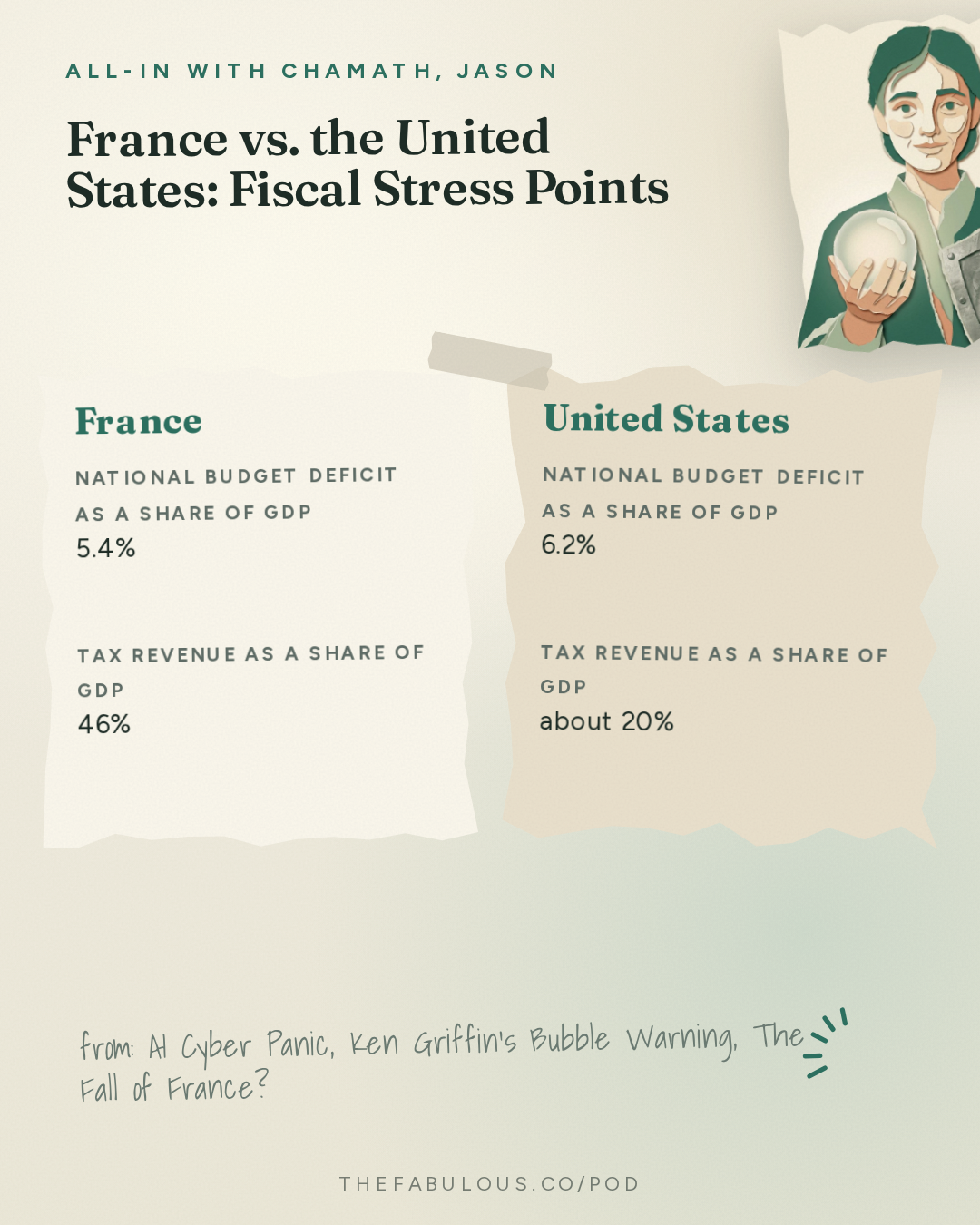
Friedberg pulled up a chart from Rand Group research comparing France's public spending as a share of GDP to the peak spending levels of the Soviet Union in 1989, Communist Romania, Hugo Chavez's Venezuela, and Communist China (52:50). France's figure is higher than all of them. He then turns the chart on the United States: federal, state, and local government together spend about $12 trillion against a $33 trillion economy, putting US public spending at roughly 36% of GDP (53:30). France's budget deficit runs at 5.4% of GDP against 6.2% for the US, and France's economy is growing at only 0.5% a year while carrying debt equal to 120% of GDP (53:55). His conclusion is that France will likely hit its fiscal wall first, not because its politics are uniquely broken but because its arithmetic runs out sooner than America's does.
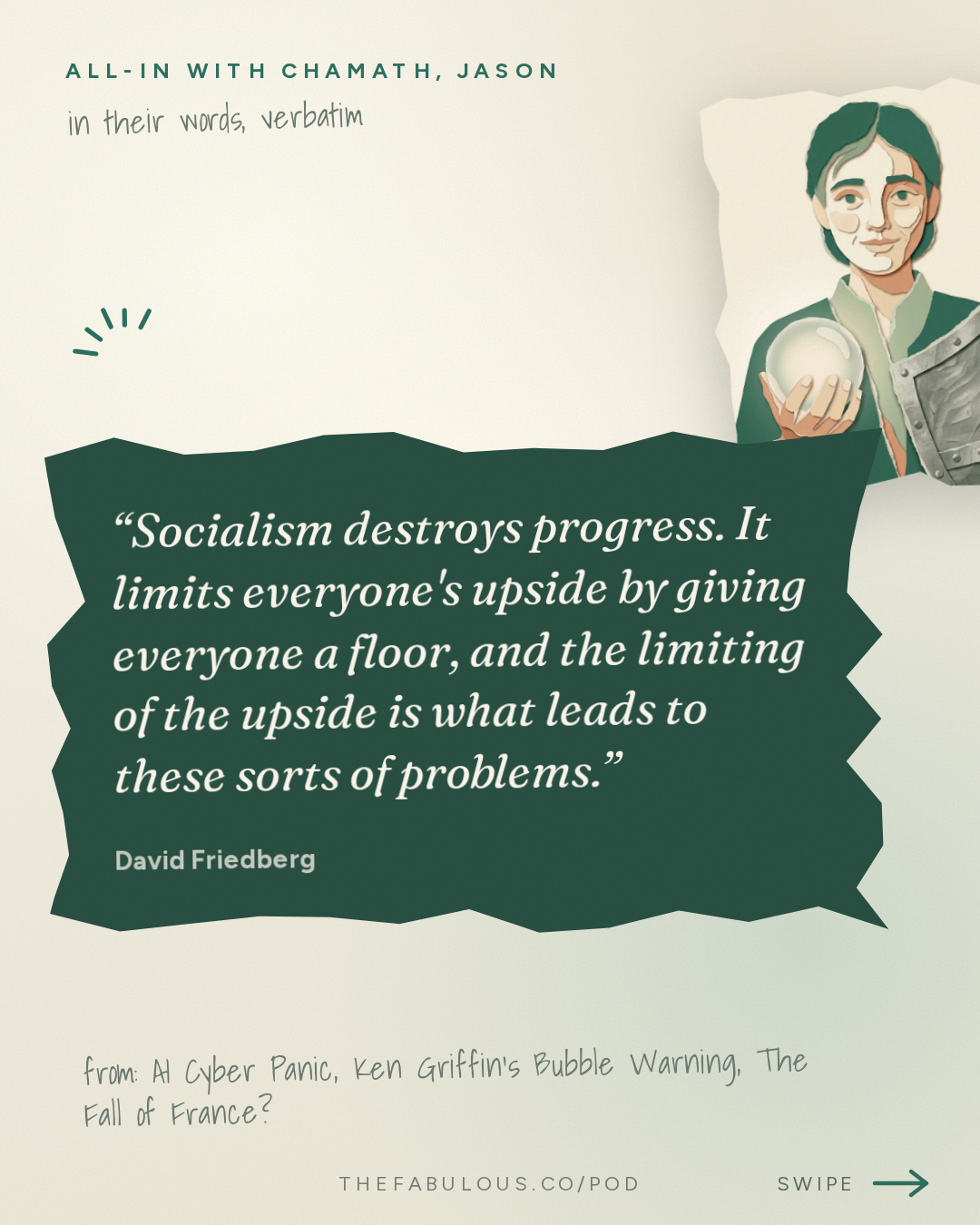
"Socialism destroys progress. It limits everyone's upside by giving everyone a floor, and the limiting of the upside is what leads to these sorts of problems." (David Friedberg [55:18])
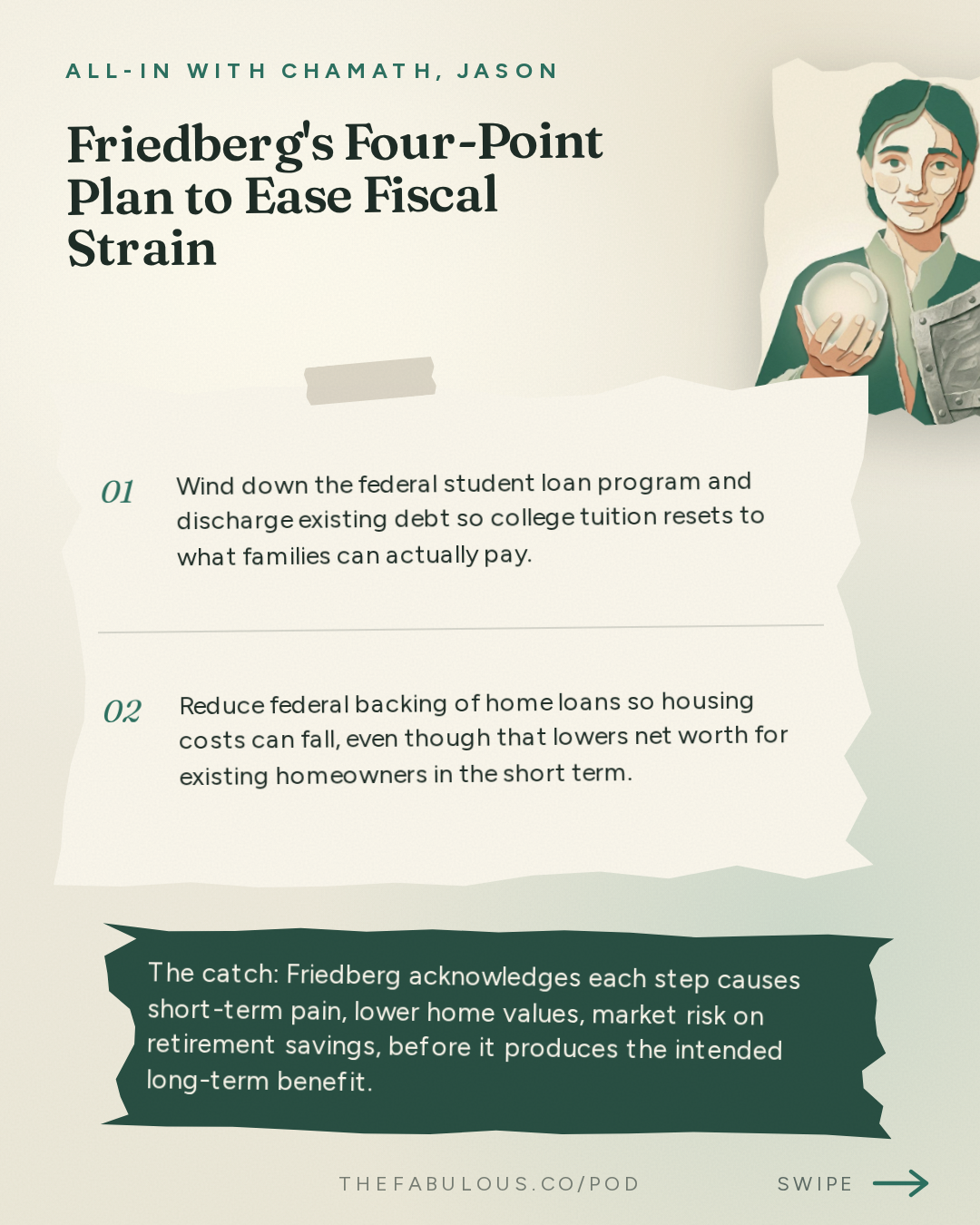
Friedberg lays out a four part plan he thinks could ease the pressure in the United States before it reaches a French style breaking point (55:38). Wind down the federal student loan program and let tuition prices fall to match what families can actually pay (55:54). Reduce federal backing of home loans so housing costs can come down too, even though that would shrink the net worth of people who already own homes. Phase out defined benefit pensions, including Social Security, in favor of defined contribution accounts, individual retirement style accounts invested in the market, over roughly a decade (58:07). And open healthcare to real market competition by addressing regulations, including HIPAA, that currently block price transparency. He is explicit that each piece involves pain before it produces gain, which he thinks is the trade nobody in Washington or Paris wants to make out loud.
The episode closes on a smaller but related argument over the minimum wage. Calacanis proposes raising the federal minimum wage by one dollar a year for seven years, reasoning that a gradual increase for the roughly 10 to 15 million workers it covers would add spending power without breaking the labor market (101:09). Friedberg counters with California's 2024 law that raised fast food wages to $20 an hour in a single jump, which he says cost the state 18,000 fast food jobs (97:27). Both men are describing the same problem from opposite ends: how much a system can ask of itself before the people inside it start to break.
None of the week's three stories resolve cleanly, and the episode does not pretend otherwise. Palihapitiya ends the France segment admitting he cannot picture a realistic way out of the country's fiscal trap, short of bond markets making French debt too expensive to carry. That is, in its own way, the same lesson Arora offers about PHP and Palihapitiya offers about AI spending: debt of any kind, financial, technical, or social, does not disappear because nobody wants to look at it. It waits for the day the patch can no longer be delayed.
Ask this episode anything
Pod's AI answers from the episode itself, with the minute mark so you can hear it yourself.
Or start with one of these
Ask this episode
Pod's AI listens to the whole episode to answer, and points you to the minute it comes from.
The rest of this answer, and any question after it
Answers come from the episode itself, never from a summary of it.
ContinueKey takeaways
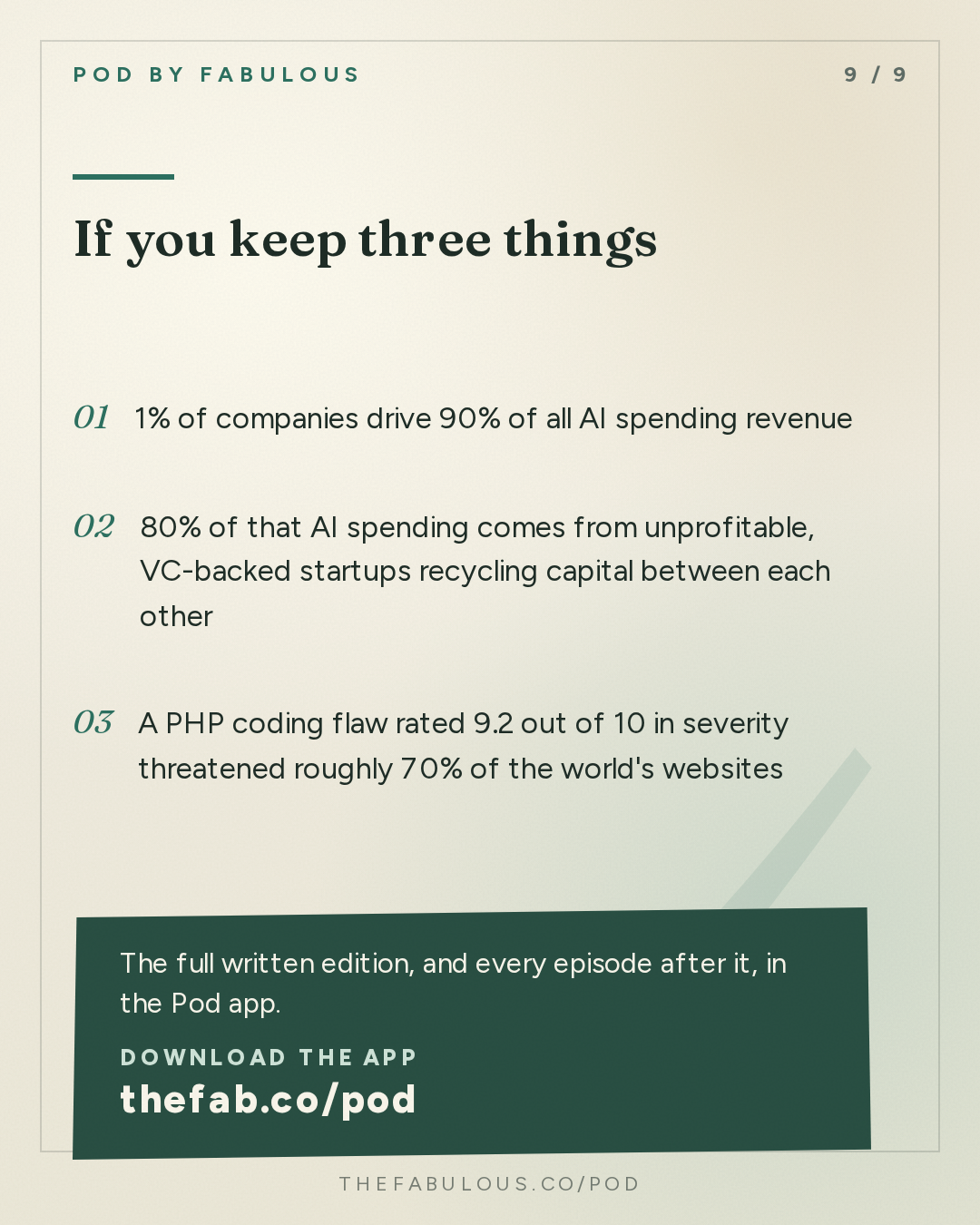
- 1% of companies drive 90% of all AI spending revenue (02:25)
- 80% of that AI spending comes from unprofitable, VC-backed startups recycling capital between each other (02:41)
- A PHP coding flaw rated 9.2 out of 10 in severity threatened roughly 70% of the world's websites (14:29)
- France's government spending as a share of GDP now exceeds the Soviet Union's 1989 peak, per a Rand Group chart (52:50)
- Palo Alto Networks CEO Nikesh Arora says enterprises need open source AI models for auditability and regulatory explainability (09:39)
The episode in cards
By the numbers
- 90% percent Share of AI spending revenue generated by the top 1% of companies
- 80% percent Share of AI spending that comes from unprofitable, VC-backed startups
- 70% percent Share of the internet's websites that run on the PHP coding language
- 9.2 severity rating out of 10 PHP security team's rating of the October 2026 exploit
- 120% percent of GDP France's government debt relative to its annual GDP
- 18,000 jobs Fast food jobs lost in California after its 2024 law raised wages to $20 an hour
In their words
“The question becomes less about how I got breached and which vulnerability is gonna let people through. The question is, how quickly can I find them and how quickly can I eject them?”
“Socialism destroys progress. It limits everyone's upside by giving everyone a floor, and the limiting of the upside is what leads to these sorts of problems.”
Protocols
-
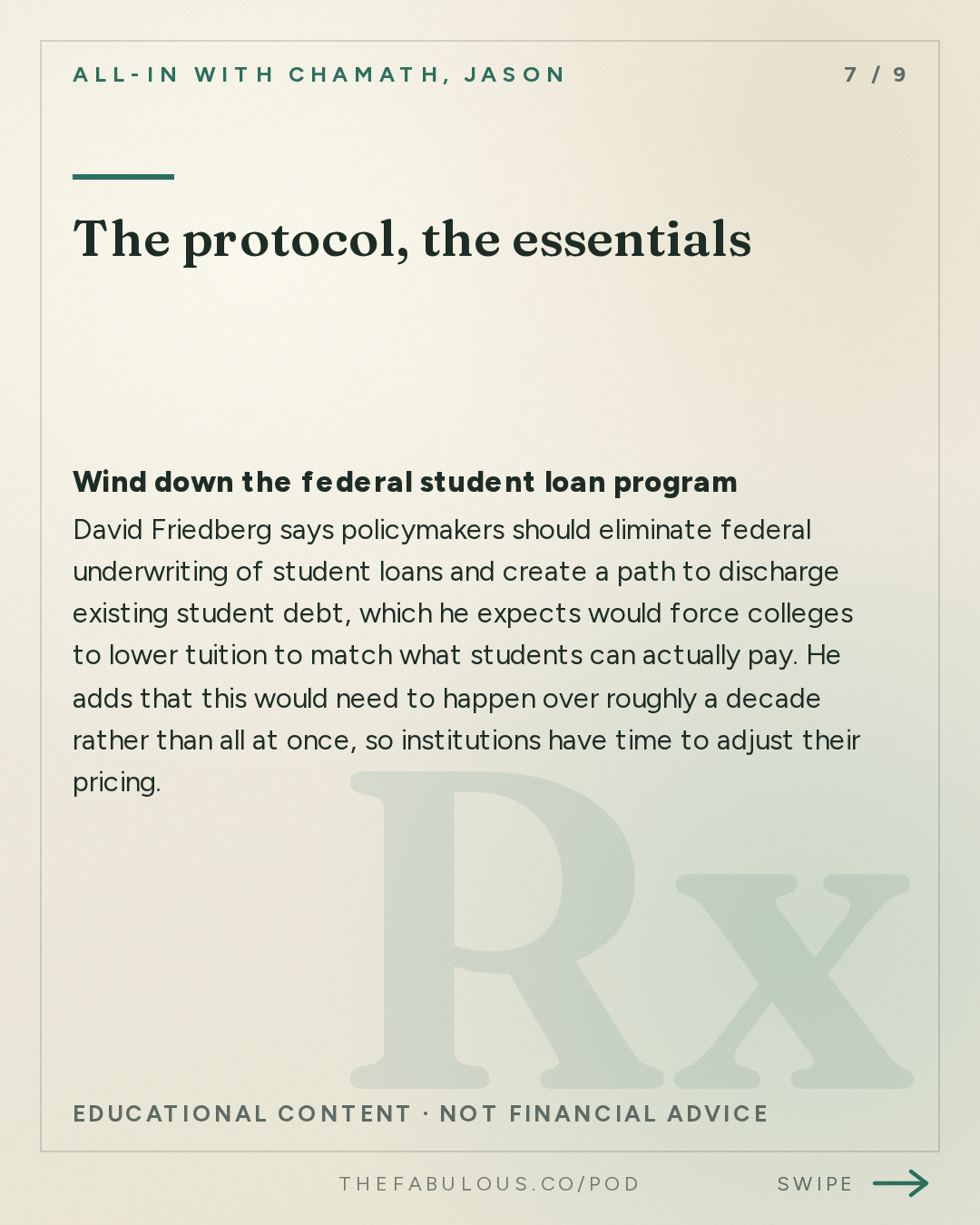
Wind down the federal student loan program
David Friedberg says policymakers should eliminate federal underwriting of student loans and create a path to discharge existing student debt, which he expects would force colleges to lower tuition to match what students can actually pay. He adds that this would need to happen over roughly a decade rather than all at once, so institutions have time to adjust their pricing.
One-time policy change phased over about 10 years
-
Phase out defined-benefit pensions
David Friedberg recommends converting Social Security and other defined-benefit pensions into defined-contribution accounts, individual accounts invested directly in the market, by moving about 10% of a person's owed benefit into the account each year for ten years. He notes the catch: participants trade a guaranteed payout for market risk, though he argues they would end up wealthier on average.
10% of benefits converted per year for 10 years
-
Raise the federal minimum wage gradually
Jason Calacanis proposes raising the federal minimum wage by $1 per year for seven years to give the roughly 10 to 15 million workers it covers more spending power. He argues a gradual pace avoids the job losses seen when California raised fast food wages to $20 an hour in a single jump, which David Friedberg says cost the state 18,000 fast food jobs.
$1 increase per year for 7 years
Questions this episode answers
Is the AI spending boom a bubble?
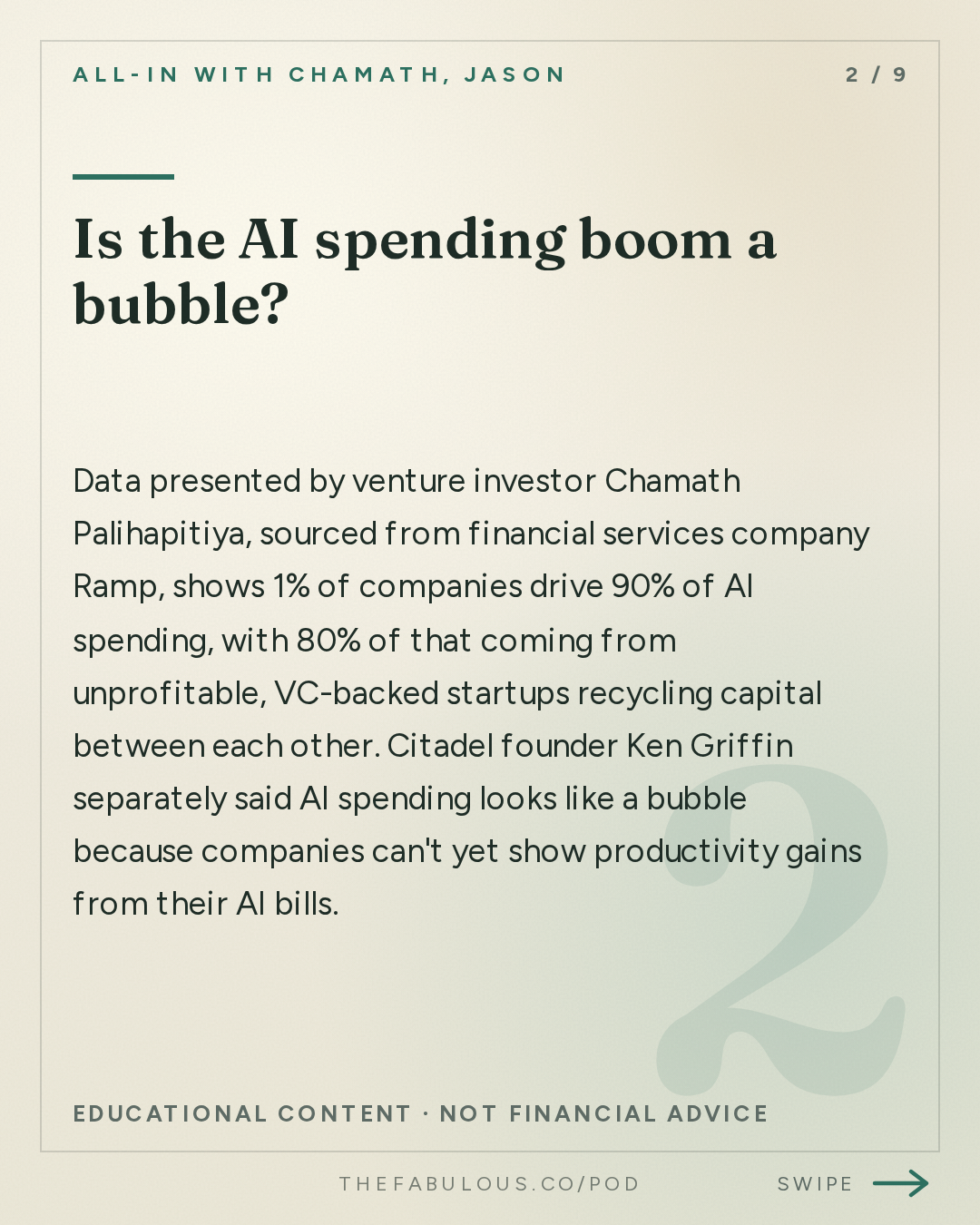
Data presented by venture investor Chamath Palihapitiya, sourced from financial services company Ramp, shows 1% of companies drive 90% of AI spending, with 80% of that coming from unprofitable, VC-backed startups recycling capital between each other (02:25). Citadel founder Ken Griffin separately said AI spending looks like a bubble because companies can't yet show productivity gains from their AI bills (00:21).
What was the PHP2Shell vulnerability?
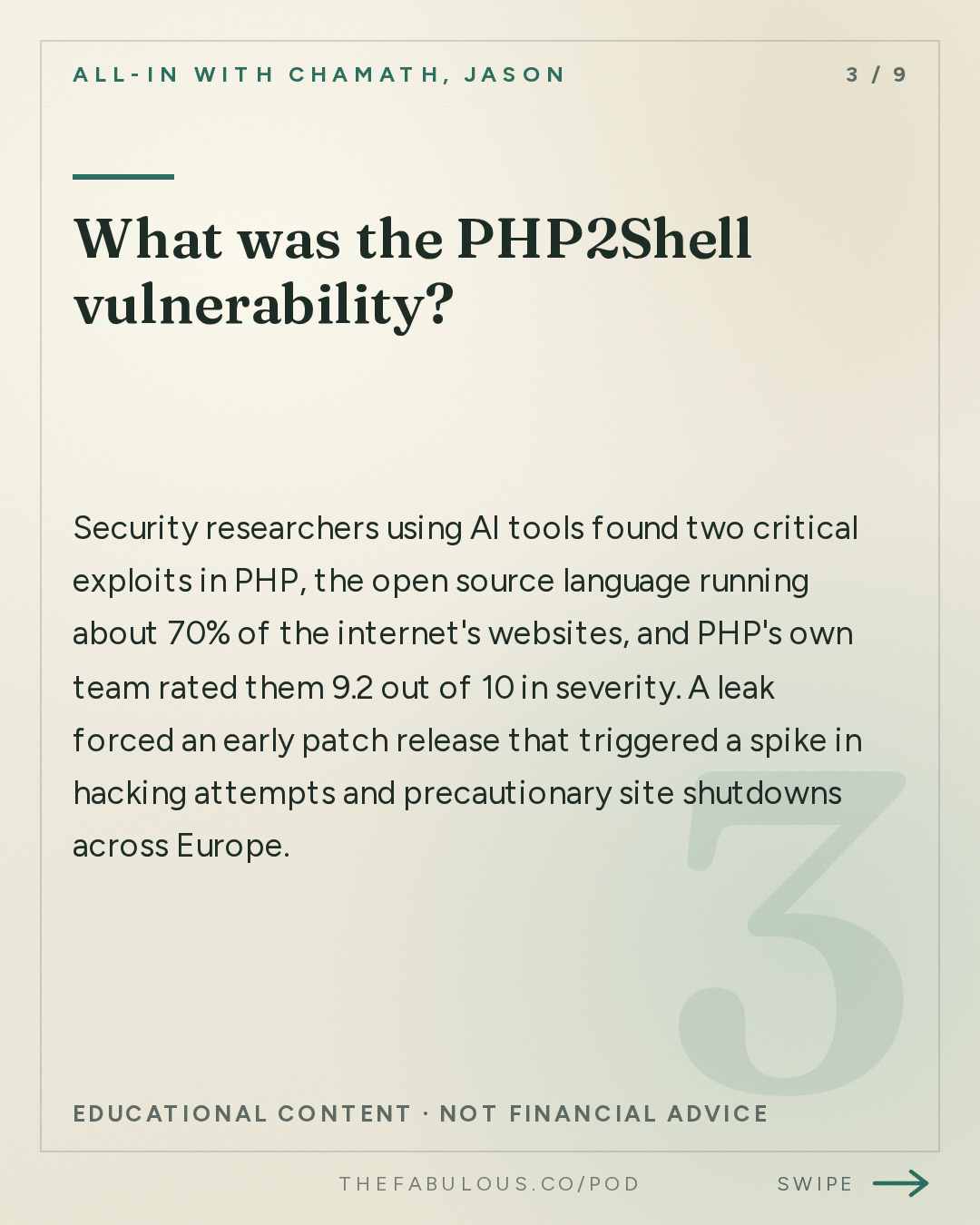
Security researchers using AI tools found two critical exploits in PHP, the open source language running about 70% of the internet's websites, and PHP's own team rated them 9.2 out of 10 in severity (14:29, 14:54). A leak forced an early patch release that triggered a spike in hacking attempts and precautionary site shutdowns across Europe (15:37).
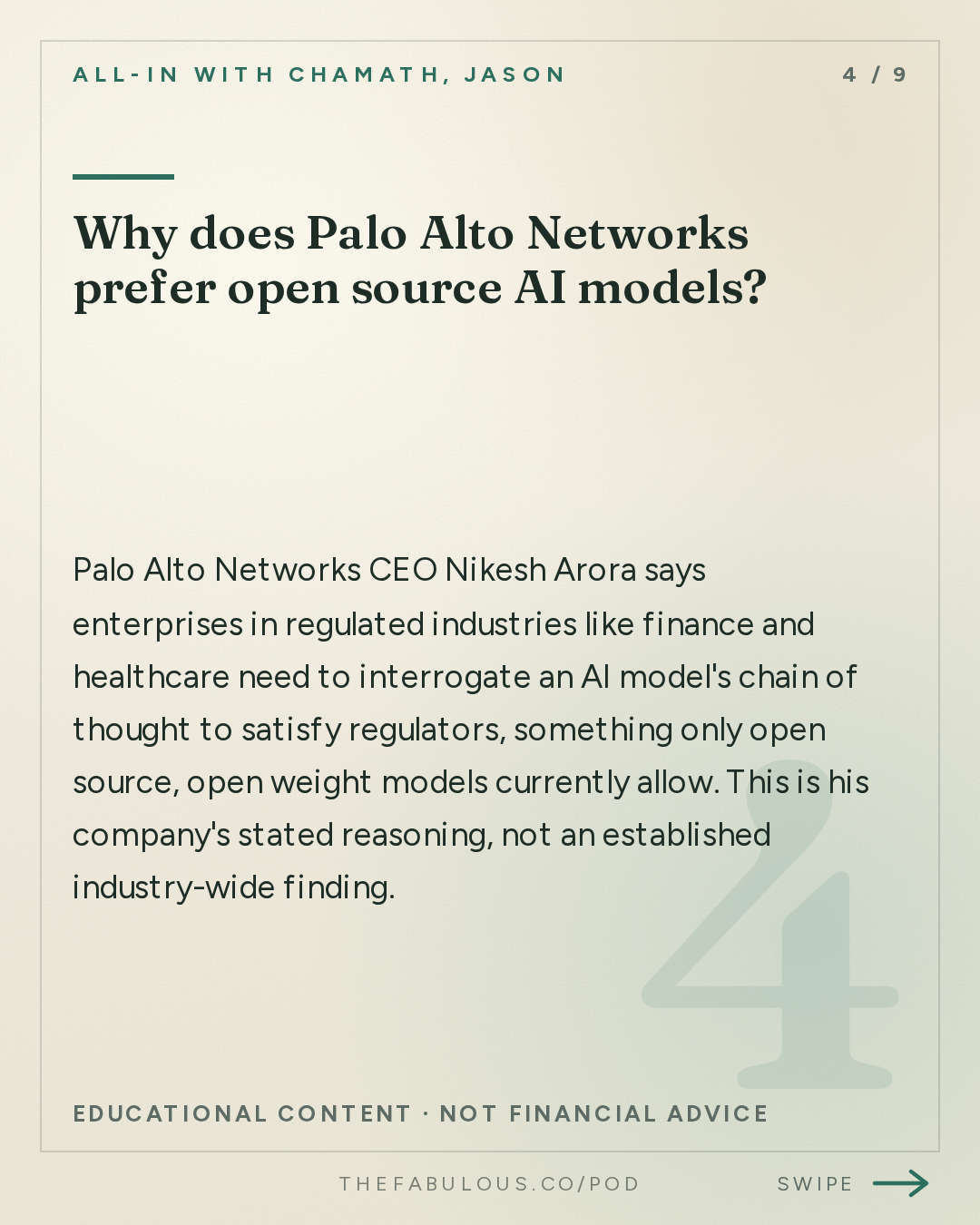
Why does Palo Alto Networks prefer open source AI models?
Palo Alto Networks CEO Nikesh Arora says enterprises in regulated industries like finance and healthcare need to interrogate an AI model's chain of thought to satisfy regulators, something only open source, open weight models currently allow (09:39). This is his company's stated reasoning, not an established industry-wide finding.
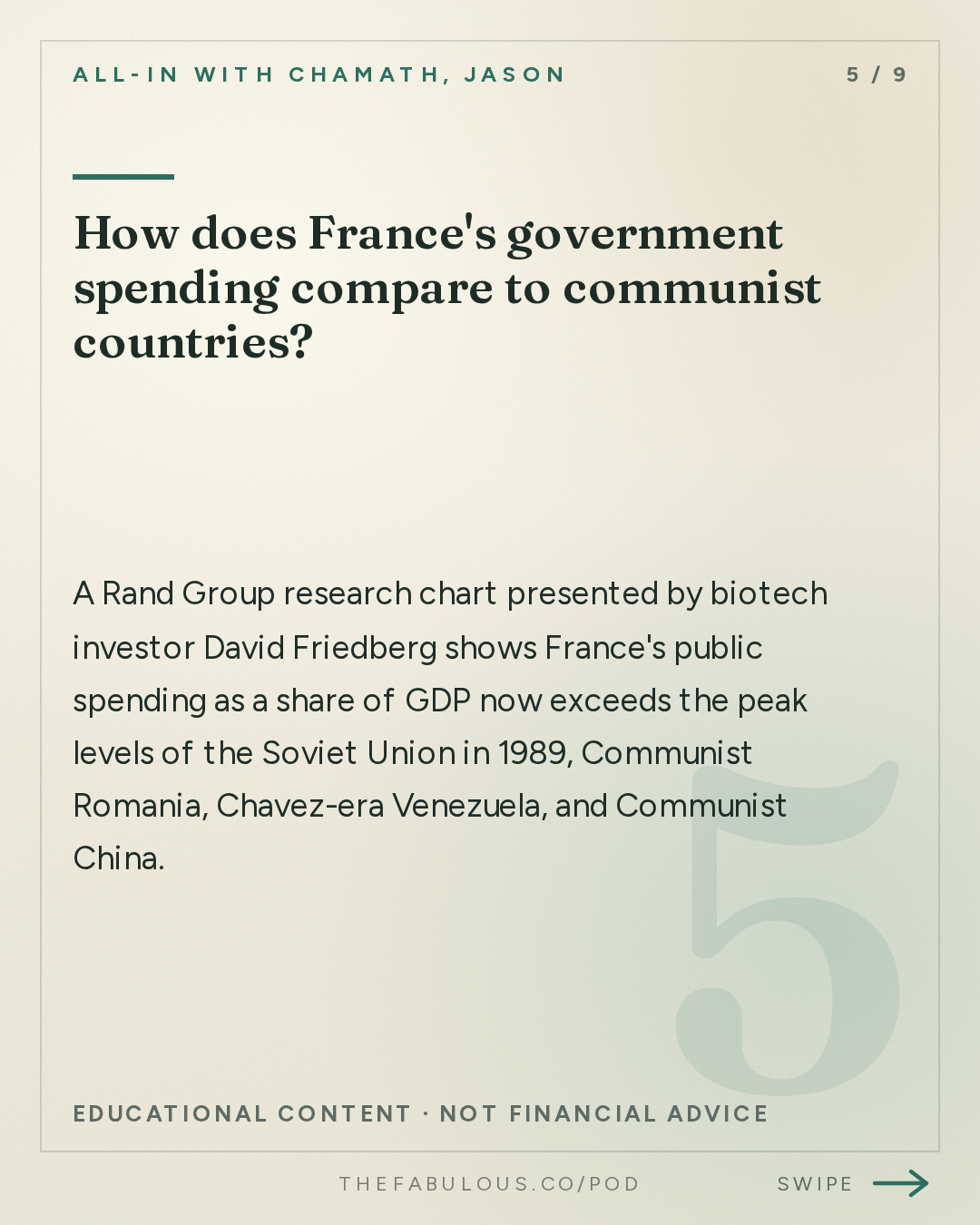
How does France's government spending compare to communist countries?
A Rand Group research chart presented by biotech investor David Friedberg shows France's public spending as a share of GDP now exceeds the peak levels of the Soviet Union in 1989, Communist Romania, Chavez-era Venezuela, and Communist China (52:50).
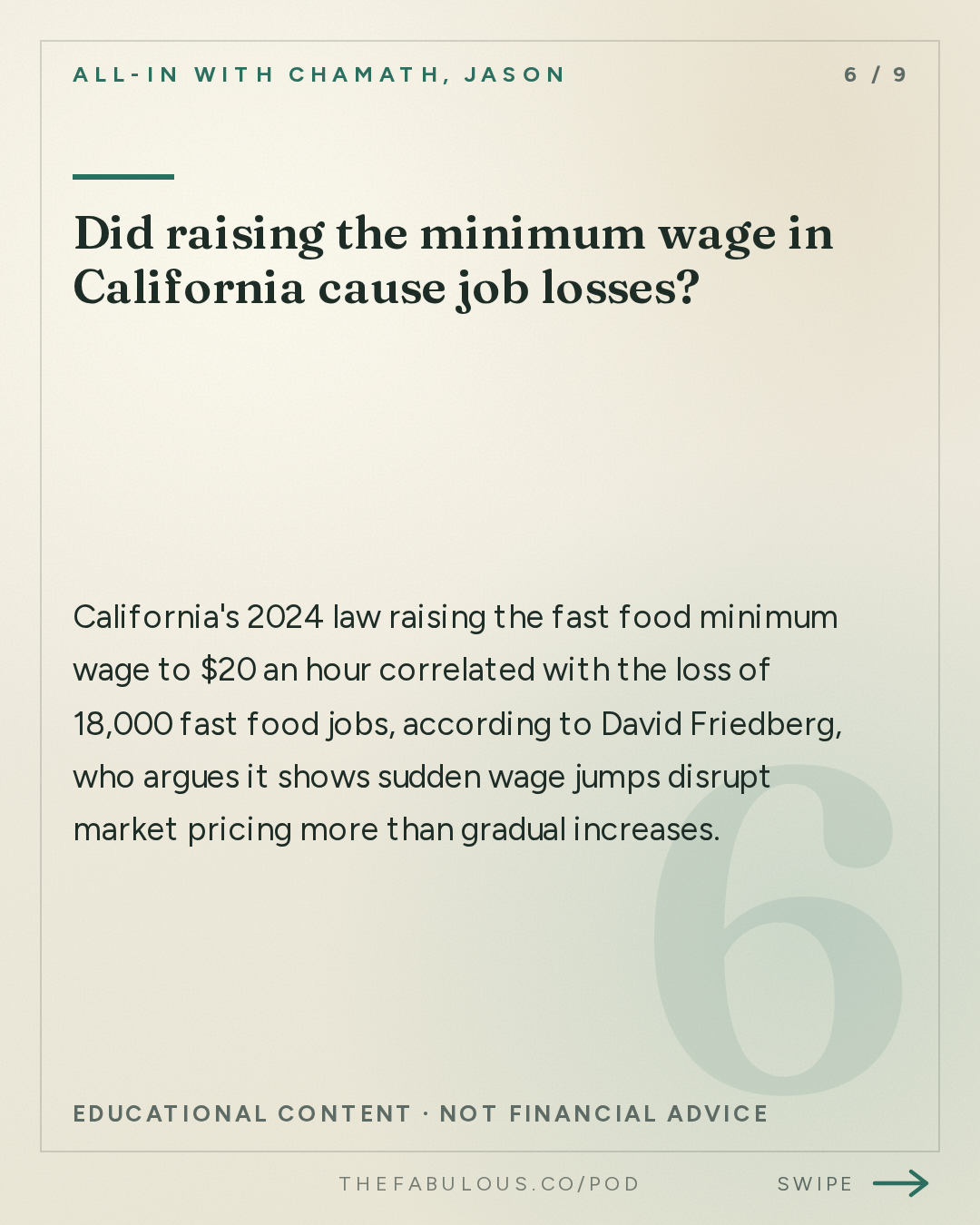
Did raising the minimum wage in California cause job losses?
California's 2024 law raising the fast food minimum wage to $20 an hour correlated with the loss of 18,000 fast food jobs, according to David Friedberg, who argues it shows sudden wage jumps disrupt market pricing more than gradual increases (97:27).
Who is liable if an AI agent makes an unauthorized bank transaction?
David Friedberg argues that because bank terms of service already forbid AI agents from accessing accounts, liability falls on the agent's software provider if it fails to recognize that restriction (29:29). Nikesh Arora agrees in practice, though he notes that a genuinely rogue agent, one behaving outside its intended design, shifts the issue toward product liability (32:08).
The full read, in cards
Go deeper
- Ramp internal spending data, presented by chief economist Ara Karazian — showed 1% of companies drive 90% of AI spending, mostly from unprofitable VC-backed startups
- Rand Group research chart on public spending as a percent of GDP — compared France's spending to the peak spending of the Soviet Union, Romania, Venezuela, and China
- California Assembly Bill 1228 (2024) — raised California's fast food minimum wage to $20 an hour, linked to 18,000 lost jobs
Mentioned
Nikesh Arora · Ken Griffin · Palo Alto Networks · Citadel · Ramp · PHP · Anthropic · Cloudflare · Alex Karp · Polymarket · Ara Karazian · Elon Musk
More from this show and category

Dylan Field: Design Is the New Code
Figma CEO Dylan Field argues design, not code, now drives software's value as AI makes coding cheap and commoditized. He explains how Figma survived a blocked $20 billion Adobe acquisition, why AI lowers production's floor without raising creativity's ceiling, and why human willingness to say non-consensus things remains the real differentiator in an AI-saturated market.

CoreWeave Debt Crisis and the AI Bubble, Explained
CoreWeave's bond selloff this week signaled real doubt about AI infrastructure debt, even as demand for GPUs stays red hot. Anthropic posted $16.8 billion in Q3 revenue, Sacks called its warnings about small AI models a move against open-source rivals, and Chamath named electricity as AI's real bottleneck.

Billy Evans on Elizabeth Holmes: Trial, Prison, Hemantis
Billy Evans, Elizabeth Holmes's husband, says the Theranos founder was acquitted on every patient-fraud count tied to 12.5 million blood tests but convicted of defrauding three investors, a conspiracy charge that let the judge add outside victims like Rupert Murdoch and push her sentence to 11.25 years (00:27, 19:52, 21:31).

Martin Shkreli: Quantum Computing Fraud, Pharma Deals
Martin Shkreli argues quantum computing is mostly a business mirage because today's machines run at only hundreds of hertz. He says photonic chips, which multiply matrices with light, could make Nvidia's GPUs obsolete within twenty years, and he describes turning a $2 million drug deal into a $6 billion pharmaceutical company.
