
Rick Smith on Building Axon From Taser to AI Policing
Freedom vs. Safety: Axon CEO Rick Smith on the Future of Policing
The brief
Axon CEO Rick Smith explains how a failed consumer gadget became a $30 billion public-safety company by pivoting to police, surviving an SEC investigation and short-seller attack, and building body cameras, cloud video, drones, and ethics boards around a single mission: reduce how often police have to shoot someone.
Rick Smith spent seven years trying to sell a stun gun to ordinary Americans before he discovered the real customer was standing next to him in uniform the whole time. The device he and a retired NASA scientist built from Ace Hardware parts in a Tucson garage in 1993 (02:57) was supposed to let people like his mother defend themselves without a firearm. It flopped. Consumers kept asking him why, if the thing worked, the police weren't using it. So in 1999, with the company roughly $2 million in debt to Silicon Valley Bank and his father putting in $500,000, which was matched by Bruce Culver for a total of $1 million (08:32), Smith pivoted to law enforcement. That decision, made out of necessity rather than vision, is the hinge on which the rest of the story turns.
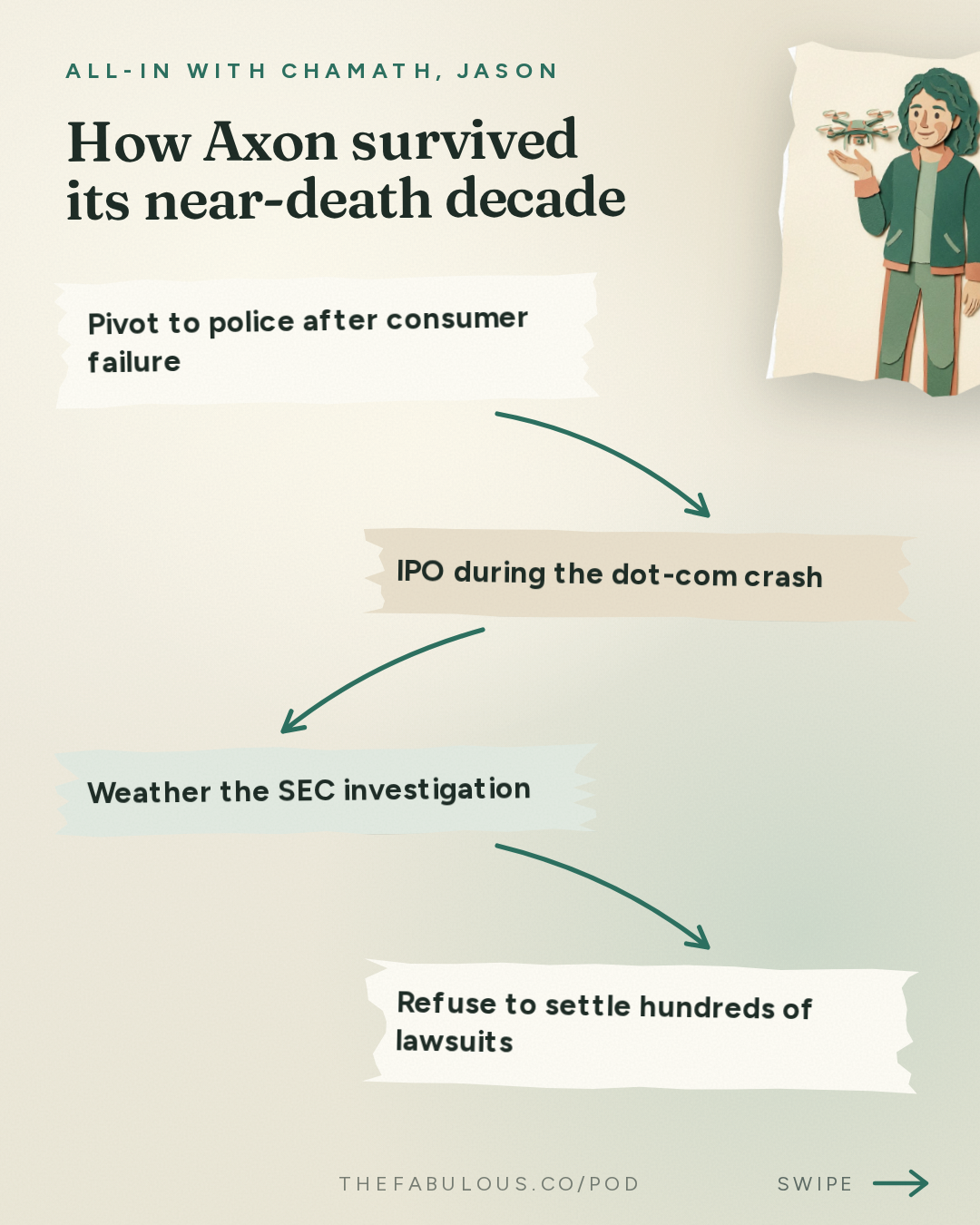
What follows is a case study in how companies actually survive, which is rarely in a straight line. Axon, then called Taser, went public in 2001 at a roughly $12 million valuation (09:50) and proceeded to triple in size for three straight years, becoming, by Smith's account, the best-performing stock in the world on a one and three year basis in 2004, the same year Google went public (13:39). Then came the fall: an SEC investigation into whether the company had misrepresented product safety, a short seller campaign, and, strangest of all, a personal assistant who was secretly feeding internal documents to short sellers who then leaked them to the New York Times (14:00). The stock dropped from $33 to $7 a share (14:25), customers stopped buying because cities got nervous about a company under federal investigation, and Smith walked into the SEC's San Francisco office unannounced, against his lawyers' advice, with boxes of documents, hoping to speed up an inquiry that was slowly bleeding his company to death (14:25).
The SEC eventually closed the case with no findings, which Smith describes dryly as "as good as it gets" (15:14), but the damage had metastasized into something worse: hundreds of lawsuits, from shareholders and from anyone ever injured by a police Taser. Market cap had cratered from a 2004 peak of about $2 billion to around $100 million (15:34). Most companies in that position settle to make the bleeding stop. Smith did the opposite. When his own insurer wanted to settle an early case for about $2 million, Axon refused, telling the insurer that if it paid Axon a smaller amount to sign away its liability, Axon would take the case to trial itself rather than let the insurer set a precedent that would invite a flood of copycat suits.
"If you settle this case, we will get swamped in litigation... we dig in like religious fanatics to defend our belief system." — Rick Smith (16:13)
Axon won, and kept winning. By Smith's account the company now runs with zero active litigation (16:49), a reversal built on a decade of choosing which fights to have rather than avoiding fights altogether.
The pivot nobody on the cap table wanted
The second rescue came from a friend, not a lawyer. Hadi Partovi, a college friend of Smith's who had made money in the late-1990s internet boom while Smith was still struggling to get Taser off the ground, joined Axon's board around 2007 and became, in Smith's words, a part-time chief technology officer for roughly five years (18:26). Smith had built hardware his whole career. Software was new territory, and the company nearly lost all its customer data in a data-center outage before Partovi talked him into moving to the cloud, first AWS, then Azure (18:50). Partovi also pushed for the name change from Taser to Axon, arguing that Taser had become "a sledgehammer brand" that meant electric weapon to the public and undersold everything else the company was building (20:06).
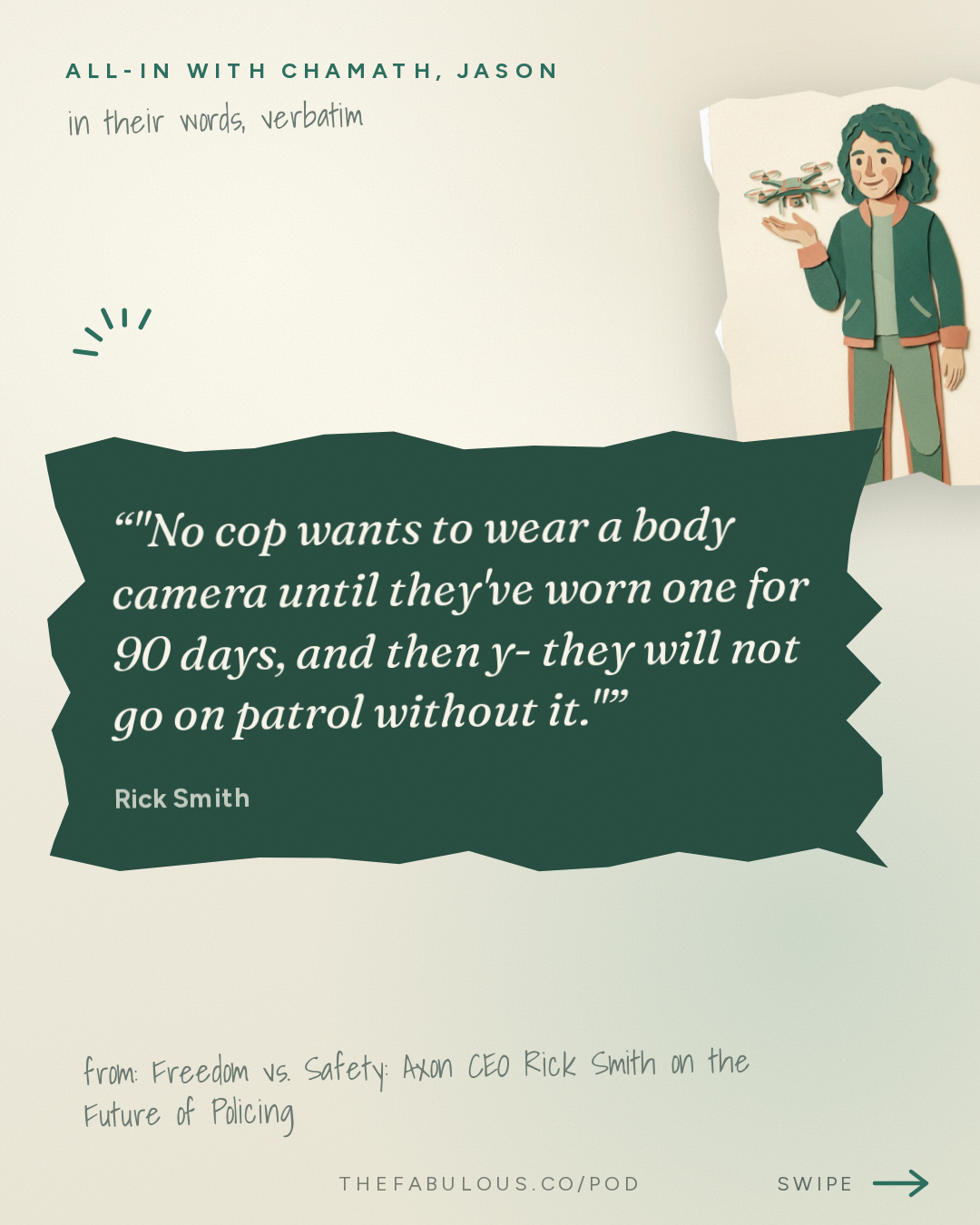
That everything else turned out to be the body camera, which Smith says now drives more of the company's roughly $30 to $40 billion valuation than the weapon the company was named after. The idea came out of a courtroom, not a product meeting. Co-defending a case where a man died in police custody, Smith watched the family present sympathetic photographs while the officer, bound by professional restraint, could only describe a violent, drug-fueled confrontation in flat, procedural language. Smith realized police needed a way to show, not just tell. Body cameras met fierce internal resistance at first; officers worried about being second-guessed by supervisors, what Smith calls fear of "Big Brother" (23:16). The adoption pattern that eventually won them over, according to a police union leader Smith quotes, was behavioral rather than rational: "No cop wants to wear a body camera until they've worn one for 90 days, and then they will not go on patrol without it" (24:38). The underlying reason is that officers are routinely subject to false allegations that a camera can instantly resolve, something Smith illustrates with a story from a ride-along in Phoenix where a suspect's threat to accuse an officer of rape evaporated the moment she was reminded the interaction was being recorded (24:58).
Adoption tipped nationally after the 2014 shooting of Michael Brown in Ferguson, Missouri, when both police unions and the family wanted a camera's account of events, for opposite reasons (25:43). Axon's bet on cloud infrastructure, made when governments still assumed anything stored off-premises was less secure, let the company absorb the sudden, enormous volume of footage. Smith says Axon now manages more video every day than YouTube by volume, with over a million police officers uploading roughly two hours of footage daily (20:23).
Drones, ethics boards, and the next decade
Axon's newest frontier is autonomous and semi-autonomous systems. The company has taken what Smith describes as the largest investment position in drone maker Skydio and secured exclusive rights to sell Skydio's drones into the public-safety market (47:33), enabling drones to reach a scene, in some cases, before a 911 dispatcher has finished logging the call (36:52). The more provocative project is a non-lethal, taser-equipped drone designed for scenarios like school shootings, a project that caused several members of Axon's AI ethics advisory board to resign in protest in 2022 over fears of normalizing armed robotics (41:31). Smith's counterargument is that the alternative, today, is sending armed officers to exchange gunfire, a method that kills bystanders and forecloses any non-lethal option once a human with a gun is in the room (42:39). He rebuilt the board, now called the Equity and Ethics Advisory Council, with more voices from communities most affected by over-policing (44:11), arguing that hearing objections early lets the company design in safeguards rather than argue about them after launch.
Smith's broader prediction is that robotic policing tools will be governed by "multi-key" approval systems requiring real-time sign-off from a supervising administrator before any force, lethal or not, is used (46:29), a structure he argues will make these systems less abusable than the status quo, in which an individual officer carries a loaded weapon out the door with no real-time oversight at all. David asked whether humanoid robots priced between $10,000 and $30,000 might reach commercial sale within 12 to 18 months (45:36), and Smith believes the deterrent effect of all this technology will come less from harsher punishment than from a higher probability of getting caught (40:55), a distinction criminology has long supported but that rarely survives contact with political debate.
The honest tension in the conversation, which Smith does not fully resolve, is between a company whose business model depends on more cameras, more sensors, and more government reach, and a public increasingly uneasy about exactly that. Smith's answer is procedural rather than philosophical: build in oversight, invite critics in early, and trust that democracies correct course when they overreach. Whether that is sufficient reassurance probably depends on which side of the camera a person expects to be standing on.
Ask this episode anything
Pod's AI answers from the episode itself, with the minute mark so you can hear it yourself.
Or start with one of these
Ask this episode
Pod's AI listens to the whole episode to answer, and points you to the minute it comes from.
The rest of this answer, and any question after it
Answers come from the episode itself, never from a summary of it.
ContinueKey takeaways
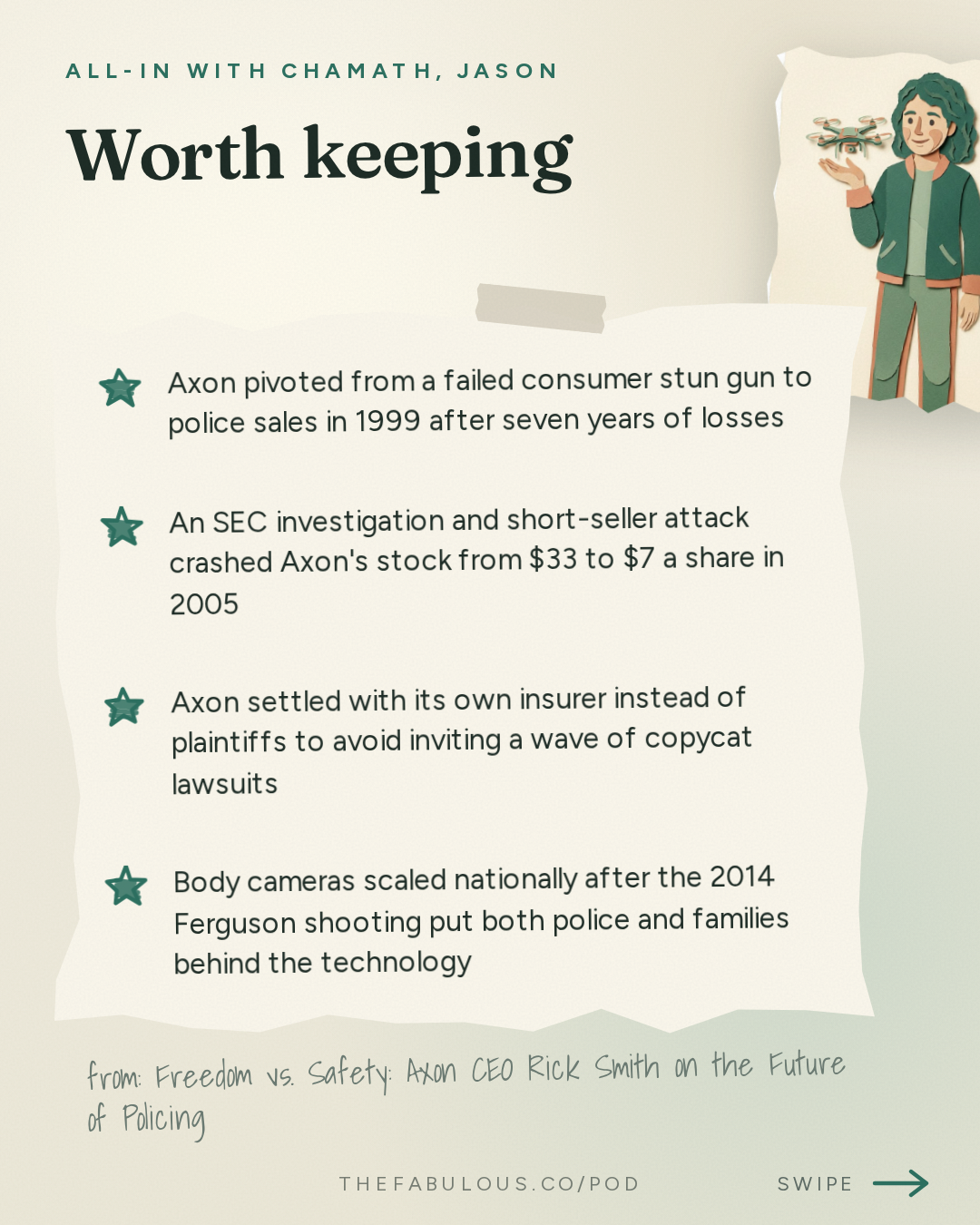
- Axon pivoted from a failed consumer stun gun to police sales in 1999 after seven years of losses
- An SEC investigation and short-seller attack crashed Axon's stock from $33 to $7 a share in 2005
- Axon settled with its own insurer instead of plaintiffs to avoid inviting a wave of copycat lawsuits
- Body cameras scaled nationally after the 2014 Ferguson shooting put both police and families behind the technology
- Rick Smith says robotic force systems will need multi-key, real-time administrator approval before use
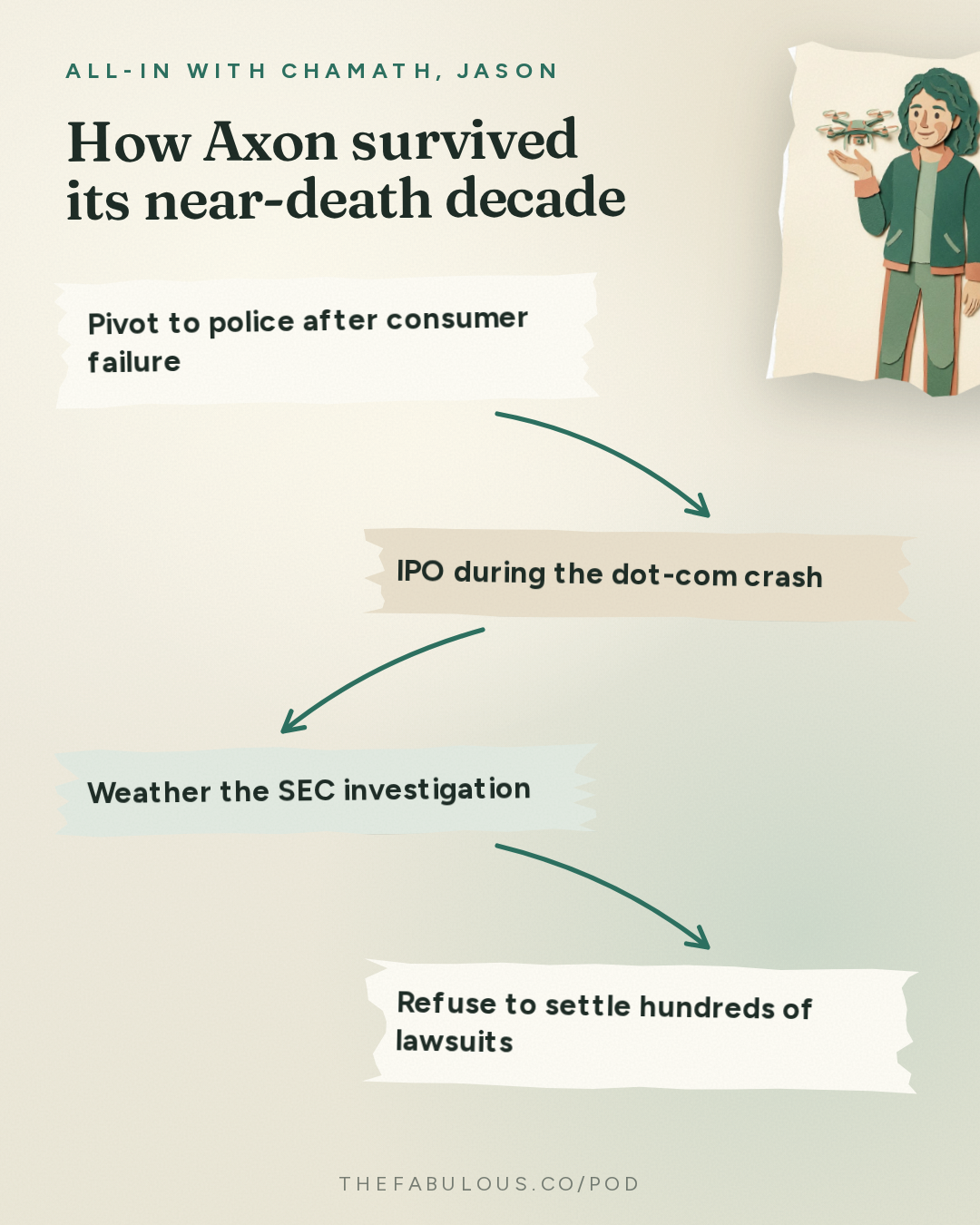
The episode in cards
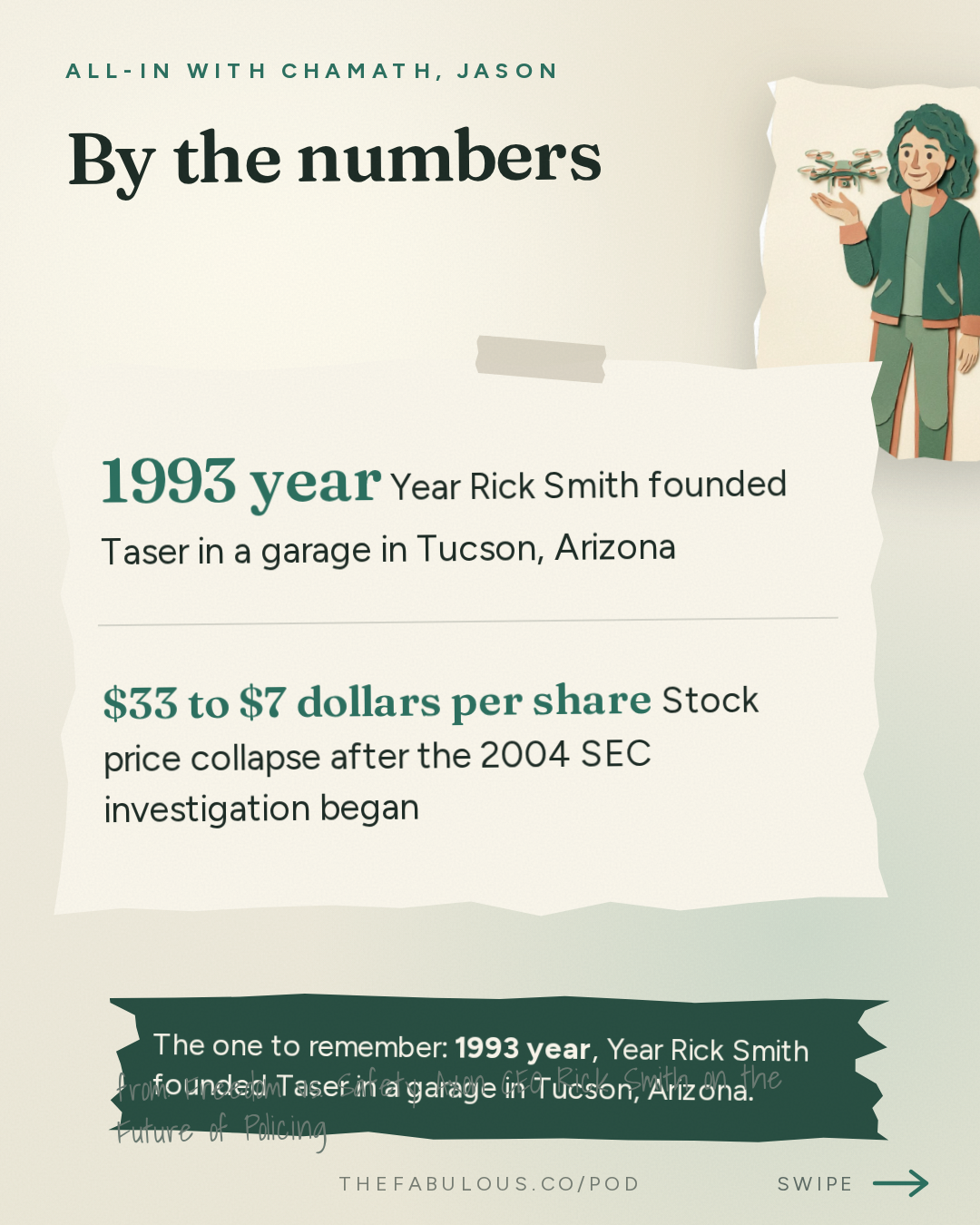
By the numbers
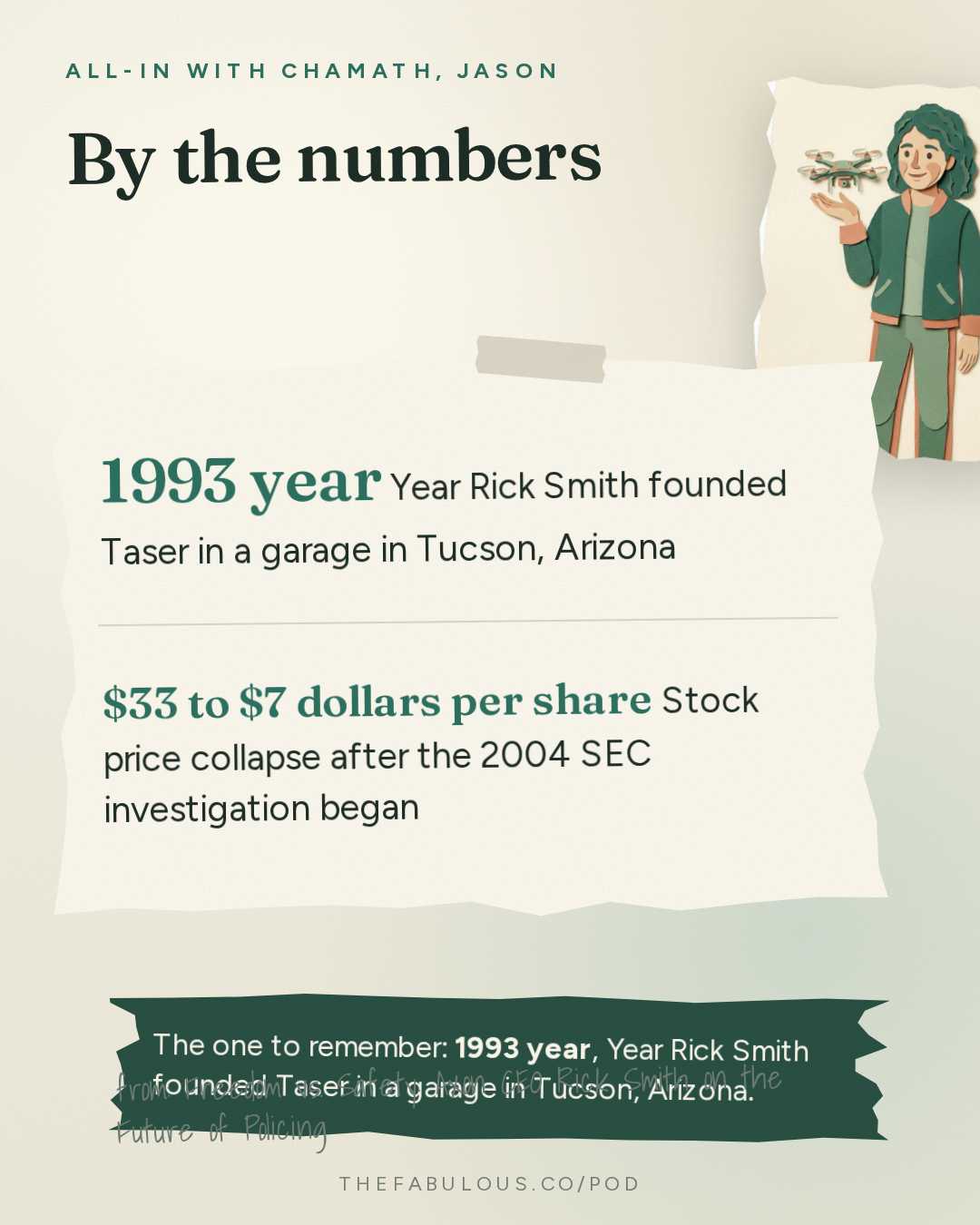
- 1993 year Year Rick Smith founded Taser in a garage in Tucson, Arizona
- $33 to $7 dollars per share Stock price collapse after the 2004 SEC investigation began
In their words
“If we had Captain Kirk's phaser, like, people would choose not to kill other people 'cause they'd have a more civilized way to stop somebody who's threatening them.”
“"No cop wants to wear a body camera until they've worn one for 90 days, and then y- they will not go on patrol without it."”
“I don't wanna live in a world where everybody else has robotics and AI, and the police are showing up in a '74 Chevy, you know, with an old radio.”
Protocols
-
Multi-key approval for robotic force
Rick Smith says Axon is building robotic and drone systems so that before an officer can deploy even a non-lethal weapon remotely, a supervising administrator must give real-time approval. The catch is that this only covers Axon-built systems, not every robotic tool a department might acquire elsewhere.
Every use of force via a robotic or drone system
-
Case-code verification before license plate searches
Rick Smith describes a proposed framework, modeled on Senator Hawley's bill, under which officers must enter a valid law enforcement case code and get sign-off from a second officer before running a license plate search. The catch is that misuse still carries only after-the-fact criminal and civil penalties rather than preventing the search outright.
Every license plate reader search
Questions this episode answers
Why did Axon (originally Taser) almost go out of business in the mid-2000s?
An SEC investigation launched in late 2004 into whether the company misrepresented product safety, combined with a short-seller campaign that included a mole leaking internal documents to the New York Times, dropped the stock from $33 to $7 a share (14:25). Police departments stopped buying while the company was under federal investigation, and Axon followed the stock crash with hundreds of lawsuits from shareholders and plaintiffs (15:14).
How did body cameras become standard in American policing?
Adoption accelerated after the 2014 shooting of Michael Brown in Ferguson, Missouri, when both the Brown family and the police union called for cameras, for opposing reasons (25:43). Rick Smith says officers resist wearing them at first but that a police union leader told him no cop wants to go on patrol without one after wearing it for 90 days, because footage resolves false accusations instantly (24:38).
What is Axon's partnership with Skydio drones?
Rick Smith says Axon has become the largest investor in Skydio, America's leading drone maker, and has secured exclusive rights to sell Skydio drones into the public safety market (47:33). The goal is to get a drone to a scene within seconds of a call, sometimes before a 911 dispatcher finishes logging it (36:52).
Why did members of Axon's ethics board resign over its taser drone project?
In 2022, several members of Axon's AI ethics advisory board quit after the company announced a non-lethal, taser-equipped drone intended for extreme scenarios like school shootings, citing concerns about normalizing armed robotics (41:31). Rick Smith says many board members privately agreed the approach was safer than sending armed officers into gunfights, but found the project too politically risky to support publicly, and he rebuilt the board afterward with more voices from communities affected by over-policing (44:11).
What deters crime more, according to Rick Smith: harsher sentences or getting caught?
Rick Smith argues the best deterrent to criminal behavior is a high probability of getting caught and prosecuted, not the length of the sentence (40:55), a view he uses to justify expanding surveillance and drone technology in policing as long as safeguards against misuse are in place.
The full read, in cards
Go deeper
- Better Angels of Our Nature — Steven Pinker's argument that a functional police force underwrites social trust, cited via the 1968 Montreal police strike
Mentioned
Rick Smith · Axon · Hadi Partovi · Skydio · SEC · Senator Hawley · Ferguson, Missouri · Silicon Valley Bank · Steven Pinker · Michael Brown · Rob Henderson
More from this show and category

Why Republicans Lost the 2026 Midterms
Republicans suffered a historic 2026 midterm blowout, driven by Iran-war inflation and a belief the economy now rewards asset owners over wage earners. The panel also unpacks a $4 trillion AI stock selloff, state pushback against data centers, and OpenAI's surprise proof against a 27-year-old computer science hypothesis.

What Anthropic's S-1 Filing Really Reveals
Anthropic's leaked S-1 shows a six-year-old company aiming to raise $100 billion at a valuation near $2 trillion, with an 85% gross margin and a reported $80 billion loss that turns out to be an accounting artifact, not real cash burn (07:07). The same filing reveals a new macro risk: AI firms now compete with the US Treasury for capital (32:48).

Whoop CEO Will Ahmed on Health Data and HRV
Whoop CEO Will Ahmed says his wearable has logged over 50 billion hours of physiological data from members who wear it 23.6 hours a day, letting its AI flag illness before symptoms, fueling a fight with the FDA over whether blood pressure tracking counts as wellness or medicine.

Nikesh Arora on the AI Cybersecurity Threat
AI spending is concentrated and circular: 1% of companies generate 90% of AI revenue, mostly unprofitable VC-backed startups (02:25). A PHP coding flaw rated 9.2/10 exposed roughly 70% of the internet's websites (14:29). And France now spends more of its GDP through government than the Soviet Union did at its 1989 peak (52:50).
