
What Anthropic's S-1 Filing Really Reveals
Anthropic S-1 Shocker, Greatest Business Ever? Google's $500B Wipeout, Midterm Predictions
The brief
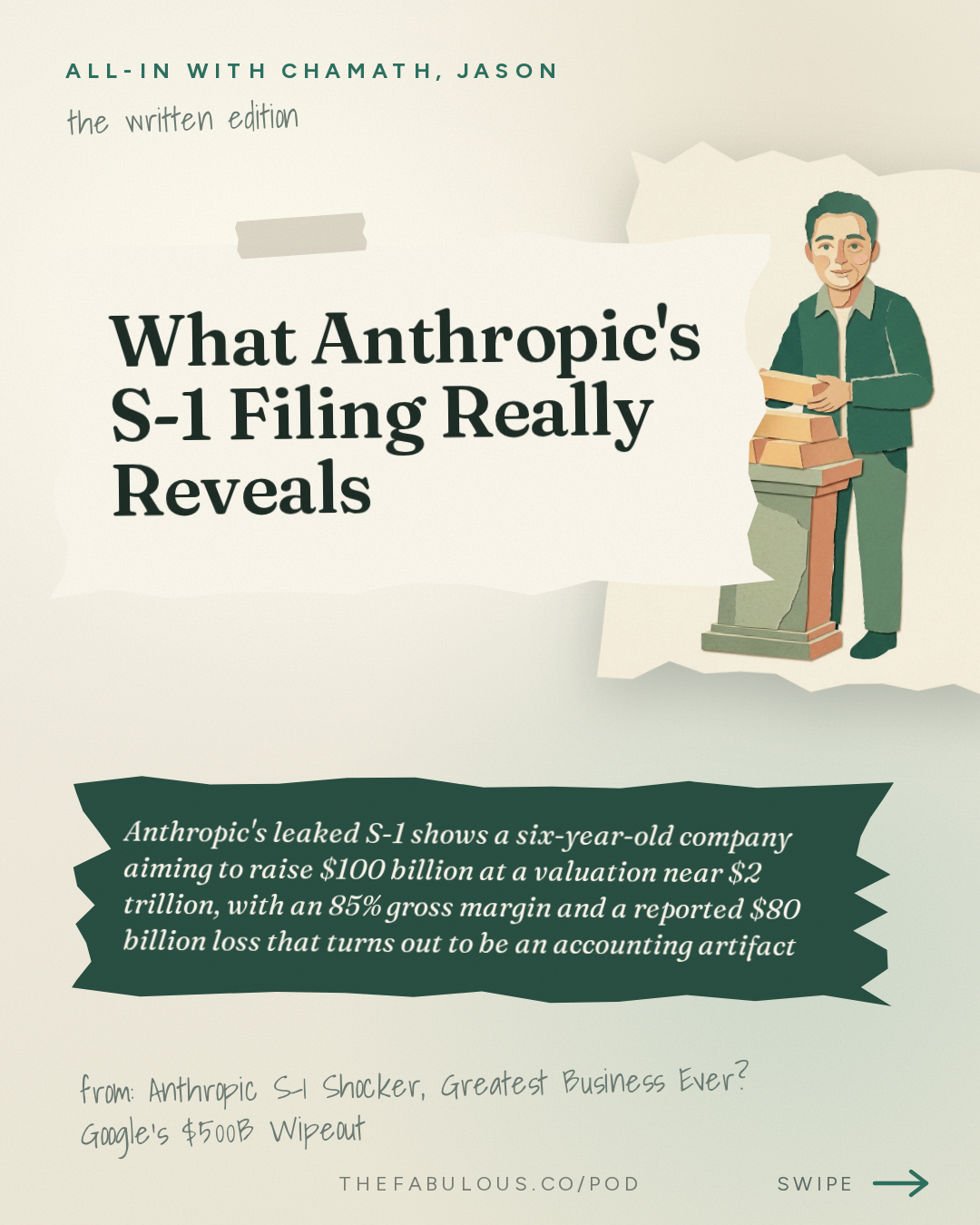
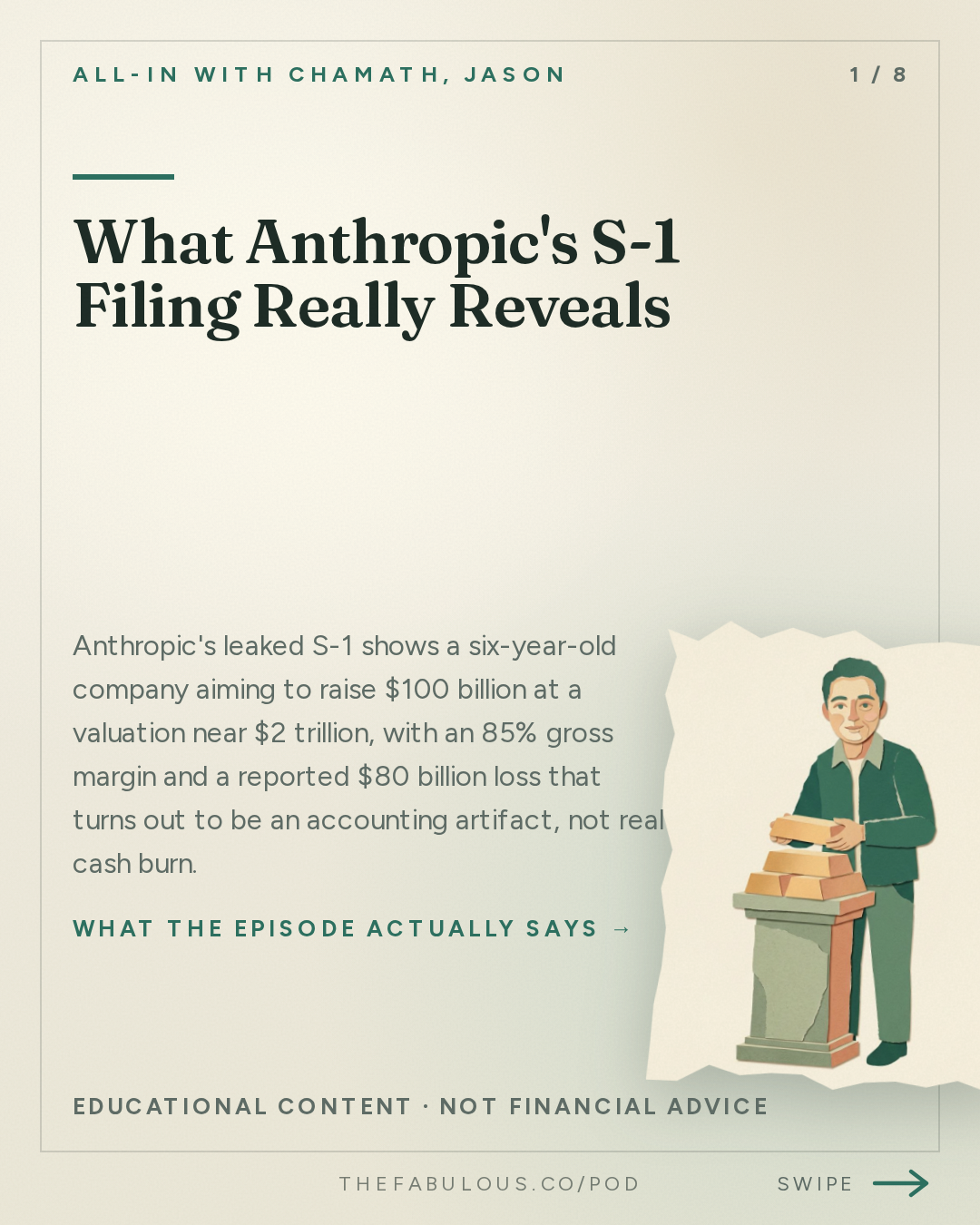
Anthropic's leaked S-1 shows a six-year-old company aiming to raise $100 billion at a valuation near $2 trillion, with an 85% gross margin and a reported $80 billion loss that turns out to be an accounting artifact, not real cash burn (07:07). The same filing reveals a new macro risk: AI firms now compete with the US Treasury for capital (32:48).
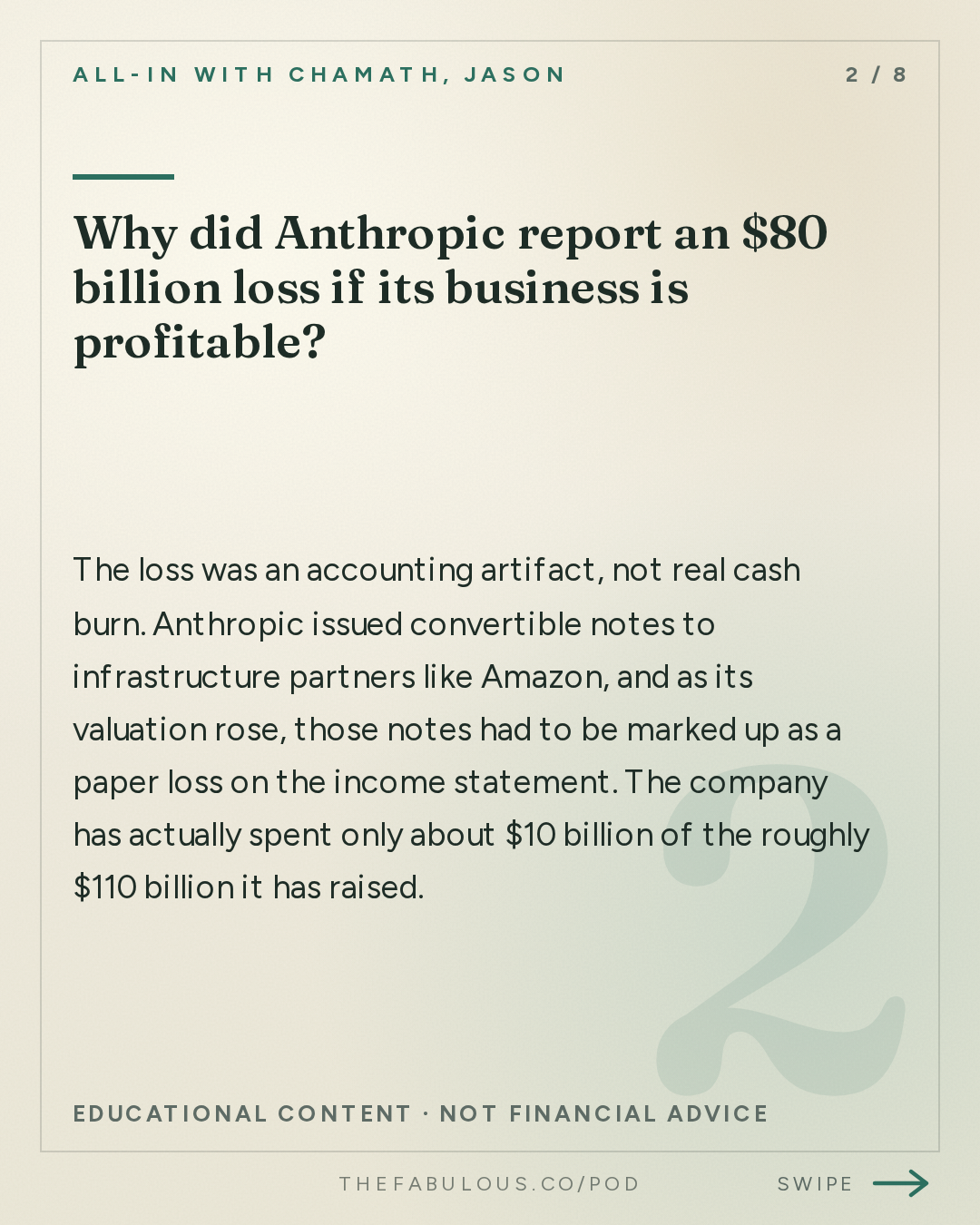
Buried inside Anthropic's initial public offering filing is a number that looks like proof of disaster: an $80 billion loss. Read the filing closely, and the loss turns out to be an illusion. It came from convertible notes Anthropic issued to infrastructure partners like Amazon. As the company's valuation rose, those notes had to be marked up on the books, which flowed through as a paper loss on the income statement, even though no cash actually left the building (07:07). Strip that away, and the business underneath looks almost absurdly healthy: Anthropic has raised roughly $110 billion and spent only about $10 billion of it (07:30), leaving more than $100 billion in cash sitting on the balance sheet (05:22).
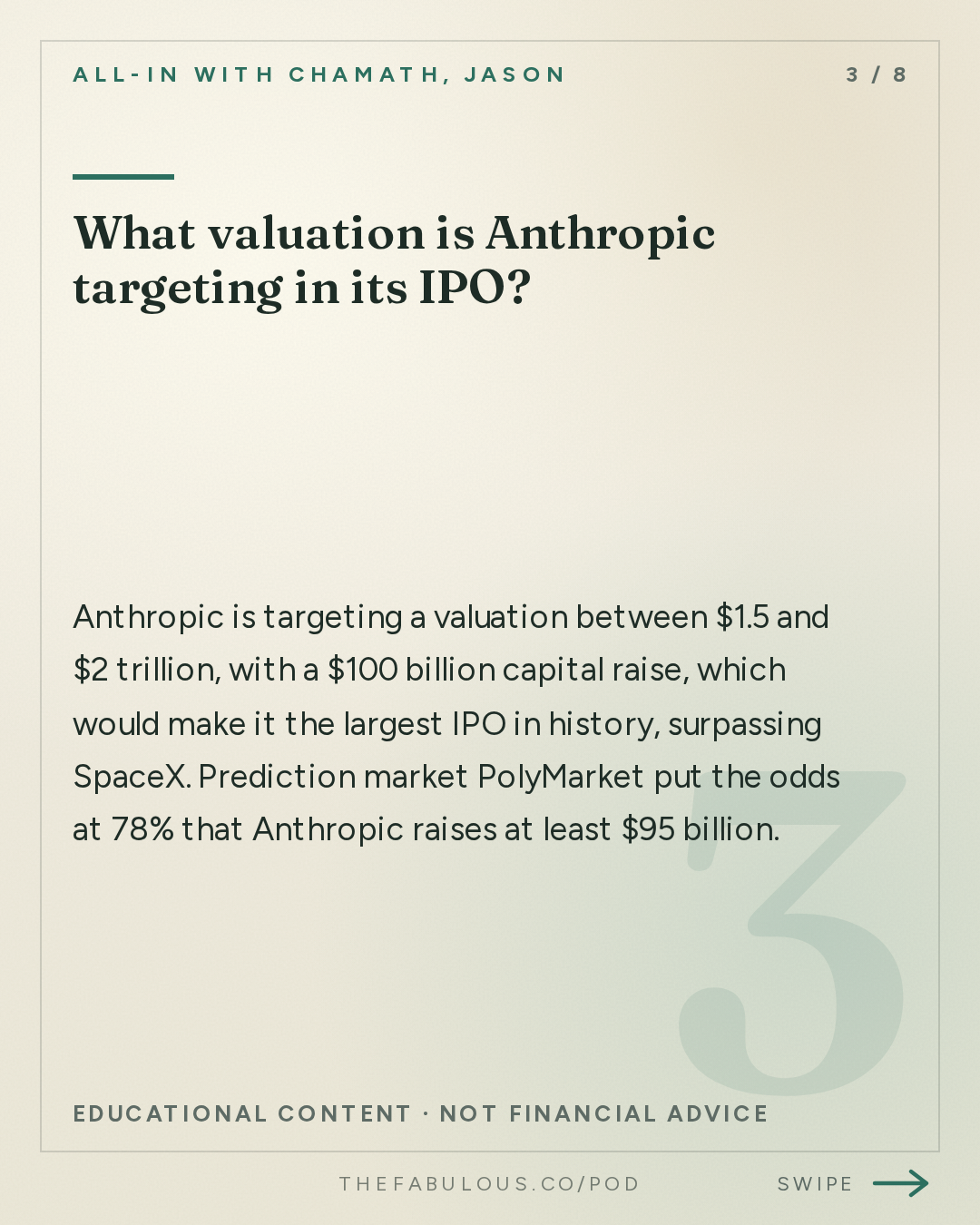
That filing, the S-1 a company submits before going public, is what the hosts spend the first half of this episode taking apart. The numbers are startling on their own. Anthropic is targeting a $100 billion raise at a valuation between $1.5 and $2 trillion (03:56), with revenue of $16.3 billion in just the first half of 2026, fourteen times what it made in the same period a year earlier (04:55). Co-host David Sacks calls it a historic outcome:
So this is probably the fastest value creation of any venture-backed company in history. [06:16] — David Sacks
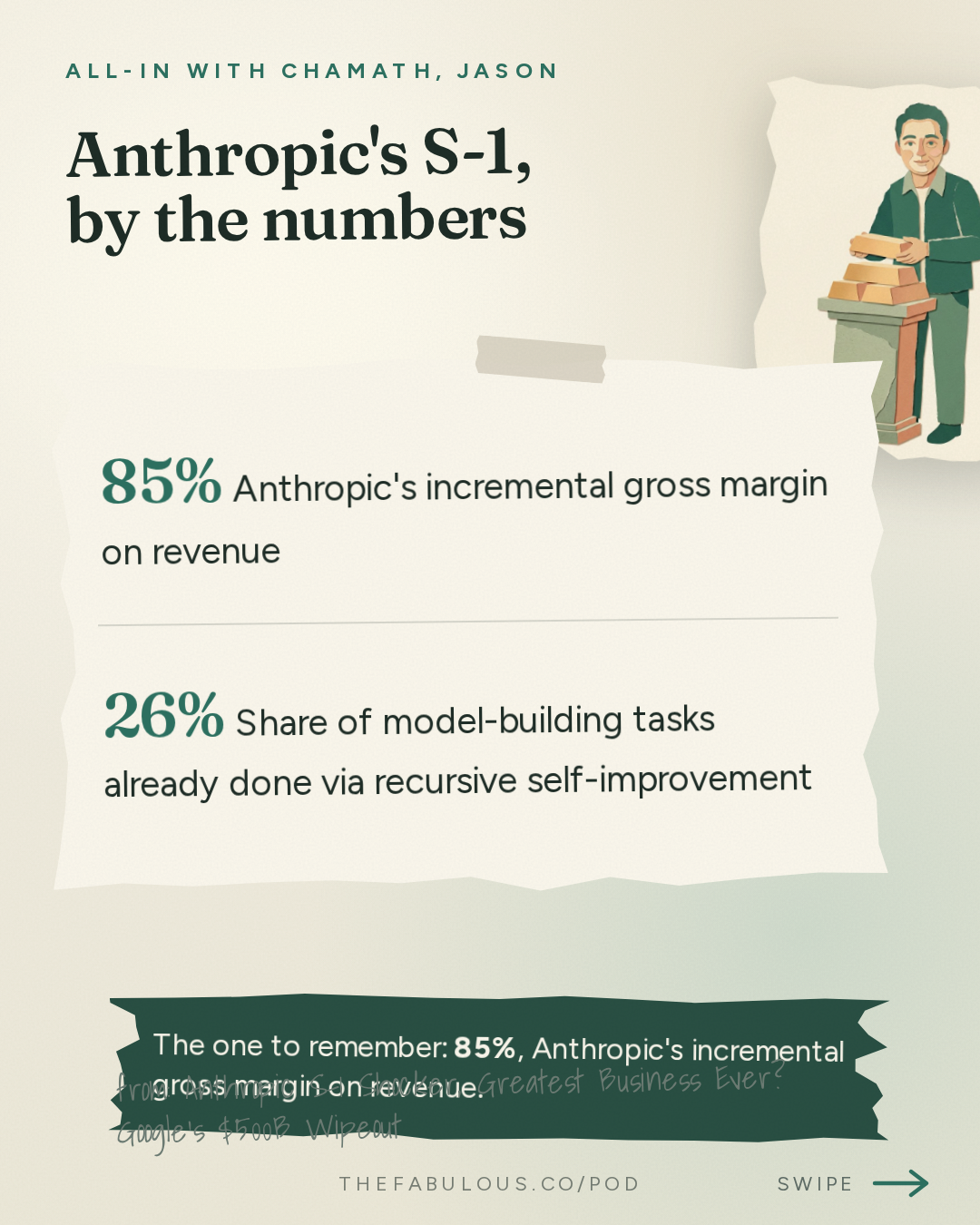
The margin story is just as striking. Anthropic is booking an 85% incremental gross margin, meaning for every new dollar of revenue, 85 cents drops to gross profit (07:30). Co-host David Friedberg traced the money further back, mapping how a dollar NVIDIA spends making a chip turns into roughly $18 by the time Anthropic sells the resulting intelligence to a customer, once you follow it through NVIDIA's own margin, then a cloud provider's margin, then Anthropic's (13:50). His read is that this is the first time a business has plausibly approached what former Google CEO Eric Schmidt once called Google's real total addressable market: global commerce itself.
Google's total addressable market is global commerce. And I think for the first time ever, we're seeing a business actually potentially starting to realize that theory. [14:47] — David Friedberg
The Microsoft comparison the hosts pulled up makes the same point from a different angle. Microsoft's revenue grew from $198 billion to $332 billion over four years, while headcount grew by only 2,000 people (16:58). That is not a story about job losses, the hosts argue. It is a story about the same number of humans producing far more output, which is the quieter and more defensible version of the AI productivity claim.
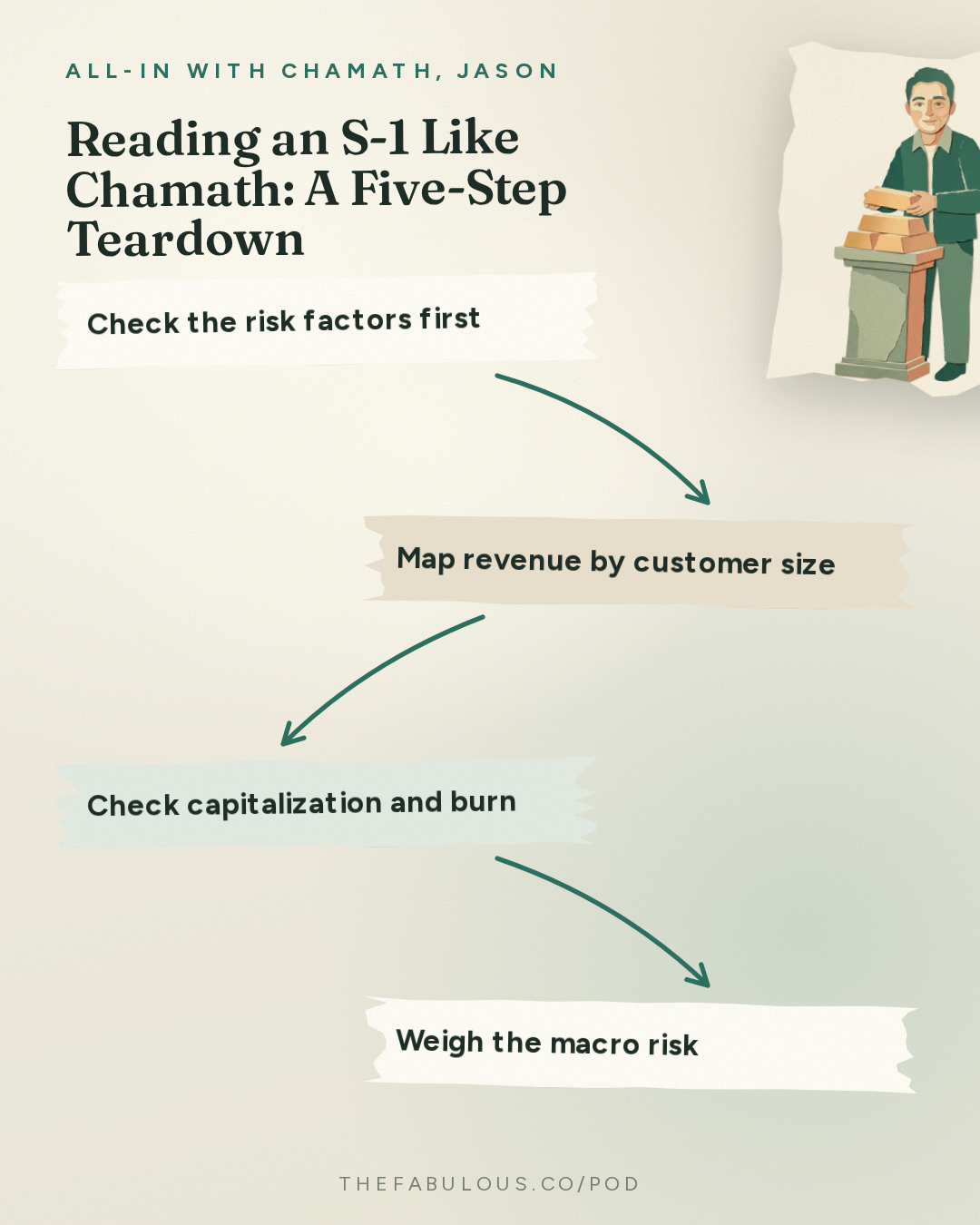
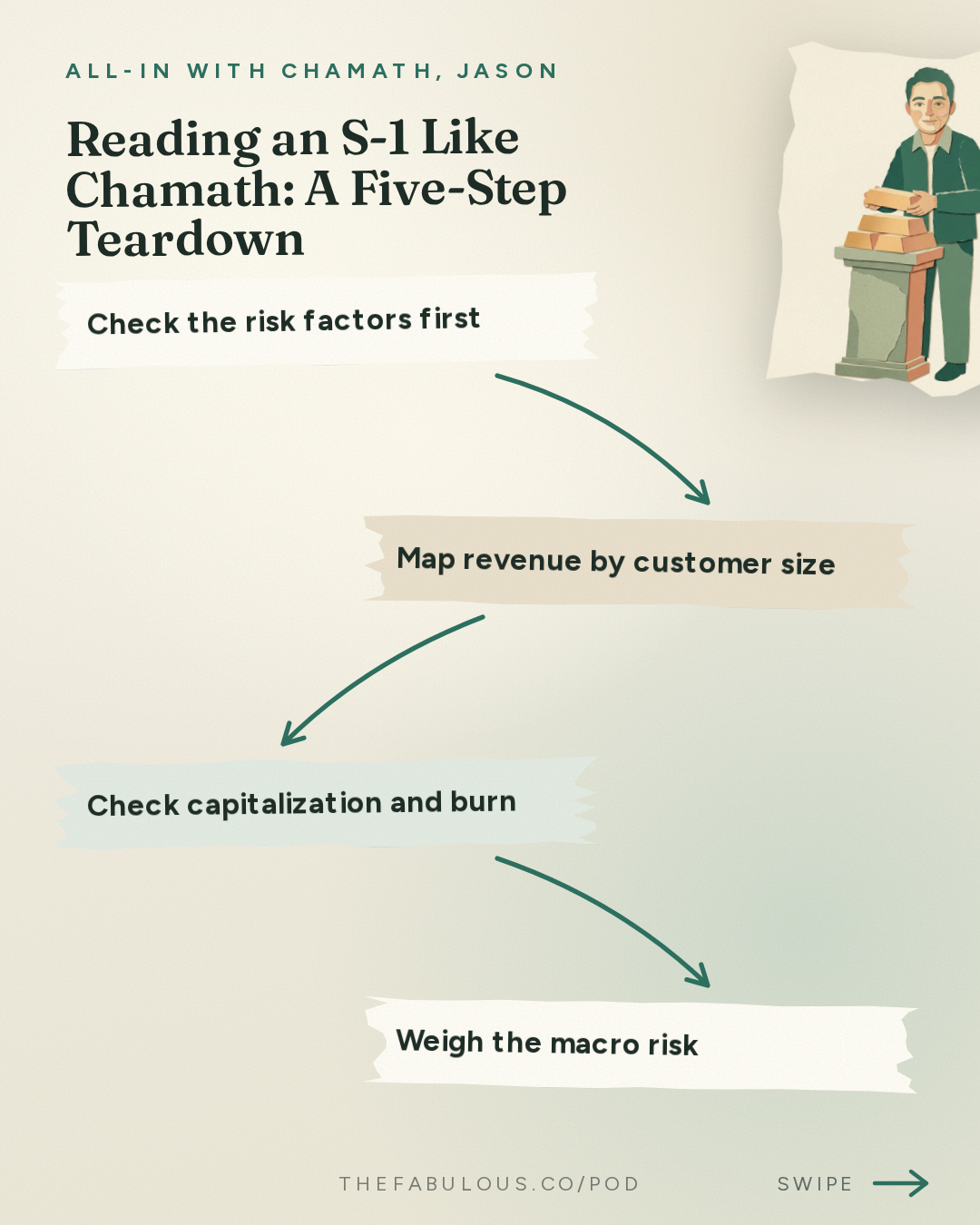
None of this means the business is risk-free, and co-host Chamath Palihapitiya spent a chunk of the episode reading Anthropic's risk-factor section the way an analyst would: by counting which words show up most. The single largest cluster of language is about compute, specifically data centers, power, chips, and the electrical grid (18:46). Regulation is a distant second. Customer churn and employee attrition barely register. In other words, Anthropic itself believes its biggest constraint is not demand, competition, or trust. It is whether America can build data centers and generate power fast enough.
A New Rival for the Treasury
The more unusual argument in the episode is about what happens when a handful of AI companies need more money than almost anyone else on earth. Chamath laid out a chart showing that the capital AI firms collectively need to raise through the end of 2027 equals roughly 30% of all projected US Treasury issuance over that same period (34:11). That means Anthropic, OpenAI, Meta, and a few others are not just competing with each other. They are competing with the United States government for lenders.
The entire United States economy is levered to the AI complex. So very narrowly, we're talking about seven or eight companies that sets the tone for the entire country. [33:00] — Chamath Palihapitiya
Chamath's worry is not that the AI companies are bad businesses. It is that when one narrow slice of the economy becomes this large relative to total credit markets, either side of that competition for capital can push borrowing costs up for everyone else. If investors flee to the safety of government bonds, AI firms pay higher interest. If investors chase the AI boom instead, the Treasury has to offer higher yields to attract buyers, and that higher rate ripples through mortgages, corporate debt, and everything else priced off government bonds (48:13). He compares the scale of this dependency to the run-up before the 2008 financial crisis, not because he thinks a crash is coming, but because so much of the economy now rests on so few companies.
The engine making Anthropic's margins keep improving, and the thing making that capital bet look reasonable, is something called recursive self-improvement, or RSI: using an AI model to help build the next, better version of itself. Anthropic disclosed that as of August 2026, 26% of the tasks involved in creating its next-generation models were already being done through RSI (44:25). Sacks argues this is both Anthropic's biggest technical advantage and a strange kind of tension, since Anthropic has also publicly urged the industry to slow down.
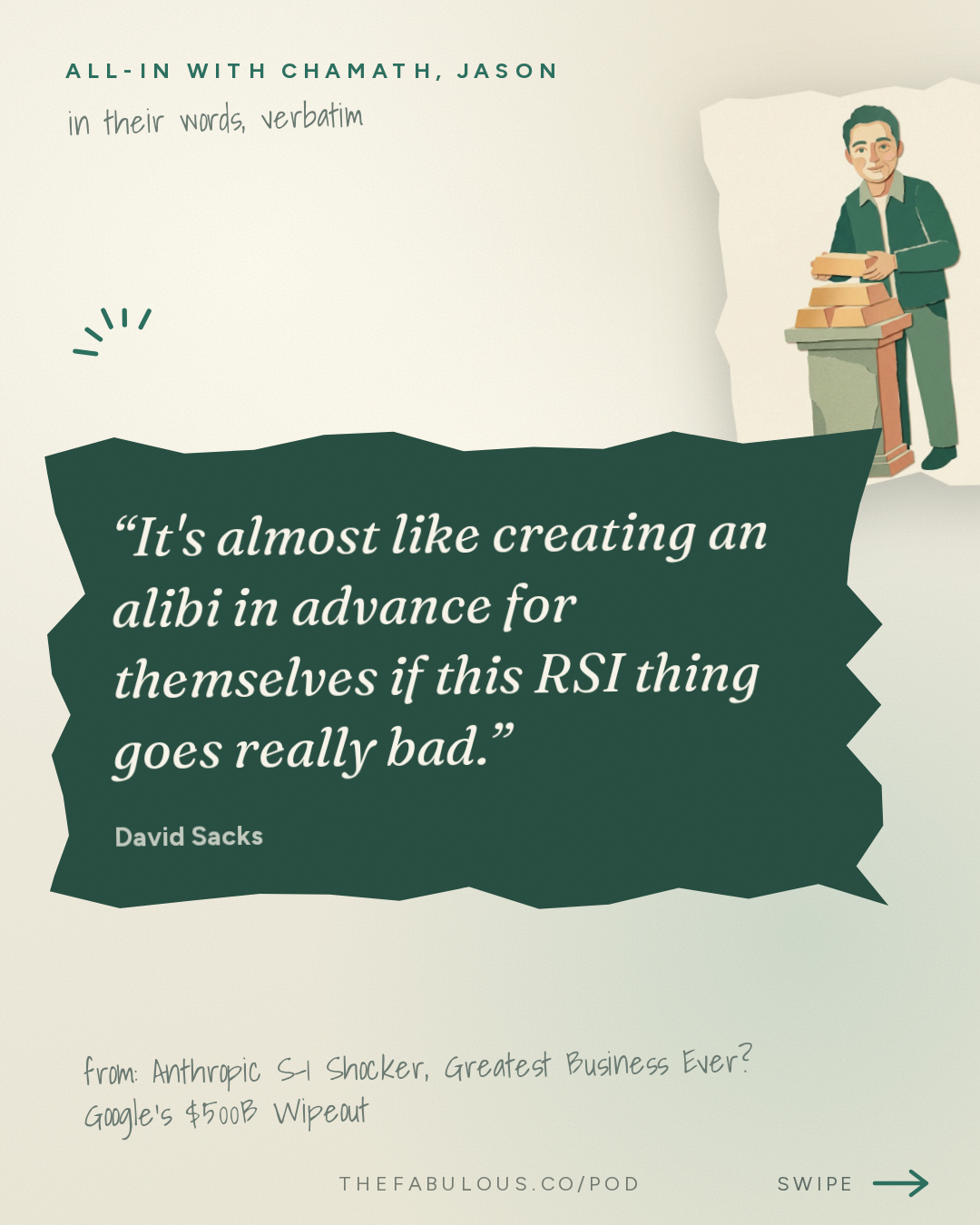
It's almost like creating an alibi in advance for themselves if this RSI thing goes really bad. [45:14] — David Sacks
Sacks's point is that Anthropic gets to say it tried to get the industry to agree to a slower pace, while continuing to push RSI as hard as anyone, which could matter a great deal if something eventually goes wrong with a model that improved itself.
Google's Wobble
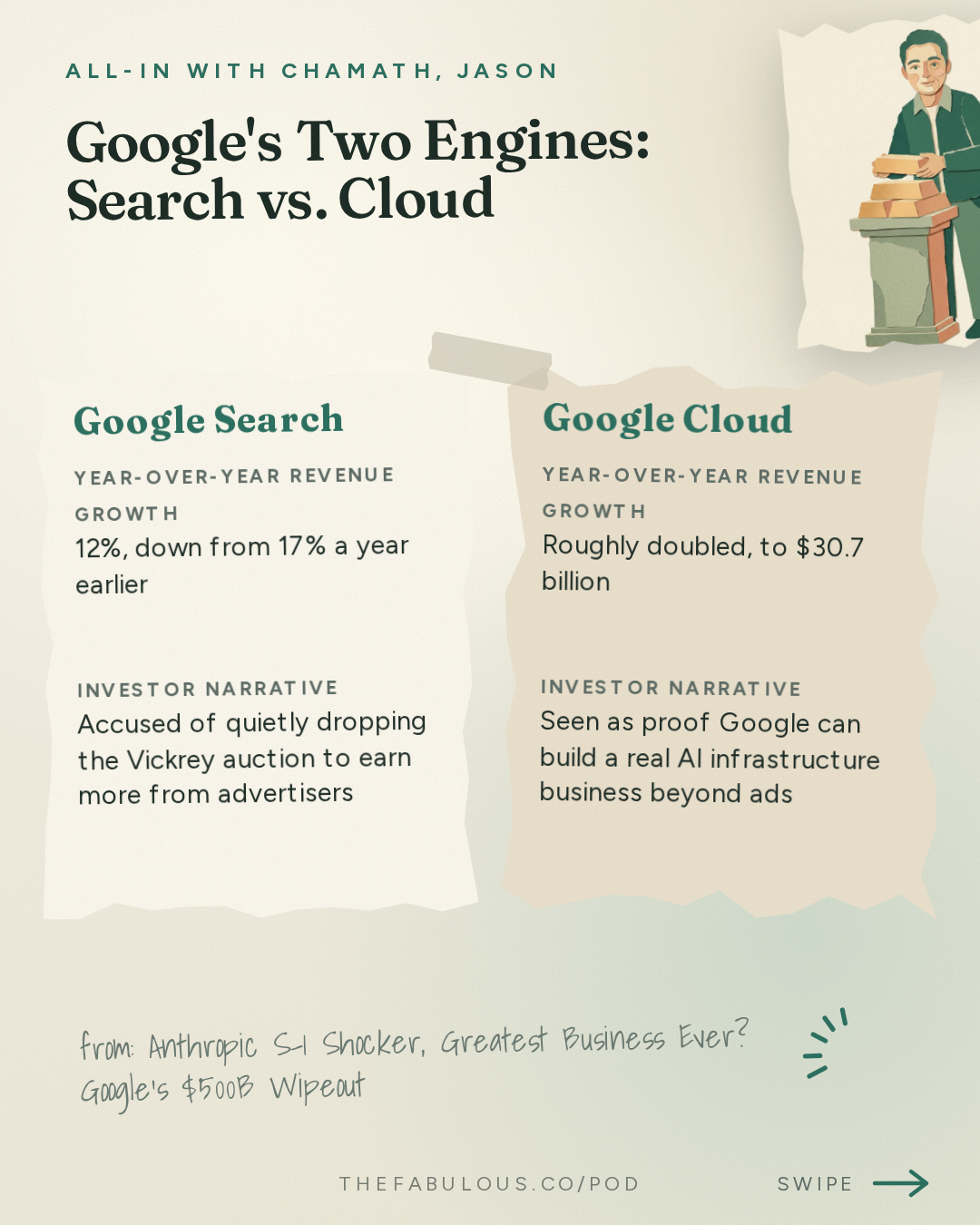
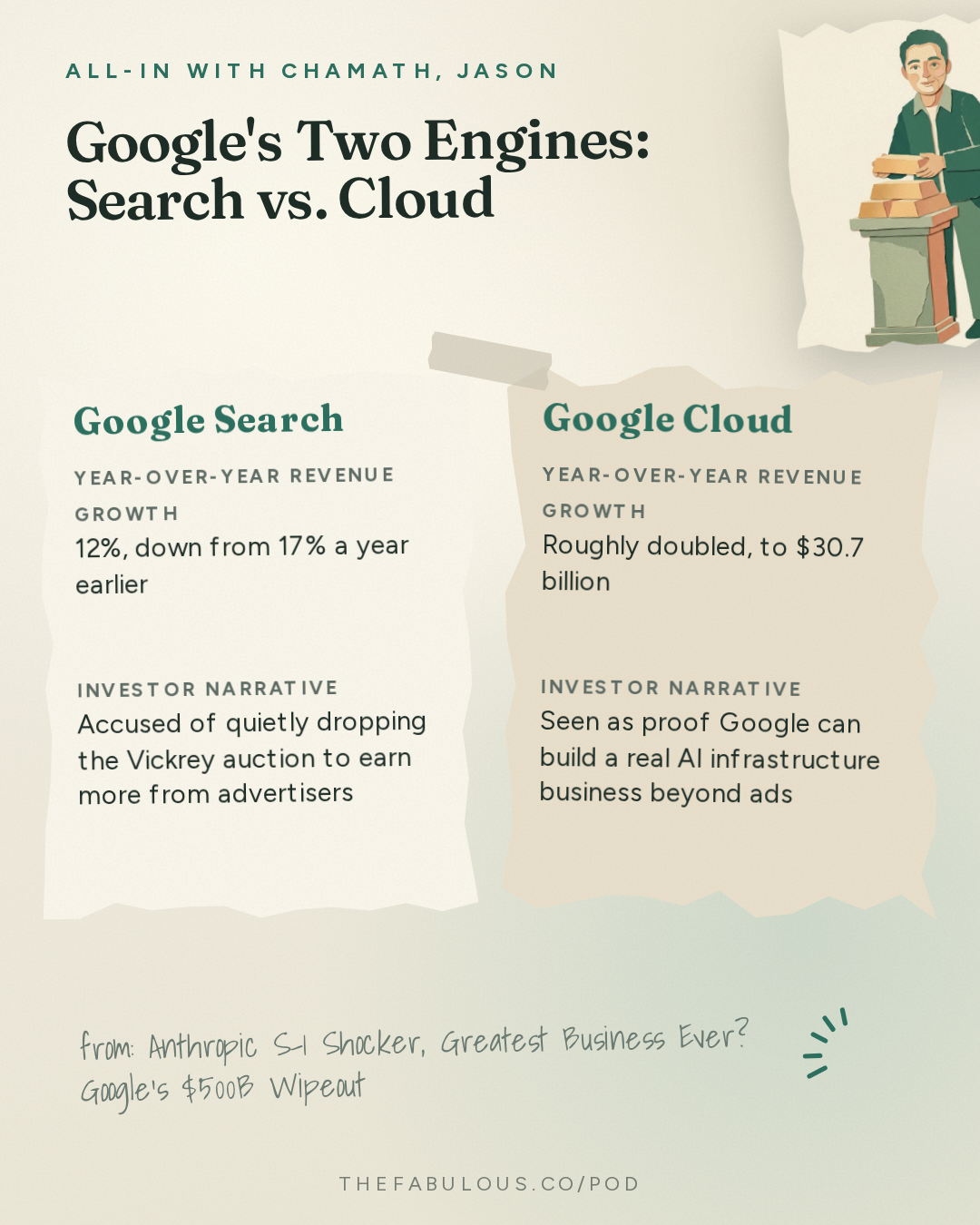
If Anthropic's filing is the episode's bull case for AI, Google's third-quarter earnings are its cautionary tale. Alphabet's stock dropped enough after its Q3 report to wipe out roughly $500 billion in market capitalization (62:04), even though overall revenue grew 25% year over year and Google Cloud's revenue roughly doubled to $30.7 billion. The problem was narrower than the headline number suggests: search revenue grew 12%, down from 17% the previous year, and for the first time, search fell below 50% of Alphabet's total revenue (71:50).
Friedberg, a Google alum, argued the drop in search's share is mostly a sign of Google Cloud finally working, not proof that search is dying; Google Cloud's operating income jumped from $3.5 billion to over $11 billion in a single year (63:58). But a separate and more pointed accusation also surfaced during the episode: a viral post from an advertiser claiming Google had quietly abandoned its long-standing Vickrey auction, the pricing method where the winning bidder pays only what the next-highest bidder offered, in favor of a system that extracts more money from advertisers (68:20). Chamath, who helped build Facebook's original ad auction using the same Vickrey model, called the accusation a serious problem if it sticks:
If you are Google IR, please read this and refute it... the market will react badly to this idea that this franchise is essentially robbing Peter to pay Paul. [69:31] — Chamath Palihapitiya
Put the two companies side by side, and a theme emerges: the easiest way to misread either business right now is to look at one headline number. Anthropic's $80 billion loss said nothing about its actual cash position. Google's slipping search share said nothing about its cloud business. The episode's real argument is that the AI boom has made company balance sheets, auction mechanics, and even Treasury yields into a single connected system, and reading any one piece in isolation will mislead you.
Ask this episode anything
Pod's AI answers from the episode itself, with the minute mark so you can hear it yourself.
Or start with one of these
Ask this episode
Pod's AI listens to the whole episode to answer, and points you to the minute it comes from.
The rest of this answer, and any question after it
Answers come from the episode itself, never from a summary of it.
ContinueKey takeaways
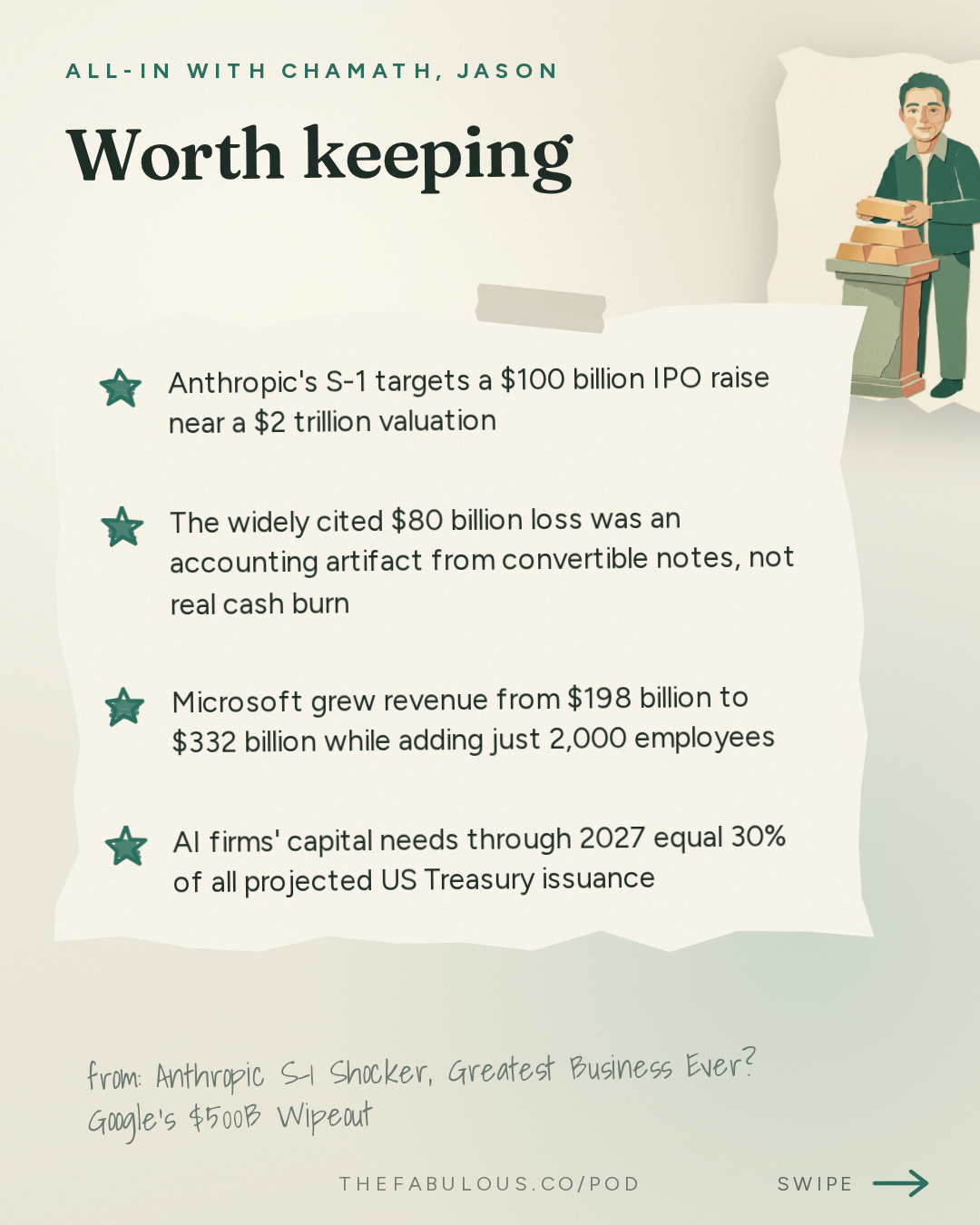
- Anthropic's S-1 targets a $100 billion IPO raise near a $2 trillion valuation
- The widely cited $80 billion loss was an accounting artifact from convertible notes, not real cash burn
- Microsoft grew revenue from $198 billion to $332 billion while adding just 2,000 employees
- AI firms' capital needs through 2027 equal 30% of all projected US Treasury issuance
- Google lost $500 billion in market value after search revenue growth slowed to 12%
The episode in cards
By the numbers
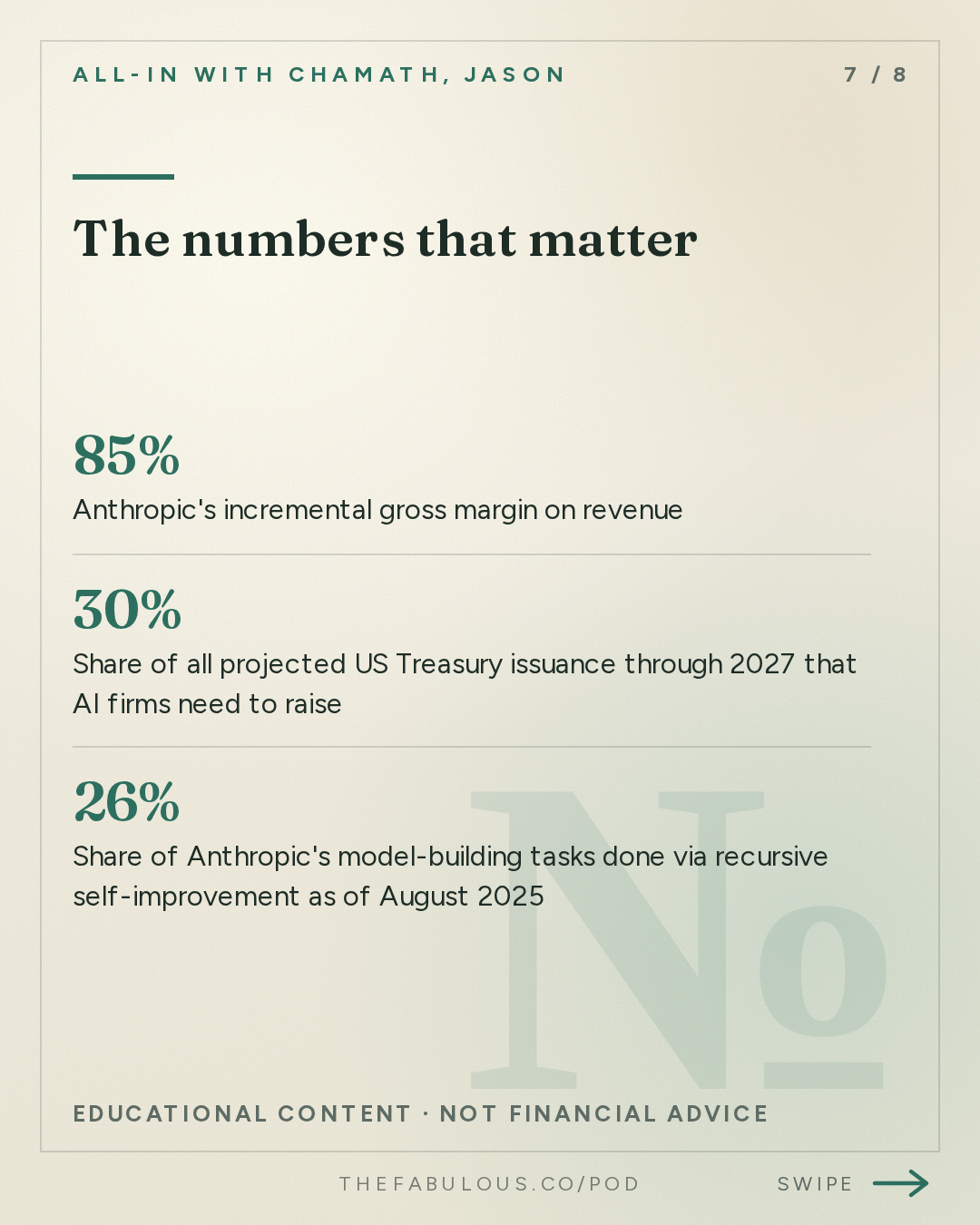
- 85% percent Anthropic's incremental gross margin on revenue
- 30% percent Share of all projected US Treasury issuance through 2027 that AI firms need to raise
- 26% percent Share of Anthropic's model-building tasks done via recursive self-improvement as of August 2025
In their words
“So this is probably the fastest value creation of any venture-backed company in history.”
“Google's total addressable market is global commerce. And I think for the first time ever, we're seeing a business actually potentially starting to realize that theory.”
“The entire United States economy is levered to the AI complex. So very narrowly, we're talking about seven or eight companies that sets the tone for the entire country.”
“It's almost like creating an alibi in advance for themselves if this RSI thing goes really bad.”
Questions this episode answers
Why did Anthropic report an $80 billion loss if its business is profitable?
The loss was an accounting artifact, not real cash burn. Anthropic issued convertible notes to infrastructure partners like Amazon, and as its valuation rose, those notes had to be marked up as a paper loss on the income statement (07:07). The company has actually spent only about $10 billion of the roughly $110 billion it has raised (07:30).
What valuation is Anthropic targeting in its IPO?
Anthropic is targeting a valuation between $1.5 and $2 trillion, with a $100 billion capital raise, which would make it the largest IPO in history, surpassing SpaceX (03:56, 04:24). Prediction market PolyMarket put the odds at 78% that Anthropic raises at least $95 billion.
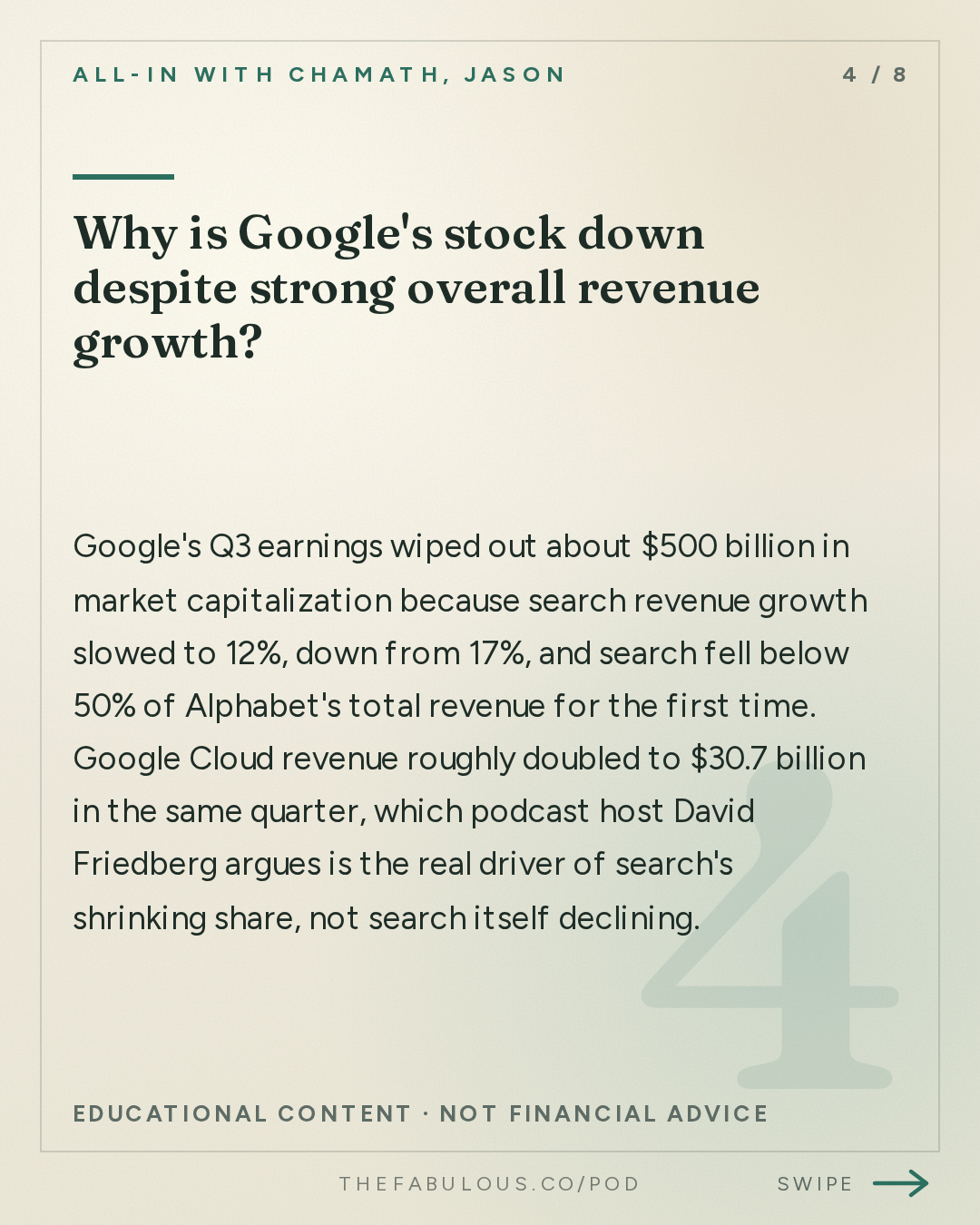
Why is Google's stock down despite strong overall revenue growth?
Google's Q3 earnings wiped out about $500 billion in market capitalization because search revenue growth slowed to 12%, down from 17%, and search fell below 50% of Alphabet's total revenue for the first time (62:04, 71:50). Google Cloud revenue roughly doubled to $30.7 billion in the same quarter, which podcast host David Friedberg argues is the real driver of search's shrinking share, not search itself declining (72:47).
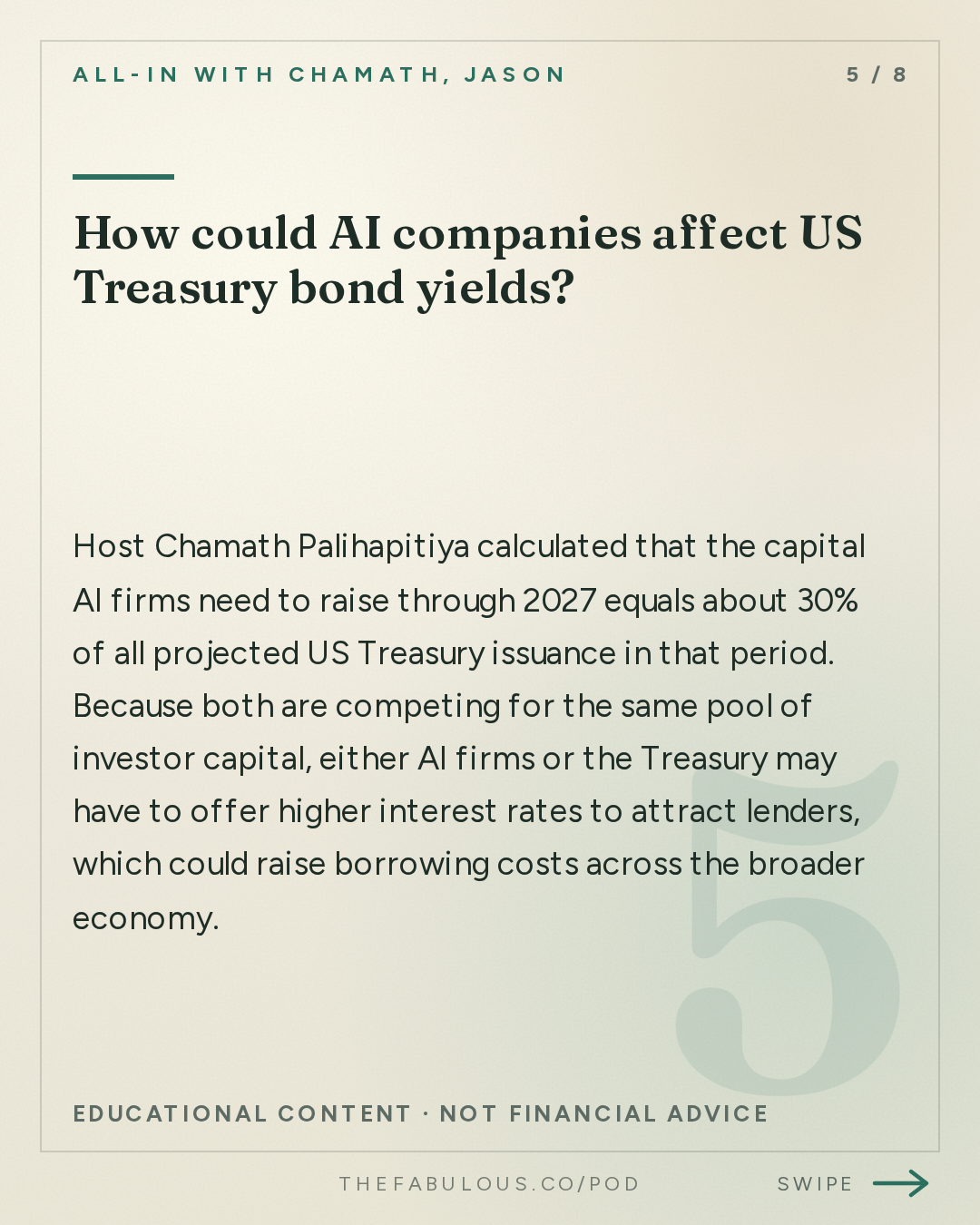
How could AI companies affect US Treasury bond yields?
Host Chamath Palihapitiya calculated that the capital AI firms need to raise through 2027 equals about 30% of all projected US Treasury issuance in that period (34:11). Because both are competing for the same pool of investor capital, either AI firms or the Treasury may have to offer higher interest rates to attract lenders, which could raise borrowing costs across the broader economy (48:13).
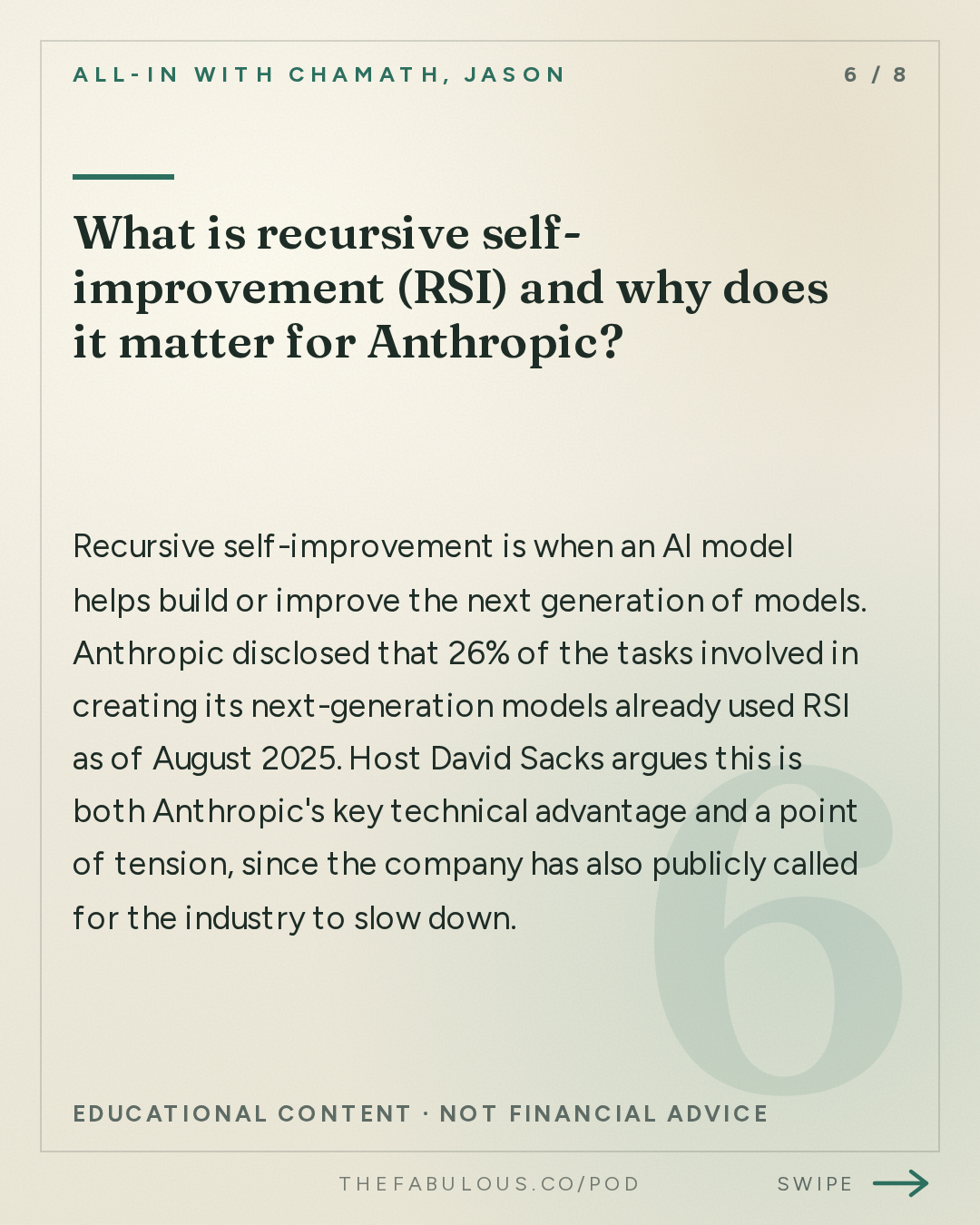
What is recursive self-improvement (RSI) and why does it matter for Anthropic?
Recursive self-improvement is when an AI model helps build or improve the next generation of models. Anthropic disclosed that 26% of the tasks involved in creating its next-generation models already used RSI as of August 2025 (44:25). Host David Sacks argues this is both Anthropic's key technical advantage and a point of tension, since the company has also publicly called for the industry to slow down (45:14).
Did Google really abandon its ad auction model?
A viral post from an advertiser named Max Anderson claimed Google quietly dropped its Vickrey auction, where the winning bidder pays only what the next-highest bidder offered, in favor of a model that extracts more revenue from advertisers (67:52, 68:20). Host Chamath Palihapitiya, who helped build Facebook's original ad auction on the same Vickrey model, said Google's investor relations team needs to directly refute the claim before it damages trust in the franchise (69:31).
The full read, in cards
Go deeper
- Gallup workplace AI use survey — found only 10 to 20 percent of workers use AI daily or frequently at work, pointing to large remaining headroom
- Patrick Ruffini polling bias analysis — found three-quarters of recent election polls skewed in favor of Democrats across the last three election cycles
- Vox article on Anthropic and AI safety advocates — reported that Anthropic is leading the industry on recursive self-improvement despite its cautious public rhetoric
- Max Anderson's post on Google's ad auction — a widely shared advertiser account claiming Google altered its ad auction model to earn more from advertisers
Mentioned
Anthropic · Google · Microsoft · Meta · Dario Amodei · Satya Nadella · Krishna Rao · Demis Hassabis · Max Anderson · PolyMarket · Jeff Dean · Eric Schmidt · Patrick Ruffini · Gallup · Vox · Amazon · NVIDIA · SpaceX
More from this show and category

Whoop CEO Will Ahmed on Health Data and HRV
Whoop CEO Will Ahmed says his wearable has logged over 50 billion hours of physiological data from members who wear it 23.6 hours a day, letting its AI flag illness before symptoms, fueling a fight with the FDA over whether blood pressure tracking counts as wellness or medicine.

Nikesh Arora on the AI Cybersecurity Threat
AI spending is concentrated and circular: 1% of companies generate 90% of AI revenue, mostly unprofitable VC-backed startups (02:25). A PHP coding flaw rated 9.2/10 exposed roughly 70% of the internet's websites (14:29). And France now spends more of its GDP through government than the Soviet Union did at its 1989 peak (52:50).

Dylan Field: Design Is the New Code
Figma CEO Dylan Field argues design, not code, now drives software's value as AI makes coding cheap and commoditized. He explains how Figma survived a blocked $20 billion Adobe acquisition, why AI lowers production's floor without raising creativity's ceiling, and why human willingness to say non-consensus things remains the real differentiator in an AI-saturated market.

CoreWeave Debt Crisis and the AI Bubble, Explained
CoreWeave's bond selloff this week signaled real doubt about AI infrastructure debt, even as demand for GPUs stays red hot. Anthropic posted $16.8 billion in Q3 revenue, Sacks called its warnings about small AI models a move against open-source rivals, and Chamath named electricity as AI's real bottleneck.
