
Why Republicans Lost the 2026 Midterms
Midterm Blood Bath, $4T AI Sell Off, Data Center Freeze, What's Next for Trump
The brief
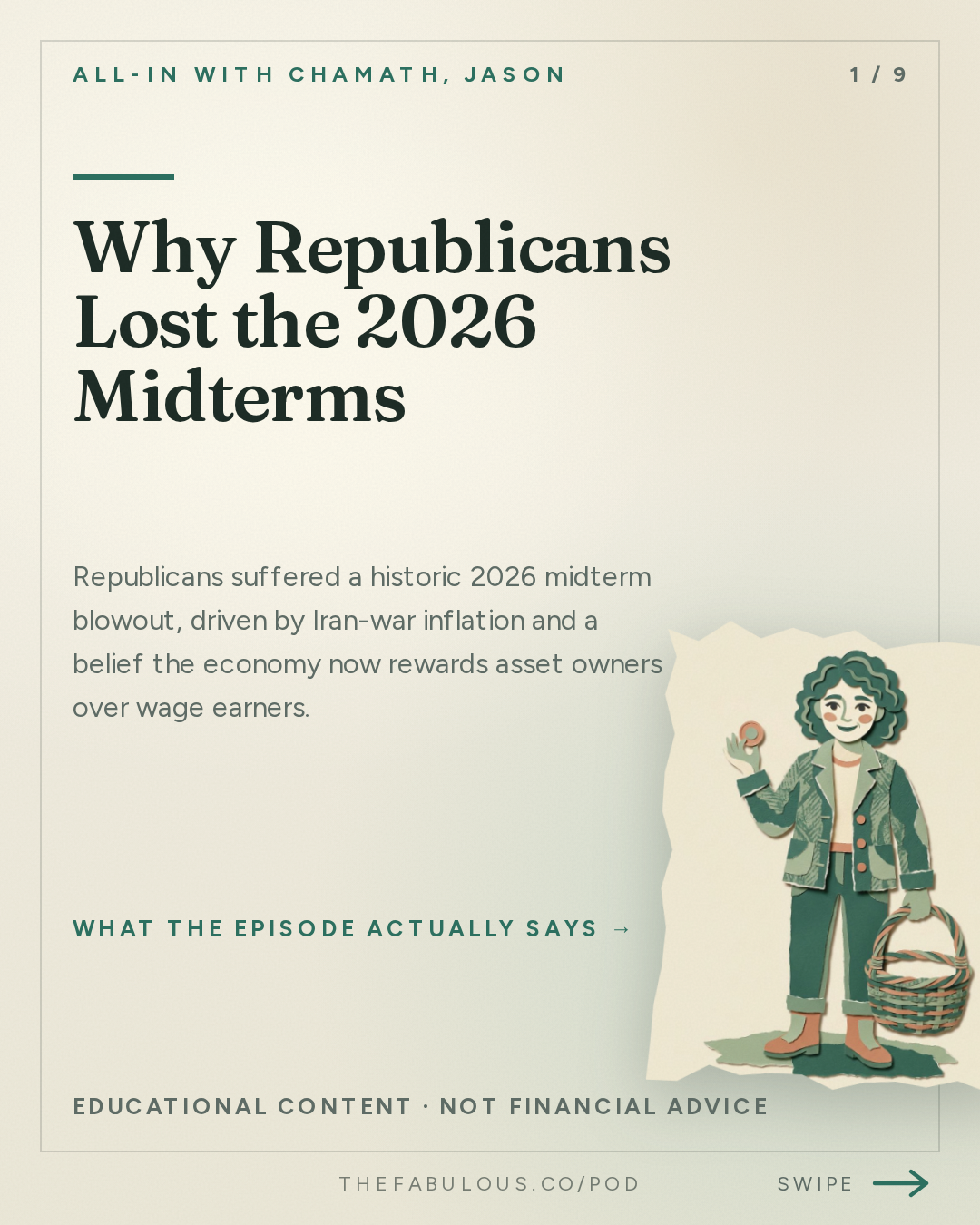
Republicans suffered a historic 2026 midterm blowout, driven by Iran-war inflation and a belief the economy now rewards asset owners over wage earners. The panel also unpacks a $4 trillion AI stock selloff, state pushback against data centers, and OpenAI's surprise proof against a 27-year-old computer science hypothesis.
On the night of the 2026 midterms, four tech investors and a comedian pulled 500,000 live viewers to a web stream, more than most cable news coverage managed that evening (02:07). It was a strange kind of victory lap, because the story the results told afterward had nothing to do with livestream numbers and everything to do with a country in a foul mood. Democrats swept both chambers of Congress and won at least 29 governor's races. Republicans lost states that had not gone blue in a generation: Texas, Kansas, Iowa, South Carolina (03:37). Something had broken. The question the hosts spent the episode chasing was what, exactly.
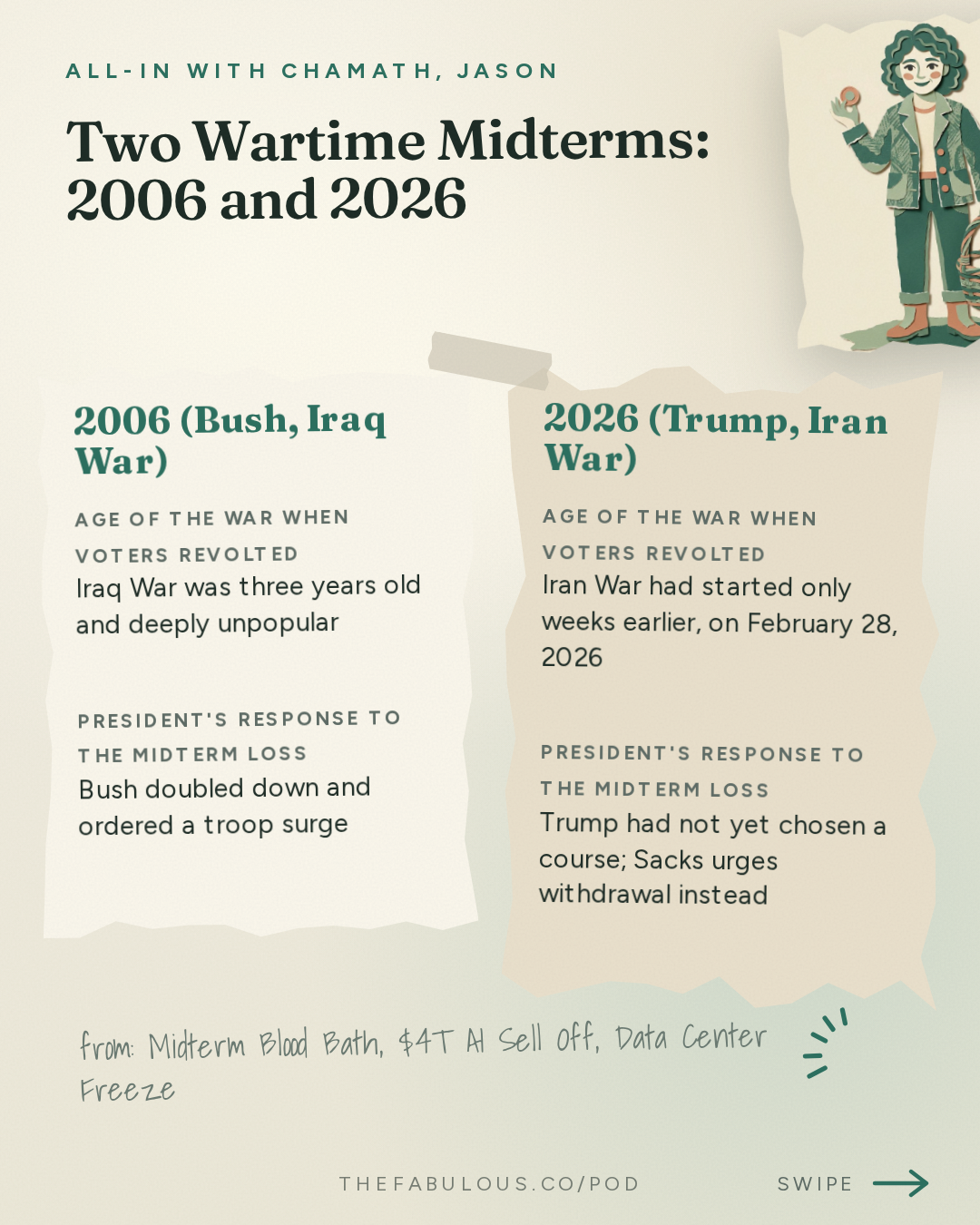
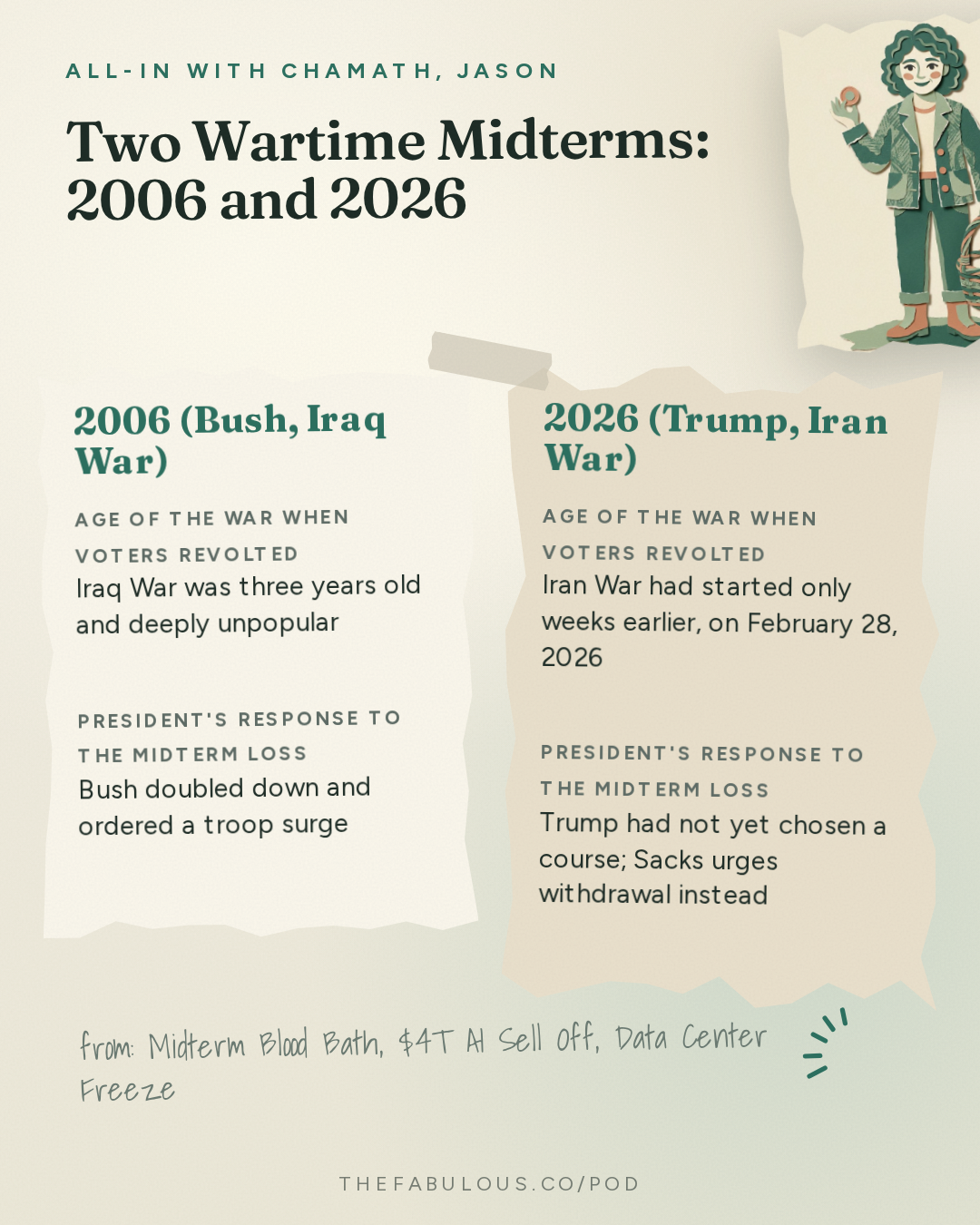
The first answer, offered by Republican strategist David Sacks, is simple: the war in Iran. Inflation had fallen to 2.4% in January, before the war began, down from 9% under President Biden (05:42). Then gas and diesel prices spiked, mortgage rates climbed back to 7.5%, and a party that had been forecast to hold the Senate by a wide margin lost roughly eight or nine seats (06:25, 34:06). Sacks points to a poll showing 74% of voters called the war either crucial or a major factor in their vote, and that bloc broke heavily toward Democrats (34:53). He also notes a defection among "podcast bros," influential right-leaning media figures like Joe Rogan and Tucker Carlson, who turned on the war and took younger male voters with them, a group whose votes swung 36 points compared with the 2024 election (09:23, 27:35).
Entrepreneur David Friedberg traces the failure further back, to the collapse of DOGE, the Department of Government Efficiency that Elon Musk left in June 2025. Friedberg argues that once Congress made clear it had no appetite for cutting the $7 trillion federal budget, the chance to address the cost of living structurally was gone. "China has just won," he tweeted that day, by his own account (14:14). He points to a Gallup survey in which 93% of Chinese citizens believe AI will make their lives better, compared with just 36% of Americans, fourth from the bottom worldwide (15:54, 16:19). In his reading, that gap primed American voters to see AI wealth as something flowing to a narrow class of winners while everyone else fell behind.
Venture investor Chamath Palihapitiya pushes past both explanations to something broader. He had argued before the election that cultural issues were fading and that a bloc of voters, neither reliably Democrat nor Republican, was simply rewarding whoever seemed to solve the affordability problem and punishing whoever did not. He offers three pieces of evidence. Money spent on advertising in contested races failed to predict winners. Gerrymandered districts, redrawn specifically to protect Republican seats, flipped anyway, with Democrats winning 11 of 15 redrawn seats (21:50). And the swing voters who elected Biden, then Trump, then this Congress were the same people each time, simply discharging their anger at whoever held power.
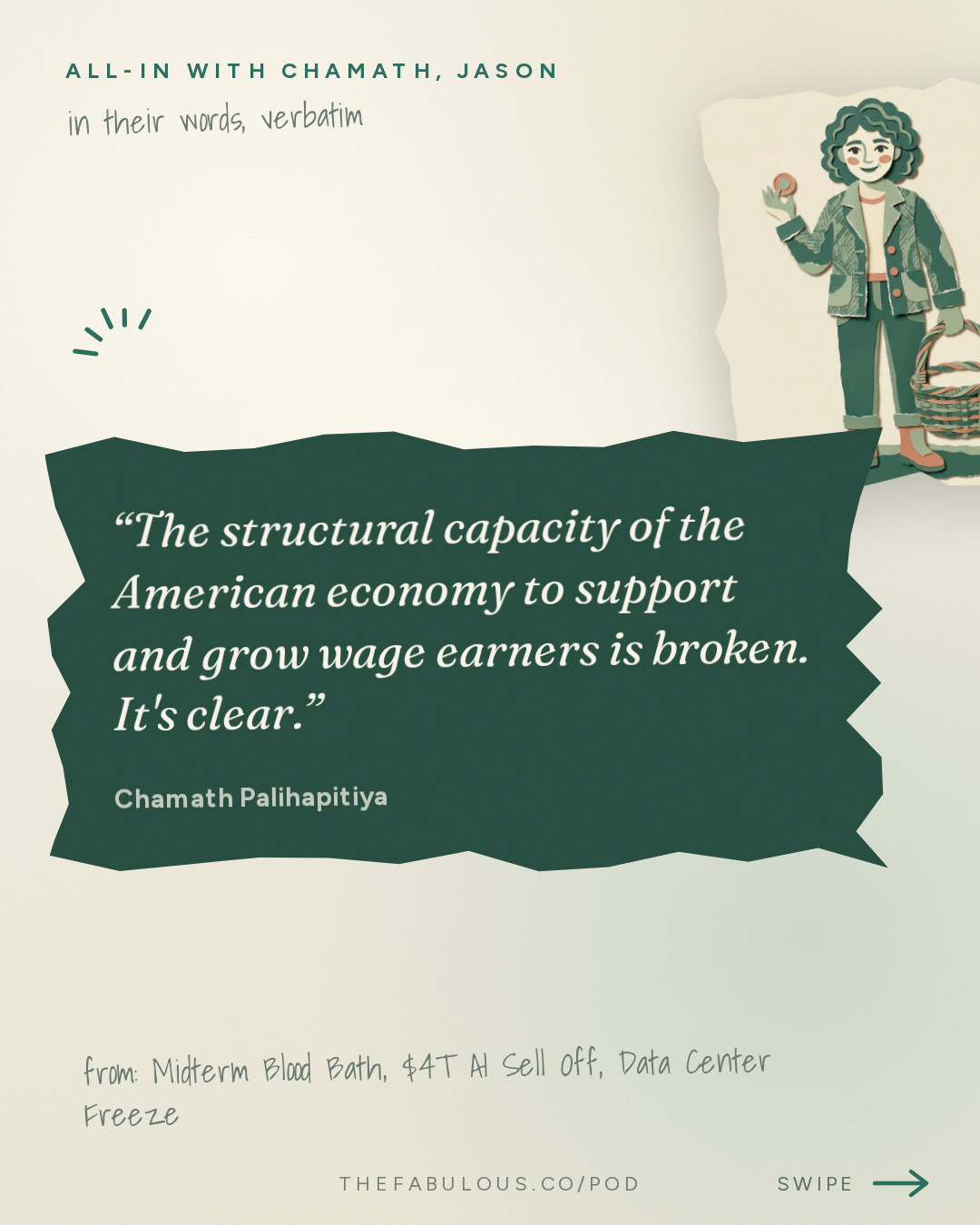
"The structural capacity of the American economy to support and grow wage earners is broken. It's clear." — Chamath Palihapitiya [20:26]
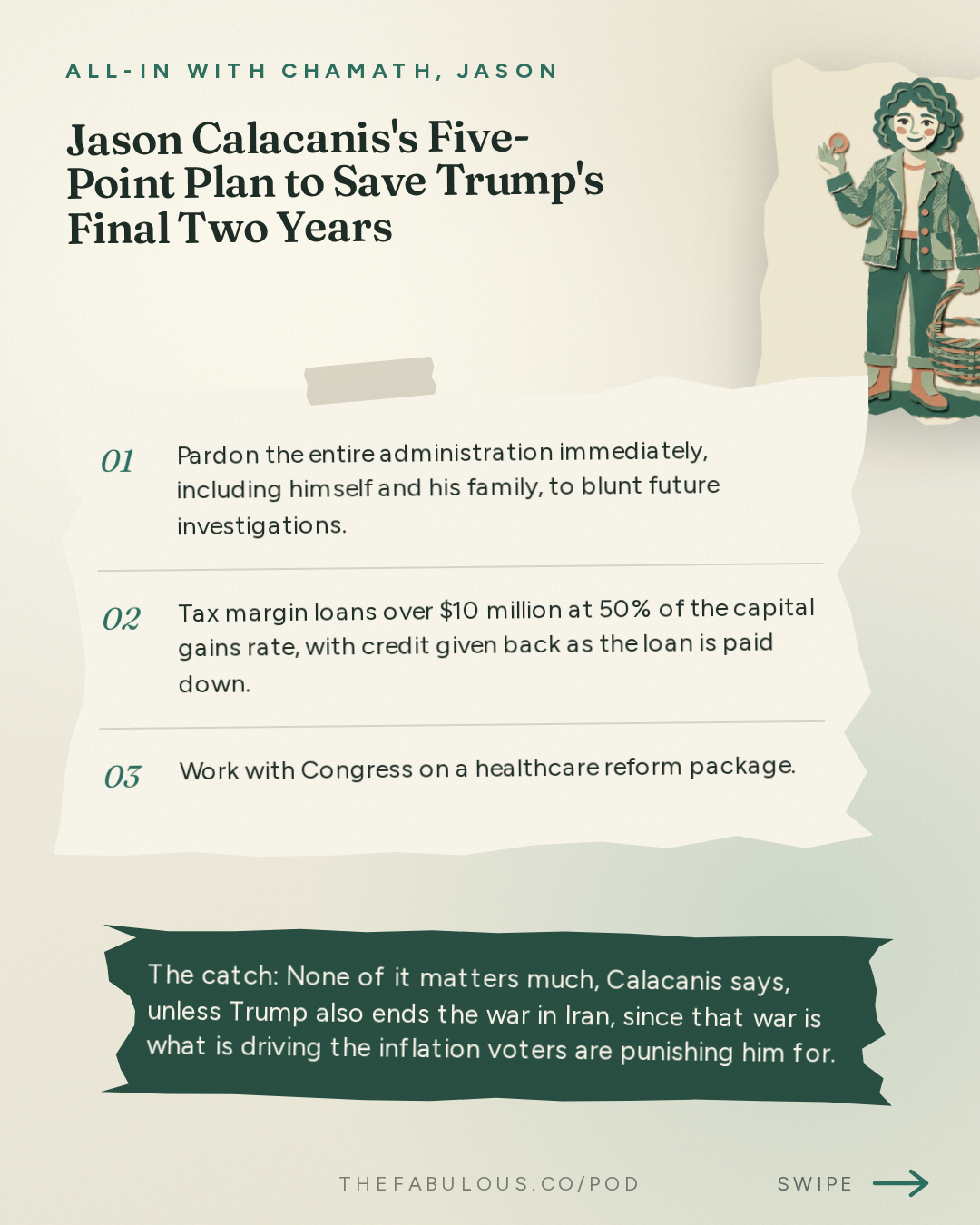
Chamath's diagnosis is that asset owners, people who hold stocks, real estate, and businesses, have profited in every interest rate environment since COVID, while wage earners have not. His prescription, echoed in part by Jason Calacanis, is to eliminate federal income taxes for anyone earning under $150,000 a year, paired with closing loopholes elsewhere, so the wage-earning class gains some stake in the system (24:39). Calacanis adds a package of his own: pardon the entire Trump administration now to defuse future investigations, tax margin loans over $10 million at half the capital gains rate, raise the minimum wage to $15 an hour over four years, and ban members of Congress from trading individual stocks (46:10 to 48:21). Sacks's counterargument is narrower and, in his telling, more urgent: end the war, and Brent crude could fall from roughly $110 to $70 a barrel almost immediately, pulling gas, diesel, and grocery prices down with it (36:15).
The Data Centers Nobody Wants Next Door
That same affordability anger is now aimed at AI infrastructure. Stocks across Nvidia, SpaceX, Tesla, AMD, and Micron lost close to $4 trillion in combined market value in a single week, the worst day in stock market history by total dollars (53:22). Prediction market odds on Anthropic's IPO, tracked by the platform PolyMarket, fell from 95% before the midterms to 71% after (54:06). Part of the trigger is political. Texas elected Gina Hinojosa, a Democrat, as governor, unseating three-term incumbent Greg Abbott in what the hosts call the biggest surprise of election night (39:00). Hinojosa has not blocked existing data center projects, but she has signaled no new permits until new regulations are in place, framing data centers as the reason local electricity bills and water use are rising while the companies get tax breaks (39:55, 75:47).
Chamath describes a video of two SpaceX employees presenting a six-gigawatt data center proposal to residents of Cochise County, Arizona, explaining promised cuts to electricity costs and property taxes while the audience shouts them down, evidence, he says, that the backlash is emotional rather than fact-based (55:28). Sacks is less sanguine about how this resolves. He separates the risk into two buckets: federal AI safety regulation, which he worries could create a surveillance apparatus, and state and local permitting, where he expects a near-total freeze on new projects through 2027 because no politician wants to be blamed for approving the next unpopular data center (74:46, 77:03). Calacanis's prediction is that capital simply moves. Data centers, he argues, can be built in Canada, Mexico, Singapore, or the Middle East once the war ends, turning the United States into a net importer of AI processing power, or "tokens," rather than an exporter (61:24, 62:41).
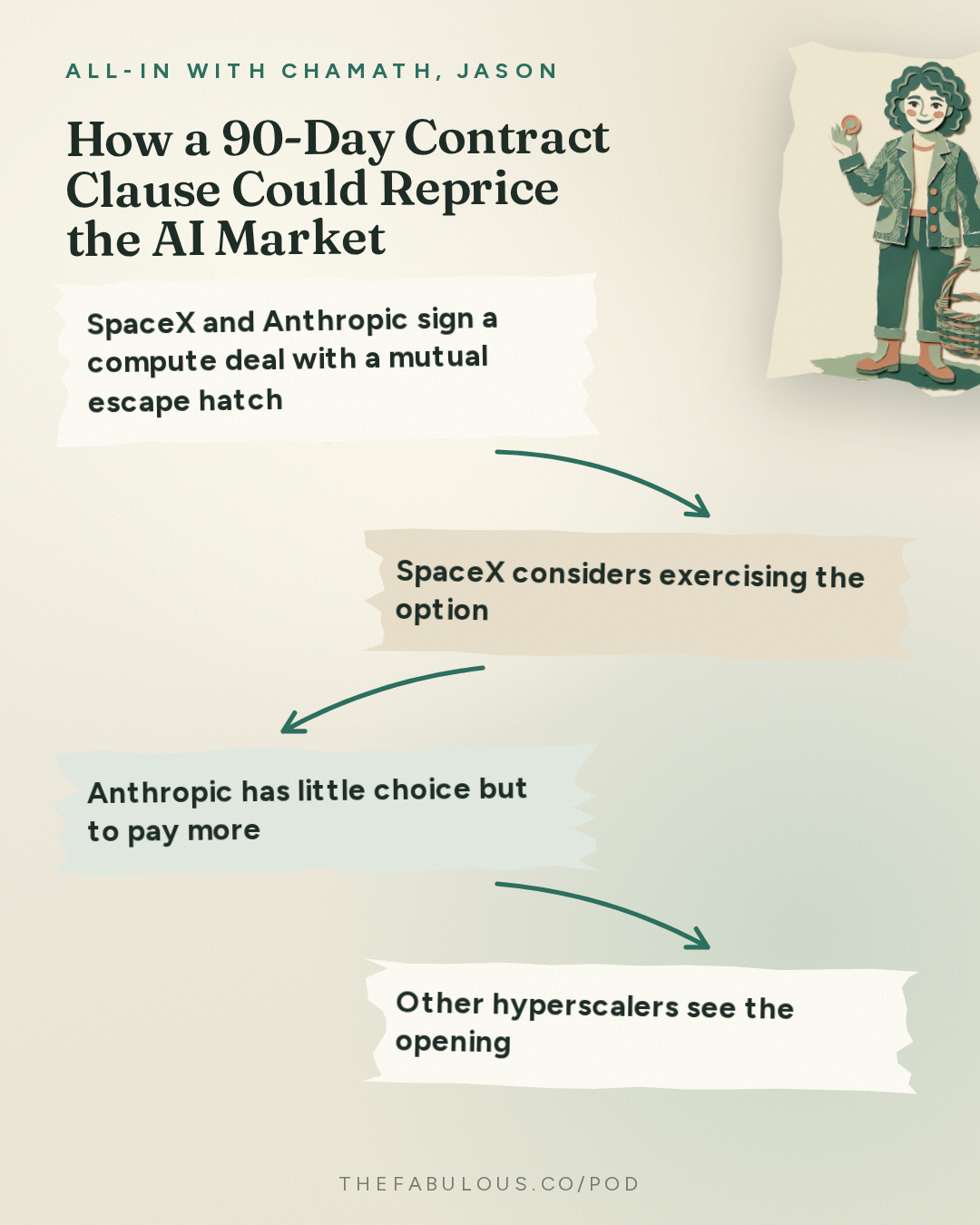
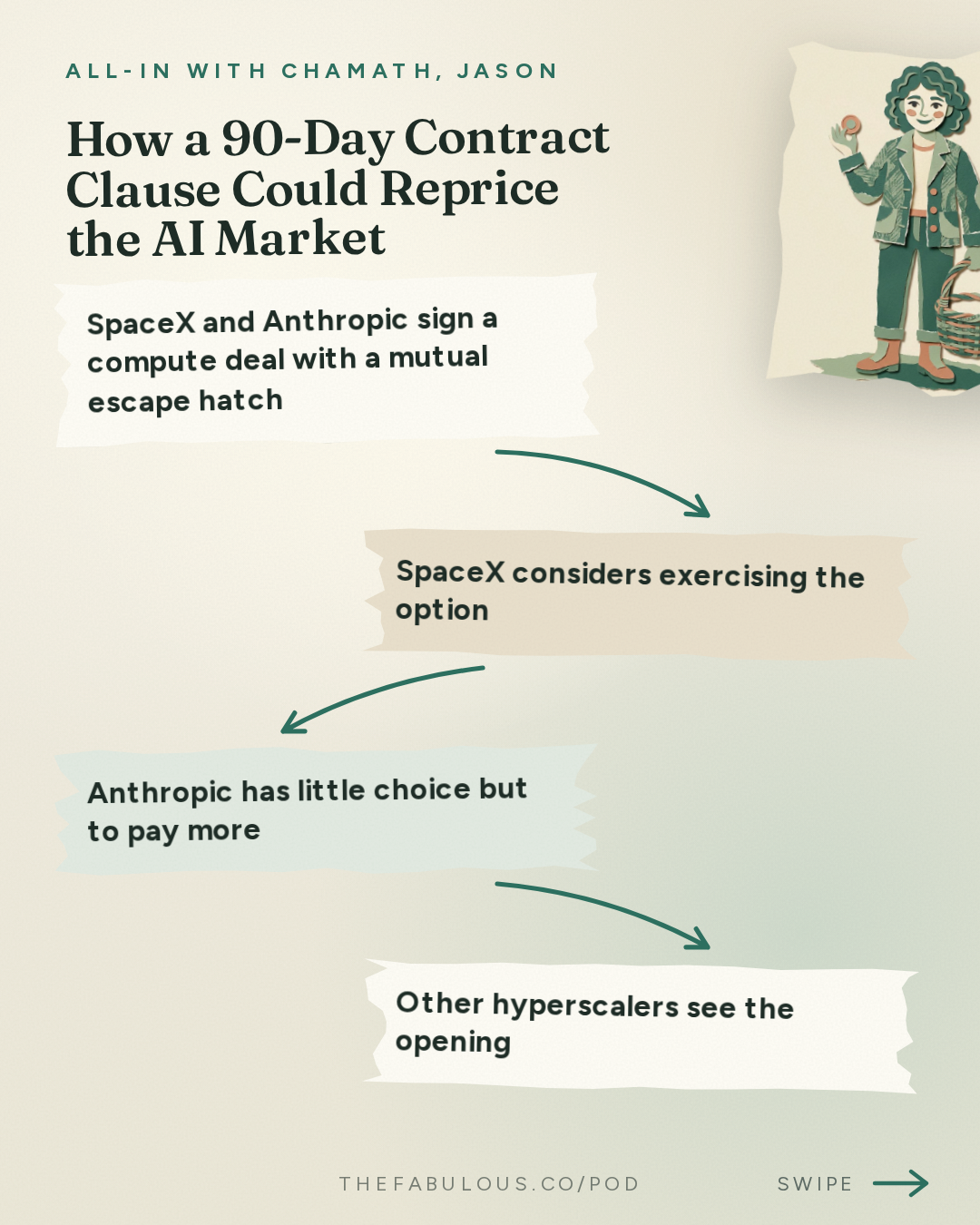
Buried in that fight is a contract detail that Chamath thinks could reprice the entire industry. SpaceX's compute deal with AI company Anthropic includes a mutual 90-day termination clause (59:29).
"If SpaceX says, 'I'm gonna terminate this compute in 90 days,' that is the king-making move." — Chamath Palihapitiya [60:06]
If SpaceX exercises that option, it could resell the freed-up computing capacity at the open market rate, which Chamath estimates runs two to three times higher than what Anthropic currently pays. Anthropic, heavily dependent on that slice of computing power, would likely have no choice but to accept the higher price. Friedberg is less certain SpaceX founder Elon Musk pulls that lever, given his working relationship with Anthropic, but both agree the clause gives Musk leverage few other players in the industry hold.
A Proof Nobody Expected
The episode's final turn is less about politics and more about what the technology can actually do. Friedberg walks through a question that has sat at the center of computer science since 1999: can a particular category of hard problems, called NP problems, always be solved as quickly as their answers can be checked? A puzzle like Sudoku is an NP problem, slow to solve but fast to verify. In 1999, researchers proposed the Exponential Time Hypothesis, which held that one class of these problems, called 3SAT, can never be solved in anything but exponential time, meaning the time required explodes as the problem grows (86:13). That hypothesis effectively closed off a central open question in math and computing for 27 years.
In a 175-page paper, OpenAI claims to have disproved it, showing that 3SAT problems can in fact be solved in sub-exponential time (88:01). The implication, still being checked by outside mathematicians, is that the deeper question, whether every efficiently checkable problem is also efficiently solvable, remains open rather than settled. Friedberg notes the paper was produced end to end in under ten days, with some reports suggesting a matter of hours (88:08). Whatever the political mood around AI, this is the kind of result that keeps the industry's sharpest believers convinced the technology is still underpriced, even as voters in Texas and elsewhere decide, for now, that they want less of it in their backyard.
Ask this episode anything
Pod's AI answers from the episode itself, with the minute mark so you can hear it yourself.
Or start with one of these
Ask this episode
Pod's AI listens to the whole episode to answer, and points you to the minute it comes from.
The rest of this answer, and any question after it
Answers come from the episode itself, never from a summary of it.
ContinueKey takeaways
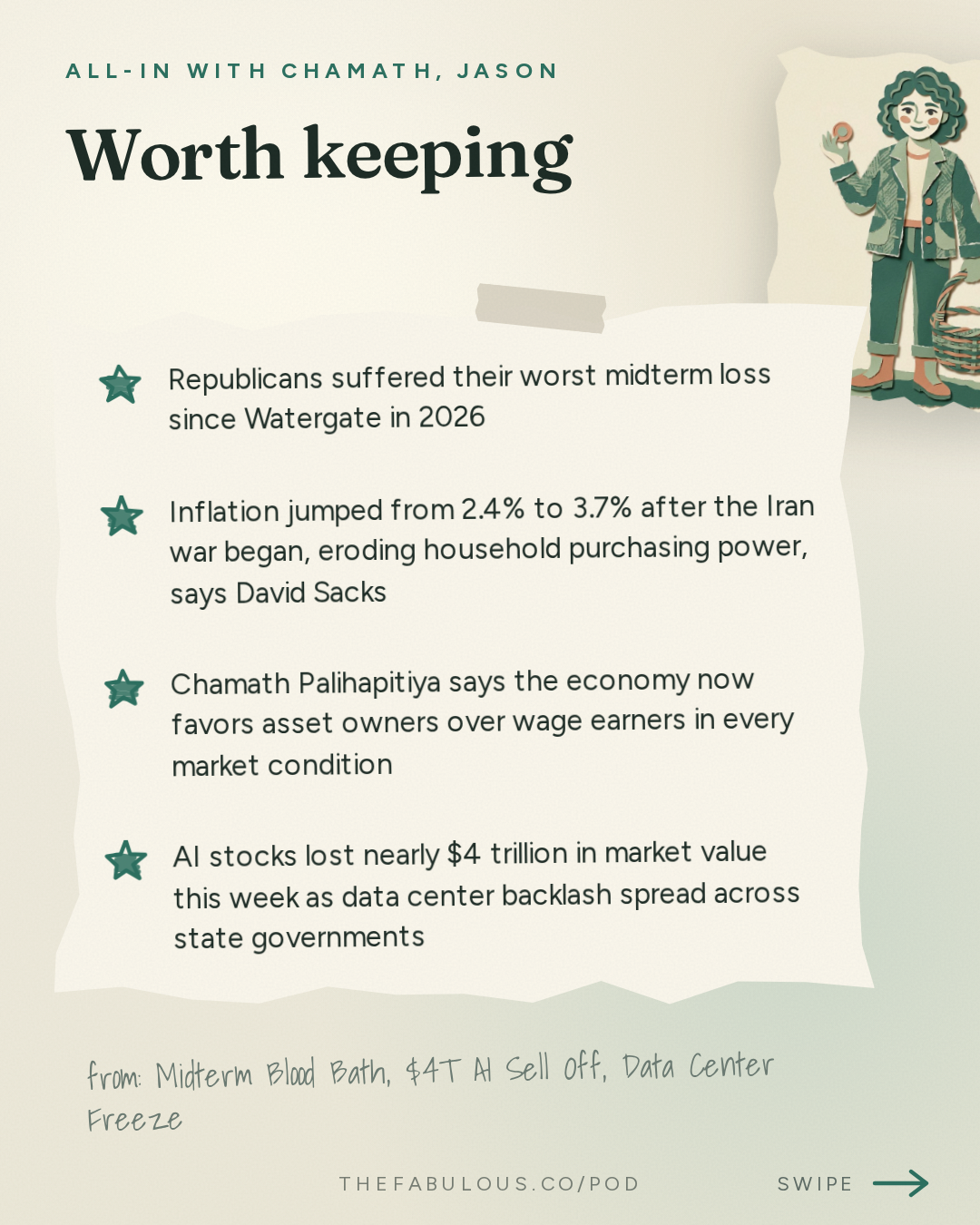
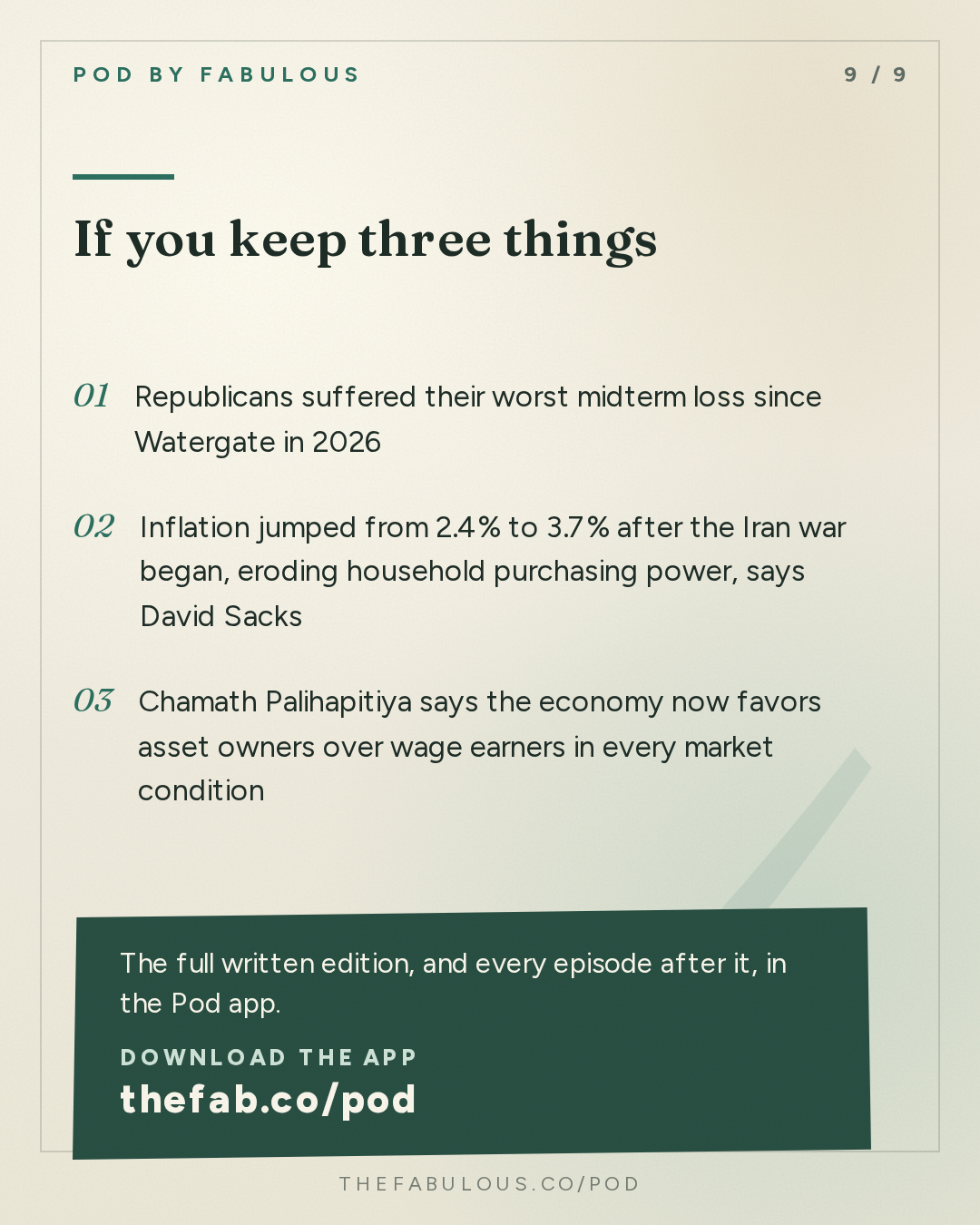
- Republicans suffered their worst midterm loss since Watergate in 2026
- Inflation jumped from 2.4% to 3.7% after the Iran war began, eroding household purchasing power, says David Sacks
- Chamath Palihapitiya says the economy now favors asset owners over wage earners in every market condition
- AI stocks lost nearly $4 trillion in market value this week as data center backlash spread across state governments
- OpenAI published a 175-page paper challenging the Exponential Time Hypothesis, a 1999 computer science conjecture
The episode in cards
By the numbers
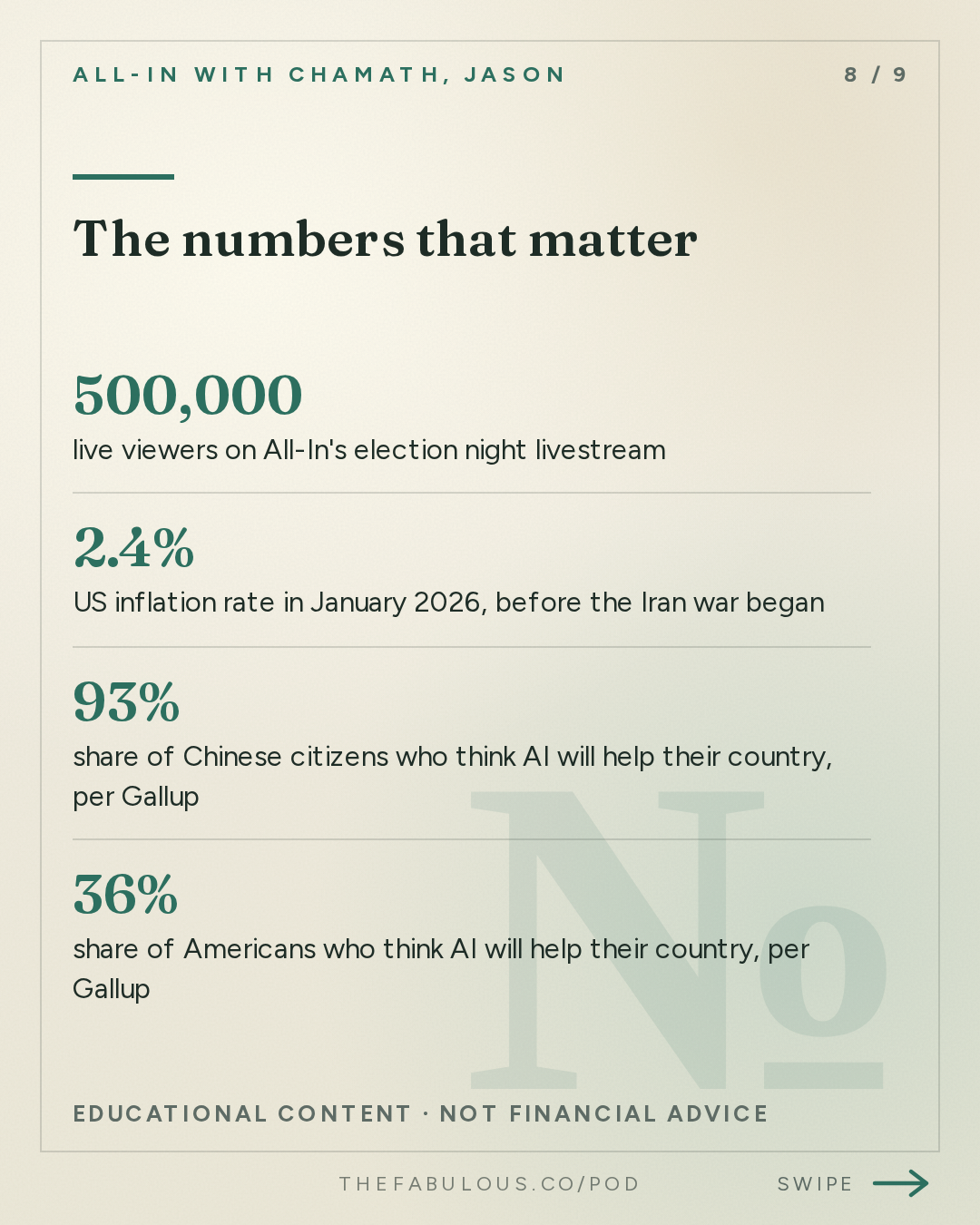
- 500,000 live viewers on All-In's election night livestream
- 2.4% percent US inflation rate in January 2026, before the Iran war began
- 93% percent share of Chinese citizens who think AI will help their country, per Gallup
- 36% percent share of Americans who think AI will help their country, per Gallup
- $4 trillion dollars AI-related stock market value wiped out in one week
- 175 pages length of OpenAI's paper challenging the Exponential Time Hypothesis
In their words
“I do not think Democrats or Republicans matter. That is my real takeaway after this election.”
“The structural capacity of the American economy to support and grow wage earners is broken. It's clear.”
“AI is gonna continue to be this really big political hot point. I think the, um, like, AI is almost like the Ring of Sauron”
“If SpaceX says, 'I'm gonna terminate this compute in 90 days,' that is the king-making move.”
Protocols
-
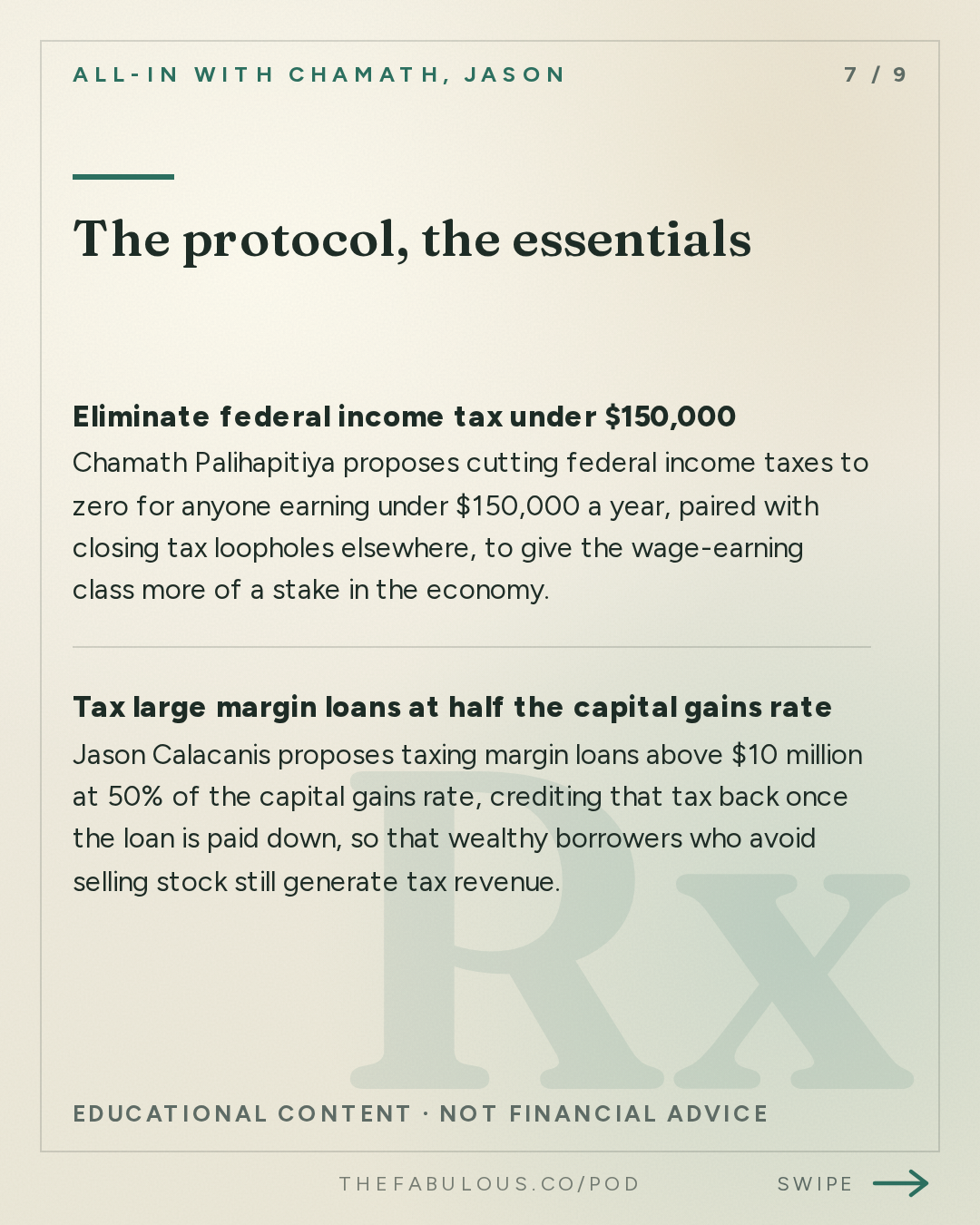
Eliminate federal income tax under $150,000
Chamath Palihapitiya proposes cutting federal income taxes to zero for anyone earning under $150,000 a year, paired with closing tax loopholes elsewhere, to give the wage-earning class more of a stake in the economy.
One-time legislative change
-
Tax large margin loans at half the capital gains rate
Jason Calacanis proposes taxing margin loans above $10 million at 50% of the capital gains rate, crediting that tax back once the loan is paid down, so that wealthy borrowers who avoid selling stock still generate tax revenue.
Applied whenever a margin loan over $10 million is taken
-
End the Iran war to reverse inflation
David Sacks says President Trump's single most important move for the next 18 months is ending the war in Iran, arguing this would let Brent crude oil fall from roughly $110 to $70 a barrel and pull gas, diesel, and food prices back down.
Immediate, one-time policy decision
Questions this episode answers
Why did Republicans lose the 2026 midterms?
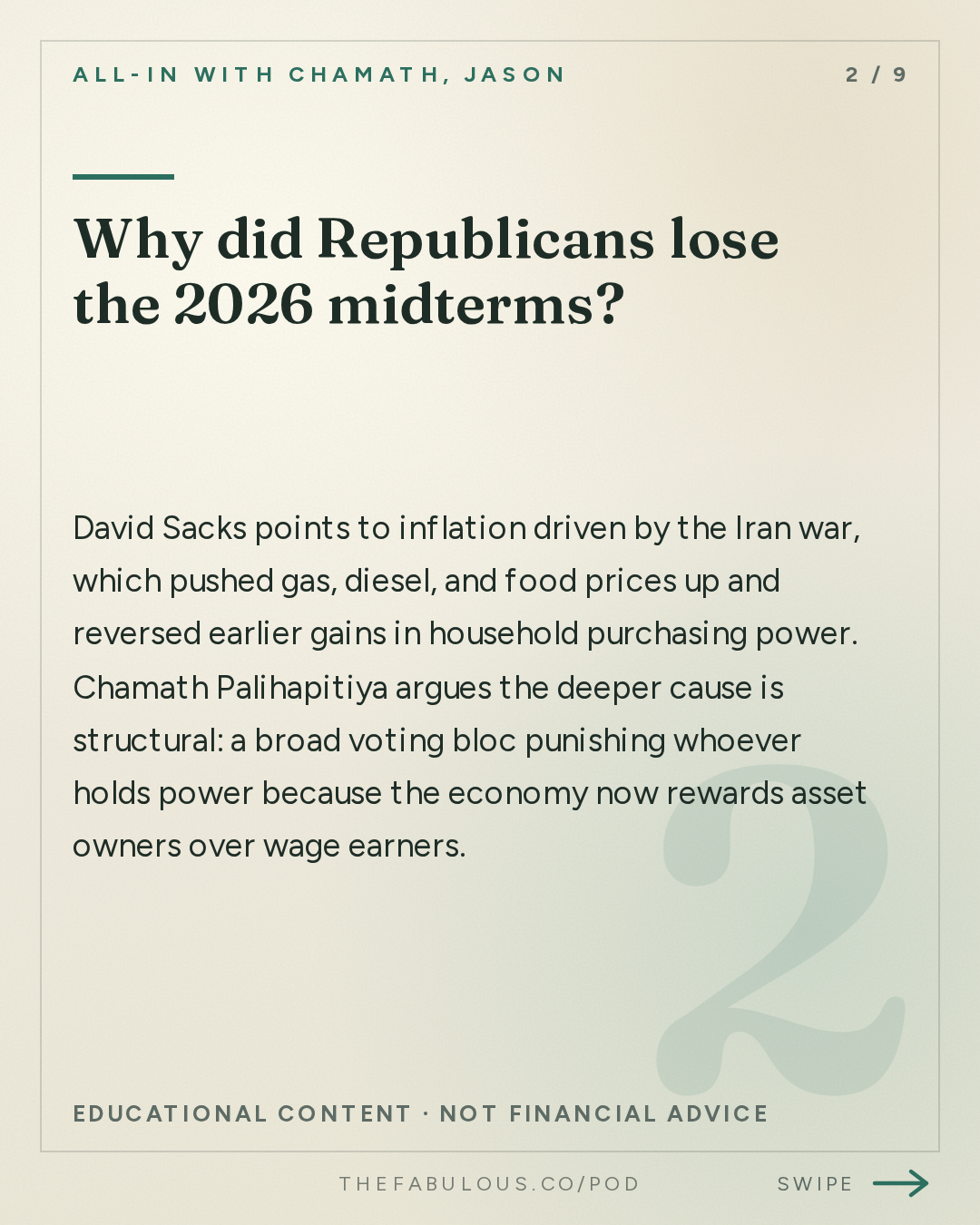
David Sacks points to inflation driven by the Iran war, which pushed gas, diesel, and food prices up and reversed earlier gains in household purchasing power (05:42, 06:53). Chamath Palihapitiya argues the deeper cause is structural: a broad voting bloc punishing whoever holds power because the economy now rewards asset owners over wage earners (19:34).
What is the Exponential Time Hypothesis and did OpenAI disprove it?
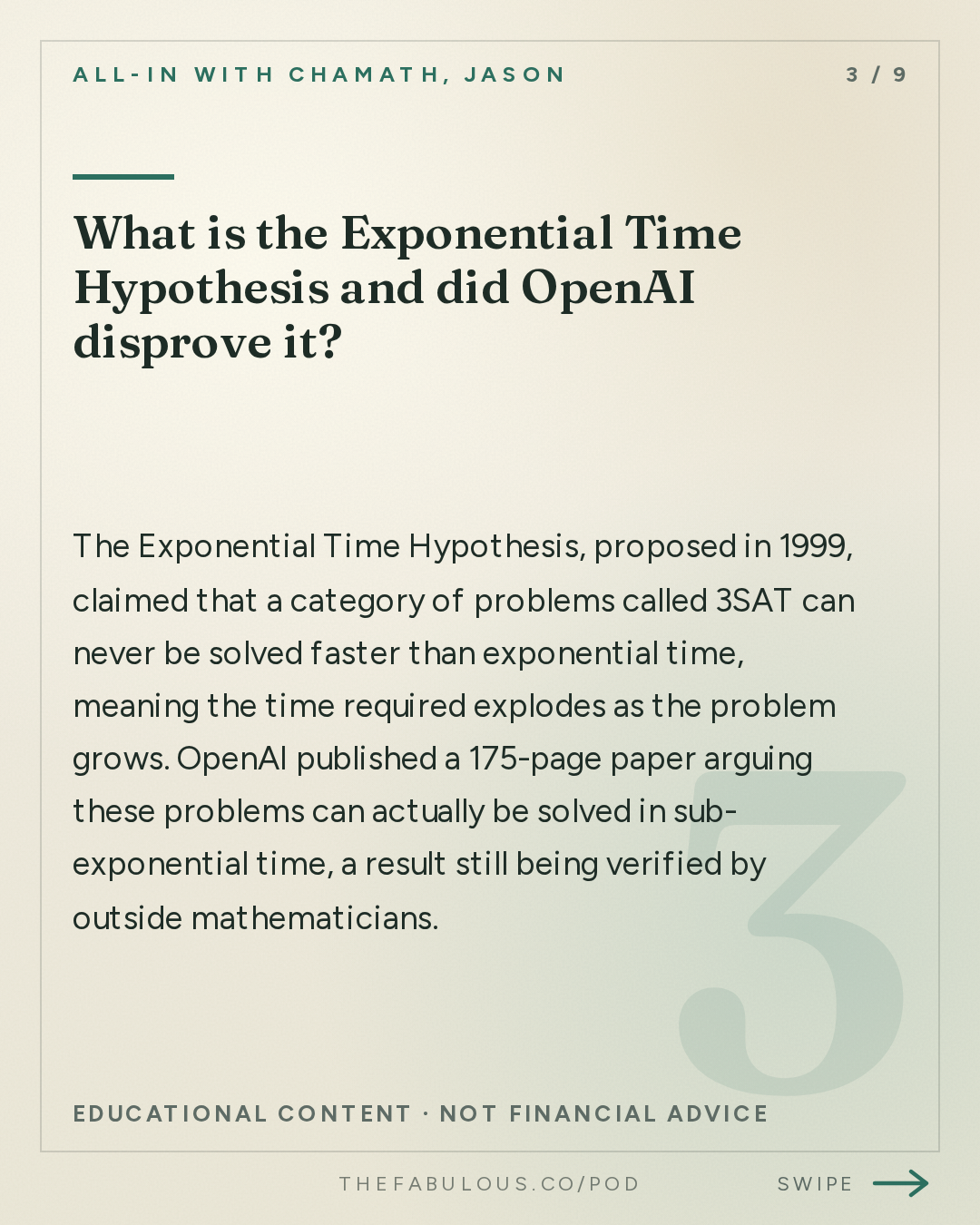
The Exponential Time Hypothesis, proposed in 1999, claimed that a category of problems called 3SAT can never be solved faster than exponential time, meaning the time required explodes as the problem grows. OpenAI published a 175-page paper arguing these problems can actually be solved in sub-exponential time, a result still being verified by outside mathematicians (87:02, 88:01).
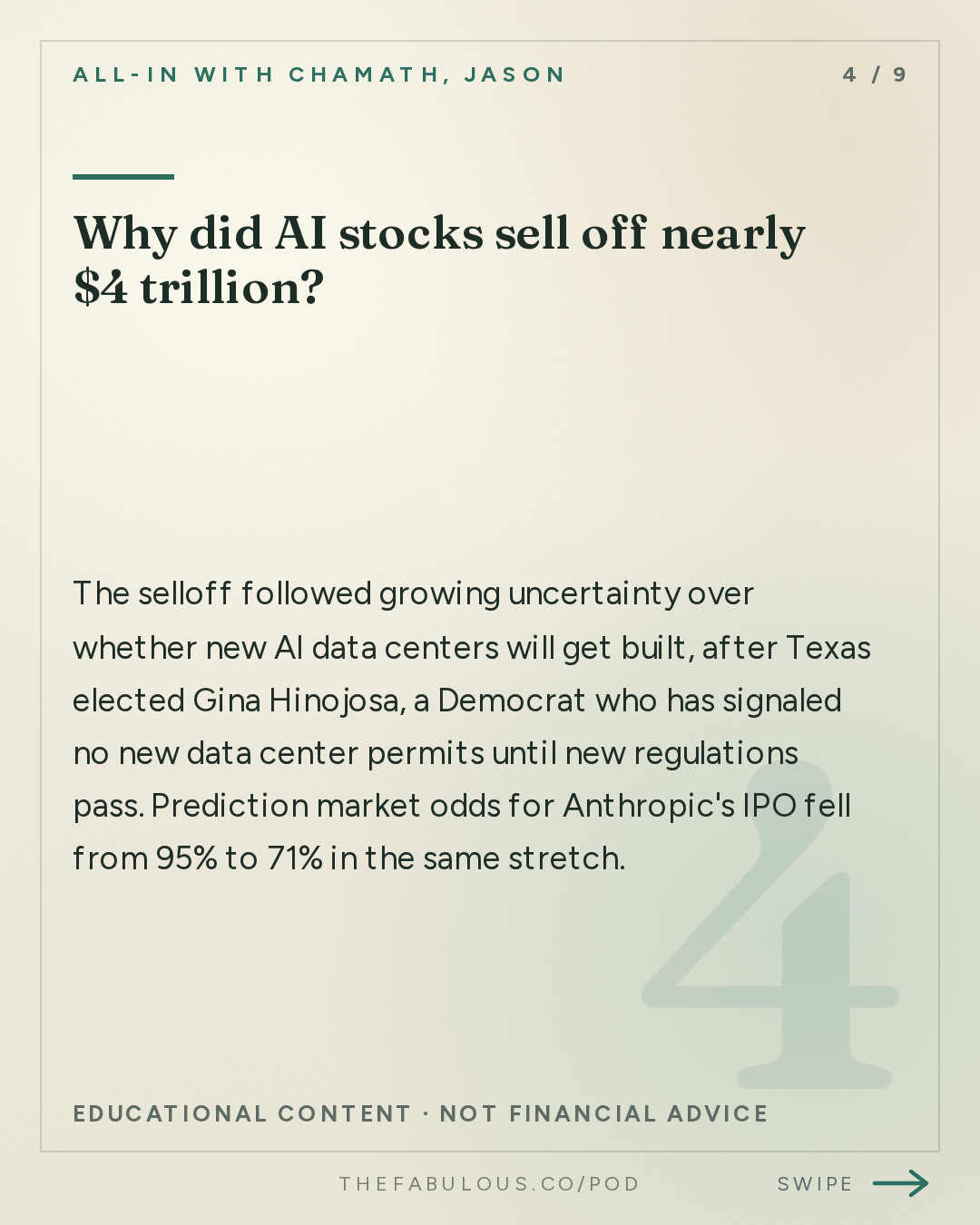
Why did AI stocks sell off nearly $4 trillion?
The selloff followed growing uncertainty over whether new AI data centers will get built, after Texas elected Gina Hinojosa, a Democrat who has signaled no new data center permits until new regulations pass (53:22, 75:27). Prediction market odds for Anthropic's IPO fell from 95% to 71% in the same stretch (54:06).
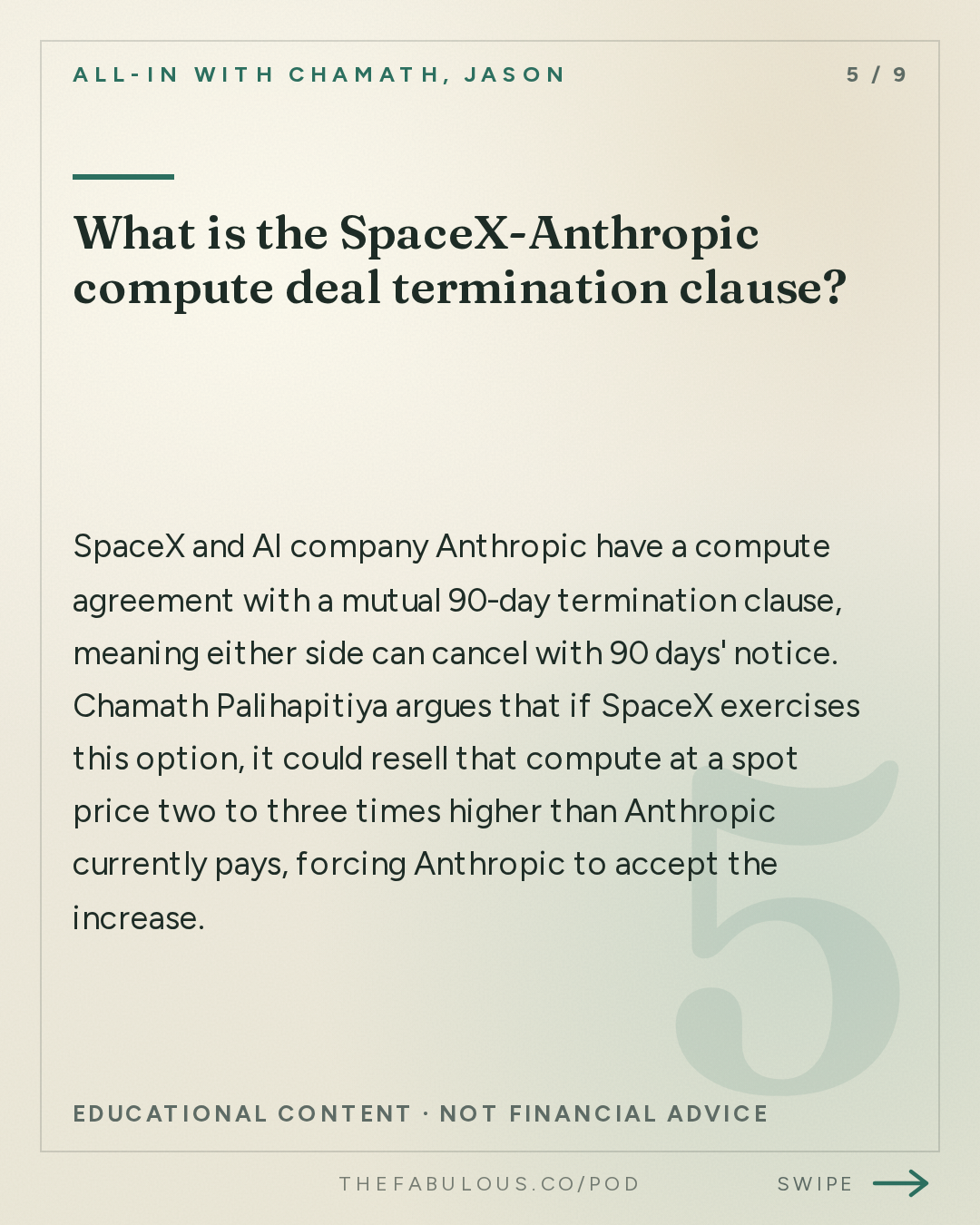
What is the SpaceX-Anthropic compute deal termination clause?
SpaceX and AI company Anthropic have a compute agreement with a mutual 90-day termination clause, meaning either side can cancel with 90 days' notice (59:29). Chamath Palihapitiya argues that if SpaceX exercises this option, it could resell that compute at a spot price two to three times higher than Anthropic currently pays, forcing Anthropic to accept the increase (60:06).
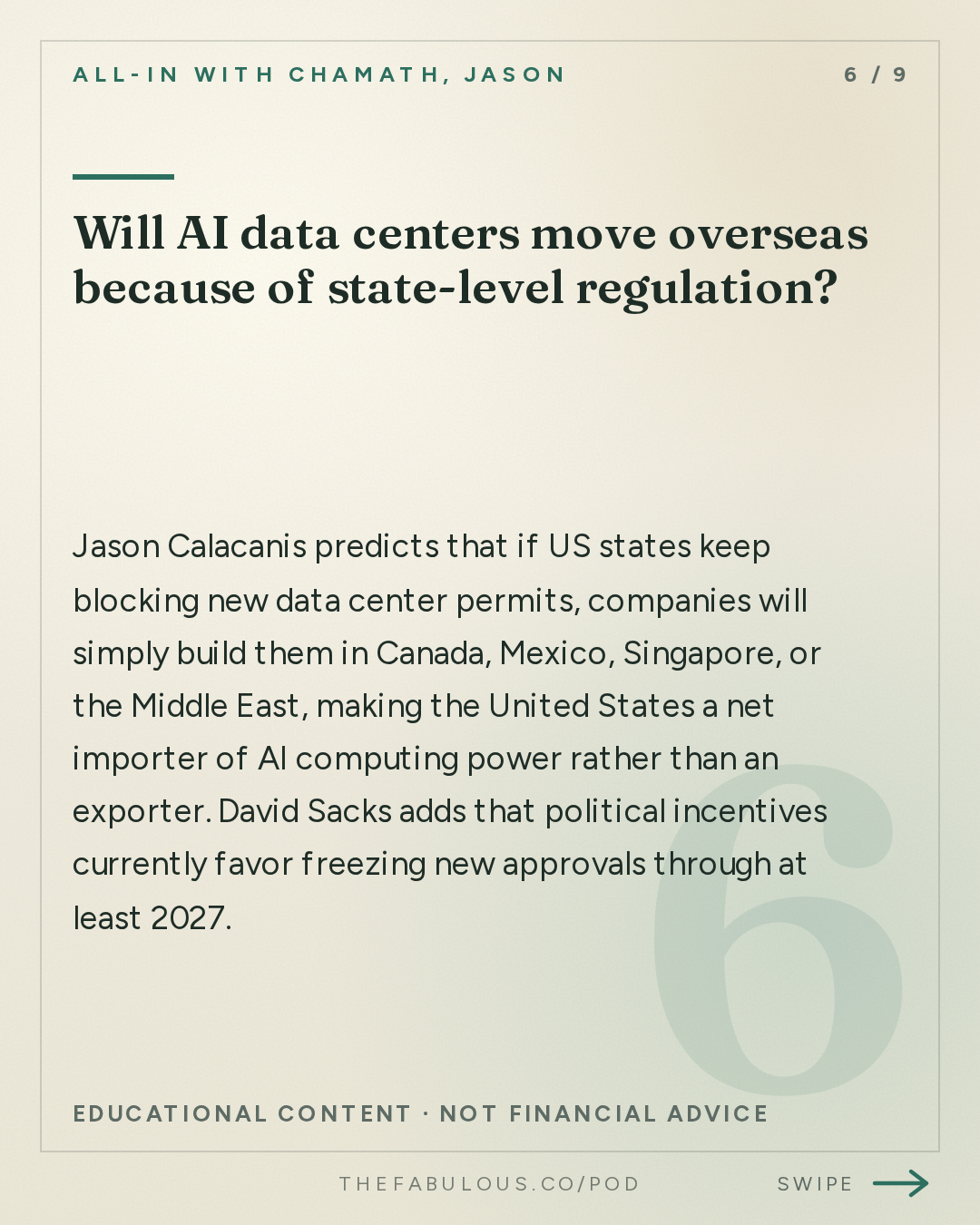
Will AI data centers move overseas because of state-level regulation?
Jason Calacanis predicts that if US states keep blocking new data center permits, companies will simply build them in Canada, Mexico, Singapore, or the Middle East, making the United States a net importer of AI computing power rather than an exporter (61:24, 62:41). David Sacks adds that political incentives currently favor freezing new approvals through at least 2027 (77:03).
The full read, in cards
Go deeper
- Gallup Global AI Optimism Survey — found China at 93% AI optimism versus the US at 36%, fourth from the bottom worldwide
- Silver Bulletin election forecasts — tracked Trump's net approval rating falling from roughly +5 to -28 over the course of 2025
- OpenAI paper on the Exponential Time Hypothesis — a 175-page proof arguing the 1999 hypothesis is false and that 3SAT problems can be solved in sub-exponential time
Mentioned
Donald Trump · Elon Musk · Gina Hinojosa · J.D. Vance · OpenAI · SpaceX · Anthropic · PolyMarket · Nate Silver · Rick Rubin
More from this show and category

What Anthropic's S-1 Filing Really Reveals
Anthropic's leaked S-1 shows a six-year-old company aiming to raise $100 billion at a valuation near $2 trillion, with an 85% gross margin and a reported $80 billion loss that turns out to be an accounting artifact, not real cash burn (07:07). The same filing reveals a new macro risk: AI firms now compete with the US Treasury for capital (32:48).

Whoop CEO Will Ahmed on Health Data and HRV
Whoop CEO Will Ahmed says his wearable has logged over 50 billion hours of physiological data from members who wear it 23.6 hours a day, letting its AI flag illness before symptoms, fueling a fight with the FDA over whether blood pressure tracking counts as wellness or medicine.

Nikesh Arora on the AI Cybersecurity Threat
AI spending is concentrated and circular: 1% of companies generate 90% of AI revenue, mostly unprofitable VC-backed startups (02:25). A PHP coding flaw rated 9.2/10 exposed roughly 70% of the internet's websites (14:29). And France now spends more of its GDP through government than the Soviet Union did at its 1989 peak (52:50).

Dylan Field: Design Is the New Code
Figma CEO Dylan Field argues design, not code, now drives software's value as AI makes coding cheap and commoditized. He explains how Figma survived a blocked $20 billion Adobe acquisition, why AI lowers production's floor without raising creativity's ceiling, and why human willingness to say non-consensus things remains the real differentiator in an AI-saturated market.
