
Martin Casado on AI's Capital Economics
Martin Casado on Frontier Model Economics, AI's Slowdown, and the Cursor Deal - [Invest Like the Best, EP.498]
The brief
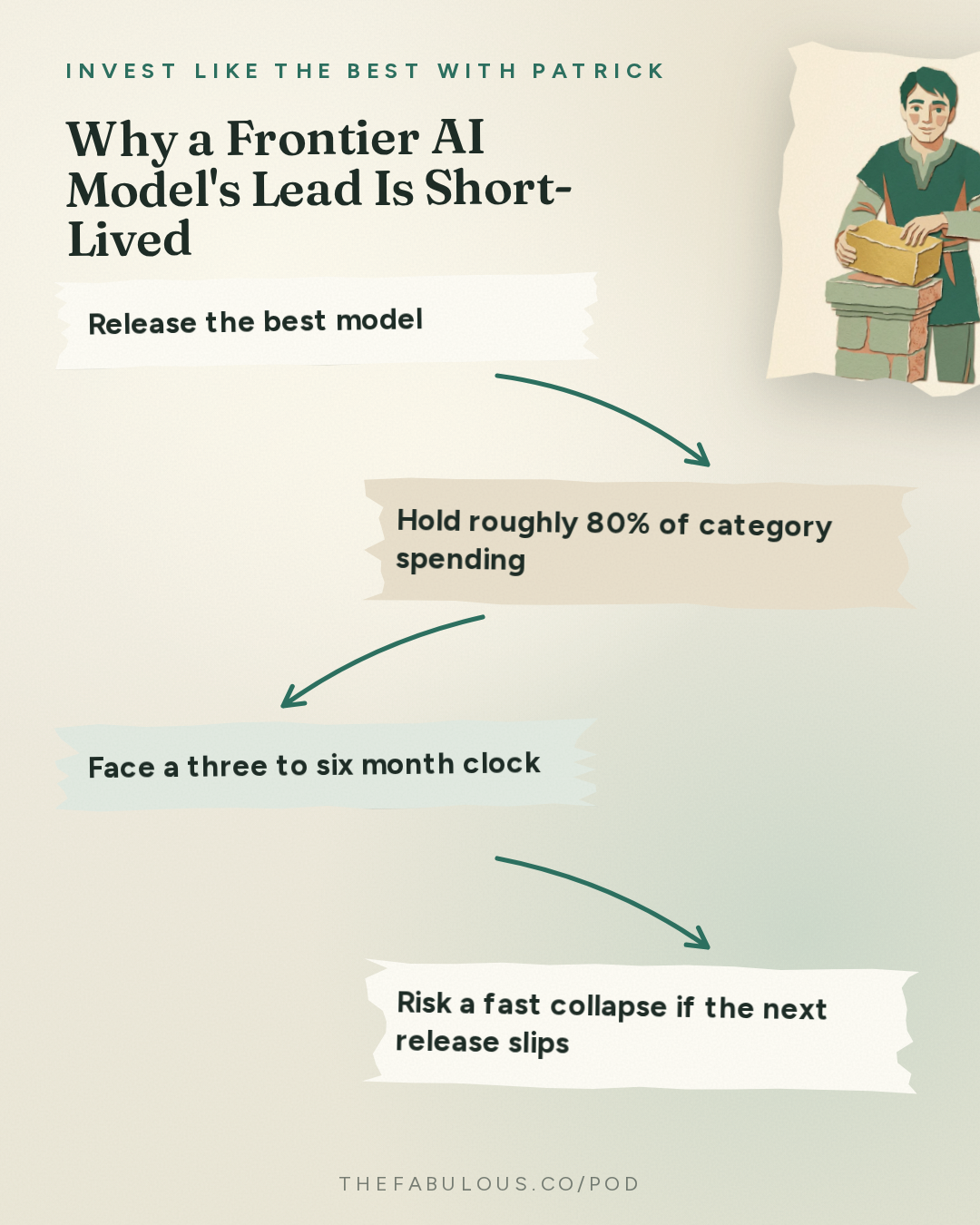
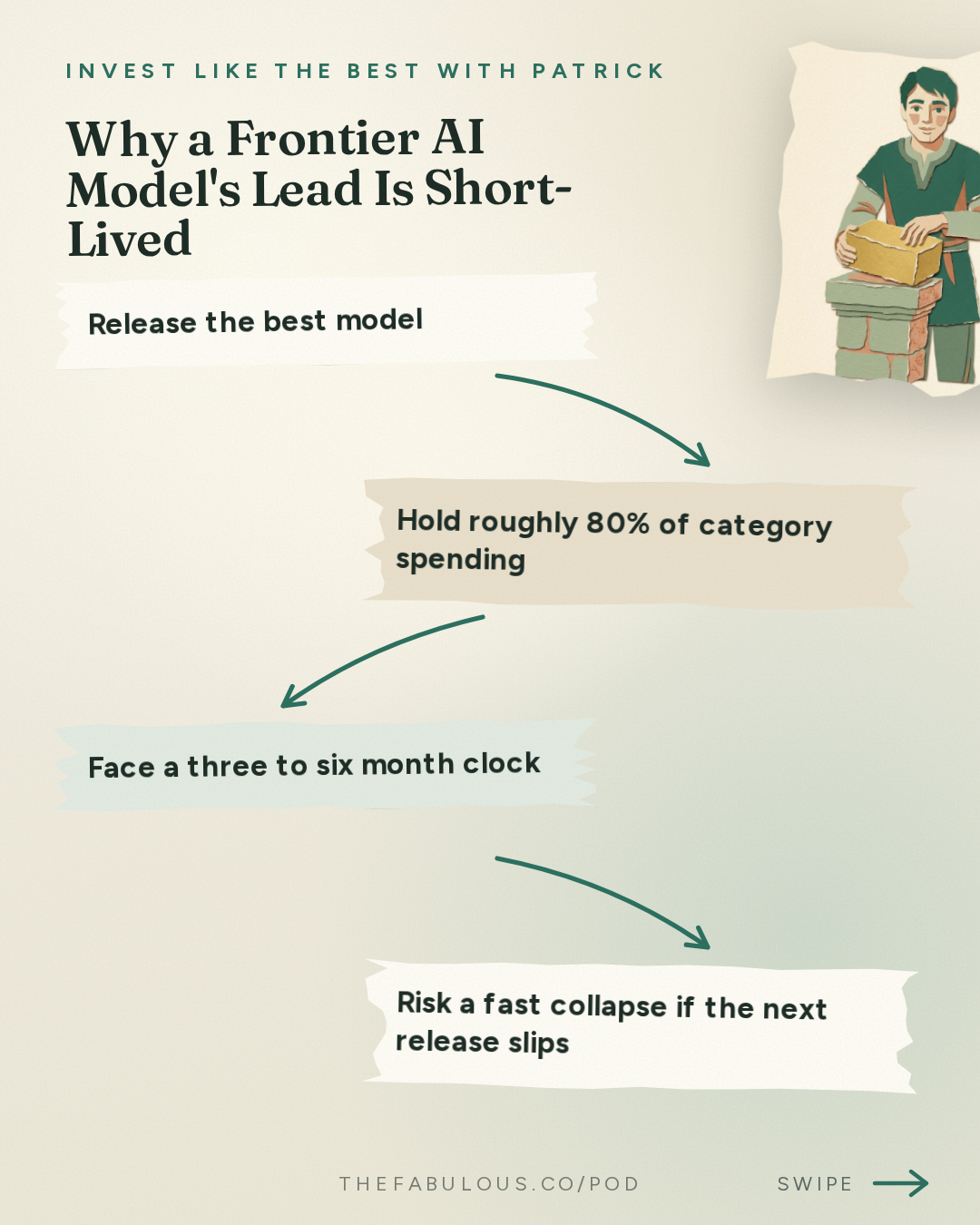
Andreessen Horowitz general partner Martin Casado says AI's biggest shift is that capital, not engineering, now solves digital problems. Frontier models last three to six months before being overtaken (24:58), the top model captures 80% of spending (23:19), and Casado insists private markets already price risk accurately (44:55).
For most of the history of computing, money could not buy a way out of an engineering problem. Programmer Fred Brooks said so in the '70s, in a book called The Mythical Man-Month: adding more people to a late software project only makes it later, because the cost of coordinating people grows faster than the work gets done (38:18). Martin Casado, a general partner at the venture firm Andreessen Horowitz, has spent his career inside that constraint. He founded a networking startup called Nicira, sold it to VMware for $1.26 billion (52:07), and now invests across the infrastructure that runs the internet. His claim, made across a long conversation with Patrick O'Shaughnessy, is that this constraint just broke. A team of twenty people and a billion dollars, he argues, can now simply buy its way to a solution, because artificial intelligence turns an engineering problem into a resourcing problem (38:38).
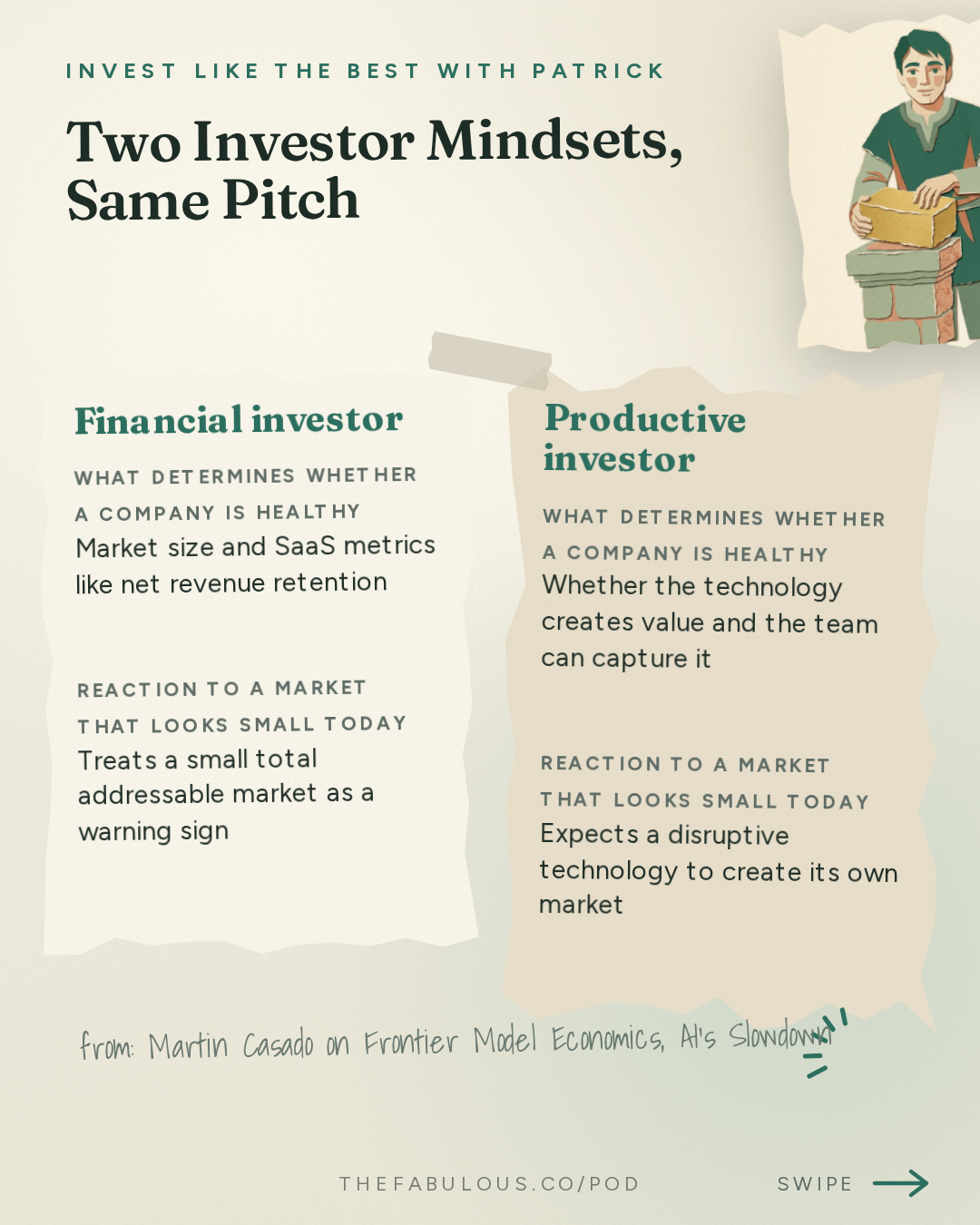
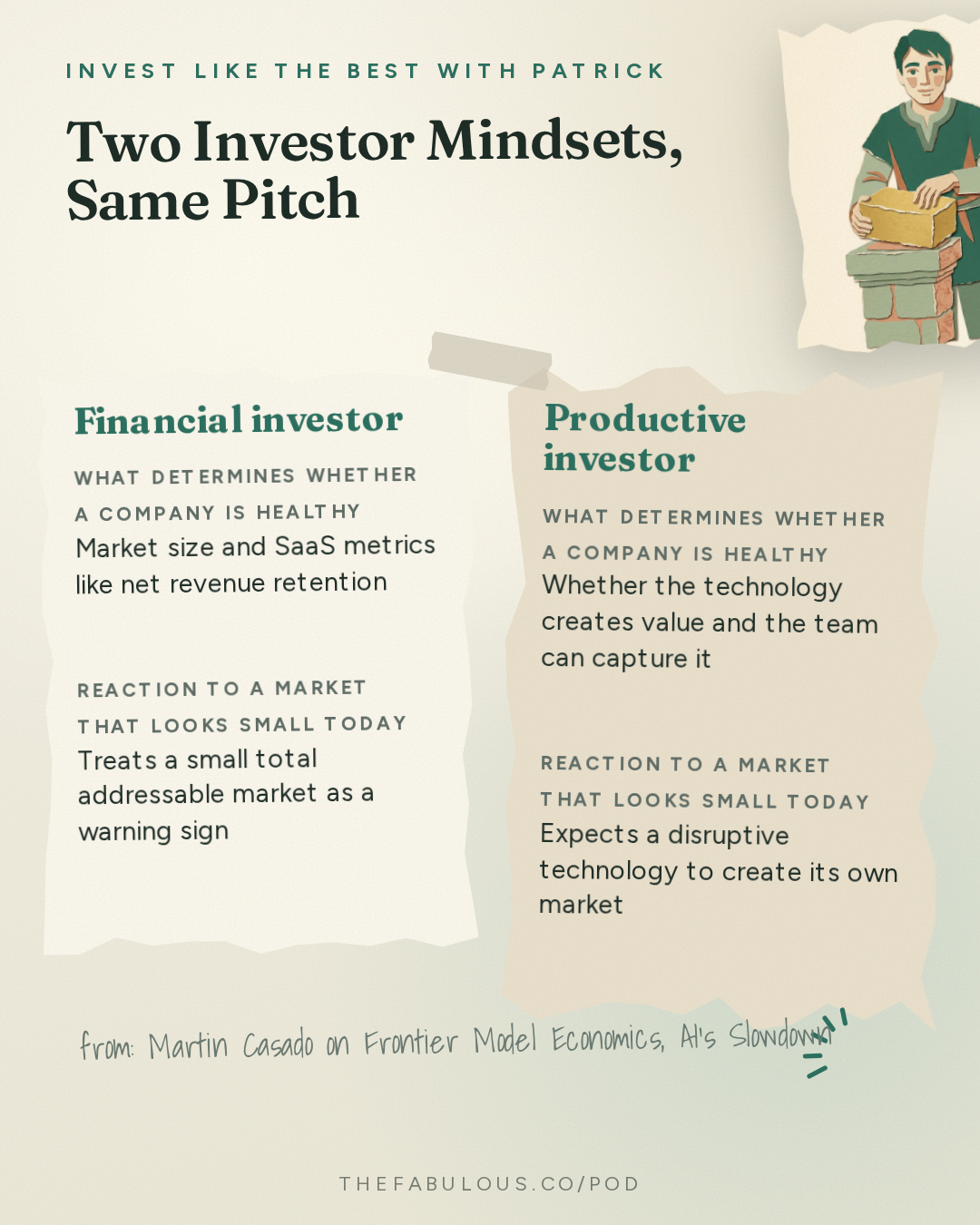
Casado starts with a complaint about language. After a decade and hundreds of deals, he noticed that investors in the same room often are not disagreeing about a company, they are using identical words to mean different things. So he sorted venture investors into four mindsets (02:10). Traditional finance investors treat market size and SaaS metrics as a stand-in for the whole business. Productive investors bet on a technology because they believe it creates value, and expect the market and the business model to catch up later. Frontier investors back people more than plans, the loose, talent-chasing style associated with 1960s and 70s venture, or with investor Chris Dixon's run through nootropics, the meal-replacement company Soylent, Oculus, and Coinbase (03:20). Speculative investors do not care about the underlying asset at all, they are just trying to time a market. Casado's point is not that one mindset is correct. It is that mixing them produces nonsense, like an investor who claims to back disruptive technology but also demands clean net revenue retention before the business model has even settled (16:00).
The Shape of a Moat
Casado's pet peeve is the term network effect, which shows up on 70% of pitch decks (07:53) and means something different to nearly everyone who says it. He argues the confusion is not about definitions, it is about conflating the mechanism that creates a moat, a brand, scale, a two-sided marketplace, a true network effect, with the shape that moat takes over time. A moat that grows super linearly with scale, the way the 1970s Metcalfe's Law model of a telephone network predicted, is genuinely defensible: the leader pulls further ahead for every dollar spent. A moat that grows sublinearly is not, because a challenger spending the same money eventually catches up (11:15). By that standard, Casado thinks true network effects are rare. He names the old telephone monopolies, LinkedIn, and GitHub. Most of what gets called a network effect, including Uber's two-sided marketplace of drivers and riders, is really a scale effect, where unit economics improve with size but no lock exists on either side of the market (12:08). He goes further still: in a growing market, defensibility barely matters, because companies expand into new white space rather than fight over existing customers (13:03). He saw this play out with early AI investors who swore language models would never hold value because rivals could copy them. Three years later, the frontier models that are the best still earn about 80% of category spending (23:19).
On the infrastructure side, Casado still thinks in categories he has used for three decades: compute, network, storage, and databases (18:29). What changed is who the software now serves. Developer tools used to be built around human ergonomics, trading off safety or speed so a person could still use the interface. AI agents do not need that compromise, which is why Casado calls this the biggest refresh of computer science infrastructure since the internet (19:26). Transaction databases, the kind banks run on, known in the industry as OLTP for online transaction processing, stayed stable for decades because changing their query language meant retraining a generation of programmers. Agents do not need retraining, so entirely new database designs are now appearing (20:56). Networking, a field Casado studied for his PhD, had been quiet for fifteen years and is active again because AI training clusters demand far stricter performance (21:54).
When Capital Replaces Engineering
Models themselves, Casado argues, now behave like infrastructure, closer to custom chips than to ordinary software, because of what they cost and how fast they expire. A leading model, referenced here as Mythos, reportedly cost roughly $3 billion to produce (55:36), and that kind of spend sets a bar rivals must clear quickly.
"I would say the lifespan of a model is three to six months." (Martin Casado, [24:58])
That short shelf life explains an apparent contradiction Patrick O'Shaughnessy raised: companies say they have already automated 95% of possible coding tasks (26:12), yet keep paying up for the newest, priciest model. Casado separates the two facts. Running out of new tasks to automate is not the same as being willing to use a cheaper model, because two competing startups locked in the same market will always pay ten times more for the smarter option rather than risk losing to a rival that did (26:29). Pricing power holds as long as competition stays live, even once an industry runs out of new token volume to sell.
This is where Brooks's old law gets inverted. Casado recalls that a decade ago, handing five founders a billion dollars would have ended badly, they would have overhired and stalled, exactly as the Mythical Man-Month predicts. Today, because any problem that can be simulated on a computer can become a reinforcement-learning environment, meaning a digital practice space where a system tries an action and gets scored on it, Casado argues capital alone can now buy a solution to anything digital: 3D graphics, general computer use, code (31:02).
"I really think the big disruption of AI is the fact that you can throw capital at problems. In the history of tech, you haven't been able to do that." (Martin Casado, [37:13])
He is careful to say this logic is unproven outside the digital world, robotics, biology, and medicine remain open questions (32:04). The practical effect already shows up in capital markets. Casado says debt, not equity, is the tighter constraint right now: lenders are steering scarce credit toward investment-grade borrowers, leaving smaller GPU-rental infrastructure providers, known as Neoclouds, to prepay for hardware instead (39:48). Power and chip supply, not money, cap how fast those Neoclouds can grow, which is also why roughly 500 proposed pieces of US legislation aimed at slowing data center construction (43:49) make Casado take seriously the idea that some compute eventually moves offshore or into orbit.
His most contrarian claim has nothing to do with AI directly. He insists private markets are efficient, that prices mostly reflect risk-adjusted value, and that investors who claim to have found a clever non-consensus deal are usually fooling themselves (44:55). He says he was publicly criticized for arguing this on social media, and he also rejects the common venture belief that there is a fixed pool of deals that matter, so that more capital just inflates prices. In his view, capital entering private markets creates its own addressable market rather than splitting a fixed pie (49:50). Since he cannot literally buy an index of every competitive deal, his team runs a narrower version of the same idea: for every sector with credible founders, study the team, the technology, and the path to monetization, pick the strongest company, then defer to the market's price instead of hunting for a discount (46:37).
Casado has also been on the inside of some of the largest recent strategic acquisitions in software, including Cursor's deal and Fei-Fei Li's World Labs. His framework for how those deals get made is specific: a buyer is purchasing an option on a market much larger than the target's current business, so the founder has to supply what he calls an inductive proof, a base case for revenue today plus a credible step showing how attaching to the buyer's distribution unlocks the larger market (53:49). He contrasts this with the instinct many board members have to leak talks to the press to manufacture a bidding war, which he says only damages trust with the small number of sophisticated buyers capable of writing these checks (58:02).
Pressed to name what excites him most, Casado reaches for the largest frame available: the Industrial Revolution, which turned a zero-sum world into one where new value could be manufactured rather than merely redistributed (63:32). He thinks AI repeats that shift inside software specifically, converting what used to be an unscalable engineering problem into a capital allocation problem. Whether that logic extends past digital work, into biology, robotics, or the physical economy, he admits remains the open question behind his own thesis.
Ask this episode anything
Pod's AI answers from the episode itself, with the minute mark so you can hear it yourself.
Or start with one of these
Ask this episode
Pod's AI listens to the whole episode to answer, and points you to the minute it comes from.
The rest of this answer, and any question after it
Answers come from the episode itself, never from a summary of it.
ContinueKey takeaways
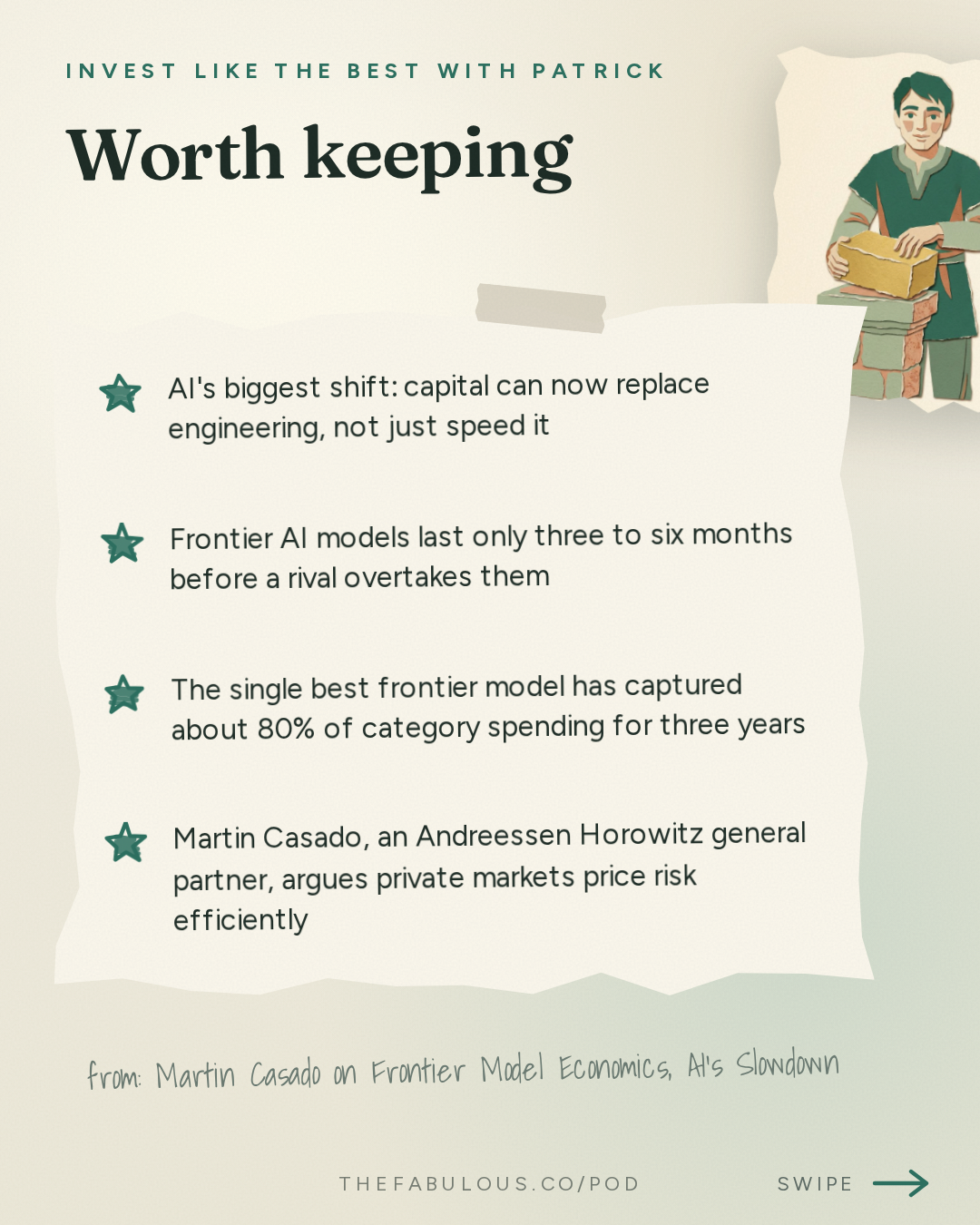
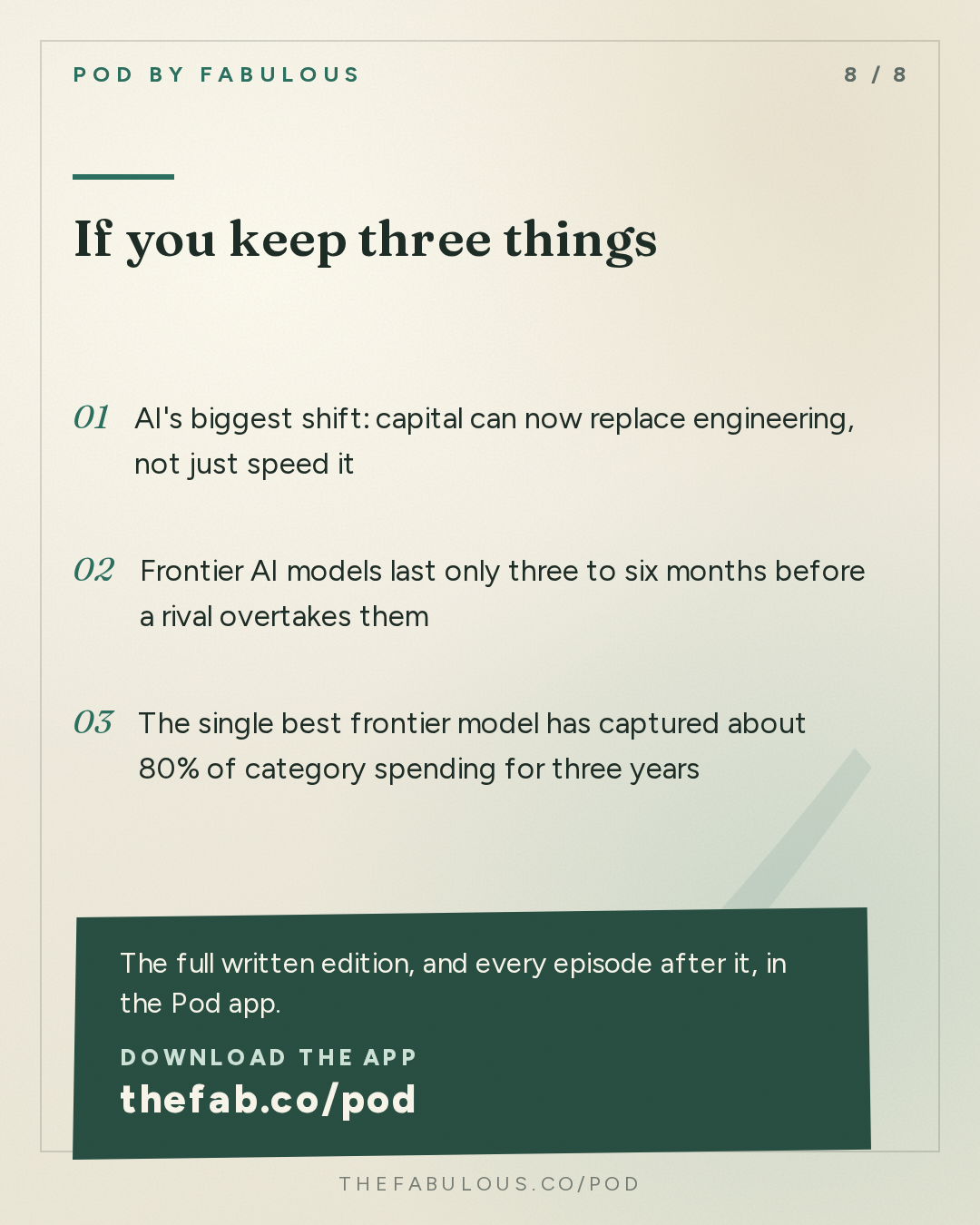
- AI's biggest shift: capital can now replace engineering, not just speed it
- Frontier AI models last only three to six months before a rival overtakes them (24:58)
- The single best frontier model has captured about 80% of category spending for three years (23:19)
- Martin Casado, an Andreessen Horowitz general partner, argues private markets price risk efficiently (44:55)
- Strategic M&A succeeds on trust and a two-step market proof, not leaks to the press (53:49, 58:02)
The episode in cards


By the numbers
- 500 bills proposed US pieces of legislation aimed at stopping data center construction
In their words
“If you truly believe you're investing in a disruptive technology, if that's what you truly believe in, A, you should believe it creates TAM, so why would you worry about market size?”
“I would say the lifespan of a model is three to six months.”
“I really think the big disruption of AI is the fact that you can throw capital at problems. In the history of tech, you haven't been able to do that.”
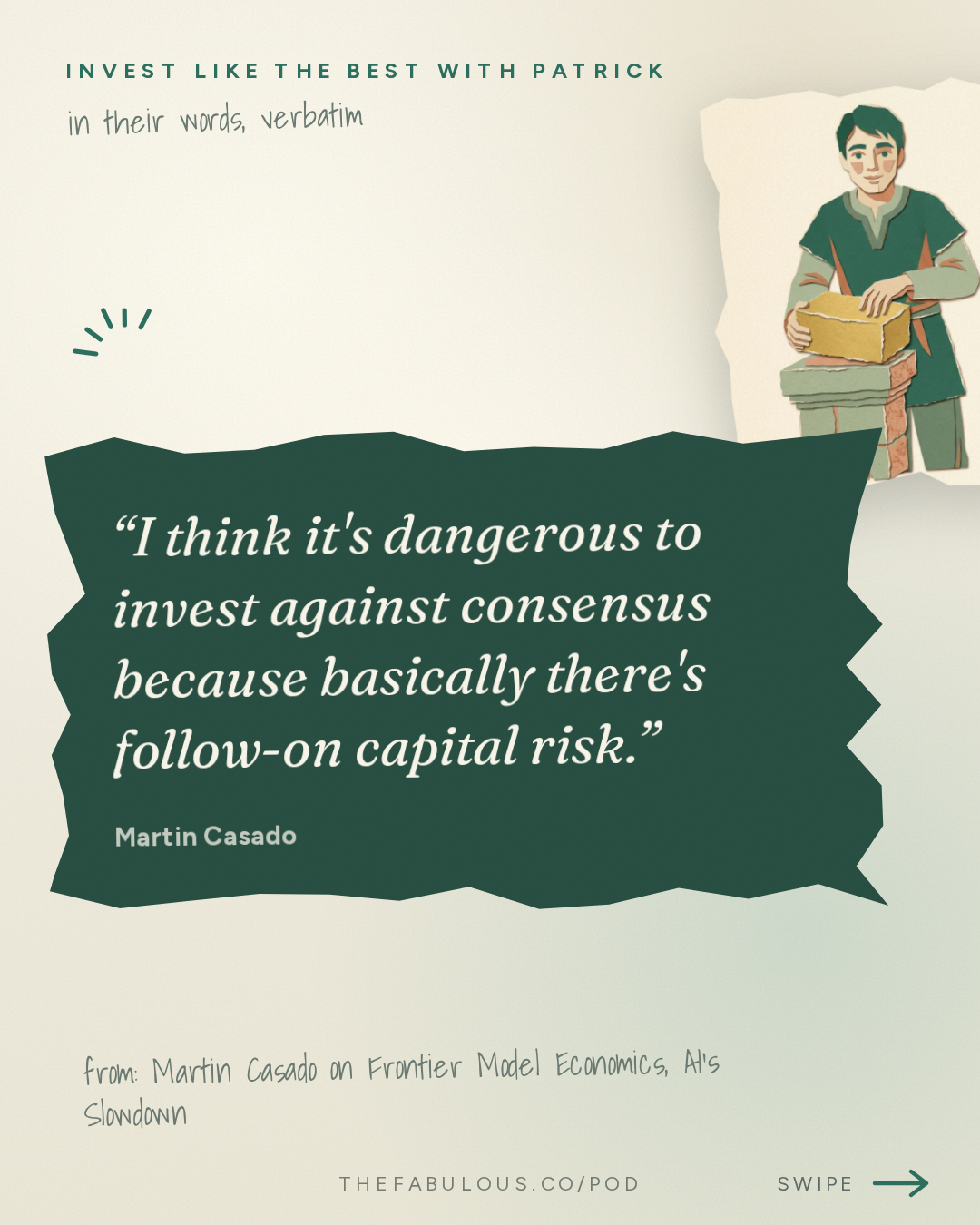
“I think it's dangerous to invest against consensus because basically there's follow-on capital risk.”
Protocols
-
Prove the Inductive Step Before Selling the Company
Martin Casado tells founders to show a strategic buyer a base case for the revenue the business can already capture, then prove an inductive step demonstrating how attaching to the buyer's platform unlocks a much larger market, because the buyer is purchasing a future option on that larger market.
Before and during acquisition talks
-
Keep Strategic M&A Talks Private and Trust-Based
Casado advises founders and board members to negotiate strategic acquisitions in good faith using real data points like a recent funding round, instead of leaking talks to the press or staging a competitive auction, because leaks destabilize trust with the small number of sophisticated buyers capable of writing these checks.
Throughout the negotiation
Questions this episode answers
How long does a frontier AI model stay competitive?
Investor Martin Casado says frontier AI models typically last three to six months before a rival releases something better (24:58). After that window, a model's pricing power and market share can collapse quickly, unlike software's usual long tail of retained use (24:22).
What percentage of the AI market do top frontier models capture?
The single best-performing frontier model has captured roughly 80% of category spending for three straight years, according to Casado, because buyers in competitive markets pay for even marginal intelligence advantages regardless of cost (23:19).
Are private markets efficient for venture investing?
Martin Casado, a general partner at Andreessen Horowitz, argues private markets price risk efficiently and that chasing underpriced non-consensus deals is largely a myth tied to investor ego (44:55, 47:51). This is his personal view and a contested one among other venture investors.
What is the Mythical Man-Month and why does Casado bring it up?
The Mythical Man-Month is programmer Fred Brooks's 1975 observation that adding engineers to a late software project makes it later, because communication overhead grows faster than output (38:18). Casado uses it to argue that AI changes the equation, since capital, not headcount, can now solve many problems because models do the engineering work (37:13).
How should founders handle strategic M&A talks?
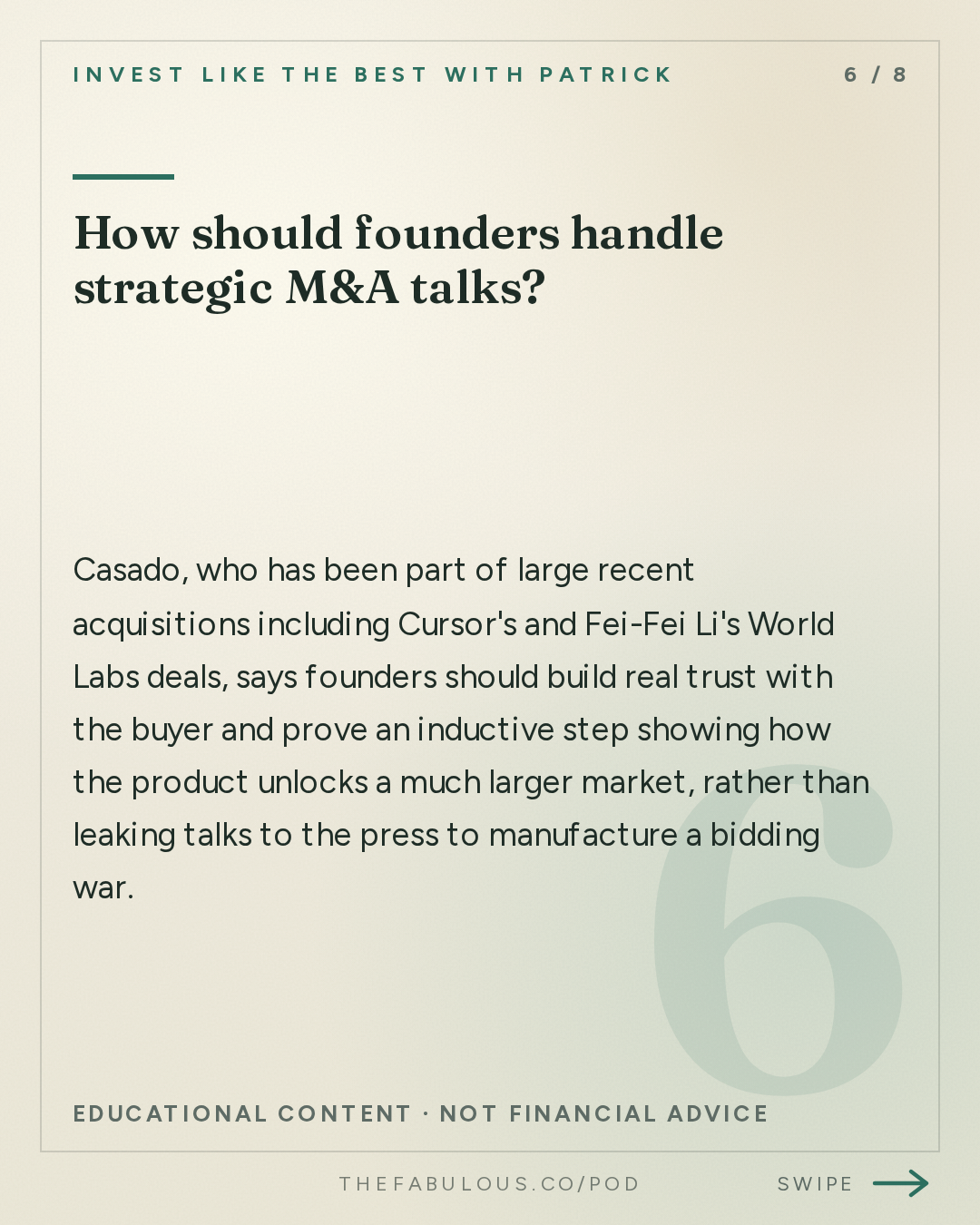
Casado, who has been part of large recent acquisitions including Cursor's and Fei-Fei Li's World Labs deals, says founders should build real trust with the buyer and prove an inductive step showing how the product unlocks a much larger market, rather than leaking talks to the press to manufacture a bidding war (53:49, 58:02).
Why does Casado think capital is now AI's biggest unlock?
He argues engineering has always been a bottleneck that money could not fix, citing Fred Brooks's Mythical Man-Month, but AI lets teams point large amounts of capital at a problem and solve it through reinforcement learning, where a system is trained in a simulated digital environment (31:02, 38:38).
The full read, in cards

Go deeper
- The Mythical Man-Month — Fred Brooks's 1975 argument that adding engineers to a late software project makes it later, which Casado uses to explain why AI's capital-driven approach is new
- Anthropic S-1 — Anthropic's investor filing, released the week of the conversation, framed the discussion of frontier model economics
Mentioned
Martin Casado · Arthur Rock · Chris Dixon · Fred Brooks · Fei-Fei Li · Metcalfe's Law · The Mythical Man-Month · Cursor · Grok · World Labs · Anthropic · OpenAI
More from this show and category

Cliff Sosin: Intelligence as a Commodity
Cliff Sosin argues intelligence is a ratio, not an unbounded scalar, so cheap AI can't solve problems that need physical experiments. The investor behind an 80% Carvana position says to put money in what AI can't replace: data, attention, physical proximity, and scale (08:14, 42:34).

Christina Cacioppo on Vanta's AI Strategy
Vanta founder Christina Cacioppo prefers an 80% growth, 80% margin business over a 160% growth, 30% margin one, despite a tenfold valuation gap. She also details how Vanta is eating the cost of AI tokens rather than marking them up, since a 4X markup on Claude would put the product in a losing price comparison with the model itself.

David Vélez on Nubank's AI Strategy and Banking's Future
Nubank founder David Vélez argues global banking is still in the Blockbuster era, with incumbents holding 90% of a $10 trillion industry (02:38), while Nubank's own AI foundation model and a flattened org structure let it serve 140 million customers at 3% of a traditional bank's cost (05:32).

Andrew Huberman on Sleep, AI, and Neurotech
Stanford neuroscientist Andrew Huberman lays out a three-step method for falling asleep fast, predicts that Meta, OpenAI, and Anthropic will become biotech companies racing to read and write the nervous system, and describes a memory experiment that undercuts how neuroscience thought memory worked. He also discusses the scientist who CRISPR-edited twin babies and reportedly now works in Austin, Texas.
