
Christina Cacioppo on Vanta's AI Strategy
Christina Cacioppo - Building an Enduring Software Company in the Age of AI - [Invest Like the Best, EP.496]
The brief
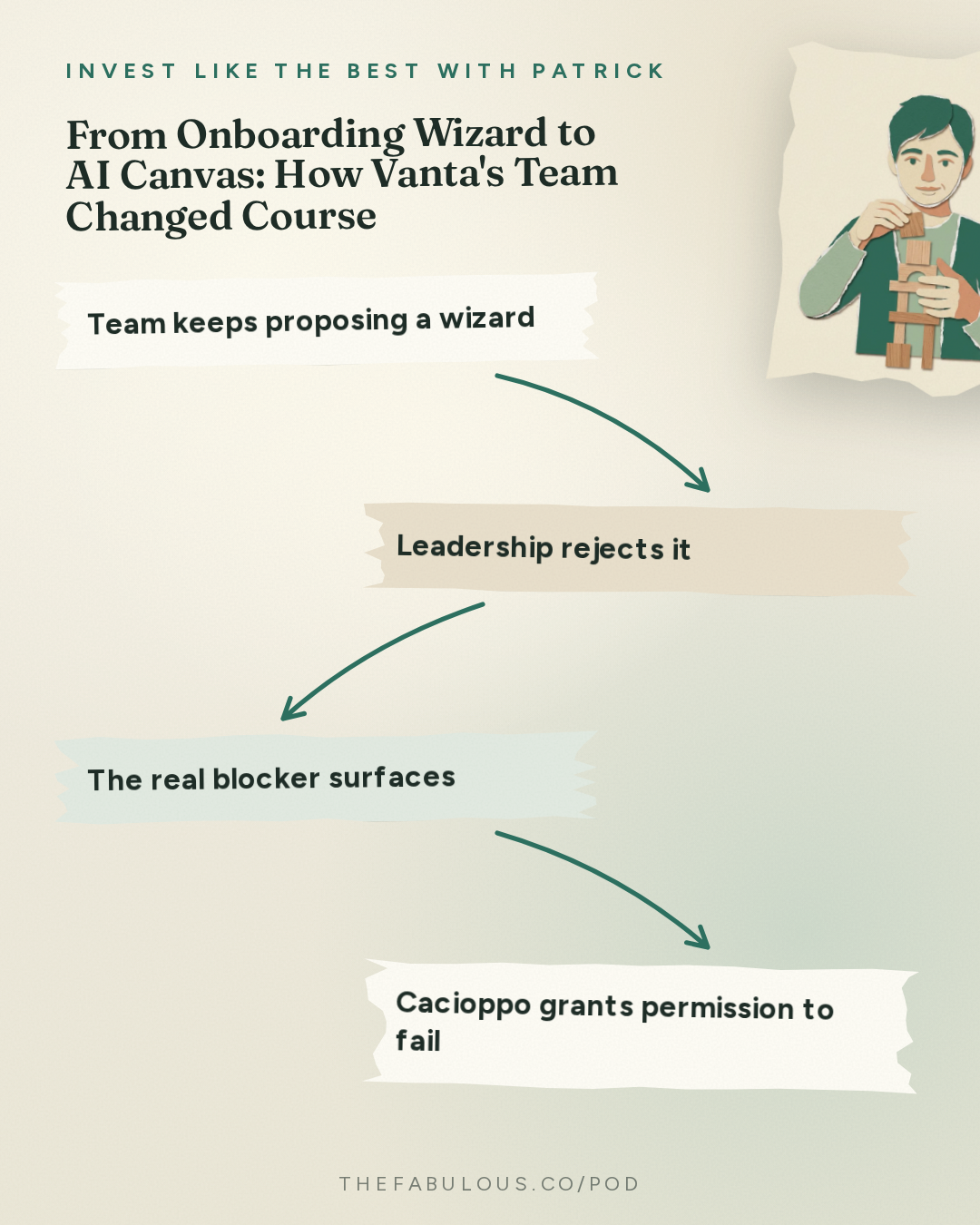
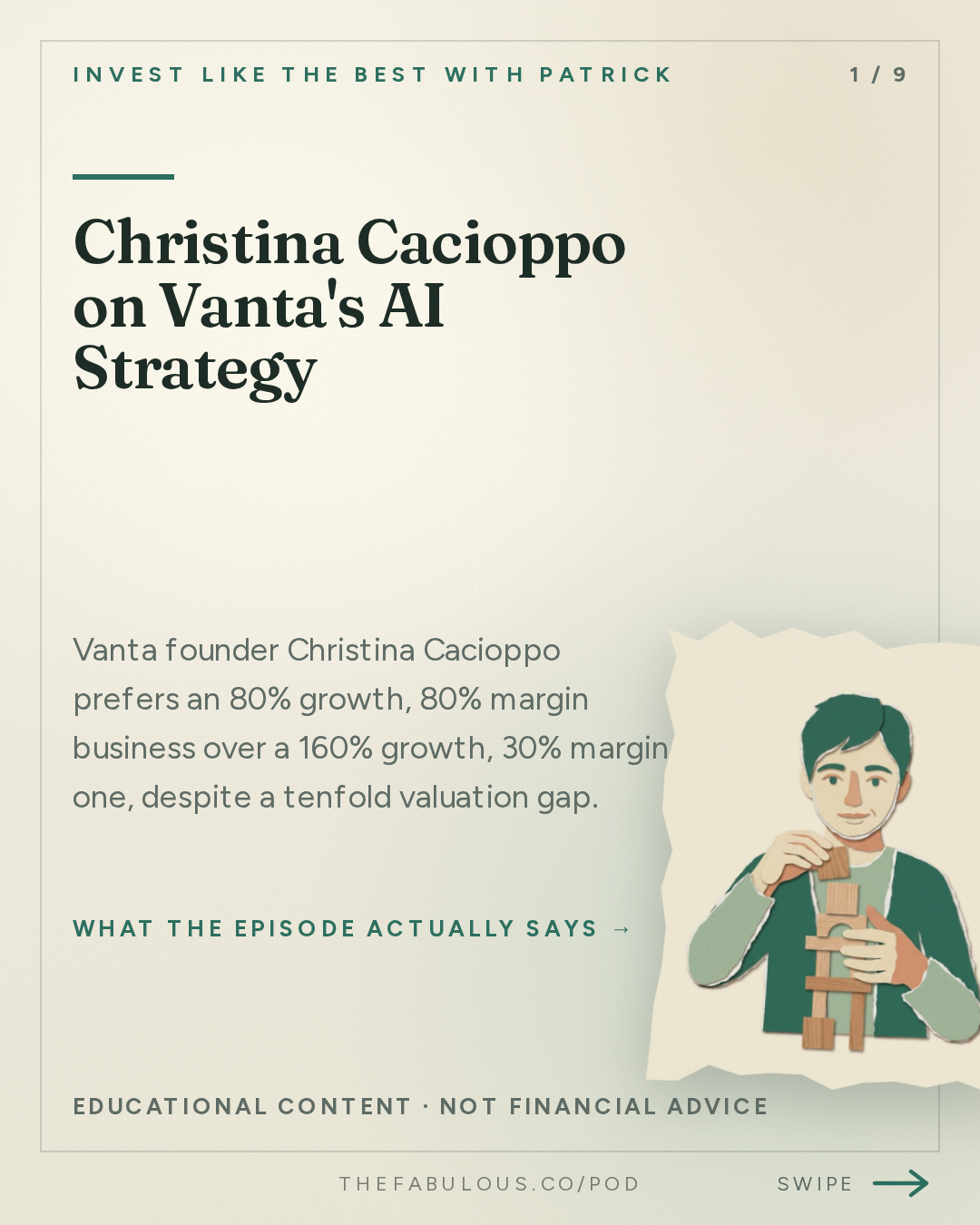
Vanta founder Christina Cacioppo prefers an 80% growth, 80% margin business over a 160% growth, 30% margin one, despite a tenfold valuation gap. She also details how Vanta is eating the cost of AI tokens rather than marking them up, since a 4X markup on Claude would put the product in a losing price comparison with the model itself.
Here is a puzzle that has nothing to do with bad management. A software company grows faster than it ever has, keeps its margins fat, and still watches investors cut its valuation to a quarter of what it used to be. That is the position Christina Cacioppo found herself in over the past year, running Vanta, the compliance and security platform she started eight years ago (02:06). Vanta now serves roughly sixteen thousand customers across five products (02:56), connects to four hundred other tools to pull in security data (03:55), and by any historical measure is a very good business. The market, for the moment, disagrees. Cacioppo calls the feeling of living through that gap cognitive dissonance, and her explanation of it is the clearest thing in this conversation about what it is actually like to run a mature software company inside an AI gold rush.
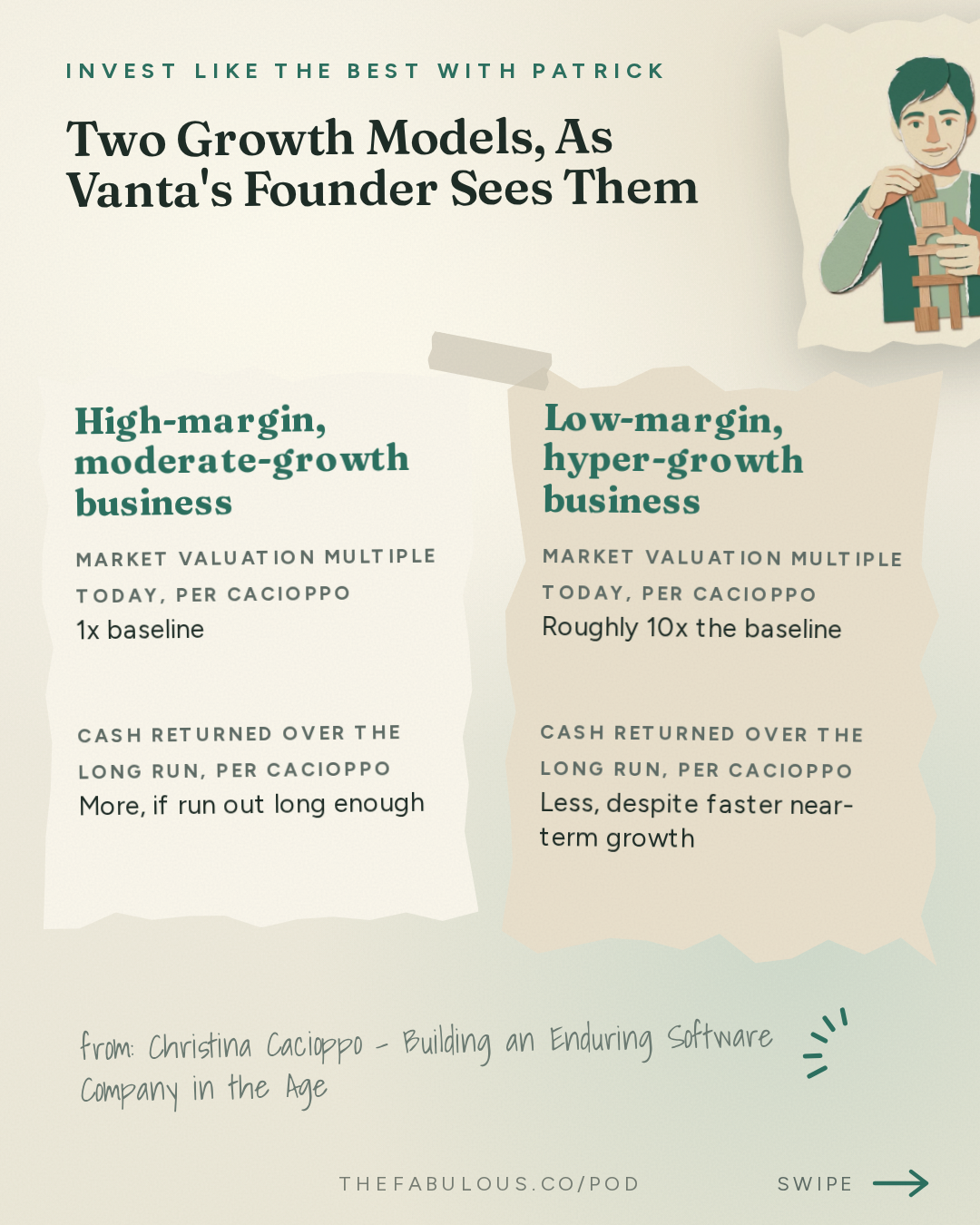
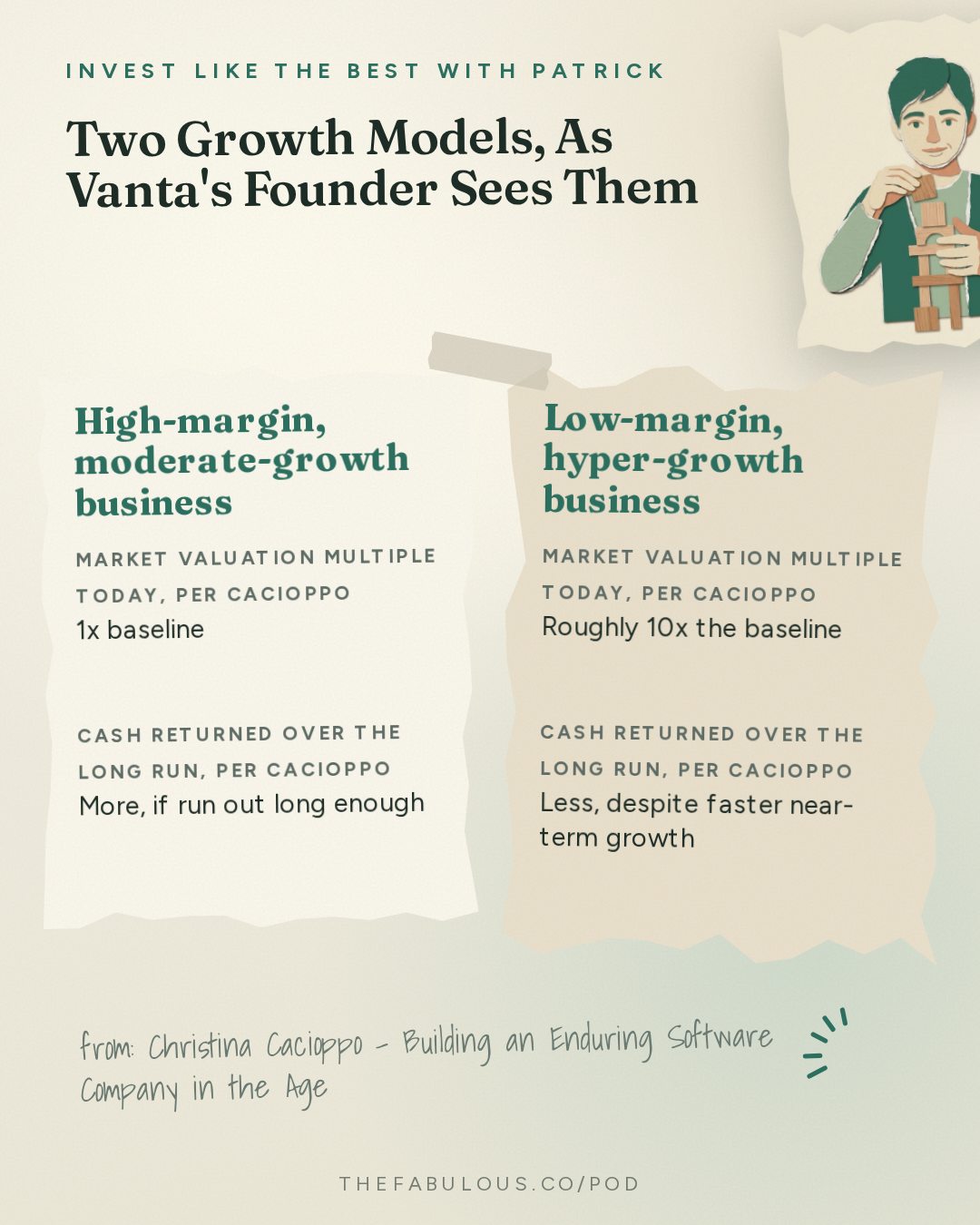
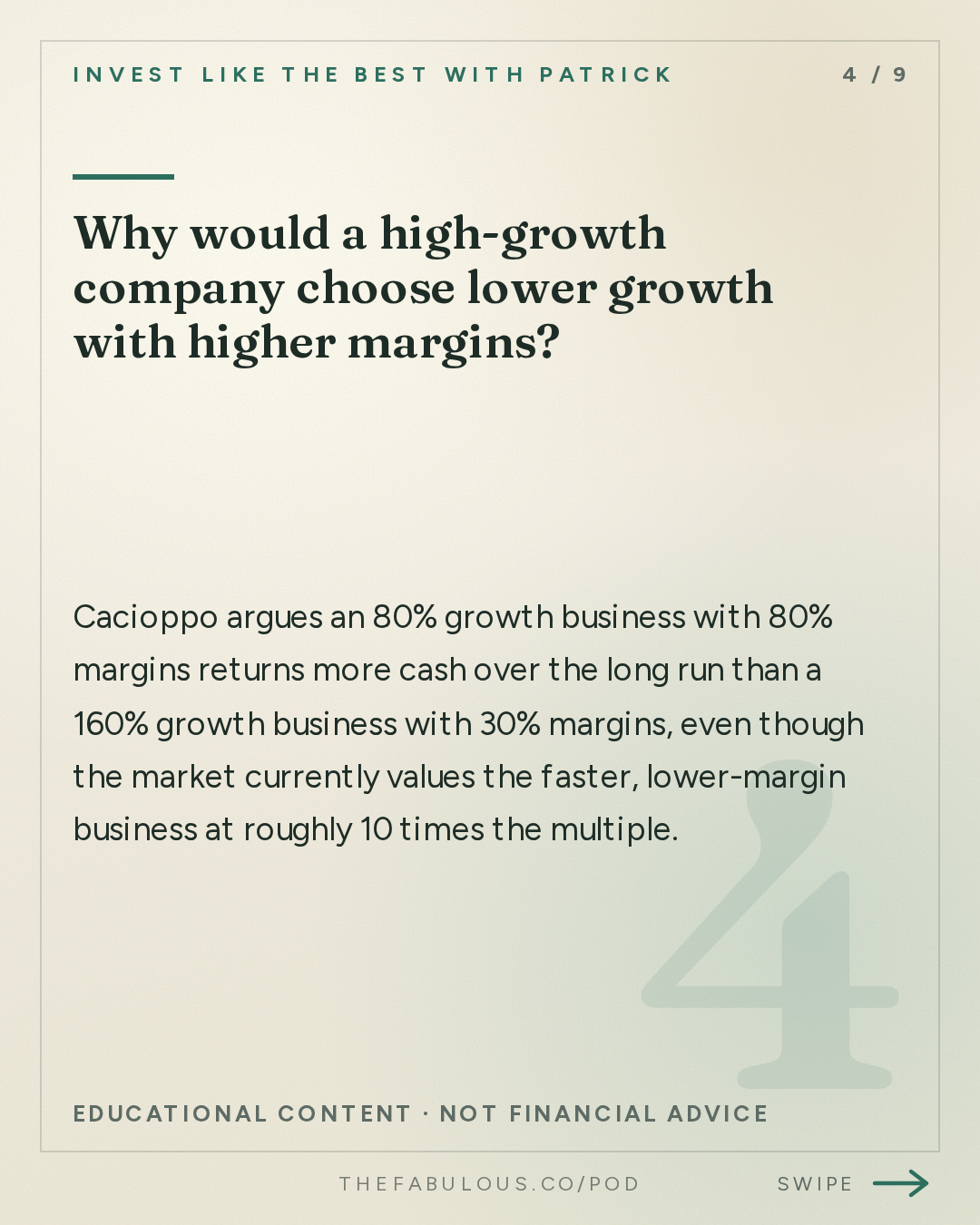
Her argument has a number attached to it. She believes an 80 percent growth business with 80 percent margins will, over a long enough horizon, return more cash to its owners than a 160 percent growth business with 30 percent margins. Today, she says, the market pays roughly three to four times the valuation multiple for the second kind of business (06:04).
"I think in the fullness of time, a eighty percent growth business with eighty percent margins will actually be better than over the same time period, run it out long enough, a hundred and sixty percent growth business with thirty percent margins." — Christina Cacioppo [06:04]
She is not claiming the market is wrong forever, only that it is wrong right now, and that she has to operate inside that wrongness anyway, because the people she hires are reading the same headlines she is. If a rival offers an engineer a story about a trillion-dollar outcome, Vanta has to compete for that engineer's attention even while Cacioppo thinks the story is often fantasy.
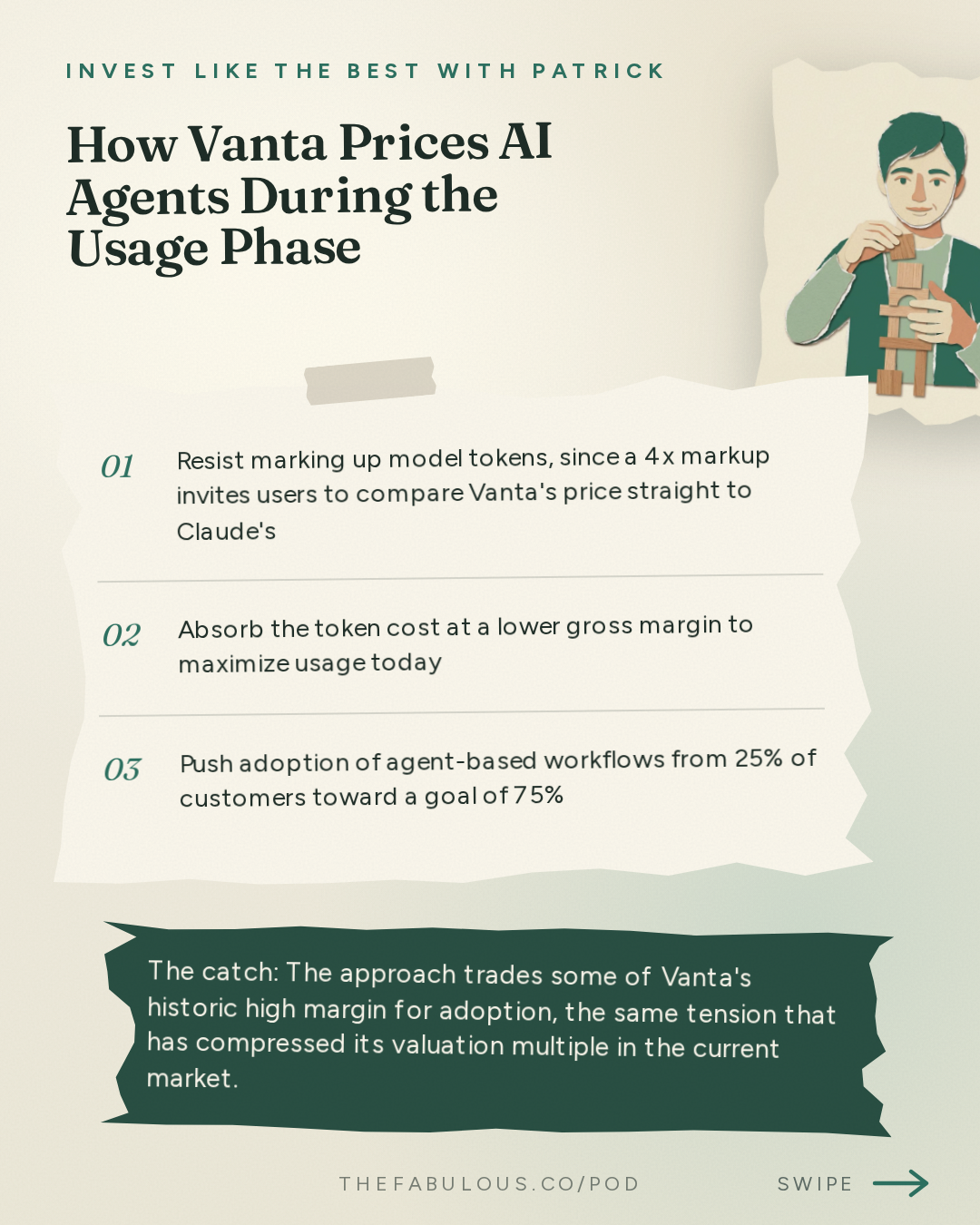
The clearest place this tension shows up is pricing. Vanta's product increasingly runs on AI agents that act on a customer's behalf: offboarding an employee's accounts, flagging a lapsed control, asking permission to fix something and then fixing it. Every one of those actions burns tokens, the units of text a language model processes, and tokens cost real money. The obvious move is to charge for them. Cacioppo has decided not to, at least not yet. Her reasoning is specific: if Vanta marked up a token from Anthropic's Claude model by four times and passed that cost to customers, those customers would quickly notice they were paying a premium for something they could evaluate directly against the model itself (10:02).
"But anyone who is marking up Claude tokens 4X and trying to pass that off to their users, I think is just saying that." — Christina Cacioppo [10:26]
So Vanta eats the cost, accepting a lower margin in order to get as many customers as possible into agent-driven workflows, which currently cover about a quarter of its customer base, with a stated goal of three quarters (10:46). The logic is sequencing: win the usage and the retention first, and treat pricing as a problem to solve later, once the product's value is proven rather than argued for in an abstract markup debate. It is a bet that current margin compression is a phase, not a new identity.
The Wizard Nobody Could Admit They Wanted to Replace
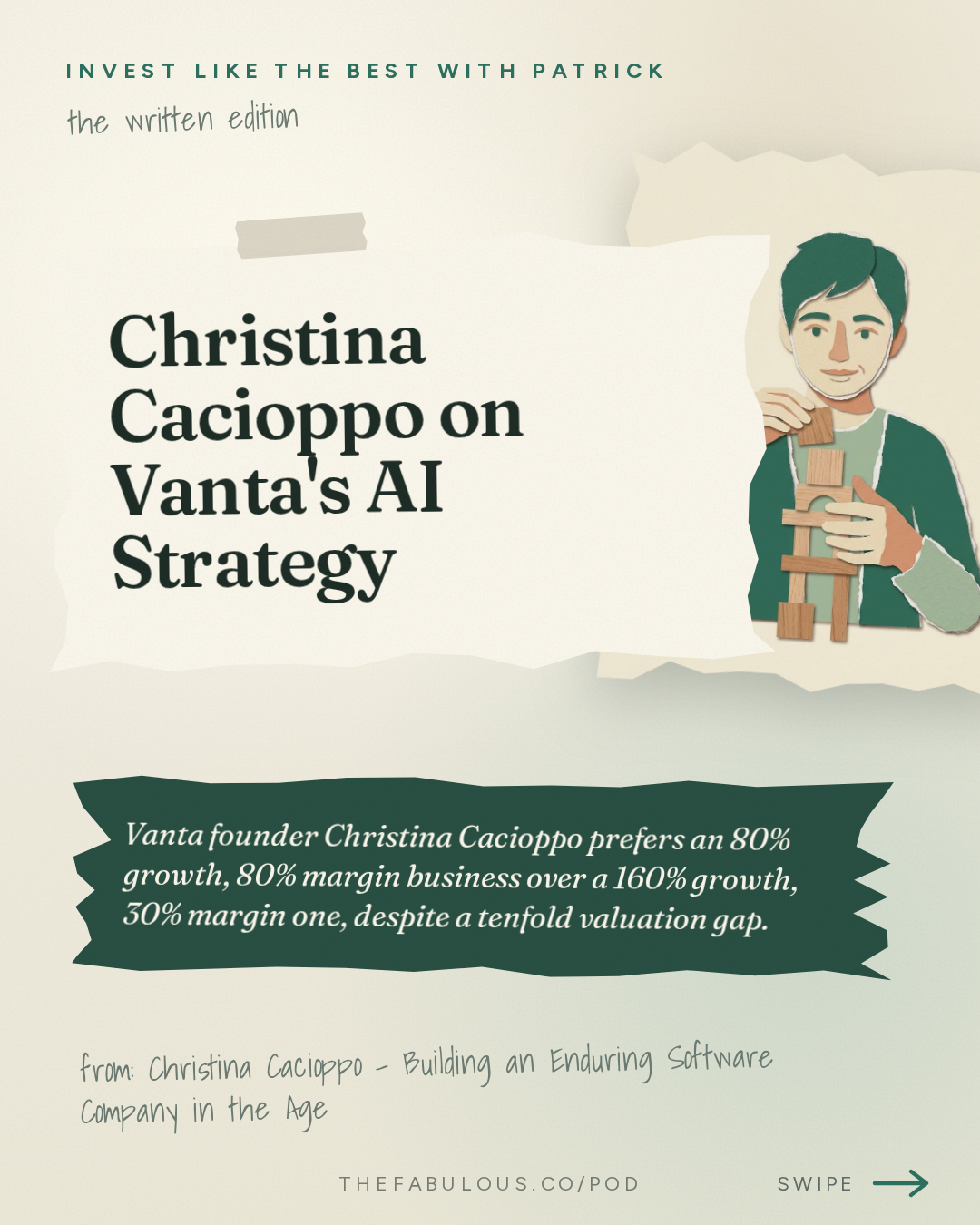
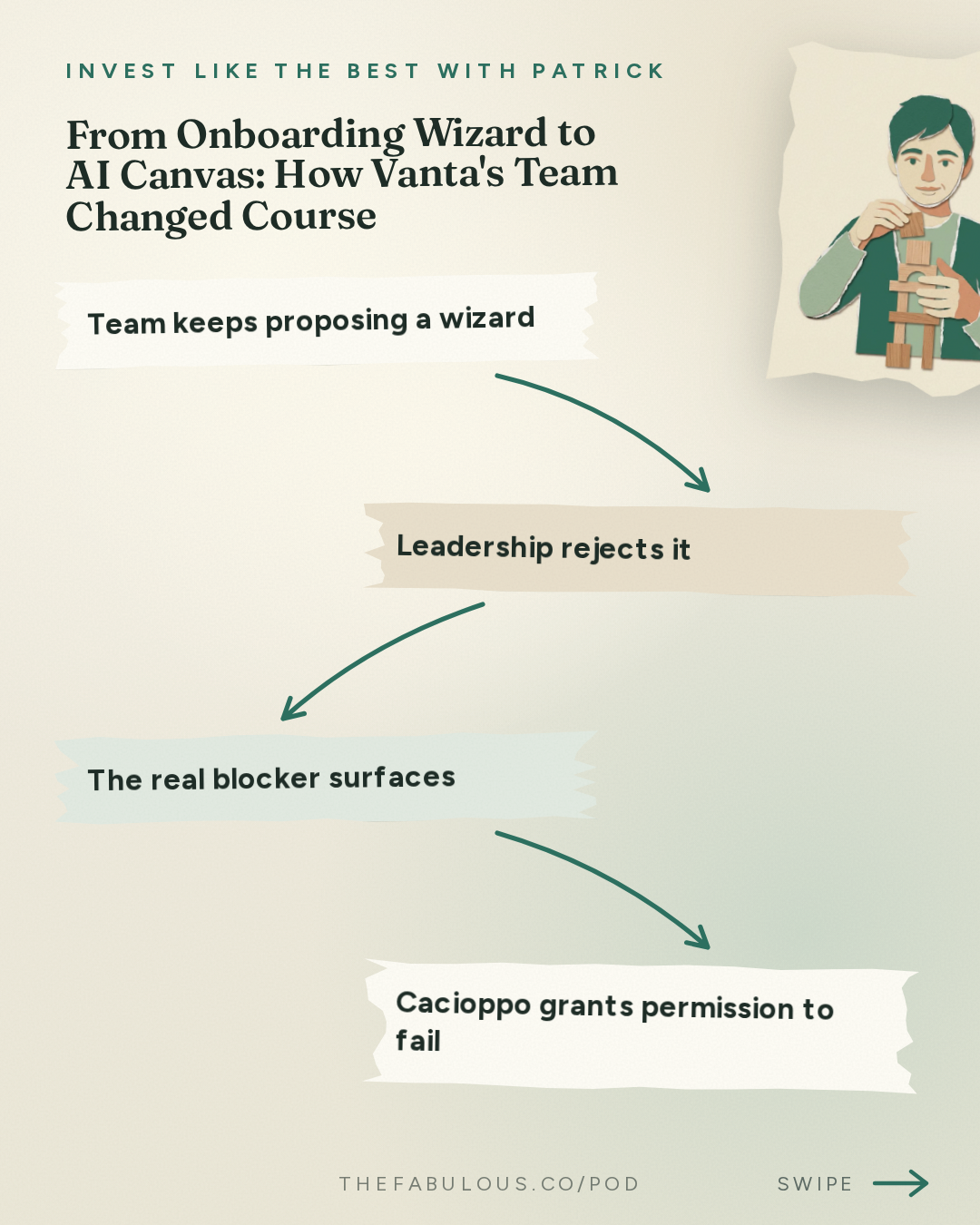
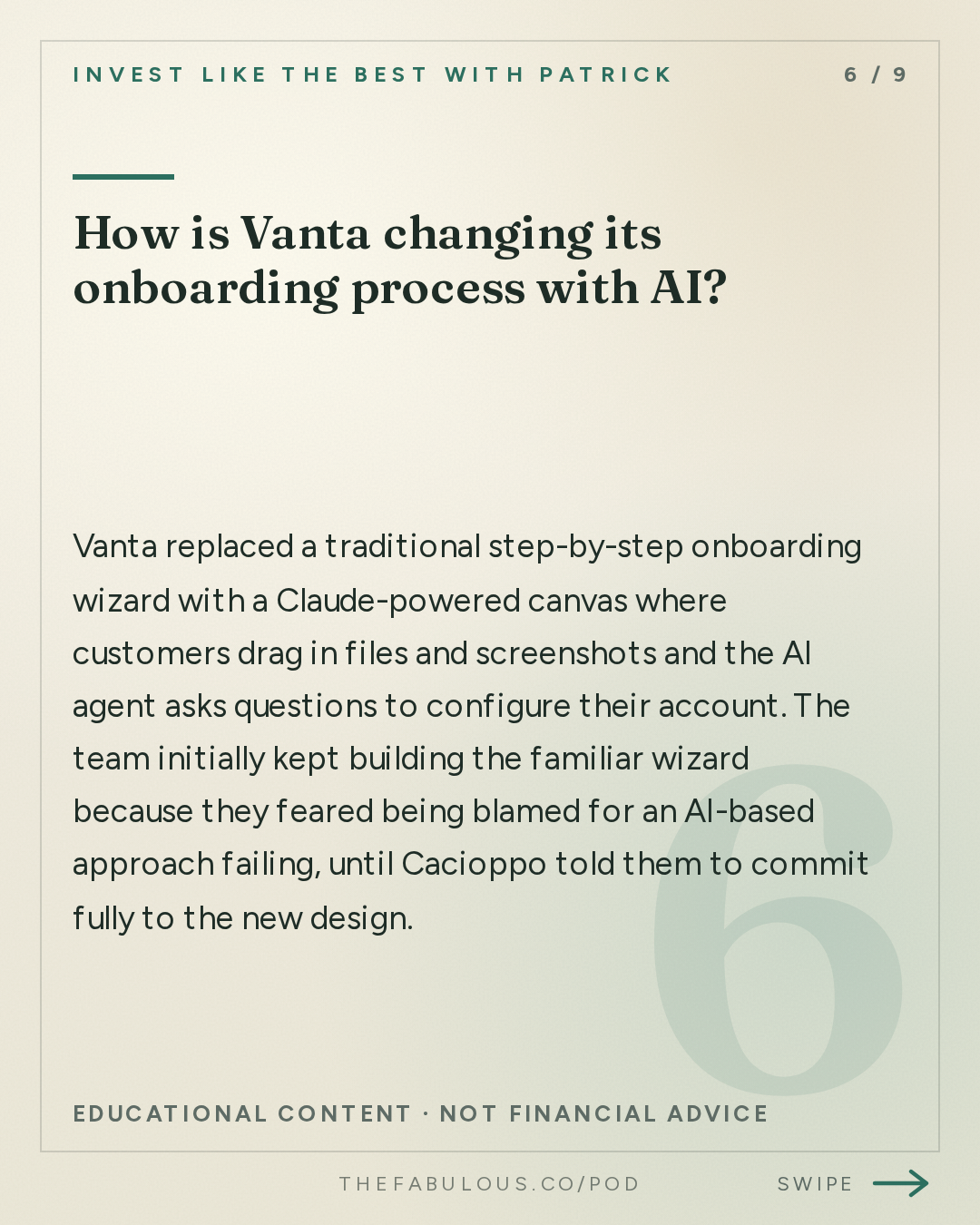
The most concrete story in the conversation is a small one about onboarding software, and it says more about organizational psychology than any abstract claim about AI could. Vanta wanted to rebuild how large customers get their existing security data into the product. The traditional approach is what Cacioppo calls an onboarding wizard: four steps, a progress bar, maybe some confetti at the end. She told her team repeatedly to abandon that pattern and instead build something closer to a blank canvas, where a customer could drag in messy files and screenshots and let a language model make sense of them (19:40). Her team, by her account talented and motivated, kept bringing her wizards anyway (20:01).
When she finally asked why, the answer was not a technical limitation. It was fear. The team did not believe they were allowed to fail, and the wizard was the design they already knew would work, while the AI-driven canvas was a gamble (20:22). Cacioppo's response was to grant explicit permission to fail and tell them to commit fully.
"Burn the boats and just make this thing work." — Christina Cacioppo [20:22]
The team shipped the canvas. It works well, by Cacioppo's account. The lesson she draws is not really about large language models at all. It is about how often an organization's hesitation around a new technology is actually a hesitation about being blamed for an experiment that does not pan out, dressed up as a technical judgment.
A related discipline she insists on for herself and other leaders: build something with the current generation of AI models personally, at least every two weeks, because models change fast enough that secondhand impressions go stale (18:16). The point is to have a visceral, not theoretical, sense of what a model can and cannot do, so that when someone claims a single agent can replace an entire team, a founder can ask where that claim is true and where it falls apart.
Paying People More Than They're Worth, On Purpose
Talent competition is where the growth-versus-margin tension becomes personal. Engineers at AI labs and fast-growing startups are being recruited with stories of valuations climbing five times in a year. Cacioppo's counter is not to match the story but to be honest about Vanta's numbers, good and bad, and let candidates judge for themselves, a habit she frames as a company value: do what it says on the tin (22:09).
On pay itself, she has become more aggressive, not less. The highest earners at Vanta now make roughly ten times what their equivalent would have earned five years ago (24:12). Her stated philosophy is to keep trying to pay the very best people enough and to accept she will never fully succeed.
"My comp philosophy is you never pay the top people enough. You should always try, and you will never hit it." — Christina Cacioppo [24:12]
She is explicit that this is not about a skill category like sales or engineering. It is about what she calls high agency: a person with enough context about the company and its customers to make reasonable decisions quickly, including some bad ones, and then correct course. That, she argues, is worth far more than its salary line suggests, and the gap between what such people are paid and what they generate is widening, not narrowing.
Cacioppo is just as direct about what she thinks is overvalued in the current moment. She is skeptical of companies post-training their own AI models, meaning adjusting a model's internal weights using a company's own data, a process that is expensive and usually unnecessary. Inference providers themselves, she says, will tell a customer the real reason to post-train is to cut cost, not to improve quality, for most use cases (29:09). The appeal she sees instead is marketing: being able to tell investors and customers that a company trained its own model, whether or not it does anything measurably better.
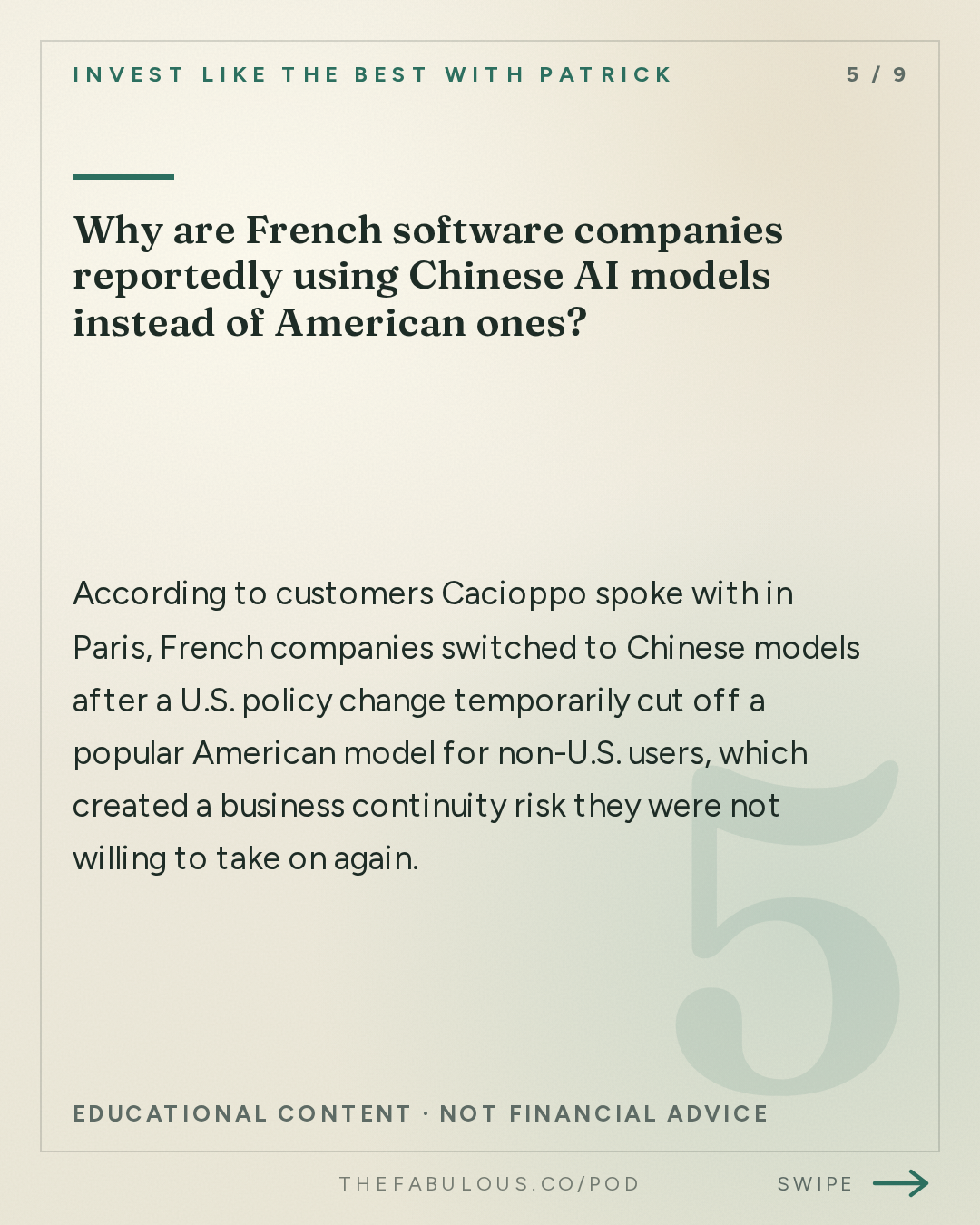
A stray detail from her travels complicates the usual assumption that AI geopolitics is mostly about national pride. She learned that many software companies in Paris have switched to using Chinese AI models, not out of any ideological preference but because of a business continuity scare: when a change in U.S. policy briefly cut off access to an American model for non-U.S. users, French founders concluded they could not safely build a business on infrastructure that might vanish by decree (33:13). It is a small story with a large implication: AI infrastructure choices are starting to look like supply chain decisions, not technology preferences.
Security itself, in Cacioppo's telling, is heading toward a world where defenders stop ranking which vulnerabilities to fix first and simply fix everything as fast as it is found, because AI-driven attackers do not get tired and will chain together many small, individually low-risk flaws into something serious (35:44). "If you're fixing things at machine speed," she says, "you don't have to prioritize" (36:27). It is a vision of security as a constant, automated back-and-forth rather than a quarterly audit.
The episode closes, fittingly, on a story about losing a billboard on Highway 101, the one Vanta had become known for after a marketing stunt went viral on Reddit (50:06). There was never a real multi-year contract, just an informal placement order, and a competitor eventually paid more and took the spot out from under them (52:52). Cacioppo offered to double the asking price and still lost, because the new tenant was flush enough not to need the money (53:28). She joked that Vanta had probably just lost some market value the moment the sign came down. It is a small, almost silly story, but it rhymes with the larger one: in this market, being first, being clever, even being loved by the internet for a week, buys less certainty than people assume. The thing that holds, by her own account, is simply shipping the next useful thing before someone else does.
Ask this episode anything
Pod's AI answers from the episode itself, with the minute mark so you can hear it yourself.
Or start with one of these
Ask this episode
Pod's AI listens to the whole episode to answer, and points you to the minute it comes from.
The rest of this answer, and any question after it
Answers come from the episode itself, never from a summary of it.
ContinueKey takeaways
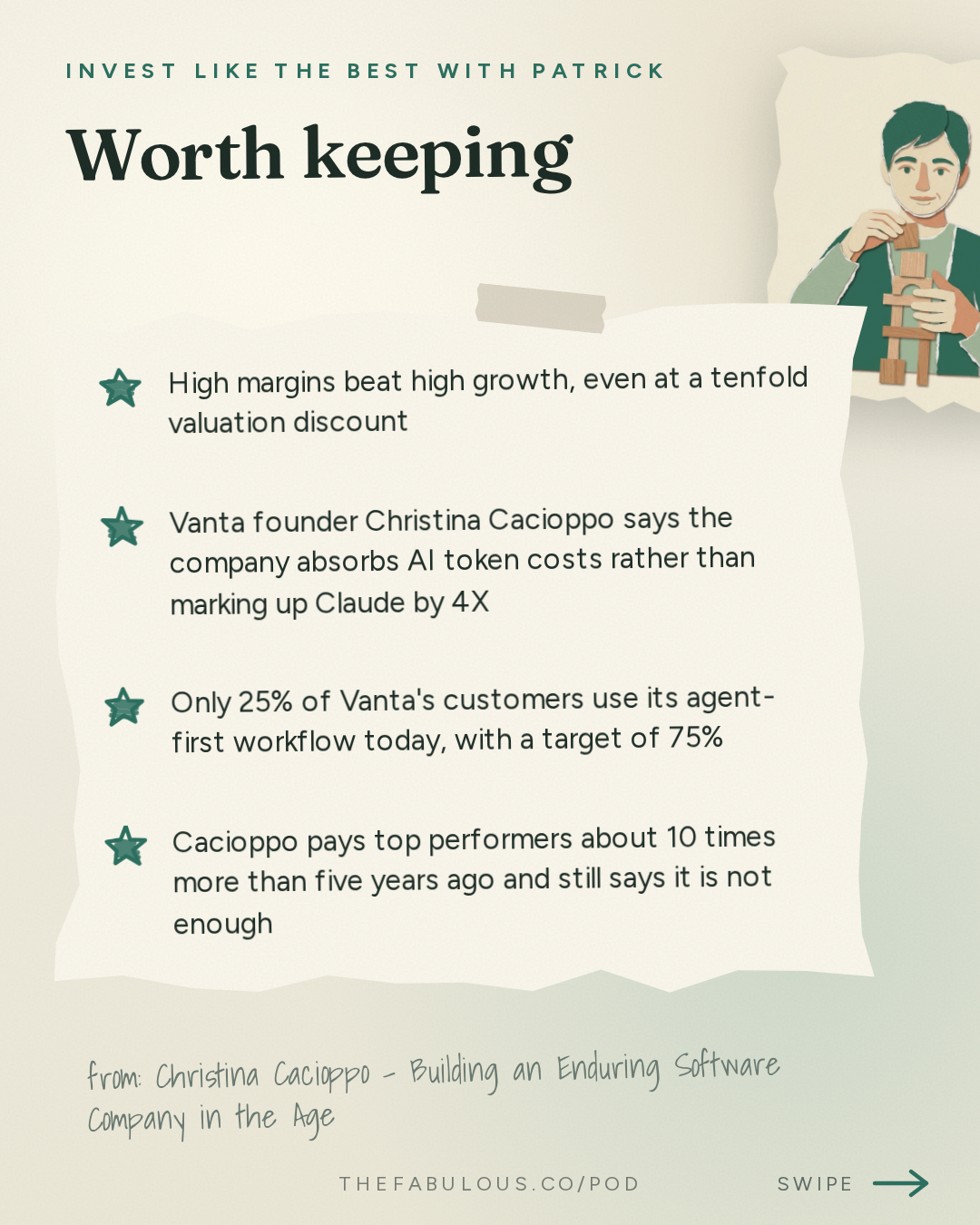
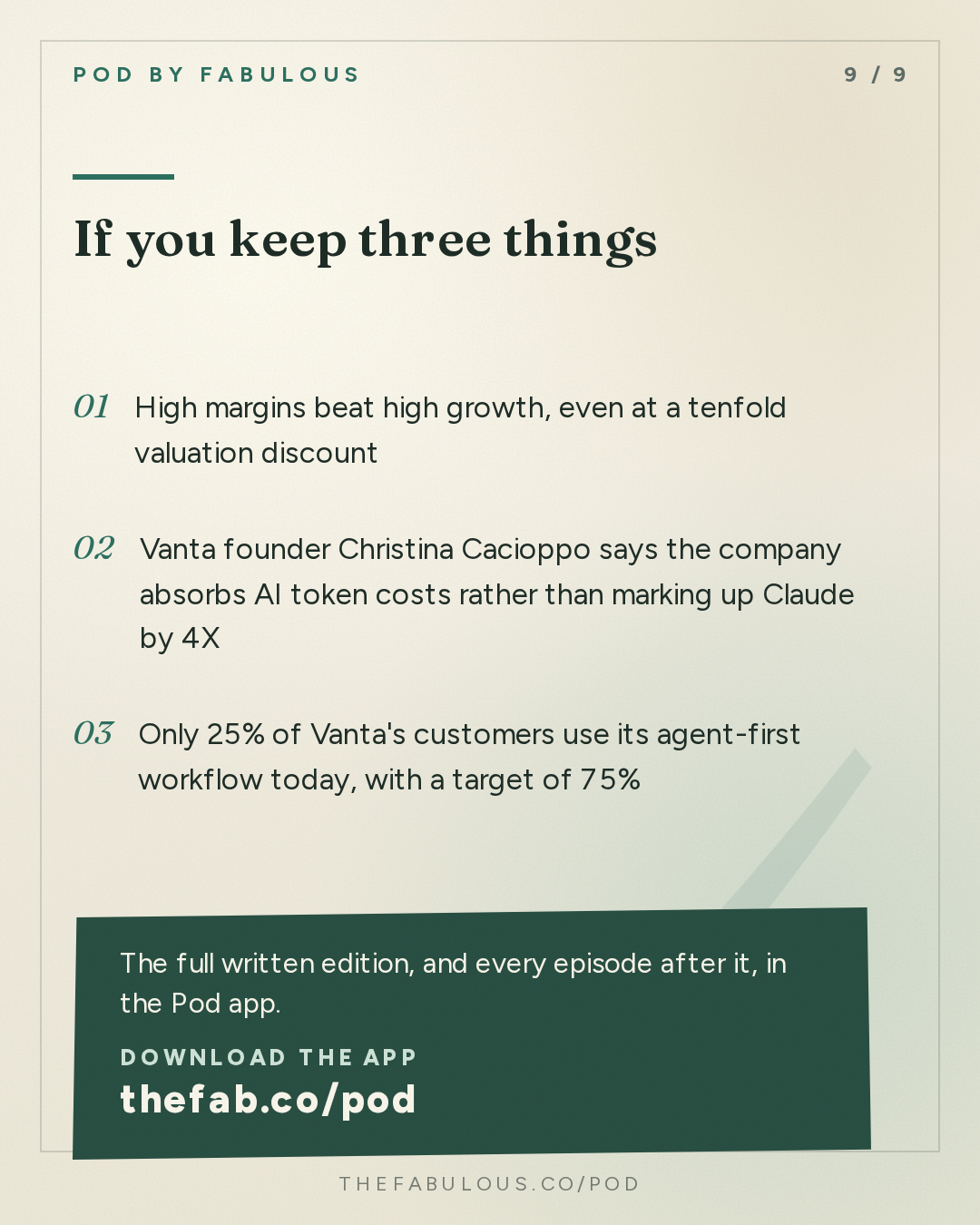
- High margins beat high growth, even at a tenfold valuation discount
- Vanta founder Christina Cacioppo says the company absorbs AI token costs rather than marking up Claude by 4X (10:26)
- Only 25% of Vanta's customers use its agent-first workflow today, with a target of 75% (10:46)
- Cacioppo pays top performers about 10 times more than five years ago and still says it is not enough (24:12)
- Cacioppo says most custom AI model training today is done for marketing, not product quality (29:09)
The episode in cards
By the numbers
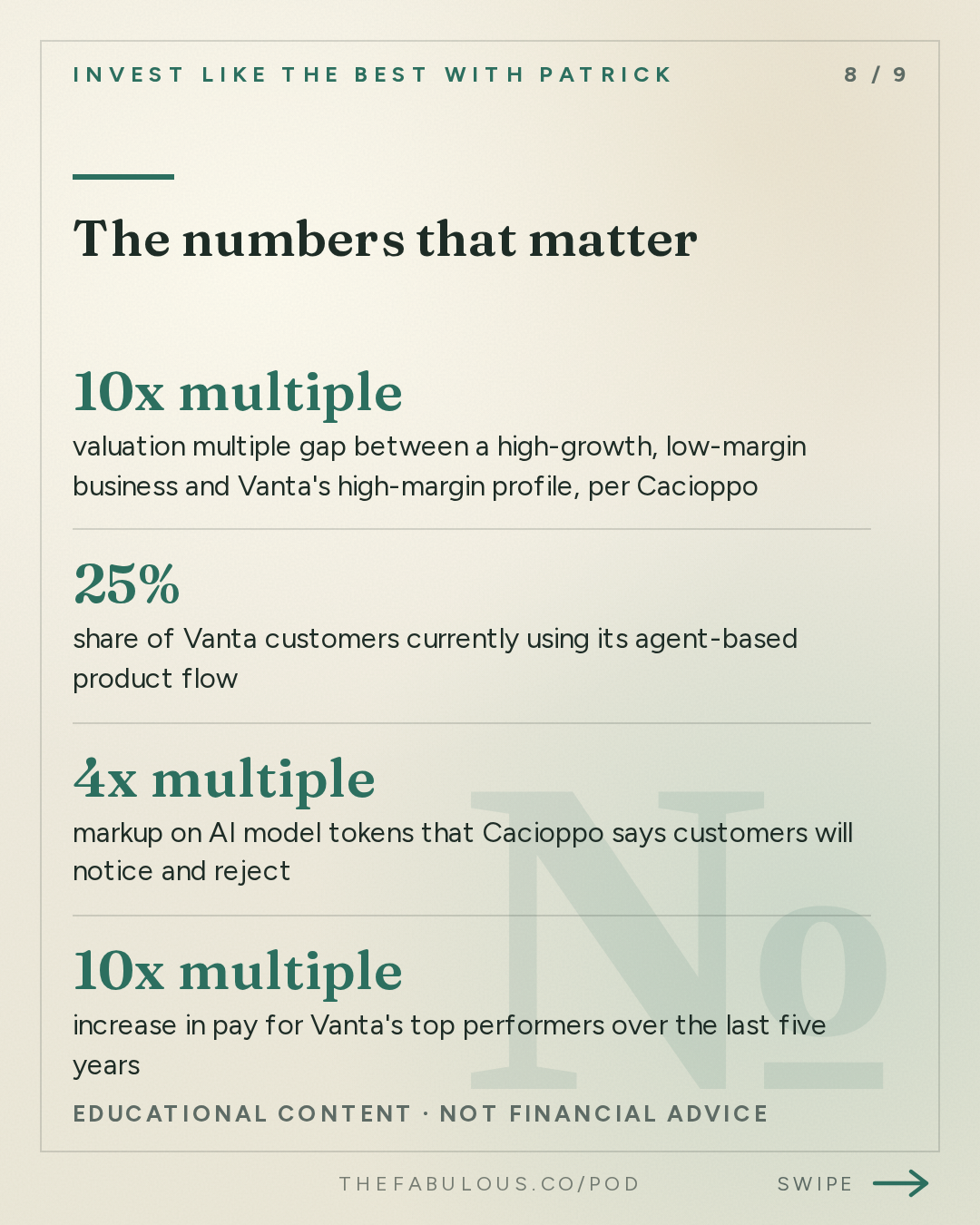
- 10x multiple valuation multiple gap between a high-growth, low-margin business and Vanta's high-margin profile, per Cacioppo
- 25% percent share of Vanta customers currently using its agent-based product flow
- 4x multiple markup on AI model tokens that Cacioppo says customers will notice and reject
- 10x multiple increase in pay for Vanta's top performers over the last five years
In their words
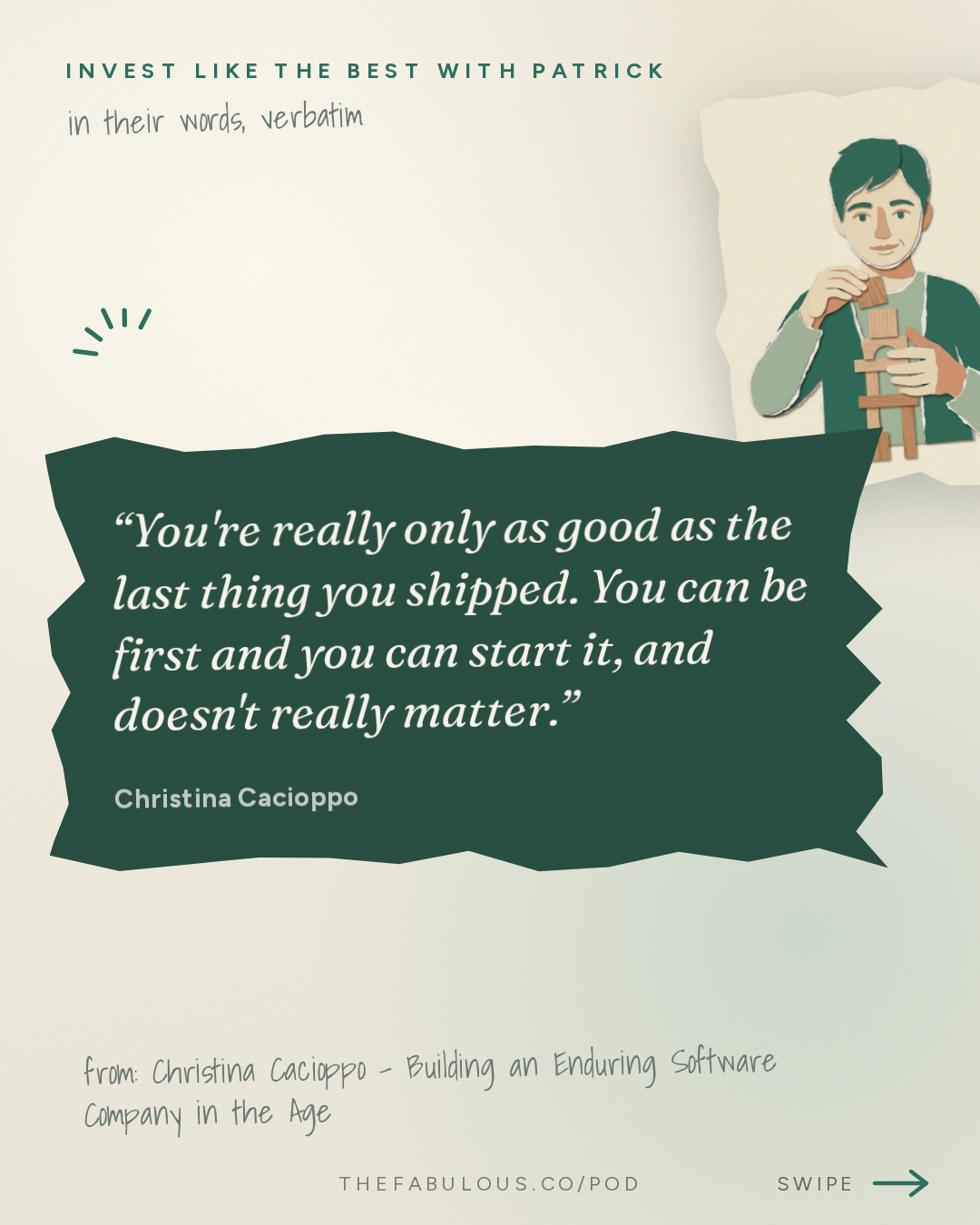
“You're really only as good as the last thing you shipped. You can be first and you can start it, and doesn't really matter.”
“I think in the fullness of time, a eighty percent growth business with eighty percent margins will actually be better than over the same time period, run it out long enough, a hundred and sixty percent growth business with thirty percent margins.”
“My comp philosophy is you never pay the top people- Enough ... enough. You should always try, and you will never hit it”
“If you're fixing things at machine speed, you don't have to prioritize.”
Protocols
-
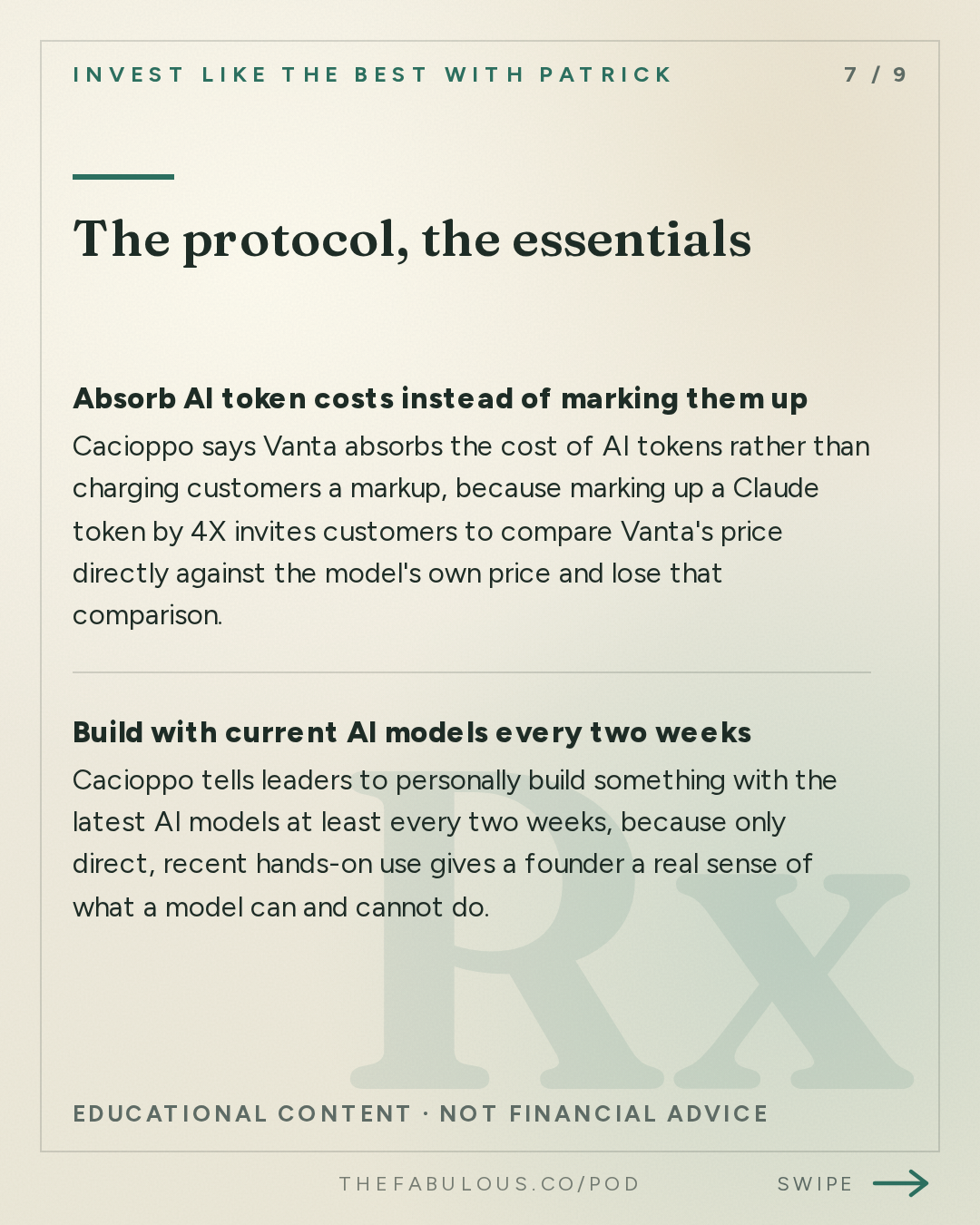
Absorb AI token costs instead of marking them up
Cacioppo says Vanta absorbs the cost of AI tokens rather than charging customers a markup, because marking up a Claude token by 4X invites customers to compare Vanta's price directly against the model's own price and lose that comparison.
Ongoing during the current usage phase
-
Build with current AI models every two weeks
Cacioppo tells leaders to personally build something with the latest AI models at least every two weeks, because only direct, recent hands-on use gives a founder a real sense of what a model can and cannot do.
Every two weeks
-
Modularize the old codebase for AI agents
Cacioppo says Vanta is breaking its eight-year-old codebase into smaller, self-contained modules so that AI coding agents can fully understand a piece of code instead of guessing at a codebase too large for their context window, though a skilled engineer still has to supervise the agent's output.
Ongoing engineering investment
-
Keep raising pay for the highest performers
Cacioppo says her compensation philosophy is to keep trying to pay the top people enough and to accept she will never fully succeed, since a single high-agency employee's decisions can be worth far more than a typical salary.
Revisited every compensation cycle
Questions this episode answers
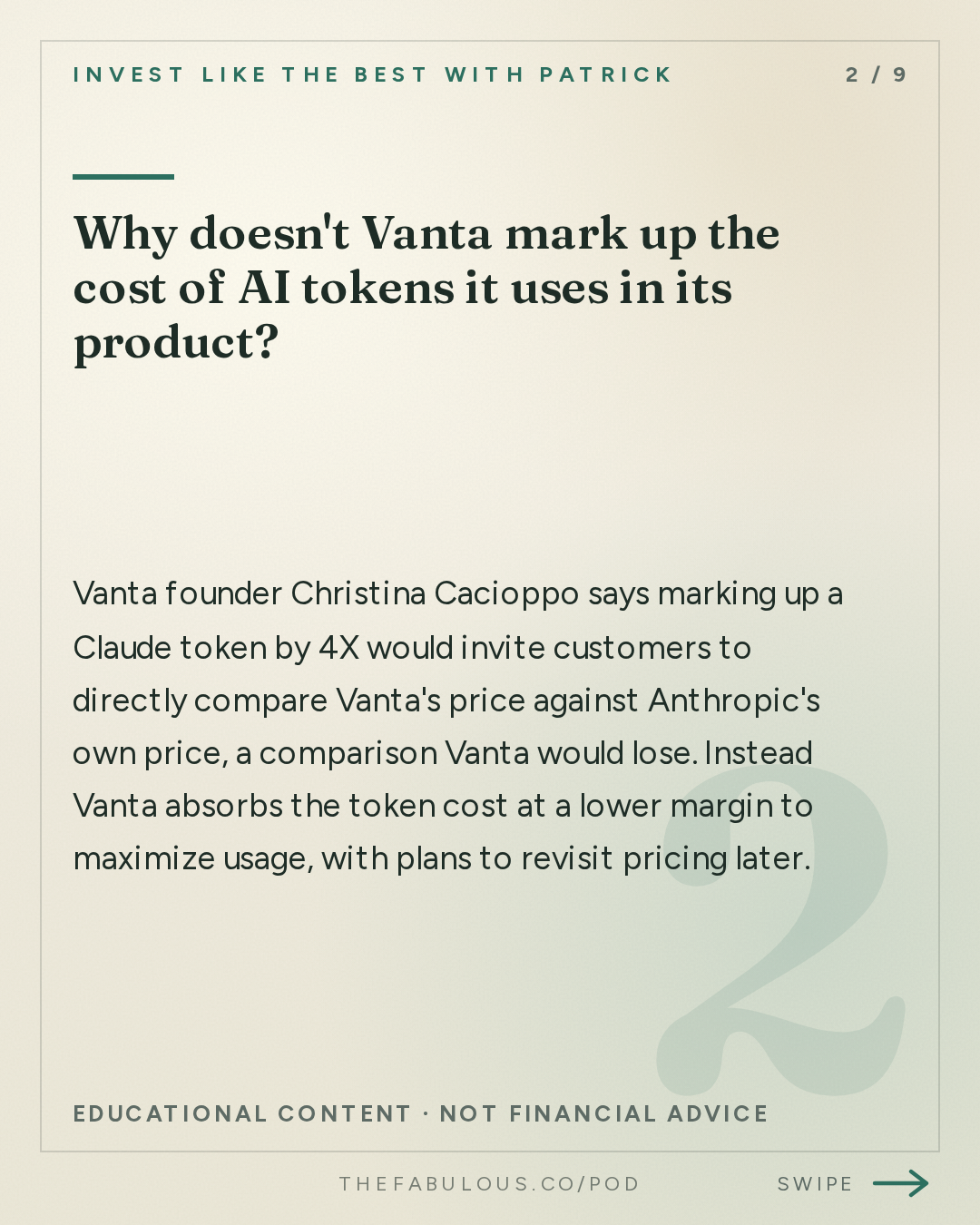
Why doesn't Vanta mark up the cost of AI tokens it uses in its product?
Vanta founder Christina Cacioppo says marking up a Claude token by 4X would invite customers to directly compare Vanta's price against Anthropic's own price, a comparison Vanta would lose (10:02). Instead Vanta absorbs the token cost at a lower margin to maximize usage, with plans to revisit pricing later (10:46).
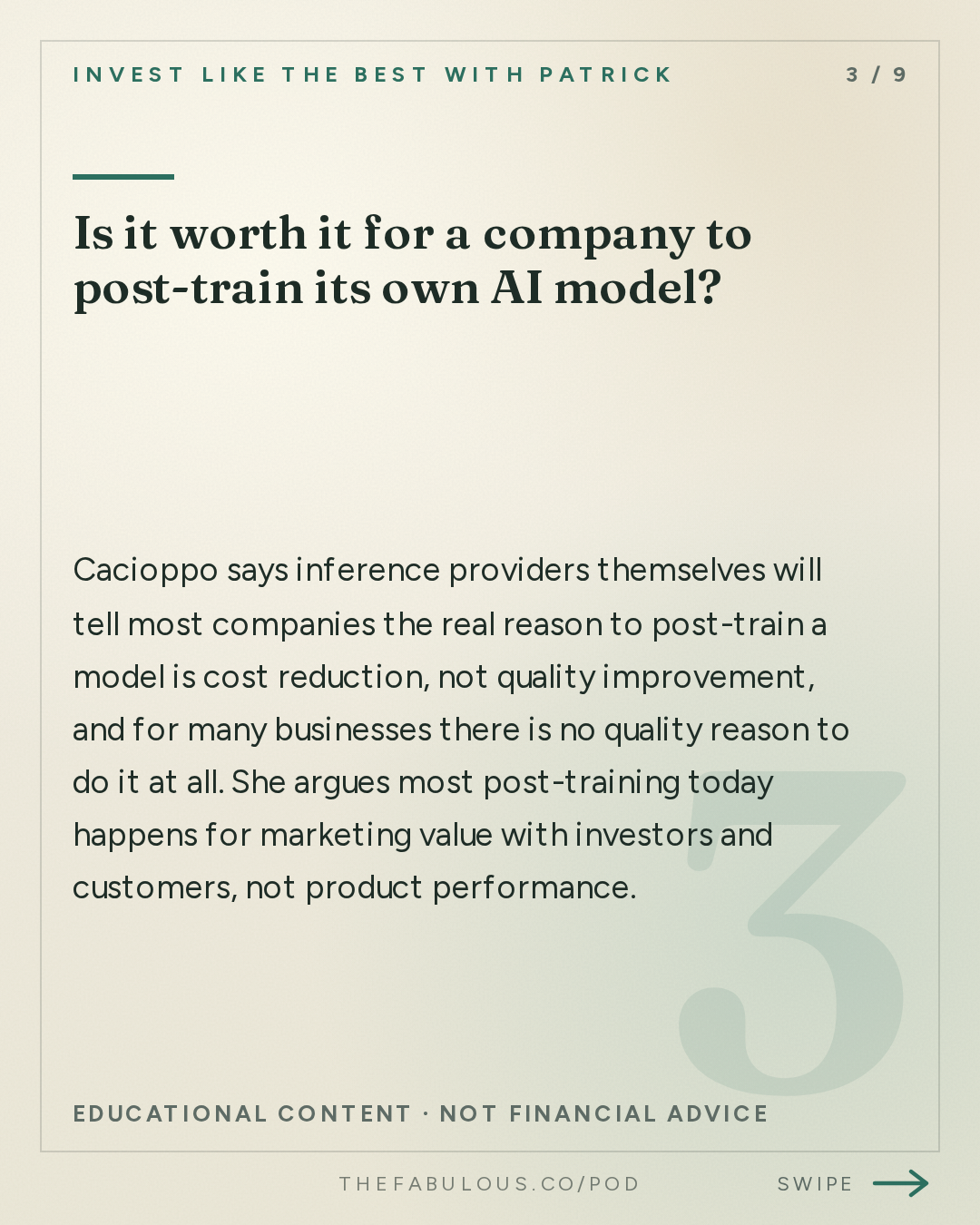
Is it worth it for a company to post-train its own AI model?
Cacioppo says inference providers themselves will tell most companies the real reason to post-train a model is cost reduction, not quality improvement, and for many businesses there is no quality reason to do it at all (29:09). She argues most post-training today happens for marketing value with investors and customers, not product performance (29:27).
Why would a high-growth company choose lower growth with higher margins?
Cacioppo argues an 80% growth business with 80% margins returns more cash over the long run than a 160% growth business with 30% margins, even though the market currently values the faster, lower-margin business at roughly 10 times the multiple (06:04).
Why are French software companies reportedly using Chinese AI models instead of American ones?
According to customers Cacioppo spoke with in Paris, French companies switched to Chinese models after a U.S. policy change temporarily cut off a popular American model for non-U.S. users, which created a business continuity risk they were not willing to take on again (32:51).
How is Vanta changing its onboarding process with AI?
Vanta replaced a traditional step-by-step onboarding wizard with a Claude-powered canvas where customers drag in files and screenshots and the AI agent asks questions to configure their account. The team initially kept building the familiar wizard because they feared being blamed for an AI-based approach failing, until Cacioppo told them to commit fully to the new design (20:22).
How much more does Vanta pay its top employees than it used to?
Cacioppo says Vanta's highest-paid employees now earn roughly 10 times what an equivalent role paid five years ago, and her stated philosophy is to keep raising pay for top performers because she believes she will never fully compensate their actual contribution (24:12).
The full read, in cards
Go deeper
- OpenAI talk at RSA Conference — Described how AI models chain many low-severity vulnerabilities together to surface serious exploits, using Hugging Face as the example
Mentioned
Christina Cacioppo · Vanta · Claude · Notion · Sarah · Wiz · CrowdStrike · Hugging Face · OpenAI · Andrew Reid
More from this show and category

David Vélez on Nubank's AI Strategy and Banking's Future
Nubank founder David Vélez argues global banking is still in the Blockbuster era, with incumbents holding 90% of a $10 trillion industry (02:38), while Nubank's own AI foundation model and a flattened org structure let it serve 140 million customers at 3% of a traditional bank's cost (05:32).

Andrew Huberman on Sleep, AI, and Neurotech
Stanford neuroscientist Andrew Huberman lays out a three-step method for falling asleep fast, predicts that Meta, OpenAI, and Anthropic will become biotech companies racing to read and write the nervous system, and describes a memory experiment that undercuts how neuroscience thought memory worked. He also discusses the scientist who CRISPR-edited twin babies and reportedly now works in Austin, Texas.

Gabe Stengel on Rogo and AI in Finance
Gabe Stengel, CEO of AI finance platform Rogo, says AI will force top investors to rebuild their firms within five years. He argues vertical AI wins by building the compliance and workflow plumbing banks need, not just smarter models, and predicts pricing will shift from per-seat fees toward per-outcome charges for deals and reports.

Michael Moritz: Imprinting, VC, and Leadership
Michael Moritz says imprints formed before age fourteen shape a person's drive for life. The former Sequoia Capital leader traces this idea to his refugee family's escape from Nazi Germany, then applies it to founders, Manchester United manager Alex Ferguson's leadership, and the vanishing information edge that once defined early venture capital.
