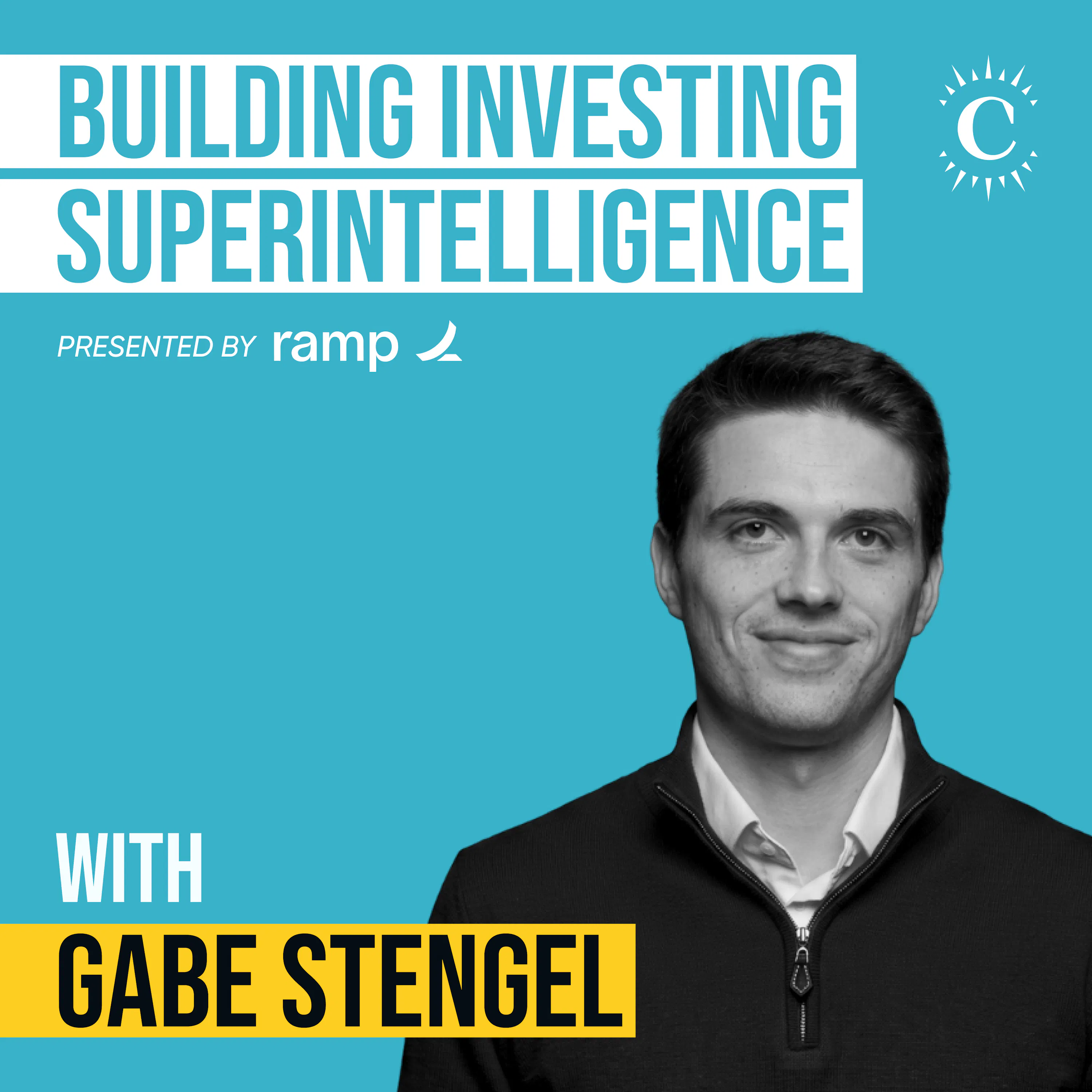
Gabe Stengel on Rogo and AI in Finance
Gabe Stengel - Building Investing Superintelligence - [Invest Like the Best, EP.492]
The brief
Gabe Stengel, CEO of AI finance platform Rogo, says AI will force top investors to rebuild their firms within five years. He argues vertical AI wins by building the compliance and workflow plumbing banks need, not just smarter models, and predicts pricing will shift from per-seat fees toward per-outcome charges for deals and reports.
![The model eras of Rogo's product — Invest Like the Best with Patrick O'Shaughnessy: Gabe Stengel - Building Investing Superintelligence - [Invest Like the Best, EP.492]](https://pod-backend.forge-production.thefab.io/public-api/cards/49f672a9895ac55fba9b8e59c6c50f3488ff52e8/1790066207174/static-01-process.png)
Key takeaways
- Gabe Stengel says AI will force investors to rebuild firms in five years
- Rogo, an AI tool for banks, wins by owning compliance and workflow plumbing over raw intelligence
- Gabe Stengel says auditability matters more than accuracy so regulators can trace every AI decision
- Rogo aims to replace per-seat and token pricing with outcome-based fees per deal or report
- Forty venture firms passed on Rogo's Series A before investor Keith Rabois backed the company
The episode in cards
![Gabe Stengel on Rogo and AI in Finance — Invest Like the Best with Patrick O'Shaughnessy: Gabe Stengel - Building Investing Superintelligence - [Invest Like the Best, EP.492]](https://pod-backend.forge-production.thefab.io/public-api/cards/49f672a9895ac55fba9b8e59c6c50f3488ff52e8/1790066207174/carousel-01-cover.png)
![The model eras of Rogo's product — Invest Like the Best with Patrick O'Shaughnessy: Gabe Stengel - Building Investing Superintelligence - [Invest Like the Best, EP.492]](https://pod-backend.forge-production.thefab.io/public-api/cards/49f672a9895ac55fba9b8e59c6c50f3488ff52e8/1790066207174/carousel-02-process.png)
![Two ways AI software companies sell — Invest Like the Best with Patrick O'Shaughnessy: Gabe Stengel - Building Investing Superintelligence - [Invest Like the Best, EP.492]](https://pod-backend.forge-production.thefab.io/public-api/cards/49f672a9895ac55fba9b8e59c6c50f3488ff52e8/1790066207174/carousel-03-comparison.png)
![By the numbers — Invest Like the Best with Patrick O'Shaughnessy: Gabe Stengel - Building Investing Superintelligence - [Invest Like the Best, EP.492]](https://pod-backend.forge-production.thefab.io/public-api/cards/49f672a9895ac55fba9b8e59c6c50f3488ff52e8/1790066207174/carousel-04-stat-grid.png)
![The place it is gonna be the most interesting is applied AI 'cause that's where AI intersects with humanity. — Invest Like the Best with Patrick O'Shaughnessy: Gabe Stengel - Building Investing Superintelligence - [Invest Like the Best, EP.492]](https://pod-backend.forge-production.thefab.io/public-api/cards/49f672a9895ac55fba9b8e59c6c50f3488ff52e8/1790066207174/carousel-05-quote.png)
![Worth keeping — Invest Like the Best with Patrick O'Shaughnessy: Gabe Stengel - Building Investing Superintelligence - [Invest Like the Best, EP.492]](https://pod-backend.forge-production.thefab.io/public-api/cards/49f672a9895ac55fba9b8e59c6c50f3488ff52e8/1790066207174/carousel-06-takeaways.png)
![Outro — Invest Like the Best with Patrick O'Shaughnessy: Gabe Stengel - Building Investing Superintelligence - [Invest Like the Best, EP.492]](https://pod-backend.forge-production.thefab.io/public-api/cards/49f672a9895ac55fba9b8e59c6c50f3488ff52e8/1790066207174/carousel-07-outro.png)
Twenty years ago, getting a mortgage meant a trip to a bank branch and a long conversation with a loan officer. It felt like the kind of decision that needed a human in the room. Today, forty to fifty percent of mortgages are delivered entirely online, through platforms like Rocket Mortgage, with no loan officer required (28:32). Gabe Stengel, founder and CEO of the AI finance platform Rogo, thinks the rest of Wall Street is about to have its own quiet mortgage moment. Deals that take five months to price could take five minutes (28:58). The people doing that pricing today, analysts, associates, junior bankers, are the ones whose work Rogo is built to absorb.
Stengel has tried to build this company twice before, without success. In high school he built a tool to track merger exchange ratios. In college he published a paper on AI for financial econometrics. Both times, in his words, nothing worked at all (03:23). Rogo itself launched right as GPT-3 arrived, before ChatGPT existed, and for a long stretch the product was more demo than tool. What changed the trajectory was not a better idea. It was the models. OpenAI's o1 Pro, Stengel says, was the first model reliable enough to act as a real search tool, capable of calculating a financial metric across twelve quarters without making things up (03:43). Anthropic's Opus 4 and 5, arriving toward the end of 2025, pushed further: they became capable of doing basically anything a junior investment banker was doing, given the right instructions and context (04:04). Stengel calls this a first mover's disadvantage for applied AI companies. Build for where the technology is going before it arrives, and the early product looks terrible, so people write you off (04:28).
Plumbing Over Intelligence
The obvious worry for a company like Rogo is that the big AI labs will eventually build the same thing for free. Stengel's answer is that intelligence is only part of the product. The harder, less glamorous part is what he calls plumbing: compliance workflows, audit trails, data rooms, and the systems that plug into a bank's CRM and portfolio-monitoring tools. When a managing director emails a deck to be marked up, Rogo can return it in twenty minutes instead of the two days a human turnaround would take, while alerting the junior analyst on the deal and preserving a record of every edit made (05:40). None of that is intelligence in the raw sense. It is integration, worked out one workflow at a time.
That distinction is also Stengel's answer to the question everyone asks him: how does Rogo compete with OpenAI and Anthropic? His view is that the labs are chasing markets worth hundreds of billions of dollars, and the narrow, messy problems of financial services, MNPI compliance, deal-room security, regulatory audit trails, sit beneath their notice, even though each of those niches can be worth five to ten billion dollars on its own (18:03). Rogo's bet is that finance is really dozens of such niches stacked together, each with its own data, its own definition of good, and its own regulator, and that owning the plumbing across all of them builds a business the labs will never bother with.
This is also why Stengel says accuracy is not the main event. Auditability is.
"I think it's actually more important to be auditable than it is to be accurate, and obviously those two things are conflated." Gabe Stengel, [34:39]
His logic: an answer that is occasionally wrong but shows its sourcing is still useful, because a banker can check it. An answer that is usually right but opaque is useless, because nobody trusts a black box in a regulated industry. As AI tools move from co-pilot, where they retrieve information, to autopilot, where they act on a client's behalf, that traceability stops being a nice feature and becomes something regulators require (35:06).
The Cost of Conviction
Rogo's business model is unusual for an AI company. Most of the buzzy AI startups, Cursor, Factory, and Cloud Code among them, ride token consumption: usage rises automatically, sometimes a hundredfold on a single contract, without adding a single salesperson (25:44). Rogo cannot do that. Its buyers, big banks used to paying for Bloomberg terminals and FactSet subscriptions, expect per-seat pricing, and every deal requires an account executive, a solutions architect, and a sales engineer walking the customer through integration by hand (25:21). Stengel's long-term goal is to skip past both seat pricing and token pricing and charge for outcomes instead: a fee per good investment idea, per LP report, per banking simulation (26:46). It is a simpler pitch than trying to explain a token bill nobody can translate into value.
The tradeoff is speed. Enterprise sales are limited by how fast people can be trained, and Stengel says the real constraint on Rogo's growth is not the model, it is how quickly a new hire becomes useful. To solve that, Rogo records every internal conversation and feeds it into a tool the team nicknamed Shrek, so a banker in New York can pull up context from a deal a colleague closed in Asia without ever having met them (36:42). It's a small detail, but it captures Stengel's broader argument: the interesting AI problems in finance are rarely about raw model capability anymore. They are about memory and coordination, a problem he calls compaction, and one that current models still handle badly once more than a couple of people are involved (23:27).
None of this came easily. When Rogo raised its Series A, an early investor introduced Stengel to forty venture firms. All forty passed, some after weeks of meetings and dinners that felt, in Stengel's words, like being broken up with by forty girlfriends (45:52). Part of the resistance was structural: Silicon Valley investors, he argues, lack intuition for how large the financial data market is, because prior giants in the space, Bloomberg, FactSet, ION Group, were never venture-backed to begin with (46:32). Investor Keith Rabois eventually backed the company, reportedly telling Stengel the idea was not even contrarian, it was just the legal-AI company Harvey applied to finance. Stengel's response to the doubt was to raise the stakes rather than lower them.
"It's fine if it gets thirty percent more likelihood that I fail if the odds that I become a hundred billion dollar company also increase by twenty percent." Gabe Stengel, [44:43]
That appetite for risk explains his most sweeping claim: that in ten years, the world's best investment firms and banks will hold ninety percent of their enterprise value not in people but in software, data, and systems (53:46). If that is right, the job of a firm's leadership is not to buy a chatbot. It is to work out which parts of a top banker's judgment are genuinely irreplaceable, built on relationships and hard-won context, and which parts are just information a system could hold instead.
Stengel does not pretend the human side disappears entirely. He doubts a small business owner handing off a company built over twenty years will ever be comfortable doing it by clicking a button instead of shaking a hand (56:46). But he thinks that exception is narrower than most people in finance believe, and narrower every year. The interesting question is not whether AI reaches capital markets. Structurally, it already has. The question is which of finance's thousand small human-run rituals turn out to be irreplaceable, and which ones were simply habits nobody had gotten around to automating yet.
![Two ways AI software companies sell — Invest Like the Best with Patrick O'Shaughnessy: Gabe Stengel - Building Investing Superintelligence - [Invest Like the Best, EP.492]](https://pod-backend.forge-production.thefab.io/public-api/cards/49f672a9895ac55fba9b8e59c6c50f3488ff52e8/1790066207174/static-02-comparison.png)
By the numbers
- 15 years how long Jane Street took to build its dominant market-making franchise
- 40 investors venture firms that passed on Rogo's Series A before Keith Rabois invested
In their words
“I think it's actually more important to be auditable than it is to be accurate, and obviously those two things are conflated.”
“The place it is gonna be the most interesting is applied AI 'cause that's where AI intersects with humanity.”
“It's fine if it gets thirty percent more likelihood that I fail if the odds that I become a hundred billion dollar company also increase by twenty percent.”
“I think figuring out how to apply AI into the investment life cycle is the biggest challenge over the next five years for every great investor.”
Protocols
-
Route managing director deck edits through email markup
Rogo lets a managing director email a deck to Rogo's AI analyst instead of a human junior analyst, and the tool returns a marked-up version in twenty minutes instead of two days, while alerting the human analyst on the deal so they can review every change made.
Every time a senior banker needs a deck marked up
-
Move toward outcome-based pricing
Gabe Stengel plans to move Rogo's pricing past both per-seat and per-token models toward charging a fee for each delivered outcome, such as a price for a good investment idea, a completed LP report, or a finished banking simulation.
Long-term pricing direction, not yet fully implemented
-
Record every internal meeting into a company brain
Rogo records every internal conversation and feeds it into an internal tool nicknamed Shrek, and new hires are told on day one that their meetings will be captured so any colleague can pull up relevant context later.
Continuous, applied to all internal meetings
-
Hire former founders for technical roles
Gabe Stengel prioritizes hiring former startup founders for engineering and product roles at Rogo, because people who built and lost their own companies already carry the product intuition that pure engineering hires often lack.
Ongoing hiring criterion
Questions this episode answers
What is Rogo and what does it do?
Rogo is an AI platform built for investment banks and private markets deal makers, founded by Gabe Stengel. It helps bankers prepare data rooms, mark up decks, and run diligence, and Stengel says it can turn a two-day deck markup into a twenty-minute task (05:40).
How does Rogo compete with OpenAI and Anthropic?
Stengel says the large AI labs are chasing hundred-billion-dollar markets and have no interest in the narrow, messy compliance and workflow problems specific to finance, such as MNPI handling or deal-room security. He compares those niches, worth five to ten billion dollars each, to a penny not worth stopping for on the labs' path to a trillion dollars in revenue (18:03).
Why does Rogo prioritize auditability over accuracy in its AI tools?
Stengel argues an AI answer without a visible source or reasoning trail cannot be trusted, even if it is usually correct, while an answer with clear sourcing stays useful even when it is occasionally wrong. In regulated finance, he says regulators need to see the full lineage of how an AI-assisted decision was made (34:39).
How does Rogo price its product?
Rogo currently charges per seat, similar to Bloomberg or FactSet, because that is how its bank customers are used to buying software. Stengel's long-term goal is to skip token-based pricing and move to outcome-based fees, charging for each good investment idea, LP report, or banking simulation delivered (26:46).
What happened when Rogo raised its Series A funding round?
An early investor introduced Gabe Stengel to forty venture capital firms, including well-known names like Sequoia and Kleiner Perkins, and all forty passed. Investor Keith Rabois backed the company about a month later, and Rogo has since built a well-known investor cap table (45:33).
The full read, in cards
![Gabe Stengel on Rogo and AI in Finance — Invest Like the Best with Patrick O'Shaughnessy: Gabe Stengel - Building Investing Superintelligence - [Invest Like the Best, EP.492]](https://pod-backend.forge-production.thefab.io/public-api/cards/49f672a9895ac55fba9b8e59c6c50f3488ff52e8/1790066207174/heavy-01-cover.png)
![What is Rogo and what does it do? — Invest Like the Best with Patrick O'Shaughnessy: Gabe Stengel - Building Investing Superintelligence - [Invest Like the Best, EP.492]](https://pod-backend.forge-production.thefab.io/public-api/cards/49f672a9895ac55fba9b8e59c6c50f3488ff52e8/1790066207174/heavy-02-takeaways.png)
![How does Rogo compete with OpenAI and Anthropic? — Invest Like the Best with Patrick O'Shaughnessy: Gabe Stengel - Building Investing Superintelligence - [Invest Like the Best, EP.492]](https://pod-backend.forge-production.thefab.io/public-api/cards/49f672a9895ac55fba9b8e59c6c50f3488ff52e8/1790066207174/heavy-03-takeaways.png)
![Why does Rogo prioritize auditability over accuracy in its AI tools? — Invest Like the Best with Patrick O'Shaughnessy: Gabe Stengel - Building Investing Superintelligence - [Invest Like the Best, EP.492]](https://pod-backend.forge-production.thefab.io/public-api/cards/49f672a9895ac55fba9b8e59c6c50f3488ff52e8/1790066207174/heavy-04-takeaways.png)
![How does Rogo price its product? — Invest Like the Best with Patrick O'Shaughnessy: Gabe Stengel - Building Investing Superintelligence - [Invest Like the Best, EP.492]](https://pod-backend.forge-production.thefab.io/public-api/cards/49f672a9895ac55fba9b8e59c6c50f3488ff52e8/1790066207174/heavy-05-takeaways.png)
![What happened when Rogo raised its Series A funding round? — Invest Like the Best with Patrick O'Shaughnessy: Gabe Stengel - Building Investing Superintelligence - [Invest Like the Best, EP.492]](https://pod-backend.forge-production.thefab.io/public-api/cards/49f672a9895ac55fba9b8e59c6c50f3488ff52e8/1790066207174/heavy-06-takeaways.png)
![The protocol, the essentials — Invest Like the Best with Patrick O'Shaughnessy: Gabe Stengel - Building Investing Superintelligence - [Invest Like the Best, EP.492]](https://pod-backend.forge-production.thefab.io/public-api/cards/49f672a9895ac55fba9b8e59c6c50f3488ff52e8/1790066207174/heavy-07-protocol.png)
![If you keep three things — Invest Like the Best with Patrick O'Shaughnessy: Gabe Stengel - Building Investing Superintelligence - [Invest Like the Best, EP.492]](https://pod-backend.forge-production.thefab.io/public-api/cards/49f672a9895ac55fba9b8e59c6c50f3488ff52e8/1790066207174/heavy-08-outro.png)
Go deeper
- AlphaGo's Move 37 against Lee Sedol — Cited as an analogy for an AI insight that surpasses human intuition, applied to what might happen in public equities investing
Mentioned
Gabe Stengel · Rogo · Bloomberg · Jane Street · Anthropic · OpenAI · Max Levchin · Keith Rabois · Pat Grady · o1 Pro · Opus · Harvey
More from this show and category

Michael Moritz: Imprinting, VC, and Leadership
Michael Moritz says imprints formed before age fourteen shape a person's drive for life. The former Sequoia Capital leader traces this idea to his refugee family's escape from Nazi Germany, then applies it to founders, Manchester United manager Alex Ferguson's leadership, and the vanishing information edge that once defined early venture capital.

Walter Russell Mead on How America Keeps Winning
Historian Walter Russell Mead argues American state power is thriving even as the postwar world order it built is collapsing. He traces a 300-year maritime playbook from the Dutch Republic through Britain to the US, then applies it to Trump, drones in Ukraine, India's rise, and AI-driven deterrence.

Sarah Guo on Conviction's AI Investment Strategy
Sarah Guo, founder of Conviction, says AI's future rides on about 250 frontier researchers, not compute budgets alone. She traces the real bottleneck to energy and regulation rather than algorithms, describes backing robotics startup Sunday Robotics after one meeting, and argues Jevons paradox means AI will make people work more, not less.

How Whatnot Became a $20 Billion Company
Whatnot is a livestream shopping app now valued at $20 billion, built by founder Grant Lafontaine after a failed Craigslist clone idea. He pivoted to Funko Pop collectibles, became the platform's first seller to solve the marketplace chicken-and-egg problem, and scaled sales from $2.3 million in 2020 to $1 billion by 2022.