
Cliff Sosin: Intelligence as a Commodity
Cliff Sosin - Owning the Complements to Intelligence - [Invest Like the Best, EP.497]
The brief
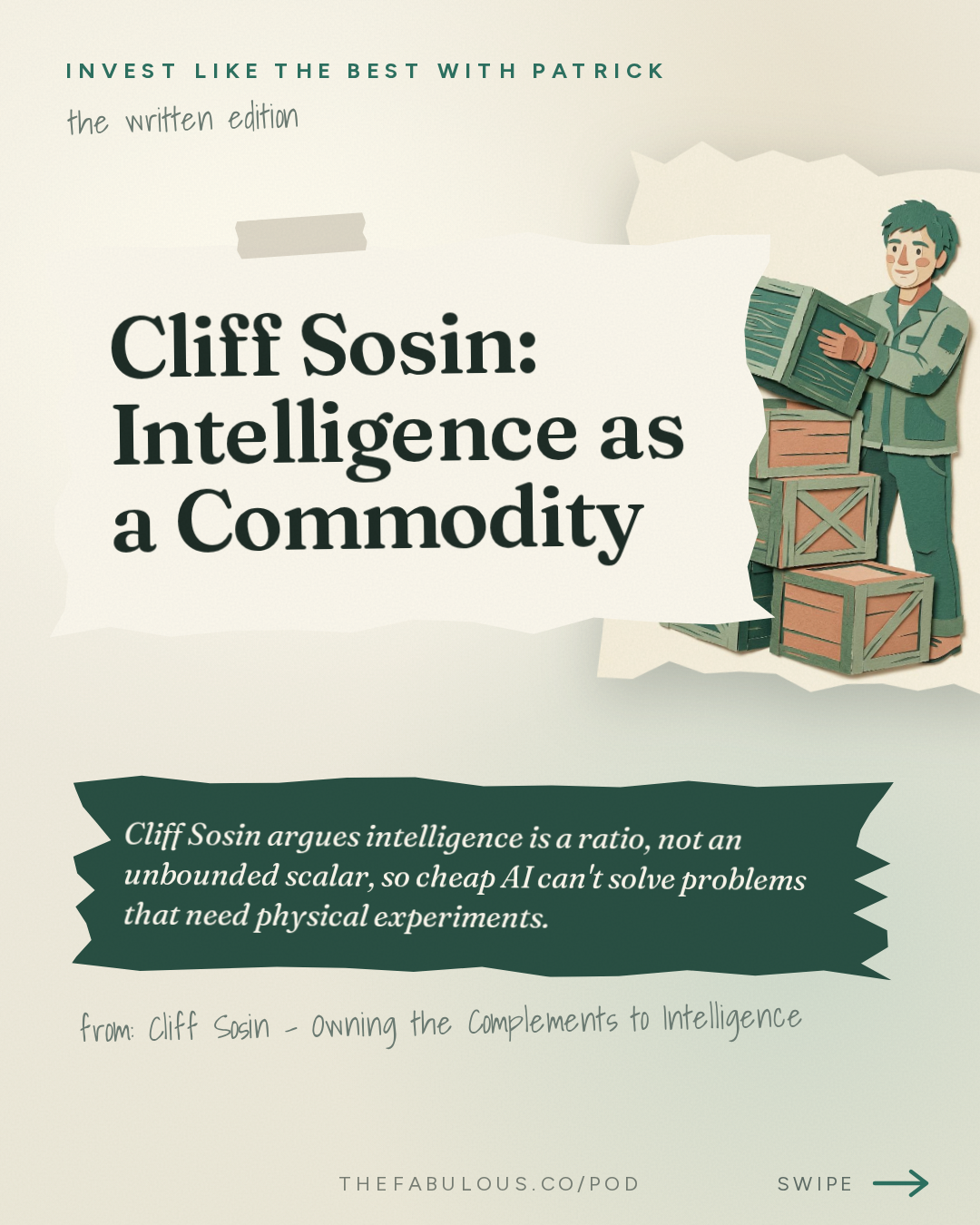
Cliff Sosin argues intelligence is a ratio, not an unbounded scalar, so cheap AI can't solve problems that need physical experiments. The investor behind an 80% Carvana position says to put money in what AI can't replace: data, attention, physical proximity, and scale (08:14, 42:34).
A technician reran a weather forecasting model after rounding off all of the initial conditions by a single decimal place. The two runs started almost identically. By the fourth or fifth simulated day, one said it would be seventy degrees and sunny. The other said twenty degrees and pouring rain (05:13). The error hadn't stayed small. It had compounded, step by step, until the forecasts had nothing in common. That accident is where chaos theory comes from, and the name people gave it was the butterfly effect: a wing flap in one place, a hurricane somewhere else (05:53).
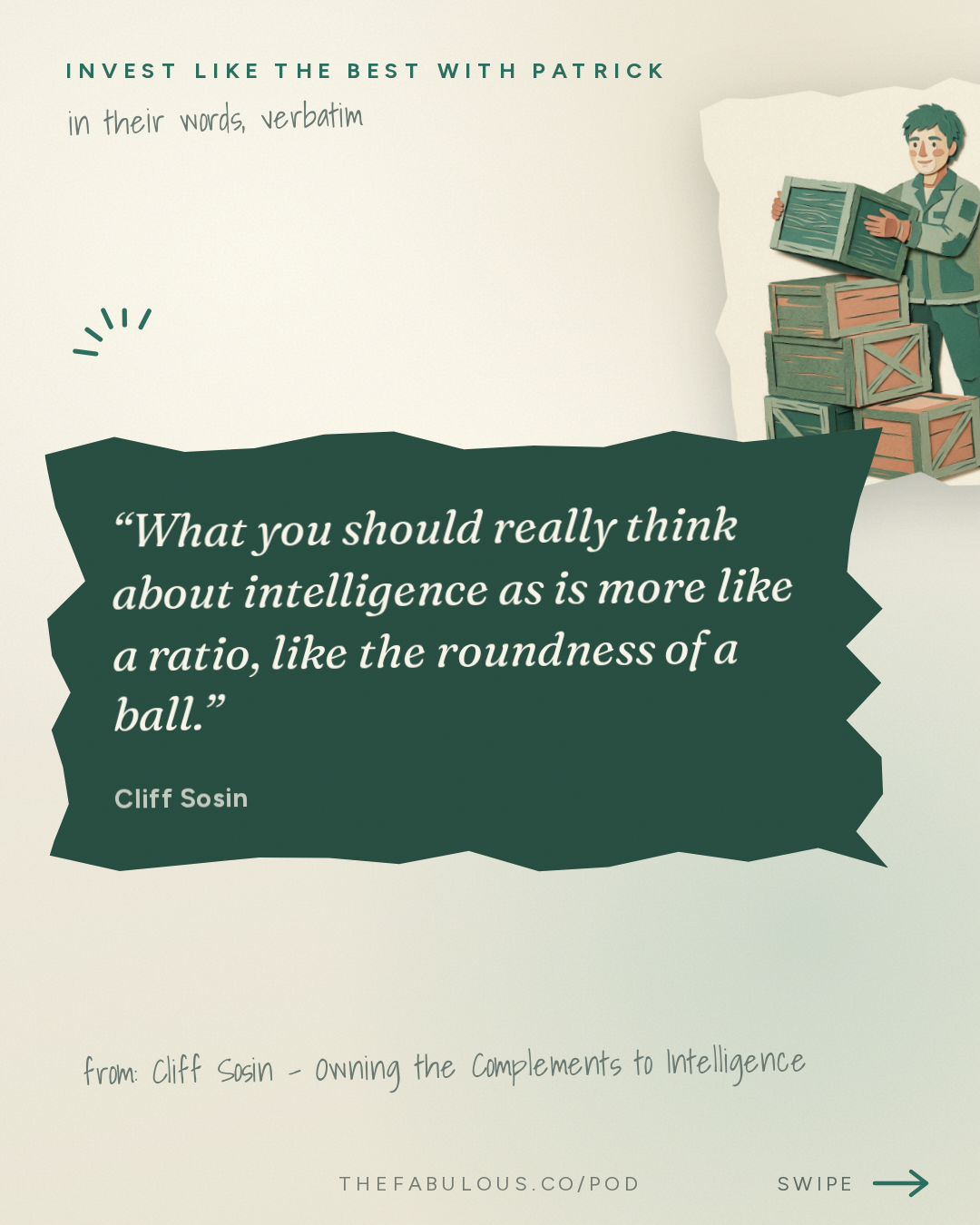
Investor Cliff Sosin shares this story in conversation with Patrick O'Shaughnessy on Invest Like the Best, because he thinks it explains something most people get backward about artificial intelligence. The popular image has intelligence as an escalator: amoeba, monkey, person, Einstein, then a vertical line to something god-like (01:52). Sosin thinks that picture is a mistake. "What you should really think about intelligence as is more like a ratio, like the roundness of a ball," he says, not an unbounded number like the height of a tree
What you should really think about intelligence as is more like a ratio, like the roundness of a ball. (Cliff Sosin, [02:19])A ball can get rounder and rounder, but it never becomes infinitely round. Intelligence, in his telling, is a tool for making predictions from a thin set of known facts about the world. In math, where the facts are complete, intelligence can reach perfection. But most of what humans care about, weather, group behavior, markets, is what mathematicians call a complex dynamic system: a system so sensitive to small errors that no amount of raw thinking power can out-forecast it. To get past that wall, Sosin says, something has to go gather new information the slow way. "You have to do experiments. You have to touch reality" (03:42).
This is not a case against artificial intelligence. Sosin calls himself AI-pilled (22:22). His point is narrower and, for investors, more useful: good-enough intelligence is getting cheap fast, and it will answer the large majority of questions people actually ask it (04:04). That is exactly why he thinks the valuable thing to own going forward isn't intelligence itself. It's whatever intelligence can't touch.
Owning What AI Can't Replace
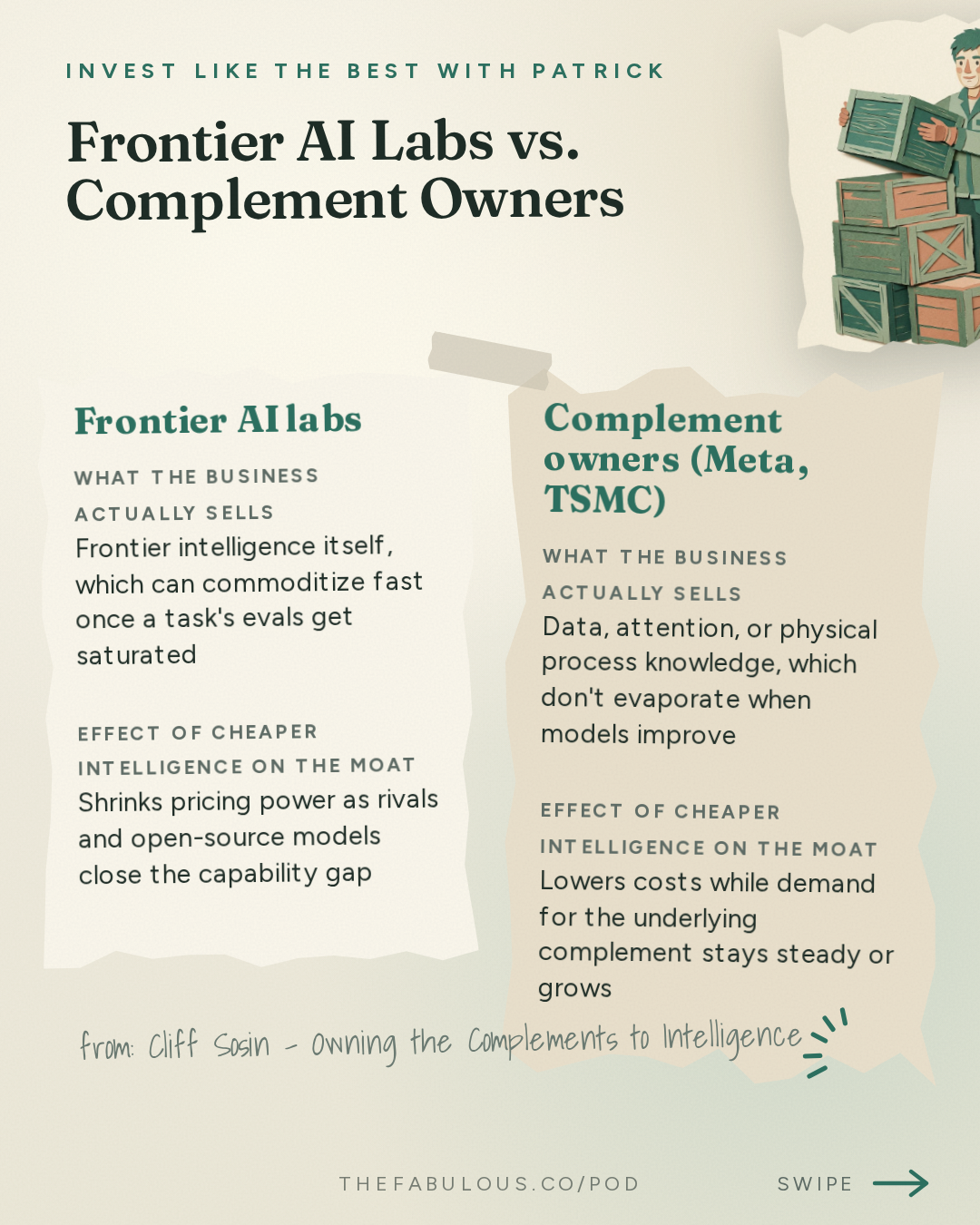
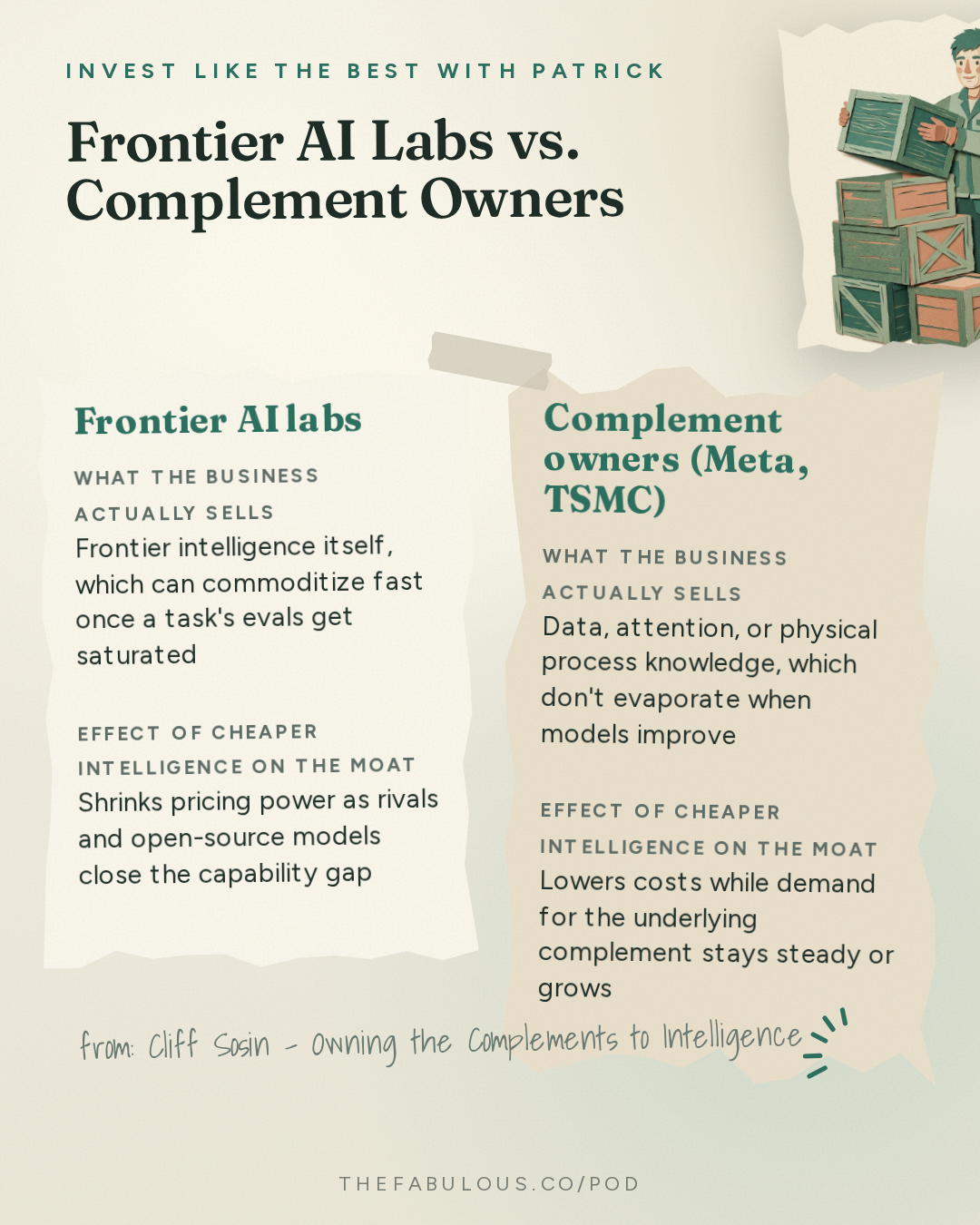
Sosin's working method is to assume every competitor, every company, every customer already has access to excellent intelligence, and then ask what's left to compete on. His answer: the complements to intelligence. "The complements to intelligence are data, attention, love, affection, whatever sort of emotional attachment," he says, along with physical proximity, scale, and, more cynically, regulatory capture (08:35). None of those things get commoditized just because a smarter, cheaper model shows up.
If intelligence becomes cheap and ubiquitous, what you wanna own are the complements to intelligence. (Cliff Sosin, [08:14])
He walks through Meta as the cleanest case. He argues the company's core business has quietly shifted from social networking to personalized television, built on an endless supply of short videos matched to what each person likes to watch (09:35). Meta earns about $250 billion a year, and spends roughly the same amount (09:54). Sosin's reductionist read is that nearly all of that spending, on data centers, on inference, on engineers writing algorithms, is really just spending on intelligence. If the price of intelligence falls by a factor of one hundred over the next five years, as he expects, Meta's costs shrink while its two durable assets, the data it holds on billions of people and the attention it already commands, stay exactly as valuable (10:35, 11:30). He contrasts that with Grindr, the dating app, which he says has plenty of data and attention but has been limited by a small team and budget, the kind of constraint cheap intelligence could actually loosen (12:13).
The same logic makes Sosin skeptical of the frontier AI labs as pure businesses. He traces a pattern: a new model launches, can only do easy tasks well, then climbs the ladder to harder and more valuable work, until the easy layer behind it gets commoditized by cheaper competitors (13:46). Programming was a huge market for the frontier model. The question is what's next, and whether there are enough high-value, low-competition problems left to climb toward. He doubts intelligence alone unlocks something like curing cancer, because that still requires touching reality through lab experiments, which take time no matter how smart the model directing them is (15:37). He points to Cogent Communications, a small network company that now routes thirty to forty percent of global internet traffic through one of its minor divisions, as a warning about where this can end: the cost of moving information collapsed, demand grew for a long time, and then the market itself started shrinking even as prices kept falling (18:31). Jevons paradox, the idea that cheaper resources get used more, only holds for part of that curve, he says. Push the price low enough and the market can shrink instead of grow (17:44).
That skepticism extends to the AI supply chain generally, chips, data centers, and the rest. Sosin says he's been willfully ignorant of these stocks because forecasting inference demand or future chip costs is something he can't do within several orders of magnitude, and even a correct forecast doesn't tell an investor who in the value chain actually captures the profit (24:04). He prefers a different historical lens:
Instead of betting on which railroad tycoon is gonna make money and how many railroads we need, I'm trying to think about, okay, once you have railroads, I'd love to have the foresight to figure out the CPG brands come next. (Cliff Sosin, [27:30])
Physical scale is the complement he returns to most. He names TSMC, the Taiwanese chip manufacturer, as a business whose moat is built from decades of process knowledge that is "not even legible to an AI," the kind of tacit, physical know-how that resists replication even by very capable software (29:45). He runs the same thought experiment on something mundane: garbage collection. Once everyone has an AI agent negotiating on their behalf, he argues, people stop being too lazy to switch providers, and a street with one low-cost hauler can roll up all its neighbors, turning scale into an even bigger advantage (31:53). He expects this to sharpen prices broadly: instead of a flat $60-a-month bill that quietly rises five percent a year unnoticed, people may see garbage collection, and lots of other sticky-priced services, move day to day as agents compete on actual marginal cost (37:09).
A Concentrated Bet on the Idea
Sosin's own portfolio, rough justice, is about five positions, with eighty percent in Carvana, the online used-car retailer, and Hilton Grand Vacations, and five percent in Meta (42:34). He defends the concentration not on conventional diversification math but on conviction: Carvana's physical infrastructure and brand are differentiated enough, he says, that there are few scenarios where the business goes badly wrong, and that confidence is what makes a large position tolerable (55:20). It's a bet that mirrors his larger thesis. Carvana already built the kind of full-stack, vertically integrated business that Sosin thinks cheap AI coordination will make possible across other industries, from pet care to hospitality, by solving the principal-agent and complexity problems that used to force companies to specialize narrowly (48:34).
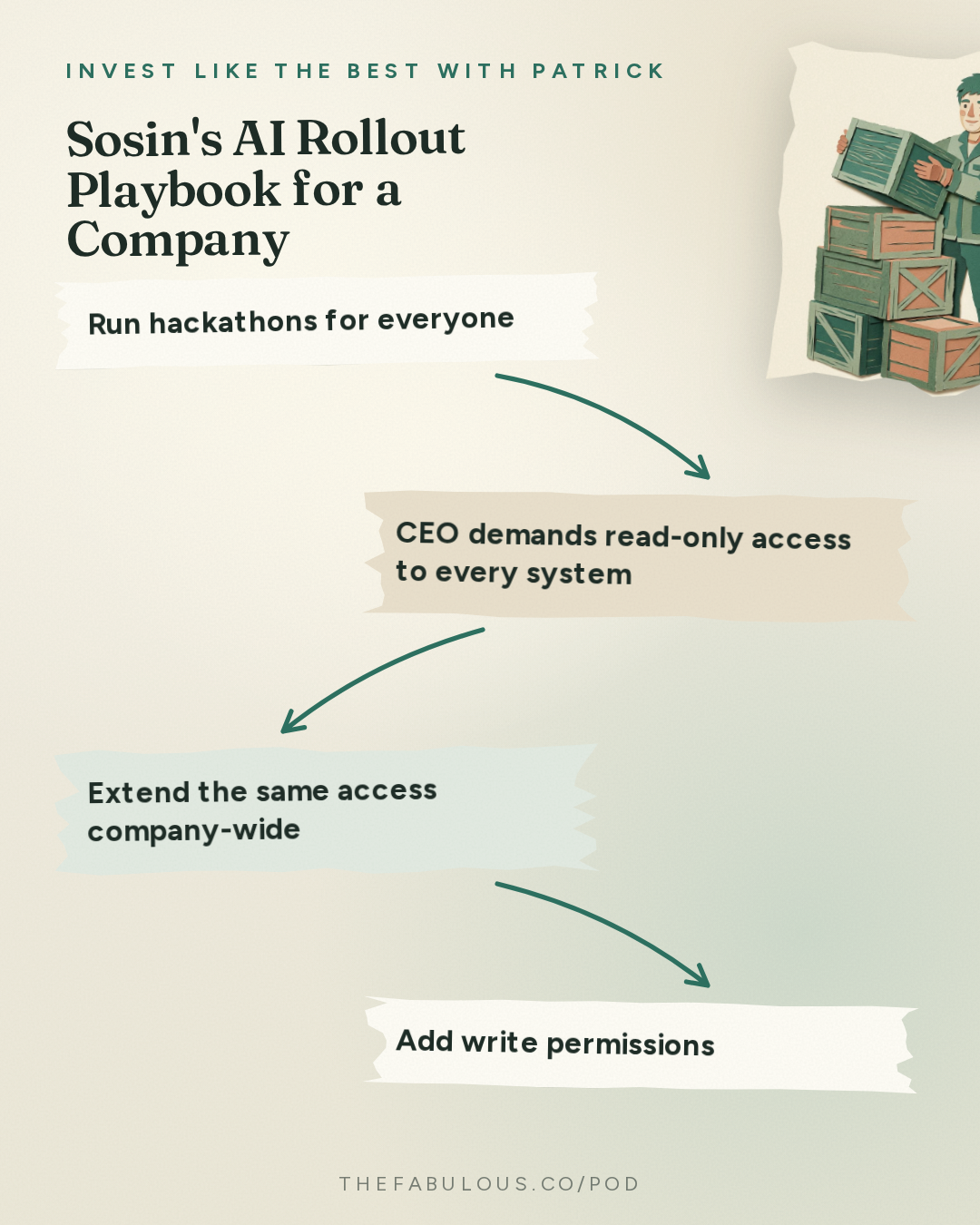
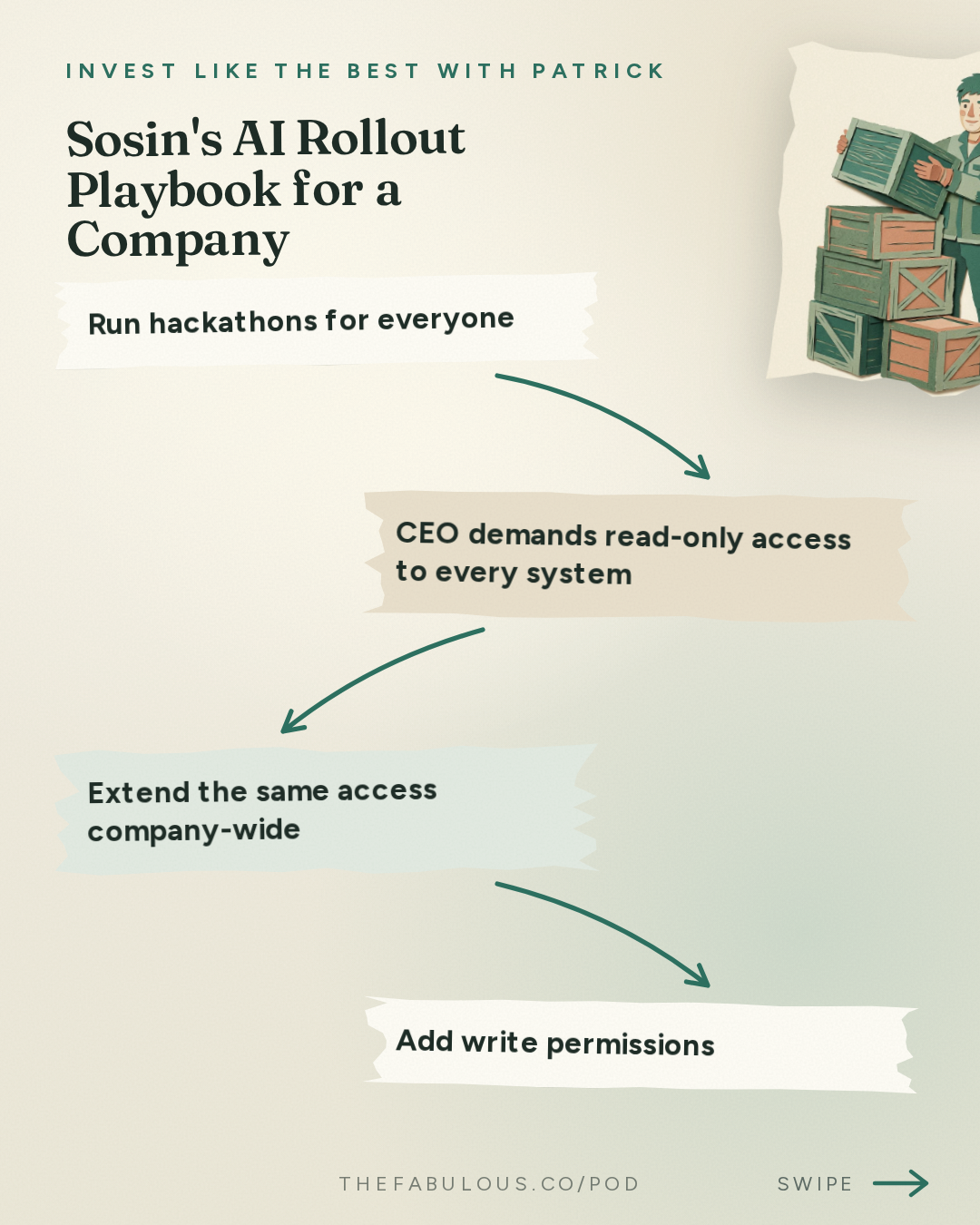
His advice to the companies he owns is almost procedural. Start with hackathons for everyone, not just engineers, to reset what people believe is possible (42:59). Then have the CEO demand read-only access to every internal system through an AI assistant, which sounds simple and turns out to be a multi-year fight over permissions, before write access and a change-management process can even be discussed (43:27). He is candid that this sequence can take years, while a faster-moving competitor could win the market first (44:39).
Sosin is careful not to oversell certainty. He holds two contradictory stories at once: AI build-out could be wildly underbuilt given how much he personally uses it, or wildly overbuilt because most people won't adapt as fast as he has (52:13). He thinks ubiquitous intelligence likely pushes corporate margins down and consumer surplus up, since so much of what companies currently charge for is just crystallized intelligence that gets cheaper to produce (48:00). He even expects his own profession to get automated, starting with short-timescale trading before it reaches the long-term judgment calls he makes himself (54:10). What he's confident about is narrower and, in a noisy debate about AI, oddly calming: intelligence is going to get much, much cheaper, and the money will go to whoever owns what stays scarce anyway.
Ask this episode anything
Pod's AI answers from the episode itself, with the minute mark so you can hear it yourself.
Or start with one of these
Ask this episode
Pod's AI listens to the whole episode to answer, and points you to the minute it comes from.
The rest of this answer, and any question after it
Answers come from the episode itself, never from a summary of it.
ContinueKey takeaways
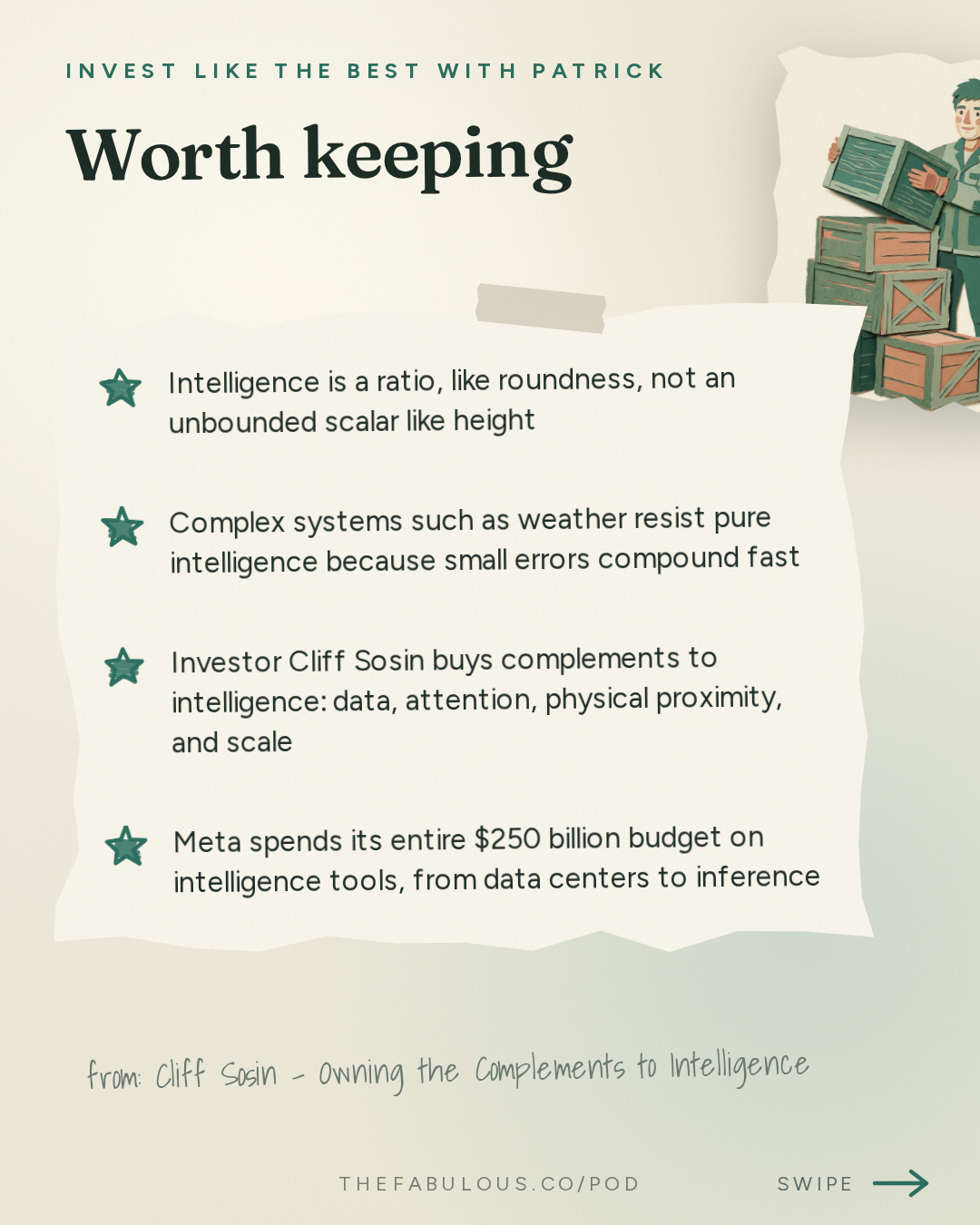
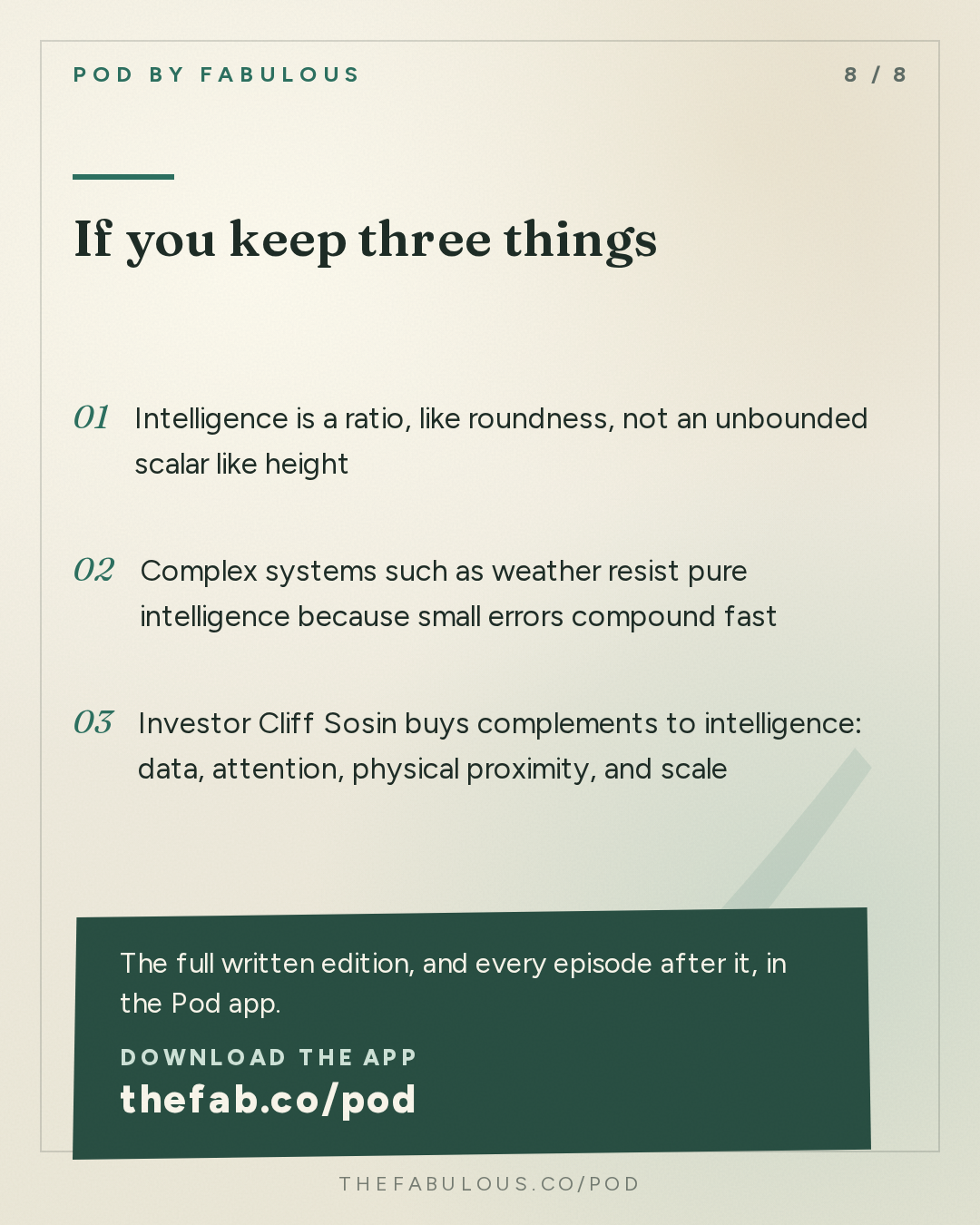
- Intelligence is a ratio, like roundness, not an unbounded scalar like height
- Complex systems such as weather resist pure intelligence because small errors compound fast
- Investor Cliff Sosin buys complements to intelligence: data, attention, physical proximity, and scale
- Meta spends its entire $250 billion budget on intelligence tools, from data centers to inference
- Sosin holds 80% of his portfolio in Carvana because its physical and brand moat resists AI-driven competition
The episode in cards
In their words
“What you should really think about intelligence as is more like a ratio, like the roundness of a ball.”
“To get past that, you then need to go out and get more information about the world, and that just takes time. You have to do experiments. You have to touch reality.”
“If intelligence becomes cheap and ubiquitous, what you wanna own are the complements to intelligence.”
“Instead of betting on which railroad tycoon is gonna make money and how many railroads we need, I'm trying to think about, okay, once you have railroads, I'd love to have the foresight to figure out the CPG brands come next.”
“You need to know it so that you can tell the model what to do.”
Protocols
-
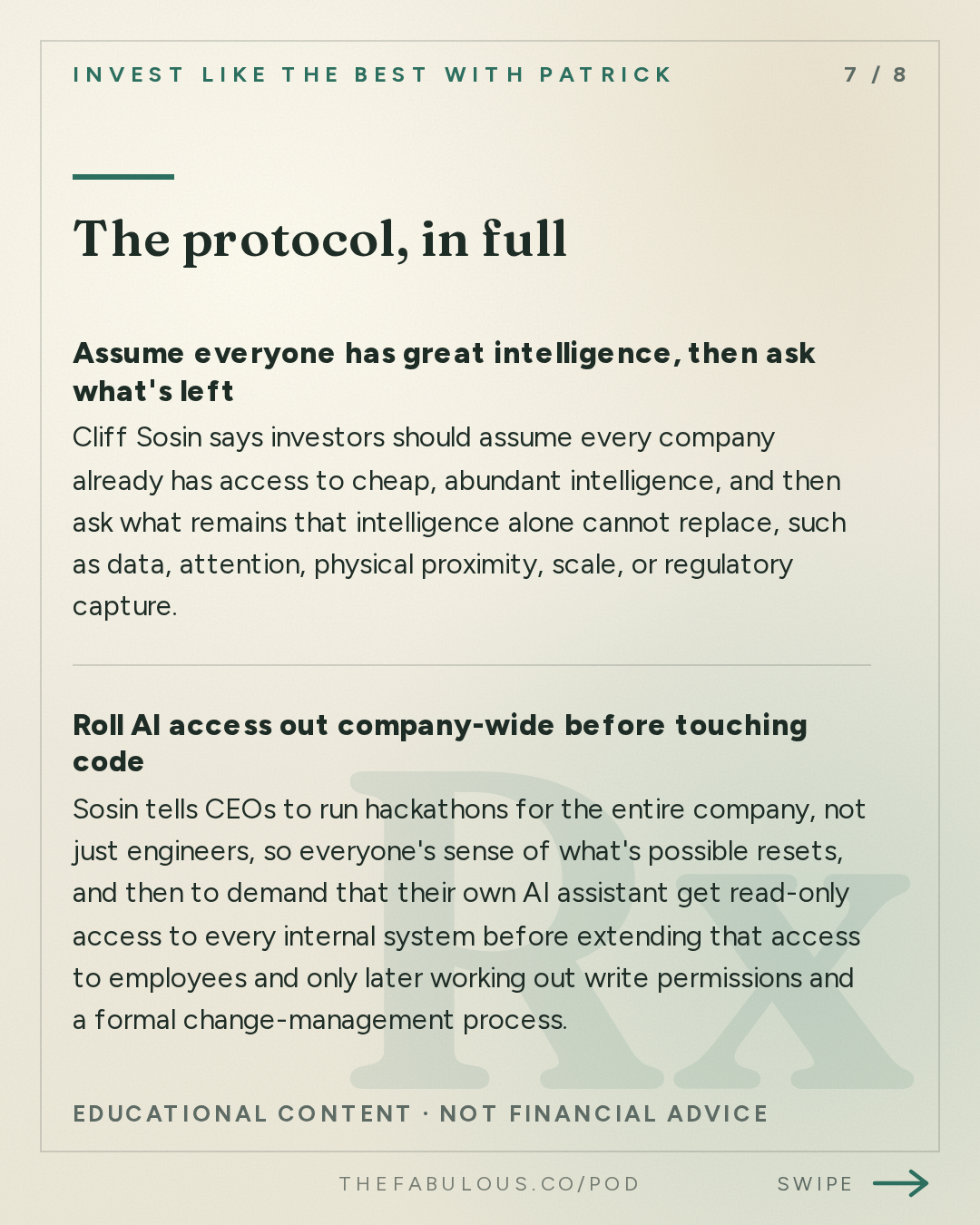
Assume everyone has great intelligence, then ask what's left
Cliff Sosin says investors should assume every company already has access to cheap, abundant intelligence, and then ask what remains that intelligence alone cannot replace, such as data, attention, physical proximity, scale, or regulatory capture.
Applied to every new investment idea
-
Roll AI access out company-wide before touching code
Sosin tells CEOs to run hackathons for the entire company, not just engineers, so everyone's sense of what's possible resets, and then to demand that their own AI assistant get read-only access to every internal system before extending that access to employees and only later working out write permissions and a formal change-management process.
A multi-year rollout, done one stage at a time
Questions this episode answers
What does Cliff Sosin mean by intelligence as a commodity?
Investor Cliff Sosin argues intelligence behaves like a ratio, such as the roundness of a ball, rather than an unbounded scalar like the height of a tree, meaning it has real limits (02:19). As it gets cheap and widely available, he treats it as a commodity rather than a scarce edge, which is why he looks for value in whatever AI can't replace instead.
What are the complements to intelligence investors should own, according to Cliff Sosin?
Sosin lists data, attention, emotional attachment, physical proximity, scale, and regulatory capture as the things that keep their value even after intelligence gets cheap and ubiquitous (08:35). He uses Meta as an example, arguing its enormous stores of user data and attention are untouched by falling AI costs (11:51).
Why can't AI solve every problem even with perfect intelligence?
Sosin says many real-world problems, like weather or curing cancer, are complex dynamic systems where small errors compound rapidly, a phenomenon traced back to a 1960s weather model that produced wildly different forecasts after a tiny rounding error (04:50). Solving these requires physical experiments over time, not just more computing intelligence (03:42).
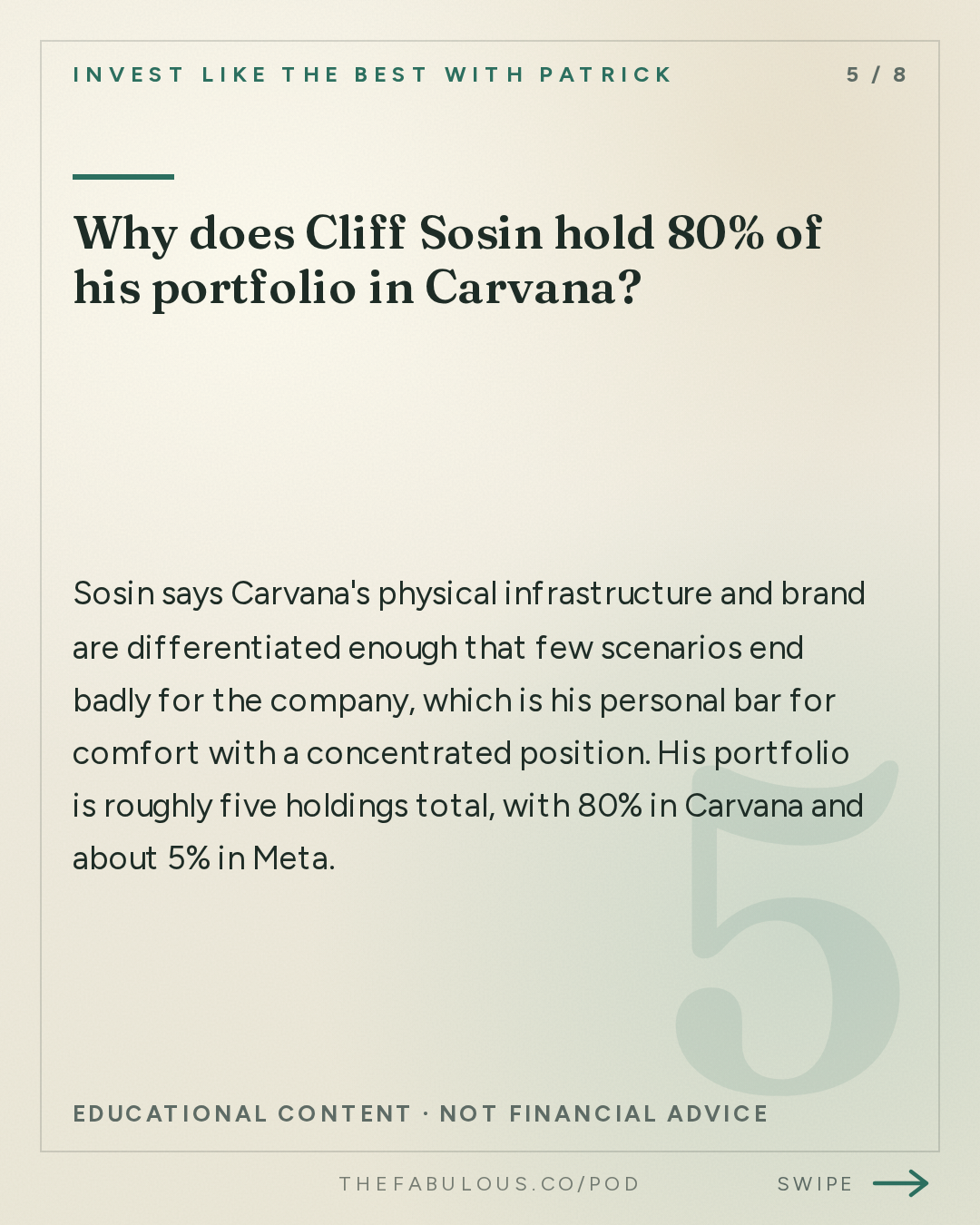
Why does Cliff Sosin hold 80% of his portfolio in Carvana?
Sosin says Carvana's physical infrastructure and brand are differentiated enough that few scenarios end badly for the company, which is his personal bar for comfort with a concentrated position (55:20). His portfolio is roughly five holdings total, with 80% in Carvana and about 5% in Meta (42:34).
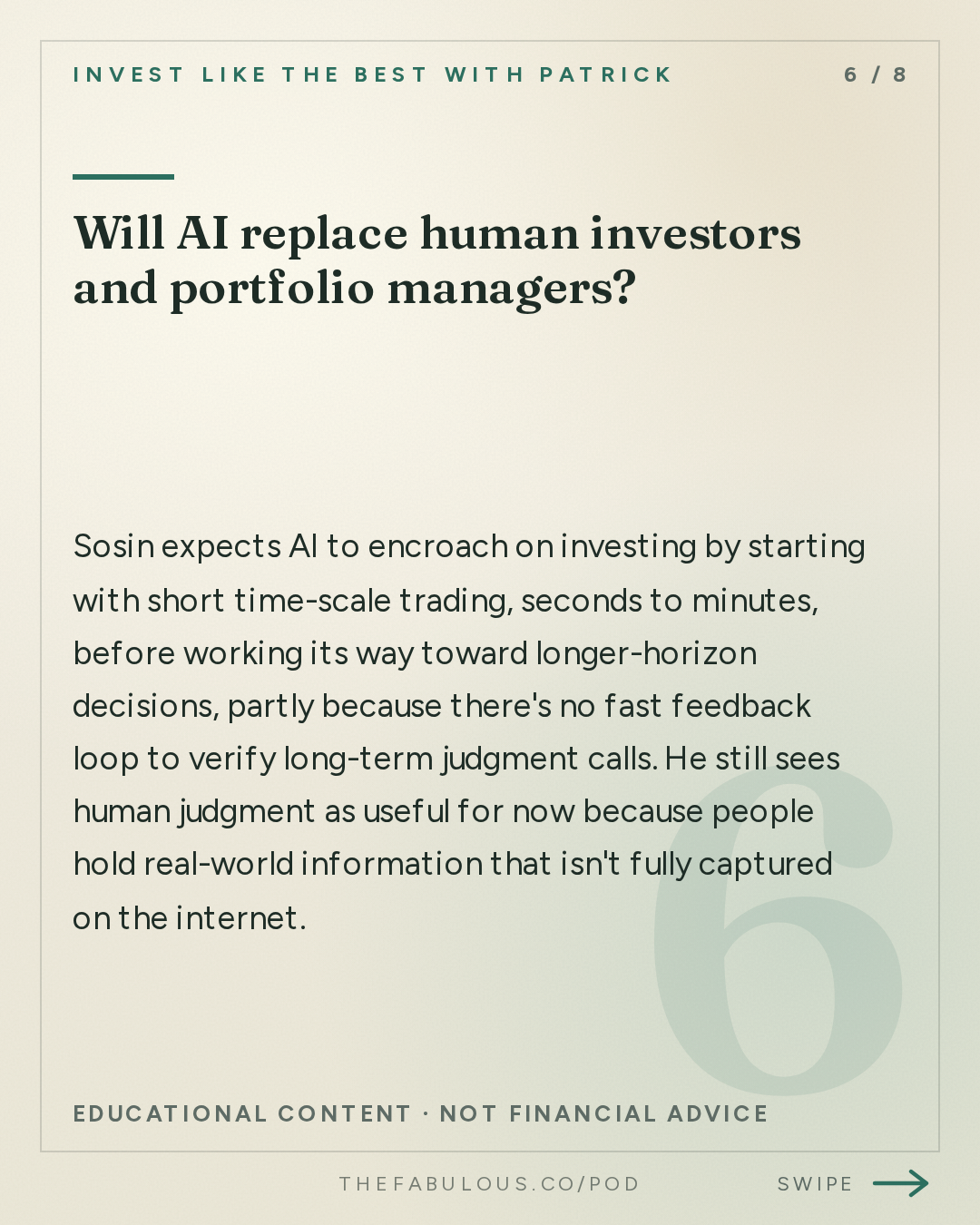
Will AI replace human investors and portfolio managers?
Sosin expects AI to encroach on investing by starting with short time-scale trading, seconds to minutes, before working its way toward longer-horizon decisions, partly because there's no fast feedback loop to verify long-term judgment calls (54:10). He still sees human judgment as useful for now because people hold real-world information that isn't fully captured on the internet (33:56).
The full read, in cards
Go deeper
- 1960s weather forecasting model (origin of chaos theory) — a rounding error in initial conditions produced completely different forecasts days later, the origin story of the butterfly effect
- The Economist feature on American capital markets — argued US capital markets are unusually good at financing new, speculative technology
- 1990s internet-era research reports — predicted falling corporate margins from internet competition, a forecast Sosin says was wrong mainly because of aggregation economics
Mentioned
Cliff Sosin · Patrick O'Shaughnessy · Meta · Carvana · Nvidia · TSMC · Grindr · Cogent Communications · SpaceX · Renaissance Technologies · Hilton Grand Vacations
More from this show and category

Christina Cacioppo on Vanta's AI Strategy
Vanta founder Christina Cacioppo prefers an 80% growth, 80% margin business over a 160% growth, 30% margin one, despite a tenfold valuation gap. She also details how Vanta is eating the cost of AI tokens rather than marking them up, since a 4X markup on Claude would put the product in a losing price comparison with the model itself.

David Vélez on Nubank's AI Strategy and Banking's Future
Nubank founder David Vélez argues global banking is still in the Blockbuster era, with incumbents holding 90% of a $10 trillion industry (02:38), while Nubank's own AI foundation model and a flattened org structure let it serve 140 million customers at 3% of a traditional bank's cost (05:32).

Andrew Huberman on Sleep, AI, and Neurotech
Stanford neuroscientist Andrew Huberman lays out a three-step method for falling asleep fast, predicts that Meta, OpenAI, and Anthropic will become biotech companies racing to read and write the nervous system, and describes a memory experiment that undercuts how neuroscience thought memory worked. He also discusses the scientist who CRISPR-edited twin babies and reportedly now works in Austin, Texas.
Gabe Stengel on Rogo and AI in Finance
Gabe Stengel, CEO of AI finance platform Rogo, says AI will force top investors to rebuild their firms within five years. He argues vertical AI wins by building the compliance and workflow plumbing banks need, not just smarter models, and predicts pricing will shift from per-seat fees toward per-outcome charges for deals and reports.
