
Invest America Act: How 530A Accounts Work
Brad Gerstner & Geoffrey Canada - Raising the Floor for Every American Child - [Invest Like the Best, EP.501]
The brief
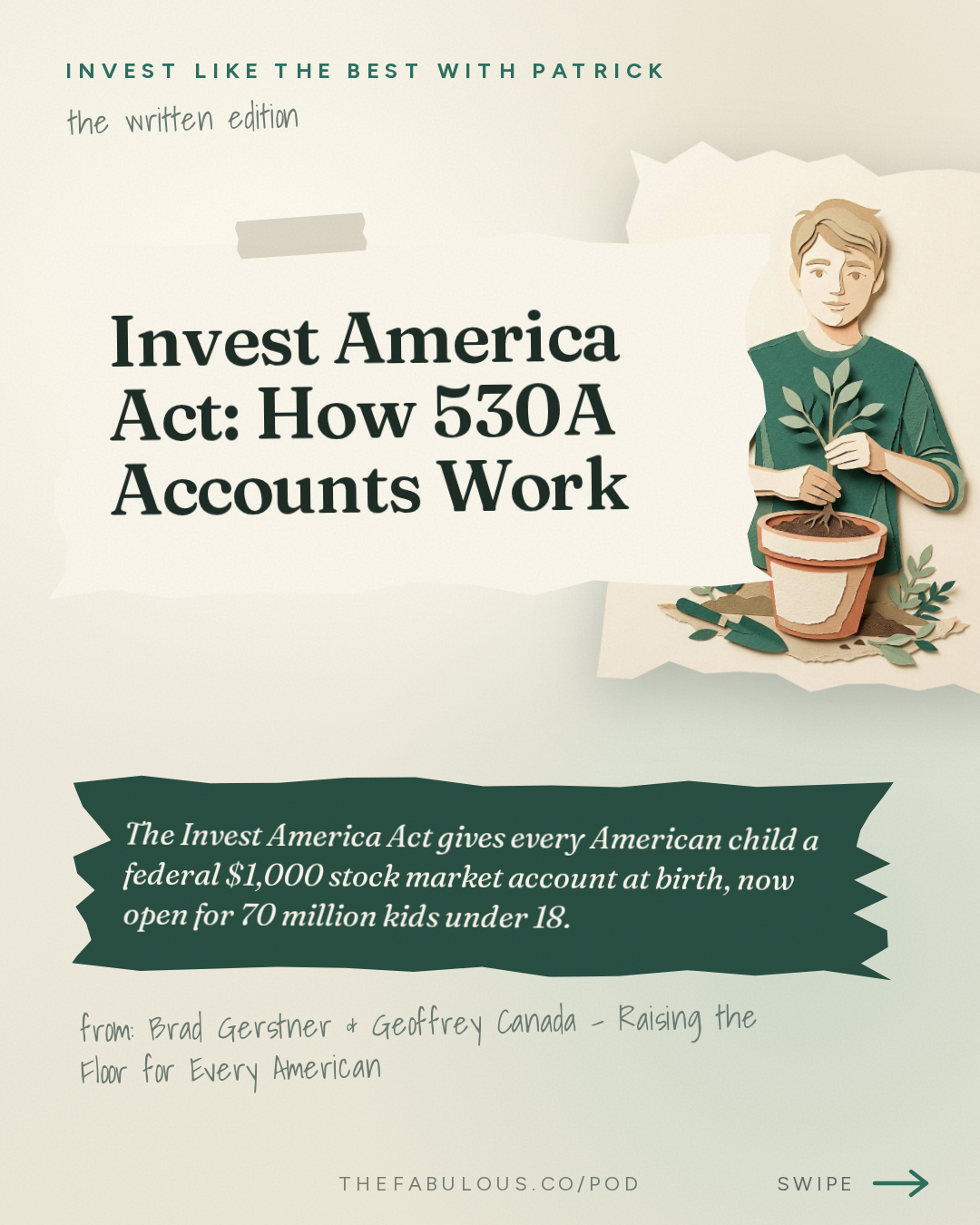
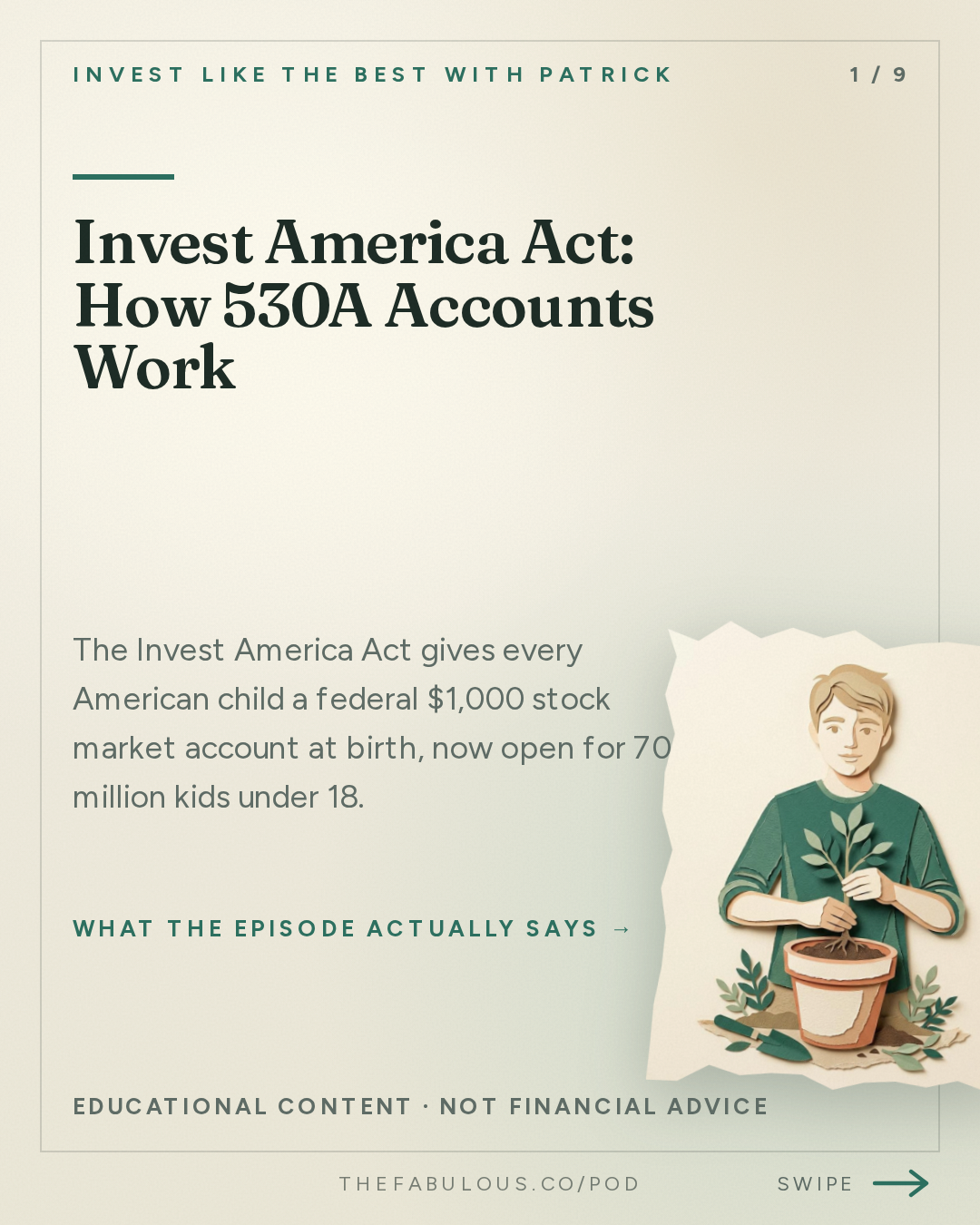
The Invest America Act gives every American child a federal $1,000 stock market account at birth, now open for 70 million kids under 18. Unlike Social Security, the account is owned outright by the family, and philanthropists including Elon Musk have already added billions in shares.
Every day in America, about 10,000 babies are born (15:15). As of July 4, 2025, each one now arrives with a federal deposit waiting: $1,000, placed automatically into the stock market the moment a Social Security number is issued (12:55). No form to fill out, no bank visit required. The money simply starts compounding before most parents know to look for it.
That quiet mechanism is the subject of a conversation between venture capitalist Brad Gerstner, founder of the investment firm Altimeter Capital, and Geoffrey Canada, the longtime president of the Harlem Children's Zone, a nonprofit that has run anti-poverty programs in New York City for more than three decades. The two met during the pandemic, when Gerstner's idea for what became known as the Invest America Act still sounded, as podcast host Patrick O'Shaughnessy admits, like a fool's errand (00:59). Five years later it is federal law, and 70 million of these accounts already exist for every American under 18 (13:48).
The Account as Argument
Gerstner's case starts with a diagnosis, not a product. Fewer than half of Americans under 40 say they believe in capitalism (11:58), and he thinks he knows why.
"There is no capitalism without capital." Brad Gerstner, [11:58]
People without savings watch the stock market make other people rich and conclude the game is rigged. Canada has spent 50 years watching that frustration curdle. He describes the 1968 riots after Dr. Martin Luther King's assassination as rage with nowhere else to go (07:47), and he hears an echo of it now in protests in Paris and London, and in American elections that have swung hard against incumbents of both parties. This is not about Democrats or Republicans, he says, it is about whether Americans believe the system is fundamentally fair (10:26).
The technical name for what the account fixes is the cold start problem: the fact that opening a brokerage account for a child, verifying identity, choosing investments, is hard even for financially sophisticated adults, let alone a single parent working two jobs (17:24). Gerstner borrows Warren Buffett's metaphor for the fix.
"Warren Buffett tells us, start with a really small snowball and a really long hill. The problem is everybody misses the first third of life." Brad Gerstner, [17:45]
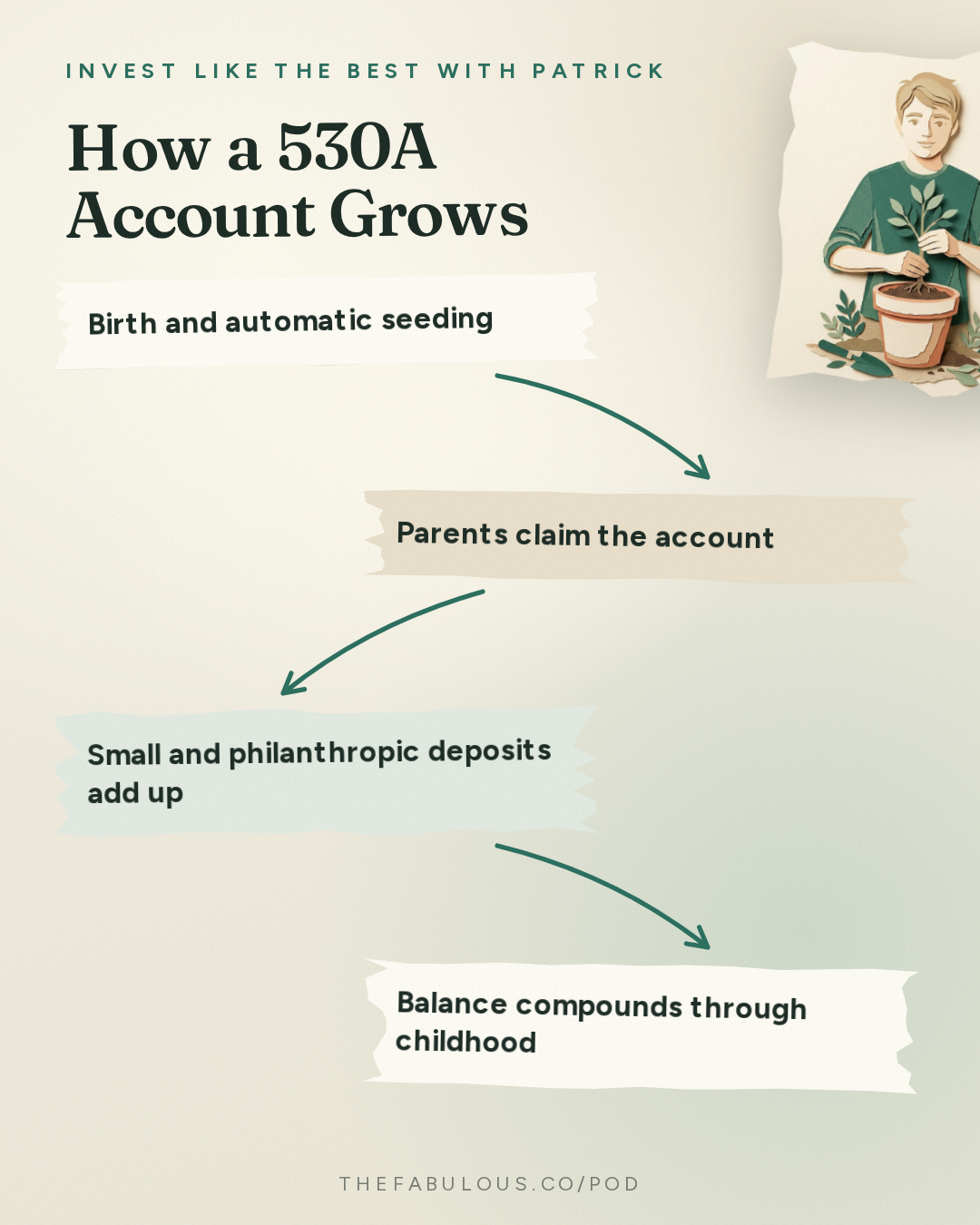
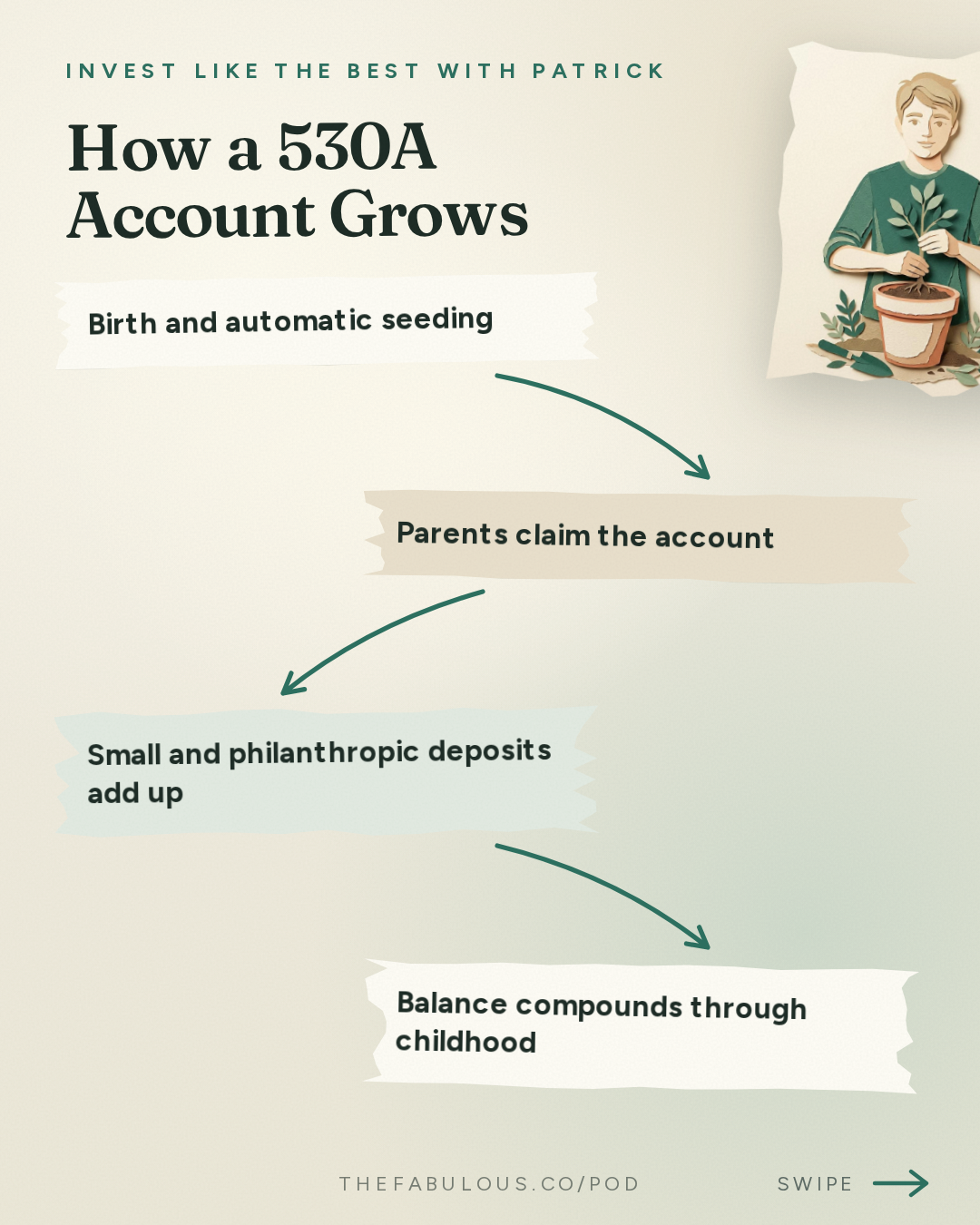
Under the new law, the accounts are called 530A accounts, after the tax code section that governs them. Every child's account is funded and invested automatically, whether or not a parent ever logs in. If a parent claims it two or three years late, Gerstner notes, the money has still been compounding the whole time (21:16).
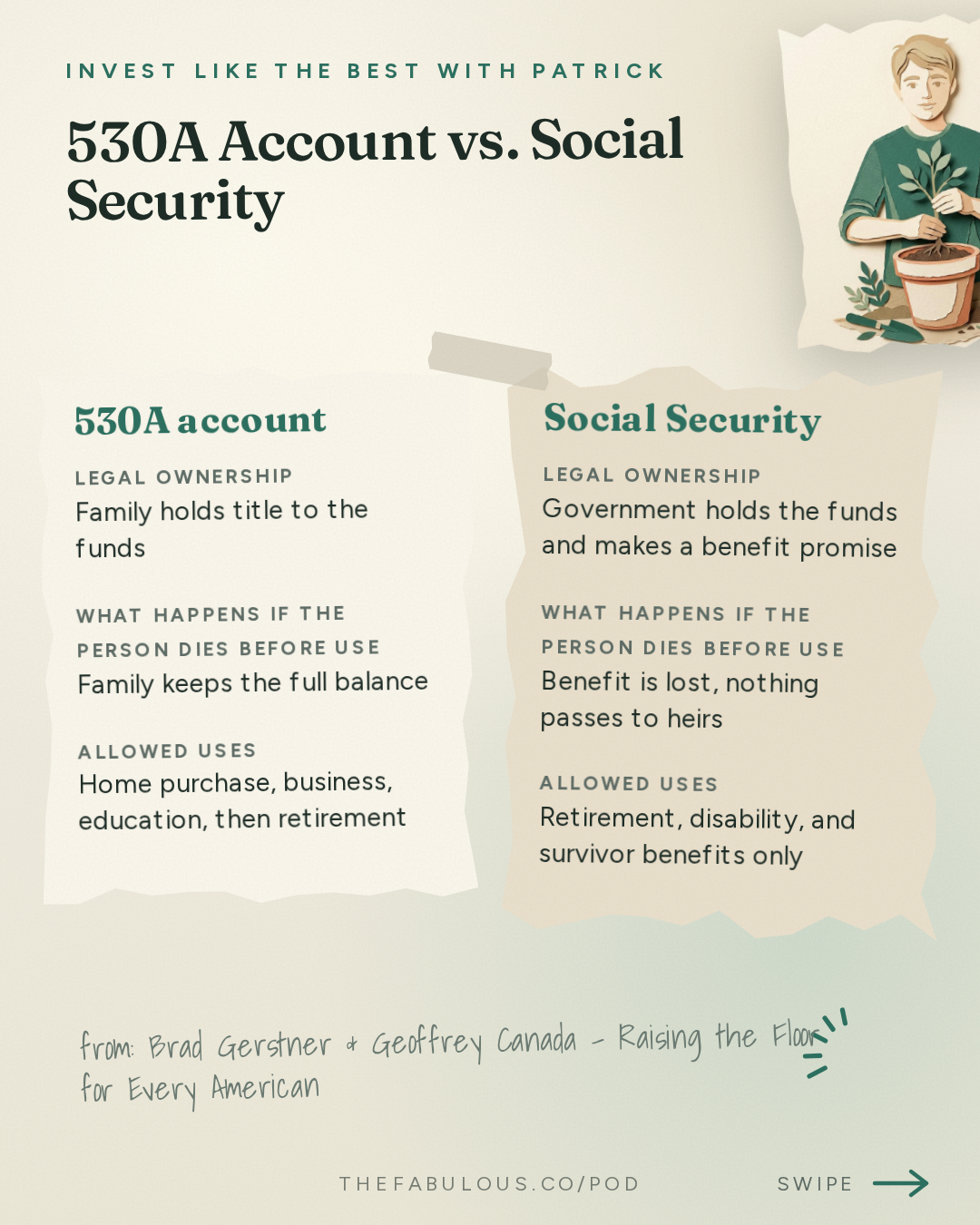
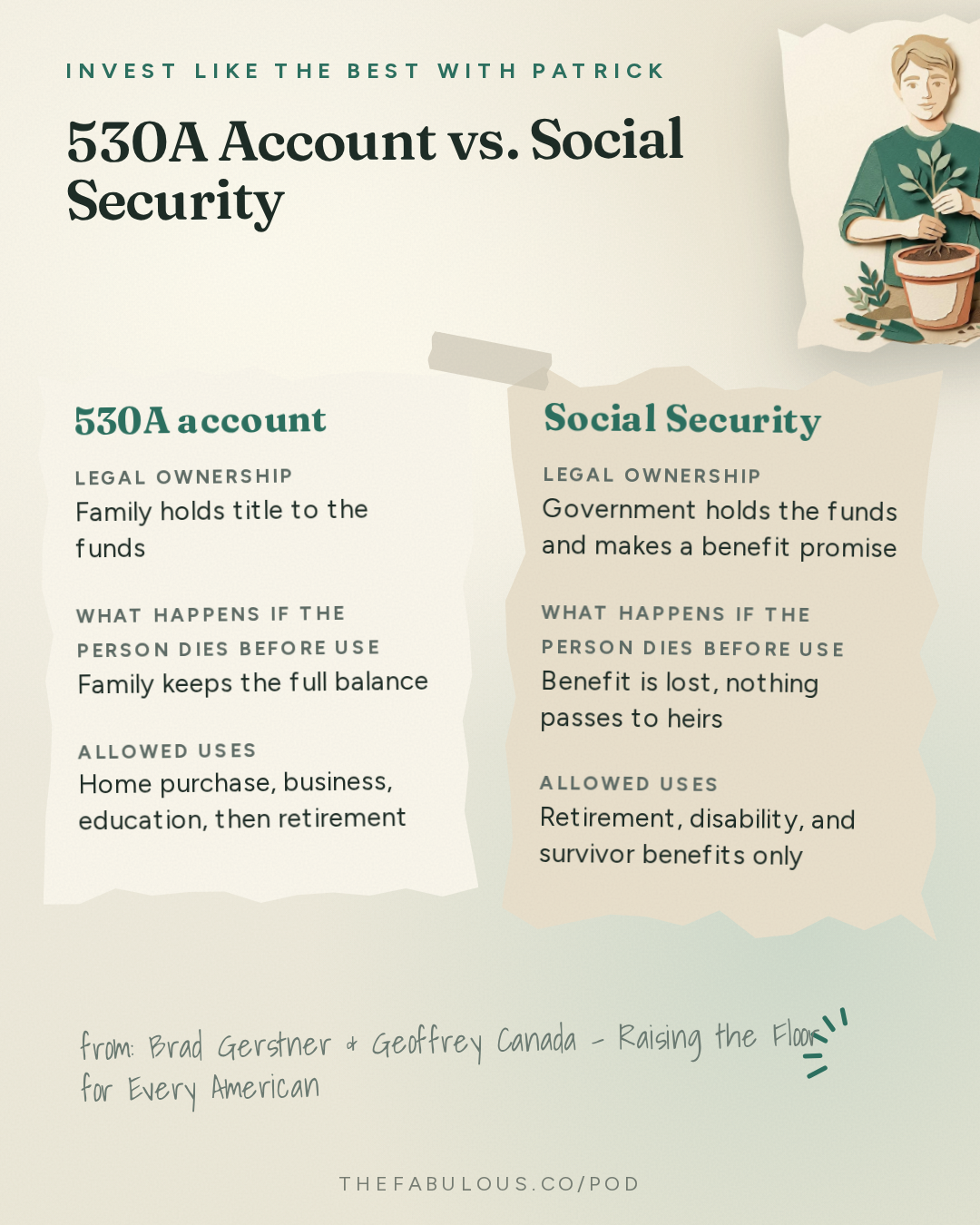
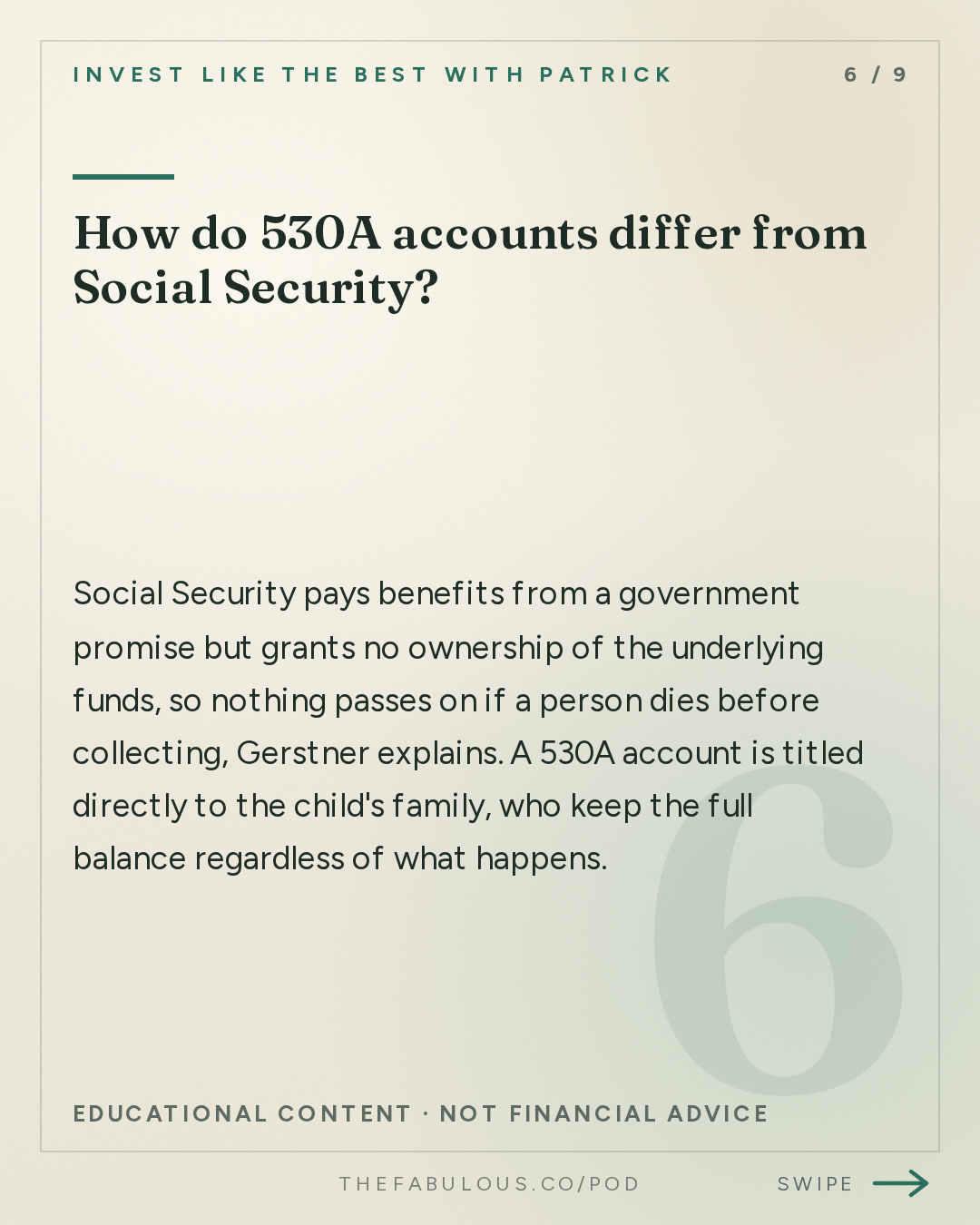
The design choice that seems to matter most to both men is ownership. Social Security promises a future payment but grants no title to it; if someone dies before collecting, the family gets nothing. A 530A account works differently.
"This isn't more dependency on the state. This is independence from the state. These are private accounts owned by individuals." Brad Gerstner, [31:18]
If a child dies after the family has built up $50,000 or $75,000, Gerstner says, the family keeps it (31:38). That distinction, he argues, is why the program won Republican votes despite initial suspicion that it was welfare in disguise (30:56), and why Democratic governors from California's Gavin Newsom to Maryland's Wes Moore have embraced it since (41:04).
Money That Arrives Before the Lesson
Canada's contribution is less about mechanism and more about what happens next. He has watched government and philanthropic programs hand money to poor families before, and seen it evaporate without financial education attached. His own childhood illustrates the problem: a 1950s school savings plan that paid him interest of just a penny for months of quarters taught him, he says, that saving made no sense (45:06). What changes the equation this time, he believes, is scale and a tool nobody had in the 1950s: artificial intelligence that can serve as a financial tutor in a child's pocket, answering questions about compounding in real time (50:11). Texas has already built a financial literacy curriculum around the accounts for 500,000 students (51:10), and Canada wants every state to follow, pairing the money with the habit of checking in on it.
The arithmetic is meant to make that habit feel worthwhile. Starting from the $1,000 federal deposit, a family adding roughly $10 a week would see the account grow to about $12,000 to $13,000 by the time a child reaches seventh grade, Gerstner estimates, compounding at something close to the long-run historical return of the S&P 500 stock index (50:29). At 18, the law allows withdrawing only 25 percent of the balance, and only for a home purchase, a business, or education; the rest rolls automatically into an individual retirement account (53:49).
Private money has moved faster than anyone expected. SpaceX CEO Gwynne Shotwell donated 2 million shares of the rocket company into the accounts of children ages 10 to 18 in the poorest half of American zip codes (23:31). Weeks later, SpaceX founder Elon Musk pledged one share of the company to every one of the 70 million account holders, a gift Gerstner values at $11.5 billion (24:16). Michael and Susan Dell, the entrepreneurs behind Dell Technologies, have told Gerstner they intend to give away their full fortune, reported at $200 billion, within ten years of their deaths, largely through these accounts (68:45). Economists Rob Shapiro, who served in the Clinton administration, and Kevin Hassett, now chairman of the National Council of Economic Advisors, studied the likely effects for the Milken Institute and found that children with capital accounts are more likely to finish high school and college, more likely to buy homes and start businesses, and less likely to be incarcerated (34:03). Gerstner projects the accounts will hold $3 trillion to $5 trillion within 10 to 15 years (32:59).
Both men reach for history to explain why they think this moment resembles 1935, when Social Security was created amid fears that industrial unemployment would tear the country apart. British economist John Maynard Keynes wrote in 1930 that machines would cause what he called technological unemployment, but predicted living standards in a century would be four to eight times higher (61:31). Gerstner notes that 80 percent of today's jobs did not exist in 1930 (63:35), and that the actual multiplier, 8.2 times, has just edged past the top of Keynes's forecast (63:12). His conclusion is that artificial intelligence will displace work the way machinery once did, and that the country needs a new bridge, the way Social Security was a bridge in 1935, to keep people invested in the outcome rather than afraid of it.
"We do not have an abundance problem. We do not have an invention problem. We have a distribution problem." Brad Gerstner, [78:01]
Canada's closing argument is more personal. He traces his own turn toward markets to the moment he first owned something.
"I wasn't down with capitalism until I got some capital. I'm just being honest." Geoffrey Canada, [80:23]
It is a striking thing to hear from a man who has spent 50 years running anti-poverty programs, and that is the point. The bet underneath Invest America is not that poor families need to be taught to value markets. It is that they have never been handed a reason to. Whether $1,000 at birth, a few dollars a week, and a share of SpaceX add up to that reason will take a decade or two to find out. But for the first time, Canada says, there is an infrastructure built for every child in the country to find out at all.
Ask this episode anything
Pod's AI answers from the episode itself, with the minute mark so you can hear it yourself.
Or start with one of these
Ask this episode
Pod's AI listens to the whole episode to answer, and points you to the minute it comes from.
The rest of this answer, and any question after it
Answers come from the episode itself, never from a summary of it.
ContinueKey takeaways
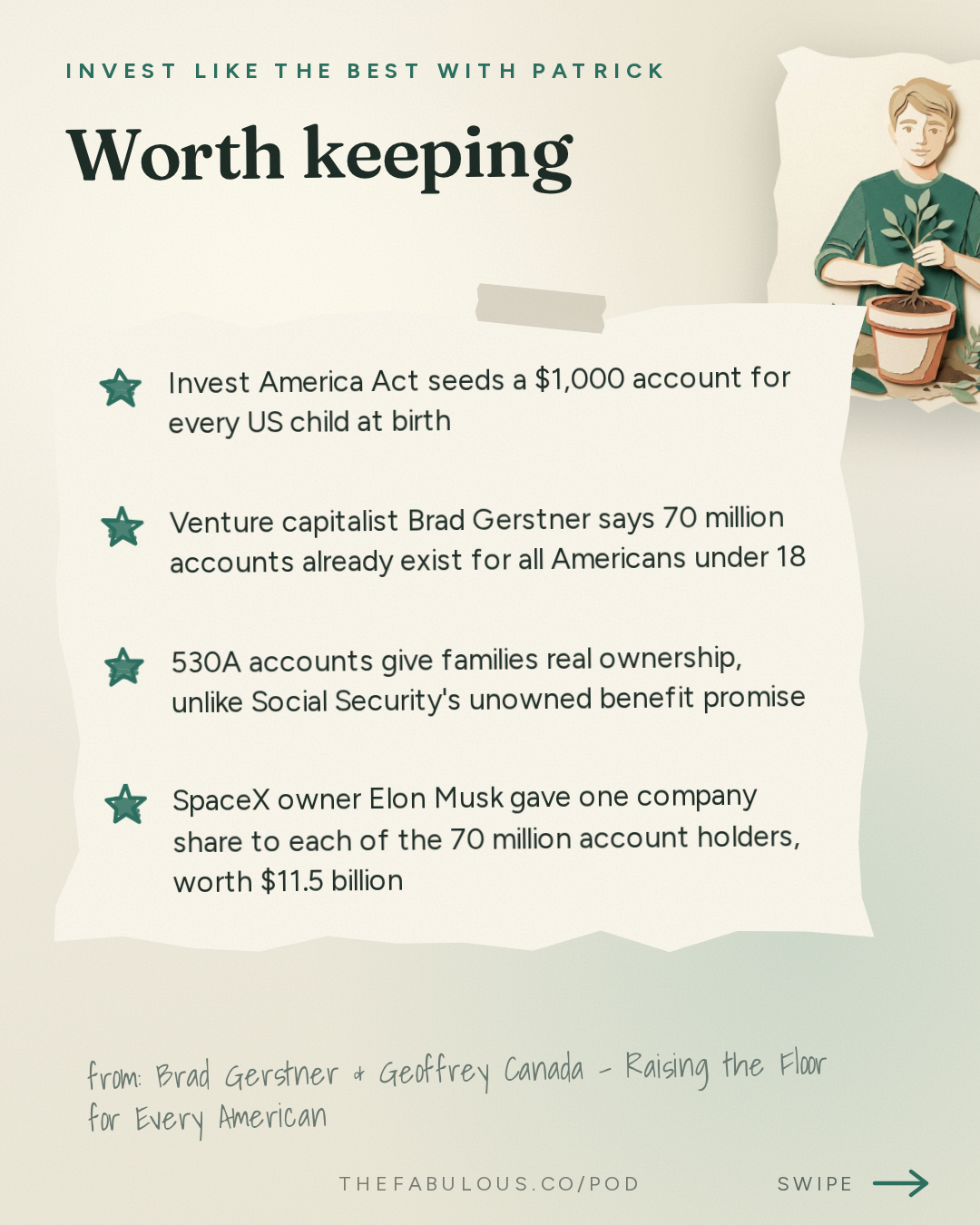
- Invest America Act seeds a $1,000 account for every US child at birth
- Venture capitalist Brad Gerstner says 70 million accounts already exist for all Americans under 18
- 530A accounts give families real ownership, unlike Social Security's unowned benefit promise
- SpaceX owner Elon Musk gave one company share to each of the 70 million account holders, worth $11.5 billion
- Economist John Maynard Keynes predicted 4-8x growth by 2030; actual growth hit 8.2x
The episode in cards


By the numbers
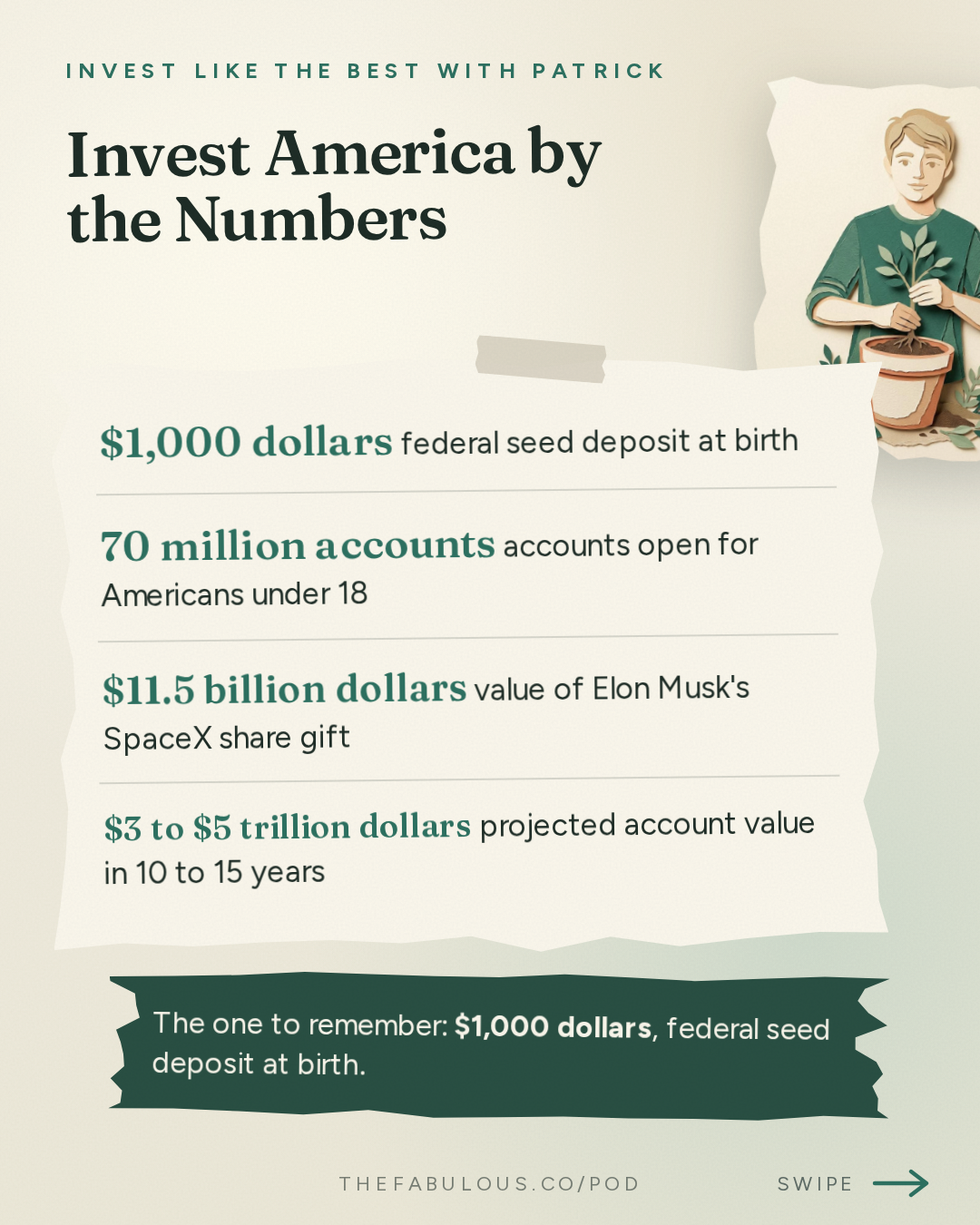
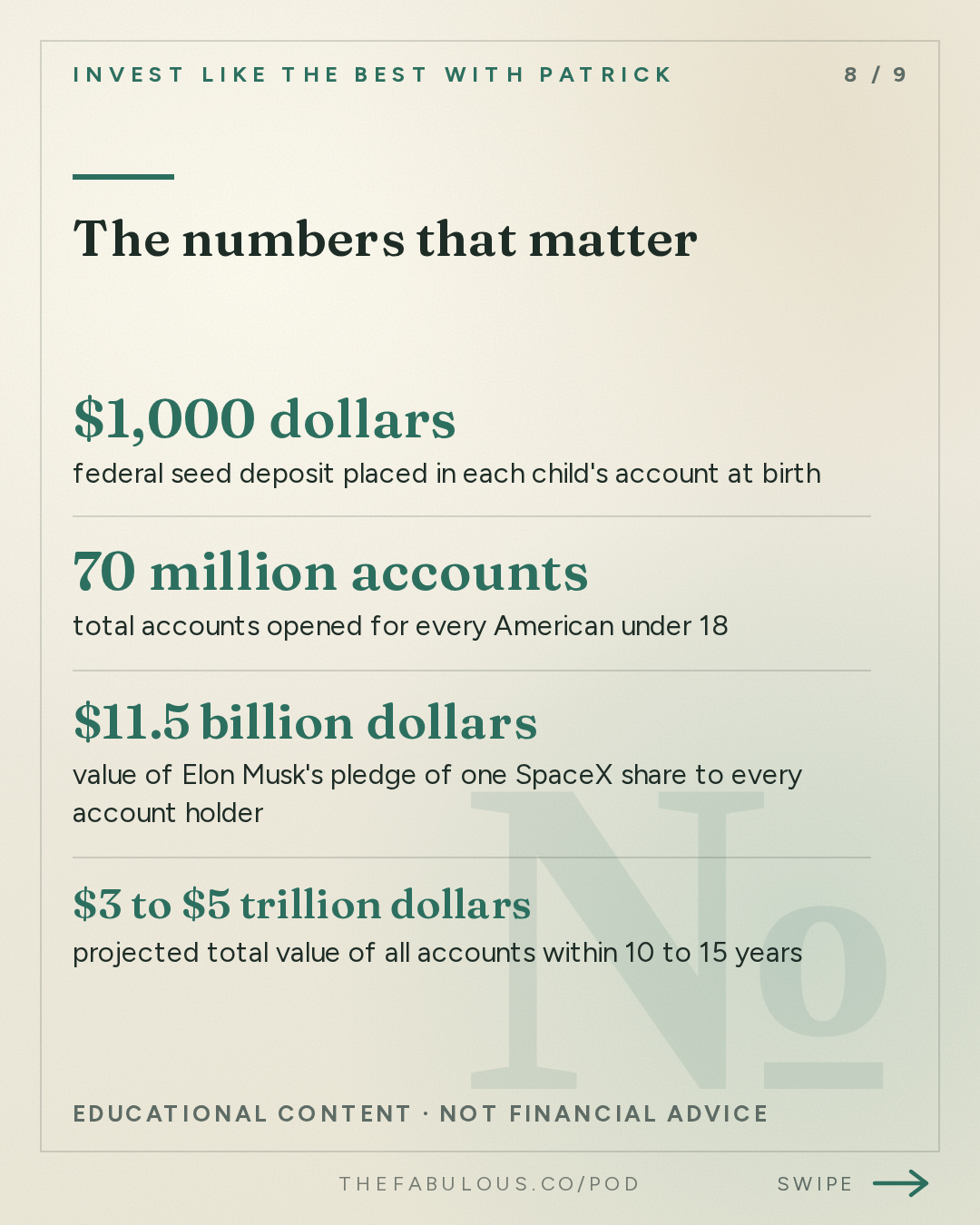
- $1,000 dollars federal seed deposit placed in each child's account at birth
- 70 million accounts total accounts opened for every American under 18
- $11.5 billion dollars value of Elon Musk's pledge of one SpaceX share to every account holder
- $3 to $5 trillion dollars projected total value of all accounts within 10 to 15 years
In their words
“There is no capitalism without capital.”
“Warren Buffett tells us, start with a really small snowball and a really long hill. Yeah. The problem is everybody misses the first third of life”
“This isn't more dependency on the state. This is independence from the state. These are private accounts owned by individuals."”
“I wasn't down with capitalism until I got some capital. I'm just being honest”
Protocols
-
Claim the account
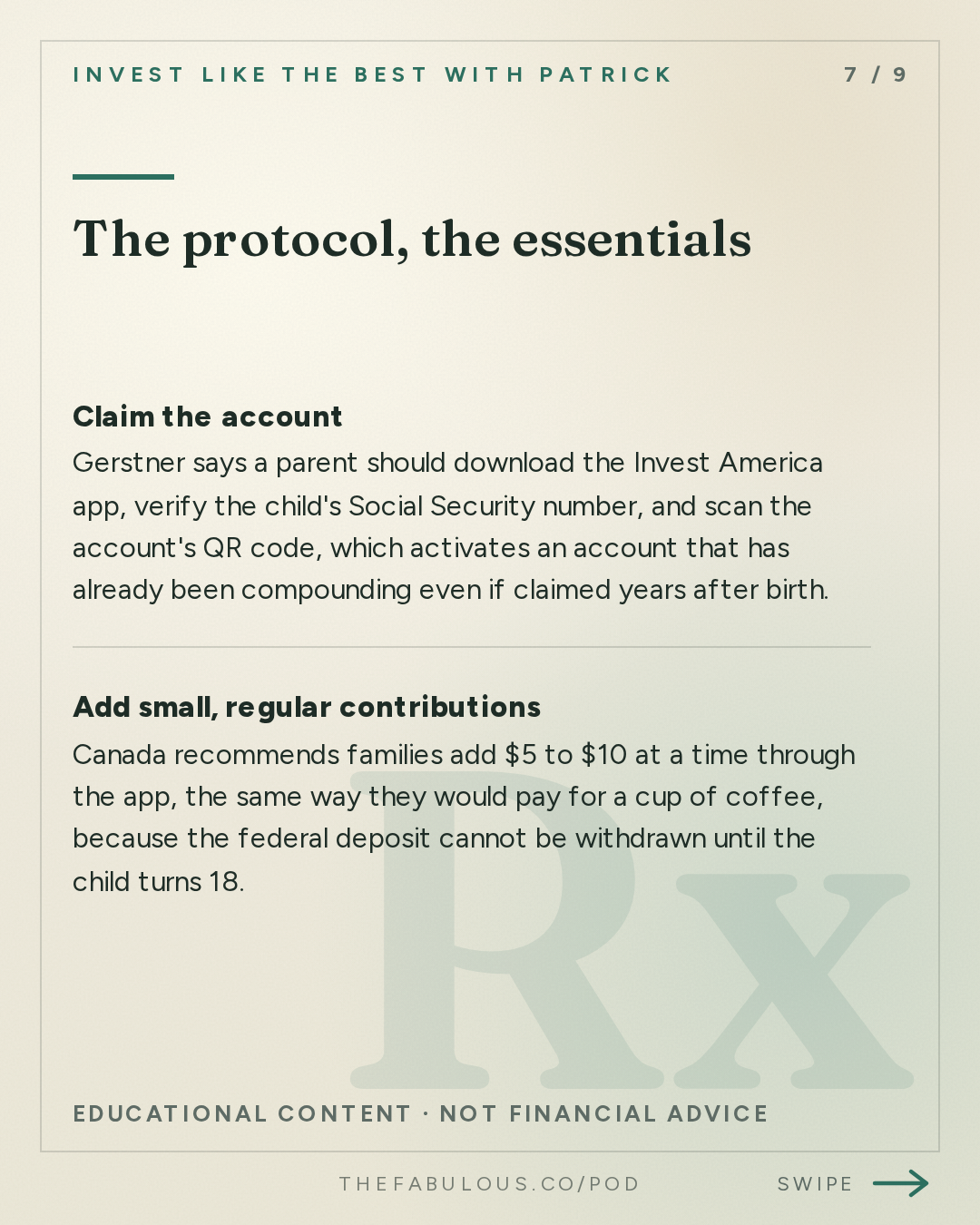
Gerstner says a parent should download the Invest America app, verify the child's Social Security number, and scan the account's QR code, which activates an account that has already been compounding even if claimed years after birth.
Once, as soon as possible after birth
-
Add small, regular contributions
Canada recommends families add $5 to $10 at a time through the app, the same way they would pay for a cup of coffee, because the federal deposit cannot be withdrawn until the child turns 18.
Weekly or whenever affordable
-
Use the age-18 withdrawal correctly
Gerstner explains that account holders may withdraw only 25 percent of the balance at age 18, and only for a home purchase, a business, or education, while the remaining 75 percent rolls automatically into an individual retirement account.
One time, at age 18
Questions this episode answers
What is the Invest America Act?
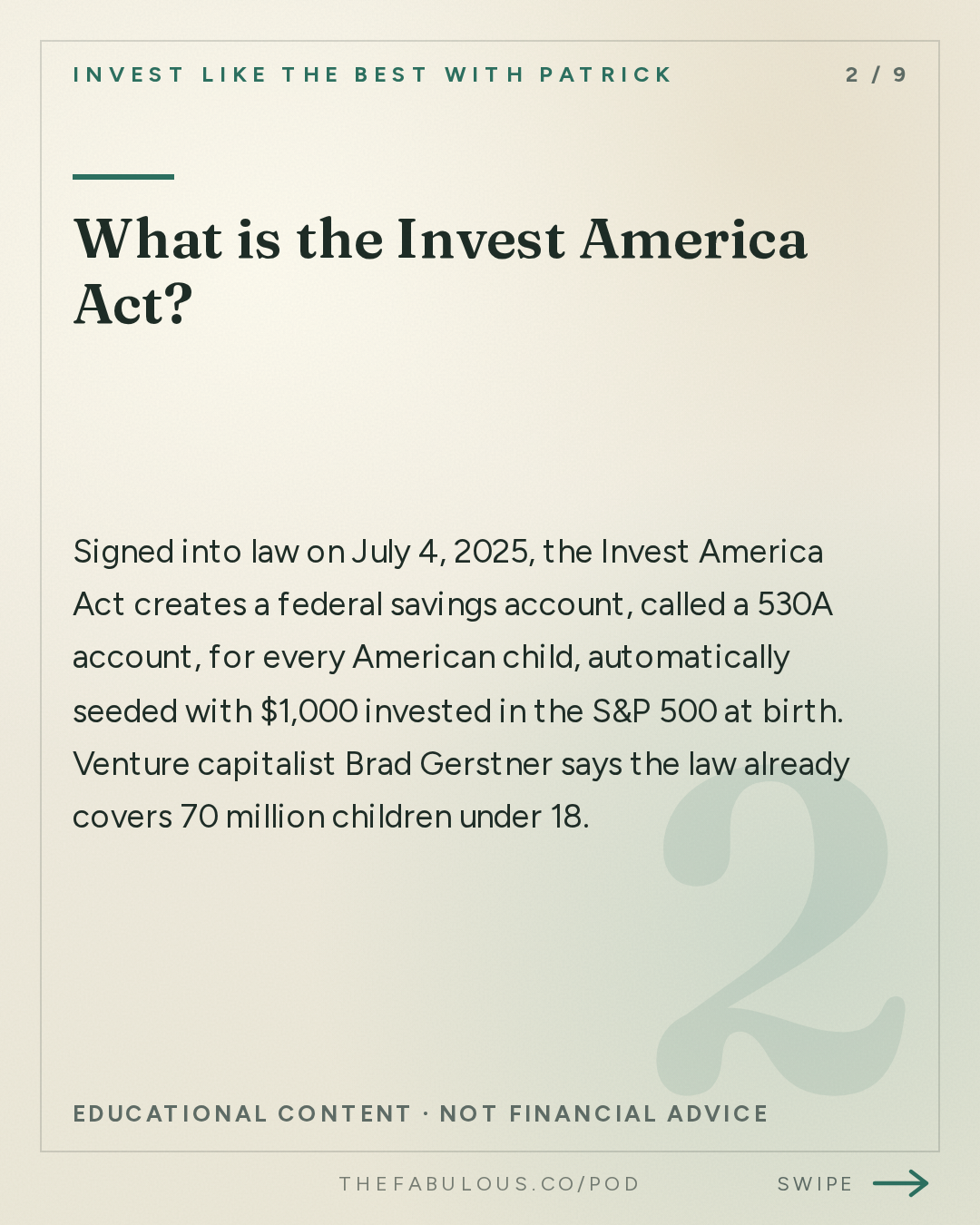
Signed into law on July 4, 2025, the Invest America Act creates a federal savings account, called a 530A account, for every American child, automatically seeded with $1,000 invested in the S&P 500 at birth (12:55). Venture capitalist Brad Gerstner says the law already covers 70 million children under 18 (13:48).
How is a 530A account different from a Trump account?
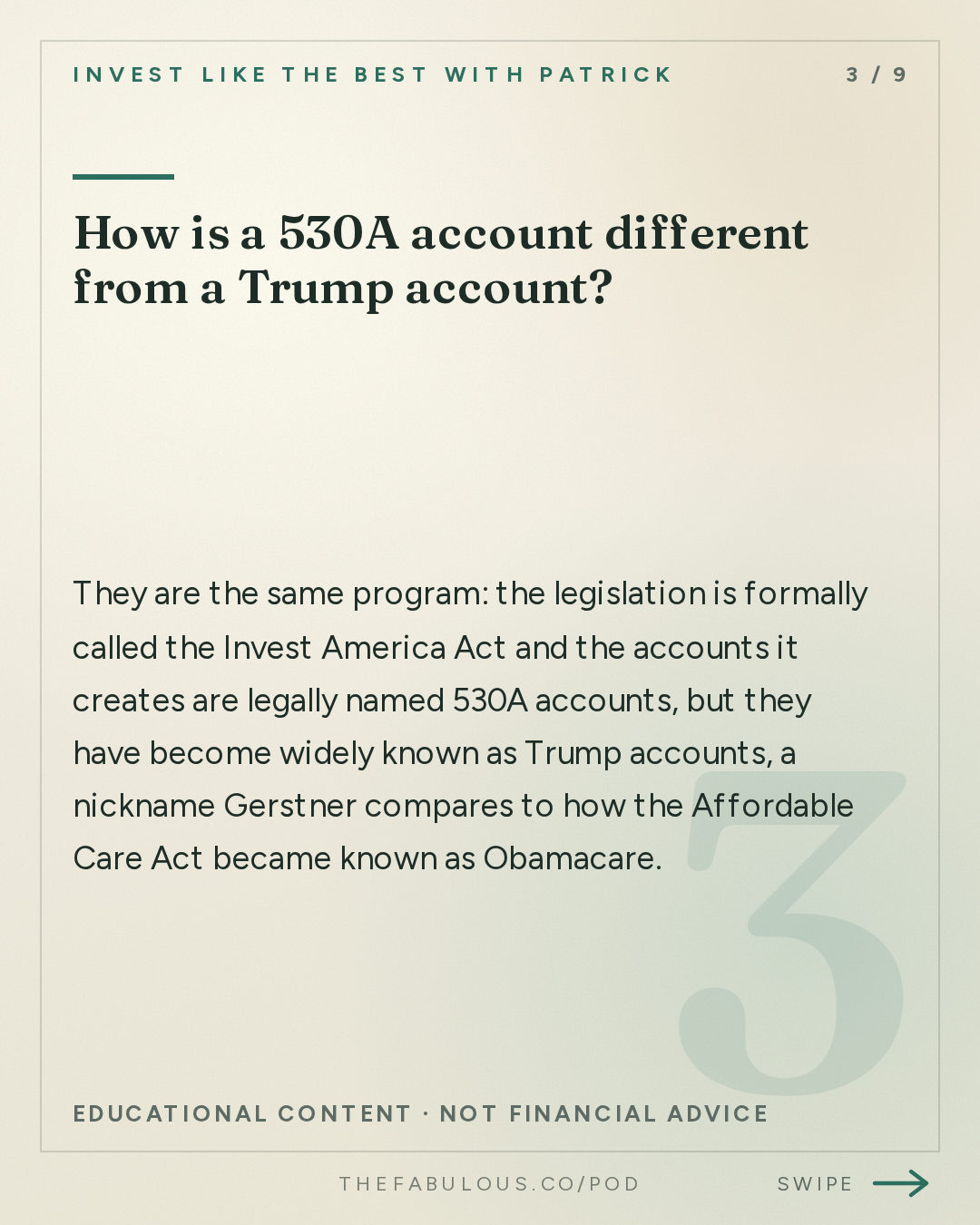
They are the same program: the legislation is formally called the Invest America Act and the accounts it creates are legally named 530A accounts, but they have become widely known as Trump accounts, a nickname Gerstner compares to how the Affordable Care Act became known as Obamacare (32:21).
Can parents withdraw money from a 530A account early?
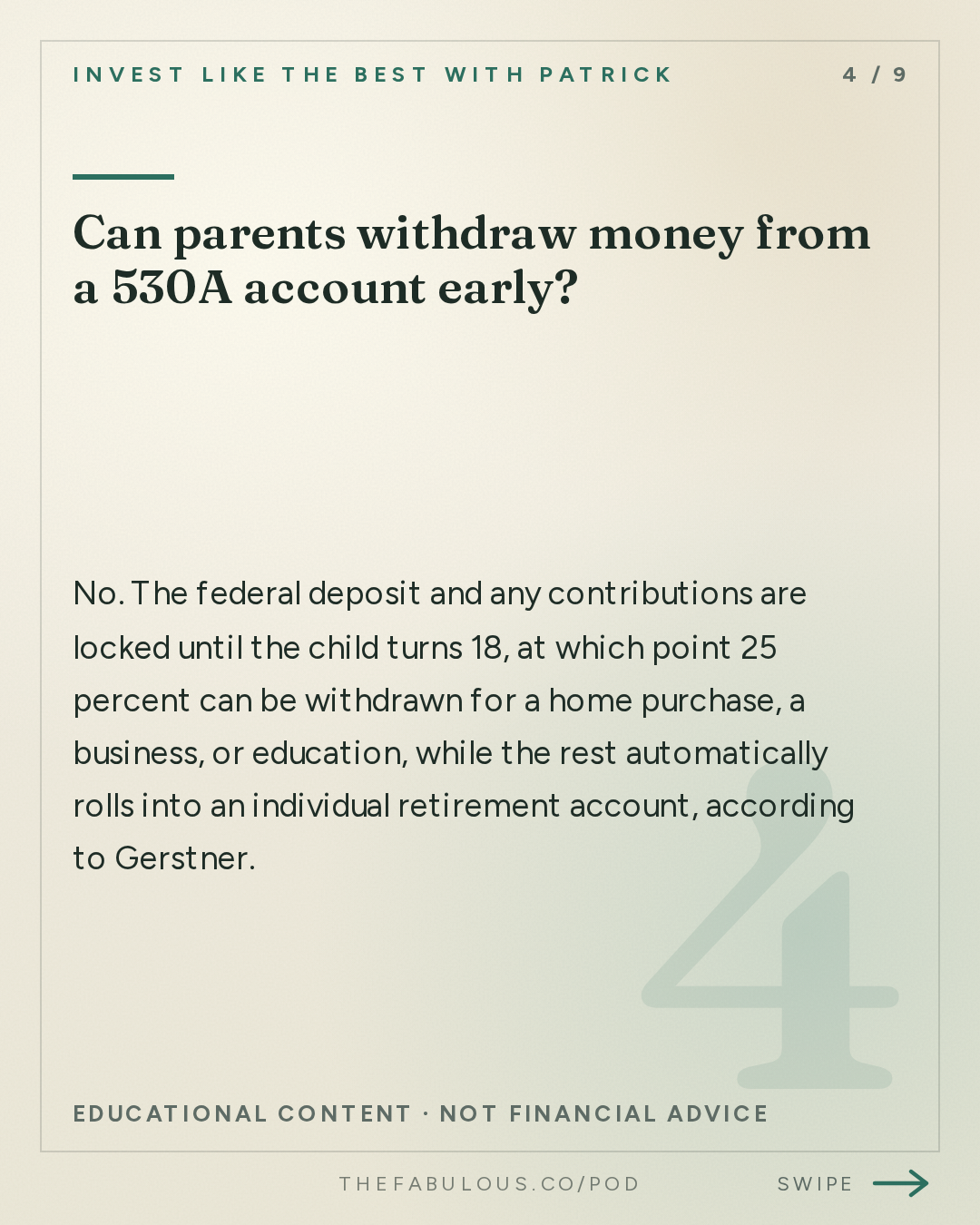
No. The federal deposit and any contributions are locked until the child turns 18, at which point 25 percent can be withdrawn for a home purchase, a business, or education, while the rest automatically rolls into an individual retirement account (53:49), according to Gerstner.
Has Elon Musk contributed to children's investment accounts?
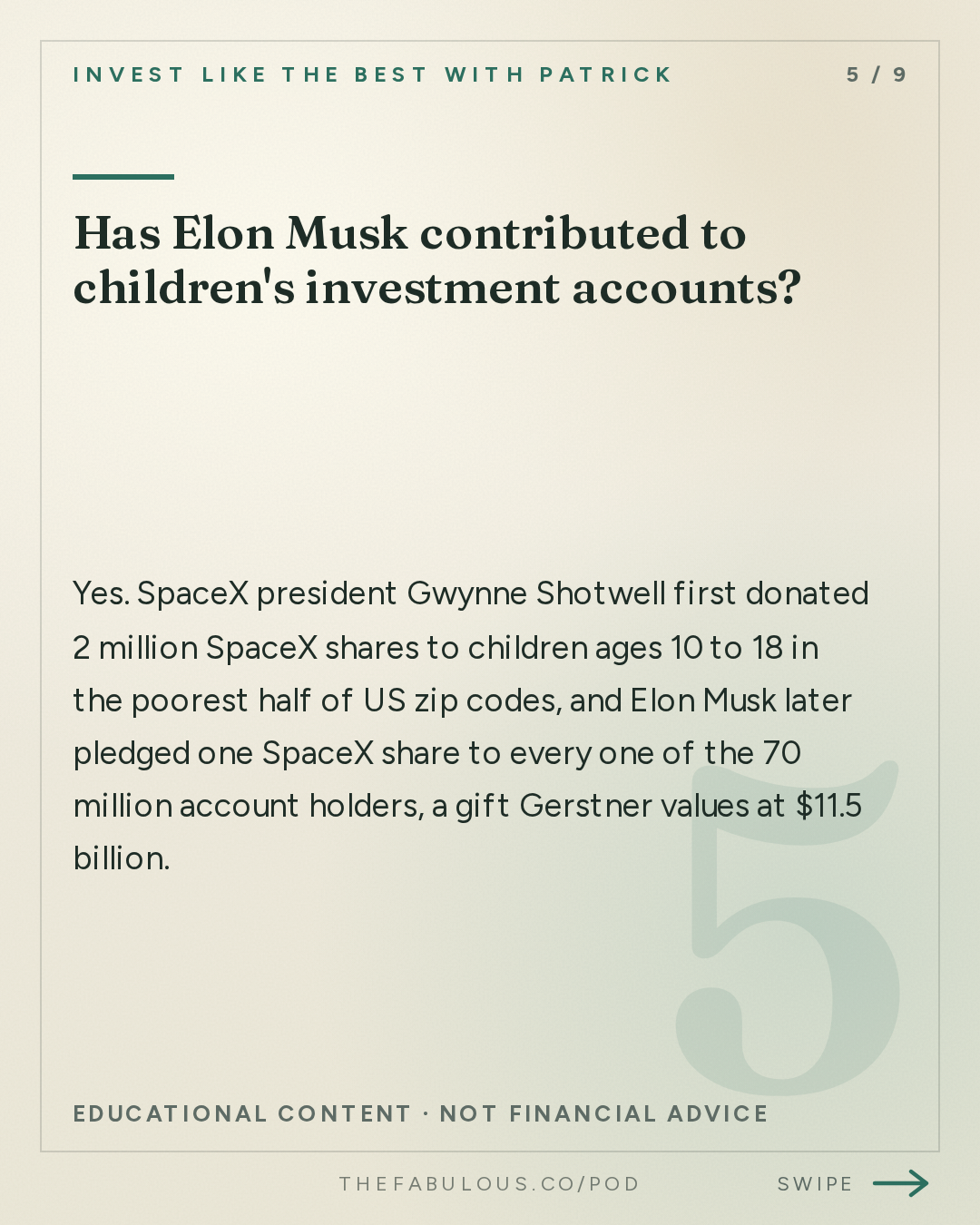
Yes. SpaceX president Gwynne Shotwell first donated 2 million SpaceX shares to children ages 10 to 18 in the poorest half of US zip codes (23:31), and Elon Musk later pledged one SpaceX share to every one of the 70 million account holders, a gift Gerstner values at $11.5 billion (24:16).
How do 530A accounts differ from Social Security?
Social Security pays benefits from a government promise but grants no ownership of the underlying funds, so nothing passes on if a person dies before collecting, Gerstner explains (31:38). A 530A account is titled directly to the child's family, who keep the full balance regardless of what happens.
How can a family claim their child's Invest America account?
Gerstner says parents need to download the Invest America app, verify their child's Social Security number, and scan the account's QR code to activate it; the deposit keeps compounding even if a family claims it years after birth (21:16).
The full read, in cards
Go deeper
- Economic Possibilities for our Grandchildren — John Maynard Keynes's 1930 essay predicted living standards would rise four to eight times within a century
- Milken Institute universal capital account study — Economists Rob Shapiro and Kevin Hassett found capital-account recipients more likely to graduate, buy homes, and avoid incarceration
- Raj Chetty's mobility research — Harvard economist's data shows the decline of the American Dream across white, Black, and brown communities alike
Mentioned
Brad Gerstner · Geoffrey Canada · Invest America Act · 530A account · Harlem Children's Zone · Michael Dell · Elon Musk · SpaceX · Social Security · Stan Druckenmiller · John Maynard Keynes · US Treasury Department · Raj Chetty · Blue Meridian Partners · Scott Bessent · Milken Institute · CalKids · Gavin Newsom · Anthropic
More from this show and category

Ramtin Naimi: Inside the 2024 AI Venture Boom
Ramtin Naimi says venture deployment is now three times faster than firms planned, straining LPs whose liquidity sits in SpaceX, Anthropic, and OpenAI. The Abstract Ventures co-founder describes a market pricing seed deals for trillion-dollar outcomes, AI margins improving fast, and losing bidders paying three to five times the primary price just to get into hot rounds.

Martin Casado on AI's Capital Economics
Andreessen Horowitz general partner Martin Casado says AI's biggest shift is that capital, not engineering, now solves digital problems. Frontier models last three to six months before being overtaken (24:58), the top model captures 80% of spending (23:19), and Casado insists private markets already price risk accurately (44:55).

Cliff Sosin: Intelligence as a Commodity
Cliff Sosin argues intelligence is a ratio, not an unbounded scalar, so cheap AI can't solve problems that need physical experiments. The investor behind an 80% Carvana position says to put money in what AI can't replace: data, attention, physical proximity, and scale (08:14, 42:34).

Christina Cacioppo on Vanta's AI Strategy
Vanta founder Christina Cacioppo prefers an 80% growth, 80% margin business over a 160% growth, 30% margin one, despite a tenfold valuation gap. She also details how Vanta is eating the cost of AI tokens rather than marking them up, since a 4X markup on Claude would put the product in a losing price comparison with the model itself.
