
Oded Rechavi: How Memories Pass Across Generations
Essentials: Genes & the Inheritance of Memories Across Generations | Dr. Oded Rechavi
The brief
Neurobiologist Oded Rechavi explains why eye color is inherited but a parent's knowledge is not, then shows the exception: in roundworms, small RNA molecules carry viral immunity and even brain-driven behavior across three generations, hinting at a physical, if limited, channel for inherited experience.
A child of an architect does not inherit blueprints. She may grow up surrounded by drafting tables and model buildings, she may even become an architect herself, but nothing in her DNA changed because her parent spent decades thinking about load-bearing walls. Eye color passes from parent to child with mathematical regularity. Learned knowledge does not. Why does biology draw this line so cleanly, and is the line ever crossed? That is the question Tel Aviv University neuroscientist Oded Rechavi spends his career answering, mostly by staring at a transparent worm one millimeter long.
Rechavi's opening move is an analogy borrowed from furniture assembly. Every cell in the body carries the same genome, the full set of genetic instructions, the way every room in a house might be issued the same IKEA catalog (01:39). A skin cell and a neuron do not differ because they hold different instructions. They differ because each cell reads only the pages it needs: a liver cell photocopies the liver pages, a neuron copies the neuron pages. That photocopy is RNA, and the finished piece of furniture, the actual protein the cell builds, is the payoff. Only a sliver of the genome, less than two percent, actually codes for the messenger RNA that specifies proteins (03:08). The rest does other jobs, many of them still mysterious.
The furniture catalog stays intact everywhere except in one very particular room: the germline, the sperm and egg cells that alone will build the next generation. Every other cell in the body, called somatic cells, is allowed to change in response to a life lived. Muscles thicken, synapses rewire, skin scars. None of it reaches the germline. "The somatic cells can change in response to experience. The sperm and the egg, the so-called germ cells, cannot," Rechavi says (09:34). Nineteenth-century biologist August Weismann named this partition, and it now carries his name: the Weismann barrier, sometimes called the second law of biology for how foundational it is to how bodies work (09:54). A brain that spends forty years mastering architecture stores that knowledge in synaptic connections, the physical links between neurons that strengthen or weaken with learning. Synaptic wiring has no route into a sperm cell's DNA (04:57). Lift weights for a decade and the muscle stays in the muscle; the gain never reaches the germline either (05:23).
A second barrier compounds the first. Even the DNA that does pass into sperm and egg does not pass unedited. Cells accumulate chemical marks on their DNA over a lifetime, called epigenetic modifications, tags that switch genes on or off without changing the underlying sequence. If those tags carried straight through to offspring, embryos would inherit a used, marked-up instruction manual rather than a clean one. So biology erases most of the marks during the transition between generations. In mammals and humans, roughly ninety percent of these modifications are stripped in the germline and the early embryo, returning the genome to something close to its original, unrestricted state (11:09). Rechavi's IKEA image extends naturally here: it is as if someone goes through the catalog and rubs out every pencil note a previous owner scribbled in, so the next family starts with a book that can still build every room in the house, not just the ones the last owner happened to need.
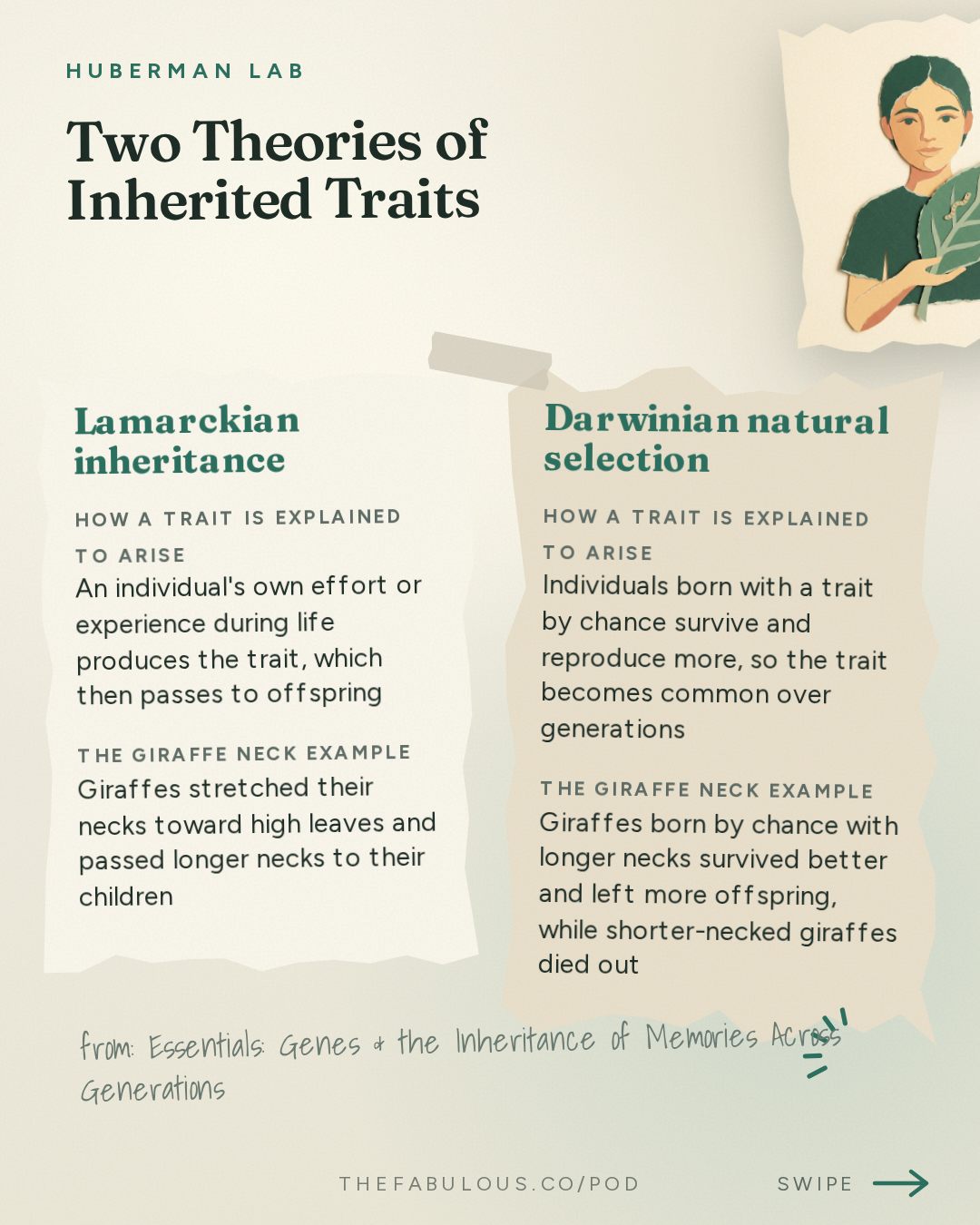
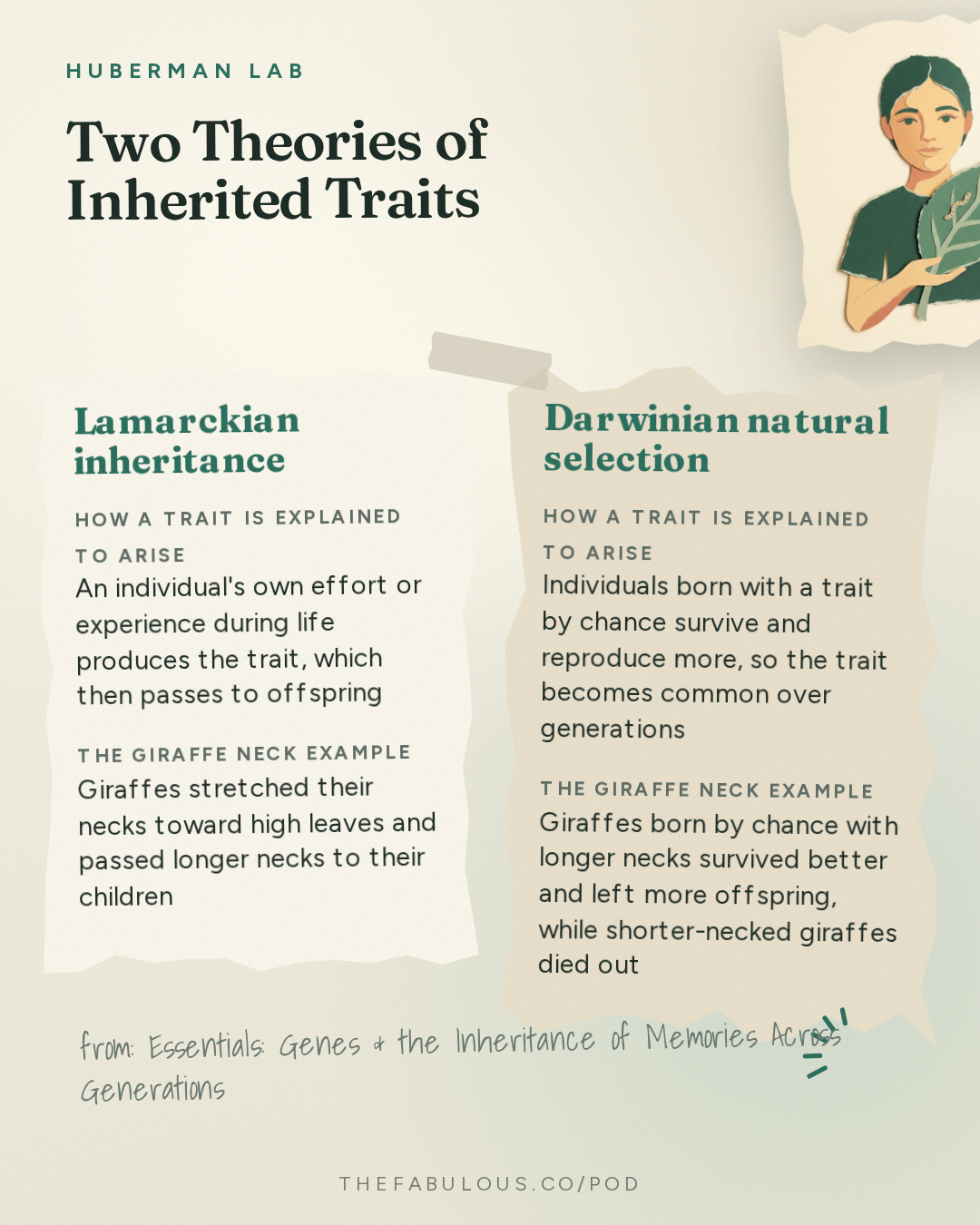
These two barriers are why the physicist Erwin Schrödinger, writing in 1944, called the inheritance of acquired traits untenable, and called that fact sad, because unlike natural selection, which does not care what an individual does in its lifetime, at least the inheritance of acquired traits would have let effort matter biologically (12:19). Nineteenth-century naturalist Jean-Baptiste Lamarck had proposed the opposite: that a giraffe stretching for high leaves would pass a longer neck to its offspring. Charles Darwin's natural selection offered a colder but better-supported account: giraffes born with longer necks simply survived better and left more offspring, no stretching required (08:25).
Why a Transparent Worm Changes the Answer
Rechavi's lab works almost entirely on Caenorhabditis elegans, a roundworm that happens to be biology's most standardized model organism, meaning a species so thoroughly studied and shared across labs worldwide that results are directly comparable. Every C. elegans has exactly nine hundred fifty-nine cells, of which three hundred two are neurons, mapped since the 1980s into a complete wiring diagram, so two labs anywhere in the world can discuss the identical, numbered neuron (15:42). The worms are transparent, so neurons can be watched firing in real time. A single mother produces about two hundred fifty genetically near-identical offspring, and a new generation appears every three days, meaning a single PhD project can run through hundreds of worm generations (16:33). That speed is why Rechavi says nearly no one left in the epigenetics field disputes that acquired traits can be inherited, at least in worms (16:53).
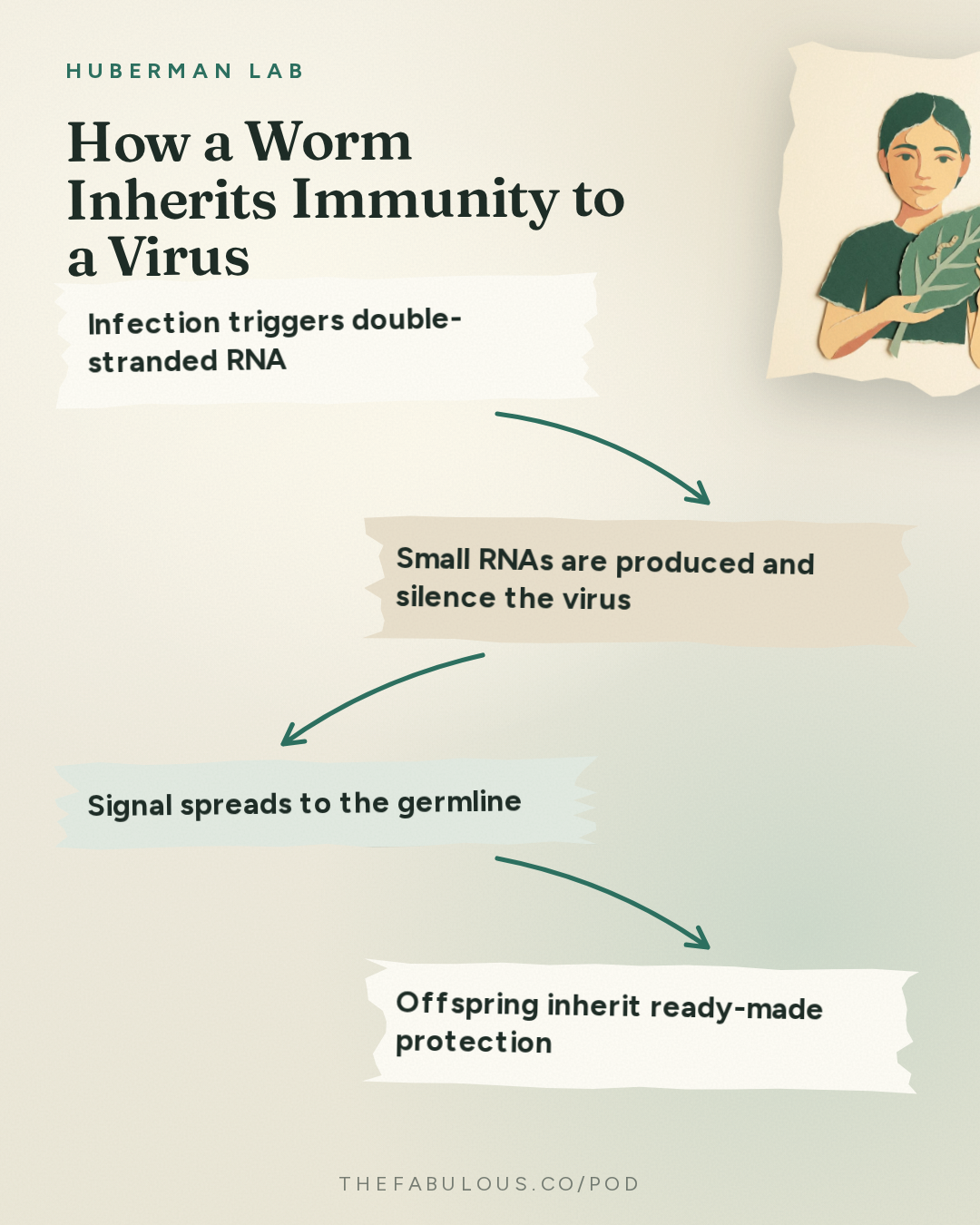
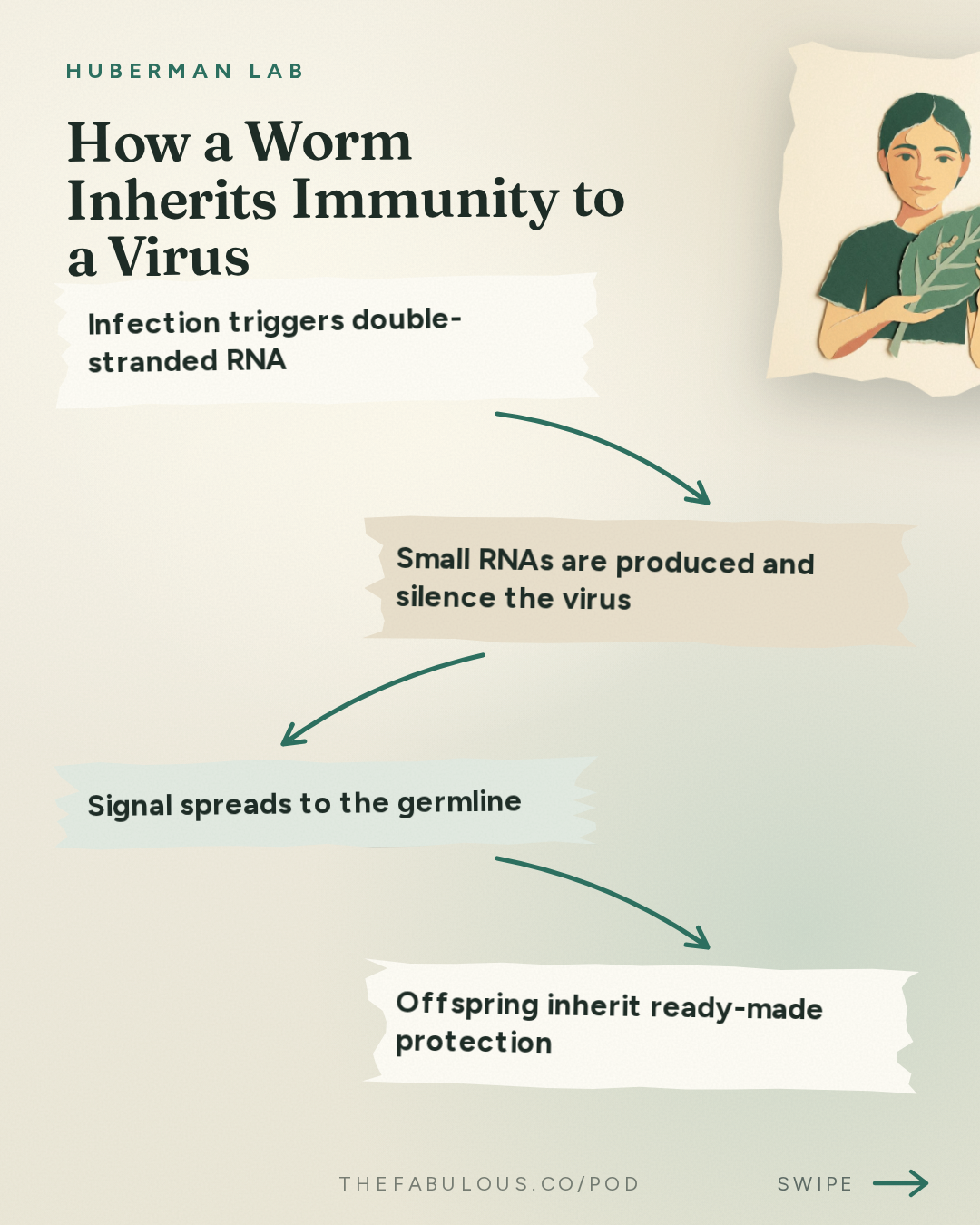
The mechanism runs through small RNA molecules, discovered by Andrew Fire and Craig Mello, who shared a 2006 Nobel Prize for showing that double-stranded RNA, RNA built of two paired strands rather than one, triggers a cell to manufacture small RNAs that silence any gene matching that sequence, a process called RNA interference (18:40, 19:45). It is the equivalent of slipping a duplicate, blank page into the IKEA book so that instruction can no longer be read. Crucially, this silencing does not stay local. Feed a worm bacteria engineered to produce double-stranded RNA, and the silencing signal travels from the gut, where it entered, to tissues across the body, including the germ cells, and then into the next generation (21:01).
Rechavi's own contribution began with a fluorescent virus. Infected worms that successfully fight it off stay black; worms that lose the fight turn green as the virus replicates (22:23). His team infected worms, let them clear the infection using small RNAs, then stripped their descendants of the very genes needed to manufacture small RNAs from scratch. Those descendants should have been defenseless. Instead, when exposed to the virus, they stayed black. They had inherited ready-made small RNAs matching the viral genome from their parents, effectively a pre-built antidote passed down without any genetic machinery of their own to make it, and the protection persisted for additional generations (23:41). As Rechavi puts it, "the parent worms effectively put something into the genetic instructions of the offspring that would afford them an advantage" (23:41).
A Brain That Writes to the Next Generation
The more provocative finding involves not viruses but behavior. In a 2019 paper published in the journal Cell, Rechavi's team altered the production of naturally occurring small RNAs specifically inside a worm's brain, without touching the brain of any descendant. The descendants' ability to locate food changed anyway, and the effect persisted for three generations (28:51). The chain of causation runs from brain-derived small RNAs to a single gene in the germline called sage-2, which the small RNAs regulate, altering how that gene is expressed and, downstream, how the animal behaves (29:24). The information never needs to travel back from germ cells to brain to matter; changing sage-2 in the germline alone is enough to shift food-finding behavior in offspring.
This does not mean the brain is somehow writing memories into DNA. Rechavi is careful about the distinction: the brain stores information in synaptic connections, a language of wiring and strength between neurons, while heritable information has to pass through the bottleneck of a single fertilized egg, meaning it must be translated into some molecular form before it can cross generations at all (26:16). What his experiments show is a physical bridge, small RNAs manufactured in the brain, that can carry a simplified signal into the germline and alter a specific gene there. He calls it striking partly because "the brain can synthesize information about the environment and about internal state and can also think ahead," which makes brain-to-germline signaling qualitatively different from, say, a muscle or gut cell doing the same thing (25:19).
The reason worms manage this at all, and mammals may not manage it the same way, is that worm cells can amplify small RNAs continuously, preventing the signal from diluting across generations, an amplification step that has no known equivalent in mammals (30:34). That gap is why Rechavi repeats, almost as a refrain, that none of this is confirmed in humans. What mammalian studies do show is suggestive: overfeeding rodents produces metabolic problems in their offspring, and letting the overfed parent exercise before conceiving corrects the aberrant inheritance in the next generation (33:42). The proposed explanation is not that exercise rewires DNA, which stays fixed, but that it changes the composition of heritable RNAs, which are plastic and responsive to lifestyle in a way DNA sequence is not (34:38). Rechavi imagines, with heavy caveats that this is "science fiction, doesn't happen now," a future in which IVF clinics might screen not just embryo DNA but the RNA profile of gametes, and advise a prospective parent, in his words, "maybe you should run on the treadmill a little bit" before conceiving (34:38). It remains speculation. But the worm work makes one thing concrete: heredity is not exclusively a DNA story. Somewhere in a spool of small RNA, a parent's recent history can, at least in this one animal, leave a readable trace in its children.
Ask this episode anything
Pod's AI answers from the episode itself, with the minute mark so you can hear it yourself.
Or start with one of these
Ask this episode
Pod's AI listens to the whole episode to answer, and points you to the minute it comes from.
The rest of this answer, and any question after it
Answers come from the episode itself, never from a summary of it.
ContinueKey takeaways
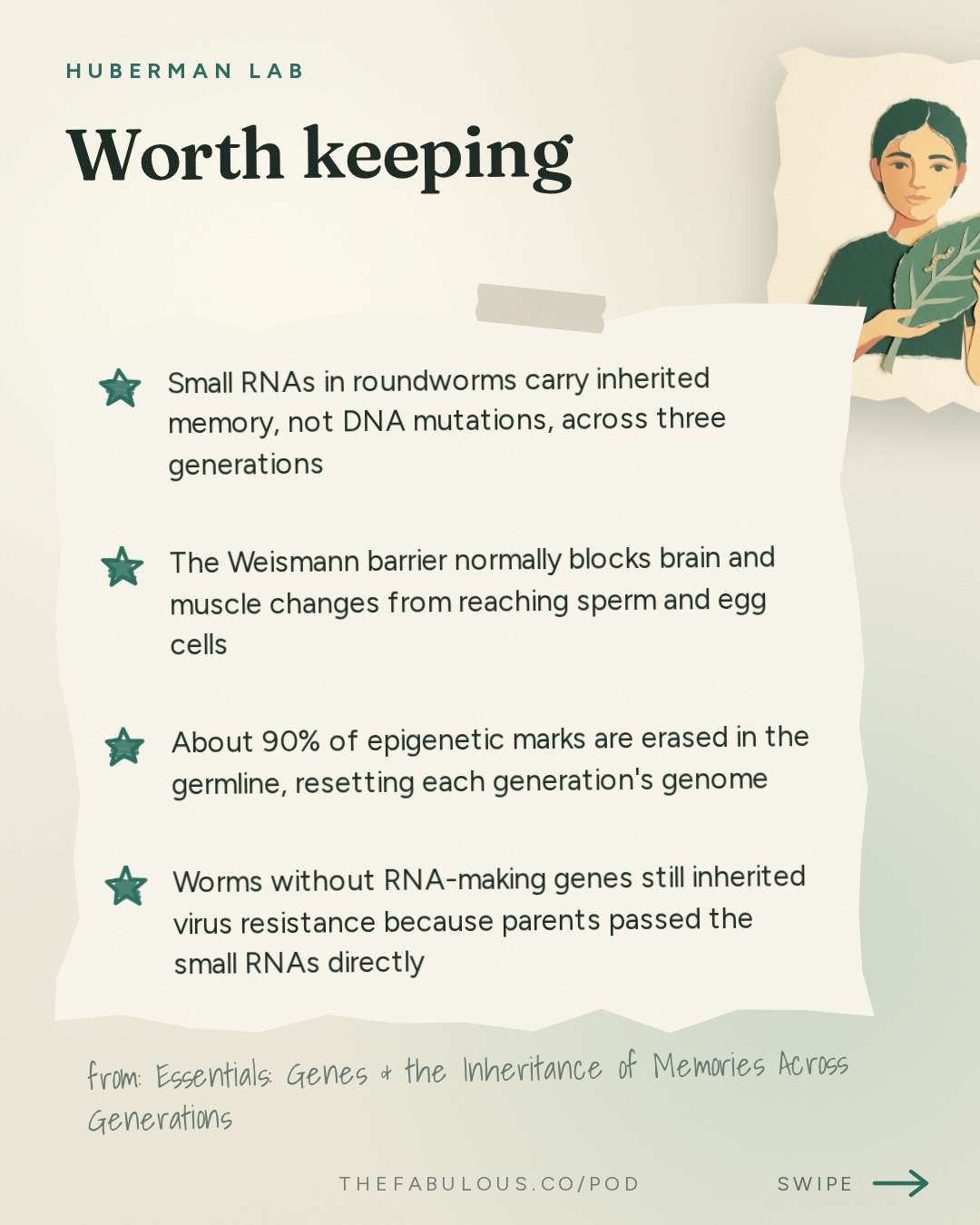
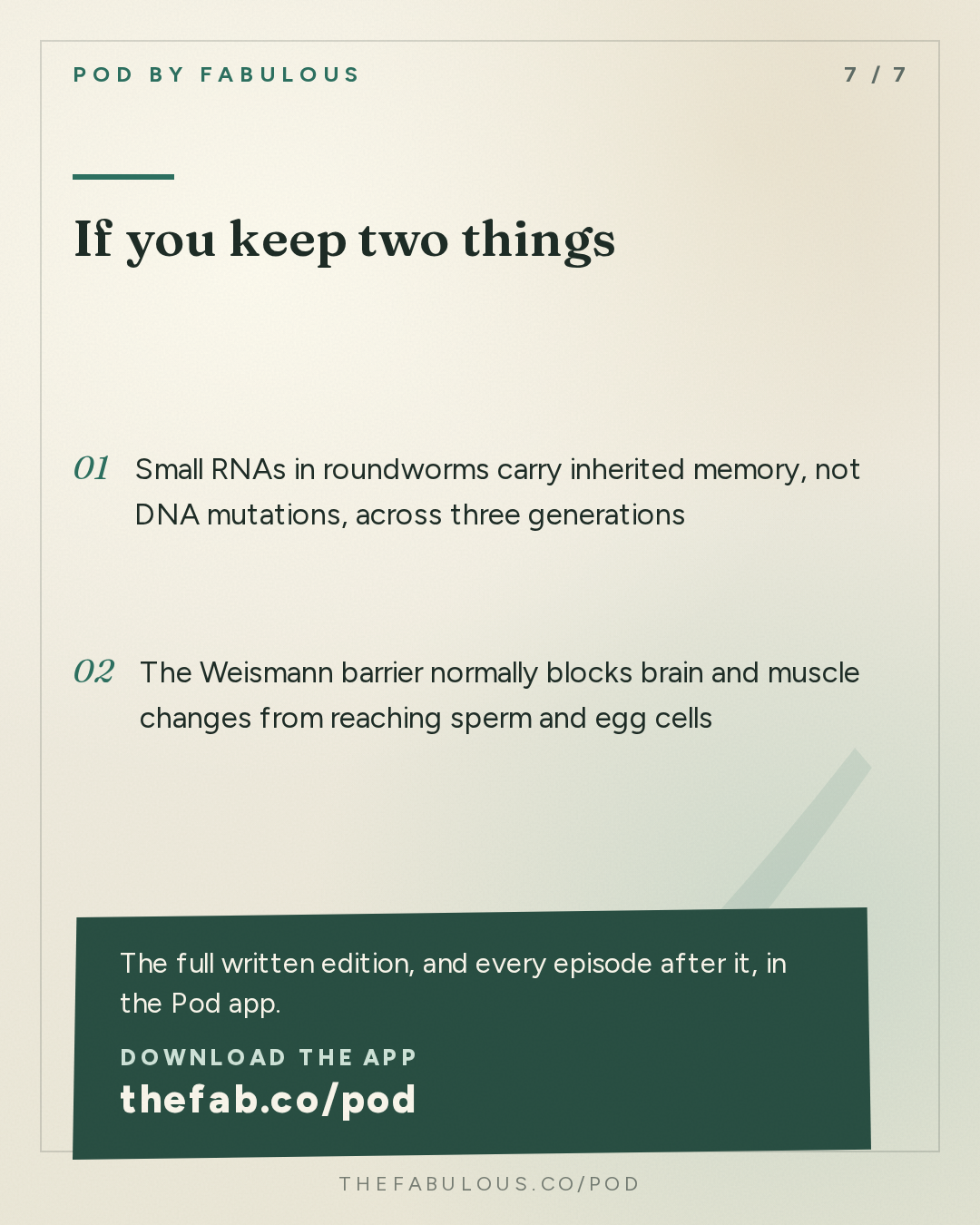
- Small RNAs in roundworms carry inherited memory, not DNA mutations, across three generations
- The Weismann barrier normally blocks brain and muscle changes from reaching sperm and egg cells (09:54)
- About 90% of epigenetic marks are erased in the germline, resetting each generation's genome (11:09)
- Worms without RNA-making genes still inherited virus resistance because parents passed the small RNAs directly (23:41)
- Rodent studies suggest parental exercise can correct metabolic problems caused by parental overfeeding in offspring (33:42)
The episode in cards
By the numbers
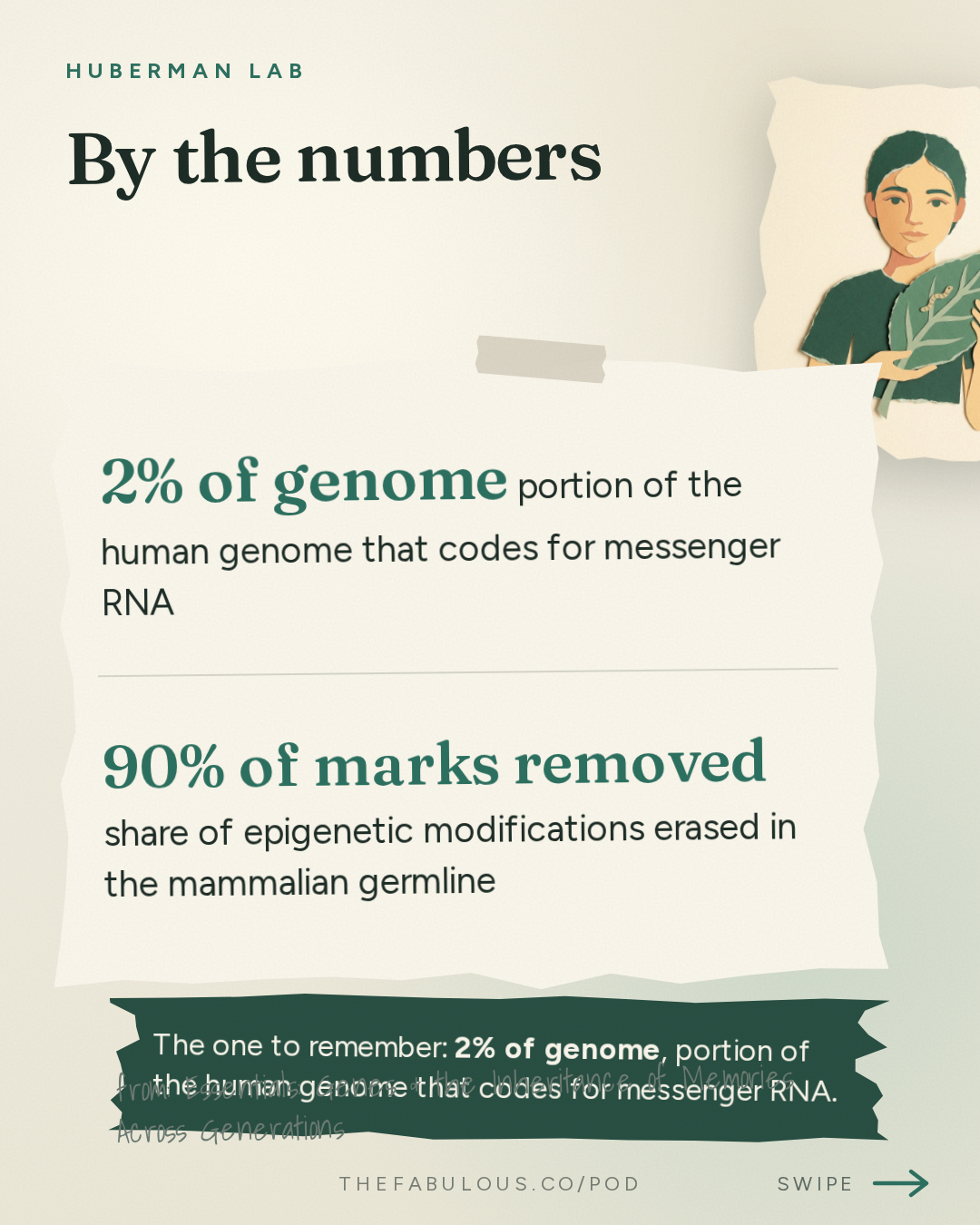
- 2% of genome portion of the human genome that codes for messenger RNA
- 90% of marks removed share of epigenetic modifications erased in the mammalian germline
In their words
“This is like the IKEA book that you have in every cell in your body, the in- instructions to make everything that you need in your house”
“The somatic cells, they can change in response to experience. The sperm and the egg, the so-called germ cells, cannot”
“The, the parent worms effectively put something into the genetic instructions of the offspring that would afford them, um”
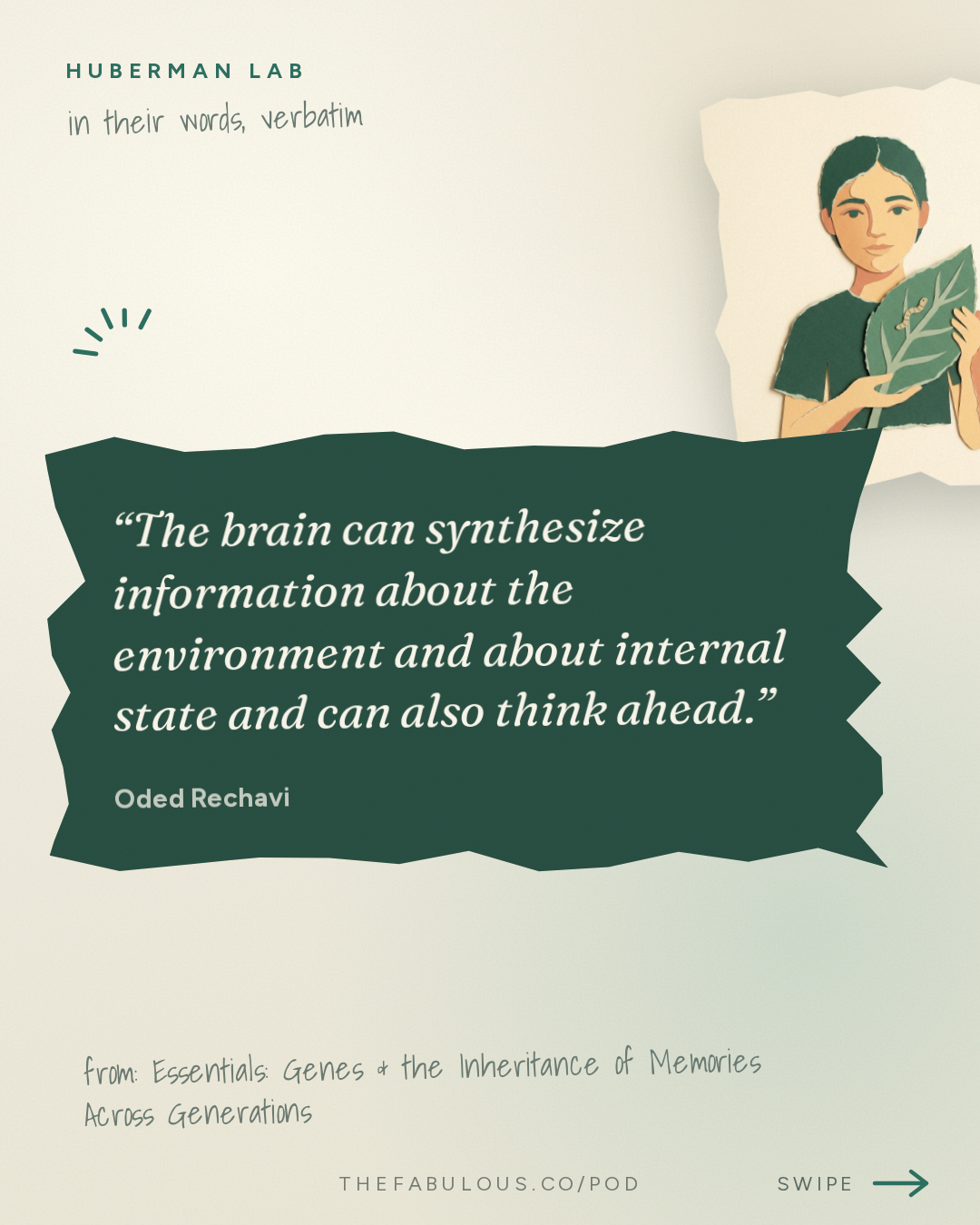
“The brain can synthesize information about the environment and about internal state and can also think ahead.”
Questions this episode answers
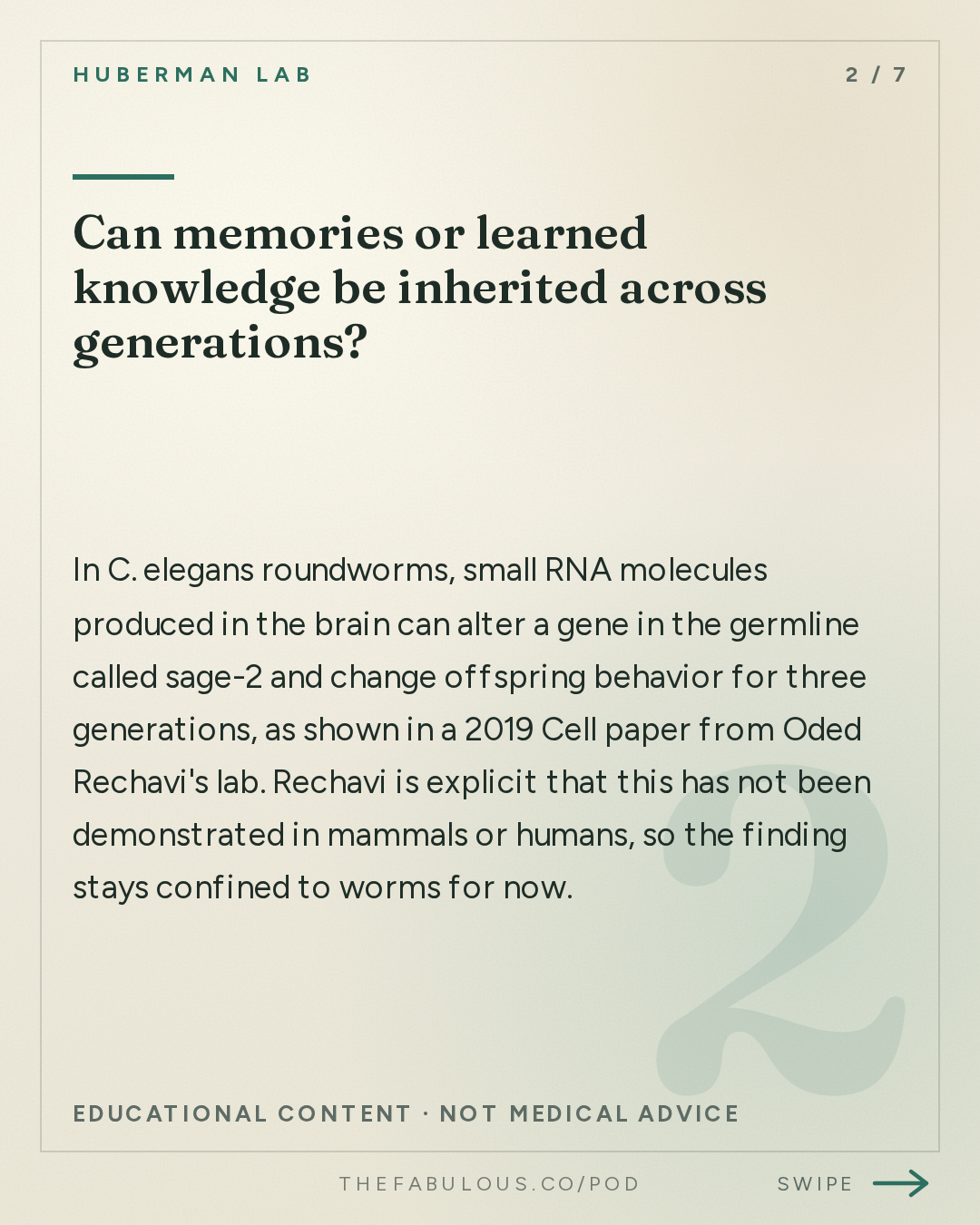
Can memories or learned knowledge be inherited across generations?
In C. elegans roundworms, small RNA molecules produced in the brain can alter a gene in the germline called sage-2 and change offspring behavior for three generations, as shown in a 2019 Cell paper from Oded Rechavi's lab (28:51). Rechavi is explicit that this has not been demonstrated in mammals or humans, so the finding stays confined to worms for now (25:19).
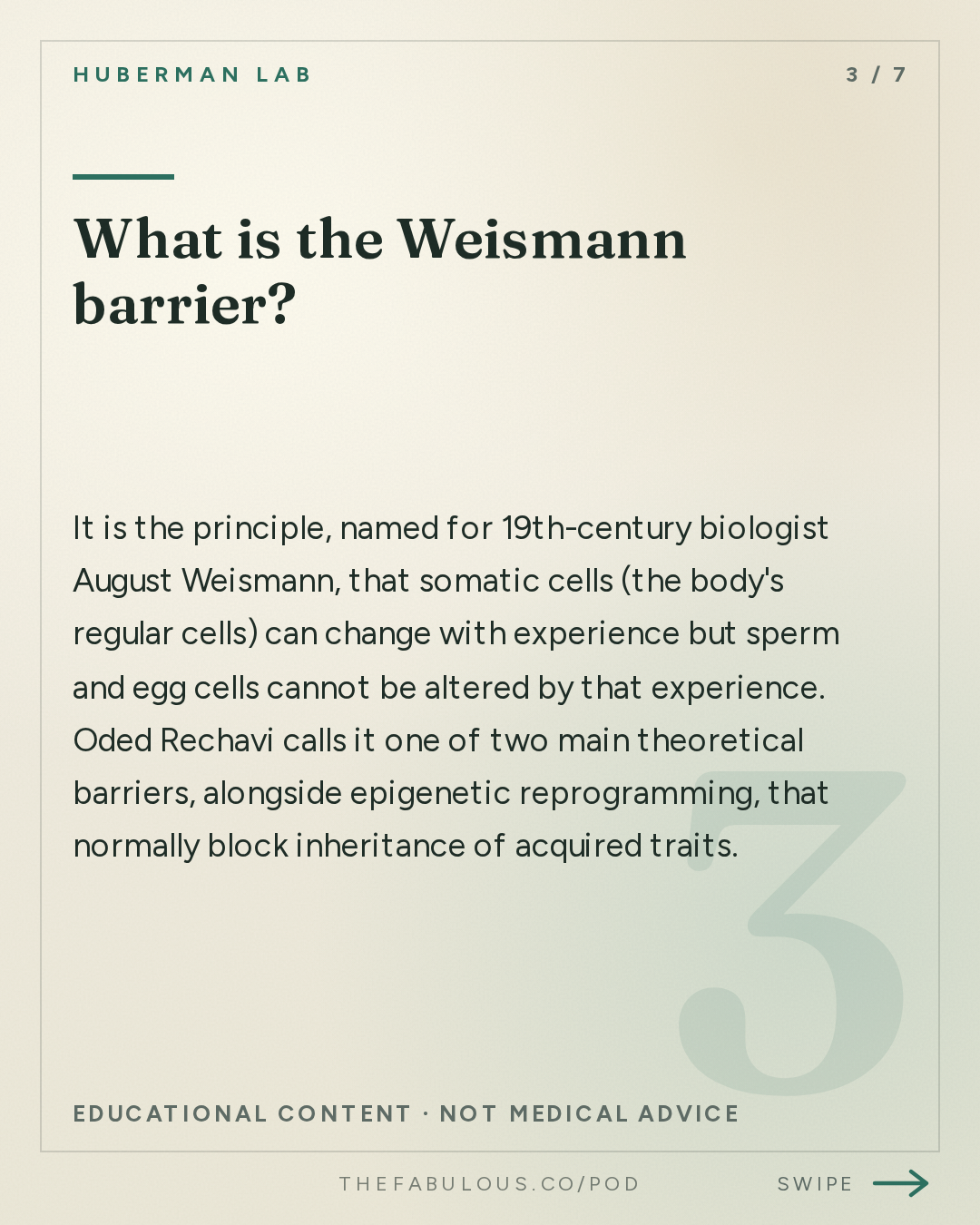
What is the Weismann barrier?
It is the principle, named for 19th-century biologist August Weismann, that somatic cells (the body's regular cells) can change with experience but sperm and egg cells cannot be altered by that experience (09:54). Oded Rechavi calls it one of two main theoretical barriers, alongside epigenetic reprogramming, that normally block inheritance of acquired traits (09:14).
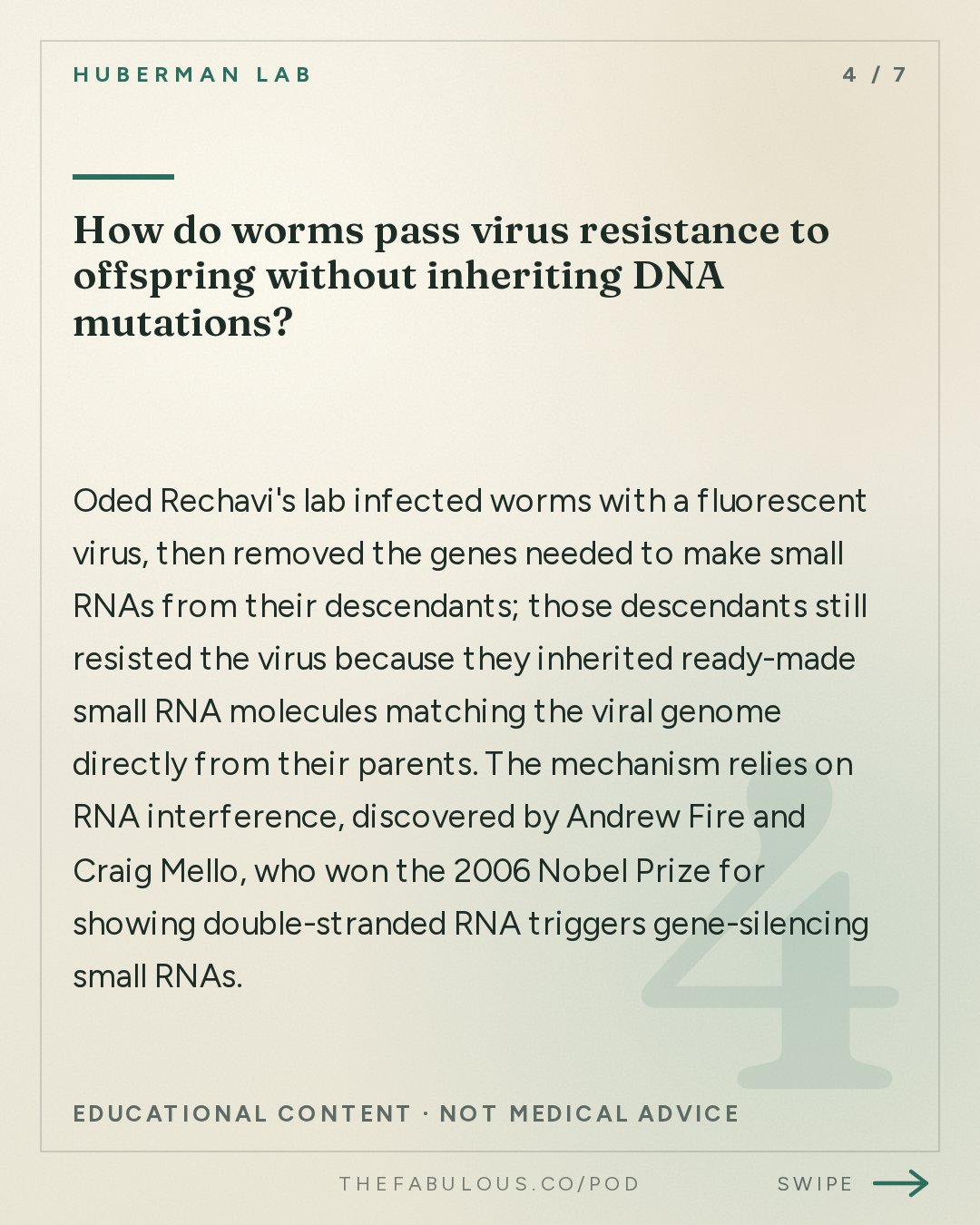
How do worms pass virus resistance to offspring without inheriting DNA mutations?
Oded Rechavi's lab infected worms with a fluorescent virus, then removed the genes needed to make small RNAs from their descendants; those descendants still resisted the virus because they inherited ready-made small RNA molecules matching the viral genome directly from their parents (23:41). The mechanism relies on RNA interference, discovered by Andrew Fire and Craig Mello, who won the 2006 Nobel Prize for showing double-stranded RNA triggers gene-silencing small RNAs (18:40).
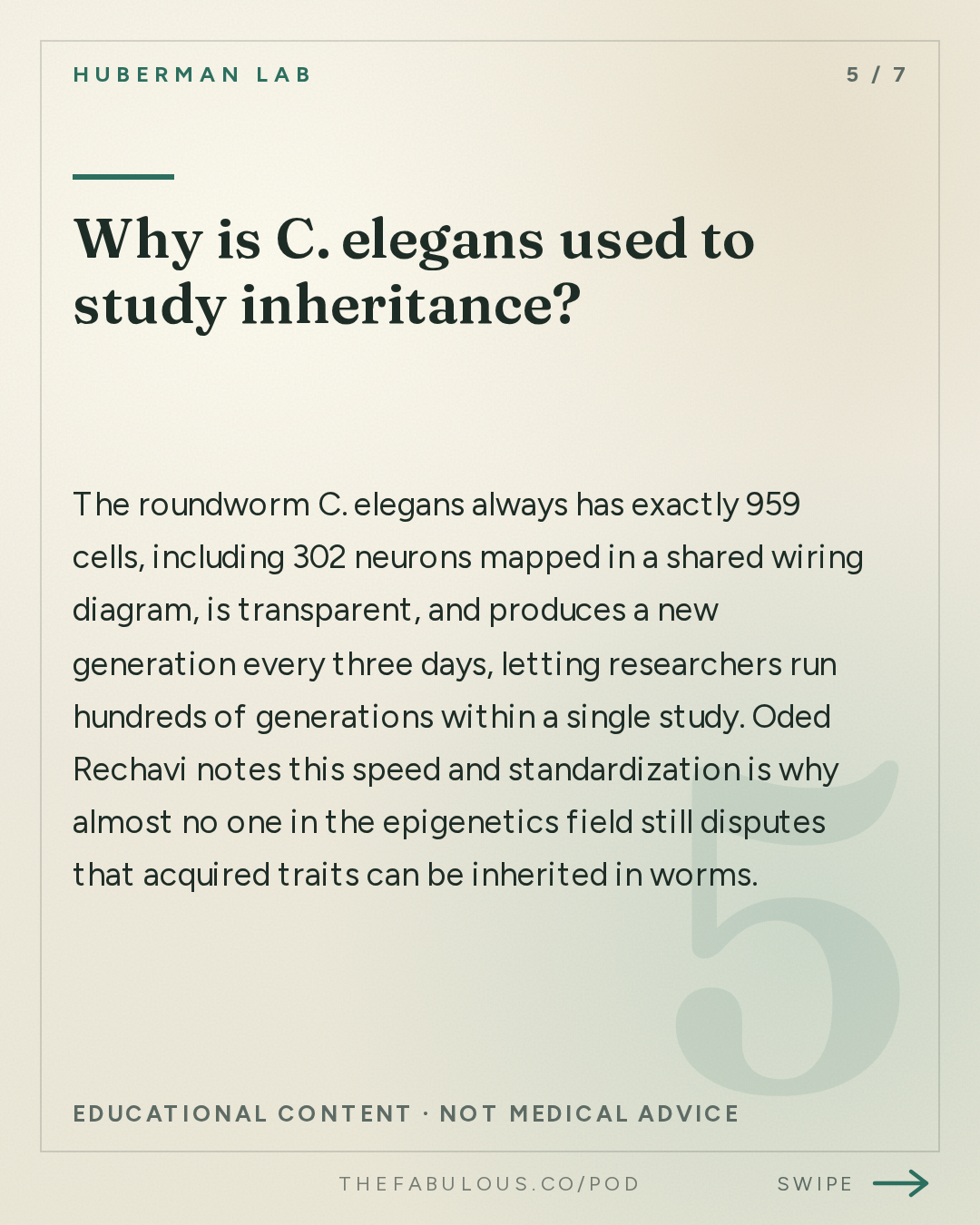
Why is C. elegans used to study inheritance?
The roundworm C. elegans always has exactly 959 cells, including 302 neurons mapped in a shared wiring diagram, is transparent, and produces a new generation every three days, letting researchers run hundreds of generations within a single study (15:42, 16:33). Oded Rechavi notes this speed and standardization is why almost no one in the epigenetics field still disputes that acquired traits can be inherited in worms (16:53).
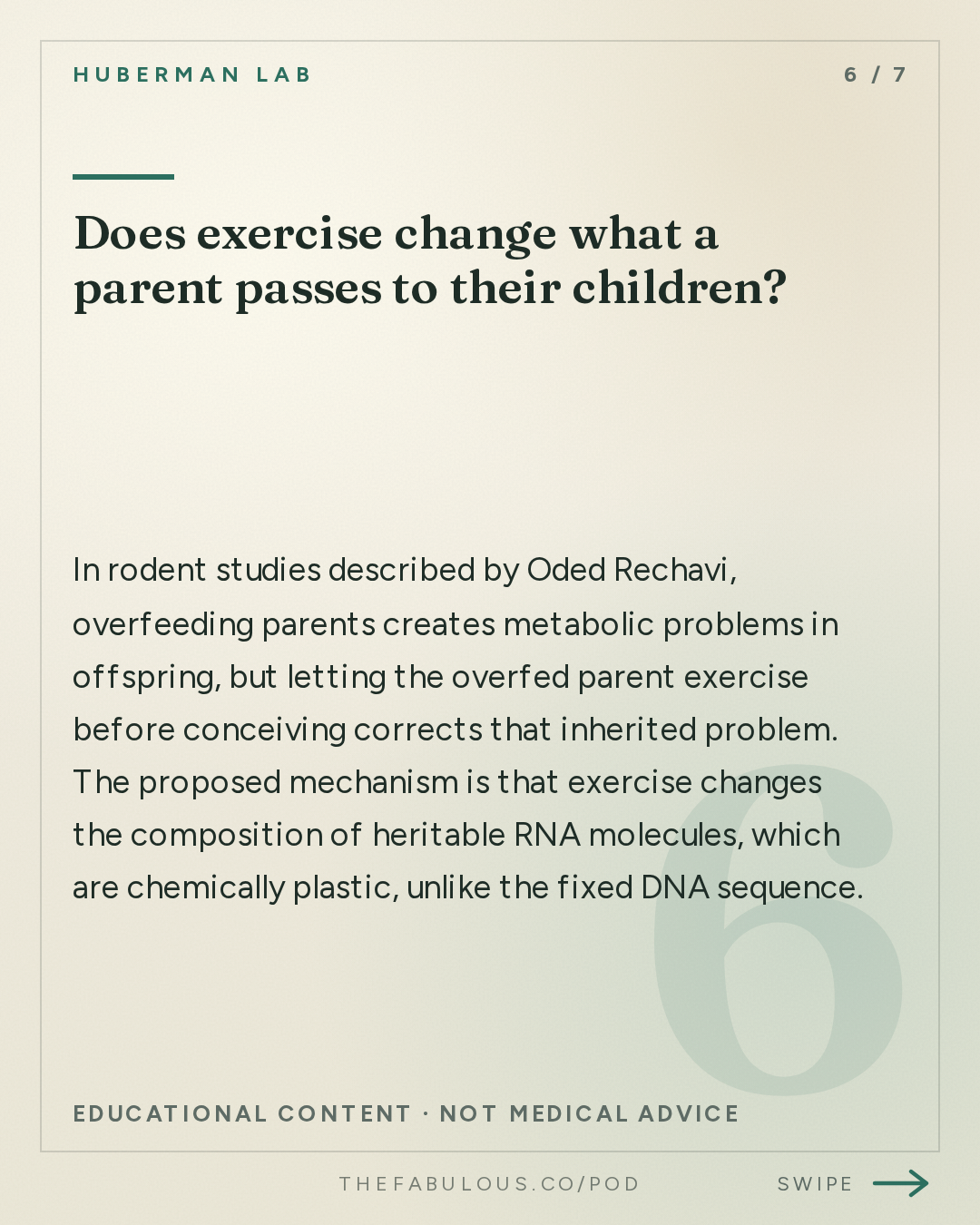
Does exercise change what a parent passes to their children?
In rodent studies described by Oded Rechavi, overfeeding parents creates metabolic problems in offspring, but letting the overfed parent exercise before conceiving corrects that inherited problem (33:42). The proposed mechanism is that exercise changes the composition of heritable RNA molecules, which are chemically plastic, unlike the fixed DNA sequence (34:38).
The full read, in cards
Go deeper
- Fire and Mello RNA interference paper — Showed double-stranded RNA triggers small RNA production that silences matching genes, work that won the 2006 Nobel Prize
- Rechavi lab Cell paper, 2019 — Showed that altering small RNA production only in a worm's brain changes food-finding behavior in offspring for three generations via the gene sage-2
- What Is Life? — Erwin Schrödinger's 1944 book arguing that inheritance of acquired traits is untenable
Mentioned
Oded Rechavi · Andrew Huberman · August Weismann · Jean-Baptiste Lamarck · Charles Darwin · Erwin Schrödinger · Andrew Fire · Craig Mello · C. elegans · sage-2 · Cell
More from this show and category

Huberman's Rational Guide to Supplements
Andrew Huberman's framework ranks behavior, then nutrition, then supplements, then prescription drugs, arguing supplements only work once the first two are solid (00:42). He gives exact doses for sleep, hormone, and focus compounds, and insists on testing one ingredient at a time (35:08).

Jared Diamond on Leadership: Why Charisma Isn't Required
Charisma is optional for great leadership, biologist and historian Jared Diamond argues, pointing to the uncharismatic dictators Stalin and Pinochet as proof (00:26). Diamond, 89, applies a 'natural experiment' method from biology to politics, religion, business, and sports, showing only 2 of 22 modern political leaders stepped down voluntarily and that coaches and CEOs get too much credit or blame for outcomes that are mostly random (95:37).

Neuralink Trials for Quadriplegia: What Comes First
Neuralink's head neurosurgeon Matt MacDougall explains that the implant's first job is letting quadriplegic patients move a cursor and type by thought alone, not reconnect limbs. He also covers the robotic surgery that makes this possible, the safety case made in pigs and monkeys, and his own subdermal RFID chip.
How Diet Affects Memory and the Hippocampus
USC neuroscientist Scott Kanoski says the hippocampus, the brain's memory hub, tracks recent meals via the vagus nerve to judge hunger and fullness. Sugar, heat-processed foods, and artificial sweeteners early in life can impair that memory system and its gut bacteria, while exercise and simple recall of a recent meal can help restore or harness it.
