
Gina Poe on How Sleep Builds Memory and Heals
Essentials: Use Sleep to Enhance Learning, Memory & Emotional State | Dr. Gina Poe
The brief
Sleep cycles every 90 minutes, and early cycles release growth hormone and clean the brain, while later ones handle emotion and creativity. Neurobiologist Gina Poe explains how REM sleep silences the stress chemical norepinephrine, letting the brain separate emotion from memory, and why consistent bedtimes protect this whole system.
A brain at night is not resting. It is running two overlapping jobs on a strict schedule: a maintenance crew that cleans and repairs, and a courier service that moves the day's experience into permanent storage. Miss the shift change, and neither job gets done properly, no matter how many hours you eventually log. That is the counterintuitive claim at the center of this conversation with UCLA neuroscientist Gina Poe, who has spent her career studying what sleep actually does inside the skull, not just how long it lasts.
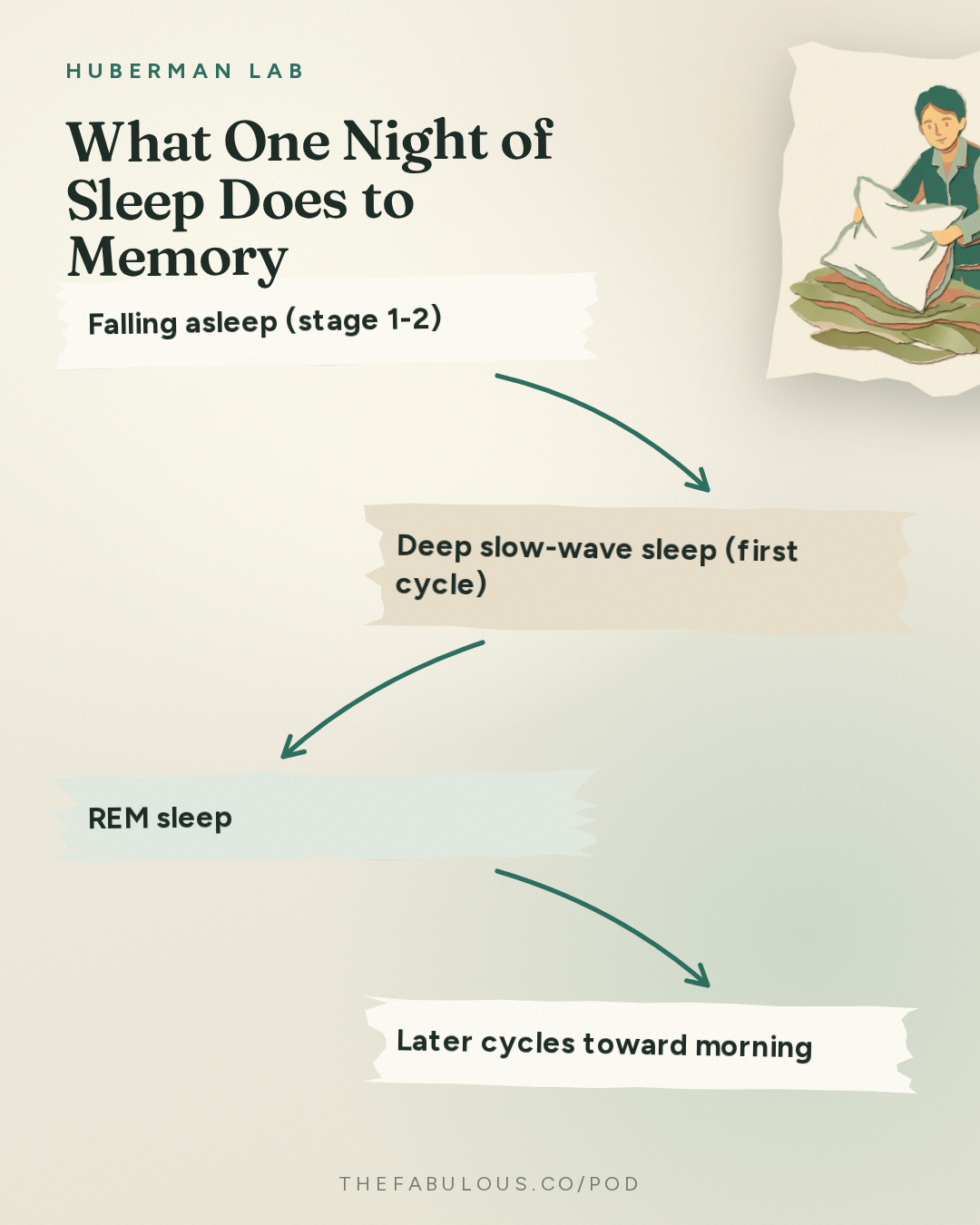
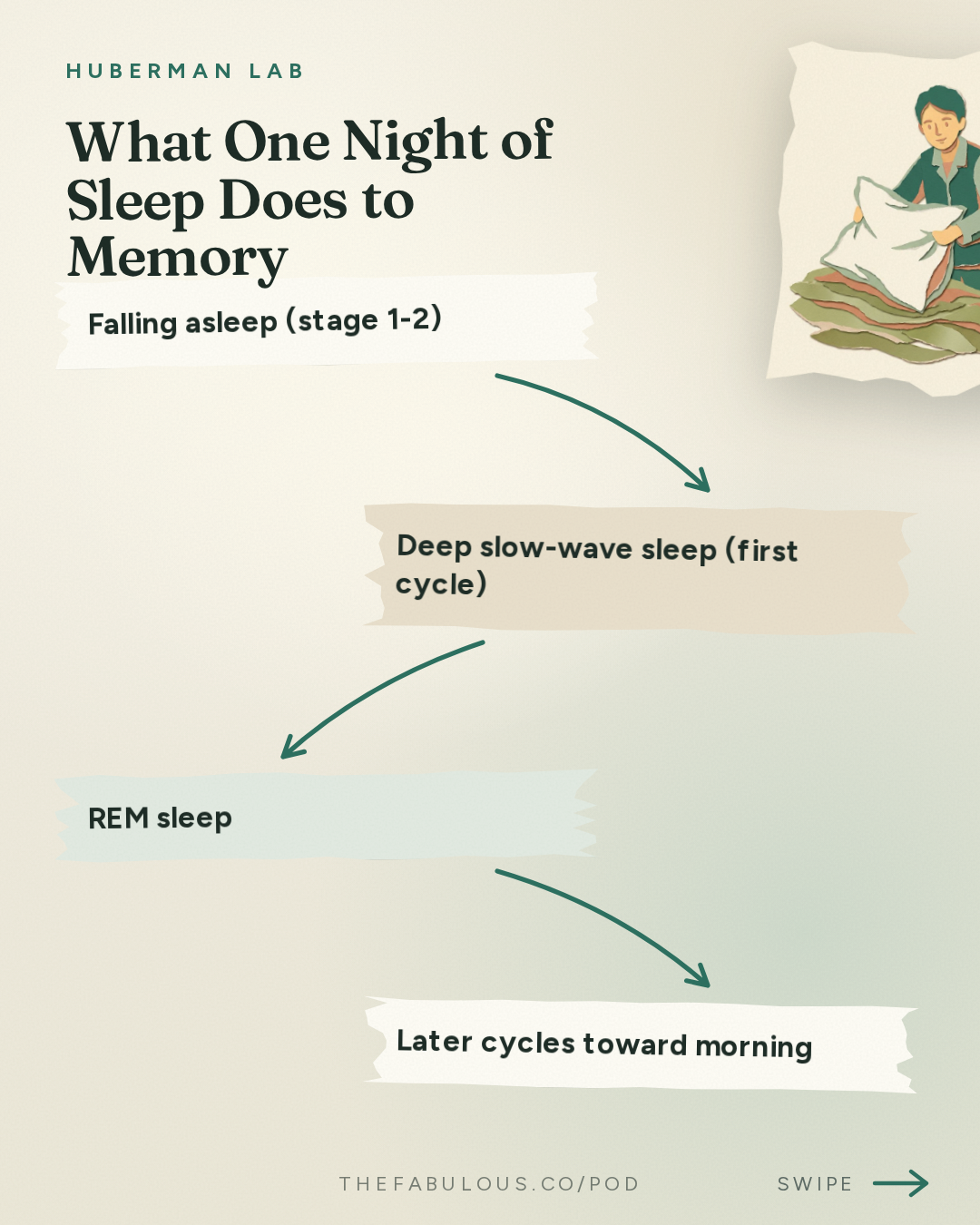
Poe divides sleep into four states. Non-REM sleep, the kind without rapid eye movement, has three stages: light stage one dozing, stage two with its bursts of thalamus-to-cortex activity called sleep spindles, and stage three, deep slow-wave sleep, where big, slow electrical waves sweep across the brain. Then there is REM sleep, rapid eye movement sleep, where dreaming is most vivid. The whole sequence repeats roughly every 90 minutes (02:08), and a full night is about five of these cycles, or seven and a half to eight hours (02:18).
"Sleep is really different from wakefulness, and in fact, can't be replaced by any state of wakefulness that we've been able to come up with so far," Poe says (00:43).The brain's chemistry during sleep, she argues, is not a dimmed-down version of waking life. It is a separate mode with its own agenda.
The first four hours matter most for what Poe calls sensorimotor memory, the kind tied to new physical or perceptual experience (03:14). Early dreams tend to replay whatever a person just learned, because that information still lives mostly in the hippocampus, a seahorse-shaped structure deep in the temporal lobe that acts like short-term working memory. Poe points to a study by Brazilian neuroscientist Sidarta Ribeiro, who tracked memory in rats across a full day of sleep and watched a single memory trace move from the hippocampus to the first cortical area it projects to, then the next, then the next, cycle by cycle (03:42). The memory, and the dreams that carry it, migrate outward toward the cortex, the brain's long-term storage, over the course of the night.
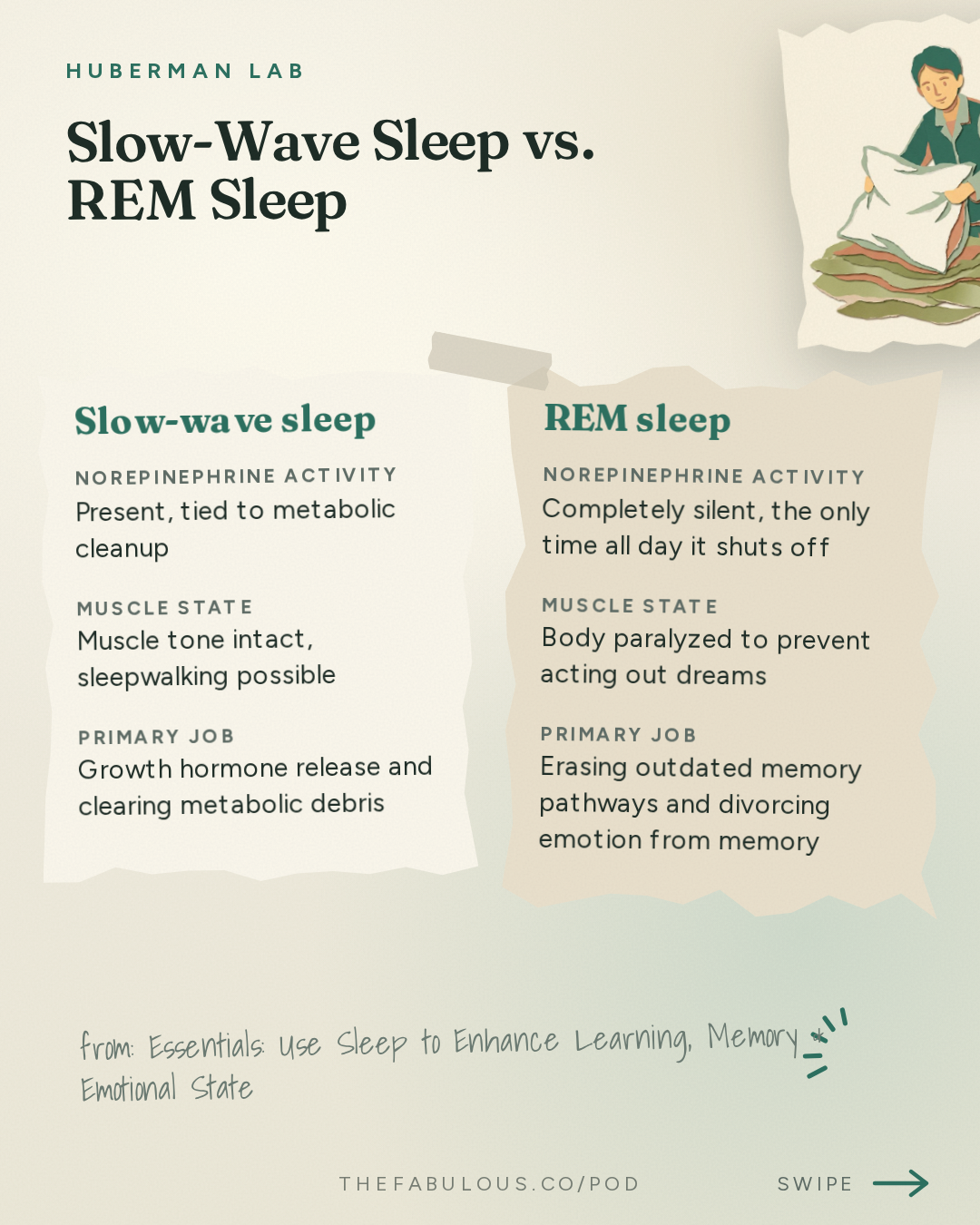
That first slow-wave cycle also carries the single largest release of growth hormone of the entire 24-hour day (04:55), equally in men and women. Miss it, and the body does not simply push the same amount of hormone into a later window. It loses the bolus entirely, because every cell in the body runs its own circadian clock, and those clocks expect growth hormone at a specific time tied to melatonin, the hormone that signals nighttime. Go to sleep 90 minutes late, and the clocks have already moved on. This is why Poe calls consistent bedtimes, not just total hours, one of the strongest markers of healthy aging brains:
"One of the best markers of good neurological health when we get older is consistent bedtimes," she says (06:40).The same timing rule applies to alcohol. A drink before bed suppresses REM sleep and disrupts the stage-two transition where sleep spindles do their work of writing memory to the cortex (08:33), so the damage happens whether or not total sleep time looks normal on paper.
Move past the first third of the night and the balance shifts toward longer REM periods, along with a documented rise in creative problem-solving (09:28). Poe describes it as the brain opening folders and comparing documents, checking for anything conceptually similar and forging a link between them (10:04). That linking, she suggests, is one origin of insight: two memories that seem unrelated turn out to share a thread, and REM sleep is where the thread gets noticed.
The Brain's Cleaning Shift
Wakefulness leaves debris. Learning something new rearranges synapses and unfolds proteins in order to refold them differently, and that process burns through adenosine triphosphate, or ATP, the cell's basic fuel. In the first 20 minutes of sleep, the brain rebuilds that ATP supply, which is why brief naps are called power naps (16:26). Then, during the big slow waves of deep sleep, it clears out misfolded and unfolded proteins and other metabolic leftovers (16:53). Poe's image for this is mechanical: neurons physically swell a little when they fire, as sodium pulls water into the cell, and contract when silent. During slow-wave sleep, large populations of neurons expand and contract in unison, pushing fluid through brain tissue like a pump clearing a boat's hull.
"I think of it actually as a bilge pump cleaning out our brain," Poe says (18:14).Skip that stage, night after night, and the debris compounds, the way an unwashed venue makes each new party harder to move through.
This cleanup, like the growth hormone bolus, is scheduled, not floating. Go to sleep at 1 or 2 in the morning instead of 11 p.m., and slow-wave sleep does not simply arrive later; it gets crowded out by lighter stage-two and REM sleep instead (19:04). Poe adds one caveat: someone whose entire circadian rhythm is shifted later, with melatonin and morning cortisol rising later too, may be fine. The problem is a mismatch between bedtime and the body's clock, not the clock time itself. As for tracking any of this at home, Poe wears a sleep tracker but does not fully trust it: commercial trackers are only about 70 percent accurate at correctly staging sleep (15:39), enough to spot a rough trend, not enough to treat as ground truth.
REM Sleep as an Emotional Editor
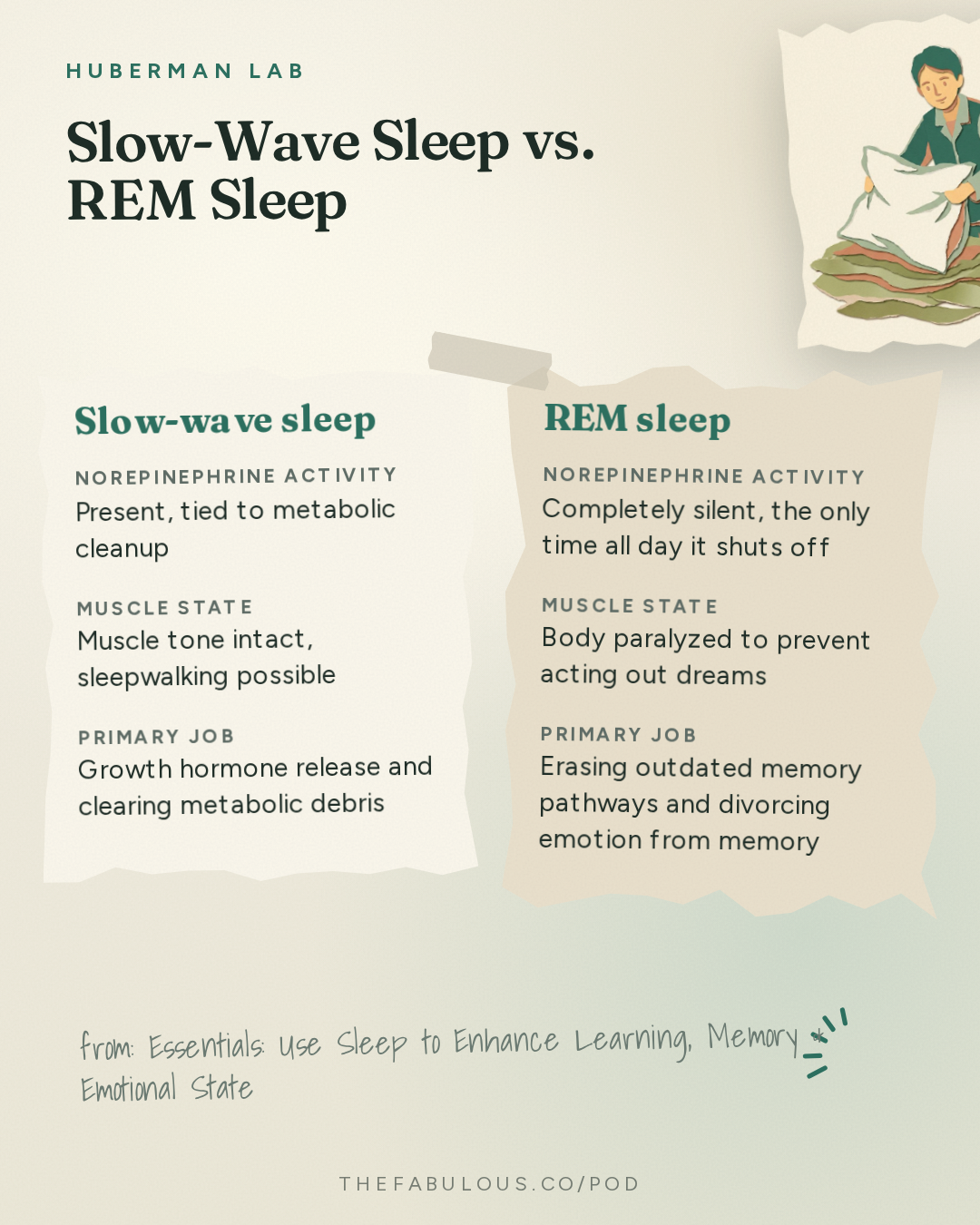
The most striking mechanism in the conversation involves a small brainstem structure called the locus coeruleus, which produces norepinephrine, the brain's version of adrenaline. During waking hours it fires in bursts that snap attention toward anything sudden or important, and it maintains a steady background rate that signals alertness. During non-REM sleep that rate slows. During REM sleep it stops firing entirely, the only time all day it goes fully silent (22:38). Poe considers that silence essential, because it is what allows the brain to erase old, no-longer-useful connections in what she calls the novelty encoding pathway, the circuitry that first tags an experience as new before it gets consolidated elsewhere. Without that erasure, the pathway stays full and the brain loses the flexibility to learn new things (22:52).
The same silence, Poe argues, does something more consequential for trauma. REM sleep is emotionally activating; the brain rehearses vivid, often frightening content. But without norepinephrine driving the body's stress response, the emotional charge can be filed away separately from the factual memory.
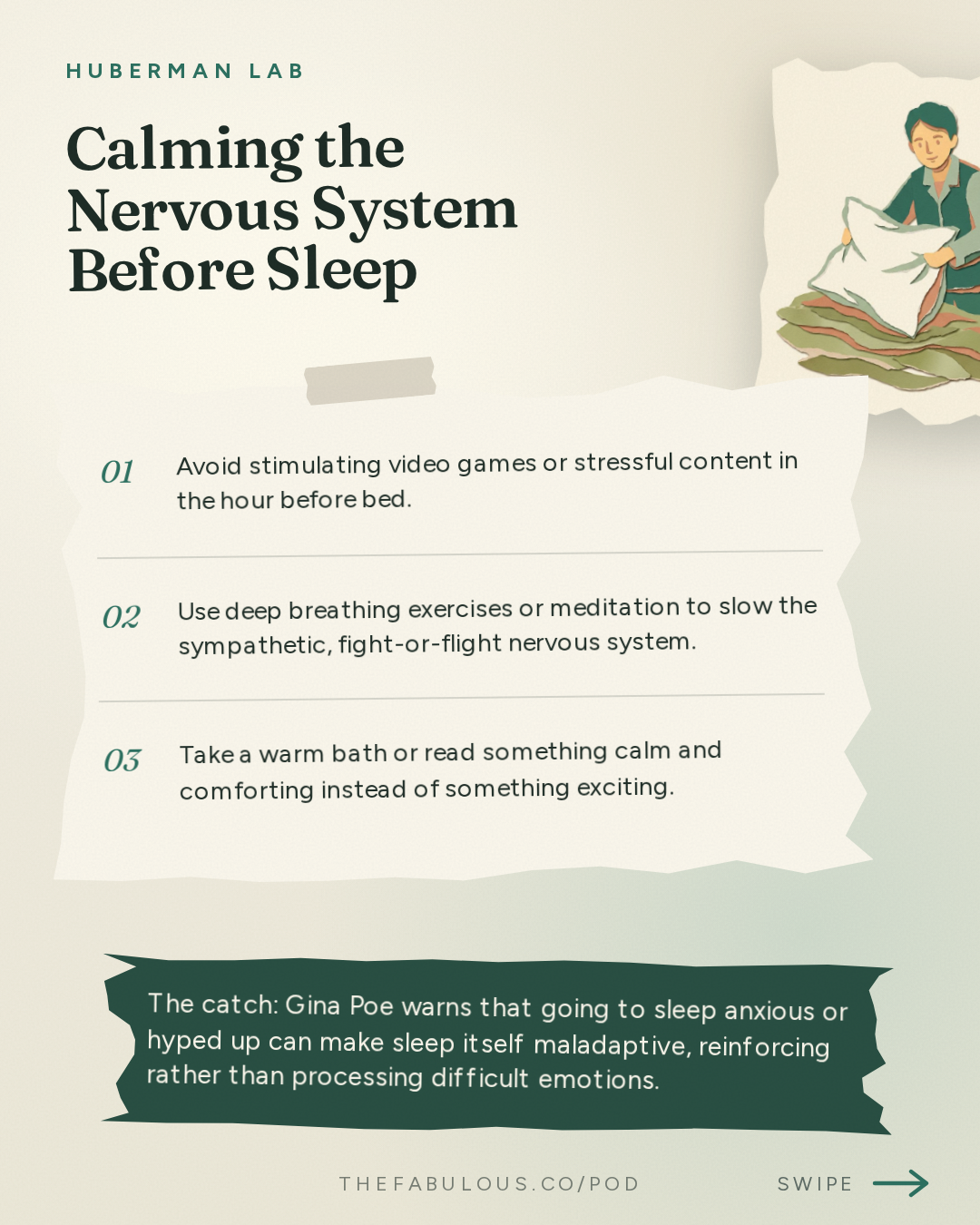
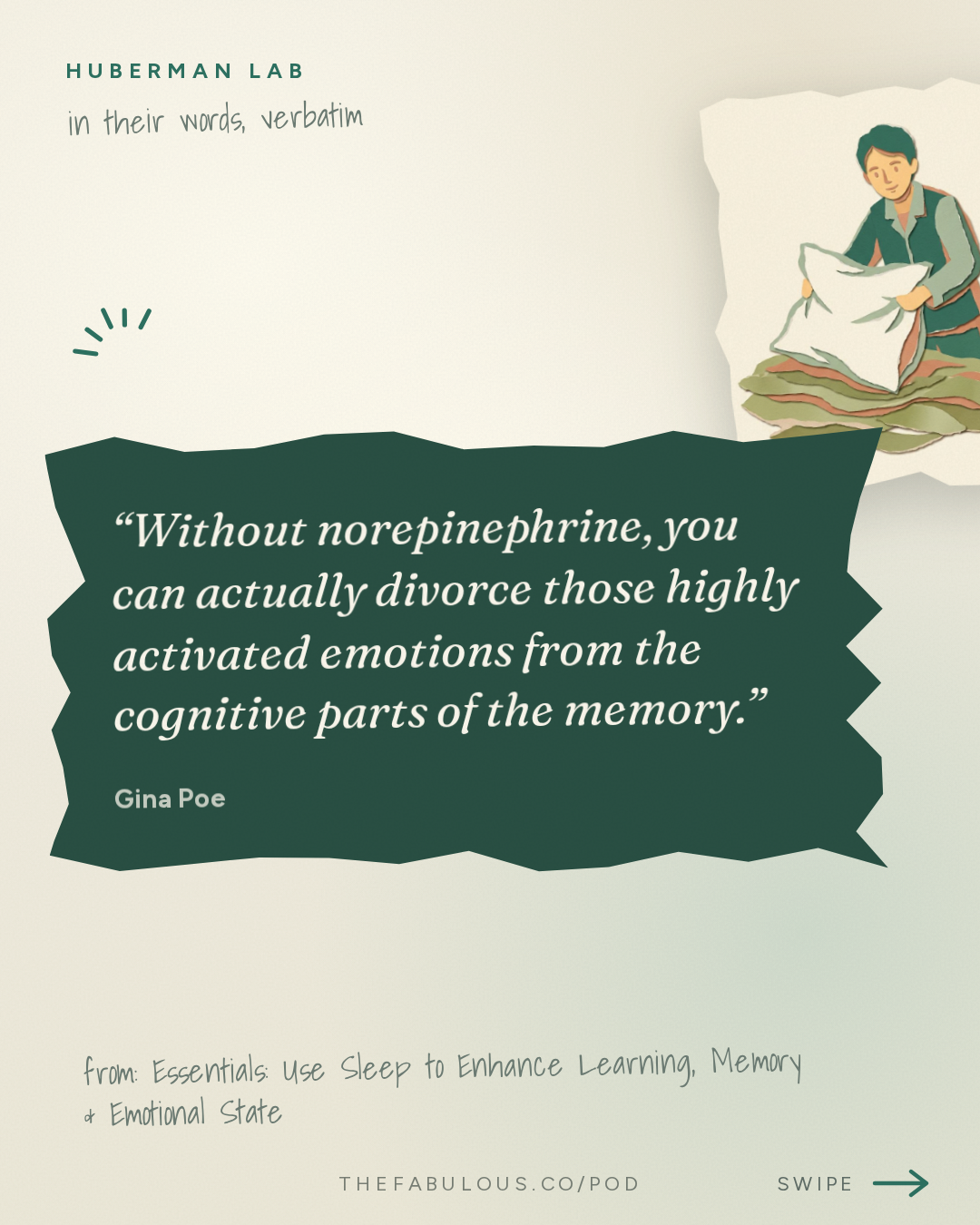
"Without norepinephrine, you can actually divorce those highly activated emotions from the cognitive parts of the memory," Poe says (31:48).A person can remember that an event was terrifying without the heart-racing, sweating replay every time it comes to mind, which is precisely what does not happen in post-traumatic stress disorder, where the memory keeps reliving itself. Poe notes that talk-therapy approaches which simply have people recount trauma repeatedly, without addressing the nervous system beforehand, often fail for this reason: they reactivate the emotion without calming the sympathetic, fight-or-flight system first (30:15). Her practical suggestion is almost anticlimactic given the mechanism behind it: keep the locus coeruleus quiet going into sleep by avoiding stimulating video games, stressful content, or anything else that revs up the nervous system right before bed, and use deep breathing, meditation, a warm bath, or a calm, comforting book instead (24:20).
One more marker ties learning ability directly to sleep architecture. Sleep spindle density, the number of those thalamus-cortex bursts produced per minute, correlates with general intelligence, and increasing spindle density on a given night correlates with how well new material gets consolidated (25:20). Research by neuroscientists Julie Seep and Anita Luethi found that spindles coincide with a surge of plasticity in the distal dendrites, the branches of neurons that listen to activity elsewhere in the cortex rather than to the outside world, which is where new information gets woven into existing knowledge, or schema (26:03).
None of this argues for heroic sleep hacking. It argues for something plainer and harder to sell: the same bedtime, most nights, protected enough to let the cycles run their full course. The reward is not just more sleep. It is a brain that got its scheduled maintenance, its memory transfer, and its chance to file the day's fear away from the facts of it.
Ask this episode anything
Pod's AI answers from the episode itself, with the minute mark so you can hear it yourself.
Or start with one of these
Ask this episode
Pod's AI listens to the whole episode to answer, and points you to the minute it comes from.
The rest of this answer, and any question after it
Answers come from the episode itself, never from a summary of it.
ContinueKey takeaways
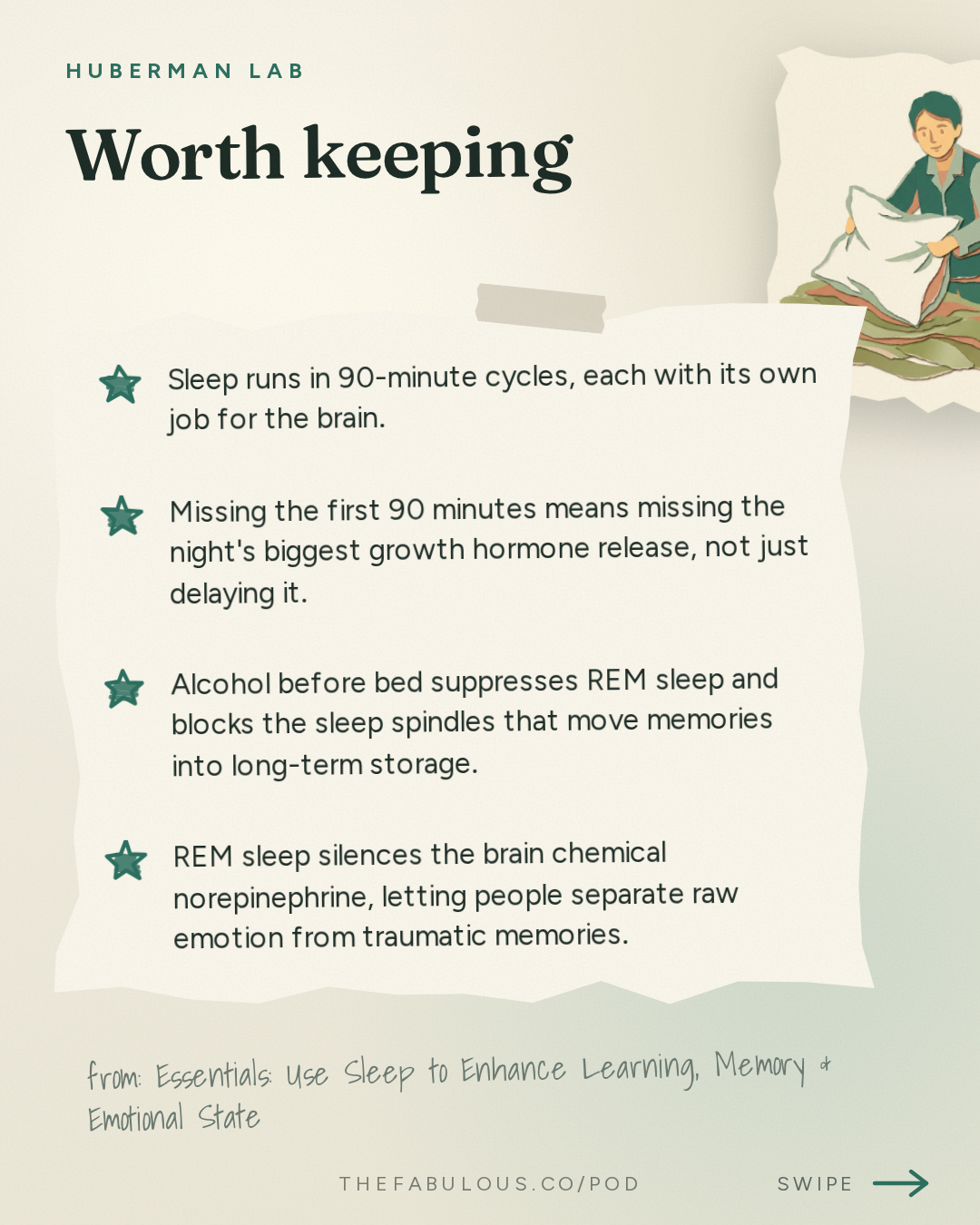
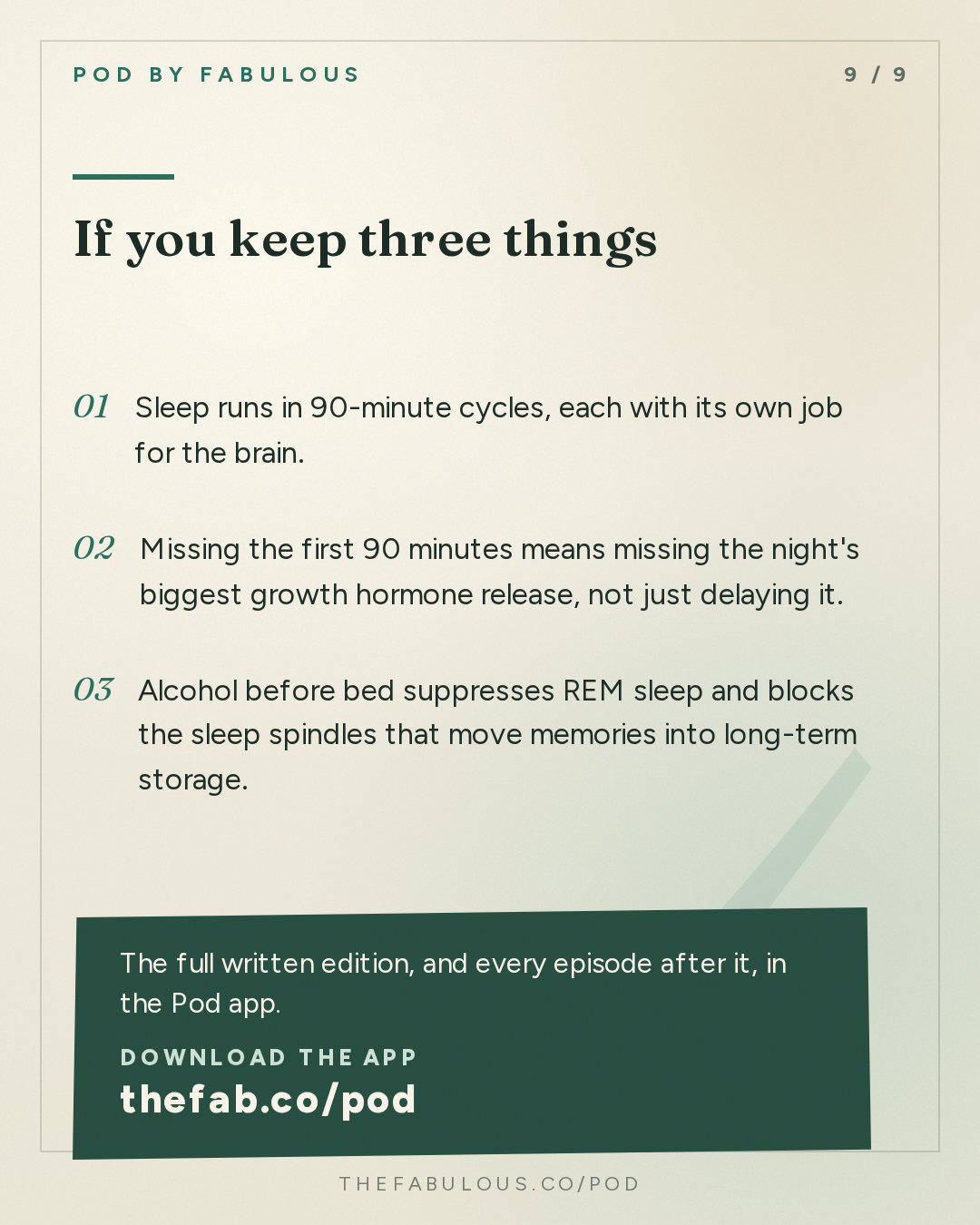
- Sleep runs in 90-minute cycles, each with its own job for the brain.
- Missing the first 90 minutes means missing the night's biggest growth hormone release, not just delaying it.
- Alcohol before bed suppresses REM sleep and blocks the sleep spindles that move memories into long-term storage.
- REM sleep silences the brain chemical norepinephrine, letting people separate raw emotion from traumatic memories.
- Sleep spindle density, brief bursts of brain activity in light sleep, tracks with intelligence and new learning.
The episode in cards
By the numbers
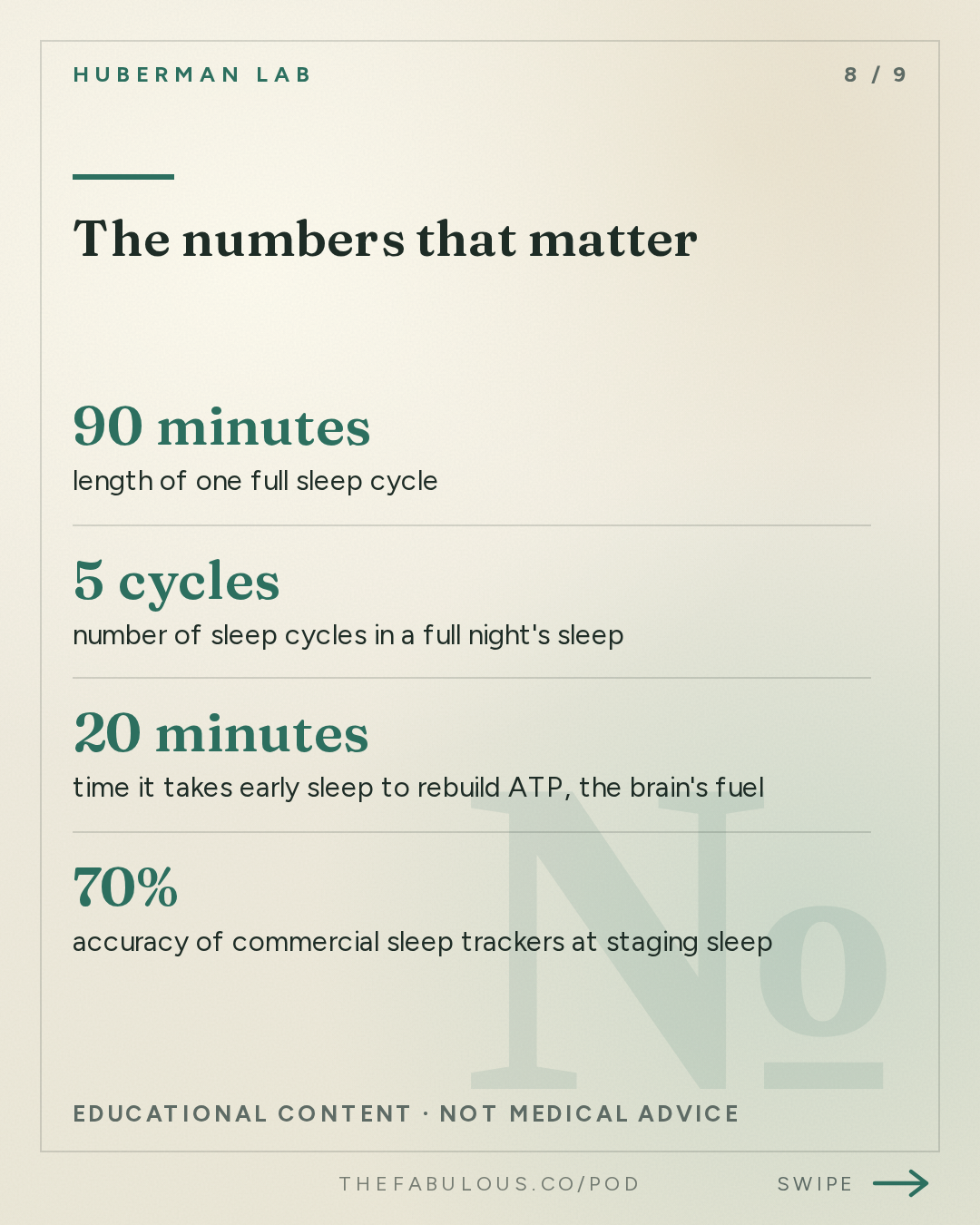
- 90 minutes length of one full sleep cycle
- 5 cycles number of sleep cycles in a full night's sleep
- 20 minutes time it takes early sleep to rebuild ATP, the brain's fuel
- 70% percent accuracy of commercial sleep trackers at staging sleep
In their words
“Sleep is really different from wakefulness, and in fact, can't be replaced by any state of wakefulness that we've been able to come up with so far.”
“One of the best markers of good neurological health when we get older is consistent bedtimes.”
“I think of it actually as a bilge pump cleaning out our brain.”
“Without norepinephrine, you can actually divorce those highly activated emotions from the cognitive parts of the memory.”
Protocols
-
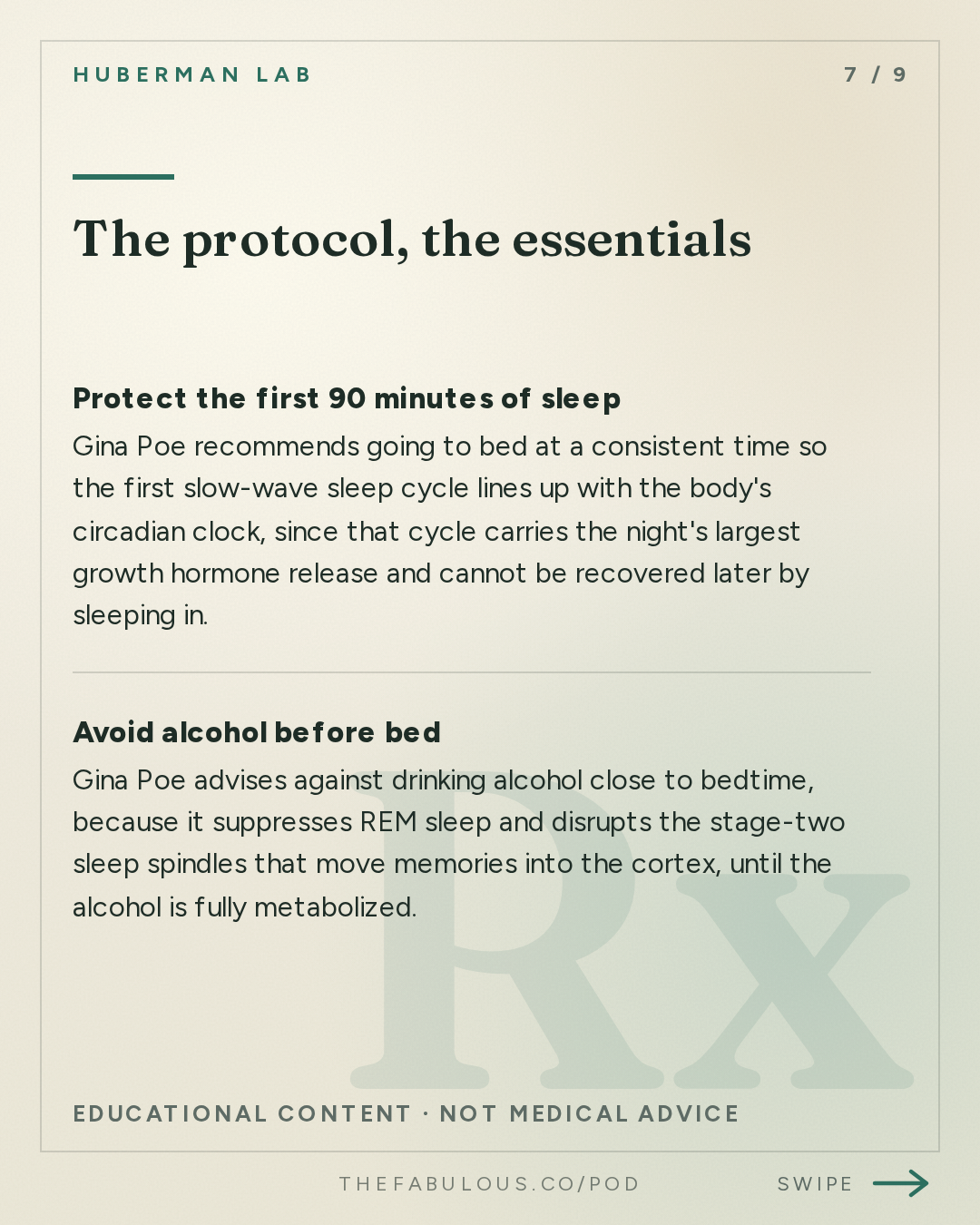
Protect the first 90 minutes of sleep
Gina Poe recommends going to bed at a consistent time so the first slow-wave sleep cycle lines up with the body's circadian clock, since that cycle carries the night's largest growth hormone release and cannot be recovered later by sleeping in.
every night
-
Avoid alcohol before bed
Gina Poe advises against drinking alcohol close to bedtime, because it suppresses REM sleep and disrupts the stage-two sleep spindles that move memories into the cortex, until the alcohol is fully metabolized.
before every night of intended full sleep
-
Calm the nervous system before sleep
Gina Poe suggests avoiding stimulating video games or stressful content right before bed and instead using deep breathing, meditation, a warm bath, or a calm book, aiming for something neither too exciting nor too boring, so the sympathetic nervous system settles before sleep begins.
nightly, especially after a stressful day
-
Use a short nap to rebuild mental energy
Gina Poe notes that the first 20 minutes of sleep rebuild ATP, the brain's fuel, from adenosine, which is the likely reason short naps of about this length feel restorative.
as needed during the day
Questions this episode answers
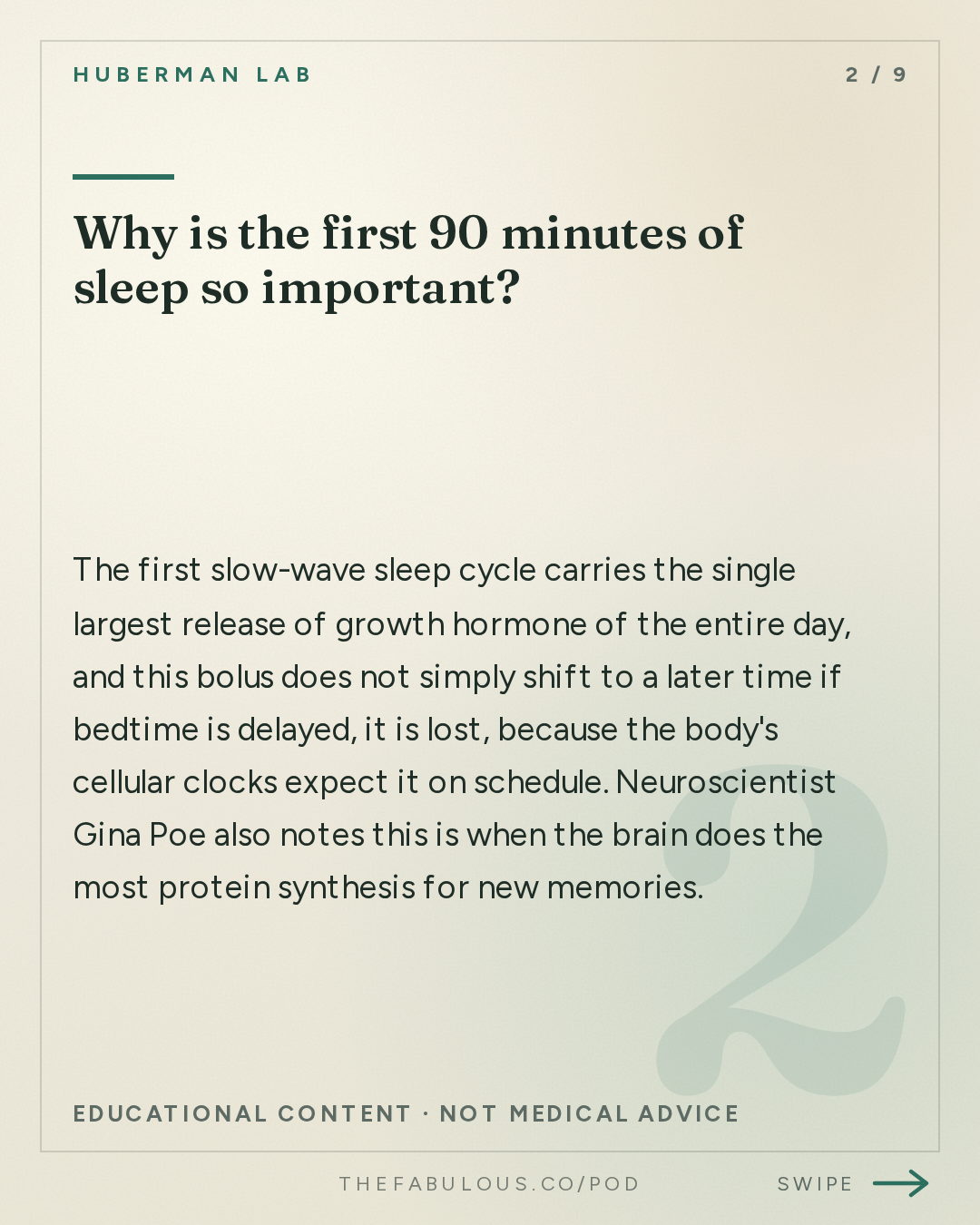
Why is the first 90 minutes of sleep so important?
The first slow-wave sleep cycle carries the single largest release of growth hormone of the entire day, and this bolus does not simply shift to a later time if bedtime is delayed, it is lost, because the body's cellular clocks expect it on schedule (04:55). Neuroscientist Gina Poe also notes this is when the brain does the most protein synthesis for new memories (05:24).
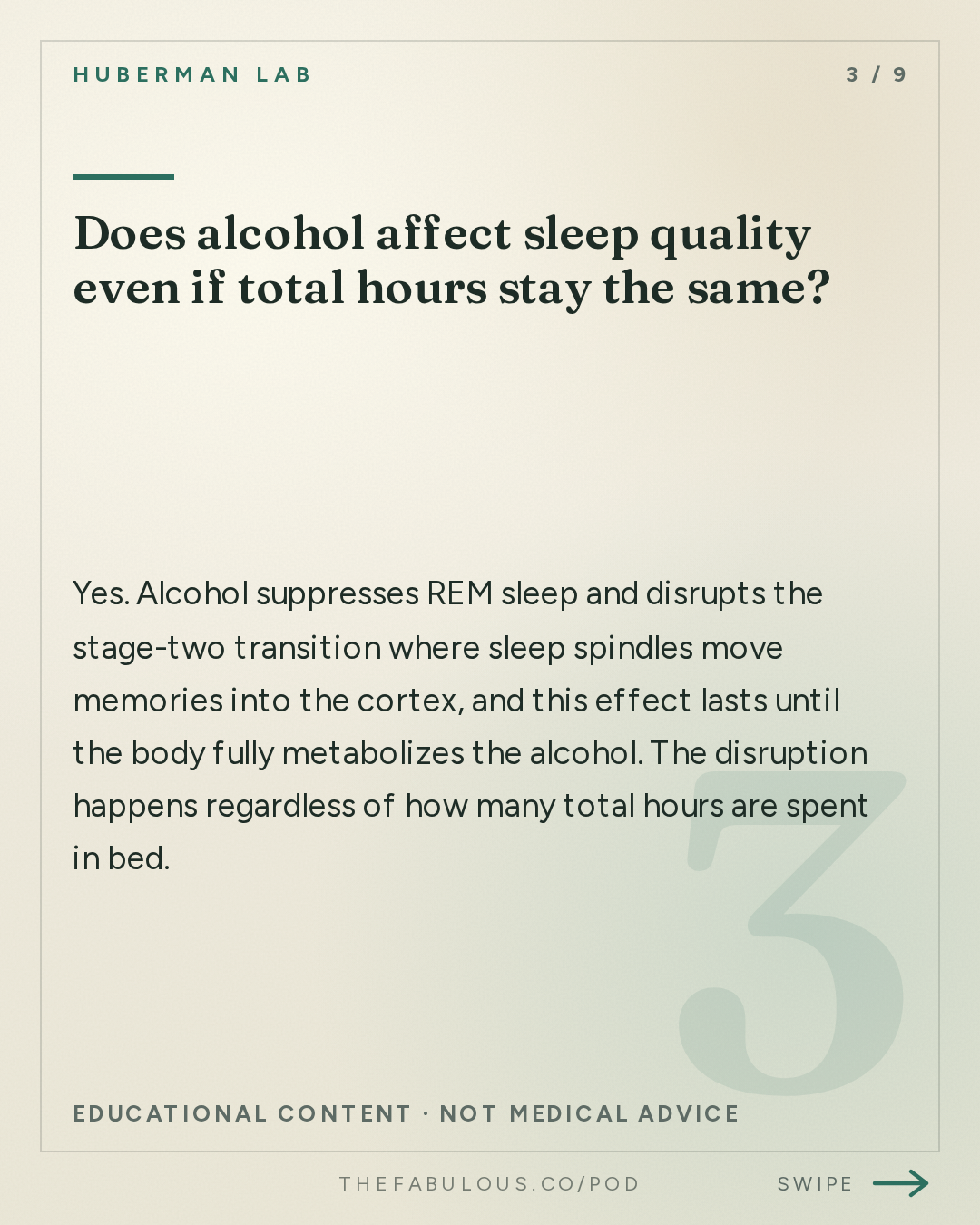
Does alcohol affect sleep quality even if total hours stay the same?
Yes. Alcohol suppresses REM sleep and disrupts the stage-two transition where sleep spindles move memories into the cortex, and this effect lasts until the body fully metabolizes the alcohol (08:33). The disruption happens regardless of how many total hours are spent in bed.
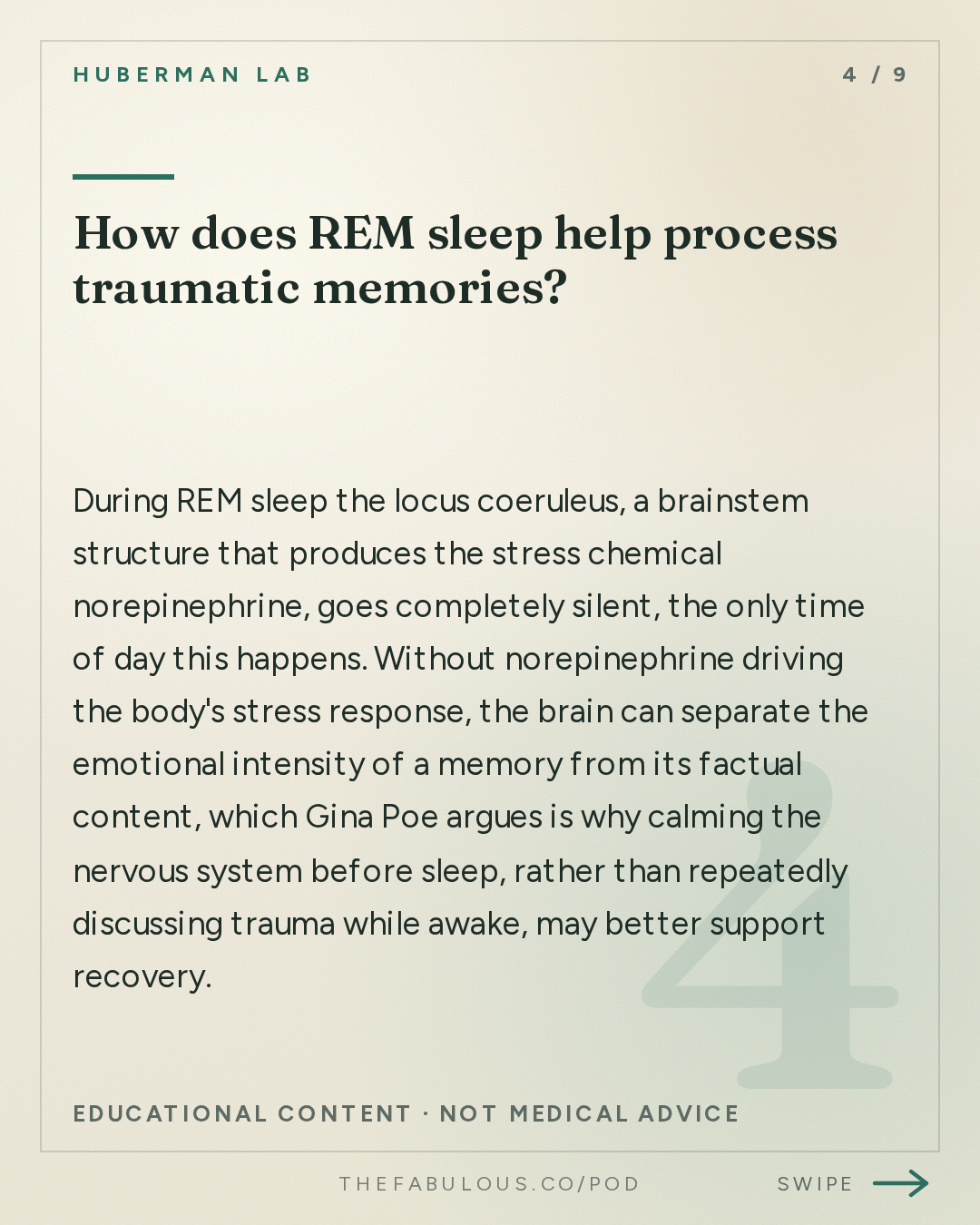
How does REM sleep help process traumatic memories?
During REM sleep the locus coeruleus, a brainstem structure that produces the stress chemical norepinephrine, goes completely silent, the only time of day this happens (22:38). Without norepinephrine driving the body's stress response, the brain can separate the emotional intensity of a memory from its factual content, which Gina Poe argues is why calming the nervous system before sleep, rather than repeatedly discussing trauma while awake, may better support recovery (31:48).
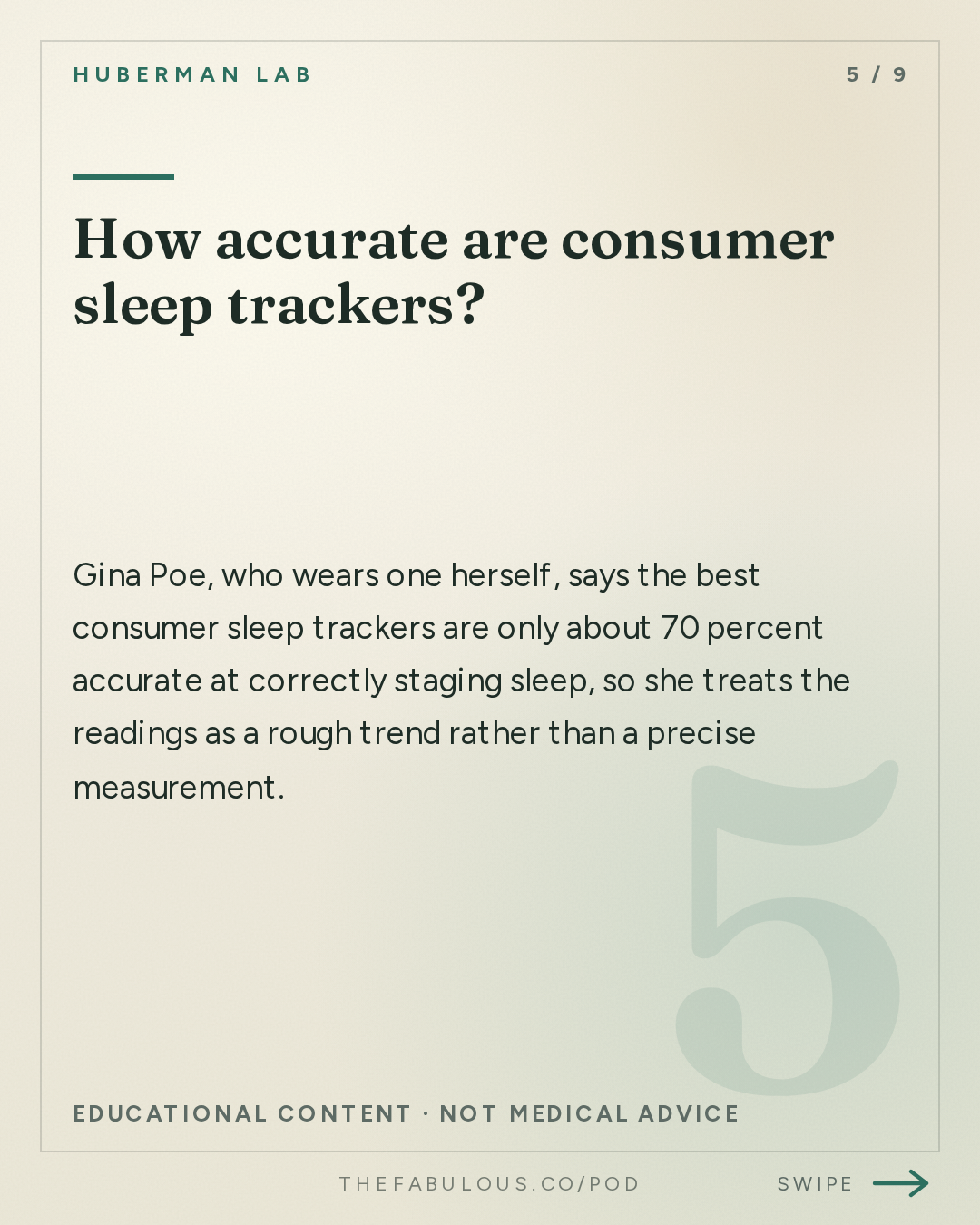
How accurate are consumer sleep trackers?
Gina Poe, who wears one herself, says the best consumer sleep trackers are only about 70 percent accurate at correctly staging sleep (15:43), so she treats the readings as a rough trend rather than a precise measurement.
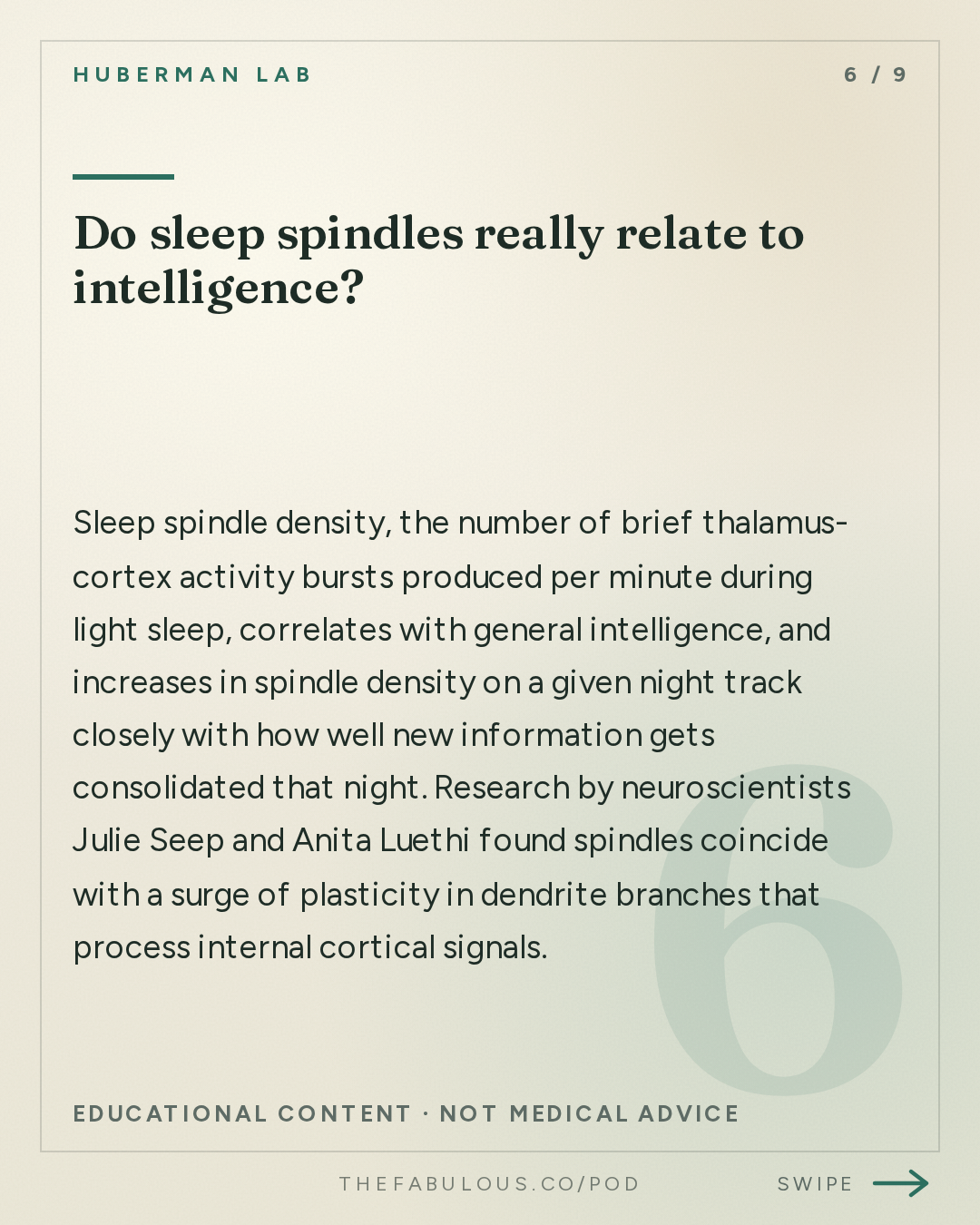
Do sleep spindles really relate to intelligence?
Sleep spindle density, the number of brief thalamus-cortex activity bursts produced per minute during light sleep, correlates with general intelligence, and increases in spindle density on a given night track closely with how well new information gets consolidated that night (25:20). Research by neuroscientists Julie Seep and Anita Luethi found spindles coincide with a surge of plasticity in dendrite branches that process internal cortical signals (26:03).
The full read, in cards
Go deeper
- Sidarta Ribeiro's rat memory consolidation study — tracked a single memory moving from the hippocampus through successive cortical areas across a full sleep period in rats
- Julie Seep and Anita Luethi sleep spindle studies — found sleep spindles coincide with a surge of plasticity in the distal dendrites, the branches of neurons that process internal, cross-cortical signals
Mentioned
Gina Poe · Andrew Huberman · Sidarta Ribeiro · Julie Seep · Anita Luethi · Locus Coeruleus · Hippocampus · Thalamus · Norepinephrine
More from this show and category

Jared Diamond on Leadership: Why Charisma Isn't Required
Charisma is optional for great leadership, biologist and historian Jared Diamond argues, pointing to the uncharismatic dictators Stalin and Pinochet as proof (00:26). Diamond, 89, applies a 'natural experiment' method from biology to politics, religion, business, and sports, showing only 2 of 22 modern political leaders stepped down voluntarily and that coaches and CEOs get too much credit or blame for outcomes that are mostly random (95:37).

Neuralink Trials for Quadriplegia: What Comes First
Neuralink's head neurosurgeon Matt MacDougall explains that the implant's first job is letting quadriplegic patients move a cursor and type by thought alone, not reconnect limbs. He also covers the robotic surgery that makes this possible, the safety case made in pigs and monkeys, and his own subdermal RFID chip.
How Diet Affects Memory and the Hippocampus
USC neuroscientist Scott Kanoski says the hippocampus, the brain's memory hub, tracks recent meals via the vagus nerve to judge hunger and fullness. Sugar, heat-processed foods, and artificial sweeteners early in life can impair that memory system and its gut bacteria, while exercise and simple recall of a recent meal can help restore or harness it.

Elissa Epel's Guide to Stress and Resilience
Psychologist Elissa Epel says stress is simply when demands exceed our resources, and most modern stress comes from our own thoughts. She shows how a challenge mindset, radical acceptance, and small daily practices like 'dropping the rope' change inflammation, telomere length, and mitochondrial energy output measurably.
