
Health Benefits of Fish vs Plant Protein
#619: How Much Fish Should a Healthy Diet Contain?
The brief
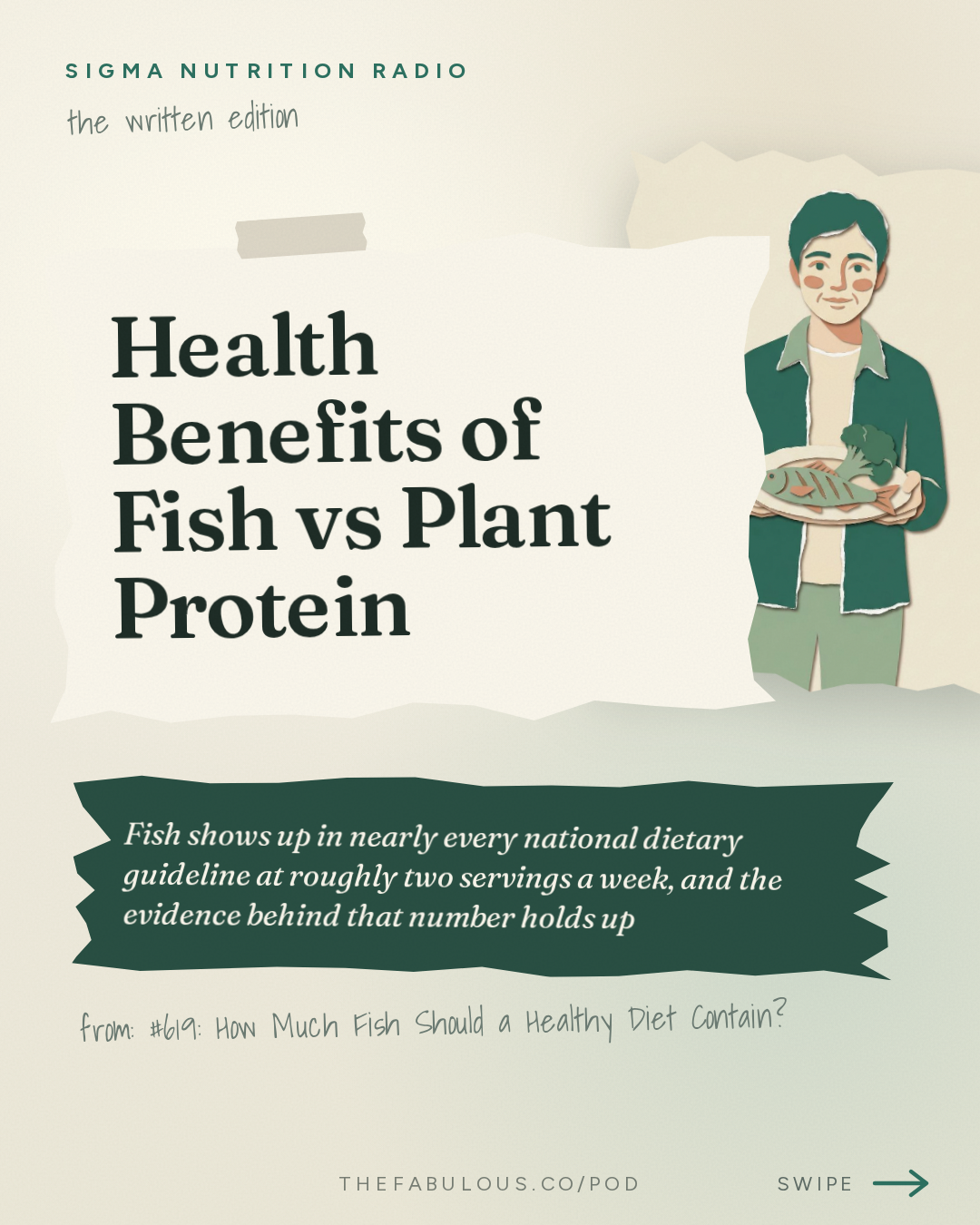
Fish shows up in nearly every national dietary guideline at roughly two servings a week, and the evidence behind that number holds up, but newer research shows the benefit depends heavily on what fish replaces and which population is eating it, and fish itself is not biologically required for good health.
A Danish research team once looked at Inuit populations in Greenland eating diets soaked in marine fat and saw, seemingly, no heart disease. That single, loosely documented observation from the 1970s helped launch decades of research into fish oil and the heart. It also turned out not to hold up. Later work found similar rates of coronary heart disease and atherosclerosis in those populations compared with age-matched Danish and Canadian controls (09:20). The story is a useful warning for the rest of the episode: a plausible idea can slip into what nutrition scientist Dr. Alan Flanagan calls "nutrition lore" long before anyone tests it properly.
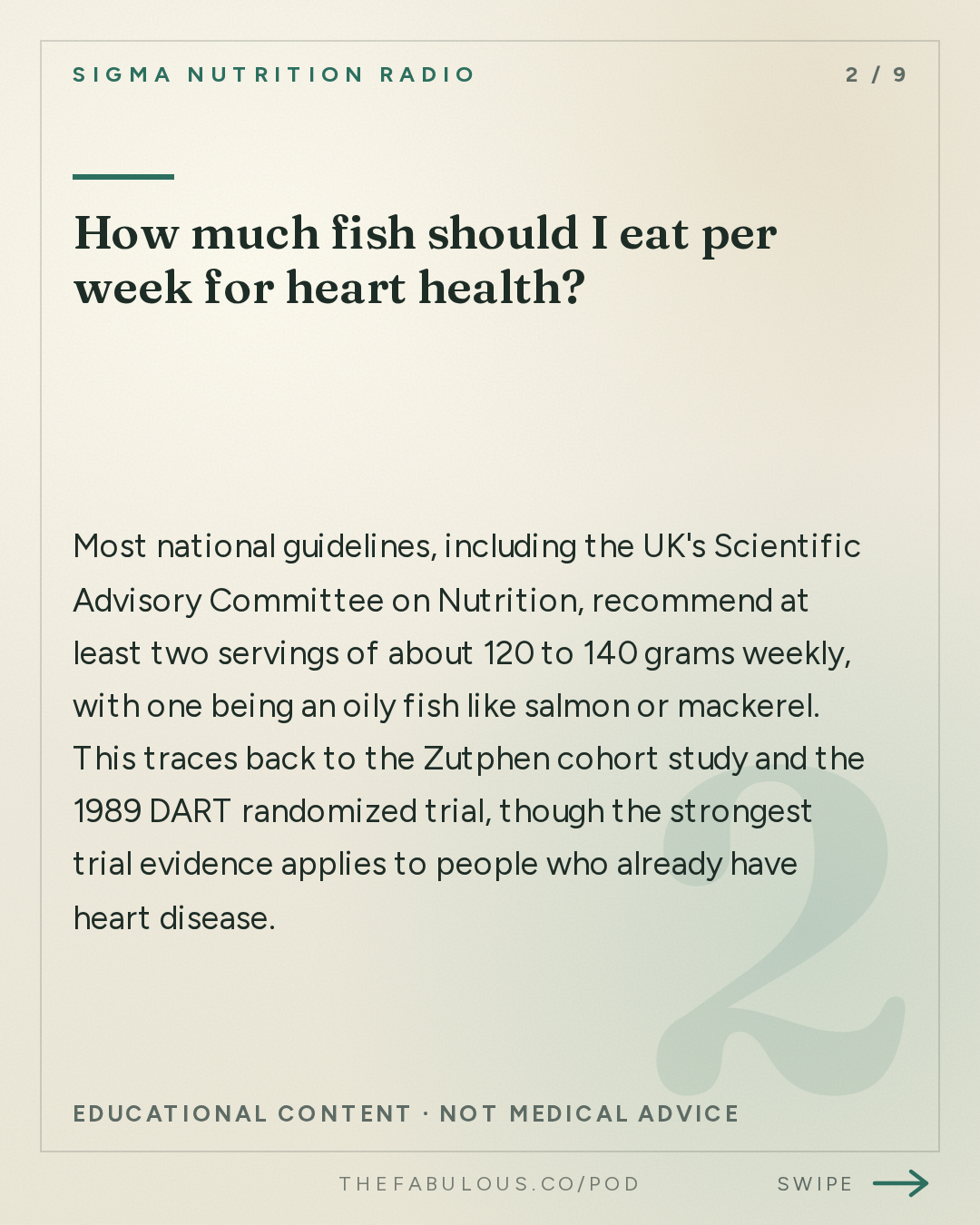
What follows in this episode of Sigma Nutrition Radio, hosted by Danny Lennon with Flanagan, is a slow, careful walk through what actually justifies the advice most countries give about fish. The UK's Scientific Advisory Committee on Nutrition recommends at least two portions a week, roughly 120 to 140 grams each, with one portion being an oily fish such as salmon, sardines, or mackerel (03:44). The US Academy of Nutrition and Dietetics lands in similar territory, and Australia recommends two to three 150-gram servings (05:14). Japan, unsurprisingly given its naturally high fish intake, skips a general quota and instead targets specific risks: a sodium cap tied to salted and pickled fish, and a strict 80-gram weekly limit on high-mercury fish like bluefin tuna and swordfish for pregnant women (06:17). The guidelines converge, but convergence is not proof. The real question the episode asks is where the two-servings figure actually comes from, and whether it deserves the confidence usually placed in it.
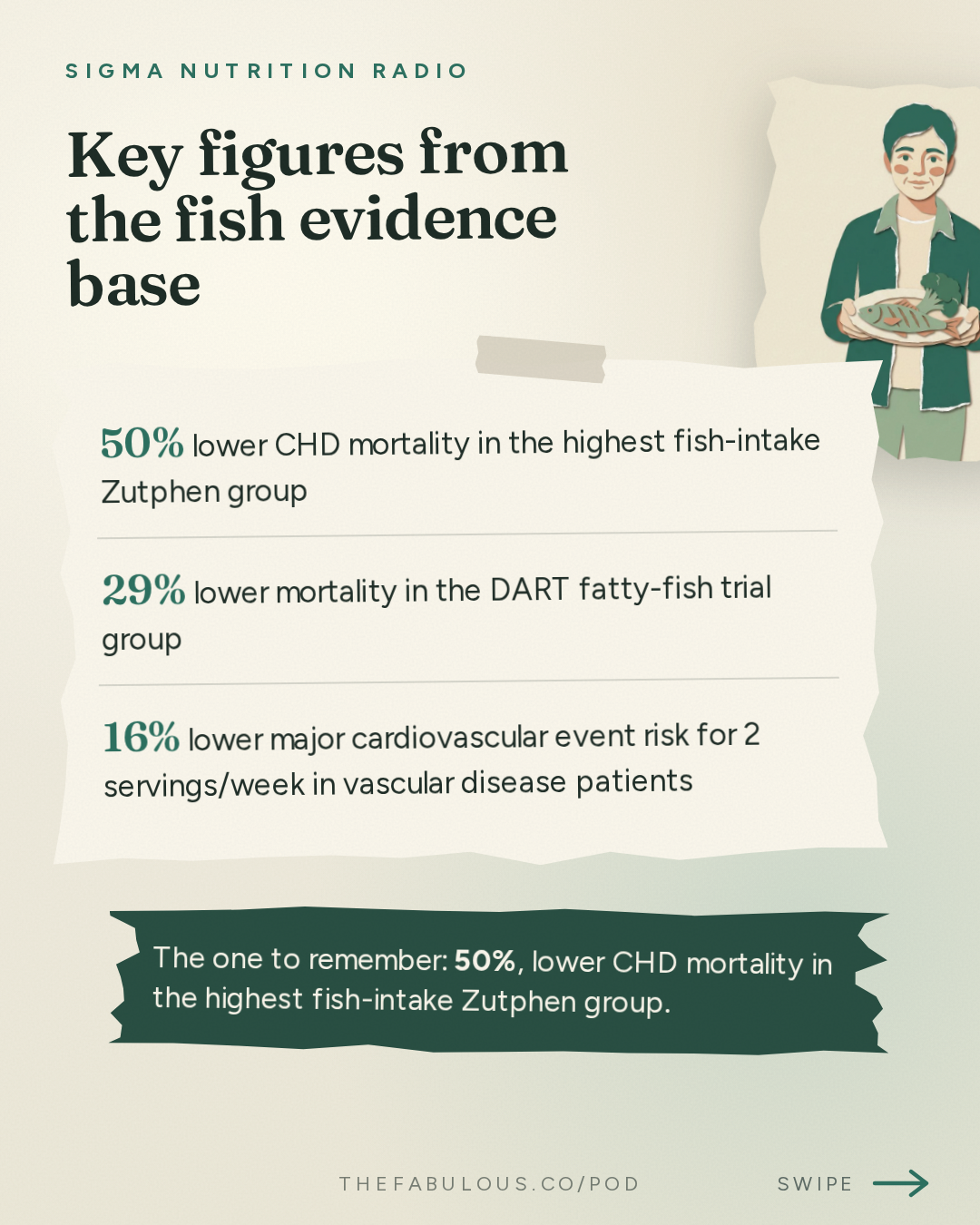
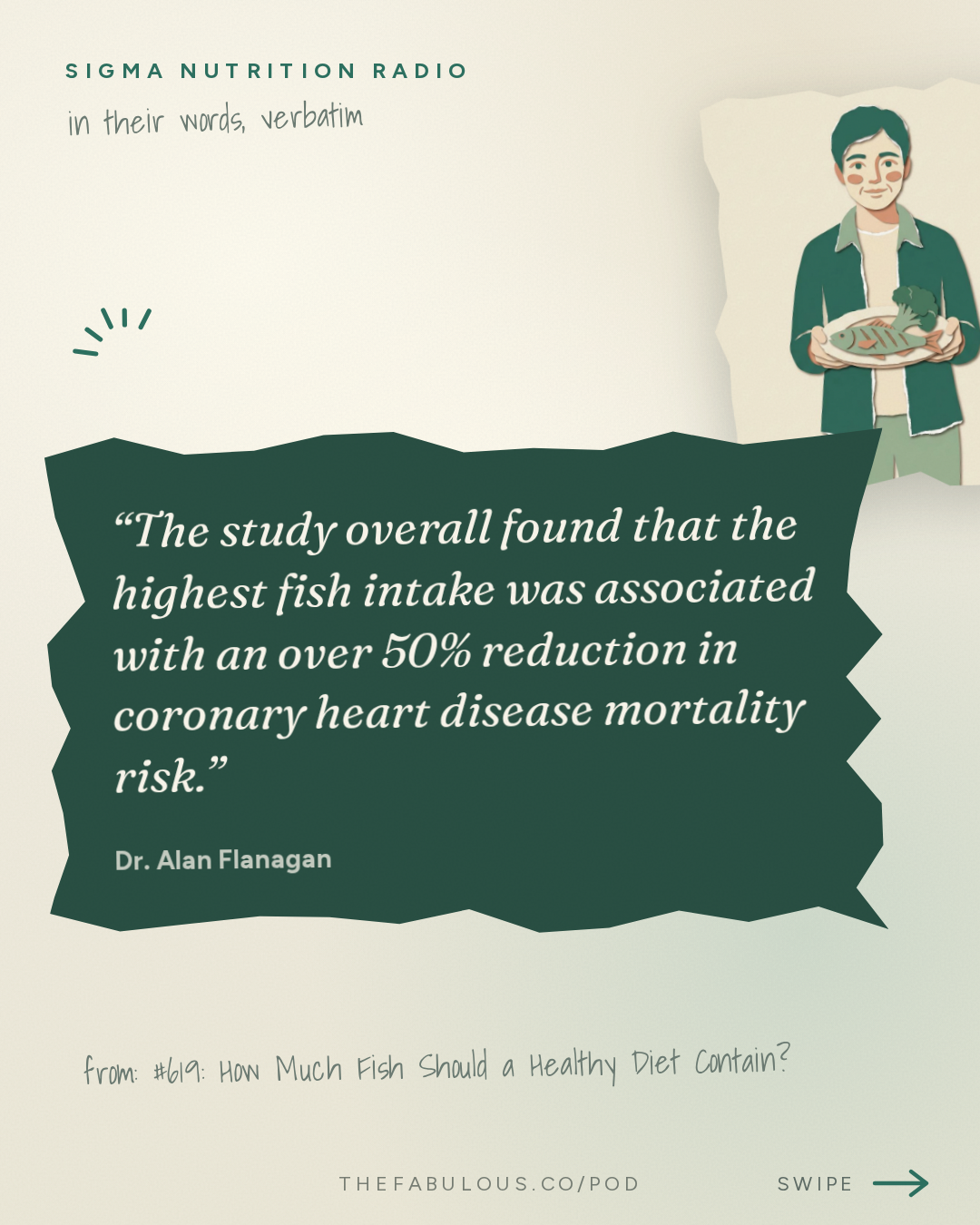
The clearest early answer comes from the Zutphen study, a Dutch cohort of 872 men followed for 20 years starting in 1960, published in the New England Journal of Medicine in 1985 (13:38). Average fish intake was about 20 grams a day, two-thirds of it lean fish like cod, one-third fatty fish like herring and mackerel. Men in the highest intake groups, above roughly 30 grams a day, had over 50 percent lower risk of dying from coronary heart disease than men who ate the least (14:50). Translated into weekly terms, that top-performing intake worked out to about one to two servings a week, which is exactly where the modern guidelines sit. The authors themselves concluded this was enough to justify a public health recommendation.
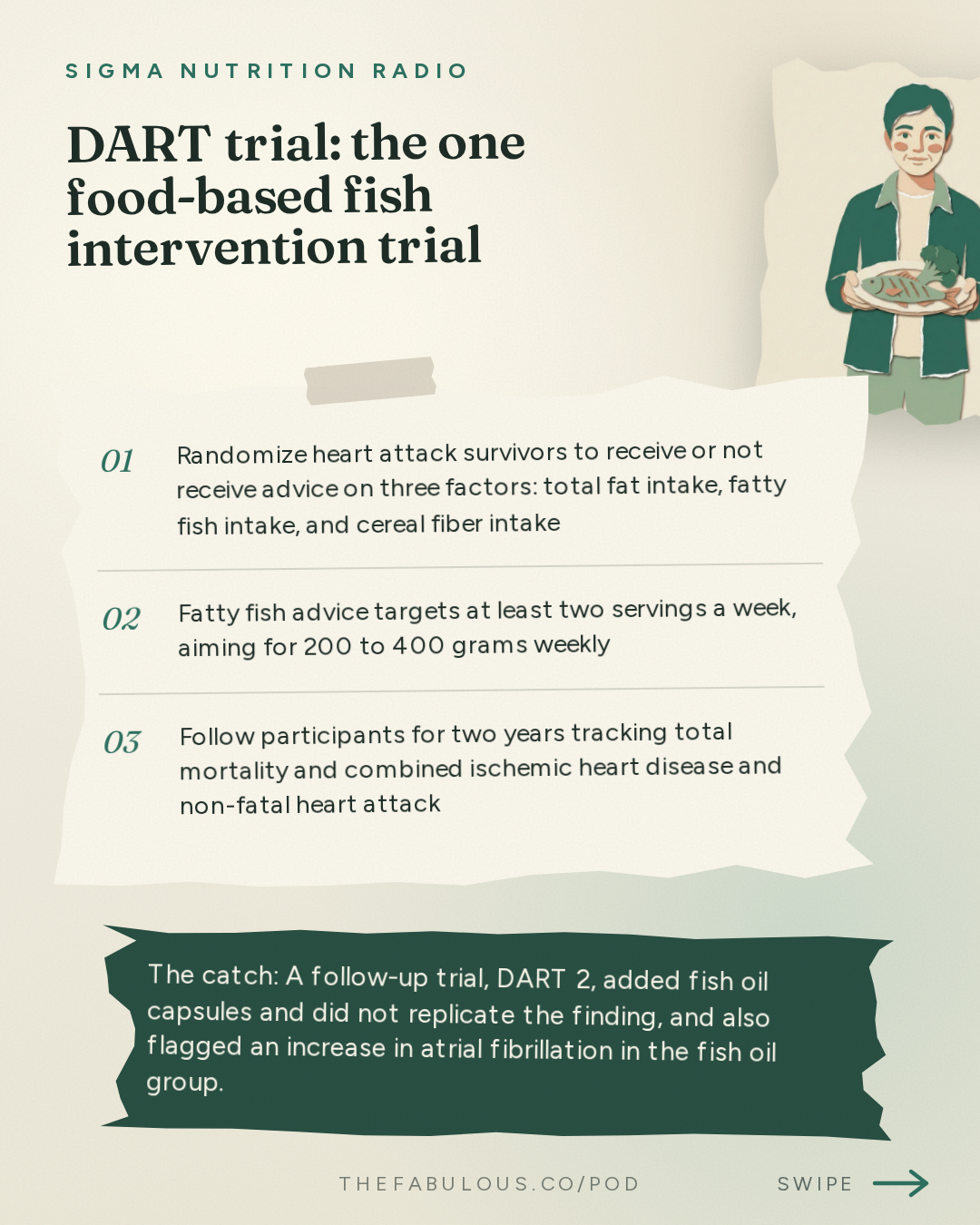
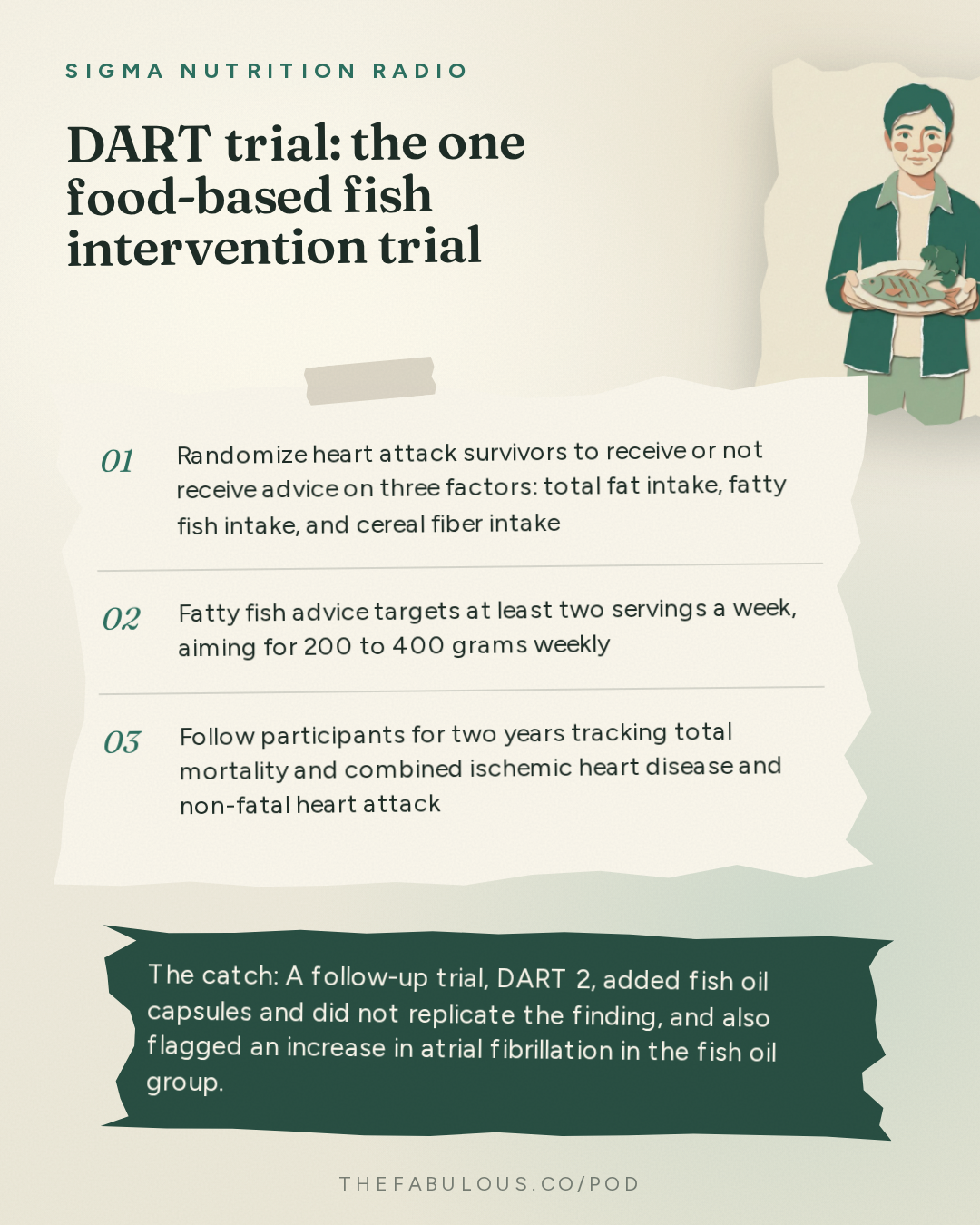
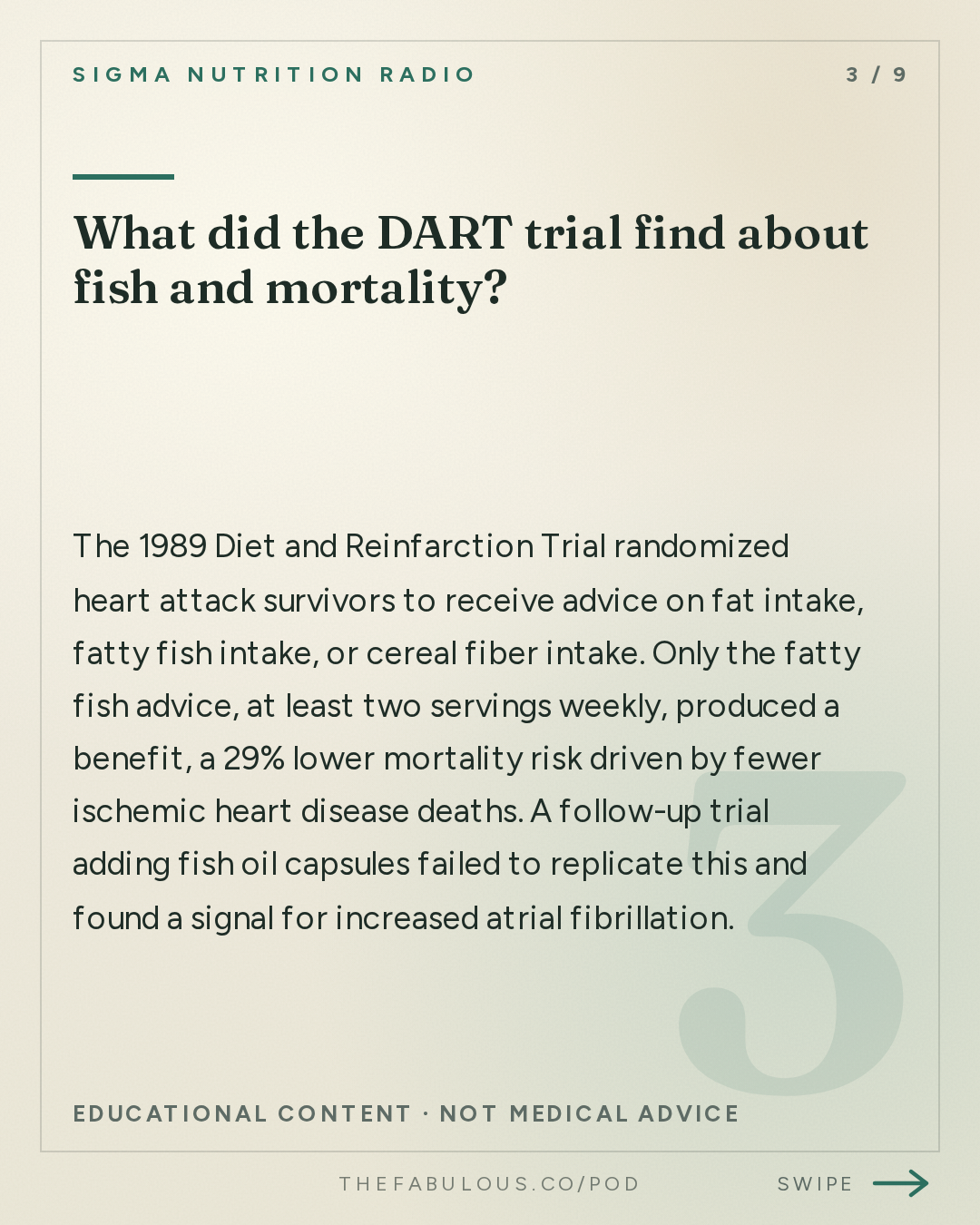
Observation is not causation, though, and the strongest piece of evidence in the whole episode is a genuine experiment. The 1989 Diet and Reinfarction Trial, known as DART, randomized heart attack survivors to receive or not receive advice on three separate things: total fat intake, fatty fish intake of at least two servings a week, and cereal fiber (16:03). Only the fish advice moved the needle. Over two years, the group advised to eat fatty fish had 29 percent lower mortality, and the effect was driven entirely by fewer deaths from ischemic heart disease (17:22). Neither the fat advice nor the fiber advice made a measurable difference, and fish's benefit held up regardless of which other advice a person also received. It is one of very few food-based, rather than supplement-based, randomized trials in this entire field, which is why it carries so much weight.
The follow-up trial, DART 2, tried to extend the finding by adding fish oil capsules into the mix and did not replicate it. It also flagged an early signal of harm, an increase in atrial fibrillation in the fish oil arm (18:08). From that point, Flanagan explains, the field's attention drifted from fish as a food toward omega-3 capsules as a supplement, a shift that has quietly muddied a lot of later evidence, since fish and fish oil are not the same exposure.
A more recent and much larger dataset adds useful texture rather than overturning the picture. A pooled analysis by Mohan and colleagues combined individual data from four international studies, roughly 191,500 participants across 58 countries (21:03). Among people without existing cardiovascular disease, higher fish intake showed no clear benefit. But among the nearly 52,000 participants who already had vascular disease, eating about two servings a week compared with almost none was tied to 16 percent lower risk of major cardiovascular events and 18 percent lower total mortality (23:35). Where the type of fish was recorded, in one of the four cohorts, it was specifically high-omega-3 oily fish that carried the benefit, with a 6 percent lower cardiovascular risk per five-gram daily increment, while non-oily fish showed no association at all. The takeaway is not that guidelines are wrong, but that the evidence is strongest for people who already have heart disease, and for oily fish specifically, not fish in general.
The comparison problem
Here the episode turns from what fish does to what fish replaces, which is where most of the public confusion lives. Modern nutrition epidemiology increasingly uses substitution models: statistically swap a fixed amount of one food or nutrient for another and see what happens to disease risk. A 2023 meta-analysis by Neuenschwander and colleagues modeled replacing 50 grams a day of fish with 7 grams of nuts or 12.5 grams of legumes, using data from 24 cohorts, and found no significant difference in coronary heart disease or all-cause mortality either way (28:07). No harm, no benefit, and only very low certainty behind even that.
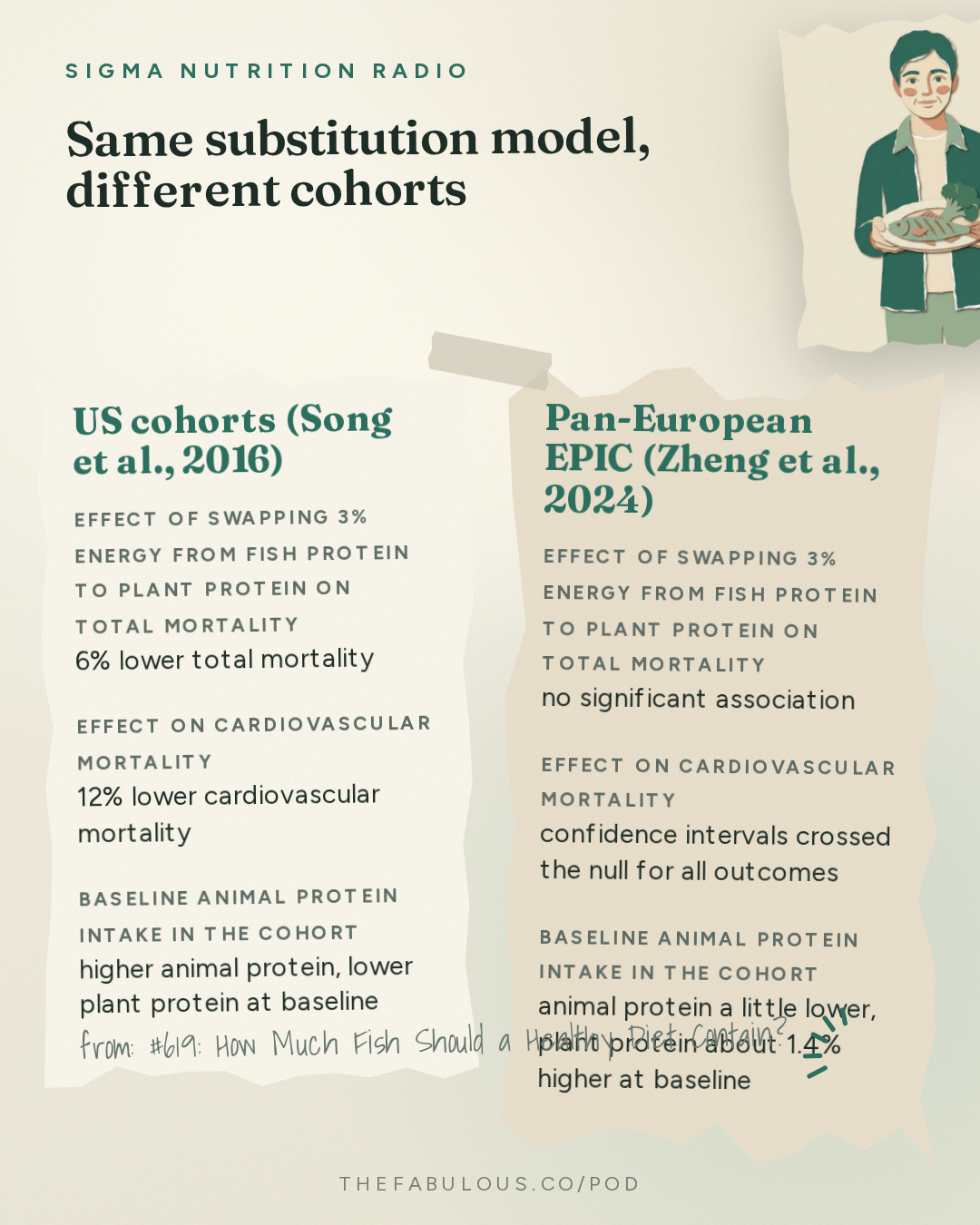
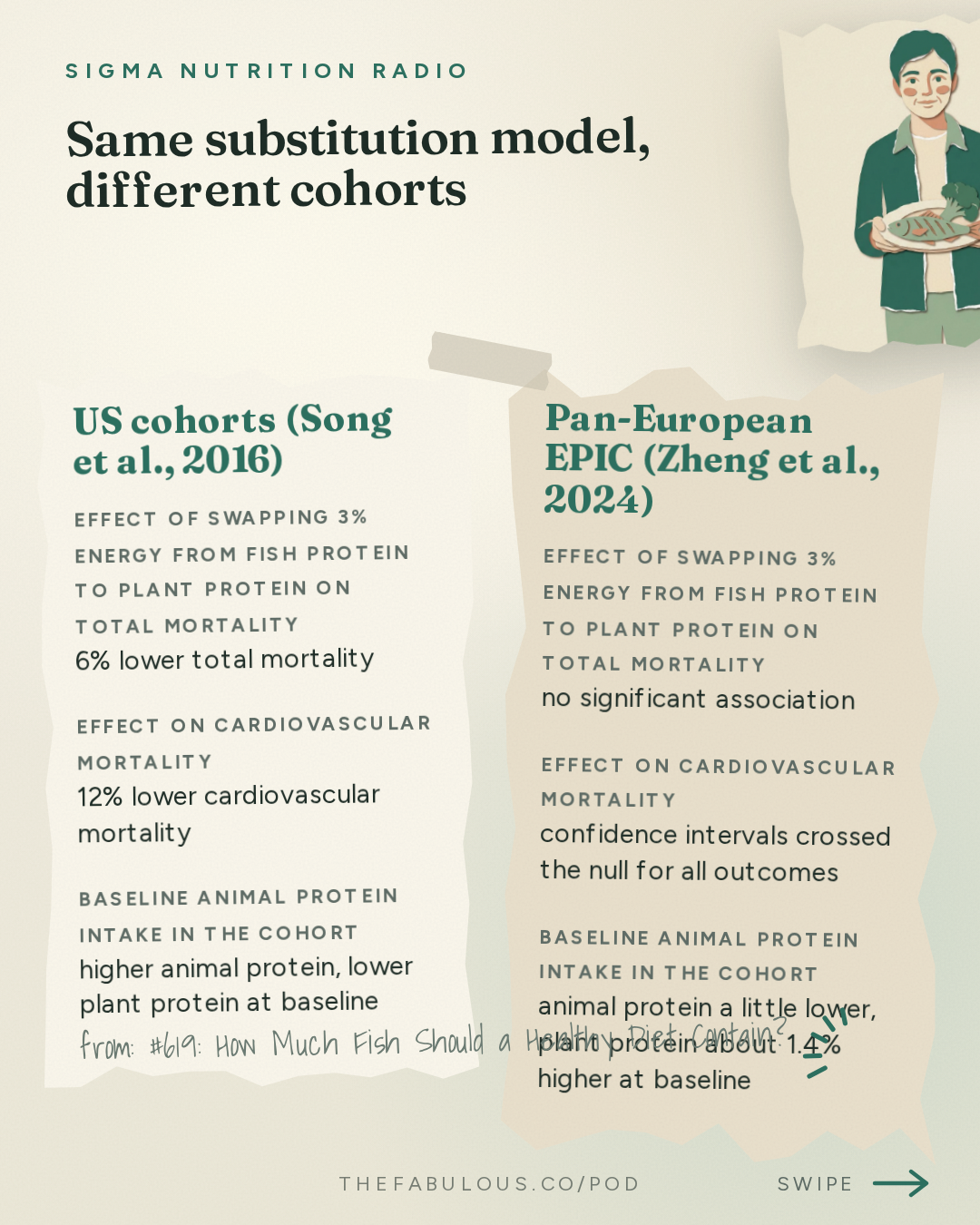
Other studies using a different substitution method, swapping 3 percent of energy from animal protein for plant protein, reach different conclusions, and the reason why is the real payoff of this episode. A widely cited 2016 paper by Song and colleagues, drawn from Harvard's Nurses' Health Study and Health Professionals Follow-up Study, found that replacing 3 percent of energy from fish protein with plant protein was linked to 6 percent lower total mortality and 12 percent lower cardiovascular mortality (33:26). But a 2024 paper by Zheng and colleagues, using the same 3-percent substitution model in the Pan-European EPIC cohort of roughly 31,000 people across seven countries, found essentially nothing, no signal for total cardiovascular disease, heart disease, or stroke in either direction (37:50).
Flanagan's explanation is that the American cohorts start from a background diet that is heavier in animal protein and lighter in plant protein than the European cohort, so almost any modeled shift toward plants looks beneficial there, regardless of whether fish itself is the active ingredient.
"It's a mathematical abstraction that is often then having to be forced to fit your data." — Dr. Alan Flanagan [41:13]
Because the swap is a statistical construction, not something most participants actually do, the result is pulled toward whatever people who already eat more plants and less fish look like in that particular population. Run the same model in a population with a different starting diet, and the number changes or disappears, exactly what happened between the US and European cohorts.
What vegetarian cohorts actually show
The episode's final piece of evidence looks at populations that avoid fish, or meat, or both. In the 2019 EPIC Oxford study of just under 49,000 people, pescatarians (people who eat fish but not meat) had 13 percent lower risk of ischemic heart disease than meat eaters over 18 years of follow-up, while vegetarians had a larger 22 percent lower risk, with tighter confidence intervals (44:38). Neither group showed a significant difference in stroke risk. In the 2024 Adventist Health Study-2, a religiously and ethnically diverse US cohort of nearly 88,500 people, pesco-vegetarians had 15 percent lower all-cause mortality at age 65 compared with regular meat eaters, falling to a still-significant 10 percent at age 85 (47:59).
Put together, these cohorts show that multiple versions of a low-meat or no-meat diet, with or without fish, land in broadly similar, favorable territory. That is the evidence Flanagan leans on for the episode's central conclusion.
"Fish itself is not biologically necessary or is some type of indispensable food." — Danny Lennon [58:12]
Guidelines recommending two servings a week are not wrong, he argues, and they are not arbitrary either, they trace back to real cohort data and one solid trial. But they are not a floor beneath which health collapses. A person eating a well-planned, plant-forward diet with zero fish is not missing an essential ingredient, and a person who already eats fish twice a week is not obligated to cut it for a marginal, population-specific statistical gain. For anyone on a tight food budget, canned mackerel or sardines, at around 80 pence a tin, remain one of the cheapest ways to get omega-3s into a diet (59:54). For everyone else, the more useful move might be worrying less about fish and more about the sodium and fiber intake that most Western diets actually get wrong.
Ask this episode anything
Pod's AI answers from the episode itself, with the minute mark so you can hear it yourself.
Or start with one of these
Ask this episode
Pod's AI listens to the whole episode to answer, and points you to the minute it comes from.
The rest of this answer, and any question after it
Answers come from the episode itself, never from a summary of it.
ContinueKey takeaways
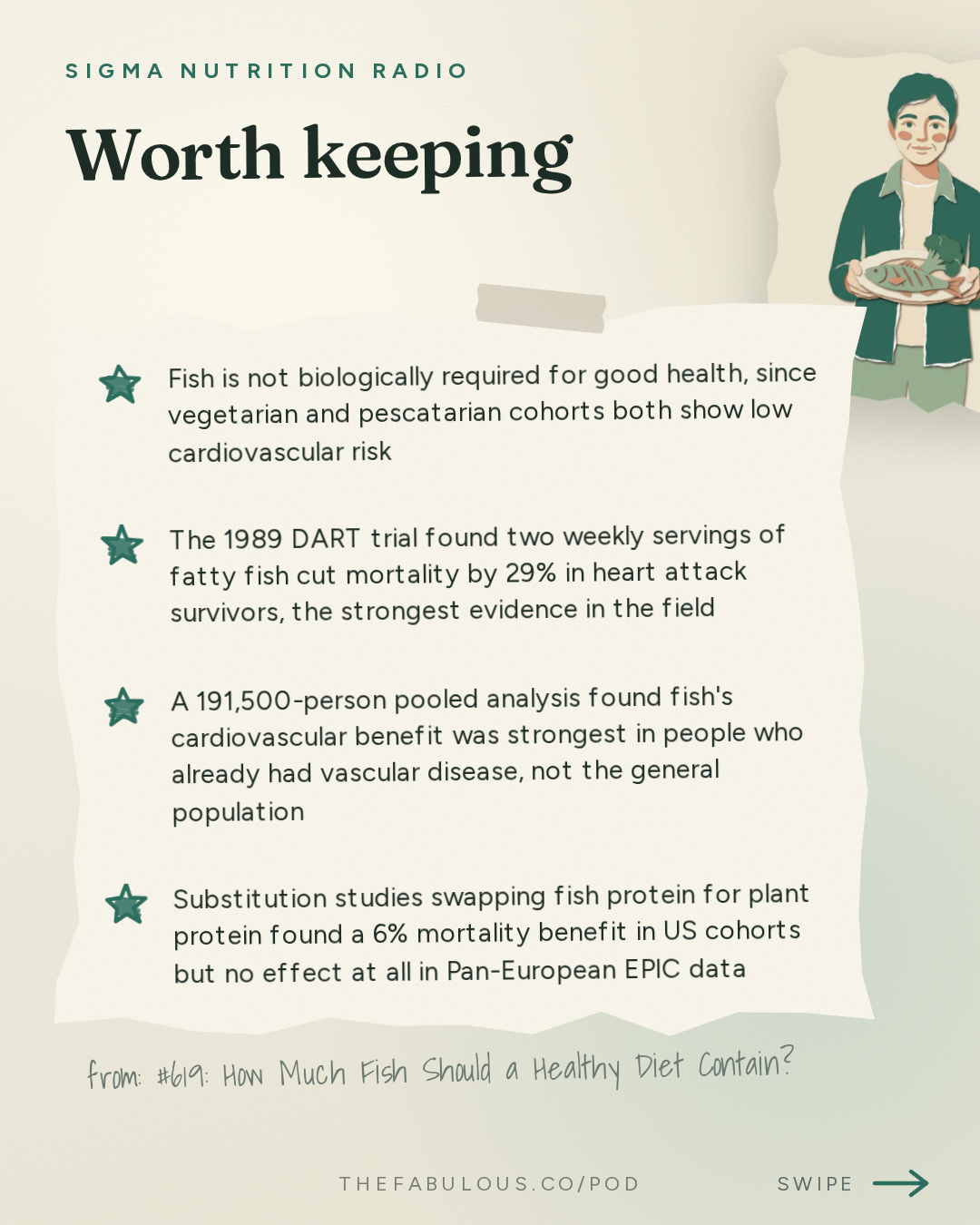
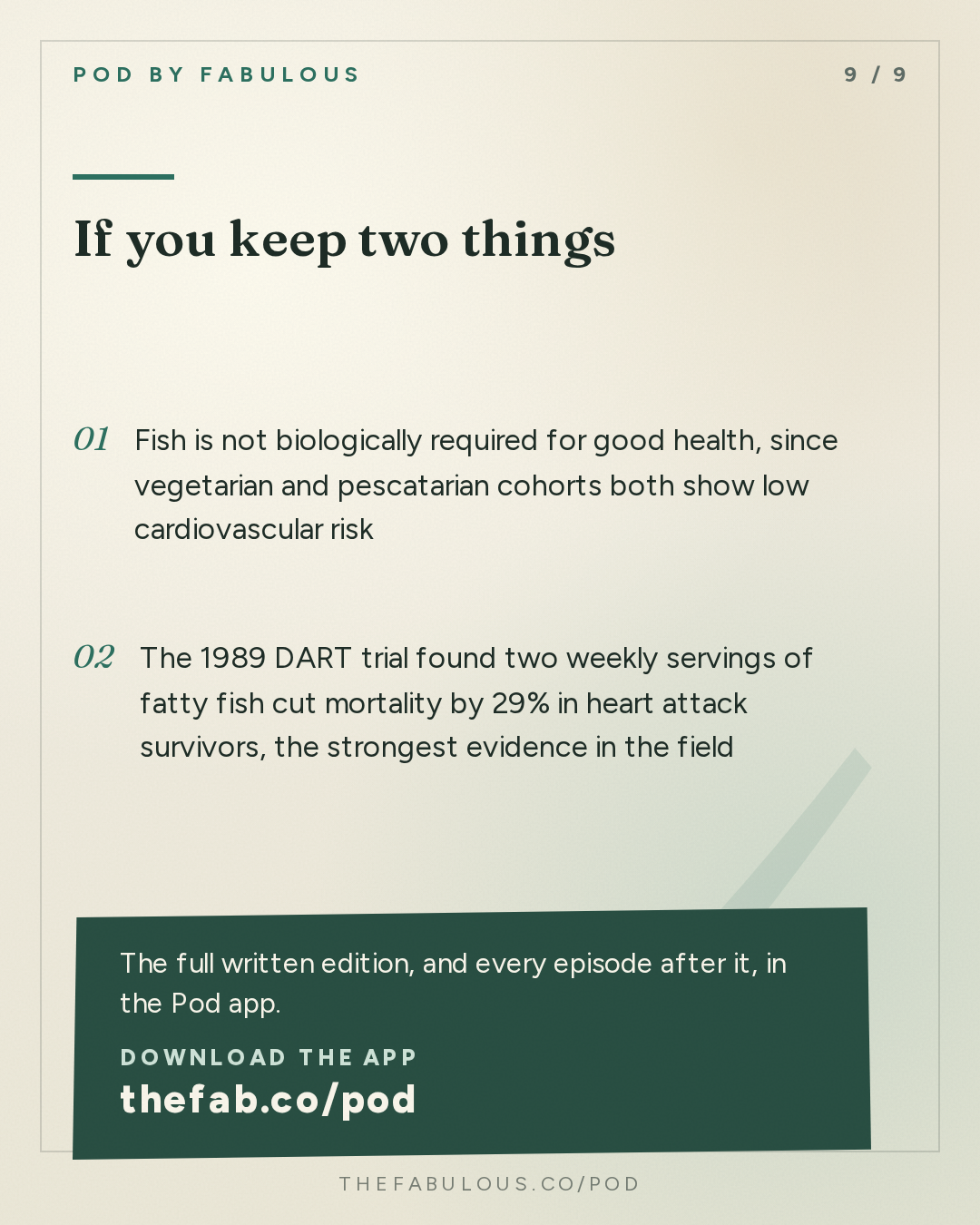
- Fish is not biologically required for good health, since vegetarian and pescatarian cohorts both show low cardiovascular risk (58:12)
- The 1989 DART trial found two weekly servings of fatty fish cut mortality by 29% in heart attack survivors, the strongest evidence in the field (17:22)
- A 191,500-person pooled analysis found fish's cardiovascular benefit was strongest in people who already had vascular disease, not the general population (23:35)
- Substitution studies swapping fish protein for plant protein found a 6% mortality benefit in US cohorts but no effect at all in Pan-European EPIC data (33:26, 37:50)
- Canned mackerel and sardines, around 80 pence a tin, are a low-cost way to get omega-3 fatty acids (59:54)
The episode in cards
By the numbers
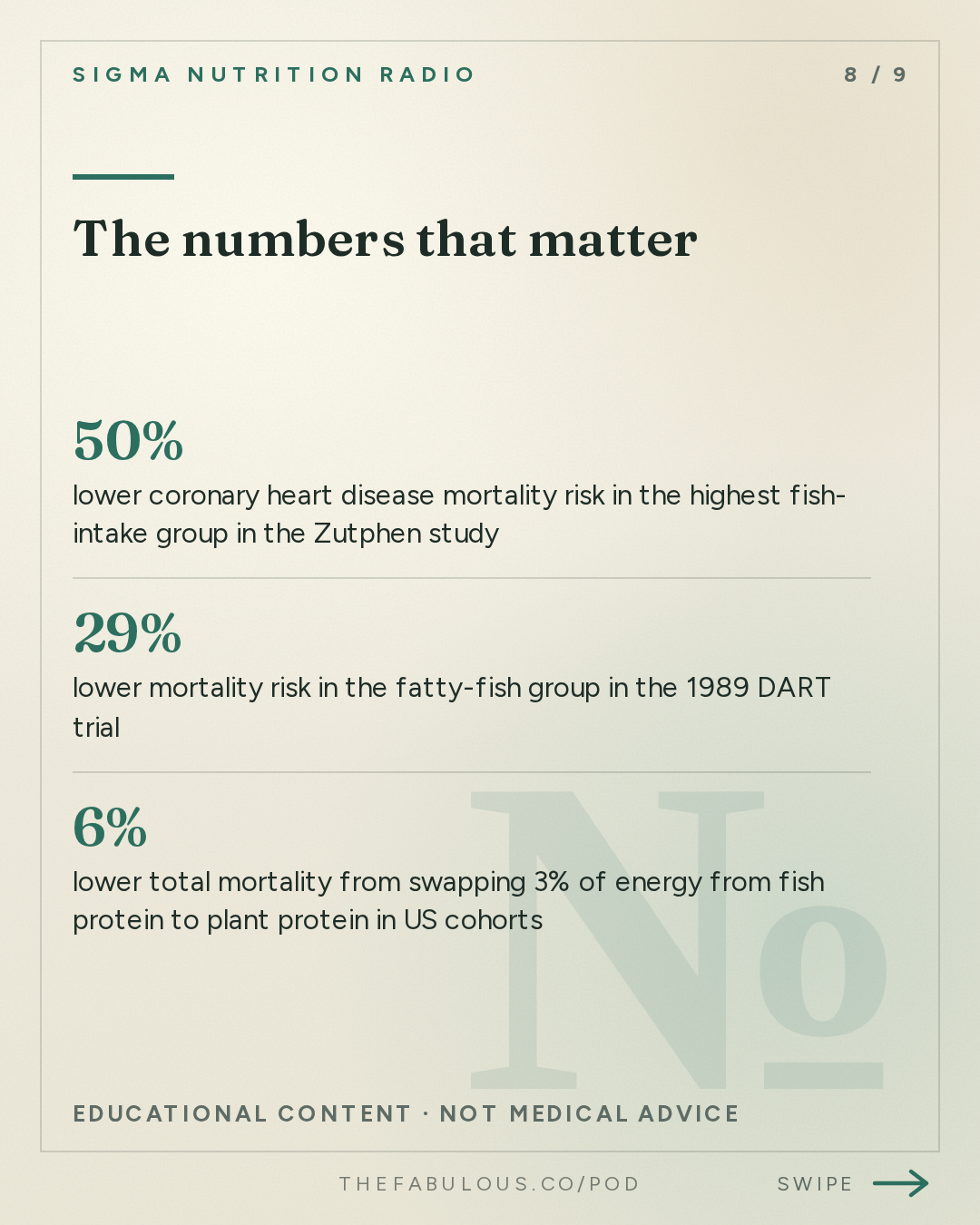
- 50% percent lower coronary heart disease mortality risk in the highest fish-intake group in the Zutphen study
- 29% percent lower mortality risk in the fatty-fish group in the 1989 DART trial
- 6% percent lower total mortality from swapping 3% of energy from fish protein to plant protein in US cohorts
In their words
“This was a population consuming very high fat diets, largely marine fat-based, and simil- seemingly absent evidence of cardiovascular disease in the population that they surveyed.”
“The study overall found that the highest fish intake was associated with an over 50% reduction in coronary heart disease mortality risk.”
“So it's a mathematical abstraction that is often then having to be forced to fit your data”
“Fish itself is biologically necessary or is some type of indispensable food. Quite”
Protocols
-
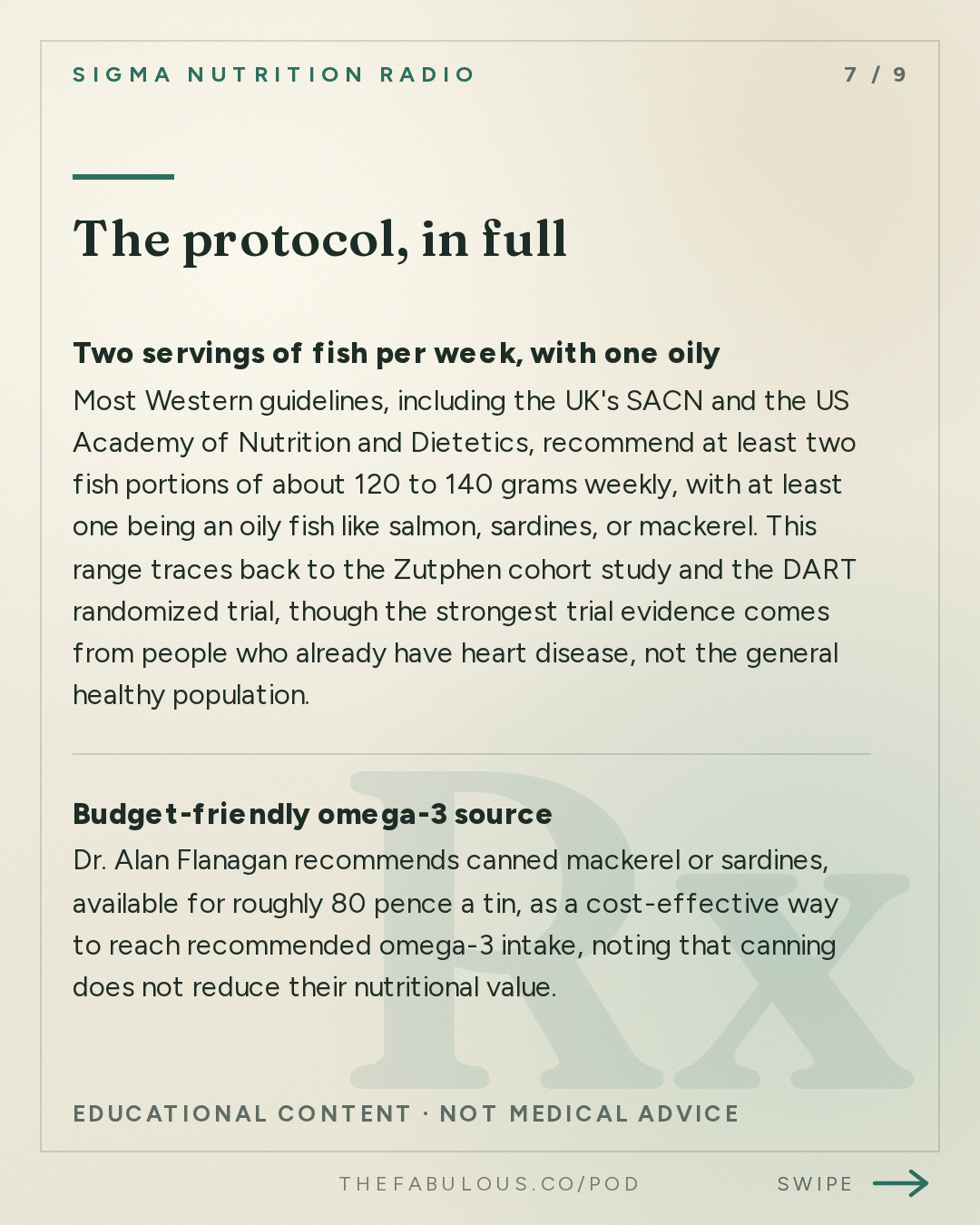
Two servings of fish per week, with one oily
Most Western guidelines, including the UK's SACN and the US Academy of Nutrition and Dietetics, recommend at least two fish portions of about 120 to 140 grams weekly, with at least one being an oily fish like salmon, sardines, or mackerel. This range traces back to the Zutphen cohort study and the DART randomized trial, though the strongest trial evidence comes from people who already have heart disease, not the general healthy population.
twice weekly
-
Budget-friendly omega-3 source
Dr. Alan Flanagan recommends canned mackerel or sardines, available for roughly 80 pence a tin, as a cost-effective way to reach recommended omega-3 intake, noting that canning does not reduce their nutritional value.
as a regular grocery staple
Questions this episode answers
How much fish should I eat per week for heart health?
Most national guidelines, including the UK's Scientific Advisory Committee on Nutrition, recommend at least two servings of about 120 to 140 grams weekly, with one being an oily fish like salmon or mackerel (03:44). This traces back to the Zutphen cohort study and the 1989 DART randomized trial, though the strongest trial evidence applies to people who already have heart disease (17:22).
What did the DART trial find about fish and mortality?
The 1989 Diet and Reinfarction Trial randomized heart attack survivors to receive advice on fat intake, fatty fish intake, or cereal fiber intake. Only the fatty fish advice, at least two servings weekly, produced a benefit, a 29% lower mortality risk driven by fewer ischemic heart disease deaths (17:22). A follow-up trial adding fish oil capsules failed to replicate this and found a signal for increased atrial fibrillation (18:08).
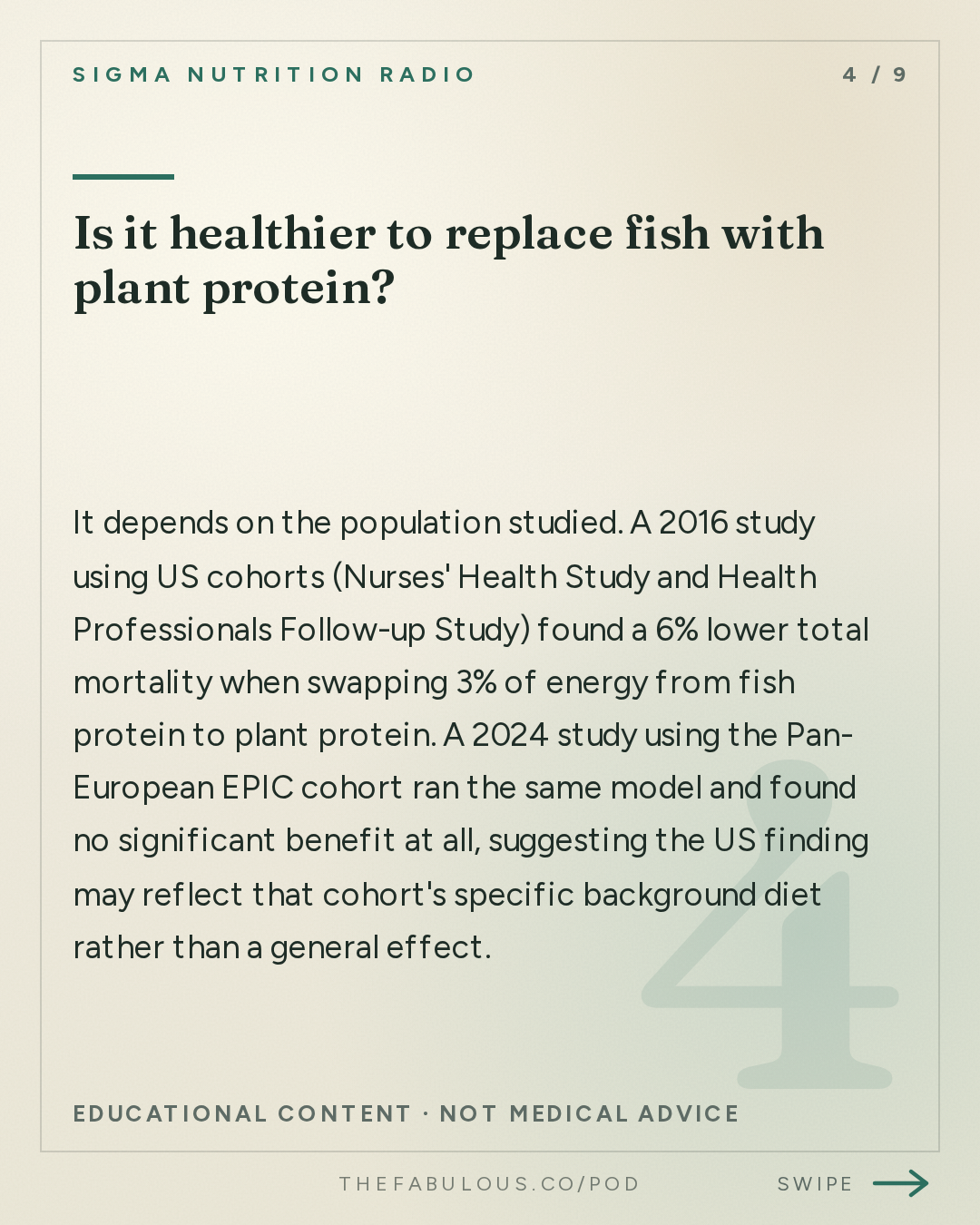
Is it healthier to replace fish with plant protein?
It depends on the population studied. A 2016 study using US cohorts (Nurses' Health Study and Health Professionals Follow-up Study) found a 6% lower total mortality when swapping 3% of energy from fish protein to plant protein (33:26). A 2024 study using the Pan-European EPIC cohort ran the same model and found no significant benefit at all, suggesting the US finding may reflect that cohort's specific background diet rather than a general effect (37:50).
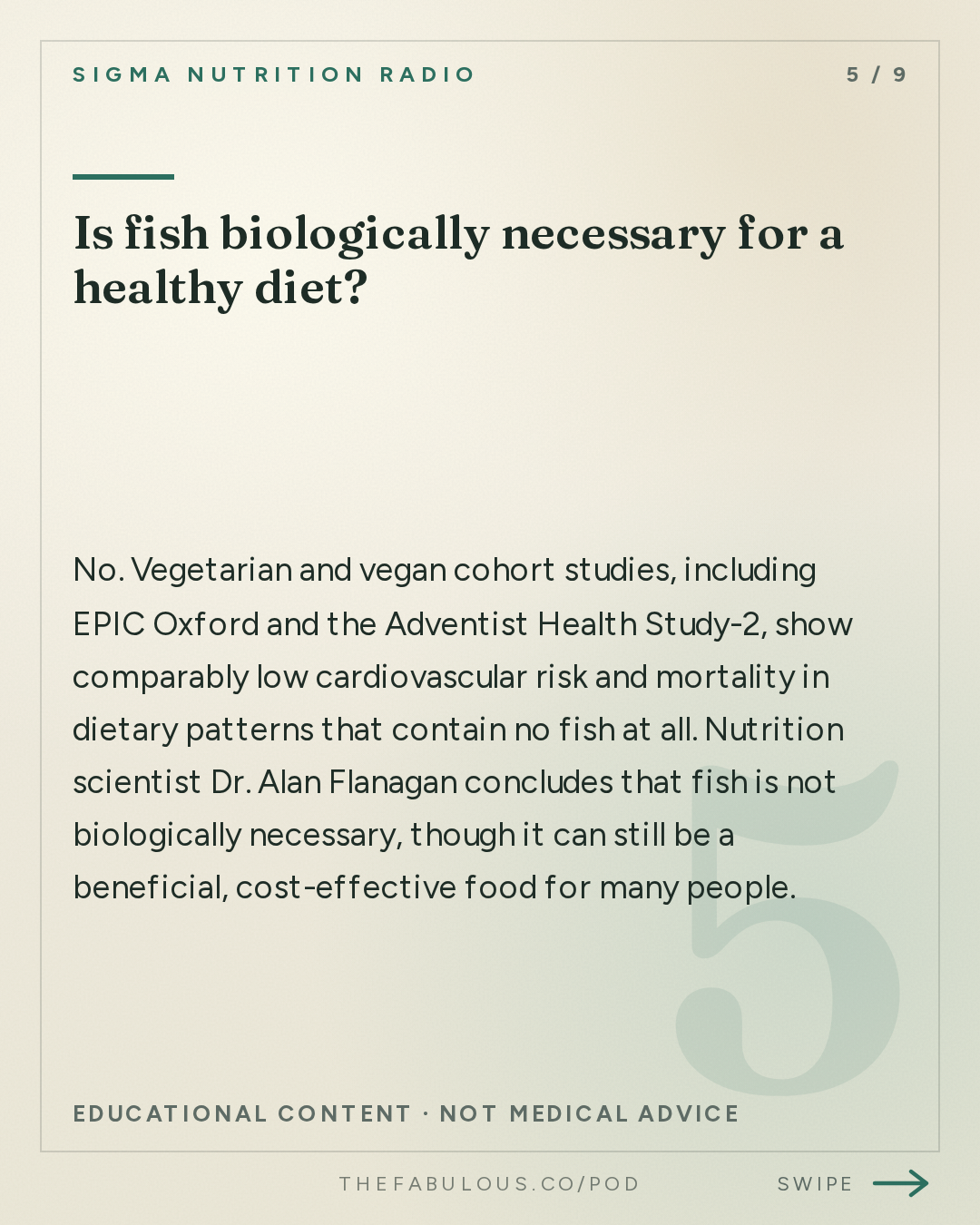
Is fish biologically necessary for a healthy diet?
No. Vegetarian and vegan cohort studies, including EPIC Oxford and the Adventist Health Study-2, show comparably low cardiovascular risk and mortality in dietary patterns that contain no fish at all (44:38, 47:59). Nutrition scientist Dr. Alan Flanagan concludes that fish is not biologically necessary, though it can still be a beneficial, cost-effective food for many people (58:12).
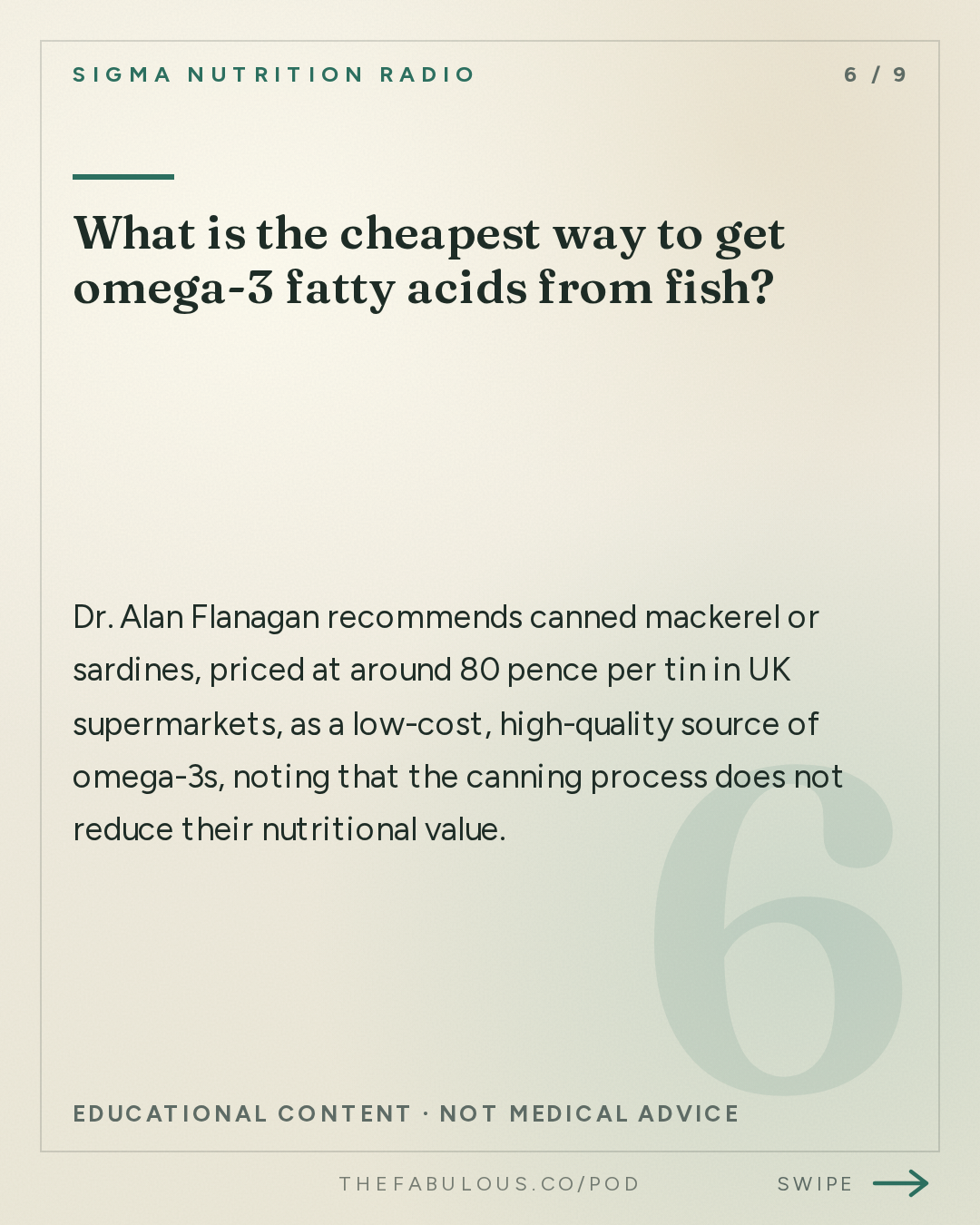
What is the cheapest way to get omega-3 fatty acids from fish?
Dr. Alan Flanagan recommends canned mackerel or sardines, priced at around 80 pence per tin in UK supermarkets, as a low-cost, high-quality source of omega-3s, noting that the canning process does not reduce their nutritional value (59:54).
The full read, in cards
Go deeper
- Zutphen Study (Kromhout et al., 1985, New England Journal of Medicine) — 20-year Dutch cohort finding over 50% lower CHD mortality in the highest fish-intake group
- Diet and Reinfarction Trial (DART, Burr et al., 1989) — Randomized trial finding 29% lower mortality with advice to eat two fatty fish servings weekly
- Mozaffarian et al. pooled analysis (JAMA Internal Medicine) — Pooled data from 191,500 participants across 58 countries, showing stronger fish benefit in people with existing vascular disease
- Neuenschwander et al. meta-analysis (2023) — Found no significant difference in CHD or mortality when substituting fish with nuts or legumes
- Song et al. (2016, JAMA Internal Medicine) — US cohort study finding 6% lower mortality substituting fish protein with plant protein
- Zheng et al. (2024, American Journal of Clinical Nutrition) — Pan-European EPIC study finding no benefit from the same fish-to-plant protein substitution
- EPIC Oxford (Tong et al., 2019) — Found pescatarians had 13% lower ischemic heart disease risk and vegetarians 22% lower, versus meat eaters
- Adventist Health Study-2 (2024, American Journal of Clinical Nutrition) — Found pesco-vegetarians had 15% lower all-cause mortality at age 65 versus omnivores
Mentioned
Dr. Alan Flanagan · Danny Lennon · Bang and Dyerberg · Dan Kromhout · Scientific Advisory Committee on Nutrition (SACN) · European Food Standards Agency (EFSA) · Academy of Nutrition and Dietetics · Diet and Reinfarction Trial (DART) · Zutphen Study · EPIC Oxford · Adventist Health Study-2 · Nurses' Health Study · Health Professionals Follow-up Study · Mozaffarian pooled analysis · Neuenschwander et al. meta-analysis · Song et al. 2016 study · Zheng et al. 2024 study
More from this show and category
Plant-Based Diets for Athletes and Sustainability
Elite sports nutritionist Pieter Res says athletes can shift toward plant protein for sustainability without losing performance or muscle growth. Research from the Van Loon lab shows 30 grams of combined plant protein per meal matches whey's muscle protein synthesis ceiling (17:31), and cutting beef remains the single biggest lever for reducing diet's environmental impact (08:49).
How to Interpret Testosterone Test Results
A single testosterone number rarely settles the question of whether treatment will help. Physician Austin Baraki says free testosterone, symptom type, and the underlying cause of a low reading (often obesity, poor sleep, or alcohol) matter more than one blood draw, and a 4 to 6 month trial beats a lifelong commitment.
Body Composition Testing: DEXA vs BIA Accuracy
No device on the market actually measures body fat; every scale, scan, or pod only estimates it from indirect signals, and a method proven accurate for a group can still mislead an individual user. Texas Tech professor Grant Tinsley explains why standardizing tests, tracking one device over time, and treating small percentage swings as noise matter more than any single number (12:49, 38:24).
Liking vs Wanting in Food Reward Psychology
Food reward splits into two separate systems: liking, the pleasure a food delivers, and wanting, the pull to eat it, which often runs on autopilot. Nutrition composition alone explains only 20% of why a food is liked (21:59); adding sensory perception explains another 40-60% (22:35), while ultra-processed classification barely moves the needle.
