
Kip Tindell's Retail Growth Advice
Advice Line with Kip Tindell of The Container Store
The brief
Kip Tindell, the co-founder of The Container Store, joins How I Built This's call-in Advice Line to coach three founders on growth limits, wholesale strategy, and protecting a viral product. His core message: cap growth deliberately, court small retailers before big ones, and treat attention as borrowed, not owned.
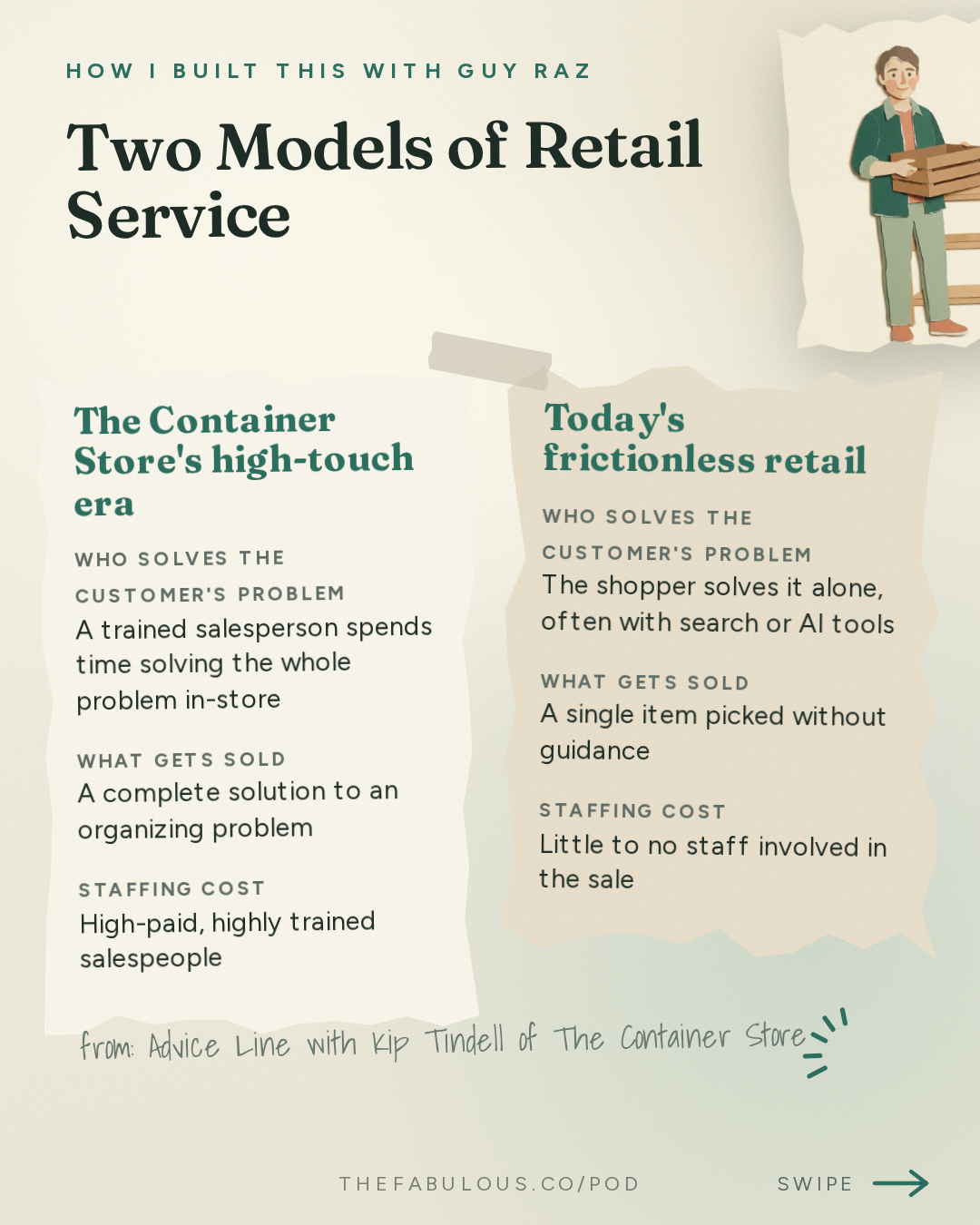
Before there was a Container Store, there was a bartender at his own father's birthday party, being told that his idea was a bad one. Kip Tindell was pouring drinks when guests informed him that a store selling nothing but empty boxes was going to fail, and fast. He remembers it as humiliating (46:16). On July 1, 1978, he and his friend Garrett Boone opened that store in Dallas anyway, at a moment when moving house meant scavenging flattened cardboard out of a grocery store's trash bin. Selling the box itself, on purpose, in a clean retail space, was the strange idea.
It stopped being strange. The company grew for over four decades, went public in 2013, and eventually operated about 100 stores (06:07). Tindell and his wife Sharon, who joined the business soon after it opened, ran it for 43 years before retiring roughly eight or nine years ago (07:15). What happened next is a small case study in impermanence: The Container Store filed for bankruptcy, and earlier this year Bed Bath & Beyond acquired it for about $150 million (06:49). Tindell's own read on this is unsentimental. He points out that most of the companies that dominated the New York Stock Exchange twenty or thirty or fifty years ago "aren't so great anymore" (07:39). Nothing, he says, is all that permanent.
That mix of pride and clear-eyed distance is what makes Tindell an interesting guest for a segment built entirely around other people's problems. On this episode of How I Built This's Advice Line, host Guy Raz brings him in to field calls from three founders at very different stages: a mother in Provence selling a magic cooling wand, a North Carolina engraver trying to grow his wholesale gift business, and an MBA student whose bed sheet went viral. Across all three calls, Tindell keeps returning to the same idea, dressed in different clothes: know your actual limit, and then respect it.
The Discipline of Enough
The clearest version of that idea is a number. For most of The Container Store's history, Tindell capped annual growth at 20 percent, even when the business could probably have grown faster.
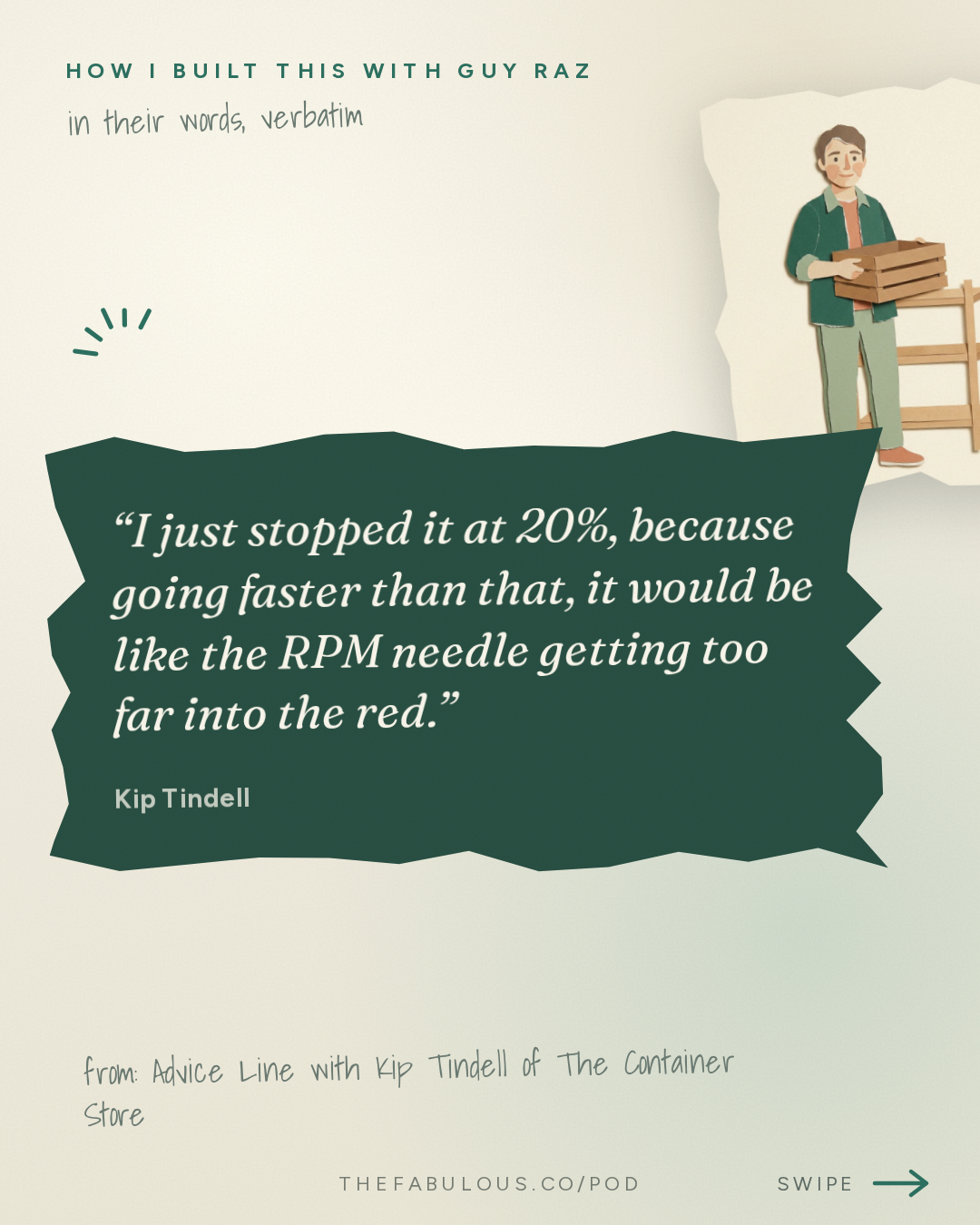
"I just stopped it at 20%, because going faster than that, it would be like the RPM needle getting too far into the red." — Kip Tindell [10:54]
The metaphor is doing real work. An engine redlines not because it lacks power but because it is spending that power faster than it can be sustained. Tindell argues that excessive growth, not too little of it, is what kills most companies (11:19), and that a founder's job is to figure out their own limitations and grow at that rate for a long time, rather than sprinting.
That philosophy gets tested directly when David Higham calls in. Higham owns Hazel Grove Customs, a Burlington, North Carolina business that laser-engraves personalized gifts such as golf ball markers, oyster shuckers, and train whistles (28:05). Wholesale now makes up just over half his revenue and is growing faster than his direct-to-consumer sales on Etsy, partly because wholesale margins beat retail once volume absorbs the shipping cost, a real constraint now that it costs about $6.50 to ship almost any package (32:29). Higham's question is where to put his next dollar: more independent retailers, bigger retail accounts, trade shows, sales reps, or corporate gifting.
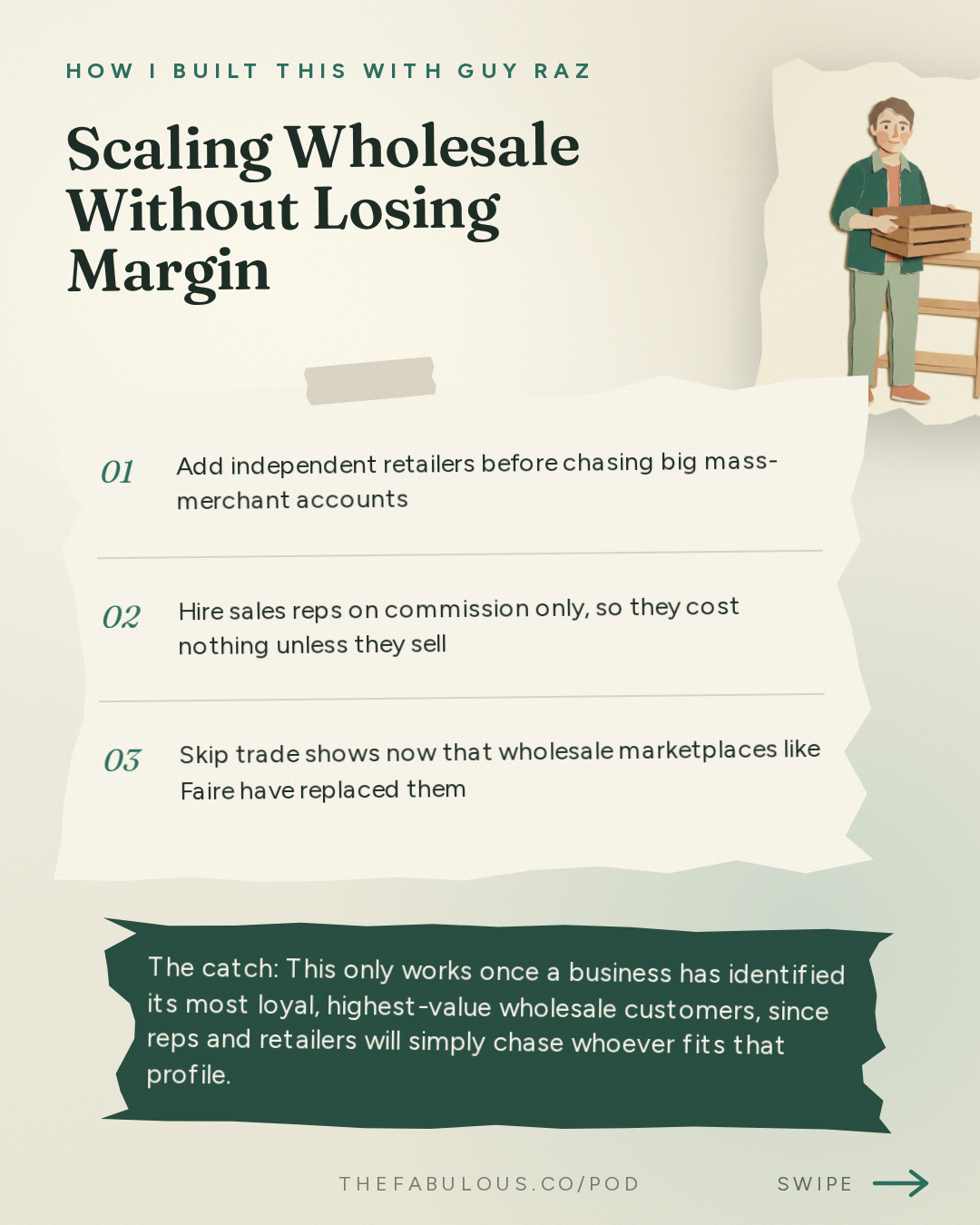
Tindell's answer is to resist the instinct to chase the biggest names first. He tells Higham to keep adding small independent retailers, arguing that larger accounts tend to arrive on their own once independents prove the product sells (30:23). He also tells him to hire sales representatives, but only on commission, since reps who are paid on commission cost the business nothing unless they close a sale (31:06). Trade shows, by contrast, he'd skip now that wholesale marketplaces like Faire have taken over that discovery function (30:45). Raz adds a related point about Higham's inbound corporate orders, some running to 700 personalized units at a time (32:48): treat that customer like a three-star client, the way the musical-instrument retailer Sweetwater and the shoe seller Zappos are known for doing (33:14). Tindell notes that Sweetwater goes as far as keeping notes on customers' families (34:04), and puts the underlying logic simply.
"The bigger things come once you do all of the smaller things right." — Kip Tindell [33:56]
It is not an exciting answer. It is also, according to a person who ran a single company at a deliberately capped rate for over 40 years, the one most likely to still be standing in a decade.
Attention Is Borrowed
The other two calls are less about discipline than about a newer problem: what to do when attention arrives faster than a brand can absorb it.
Juliet Bruce, calling from Provence, invented the Cooler Wand, a reusable wand with a detachable frozen tip that cools hot food or drinks in seconds, originally designed for her own three kids (13:49). She sells direct to consumers and through nine independent retailers in France plus one in Malta (16:33), but has no advertising budget for a genuinely new product category. Raz's advice is to stop thinking like an advertiser and start thinking like a demonstrator: film the same simple proof, repeatedly, such as a thermometer dropping in a mug of hot cocoa as a child stirs it with the wand, and target small, real influencers with a few thousand followers rather than mass accounts (18:37, 19:39). Bruce mentions that her Instagram already has a video with roughly half a million views and 12,000 likes (20:55), evidence that the low-budget approach is already working; the task is repetition, not reinvention. Tindell frames the waiting itself as a skill.
"Being patient has a lot to do with being humble and, and, and being okay with it taking a while." — Kip Tindell [21:31]
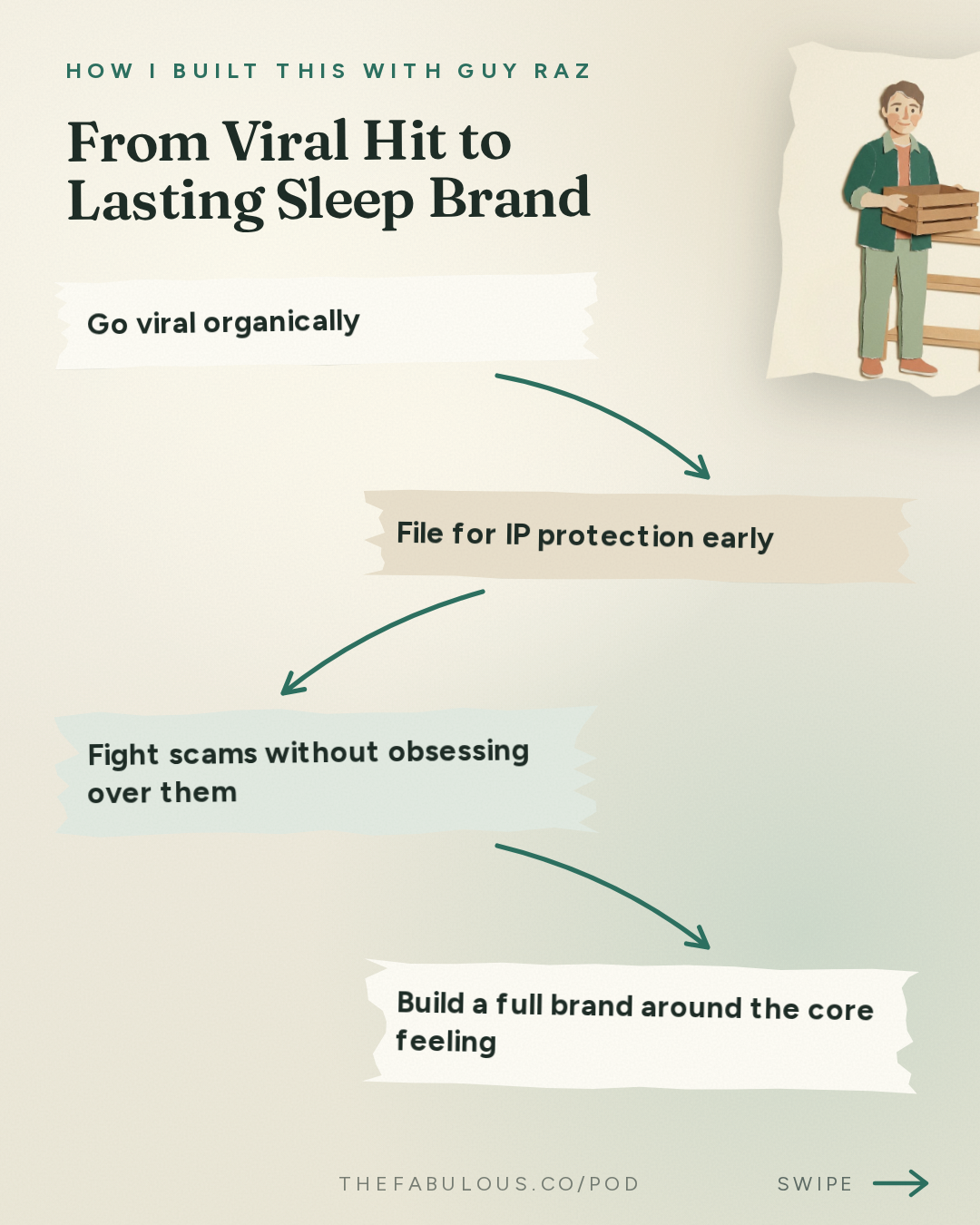
Caitlin Kao's problem is the inverse. Her company, Cayomi Sleep, launched in November 2025 with a single product, the Sherpa Nest, a fitted sheet with soft padded borders built into the perimeter, designed to recreate the pillow-fort feeling that helped Kao manage anxiety as a teenager (38:07). In eight months the company did $635,000 in revenue and the Sherpa Nest reached 197 million organic social media views without paid advertising (39:45), funding the business through pre-orders instead of outside capital. Kao's team has already found 113 different accounts scamming customers with the product's own images (41:17), and Kao's real question is how to convert a viral moment into something durable.
Tindell's advice starts with intellectual property, and with an analogy from golf: a young company that can't afford a top patent attorney should look for one willing to take a share of future gains instead of full fees now, since "there's Kip Tindell on the golf course, and there's Tiger Woods on the golf course" and a founder in Kao's position needs the Tiger Woods (40:30). He also warns against letting the fight against copycats consume the business, pointing to the fitness brand TRX's long, exhausting battle against imitators as a cautionary example (43:54). Raz's addition is about identity: viral attention, he says, is borrowed, and the task is to build a brand around the underlying feeling, security, rather than around one hero object, which might mean expanding into pillows, patterns, or fabrics under a broader sleep-brand umbrella (42:04, 42:28).
Tindell closes with an image from a Dallas golf tournament he has helped sponsor. Watching Tiger Woods hold a lead, he expected to see him celebrating; instead Woods went to the driving range to practice more.
"Relentless humility, you know, driving to be even better than you've been in the past, and patience. I, I think that builds a business, uh, more truly than anything else." — Kip Tindell [45:03]
It is a fitting note to end on for a man whose own company eventually stumbled after he left it. The lesson he offers three strangers on a call-in show is not a growth hack. It is closer to a discipline: grow at the rate a business can actually sustain, treat a viral spike as a loan rather than income, and protect what is fragile before it looks fragile. None of it guarantees that a company lasts forever. As Tindell's own story shows, nothing does. But it is, by his account, the surest way to make forty good years out of an idea that started as an embarrassment at a birthday party.
Ask this episode anything
Pod's AI answers from the episode itself, with the minute mark so you can hear it yourself.
Or start with one of these
Ask this episode
Pod's AI listens to the whole episode to answer, and points you to the minute it comes from.
The rest of this answer, and any question after it
Answers come from the episode itself, never from a summary of it.
ContinueKey takeaways
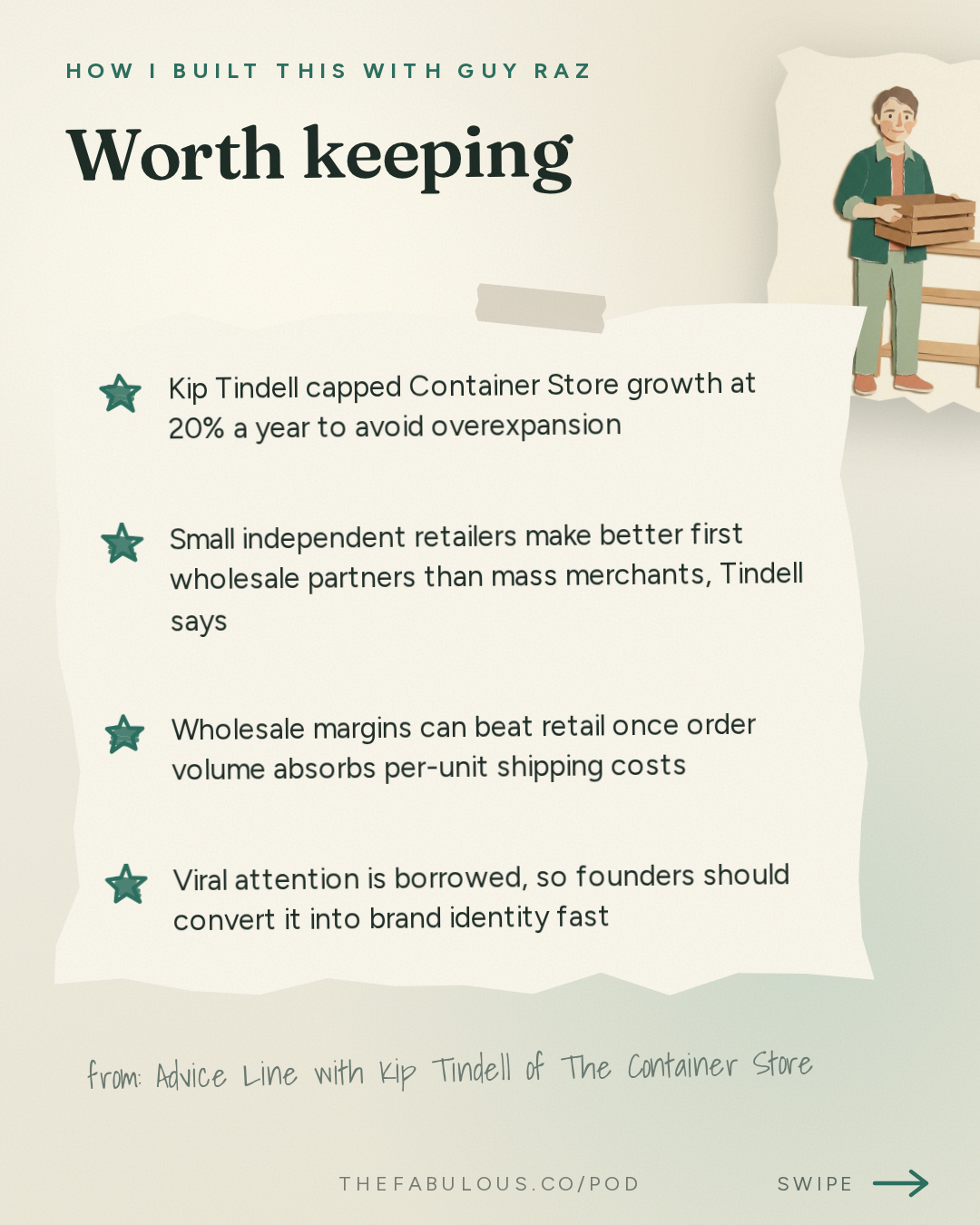
- Kip Tindell capped Container Store growth at 20% a year to avoid overexpansion
- Small independent retailers make better first wholesale partners than mass merchants, Tindell says
- Wholesale margins can beat retail once order volume absorbs per-unit shipping costs
- Viral attention is borrowed, so founders should convert it into brand identity fast
- Early patent help matters even before a business can pay full legal fees, Tindell warns

The episode in cards
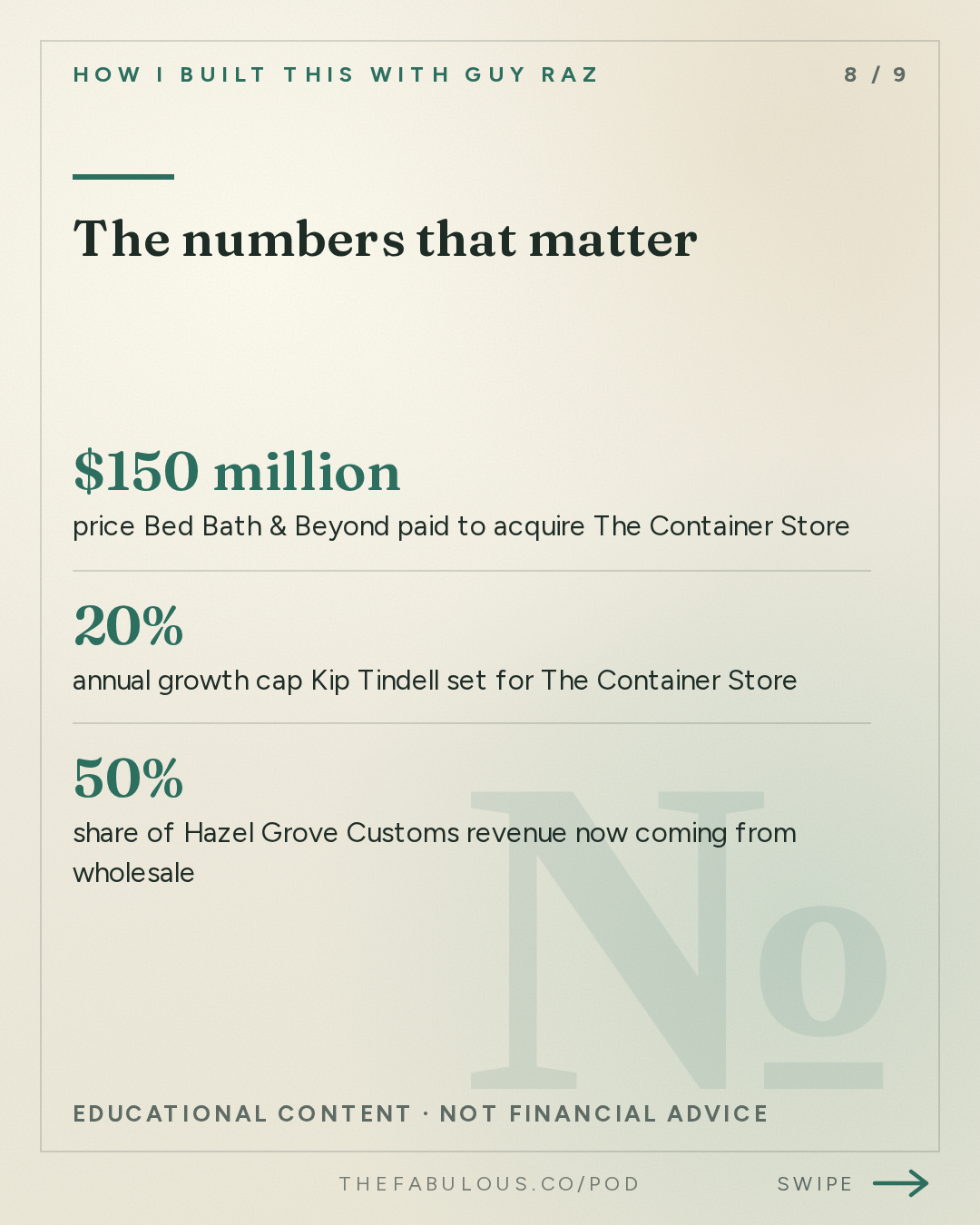
By the numbers
- $150 million price Bed Bath & Beyond paid to acquire The Container Store
- 20% annual growth cap Kip Tindell set for The Container Store
- 50% share of Hazel Grove Customs revenue now coming from wholesale
In their words
“I just stopped it at 20%, because going faster than that, it would be like the RPM needle getting too far into the red.”
“Being patient has a lot to do with being humble and, and, and being okay with it taking a while.”
“The bigger things come once you do all of the smaller things right.”
“Relentless humility, you know, driving to be even better than you've been in the past, and patience. I, I think that builds a business, uh, more truly than anything else.”
Protocols
-
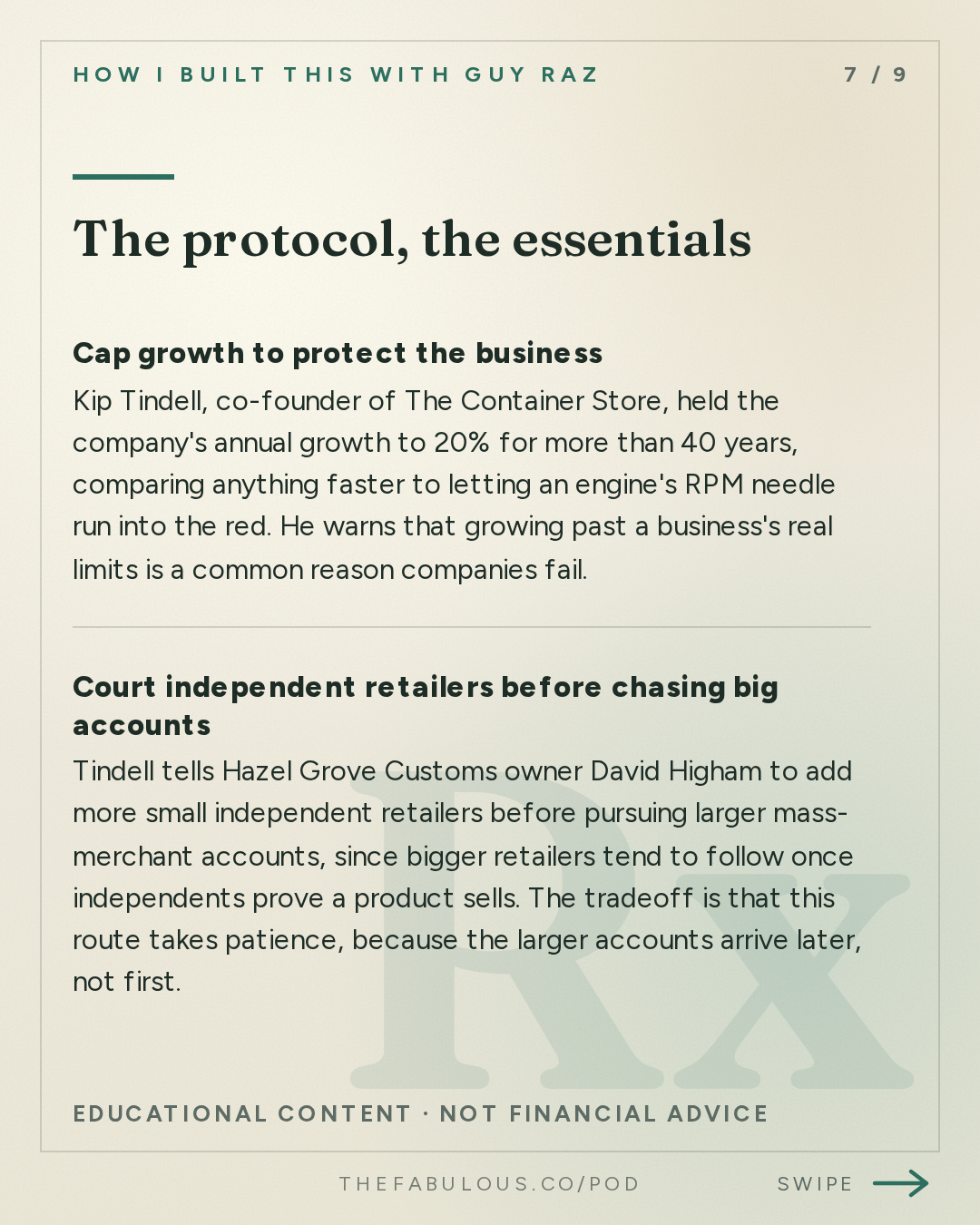
Cap growth to protect the business
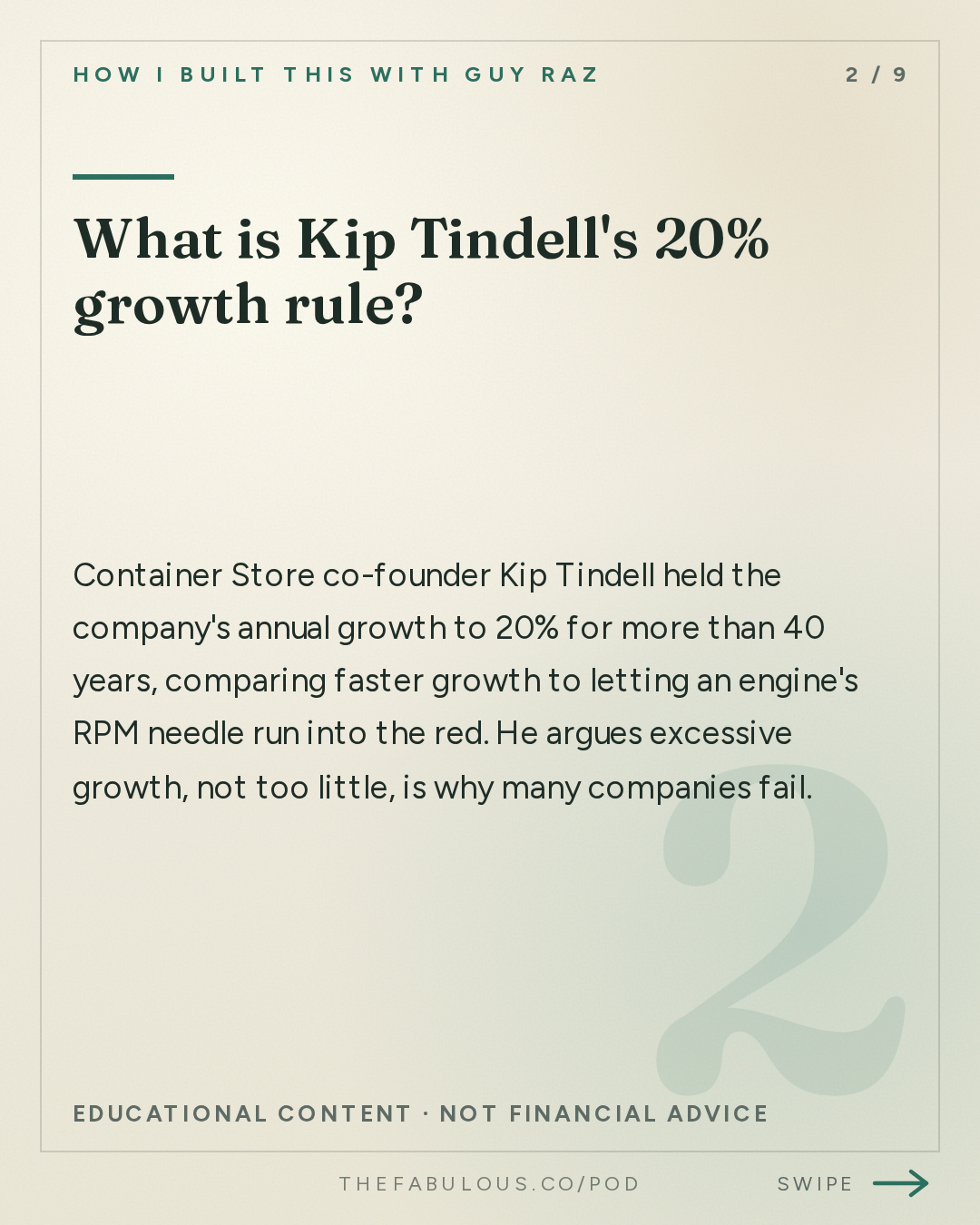
Kip Tindell, co-founder of The Container Store, held the company's annual growth to 20% for more than 40 years, comparing anything faster to letting an engine's RPM needle run into the red. He warns that growing past a business's real limits is a common reason companies fail.
every fiscal year
-
Court independent retailers before chasing big accounts
Tindell tells Hazel Grove Customs owner David Higham to add more small independent retailers before pursuing larger mass-merchant accounts, since bigger retailers tend to follow once independents prove a product sells. The tradeoff is that this route takes patience, because the larger accounts arrive later, not first.
with each new wholesale push
-
Pay sales reps on commission only
Tindell recommends hiring sales representatives who work on commission only, since they cost a business nothing unless they close a sale. The catch is that reps only work well once a company has already identified which type of wholesale customer is most valuable.
when scaling a sales team
-
Replace paid ads with repeated demonstration videos
Guy Raz tells Cooler Wand founder Juliet Bruce to skip paid advertising and instead post the same simple demonstration on repeat, such as filming a thermometer drop while a child stirs a hot drink with the product. The catch is that this approach works best for a product unusual enough that watching it beats describing it.
as often as possible, shot on a phone
-
Get IP help before there is money to pay for it
Tindell advises Cayomi Sleep founder Caitlin Kao to find a patent attorney willing to take a share of future earnings in exchange for protecting a product now, since a young company often cannot pay full legal fees upfront. The catch is that this trades away some future upside for protection while the brand is still vulnerable to copycats.
as soon as a product starts going viral
Questions this episode answers
What is Kip Tindell's 20% growth rule?
Container Store co-founder Kip Tindell held the company's annual growth to 20% for more than 40 years, comparing faster growth to letting an engine's RPM needle run into the red (10:54). He argues excessive growth, not too little, is why many companies fail (11:19).
Should a new brand sell to small independent stores or big retailers first?
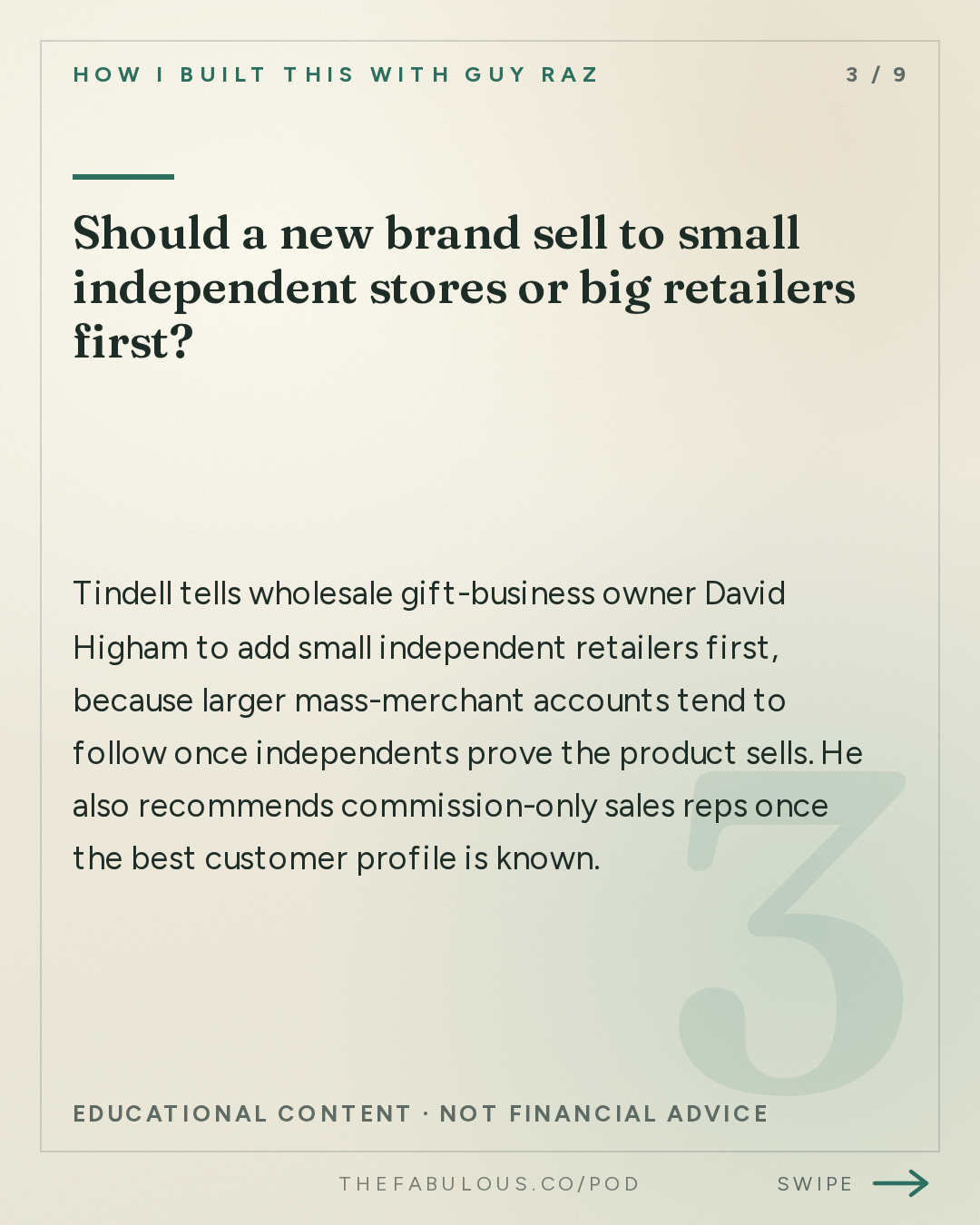
Tindell tells wholesale gift-business owner David Higham to add small independent retailers first, because larger mass-merchant accounts tend to follow once independents prove the product sells (30:23). He also recommends commission-only sales reps once the best customer profile is known (31:06).
How can a small business market a new product without an advertising budget?
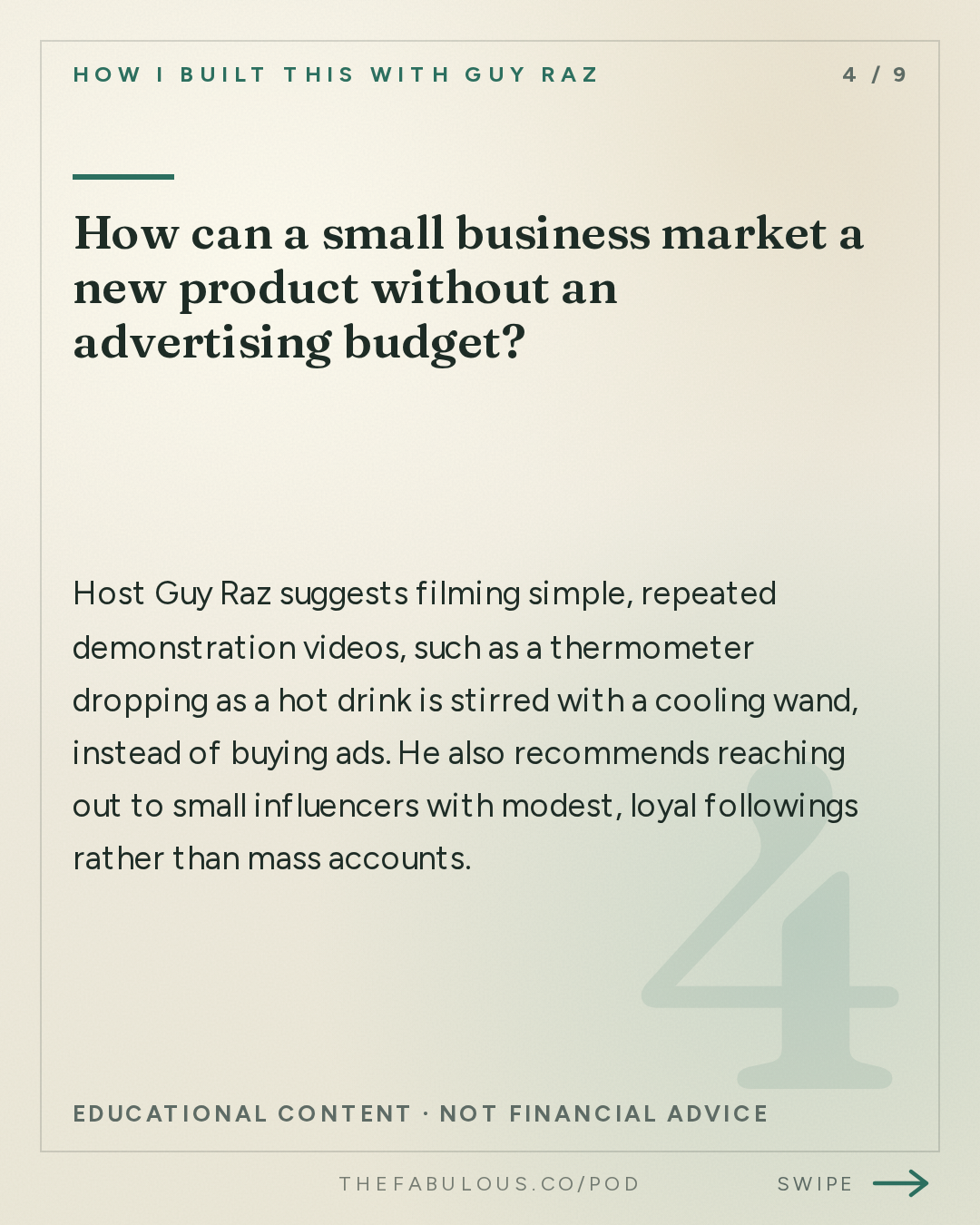
Host Guy Raz suggests filming simple, repeated demonstration videos, such as a thermometer dropping as a hot drink is stirred with a cooling wand, instead of buying ads (18:37). He also recommends reaching out to small influencers with modest, loyal followings rather than mass accounts (19:39).
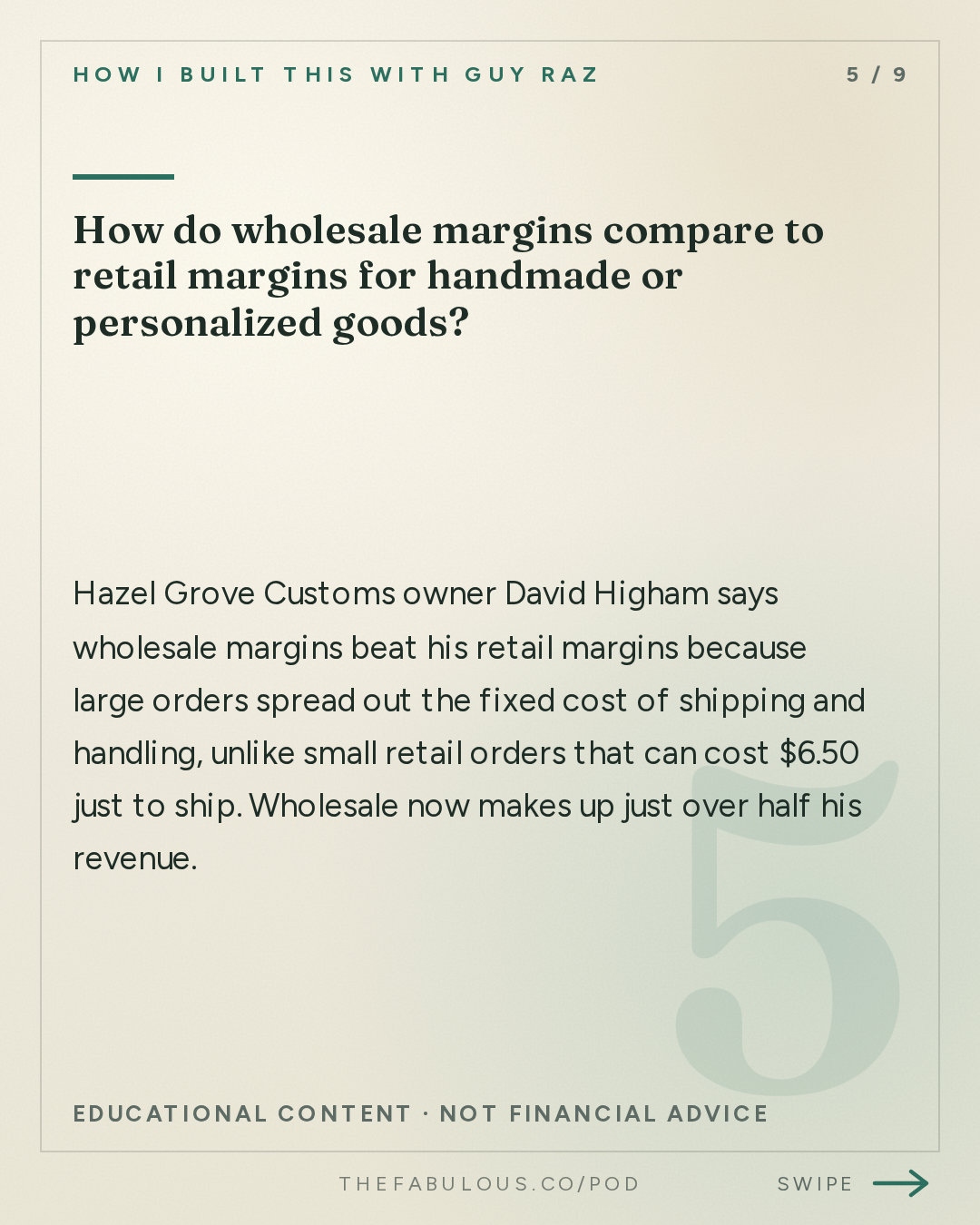
How do wholesale margins compare to retail margins for handmade or personalized goods?
Hazel Grove Customs owner David Higham says wholesale margins beat his retail margins because large orders spread out the fixed cost of shipping and handling, unlike small retail orders that can cost $6.50 just to ship (29:03, 32:29). Wholesale now makes up just over half his revenue.
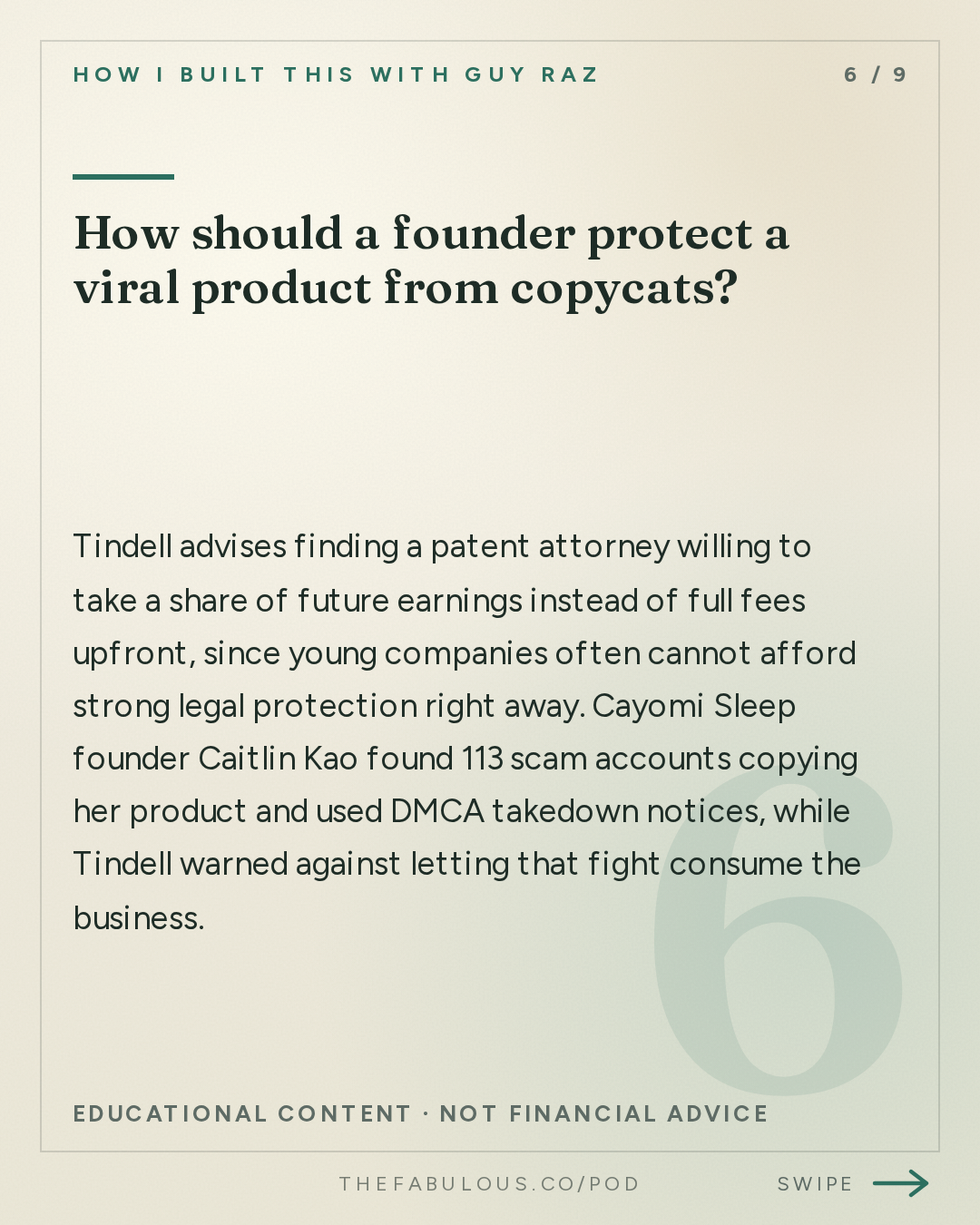
How should a founder protect a viral product from copycats?
Tindell advises finding a patent attorney willing to take a share of future earnings instead of full fees upfront, since young companies often cannot afford strong legal protection right away (40:07). Cayomi Sleep founder Caitlin Kao found 113 scam accounts copying her product and used DMCA takedown notices, while Tindell warned against letting that fight consume the business (41:17, 43:54).
The full read, in cards
Mentioned
Kip Tindell · The Container Store · Bed Bath & Beyond · Juliet Bruce · Cooler Wand · Hermès · David Higham · Hazel Grove Customs · Faire · Sweetwater · Zappos · Caitlin Kao · Cayomi Sleep · Sherpa Nest · Tiger Woods
More from this show and category

Tara Bosch's Advice: D2C to Retail Growth
Tara Bosch, who sold a majority stake in her low-sugar candy brand SmartSweets for a reported $360 million (00:49), spends this advice-line episode teaching four early founders how to move from online sales to grocery shelves, price sugar and price value in three seconds, and read customer emotion through phone calls rather than DMs.

How Sweet Loren's Cookie Dough Was Built
Loren Castle grew Sweet Loren's cookie dough into a 30,000-plus-store brand by scaling slowly for a decade. Then she rebuilt the entire line around an allergen-free recipe that became the company's top-selling product within six months of its 2017 launch, after customer emails revealed how many shoppers had dietary restrictions.
Sweet Loren's Cookie Dough Success Story
Loren Castle turned a cookie stand at Brooklyn's Smorgasburg market into Sweet Loren's, a cookie dough brand now in more than 30,000 stores. After surviving Hodgkin's lymphoma at 22, she built the business slowly, then rebuilt it entirely around allergen-free recipes once customer demand made clear that was the real opportunity, reaching profitability in 2018.
CPG Brand: Moving From D2C to Retail
SmartSweets founder Tara Bosch, who sold a majority stake for $360 million, coaches four founders on moving from D2C to grocery retail. She covers wholesale-versus-direct splits, reformulating sugar and allulose, niche marketing for a swimwear brand, and when to pivot an experience-subscription box.
