
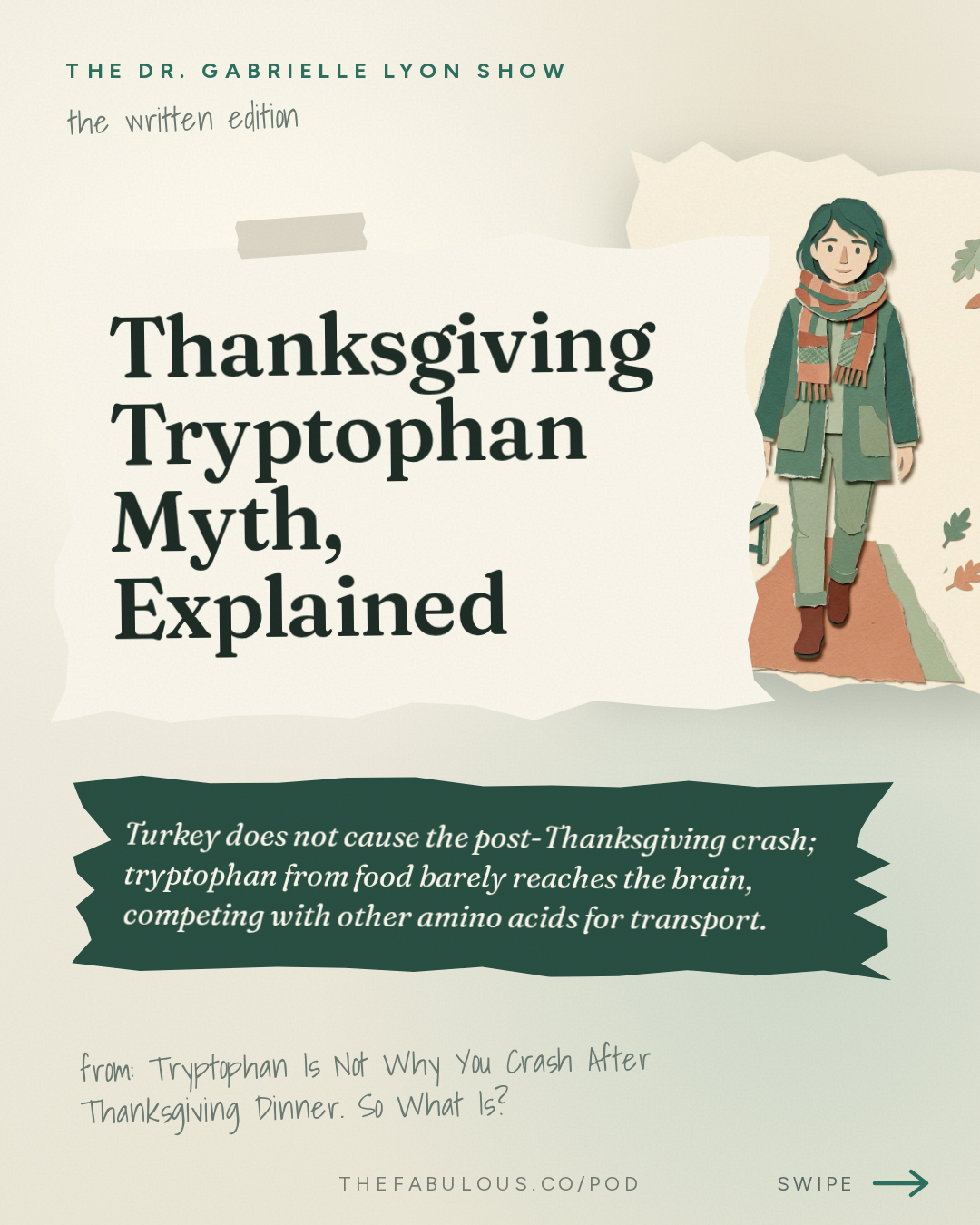
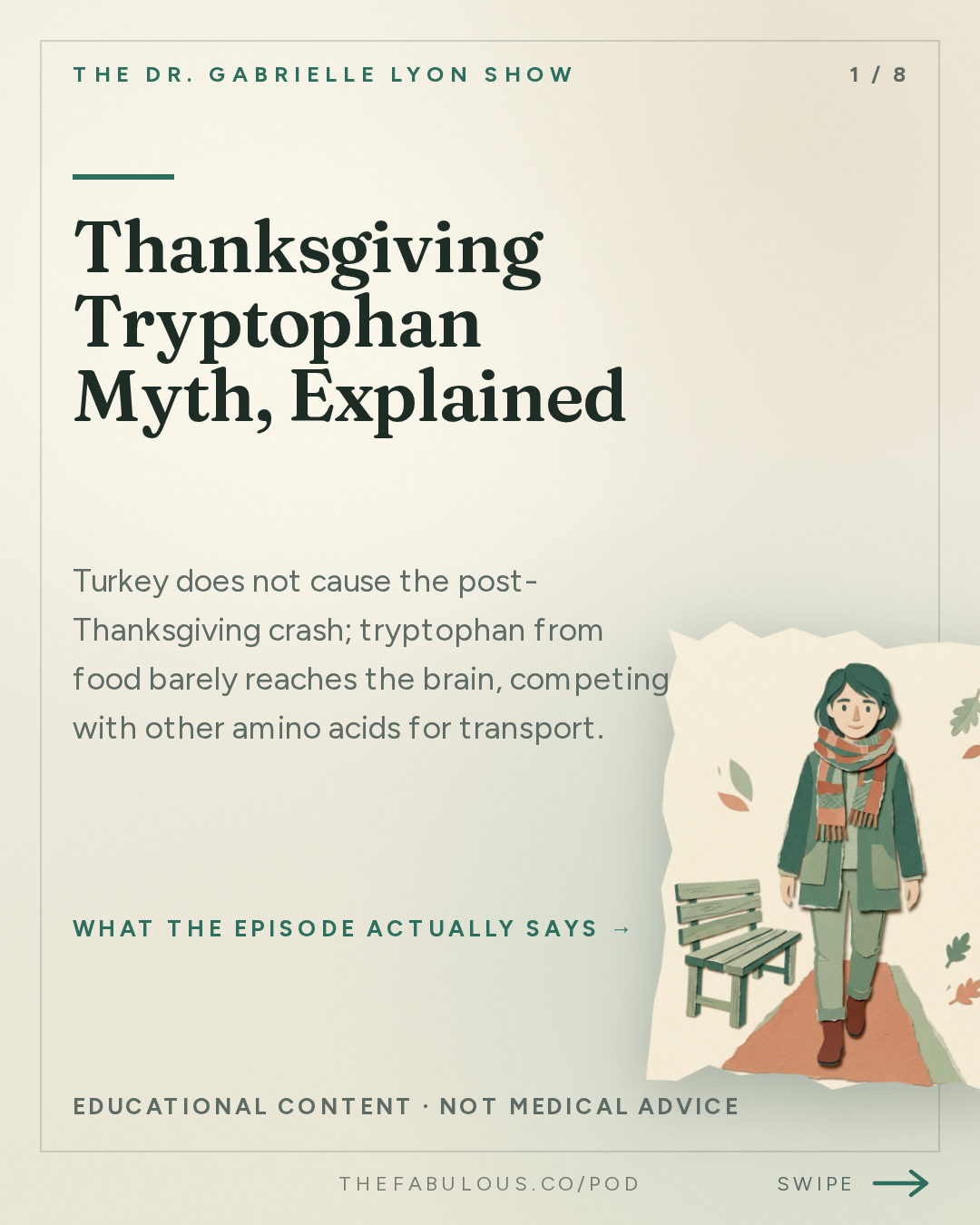
Thanksgiving Tryptophan Myth, Explained
Tryptophan Is Not Why You Crash After Thanksgiving Dinner. So What Is? | Dr. Gabrielle Lyon
▶ Listen to the full episode More from The Dr. Gabrielle Lyon Show
The brief
Turkey does not cause the post-Thanksgiving crash; tryptophan from food barely reaches the brain, competing with other amino acids for transport. Dr. Gabrielle Lyon explains the real causes (big meals, alcohol, the afternoon circadian dip), the GLUT4 mechanism that lets a post-meal walk lower blood sugar without insulin, and why psychological flexibility helps adults survive family dinners without losing themselves.
Somewhere around 2 p.m. on the fourth Thursday of November, a familiar scene plays out in millions of living rooms: someone slumps on the couch, eyes closing mid-sentence, and announces it must be the tryptophan. Physician Gabrielle Lyon, host of The Dr. Gabrielle Lyon Show, spends the first half of this Thanksgiving episode taking that explanation apart, piece by piece, and what she finds underneath is a better story than the one about a sleepy amino acid in turkey.
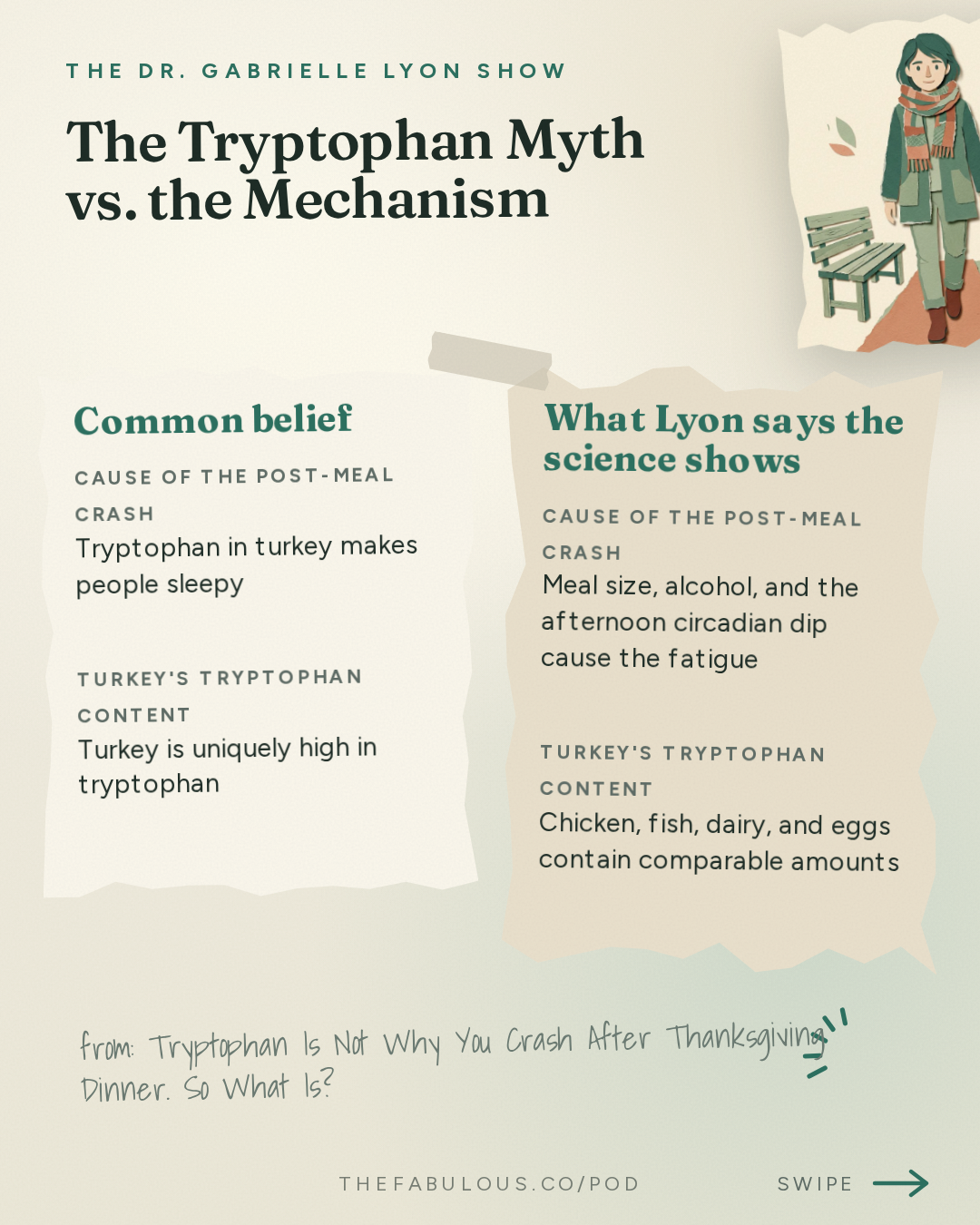
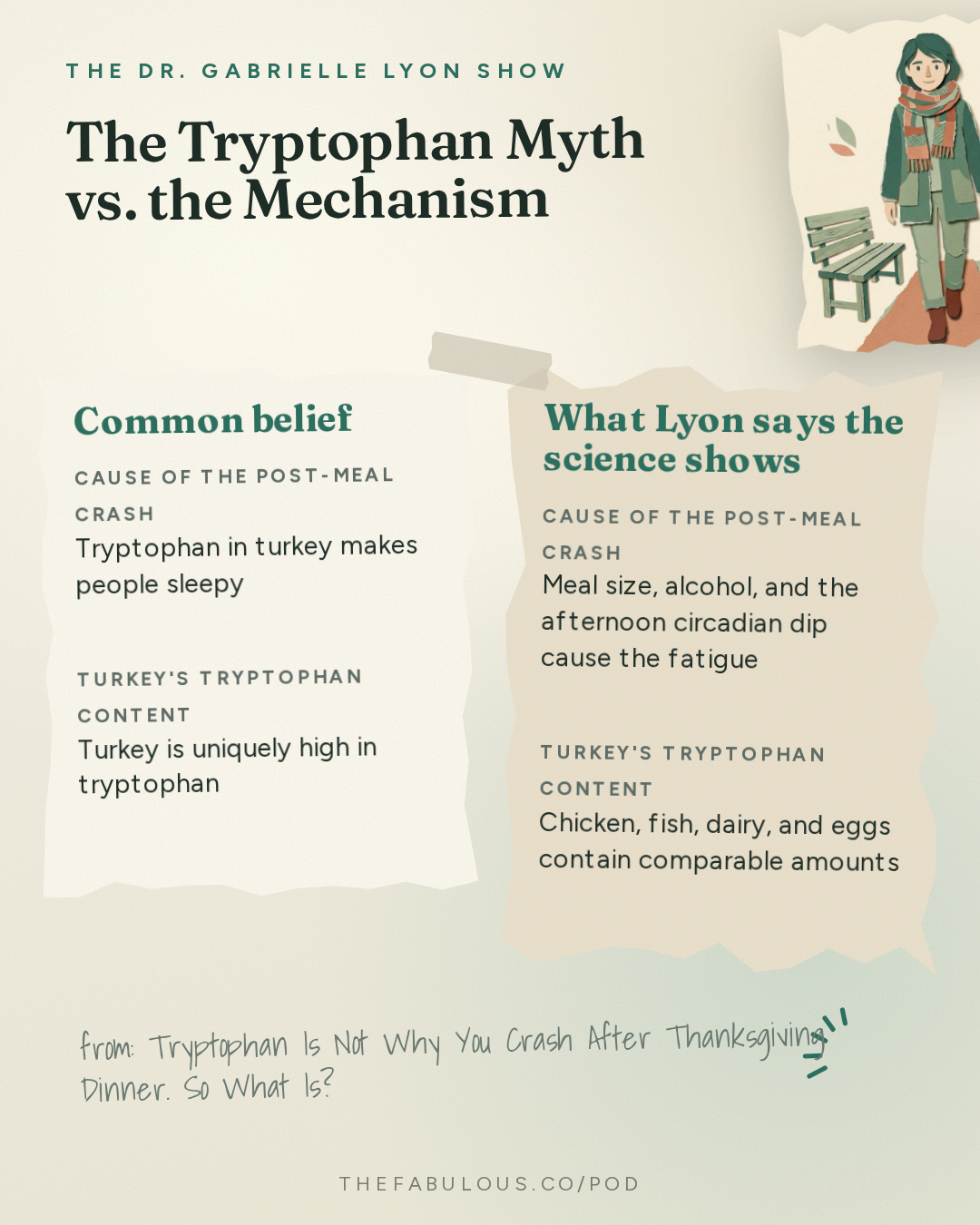
Tryptophan is real. It is an essential amino acid, meaning the body cannot make it and has to get it from food, and it is a precursor to serotonin, which can later become melatonin, the hormone involved in sleep regulation (03:19). That much is true. The myth starts with the idea that turkey is special. It is not. Chicken, fish, dairy, and eggs all contain comparable amounts of tryptophan (04:13). Worse for the folklore, tryptophan has to compete with other, larger amino acids called large neutral amino acids for the same transport system across the blood-brain barrier, the filter that controls what gets from the bloodstream into brain tissue. Eating a protein-rich meal, turkey included, does not flood the brain with tryptophan. It sends tryptophan into a crowded line with dozens of other amino acids ahead of it (04:13).
So what actually explains the nap? Lyon lists the more boring, more accurate suspects: a very large meal, possibly alcohol, a bad night of sleep beforehand, and the ordinary afternoon dip in alertness that follows the body's circadian rhythm regardless of what was for lunch (04:47). Turkey, she says, is not a sedative. It is dinner, and a notably nutritious one.
That mythbusting sets up the episode's real argument, which is less about turkey and more about the stories people tell themselves about food, movement, and worth. The next target is the Thanksgiving-morning punishment workout, the 5K or the burpee circuit done specifically to burn 800 calories before the meal even starts (07:21).
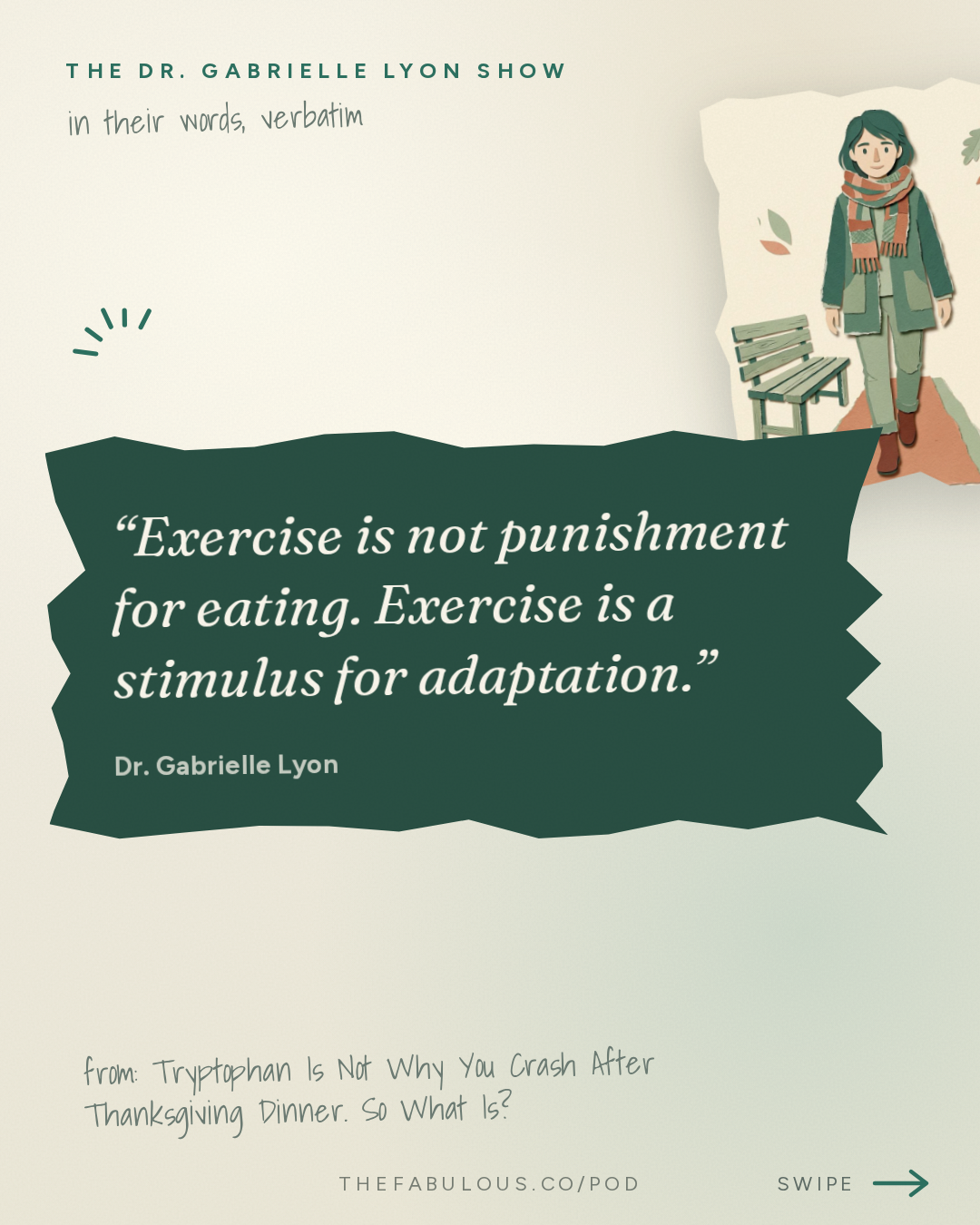
"Exercise is not punishment for eating. Exercise is a stimulus for adaptation." — Dr. Gabrielle Lyon [07:21]
Resistance training, Lyon explains, sends a physiological signal to skeletal muscle to adapt: to get stronger, to improve glucose regulation, to support metabolic health over time (07:54). Those adaptations build up through repeated training and recovery. They are not erased by one dinner, and they are not earned by one morning workout either. She adds a detail that matters for anyone over about fifty: older adults can experience anabolic resistance, a blunted response to a given amount of dietary protein, which is one reason protein quantity and timing become more important with age (09:39).
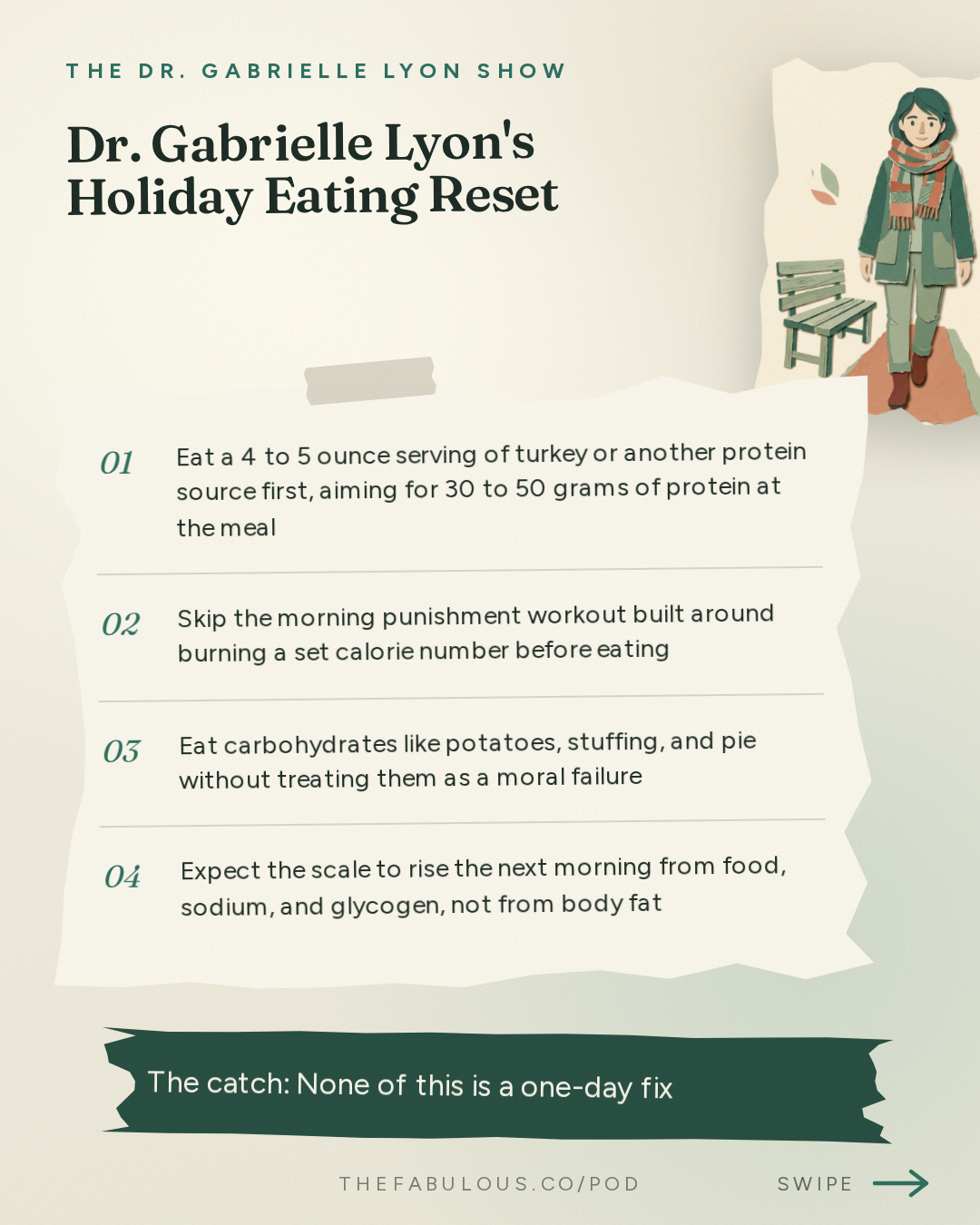
Her practical fix is simple. Aim for 30 to 50 grams of high-quality protein at a meal, the exact number depending on body size, age, and activity level (10:09). A 4- to 5-ounce serving of cooked turkey breast gets most people there on its own, delivering roughly 35 to 45 grams of protein along with all nine essential amino acids (10:35). Eat that first, she suggests, then add the sides without treating them as a moral test. Carbohydrates, she argues, have been assigned a character they do not deserve: potatoes and stuffing are not evidence of weak willpower, they are glucose that gets used for energy or stored as glycogen in muscle and liver (11:25).
What the Scale Doesn't Know
The morning-after number on the bathroom scale gets its own myth-busting. A three-pound jump overnight (13:00) is not three pounds of fat; it cannot be, given how fat storage actually works. Lyon points out that body weight the next day reflects food still in the GI tract, extra sodium and the fluid retention that comes with it, and replenished glycogen, which is stored in muscle bound to water (13:34). None of that is bad news. It is just not the news the scale implies, and panicking into a restrictive detox the next day solves a problem that was never there.
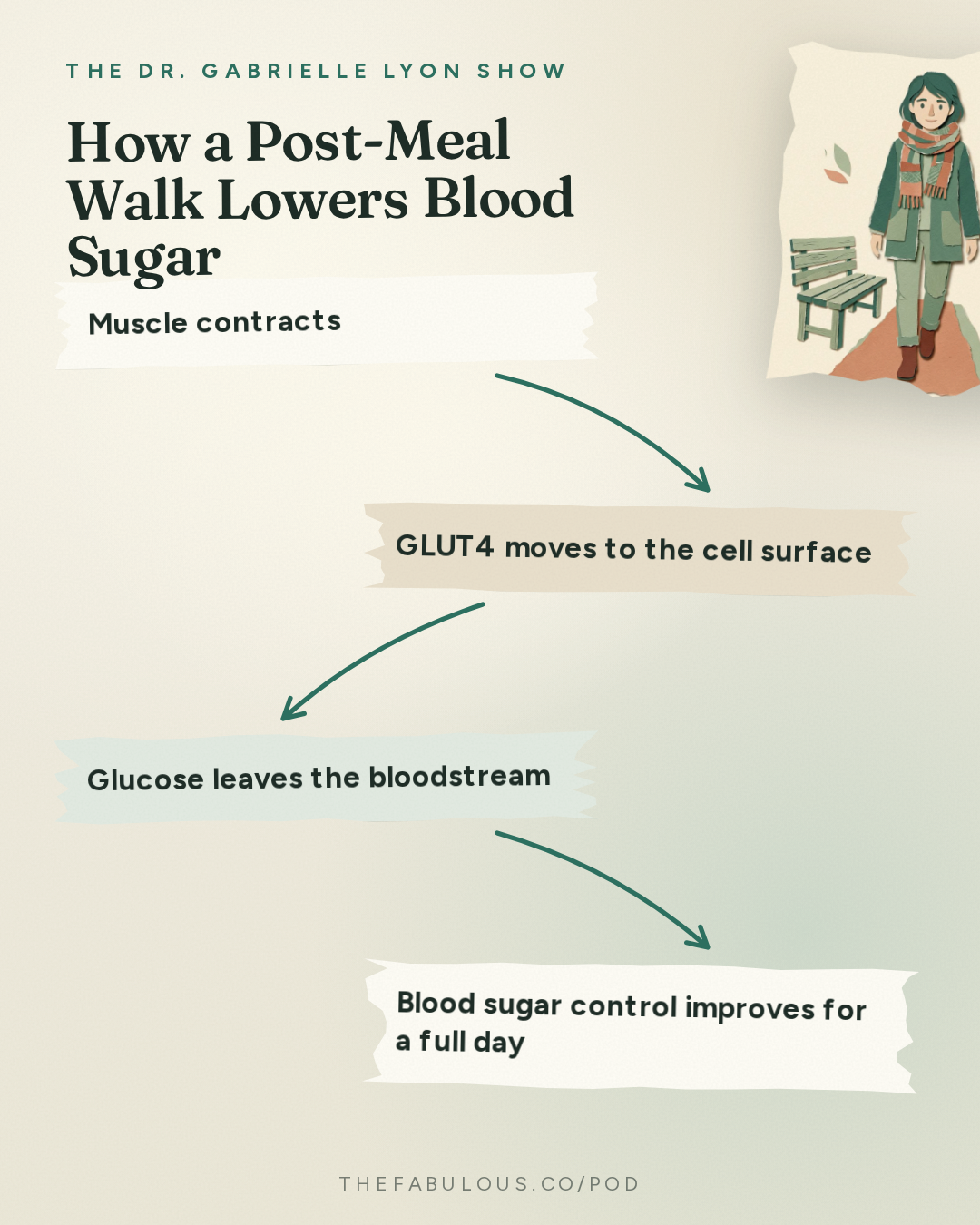
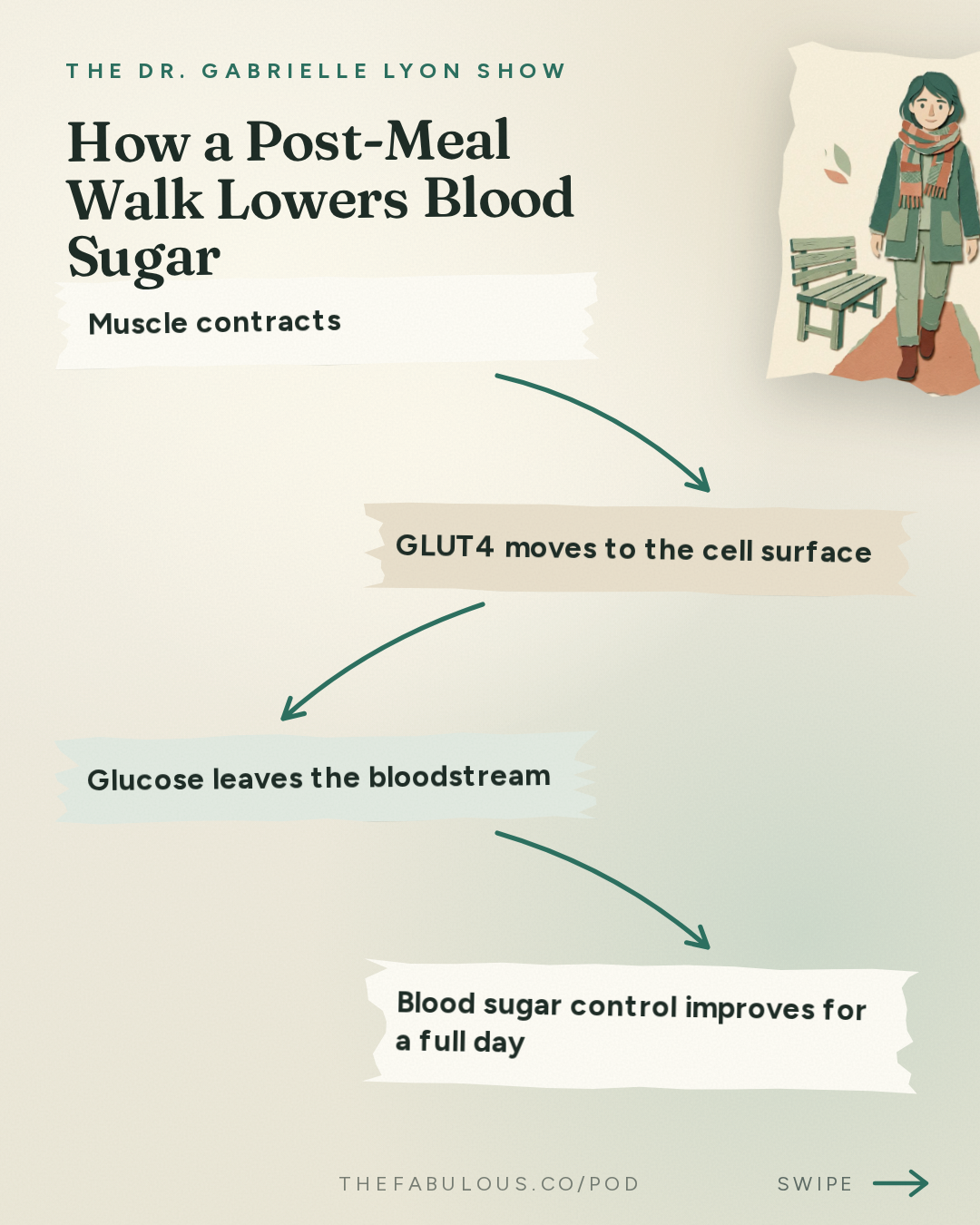
The episode's single most concrete recommendation follows directly from this: take a walk after dinner. The mechanism is where the science gets genuinely interesting. When skeletal muscle contracts, whether from walking, squats, or push-ups, it activates a pathway that moves glucose transporters called GLUT4 toward the surface of the muscle cell (15:06). Those transporters let muscle pull glucose directly out of the bloodstream, and this pathway works at least partly independent of insulin, the hormone that normally manages blood sugar. In plain terms, moving the body lets it clear glucose from the blood through a side door that does not require the usual insulin signal.
Lyon cites small studies in older adults at risk for impaired glucose tolerance that compared three 15-minute walks taken after meals against a single 45-minute walk taken all at once in the morning or afternoon. The split walks improved 24-hour glycemic control more than the one long walk did, and the walk after dinner specifically was most useful for managing the effects of that meal (15:37, 16:00). The takeaway is not that a 15-minute walk cancels out a large plate of food. It is that timing matters: when movement happens relative to eating changes how the body handles the glucose that follows.
Managing Yourself After Managing the Plate
Having spent the first half of the conversation on biology, Lyon pivots to a harder problem: surviving the family dinner table itself. Her claim is that a person can run a company, raise children, and manage a mortgage, and still regress to adolescence twenty minutes into their parents' living room (01:27). The fix she offers comes from psychology rather than physiology: psychological flexibility, the ability to feel an uncomfortable emotion while still acting in line with one's own values (17:58). It means a person can feel irritated without behaving irritably, or disagree with a relative without being disrespectful about it.
"Whoever controls your emotions controls you." — Dr. Gabrielle Lyon [17:58]
The practical version of this, she says, is to ask, before responding to the comment that always sets someone off: will this response actually improve anything? Usually the honest answer is no. Being right, as she puts it, is not the same thing as being effective (17:28), and sometimes the mature move is simply to pass the mashed potatoes.
She extends the same logic to family roles more broadly, drawing on self-determination theory's distinction between autonomy and independence (19:00). Autonomy does not mean doing everything alone; it means experiencing one's choices as genuinely chosen, even while staying closely connected to people who remember an earlier, less finished version of oneself. The test she offers is to notice when an explanation turns into a request for permission, because sharing information and asking for approval are different acts even when they sound alike (20:34).
Gratitude gets the same treatment as the biology did earlier: taken apart and rebuilt on firmer ground. Lyon notes that meta-analyses of gratitude interventions show only modest improvements in psychological wellbeing (21:46), not a miracle cure, which is exactly why she prefers specific gratitude over the generic kind. Thanking someone for making the effort to bring everyone together, rather than offering a vague "I'm grateful for my family," requires actually paying attention to what a person did.
"Attention is one of the most valuable things we can give another person." — Dr. Gabrielle Lyon [22:27]
The episode closes by tying the two halves together. Physical strength, Lyon argues, is capacity, not character; it gives a person the ability to do things without determining how that ability gets used (24:22). The same is true of psychological maturity. Getting older happens automatically, with enough luck. Growing up, she says near the start of the episode, does not (02:52). What she is really arguing, across turkey chemistry and family arguments alike, is that self-governance, managing a body and a temper with the same deliberate attention, is the actual work of the holiday, long after the dishes are done.
Ask this episode anything
Pod's AI answers from the episode itself, with the minute mark so you can hear it yourself.
Or start with one of these
Ask this episode
Pod's AI listens to the whole episode to answer, and points you to the minute it comes from.
The rest of this answer, and any question after it
Answers come from the episode itself, never from a summary of it.
ContinueKey takeaways
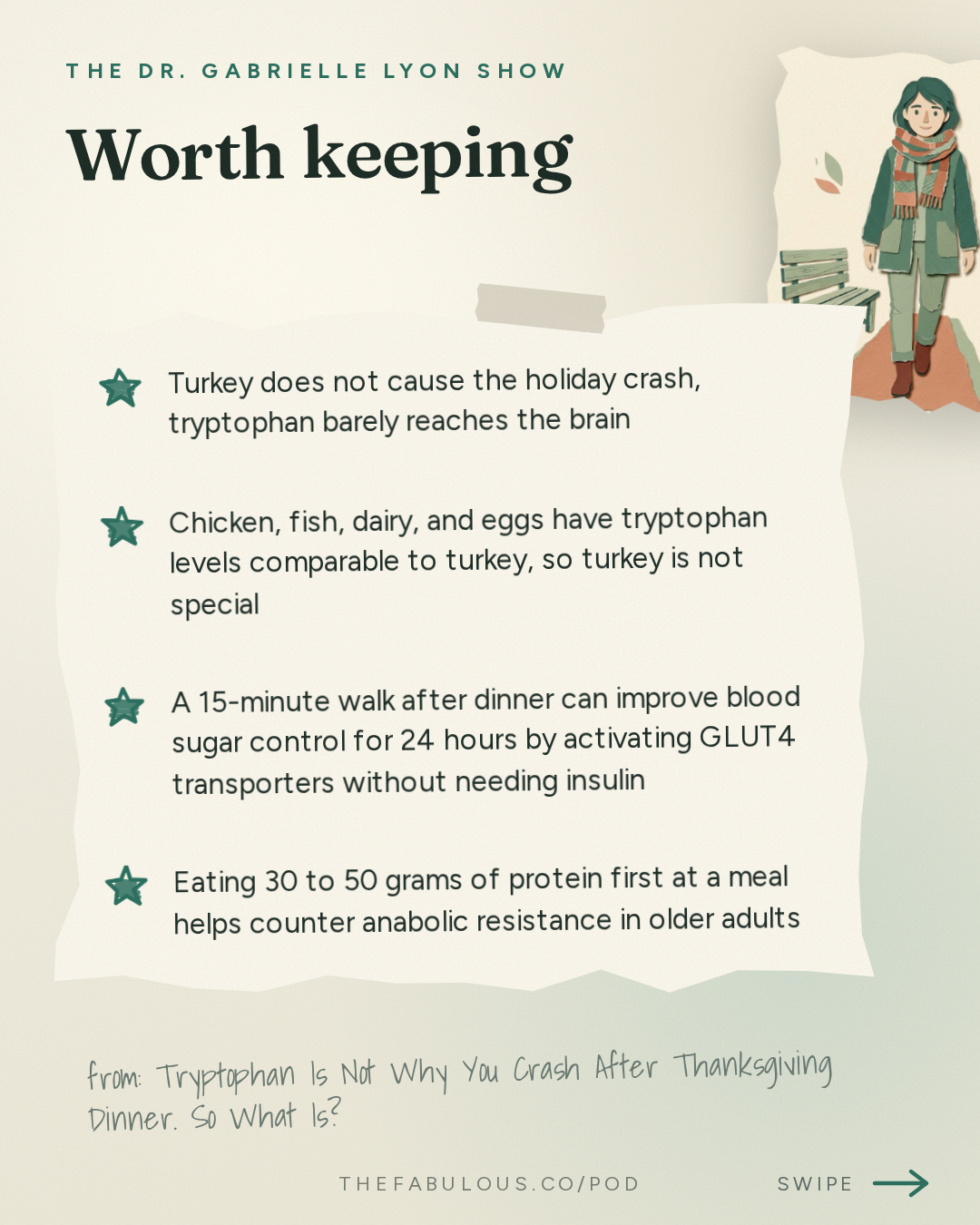
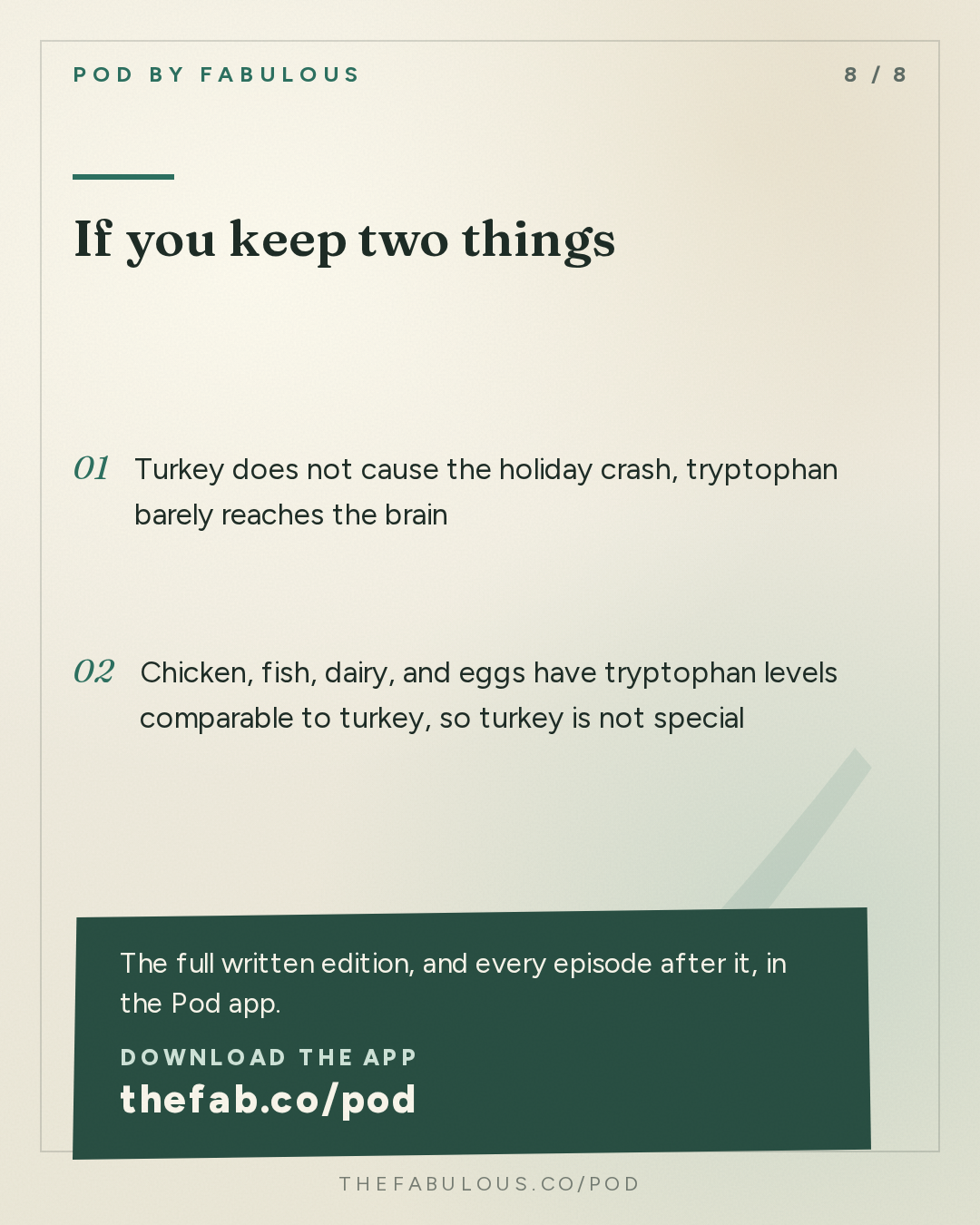
- Turkey does not cause the holiday crash, tryptophan barely reaches the brain
- Chicken, fish, dairy, and eggs have tryptophan levels comparable to turkey, so turkey is not special
- A 15-minute walk after dinner can improve blood sugar control for 24 hours by activating GLUT4 transporters without needing insulin
- Eating 30 to 50 grams of protein first at a meal helps counter anabolic resistance in older adults
- A 3-pound overnight weight gain after a big meal is mostly glycogen and water, not body fat
The episode in cards
By the numbers
- 35 to 45 grams protein supplied by that turkey serving
- 15 minutes length of each post-meal walk shown to improve 24-hour blood sugar control
In their words
“Getting older is inevitable if you're lucky, but growing up is not.”
“Exercise is not punishment for eating. Exercise is a stimulus for adaptation.”
“Whoever controls your emotions controls you.”
“Being right is not the same thing as being effective.”
“Attention is one of the most valuable things we can give another person.”
Protocols
-
Eat protein first at the holiday table
Dr. Gabrielle Lyon recommends starting the plate with a 4 to 5 ounce serving of turkey breast, which supplies roughly 35 to 45 grams of protein, before adding side dishes. The catch is that protein needs scale with body size, age, and activity level, so the exact target still falls within a 30 to 50 gram range rather than one fixed number.
at each holiday meal
-
Walk after the big meal instead of before it
Lyon advises walking, or doing push-ups and squats indoors when it is too cold outside, right after dinner, because muscle contraction moves GLUT4 glucose transporters to the cell membrane and pulls glucose out of the blood without needing insulin. The catch is that a single 15-minute walk does not erase the effects of a large meal, it only improves how the body handles the glucose that follows it.
after each large meal
-
Train for adaptation, not as payment for eating
Lyon says to skip the morning punishment workout built around burning a set number of calories, such as 800, before a holiday meal, and instead train because resistance exercise signals skeletal muscle to adapt over time. The catch is that one workout or one skipped workout does not meaningfully change long-term body composition, since those adaptations are built through repeated training, not a single session.
as part of a normal training routine, not tied to Thanksgiving specifically
-
Give one specific thank-you instead of a generic one
Lyon suggests naming one exact thing a person did, such as thanking someone for making the effort to bring everyone together, rather than saying a generic line like being grateful for family. The catch is that generic gratitude statements take little attention to produce, while specific gratitude requires actually noticing what someone did.
at the holiday table or any gathering
Questions this episode answers
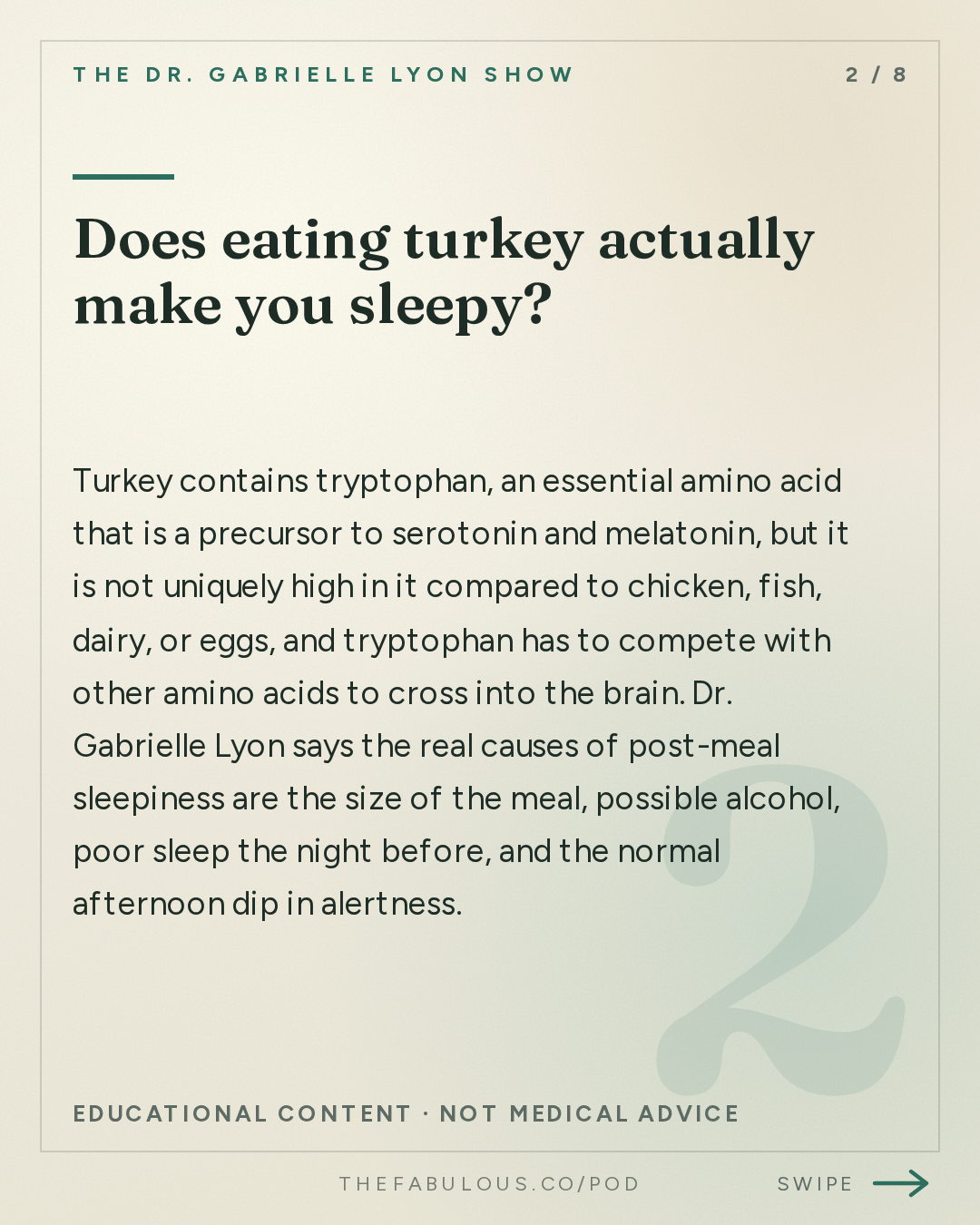
Does eating turkey actually make you sleepy?
Turkey contains tryptophan, an essential amino acid that is a precursor to serotonin and melatonin, but it is not uniquely high in it compared to chicken, fish, dairy, or eggs, and tryptophan has to compete with other amino acids to cross into the brain (04:13). Dr. Gabrielle Lyon says the real causes of post-meal sleepiness are the size of the meal, possible alcohol, poor sleep the night before, and the normal afternoon dip in alertness (04:47).
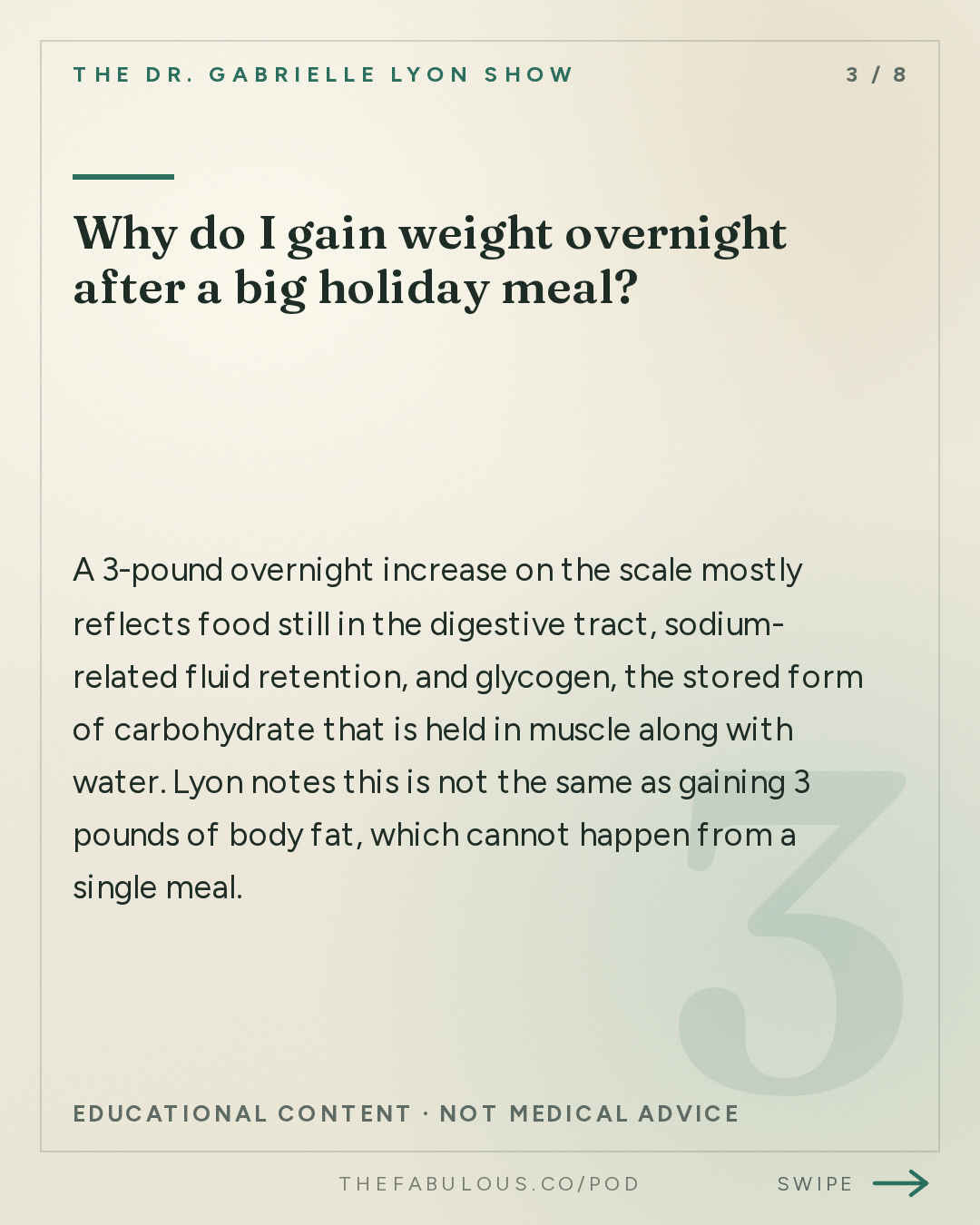
Why do I gain weight overnight after a big holiday meal?
A 3-pound overnight increase on the scale mostly reflects food still in the digestive tract, sodium-related fluid retention, and glycogen, the stored form of carbohydrate that is held in muscle along with water (13:00, 13:34). Lyon notes this is not the same as gaining 3 pounds of body fat, which cannot happen from a single meal.
Do you need to work out to earn a big holiday meal?
Lyon argues exercise should be seen as a stimulus for muscle adaptation, not a punishment or a payment for eating, and that resistance training builds strength and metabolic health through repeated sessions, not a single calorie-burning workout before dinner (07:21). She frames morning punishment workouts, such as one aimed at burning 800 calories, as based on a flawed premise (07:21).
Does walking after a meal really lower blood sugar?
Yes: muscle contraction during walking moves glucose transporters called GLUT4 to the muscle cell membrane, letting muscle pull glucose out of the blood through a pathway that works partly without insulin (15:06). Small studies in older adults found three 15-minute walks after meals improved 24-hour blood sugar control more than one 45-minute walk (15:37, 16:00).
What is psychological flexibility and how does it help at family gatherings?
Psychological flexibility is the ability to feel a difficult emotion, like irritation, while still acting in line with one's own values instead of reacting impulsively (17:58). Lyon suggests asking whether a response will actually improve anything before engaging in a recurring family argument, since being right is not the same as being effective (17:28).
The full read, in cards
Go deeper
- Meta-analysis of gratitude interventions — found gratitude practices produce only modest improvements in psychological wellbeing
- Small studies on post-meal walking in older adults at risk for impaired glucose tolerance — found three 15-minute walks improved 24-hour glycemic control more than one 45-minute walk
Mentioned
Dr. Gabrielle Lyon · Tryptophan · GLUT4 · Self-determination theory · Psychological flexibility
More from this show and category
Doris Day on Menopause, Skin Aging, and mTOR
Dermatologist Doris Day says skin estrogen receptors fall decades before menopause symptoms show. She argues that aggressive retinoids and lasers can exhaust already-depleted fibroblasts through the mTOR pathway, so mature skin often needs gentler, balanced care instead of more intensity.
Whitney Cummings on Wellness as a Second Job
Comedian Whitney Cummings argues wellness has become a second job that manufactures shame instead of easing it. She traces her own turn from childhood chaos to stand-up, critiques the sleep and hydration industry, and offers her 100 energy dollar framework for saying no without guilt.
Plant-Based Diet vs Animal Protein for Muscle
A vegan diet that drops protein intake can shrink older adults' muscle in just 12 weeks, even with resistance training. A protein-matched vegetarian diet combined with training still built muscle, though less than an omnivorous diet, showing that total protein and amino acid quality, not plant versus animal labels, determine the outcome.
IBD vs IBS: Colon Cancer Risk Explained
NBC correspondent Chloe Melas went undiagnosed with ulcerative colitis for years after doctors dismissed her rectal bleeding as hemorrhoids. She explains why inflammatory bowel disease (IBD) raises colon cancer risk while irritable bowel syndrome (IBS) does not, why women wait over a year for an IBD diagnosis, and how most Americans fall far short of their daily fiber needs.
