
Doris Day on Menopause, Skin Aging, and mTOR
Strong Retinoids and Lasers Can Age Menopausal Skin. Why Would More Do Less? | Dr. Doris Day
▶ Listen to the full episode More from The Dr. Gabrielle Lyon Show
The brief
Dermatologist Doris Day says skin estrogen receptors fall decades before menopause symptoms show. She argues that aggressive retinoids and lasers can exhaust already-depleted fibroblasts through the mTOR pathway, so mature skin often needs gentler, balanced care instead of more intensity.
Menopause reorders the body's priorities, and skin loses first. The brain, it turns out, gets first claim on a woman's dwindling estrogen supply, while the skin is left to fend for itself. That tradeoff, quiet and largely invisible, is the organizing idea behind a conversation with New York dermatologist Dr. Doris Day, who has practiced since 1998 and watched generations of patients age in real time.
Day's central observation is almost architectural: the body has two kinds of estrogen receptors, beta receptors concentrated in skin and alpha receptors in reproductive organs and the brain. As estrogen declines, skin receptors fall while the brain's receptor activity rises, because the brain needs that hormone to keep functioning. The result is a lag between when skin starts suffering and when a woman notices anything at all.
"Your skin estrogen receptors decline, but your brain estrogen receptors increase 'cause your brain needs that estrogen. So by the time you have any systemic effect of brain fog or memory or sleep, your skin's already been estrogen deficient for decades." — Dr. Doris Day [05:13]
By the time a woman notices brain fog or disrupted sleep around 55, her skin has often been estrogen deficient since her late 30s (05:34). Day calls skin the "martyred organ," always repairing, always last in line. A systematic review published this year in JAD, led by researcher Farkas, found topical estrogen works noticeably better on sun-protected skin than sun-damaged skin (03:21). None of this is fixed simply by starting hormone therapy, Day says. Hormones help bones, the heart, and the brain, but they do not restore skin the way she wishes they would.
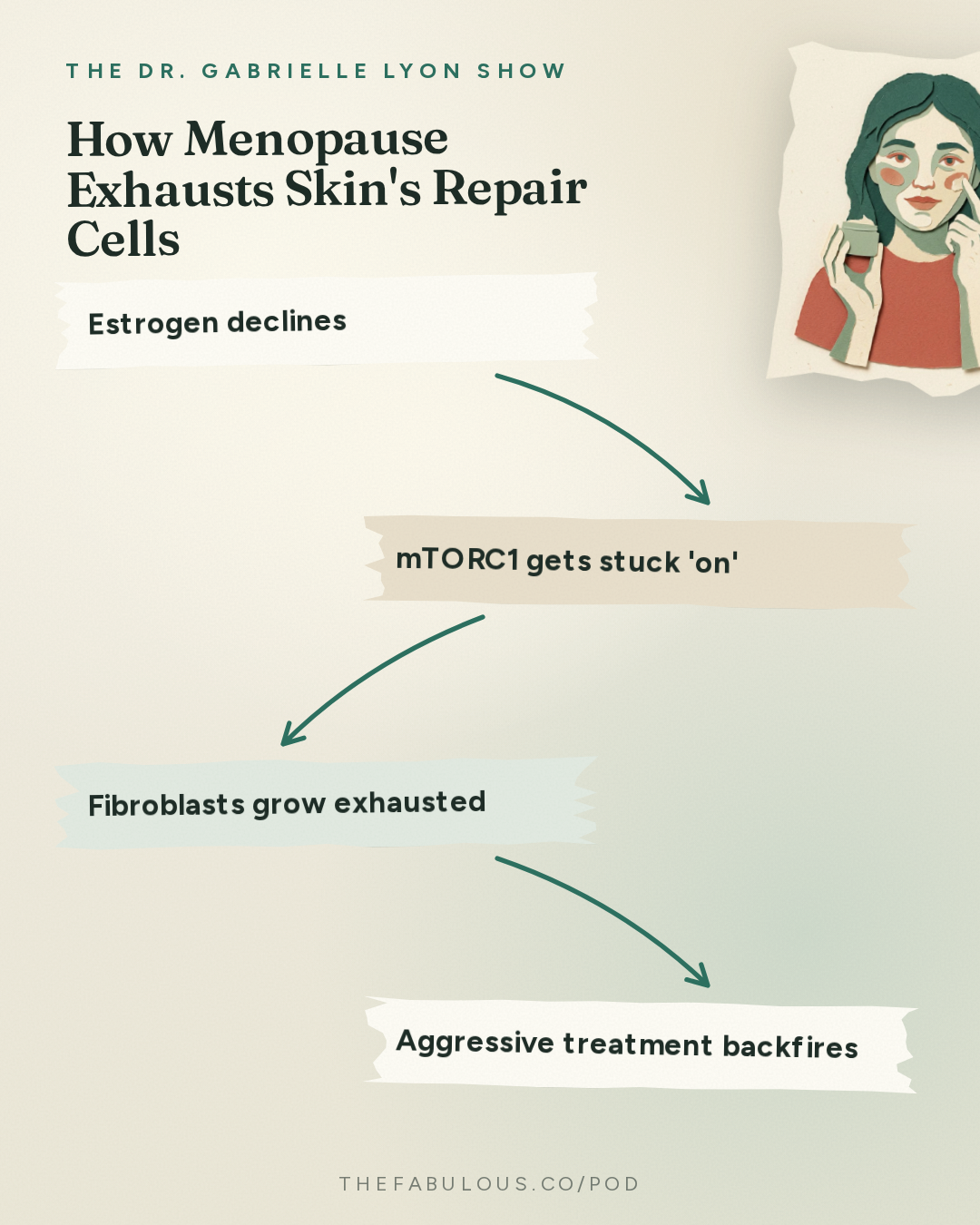
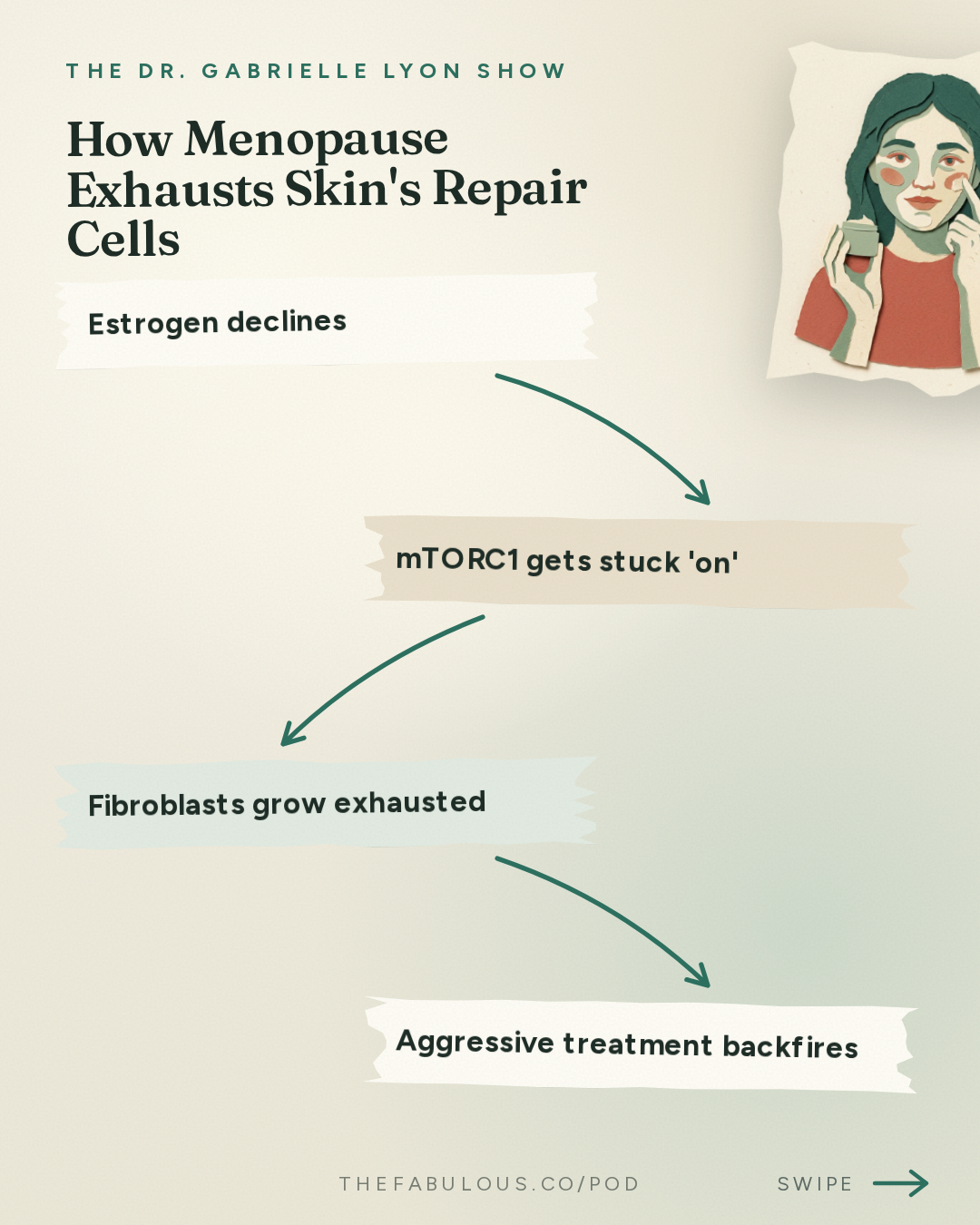
The more interesting part of the conversation is mechanical. Day walks through a cellular pathway called mTOR, short for mechanistic target of rapamycin, which acts as a master switch for cell growth and repair. It has two branches: mTORC1, which tells cells to grow and build, and mTORC2, which handles rest and repair. Estrogen normally keeps the two in balance. When estrogen falls, mTORC1 gets stuck in the "on" position inside skin cells (28:43). That leaves fibroblasts, the cells that manufacture collagen and the skin's structural matrix, running in overdrive and growing exhausted (29:10).
This is where Day's argument becomes genuinely counter-intuitive. Exhausted fibroblasts do not respond well to more stimulation. They respond worse.
"Why would you wanna put your cells that are building collagen into overdrive? Like, if I said, 'Run a marathon every day for five days,' do you think you're gonna run as fast on the fifth day?" — Dr. Doris Day [34:23]
The Case Against More
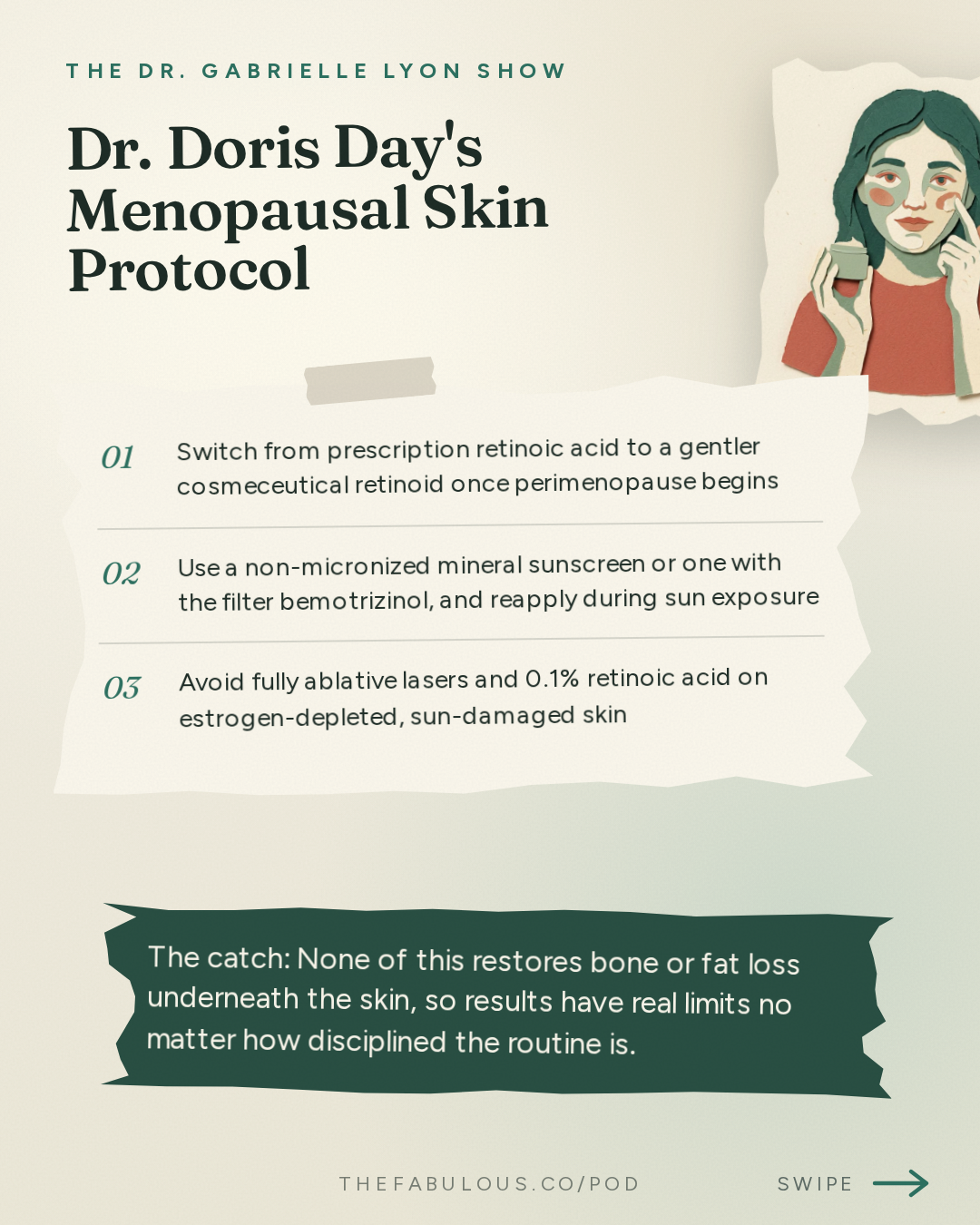
Day's clinical rule for menopausal and postmenopausal skin is to go less aggressive, not more, even though intuition suggests the opposite. She avoids fully ablative lasers, which strip the entire outer layer of skin, in older, estrogen-depleted, sun-damaged patients, because the skin cannot repair properly and can end up with a thin, fragile "cigarette paper" texture (35:34). She also steers patients away from high-concentration retinoic acid, meaning 0.1 percent formulations, switching most menopausal patients down to a gentler cosmeceutical retinoid, a lower-strength precursor the body converts on its own (33:57).
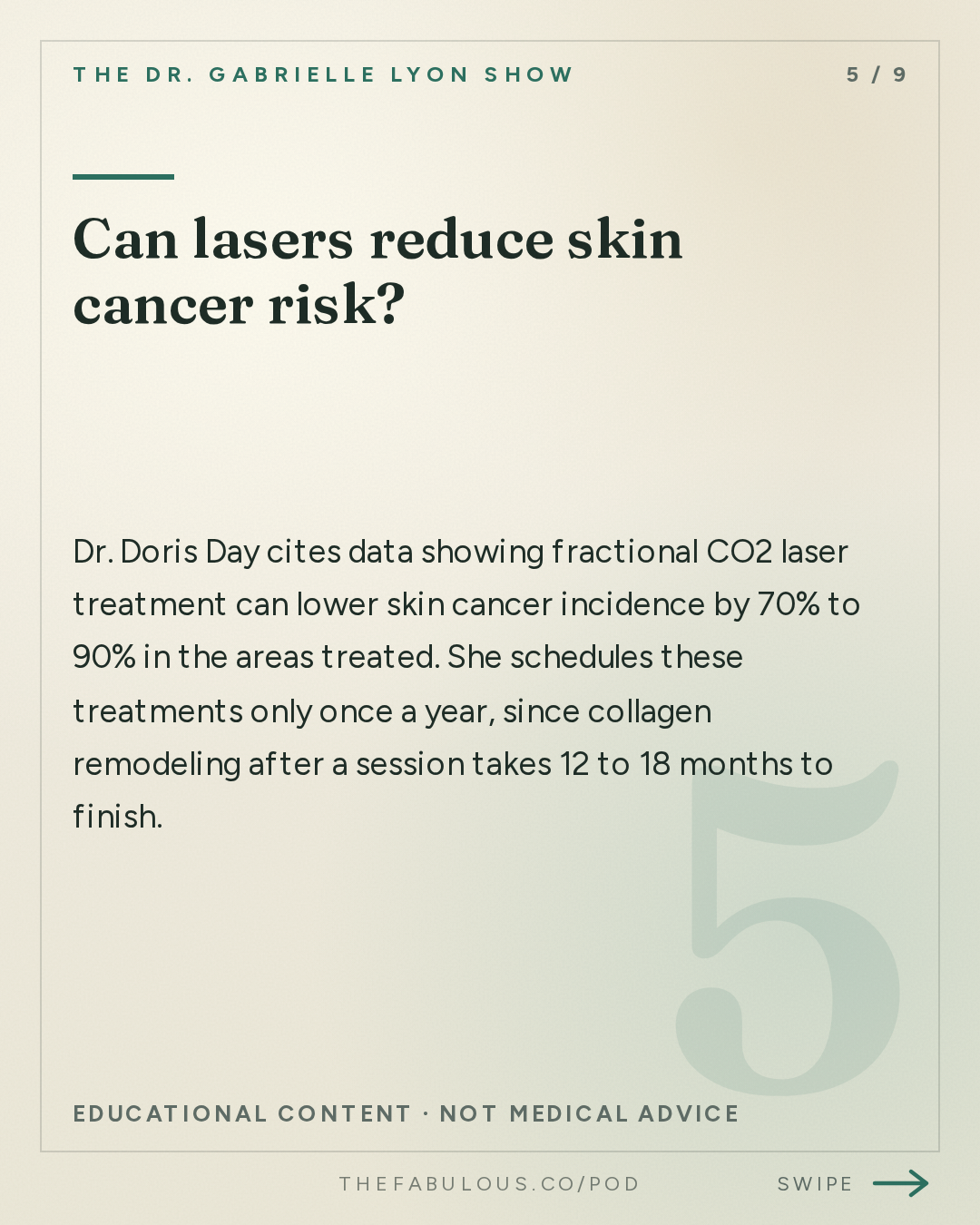
The same caution shapes her view of aesthetic devices. She described a laser-coring device called Ellacor that removes tiny cores of skin, enough to take out about 8 percent of the skin's surface in one session (55:56), but a sales representative told her real-world complication rates, mostly delayed healing and scarring, run around 20 percent (56:33). Day has not adopted it. She prefers a device called Sofwave, an ultrasound platform that stays confined to the skin layer and does not reach fat, because she wants evidence a treatment will not cause damage before she commits a patient to it (54:48). For resurfacing, she still considers fractional CO2 laser the gold standard, and cites data showing it can cut skin cancer incidence by 70 to 90 percent in treated areas (60:21). Collagen remodeling after a CO2 session takes 12 to 18 months to finish, which is why she schedules the procedure only once a year (61:23). More frequent treatment would not speed up a biological process that has its own timeline.
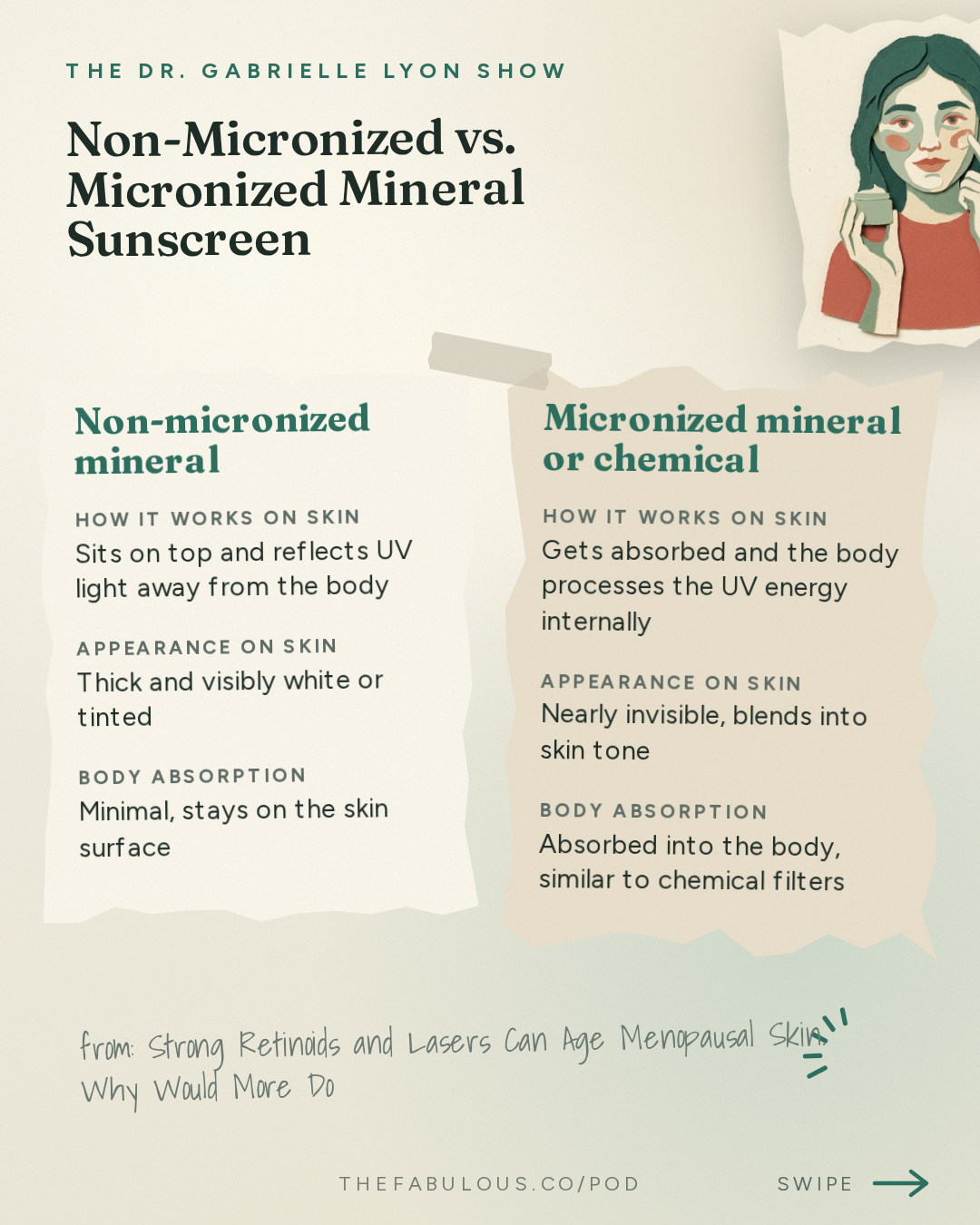
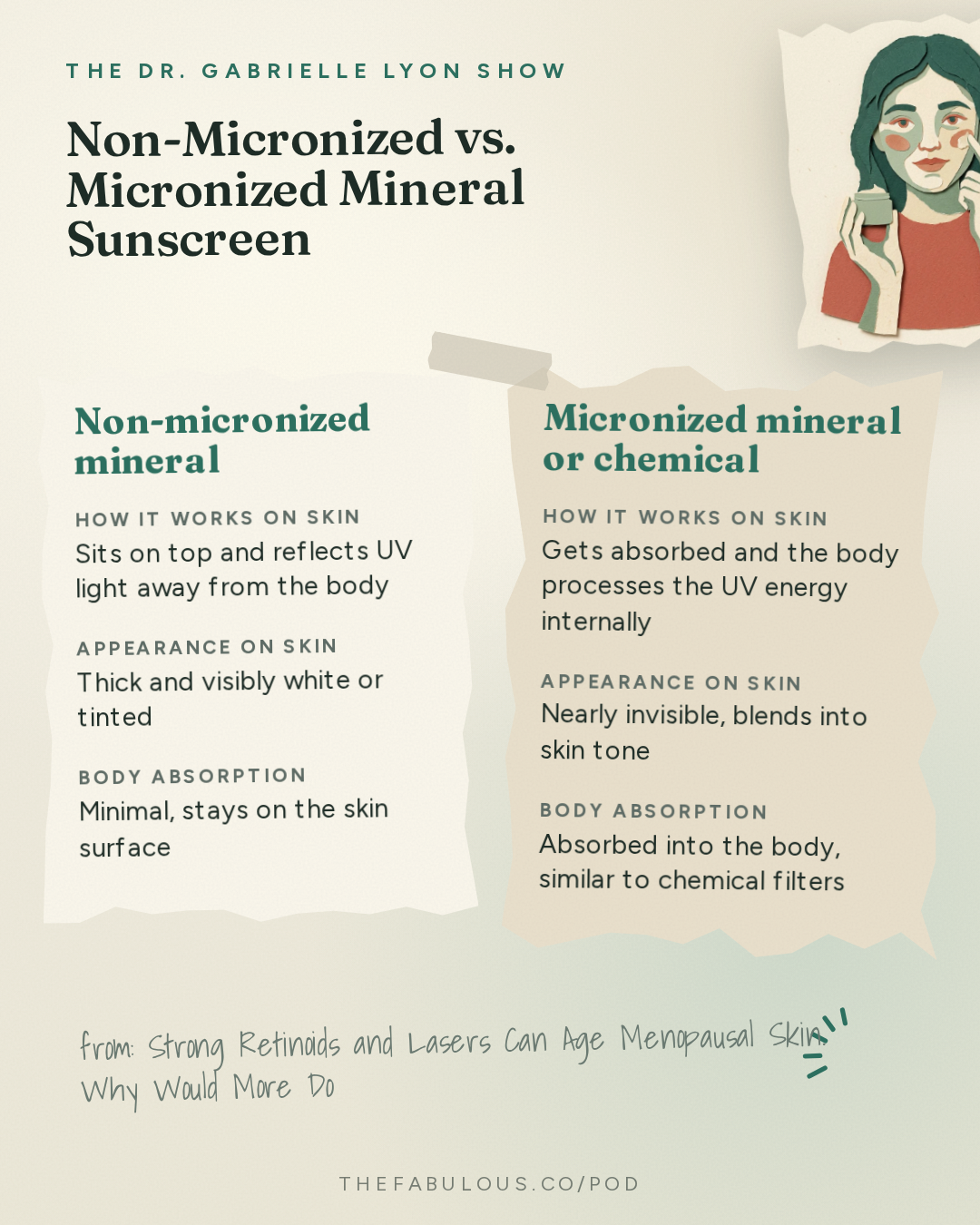
Sunscreen gets the same scrutiny. Day prefers non-micronized mineral sunscreen, the thick, visibly white kind, over micronized mineral versions, because grinding zinc into tiny particles to make it invisible on skin also makes it behave like an absorbed chemical filter (45:13). She is watching for a newer filter called bemotrizinol, already available in Europe and expected in the United States within months, which is photostable (it does not break down in sunlight) and only minimally absorbed (46:32). She also recommends internal supplements, lutein, astaxanthin, and polypodium leucotomos extract, as added protection against UV damage (46:56).
What the Skin Can't Fix
Some of the conversation's most useful material concerns the skin's ecosystem rather than its surface. Washing the entire body with soap and water every day is not necessary, Day says, and can disrupt the skin's microbiome, the community of bacteria that keeps infection-causing organisms in check (39:20). That microbiome becomes less diverse with age (41:25), which partly explains why older skin, especially below the knee, carries higher infection risk. She cites a Mayo Clinic finding that reducing inflammation in the skin, simply by moisturizing, lowers inflammation systemically, and references a Chinese study suggesting moisturized skin in older patients correlated with better cognitive function (38:04).
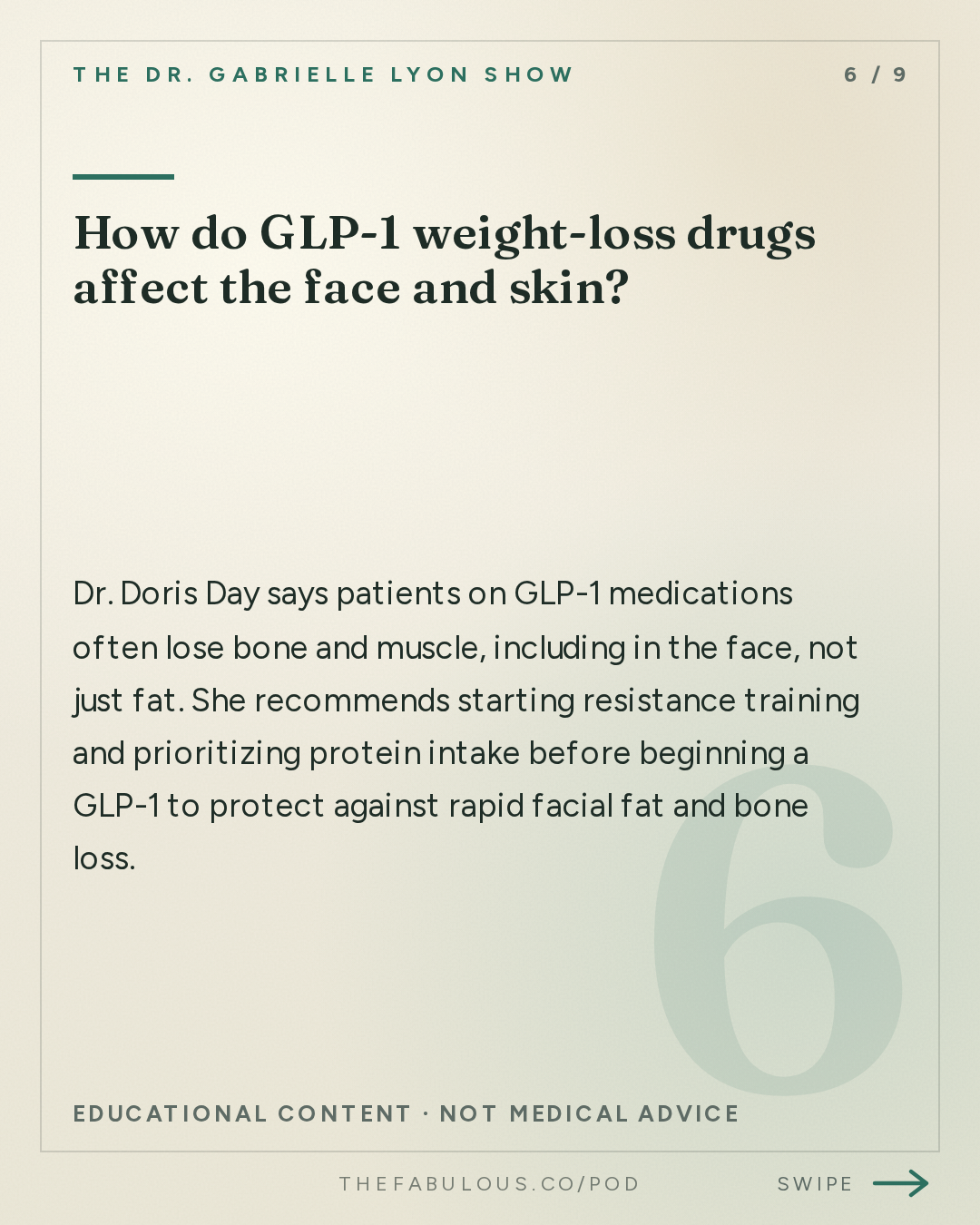
GLP-1 weight-loss drugs come up as a newer complication. Day says patients on these medications are often losing bone and muscle, not just fat, including in the face, and she will not prescribe one without first discussing resistance training, protein intake, and hydration (73:16). She described one patient who lost weight quickly while working from home and came in looking "skeletal," a pattern she compares to an eating disorder.
Underneath all of this sits a harder truth: skin treatment cannot fix bone. The orbital bone around the eye shrinks with age, so the eye socket enlarges, the eye appears to sink, and the brow drops (15:38). The jawbone recedes in women more than in men, while the upper jaw stays put, which is why aggressive lip filler alone creates an imbalanced, puckered look rather than a youthful one (18:19). Day's objection to buccal fat removal, popular among younger patients seeking cheekbone definition, is the same logic in reverse: removing fat pads in the 20s can leave a gaunt, aged appearance by the 40s, once the bone has already begun to shrink underneath (70:36). Her point throughout is not that intervention is wrong. It is that intervention has to match the biology underneath, not override it.
Day's father, an Iranian-trained anesthesiologist who walked eight to nine miles a day and died at 92 after being struck by a car (87:09), used to tell her, "We should all die young at an old age" (76:38), a line that functions as the episode's quiet thesis. Longevity, in Day's framing, is not about erasing the signs of age from skin. It is about keeping the organ functional and resilient for as long as possible, which sometimes means doing less rather than more. Near the end of the conversation she reflects on losing her sister young versus losing her father old, and the distinction she draws is worth sitting with.
"When you lose somebody young, you miss all of the things that could have been. But when somebody is older and it's their time, you miss them because there's a tangible, but they leave you with so much." — Dr. Doris Day [91:17]
It is a strange place for a dermatology conversation to land, but it fits. Day spends an hour arguing that skin should be treated as a living, aging organ with its own limits, not a surface to be endlessly corrected. The same, it turns out, is true of the people wearing it.
Ask this episode anything
Pod's AI answers from the episode itself, with the minute mark so you can hear it yourself.
Or start with one of these
Ask this episode
Pod's AI listens to the whole episode to answer, and points you to the minute it comes from.
The rest of this answer, and any question after it
Answers come from the episode itself, never from a summary of it.
ContinueKey takeaways
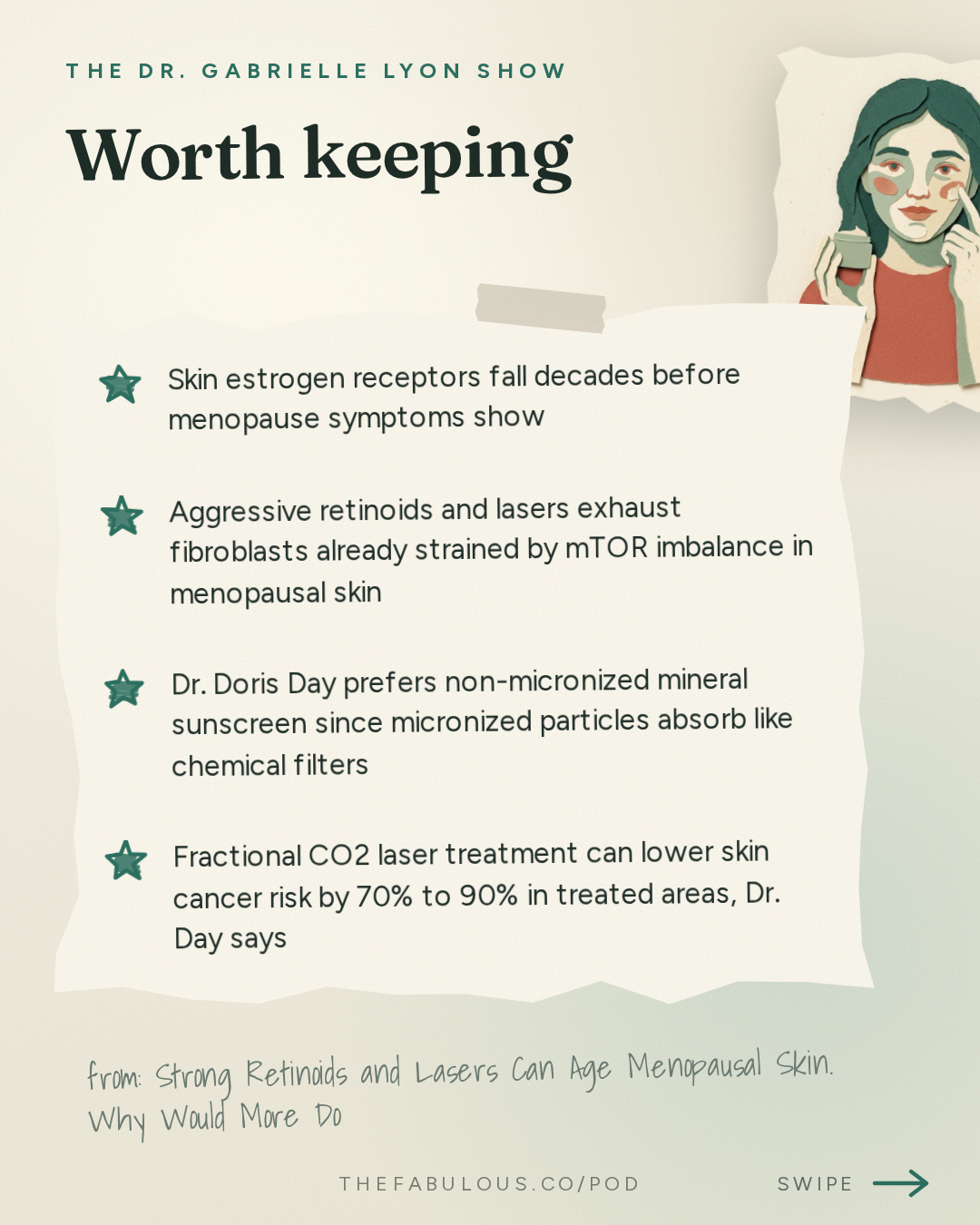
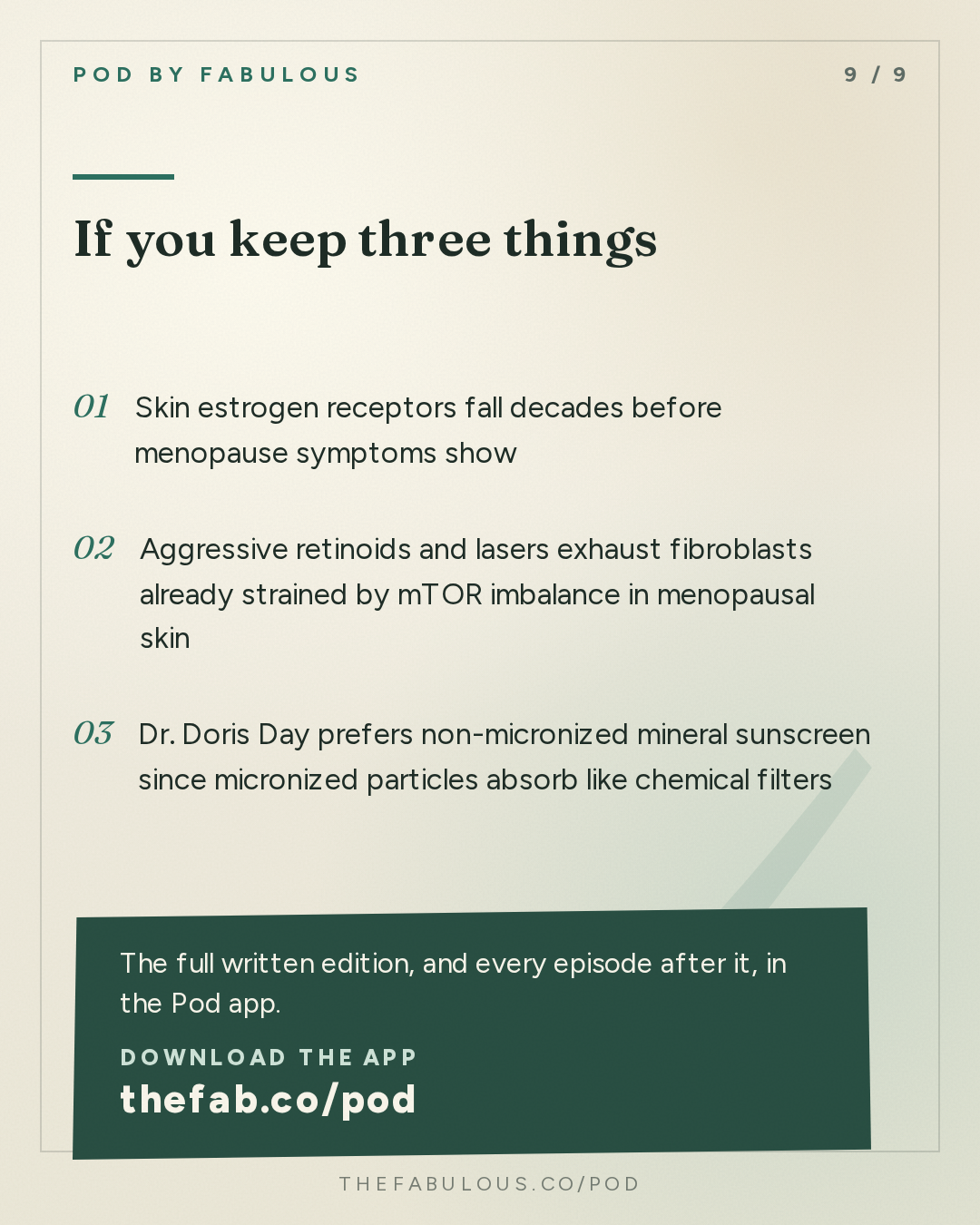
- Skin estrogen receptors fall decades before menopause symptoms show
- Aggressive retinoids and lasers exhaust fibroblasts already strained by mTOR imbalance in menopausal skin
- Dr. Doris Day prefers non-micronized mineral sunscreen since micronized particles absorb like chemical filters
- Fractional CO2 laser treatment can lower skin cancer risk by 70% to 90% in treated areas, Dr. Day says
- GLP-1 weight-loss drugs can strip facial fat and bone without resistance training and enough protein, Dr. Day warns
The episode in cards

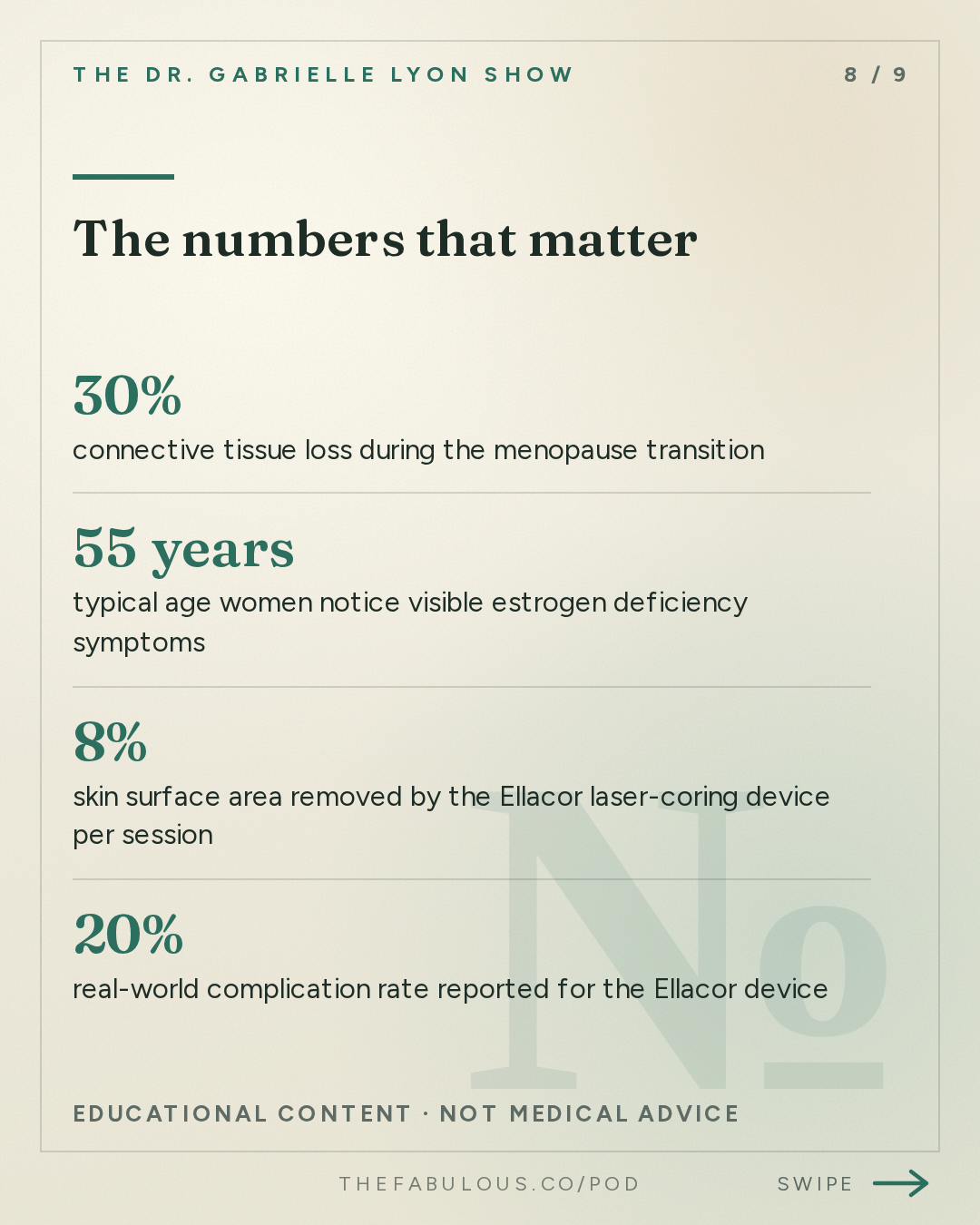
By the numbers
- 30% percent connective tissue loss during the menopause transition
- 55 years typical age women notice visible estrogen deficiency symptoms
- 8% percent skin surface area removed by the Ellacor laser-coring device per session
- 20% percent real-world complication rate reported for the Ellacor device
In their words
“Your skin estrogen receptors decline, but your brain estrogen receptors increase 'cause your brain needs that estrogen. So by the time you have any systemic effect of brain fog or memory or sleep, your skin's already been estrogen deficient for decades.”
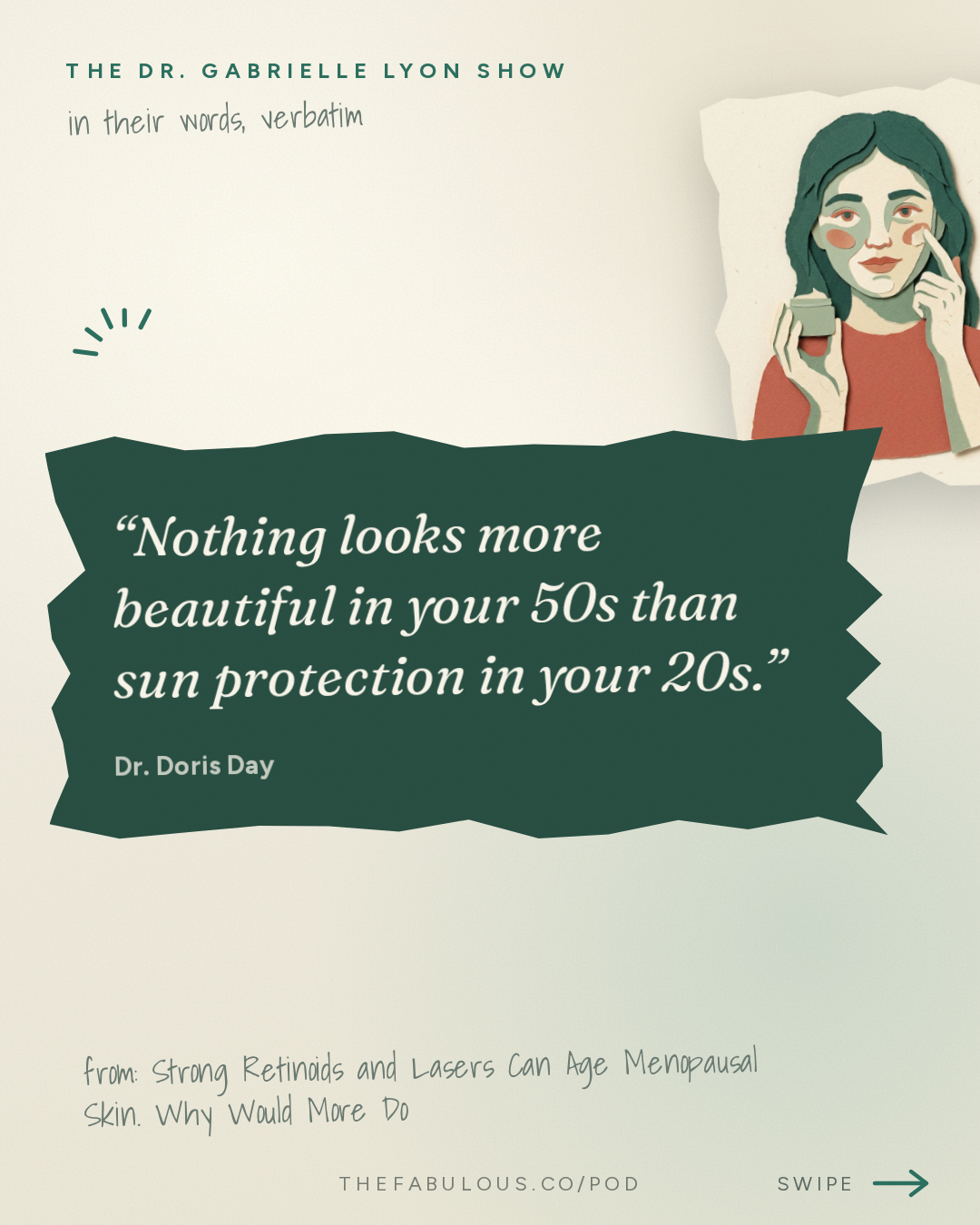
“Nothing looks more beautiful in your 50s than sun protection in your 20s.”
“Why would you wanna put your cells that are building collagen into overdrive? Like, if I said, "Run a marathon every day for five days," do you think you're gonna run as fast on the fifth day?”
“We should all die young at an old age.”
“When you lose somebody young, you miss- Yeah ... all of the things that could have been. But when somebody is older and it's their time, it's-- you miss them because there's a tangible, but they leave you with so”
Protocols
-
Switch to gentler retinoids at perimenopause
Dr. Doris Day switches most patients from prescription retinoic acid to a lower-strength cosmeceutical retinoid once they reach perimenopause, since exhausted fibroblasts respond poorly to high-strength actives like 0.1% retinoic acid.
Starting at perimenopause, ongoing
-
Choose sunscreen that stays on the skin surface
Dr. Doris Day recommends non-micronized mineral sunscreen or a formula with the new filter bemotrizinol, because micronized mineral and chemical sunscreens get absorbed into the body rather than staying on the skin's surface.
Daily, with reapplication during sun exposure
-
Avoid aggressive lasers on estrogen-depleted skin
Dr. Doris Day avoids fully ablative lasers in older, sun-damaged, estrogen-depleted skin because the skin cannot repair efficiently and can develop a thin, fragile, 'cigarette paper' texture.
Case by case, based on skin age and sun history
-
Space out CO2 laser treatments by a year
Dr. Doris Day schedules fractional CO2 laser resurfacing once a year, since collagen remodeling after treatment takes 12 to 18 months and benefits last only six to nine months, so more frequent sessions add no extra value.
Annually
-
Build muscle and protein support before starting a GLP-1
Dr. Doris Day has patients start resistance training and plan protein and hydration intake before beginning a GLP-1 medication, because these drugs can cause rapid loss of facial fat, bone density, and muscle rather than just fat.
Before and throughout GLP-1 use
Questions this episode answers
Why does skin age faster during menopause even with hormone therapy?
Dermatologist Dr. Doris Day explains that skin's estrogen beta receptors decline during menopause while the brain's estrogen receptor activity rises to protect cognitive function, so skin becomes estrogen deficient years before systemic symptoms like brain fog appear (05:13). A systematic review she cites, led by researcher Farkas and published in JAD, found topical estrogen works better in sun-protected skin than sun-damaged skin, meaning results vary by prior sun exposure (03:21).
What is mTORC1 and why does it matter for aging skin?
mTOR, short for mechanistic target of rapamycin, is a master pathway controlling cell growth and repair, with one branch called mTORC1 driving growth and another called mTORC2 handling repair. Dr. Doris Day says that when estrogen declines, mTORC1 gets stuck in the 'on' position in skin cells, leaving collagen-building fibroblasts exhausted and less able to respond to treatment (28:43).
Is micronized mineral sunscreen better than chemical sunscreen?
Dr. Doris Day says no, because grinding mineral sunscreen into micronized particles to make it invisible on skin causes it to behave like an absorbed chemical sunscreen rather than sitting on the skin's surface (45:13). She prefers non-micronized mineral sunscreen, or newer filters like bemotrizinol, which is photostable and only minimally absorbed (46:32).
Can lasers reduce skin cancer risk?
Dr. Doris Day cites data showing fractional CO2 laser treatment can lower skin cancer incidence by 70% to 90% in the areas treated (60:21). She schedules these treatments only once a year, since collagen remodeling after a session takes 12 to 18 months to finish (61:23).
How do GLP-1 weight-loss drugs affect the face and skin?
Dr. Doris Day says patients on GLP-1 medications often lose bone and muscle, including in the face, not just fat (73:16). She recommends starting resistance training and prioritizing protein intake before beginning a GLP-1 to protect against rapid facial fat and bone loss.
The full read, in cards

Go deeper
- Survival of the Prettiest — argues that beauty and fertility signals are hardwired into human perception
- Farkas systematic review (Journal of the American Academy of Dermatology) — found topical estrogen works better in sun-protected skin than sun-damaged skin
- Harvard skin cell reprogramming study — showed cultured human skin cells could be reset to a younger state, raising the question of real-world application
- Mayo Clinic moisturizer study — found that reducing inflammation in skin through moisturizing lowered inflammation systemically
Mentioned
Dr. Doris Day · Mitra Bio · Sculptra · Survival of the Prettiest · Botox · Redensity · ReQ · Sofwave · UltraClear · Ultrapulse Alpha · NYU · Brent Saunders · Shinya Yamanaka
More from this show and category
Whitney Cummings on Wellness as a Second Job
Comedian Whitney Cummings argues wellness has become a second job that manufactures shame instead of easing it. She traces her own turn from childhood chaos to stand-up, critiques the sleep and hydration industry, and offers her 100 energy dollar framework for saying no without guilt.
Plant-Based Diet vs Animal Protein for Muscle
A vegan diet that drops protein intake can shrink older adults' muscle in just 12 weeks, even with resistance training. A protein-matched vegetarian diet combined with training still built muscle, though less than an omnivorous diet, showing that total protein and amino acid quality, not plant versus animal labels, determine the outcome.
IBD vs IBS: Colon Cancer Risk Explained
NBC correspondent Chloe Melas went undiagnosed with ulcerative colitis for years after doctors dismissed her rectal bleeding as hemorrhoids. She explains why inflammatory bowel disease (IBD) raises colon cancer risk while irritable bowel syndrome (IBS) does not, why women wait over a year for an IBD diagnosis, and how most Americans fall far short of their daily fiber needs.
Retatrutide Triumph-1 Trial Results Explained
Retatrutide's Triumph-1 phase 3 trial produced an average 25% body weight loss at the highest dose over 80 weeks, with some lean mass loss that tracks in line with other obesity drugs rather than exceeding it. Preserving muscle depends on resistance training and adequate protein, not the drug itself.
