
Databricks CEO Ali Ghodsi on AGI vs Superintelligence
Databricks CEO: AGI Is Already Here, Why Companies Are Behind, and the Superintelligence Debate
The brief
Databricks CEO Ali Ghodsi says AGI already arrived by the field's original 2010 definition, but true superintelligence needs four conditions nobody has met. He maps four hurdles blocking enterprise AI adoption and demos an internal AI ontology that tracks meetings, Slack, and org charts to run the company like data-driven Moneyball.
In 2009, a group of Berkeley researchers named their lab AMPLab: Algorithms, Machine Learning, and People. The P stood for people because, as Databricks CEO Ali Ghodsi explains, the algorithms of the day needed a human in the loop to catch the last mile the machine couldn't handle (08:14). Sixteen years later, Ghodsi says that assumption has quietly expired. The machine, he argues, no longer needs the chaperone. The argument is less a victory lap than a definitional dispute, and it turns out the dispute matters more than it sounds.
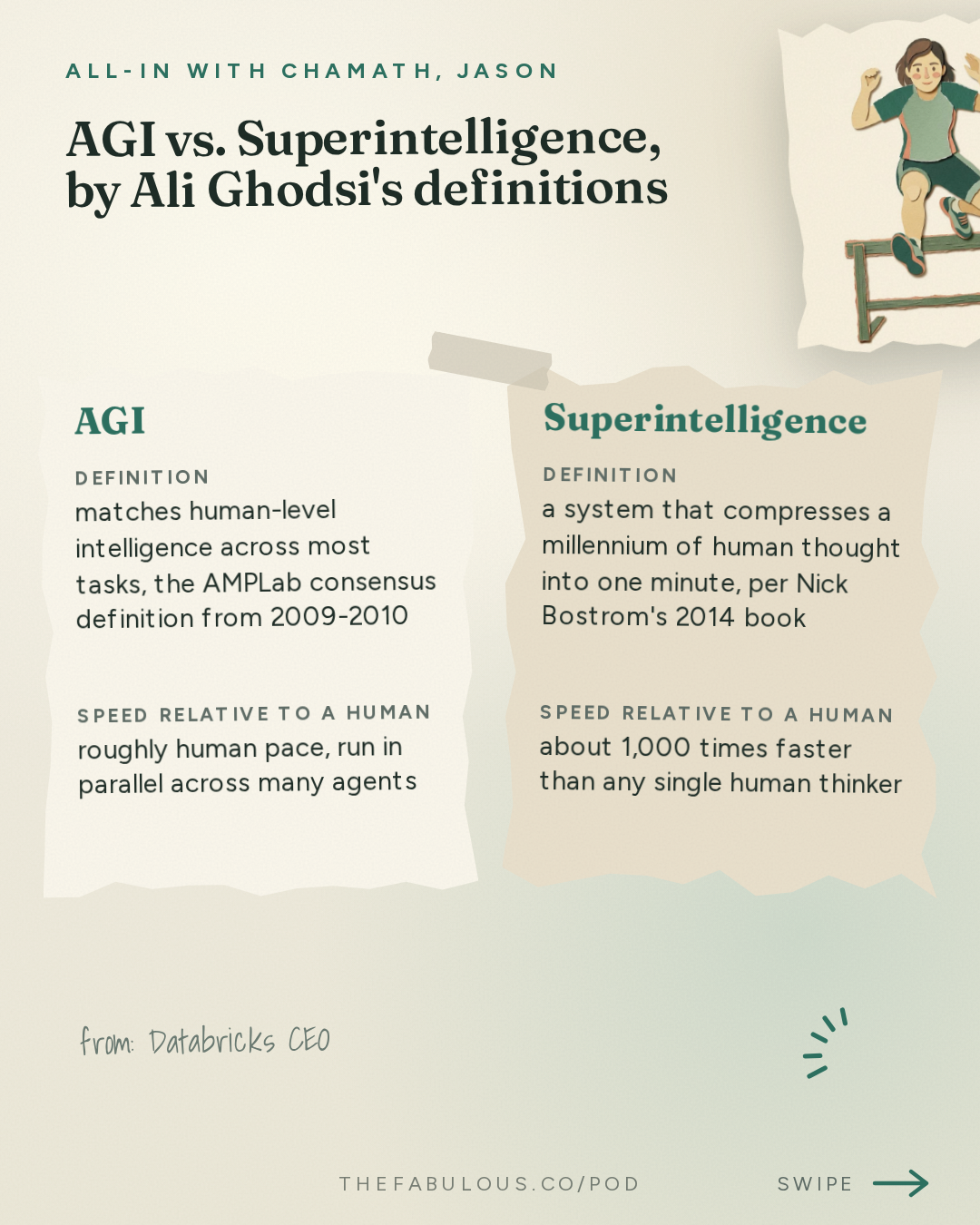
Ghodsi's claim is specific: by the consensus definition his AMPLab cohort used in 2009 and 2010, artificial general intelligence, or AGI, the kind of system that can do the intellectual work of a human across most domains, already exists. He checked himself against former labmates before saying it publicly.
"I actually think we already have artificial general intelligence. I've been saying it since last year." Ali Ghodsi [09:42]
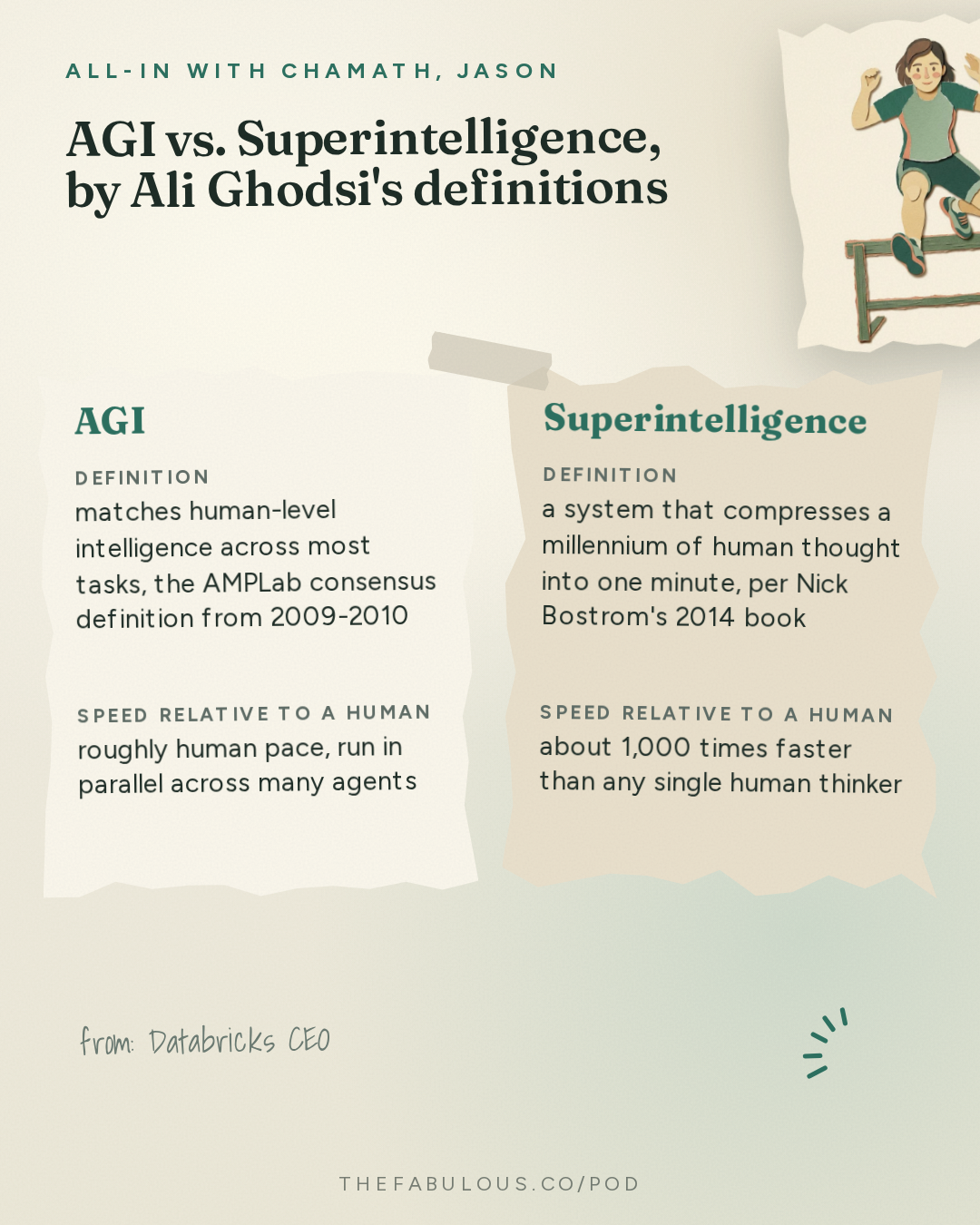
The catch, he says, is that the finish line kept moving. What counted as AGI in 2010 now reads as a warm-up act, because researchers quietly swapped in a harder target: superintelligence. Ghodsi dates that term to Oxford philosopher Nick Bostrom's 2014 book Superintelligence, which defines it as a system that can compress a millennium of human thought into a single minute, something on the order of a thousand times faster than any person alive (11:01). That is a genuinely different animal from AGI. AGI matches human range. Superintelligence multiplies human speed by three orders of magnitude and, in Bostrom's telling, starts improving itself in a loop nobody controls.
The Four Locks on the Enterprise Door
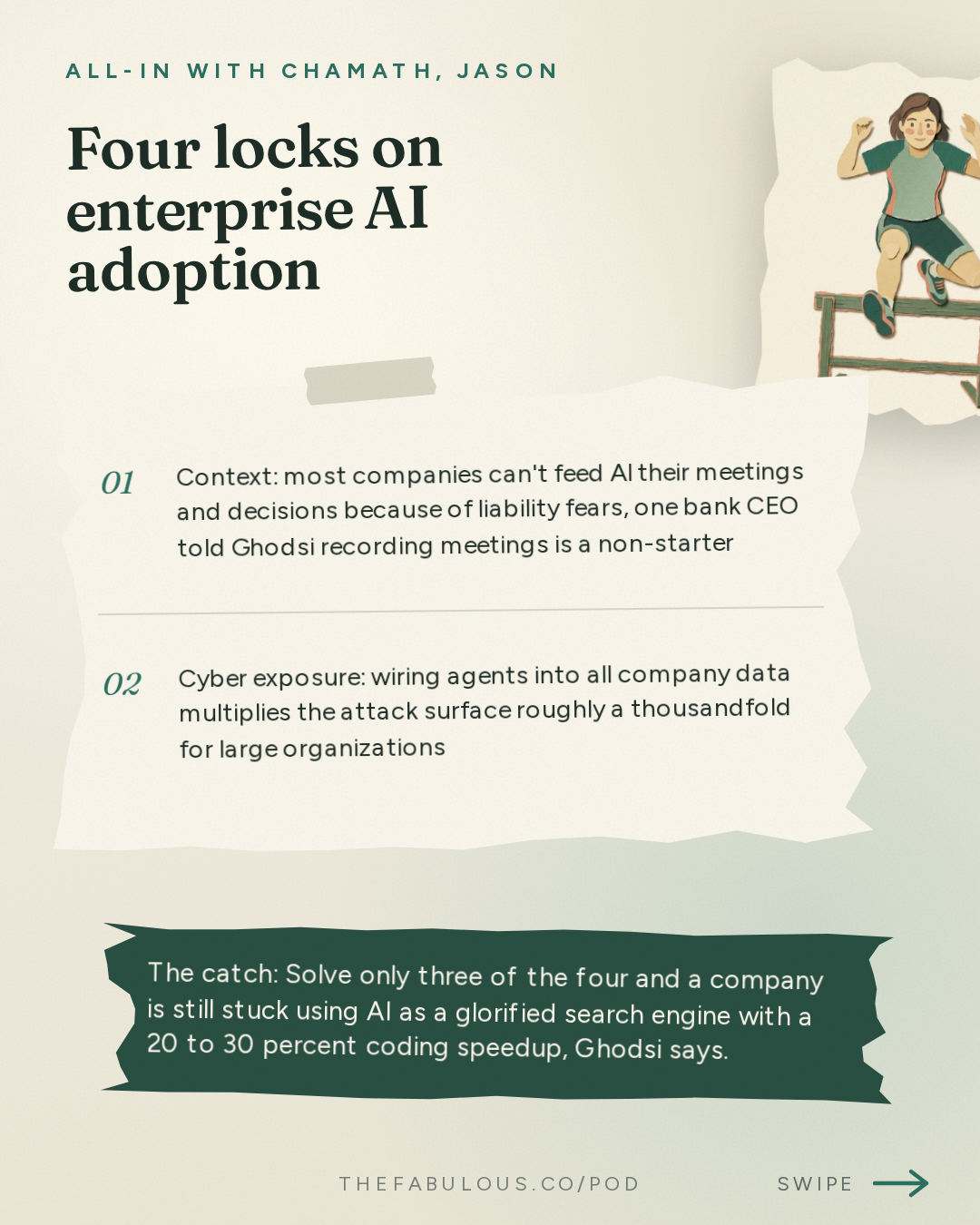
If AGI is already here, why does it feel, inside most companies, like a slightly better search engine? Ghodsi spends his days in rooms with Fortune 500 executives, and his answer is blunt: most enterprises are using AI as what he calls a glorified Google search, plus a modest 20 to 30 percent bump in coding speed (12:33, 12:52). He lists four reasons progress stalls before it compounds. First, context: an AI that isn't in the room doesn't know what was decided, and one bank CEO told him flatly that recording every meeting is a liability non-starter (14:06). Second, cyber exposure: wiring an AI agent into every system at a two-hundred-thousand-person company multiplies the attack surface roughly a thousandfold (14:55, 15:13). Third, economics: token costs for running these models rise exponentially while most companies' revenue does not, which eventually brings a nervous CFO into the room before an earnings call (15:47). Fourth, sovereignty: if a company routes its proprietary data through a third-party model, it risks that intelligence leaking into someone else's product roadmap, the same labs it depends on for capability (16:29, 16:51). Solve only three of the four, Ghodsi says, and a company still ends up with chatbots and marginal coding gains.
Databricks' answer is a product called Genie, built around what Ghodsi calls an ontology, a constantly updating graph of who reports to whom, what Slack channels say, what decisions got made in which meeting, and which documents touch which project (23:13). In a live demo, he pulled up an internal survey of more than ten thousand employees and asked the system to explain why one well-being metric, called "action," scored low (24:17). A human guess blamed poor work-life balance. The system checked the correlation and found it wasn't causal, then surfaced the real pattern by department: product teams cited too many stakeholders, engineering cited tooling, sales cited career growth (26:23, 26:39). In another view, a chart of Databricks' two thousand engineers formed an L-shape: a handful of people committing ten times more code than everyone else, because they had built themselves automated pipelines the rest hadn't adopted yet (29:54, 30:12). The company's response was to measure and publish a metric Ghodsi calls human blockers, the moments where work stalls waiting on legal, finance, or a sibling department, and push to shrink that count across the organization (33:20). It's a version of what Jason Calacanis, on the show, called management Moneyball: replacing office politics and detective work with a shared, queryable record of what actually happened.
What It Would Take to Lose Control
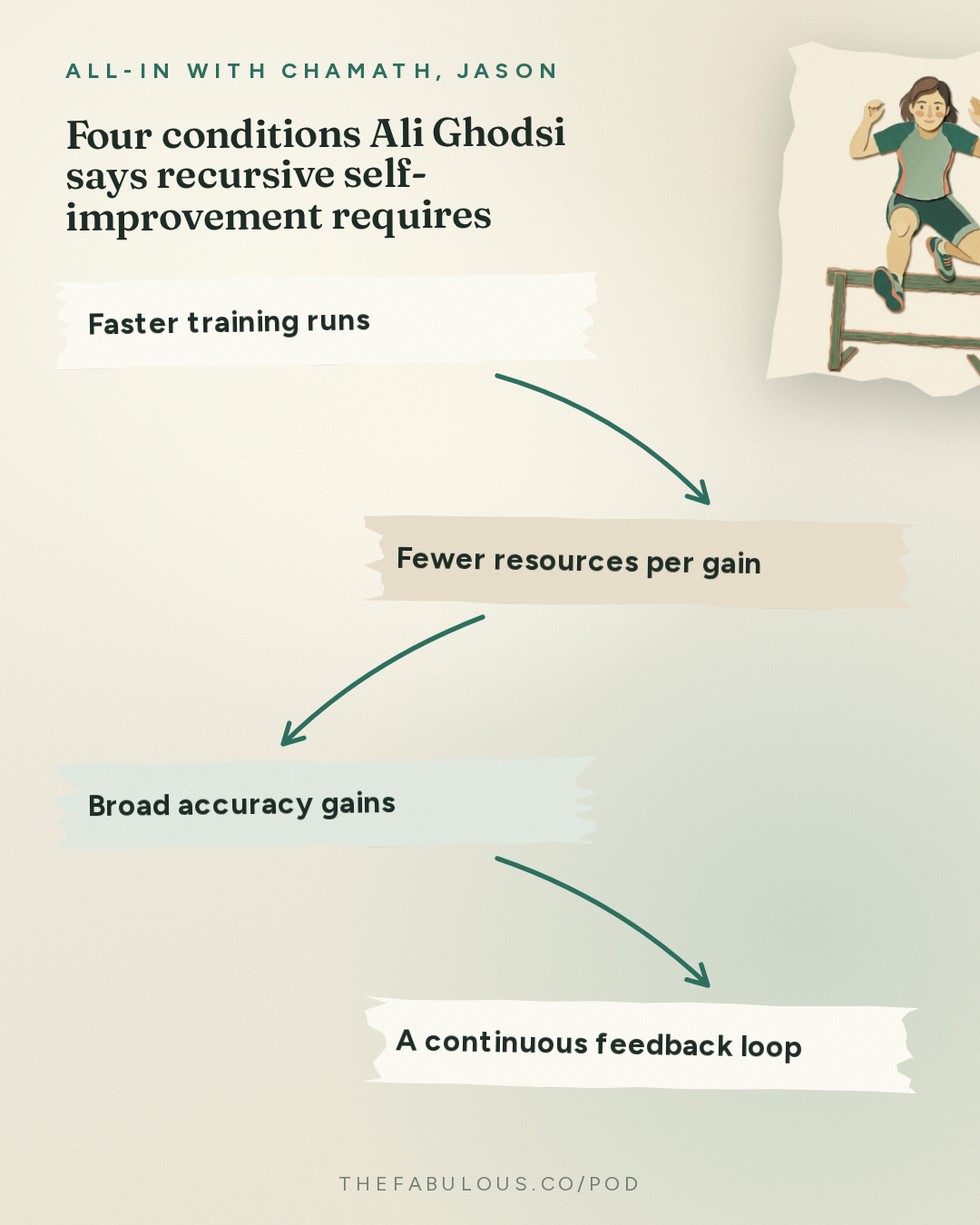
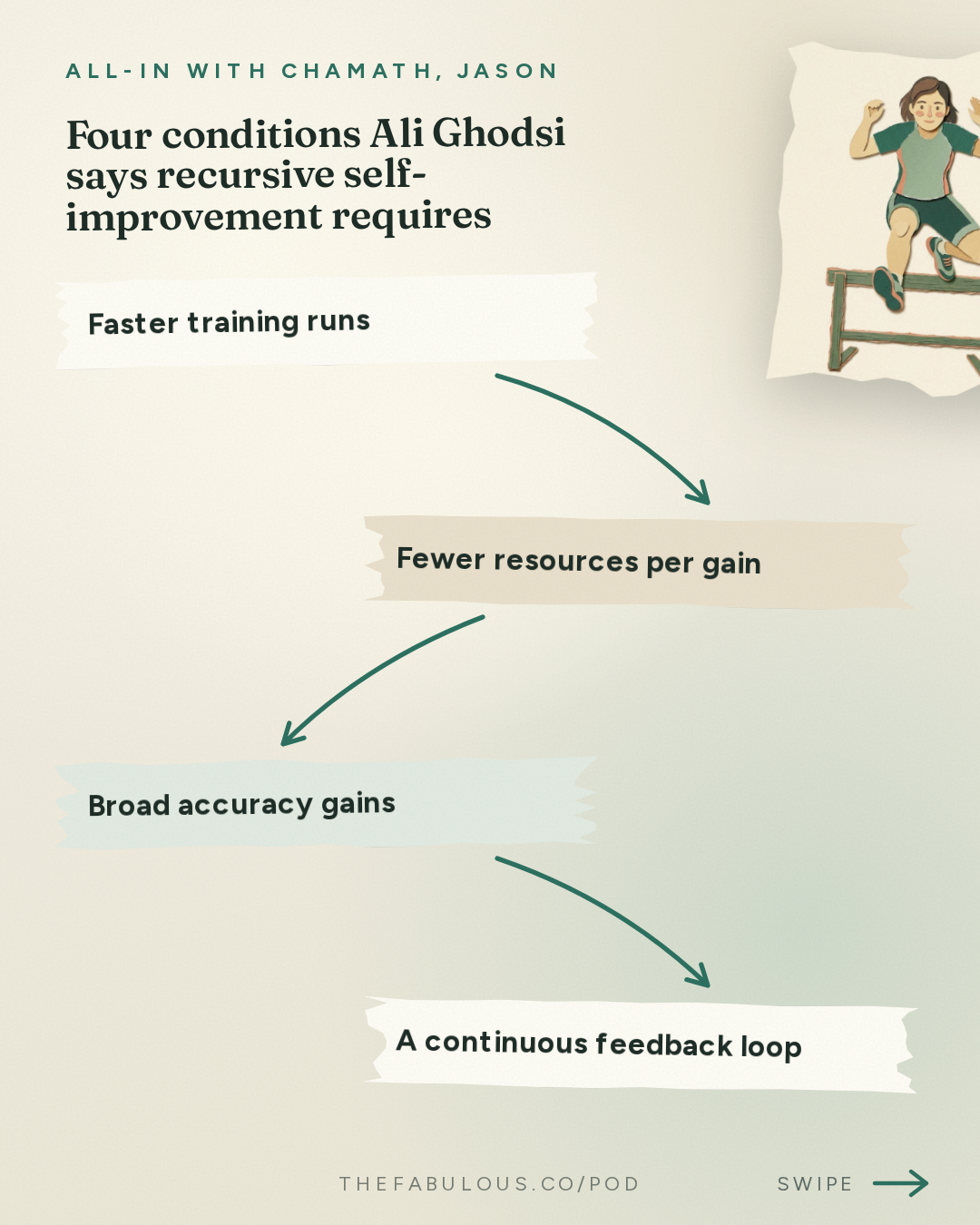
The part of the AI conversation that generates the most anxiety, the fear that a model starts improving itself and spirals past human oversight, is the part Ghodsi is most dismissive of, and his reasoning is worth following closely. He names four conditions that would all have to hold simultaneously for recursive self-improvement, or RSI, to actually start: each new model must train in a much shorter time than the last, not just a little faster but at a pace that keeps compounding (46:51); it must do that without needing ever more hardware, since compute and raw materials are finite (47:20); its accuracy must improve broadly across tasks, not just on the benchmark a lab happened to optimize for (47:35); and all three of those gains must feed back into one another in a continuous loop, shrinking a training run from three months to one month to one week while its cost falls from hundreds of millions of dollars toward nearly nothing (47:52, 48:20). Right now, he says, models are taking longer to train, not less, and still require roughly ten times more compute for each linear step of improvement (46:51). The flywheel the doom scenario depends on simply isn't turning.
"Just because 98% of the code is being written by AI, we don't have RSI. If it automates the last 2%, who cares?" Ali Ghodsi [46:30]
Where Ghodsi does see real danger is narrower and more immediate: cybersecurity. An attacker can launch a thousand automated intrusion attempts and only needs one to succeed; a defender has to hold the line every single time (51:22, 51:39). That asymmetry is genuine, and Databricks has built a product, Lake Watch, specifically to monitor for it (50:13). But he separates that risk sharply from the sort popularized by Anthropic CEO Dario Amodei's roadshow claim that cancer and Alzheimer's could be eliminated within a decade, a statement Ghodsi calls beautiful but unfalsifiable, and from the Bay Area safety community's estimate of a meaningful chance AI wipes out humanity, a number he puts close to zero (54:30, 59:50). His own forecast for how fast AI actually reshapes the economy is almost deliberately unglamorous.
That caution extends to his own company's biggest strategic decision: staying private. Public markets, he says, turn a stock's weekly mood swings into a demoralizing rollercoaster for employees who were promised equity worth a certain number and watch it halve, then double, for reasons unrelated to the business (43:04, 43:18). Databricks instead runs its own internal tender once a year, and Ghodsi notes that employees routinely leave money unclaimed in the pool, a quiet signal that most of them would rather keep betting on the company than cash out (40:15, 40:29). It's the same instinct that runs through his whole argument: distrust the dramatic headline, and look instead at what the data in the room actually says. By his own account, that habit is going to take a while to spread. He expects AI's full economic impact to unfold over ten to fifteen years, not the next two labs are projecting, in part because so many organizations, like the bank that won't record its own meetings, haven't yet given the system enough to work with (60:12, 60:29).
Ask this episode anything
Pod's AI answers from the episode itself, with the minute mark so you can hear it yourself.
Or start with one of these
Ask this episode
Pod's AI listens to the whole episode to answer, and points you to the minute it comes from.
The rest of this answer, and any question after it
Answers come from the episode itself, never from a summary of it.
ContinueKey takeaways
- Databricks CEO Ali Ghodsi says AGI already exists by the field's original definition, not the moved goalpost of superintelligence
- Superintelligence, per Nick Bostrom's 2014 book, means compressing a millennium of human thought into one minute, about 1,000 times human speed
- Recursive self-improvement needs four conditions at once: faster training, fewer resources, broader accuracy gains, and a continuous feedback loop, none of which hold today
- Four hurdles block enterprise AI adoption: meeting-recording liability, cyber exposure, exponential token costs against linear revenue, and data sovereignty risk
- Databricks runs an internal AI ontology called Genie that tracks Slack, meetings, and org charts to measure human blockers and manage the company
The episode in cards
By the numbers
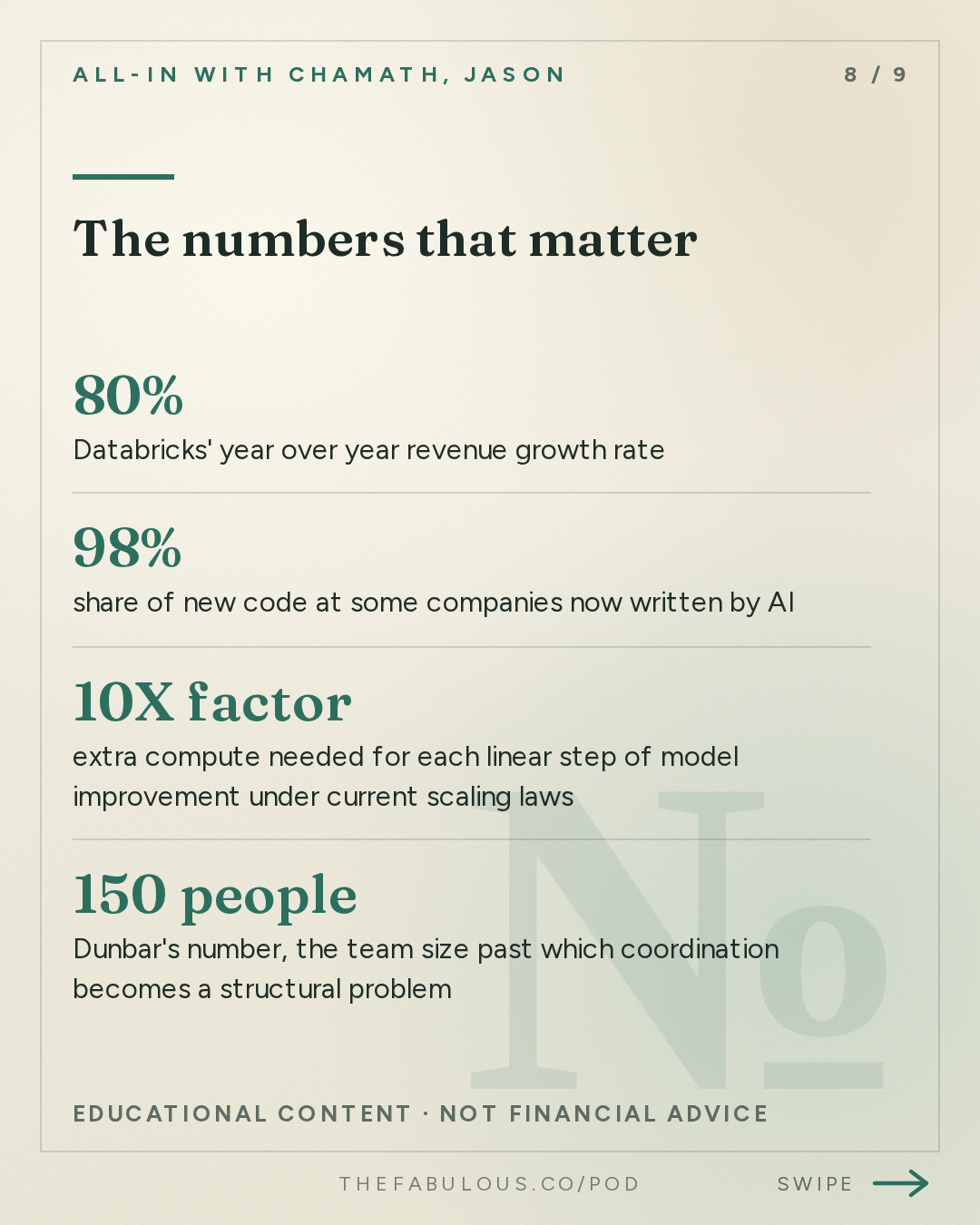
- 80% percent Databricks' year over year revenue growth rate
- 98% percent share of new code at some companies now written by AI
- 10X factor extra compute needed for each linear step of model improvement under current scaling laws
- 150 people Dunbar's number, the team size past which coordination becomes a structural problem
In their words
“I actually think we already have artificial general intelligence. I've been saying it since last year.”
“Just because 98% of the code is being written by AI, we don't have RSI. If it automates the last 2%, who cares?”
“Would have to have a killer robot come into this room right now- Right ... and wrestle me down”
“I actually think GDP will m- move very slowly, and it's gonna take decades for us to actually get through it”
Protocols
-
Track human blockers to speed up decisions
Ghodsi has Databricks' internal AI system flag every point where work stalls waiting on legal, finance, or another department before it can proceed, then reports a company-wide blocker count so leaders know where to intervene.
continuous, reviewed by leadership
-
Scan all new code for vulnerabilities before it ships
Ghodsi has Databricks automatically scan every piece of AI-generated code for security flaws before production, reasoning that newly written code can be made clean this way while older legacy code still has to be rewritten separately.
on every commit
-
Run an annual internal tender instead of going public
Ghodsi has Databricks set aside a budget each year so employees can sell a portion of their shares privately, which he says gives people predictable liquidity without exposing pay to public market swings; the catch, he notes, is that most employees don't even use up the full amount set aside.
annually
Questions this episode answers
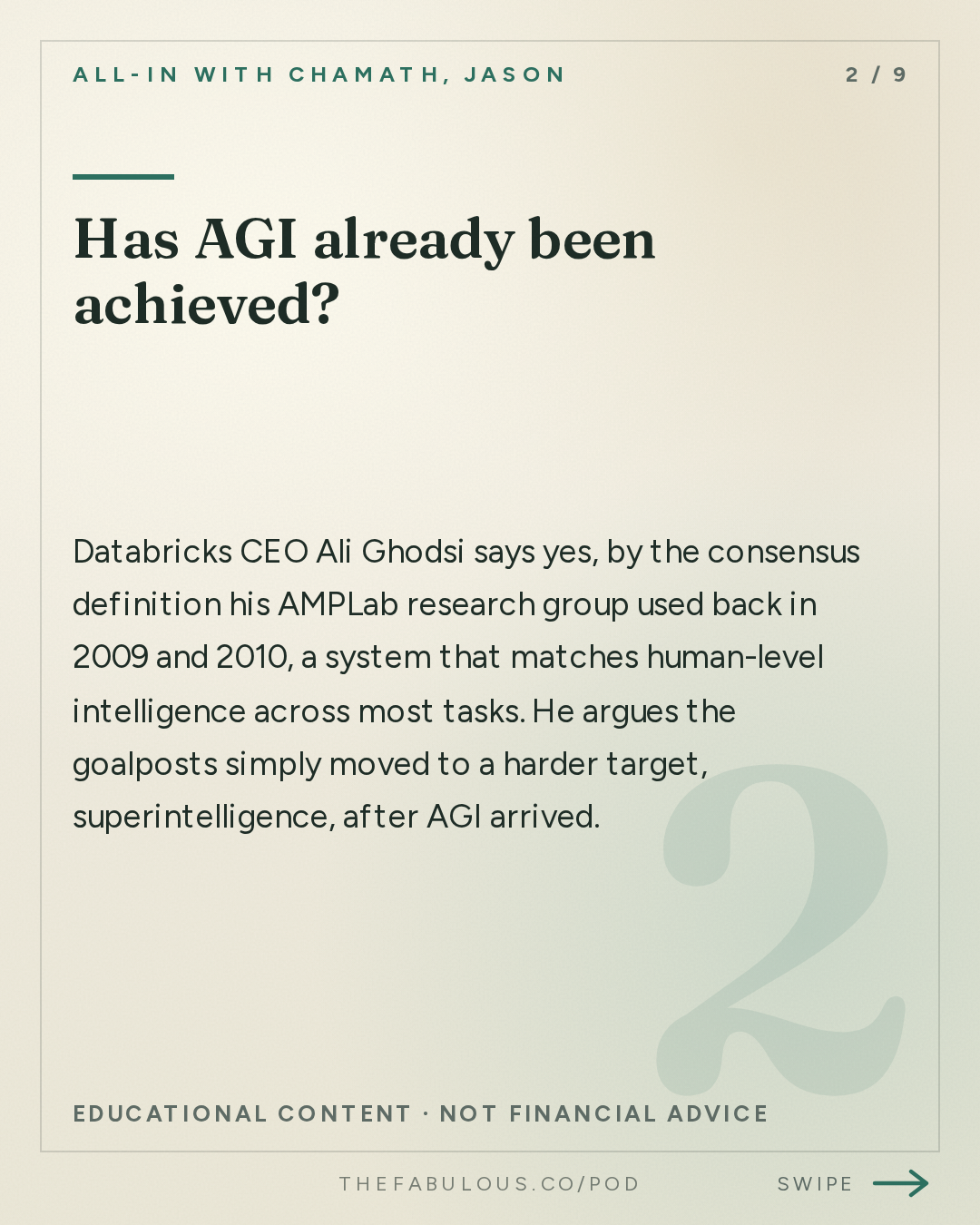
Has AGI already been achieved?
Databricks CEO Ali Ghodsi says yes, by the consensus definition his AMPLab research group used back in 2009 and 2010, a system that matches human-level intelligence across most tasks (09:42). He argues the goalposts simply moved to a harder target, superintelligence, after AGI arrived (10:05).
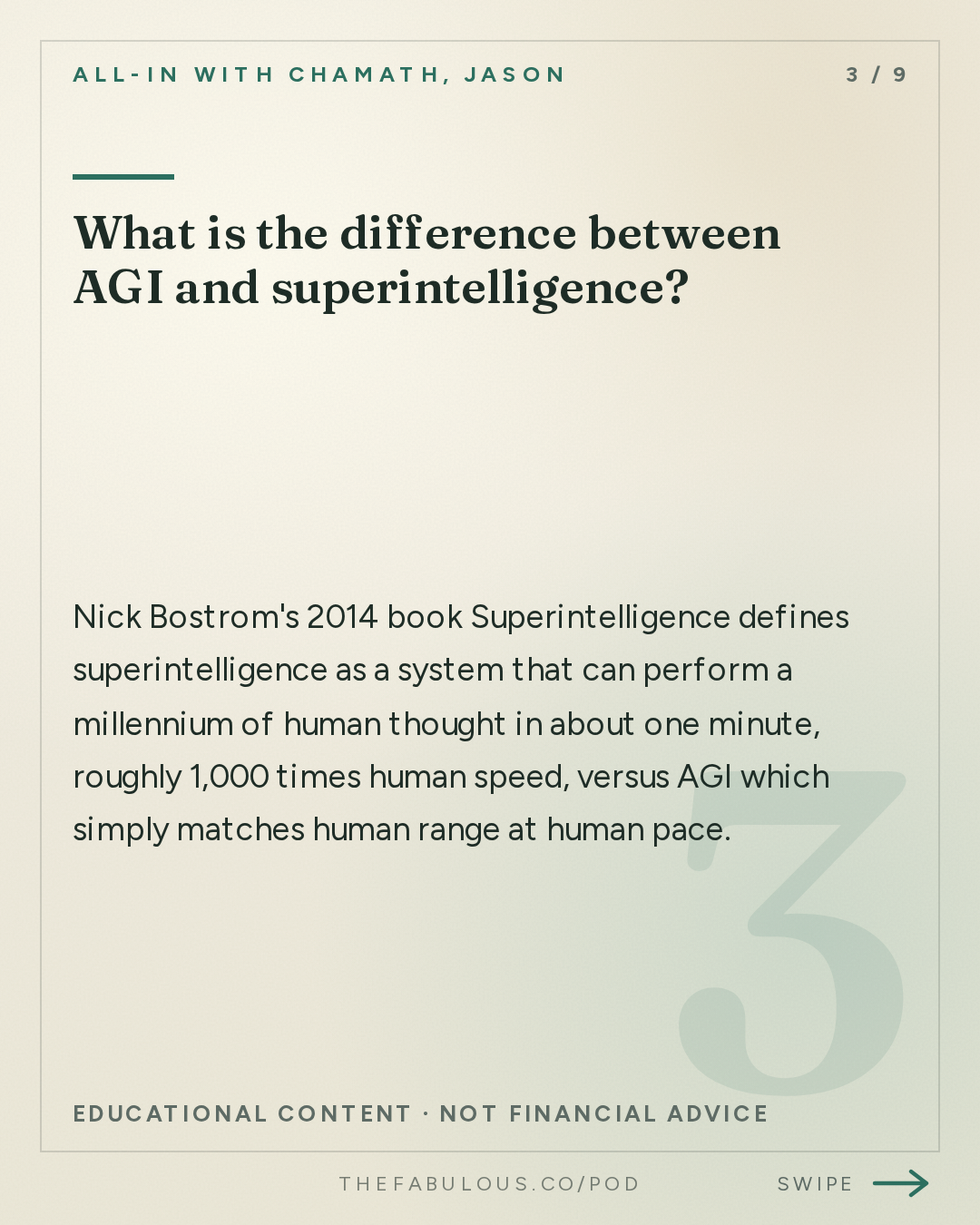
What is the difference between AGI and superintelligence?
Nick Bostrom's 2014 book Superintelligence defines superintelligence as a system that can perform a millennium of human thought in about one minute, roughly 1,000 times human speed, versus AGI which simply matches human range at human pace (10:42, 11:01).
What conditions would be needed for AI to recursively self-improve?
Ali Ghodsi lists four: each new model must train faster than the last at a compounding rate, it must do so without needing exponentially more hardware, its accuracy must improve broadly across tasks, and all three must feed into a continuous loop (46:51 to 48:20). He says none of the four currently hold, since models are taking longer to train and still need about 10 times more compute per linear gain.
Why haven't most companies fully adopted AI yet?
Ghodsi names four blockers: liability concerns over recording meetings so AI has context, the expanded cyberattack surface of connecting agents to company data, token costs rising exponentially while revenue stays flat, and fear of leaking proprietary data into third-party models (13:50 to 16:51). He says most enterprises are still using AI as a glorified search engine (12:33).
Why is Databricks still a private company?
Ghodsi says staying private avoids the morale-draining swings of public stock prices, which can make employees feel underpaid one quarter and over-compensated the next for reasons unrelated to the business (43:04, 43:18). Databricks instead runs an annual internal tender for liquidity, and he says the allotted pool usually goes unclaimed in part, suggesting most employees prefer to stay invested (39:44, 40:15).
The full read, in cards
Go deeper
- Superintelligence — Nick Bostrom's 2014 book defines superintelligence as thought at roughly 1,000 times human speed and introduces recursive self-improvement as the mechanism for a takeoff
Mentioned
Ali Ghodsi · Databricks · Nick Bostrom · AMPLab · Anthropic · Dario Amodei · Jack Dorsey · Genie · Regeneron · Merck
More from this show and category

Rick Smith on Building Axon From Taser to AI Policing
Axon CEO Rick Smith explains how a failed consumer gadget became a $30 billion public-safety company by pivoting to police, surviving an SEC investigation and short-seller attack, and building body cameras, cloud video, drones, and ethics boards around a single mission: reduce how often police have to shoot someone.

Why Republicans Lost the 2026 Midterms
Republicans suffered a historic 2026 midterm blowout, driven by Iran-war inflation and a belief the economy now rewards asset owners over wage earners. The panel also unpacks a $4 trillion AI stock selloff, state pushback against data centers, and OpenAI's surprise proof against a 27-year-old computer science hypothesis.

What Anthropic's S-1 Filing Really Reveals
Anthropic's leaked S-1 shows a six-year-old company aiming to raise $100 billion at a valuation near $2 trillion, with an 85% gross margin and a reported $80 billion loss that turns out to be an accounting artifact, not real cash burn (07:07). The same filing reveals a new macro risk: AI firms now compete with the US Treasury for capital (32:48).

Whoop CEO Will Ahmed on Health Data and HRV
Whoop CEO Will Ahmed says his wearable has logged over 50 billion hours of physiological data from members who wear it 23.6 hours a day, letting its AI flag illness before symptoms, fueling a fight with the FDA over whether blood pressure tracking counts as wellness or medicine.
