
The Overwhelm Recovery ProtocolWellness & Routines · ~5 min
About this template · Updated September 2026
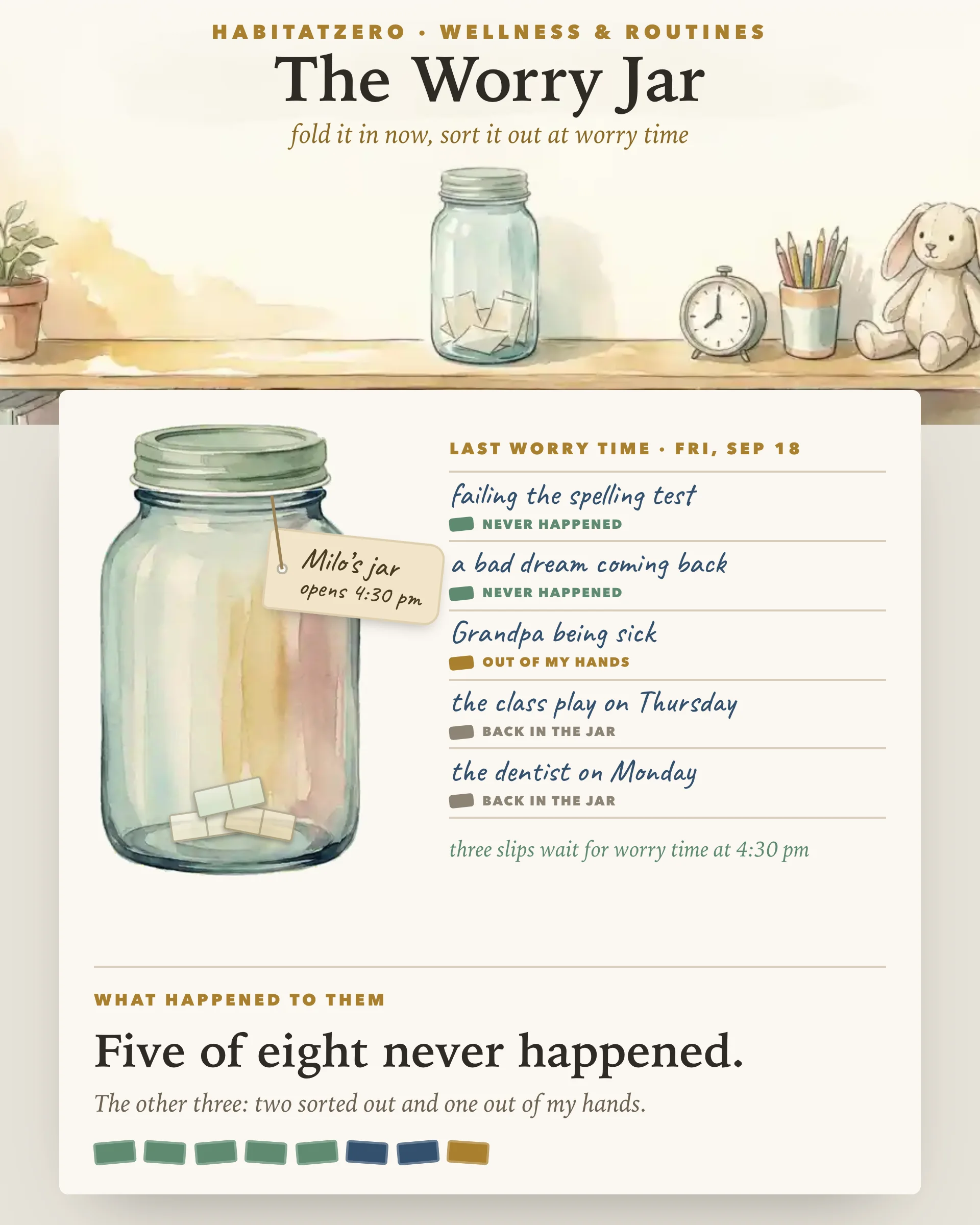
Children's worries keep odd hours. One surfaces at bath time, another in the car on the way to school, and the big one waits until the light goes off. A worry jar gives each of them somewhere to go: your child writes the worry on a slip and folds it in, and the lid stays on until the two of you open the jar together at a set time. The worry is not brushed aside. It is asked to wait, and it keeps its appointment.
The jar is a child-sized version of scheduled worry time, which researchers call worry postponement. In the early 1980s, Thomas Borkovec and his colleagues asked people who worried heavily to save their worrying for one set time and place each day and to put it off whenever it turned up at other hours. Their daily worry dropped more than a comparison group's did. The reasoning: worry clings to every place it gets rehearsed, and one fixed slot shrinks those cues.
Children need that move made physical. A slip to fold and a lid to close turn think-about-it-later into something their hands can do. They also have plenty to practice on: in a study of 193 ordinary schoolchildren aged 8 to 13, almost 70 percent said they worried every now and then, mostly about schoolwork, health and friendships.
Start with the tag: pick one of four worry times between 3:30 and 6:30 pm and add your child's name. Whenever a worry turns up, it goes on the slip in a few words, and the ideas help when a blank line feels like too much. Folding it in drops the slip into the glass, where nobody reads it again until worry time.
The jar holds twelve slips. A full jar usually means worry time has been skipped, so the page asks you to open it before anything else goes in. A worry that is already waiting cannot go in twice.
At worry time, open the jar. The lid comes off and the oldest slip comes out first. Read it together, then decide where it belongs:
Below the jar, the record keeps each sorted slip in its pile and sums them up in one line, such as five of eight never happened. A paper jar cannot do that part. Over a few weeks your child sees, in their own words, how many of their worries turned out to be false alarms.
The clearest evidence for keeping count comes from adults. Lucas LaFreniere and Michelle Newman had 29 people with generalized anxiety disorder log their worries for ten days and then track what actually happened. Of those worries, 91.4 percent did not come true. The most common result for a single person was that none of their worries did, and the people who saw more of their worries fail to happen improved more over treatment.
Keep the limits in view. That was a small study of adults with a diagnosis, and the postponement research was done with adults as well. This page is not a tested treatment for childhood anxiety, and your child's count may land well below 91 percent. The jar's job is to let your child check the worry's track record instead of taking its word for it.
For a worry that needs a real decision, The Worry Tree walks one through whether there is anything to do about it. When the worry lives in the body, The Calm Down Jar gives your child something to shake and watch settle while they breathe. Teenagers and adults who want the same appointment on paper can keep a Worry Journal.
Worry is part of growing up, and this jar is built for the everyday kind. The CDC notes that fears and worries a child does not outgrow, or that get in the way of school, home or play, can be a sign of an anxiety disorder, and that the first step is talking with your child's health care provider. If worry runs most days, your child's pediatrician or a child therapist is the right next call, and the jar's record can come along.
It is a jar where a child posts worries on small folded slips so they can wait for a set time instead of following the child around all day. The idea comes from scheduled worry time, a technique first studied with adults, turned into something a young child can hold, fill and open.
Agree on a daily worry time of about ten minutes, in the afternoon rather than at bedtime. Between those times, each new worry goes on a slip and into the jar. At worry time you open it together, read the slips out loud, make a small plan for any that still need one, and let the others go.
They are cousins built on the same idea: a worry gets a place to wait. A worry box is the jar in another shape, and a worry monster is a soft toy with a zipper mouth that swallows the slips. The container matters less than the part that follows, opening it at a set time and talking each slip through together.
Some worry is an ordinary part of growing up. If worries crowd most days, keep your child from school, sleep or play, or keep arriving with stomachaches and headaches, bring it up with their pediatrician or a child therapist, who can look at the whole picture.
You can explore the filled-in example on this page right away. To fold in your own child's worries and keep the jar, the tag and the running count from one worry time to the next, personalize it in HabitatZero, which is free.
By the team behind Fabulous, the science-based self-care app used by over 30 million people.


