Leaves on a StreamEmotional Fitness · ~3 min
About this template · Updated September 2026
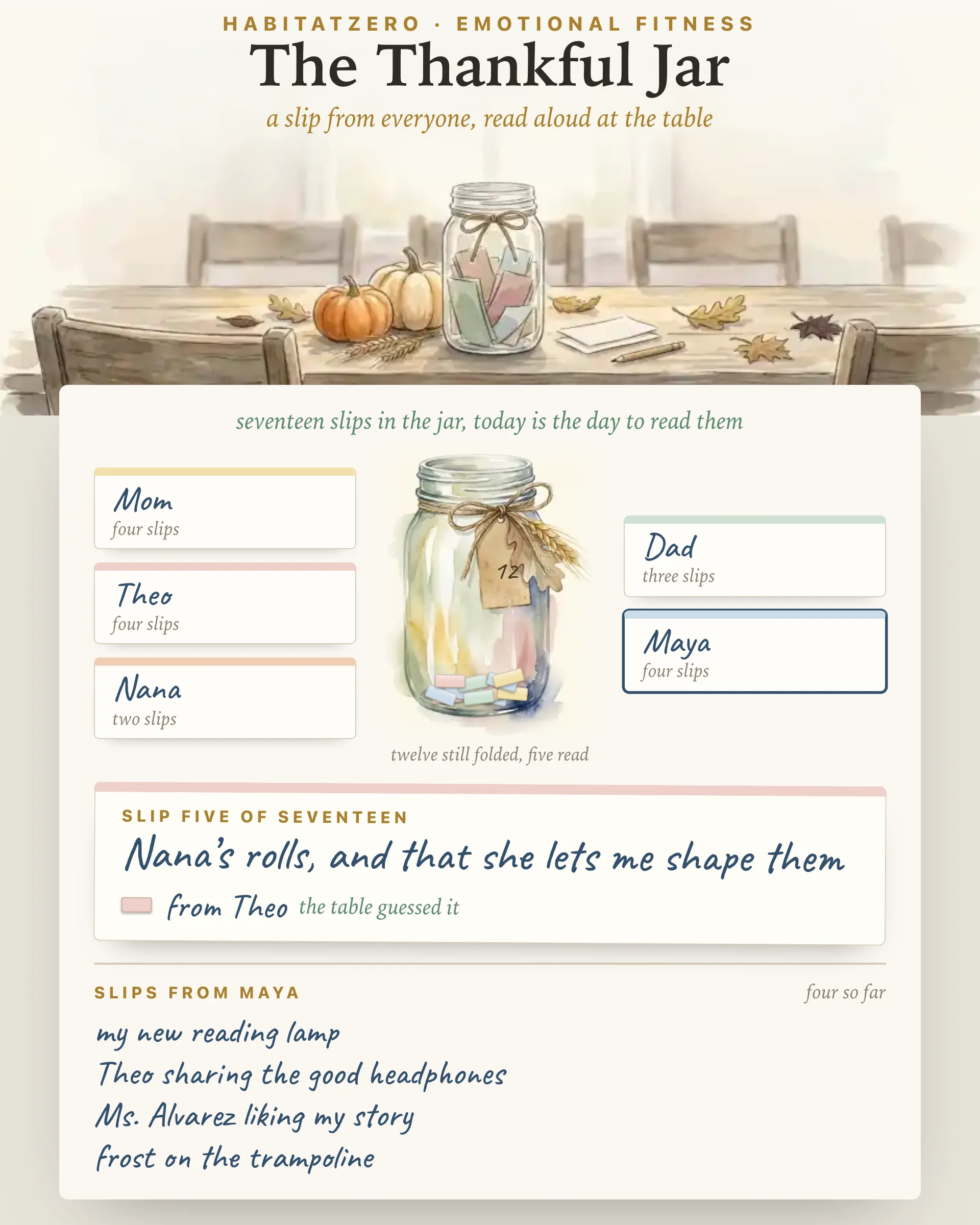
Some families have done this for so long that nobody remembers who started it. On the first of November an empty jar goes on the kitchen counter with paper slips and a pencil beside it. Whenever somebody thinks of something they are glad about, they write it down, fold it, and drop it in. On Thanksgiving, between the main course and the pie, the jar goes around the table and the slips get read out one at a time.
That is the whole tradition, and it needs no app. This page adds what glass cannot: it remembers who wrote what, counts the days, and runs the reading, guessing game included.
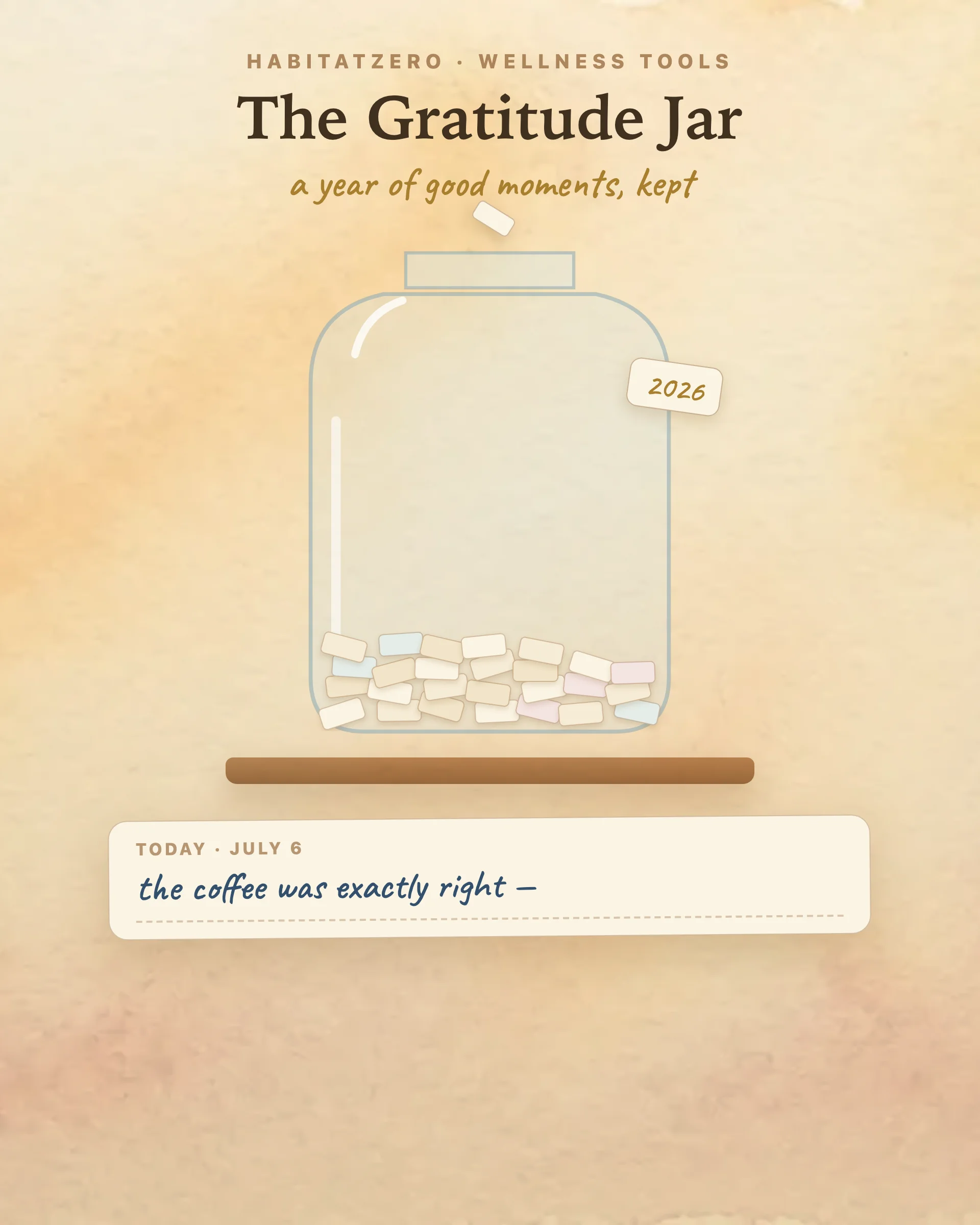
A thankful jar differs from a private gratitude habit in two ways. It belongs to several people at once, and it is pointed at one evening. If you want a personal jar that fills quietly all year, The Gratitude Jar is built for that.
Because the slips will be heard by the people they are about, they get specific: not "my family" but "Theo setting the table without being asked." And because there is a deadline, nobody has to keep it up forever. You keep it up until Thursday.
Start by setting a place for everyone who will add slips. Tap a suggested name or type your own, up to eight. Each person gets a place card beside the jar and a paper color that is theirs.
Then choose the day the jar gets read. Thanksgiving and Canadian Thanksgiving are one tap each, and any other date works too. From then on the top of the sheet counts down: nineteen days until the slips are read, then tomorrow, then today.
To add a slip, tap your place card and write one short line, or tap a suggestion if you are stuck. The slip folds into the painted jar in your color, and the paper tag on the jar keeps the count. The jar holds sixty, which is about as many as a table will happily sit through.
On the day, press open the jar. One slip comes out at random, large enough to read across a table. Everyone guesses the writer by tapping a name, the writer is revealed, and you draw the next. No slip comes out twice. At the end the last card says how many writers the table got right, and the jar can be emptied for next year.
Nobody has run a trial on thankful jars. What exists is research on the pieces.
Writing down what you are grateful for has been tested with children. In a classroom experiment with 221 early adolescents, whole classes were randomly assigned to count blessings, list hassles, or do neither. Counting blessings was associated with more self-reported gratitude, optimism and life satisfaction and with less negative mood, and the sturdiest link was with how satisfied the students felt with school, which still held three weeks later. Those are self-reports over a short stretch, so read it as encouraging rather than settled.
Parents seem to matter. A seven-day diary study of 101 parent and child pairs found that on days when a parent did more than usual to draw a child's attention to gratitude, that parent also reported seeing more of it from the child. That is an association resting on the parents' own reports, so it cannot show that one causes the other.
The jar is also a ritual. A review covering fifty years of research on family routines and rituals found them related to parenting competence, child adjustment and marital satisfaction, while pointing out that many of the studies measured rituals inconsistently and leaned on convenience samples. And one influential theory holds that gratitude expressed between people works to strengthen the relationship itself, which is a fair description of what happens when a grandmother hears her rolls read out by name.
None of this promises a happier child by December. It suggests the habit is worth a jar and a pencil.
Adults go first. If the only slips in the first week are yours, that is normal; children join a thing once it is visibly happening. The smallest ones can dictate while you write, and the slip still goes in under their name and color.
Let the odd ones in. A slip that says "pie, all of it" or thanks the dog is doing its job. The moment slips get graded for depth, teenagers stop writing them.
Keep it near dinner. Half a minute after the plates are cleared beats a Sunday session that everyone dreads. If somebody is stuck, the Gratitude Prompts Deck will deal them a question. And do not chase whoever has the fewest slips; the place cards show the count, and that is nudge enough.
The first of November is the classic start, and the run to Thanksgiving is short enough to finish. If you are planning the rest of the season too, The Fall Bucket List pairs well with it: one page for what you will do, one for what you noticed.
Start late if you have to. A jar begun the weekend before still has something in it by Thursday.
It is a family tradition for November. An empty jar sits where everyone passes it, people write what they are glad about on small slips and fold them in, and on Thanksgiving the slips are read aloud at the table. This page is that jar with names, a countdown and a read-aloud mode built in.
Give every child a place card and a slip color of their own, keep each slip to one short line, and let the littlest ones dictate while you do the writing. Put your own slips in first, because children tend to join once they see the adults doing it. One slip after dinner is plenty.
One specific line works best. Theo setting the table without being asked lands harder than my family. Food, pets, small favors, a teacher who noticed, a joke from the week all belong, and the odd ones usually get the biggest laugh when they are read out.
Most households start on the first of November and read the slips on Thanksgiving Day, often in the gap between dinner and dessert. Here you can also choose Canadian Thanksgiving or any other date, and the sheet counts down the days until then.
On this page you can look over a jar that a sample household has already filled, reading card included. Setting places for your own family and keeping their slips from one evening to the next happens once you personalize it in HabitatZero, which costs nothing.
By the team behind Fabulous, the science-based self-care app used by over 30 million people.