ADHD Daily Task OrganizerFocus & ADHD · ~10 min
About this template · Updated September 2026
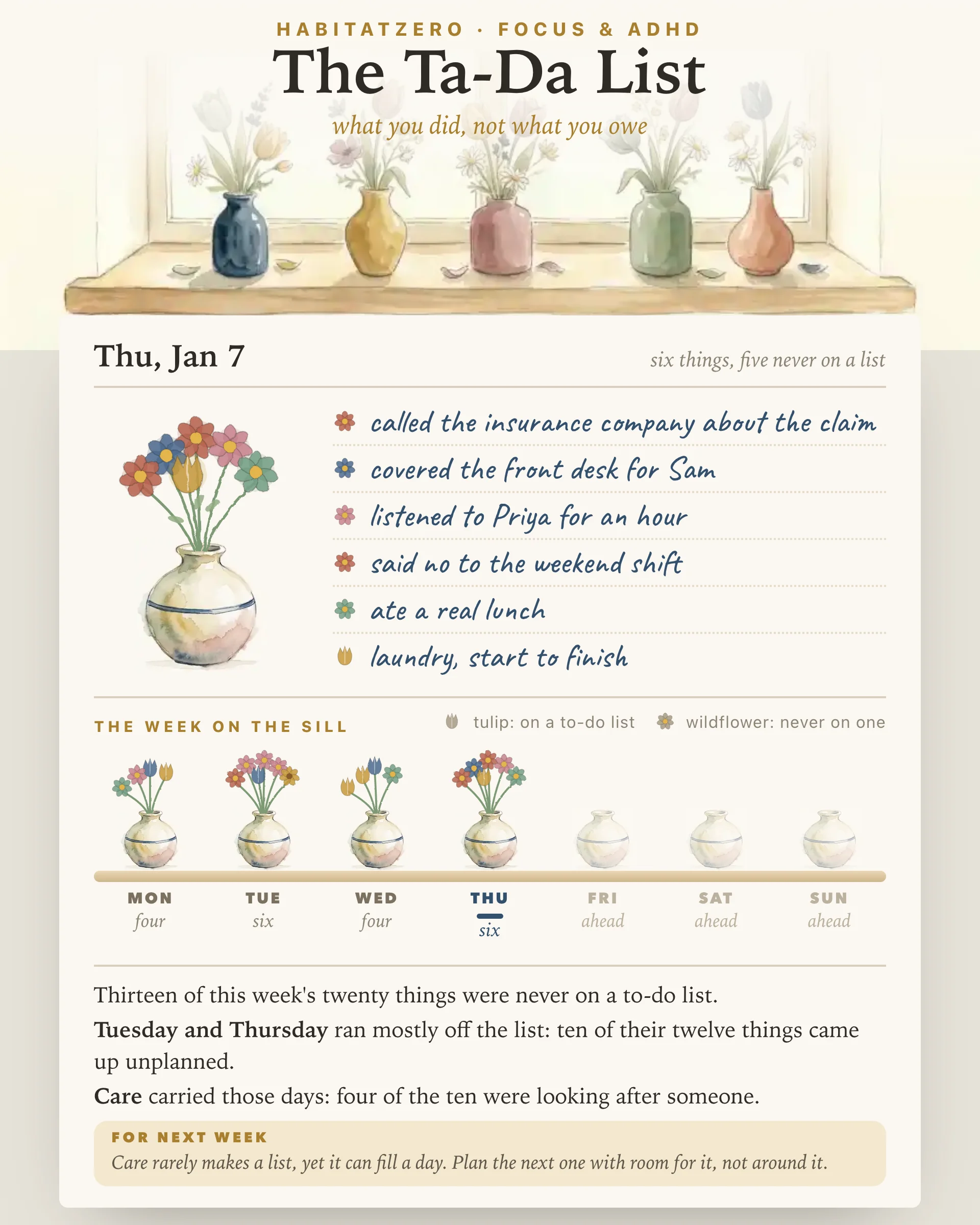
Some days end with a to-do list that looks untouched and a body that feels like it ran a marathon. You answered the school, drove your mom to an appointment, talked a friend down, fed everyone, and the list still says call the insurance company. A ta-da list is built for that mismatch. Instead of writing what you owe, you write what you did, after you did it.
People also call it a done list or a reverse to-do list. The idea is old and plain, and it works fine on paper. What paper does badly is the part this page is built for: showing you, across a week, how much of what you did never appeared on any list at all.
Each thing you did goes into today's vase in a few words. Type your own or tap an idea; the ideas lean toward the things people forget to count, like a call you dreaded or a meltdown you calmed. Then tap what kind of thing it was: work, home, care, for me, or hard stuff. If it was on your to-do list, press that toggle and it goes in as a tulip, something you planted. If it wasn't, it goes in as a wildflower, something that came up on its own.
A vase holds twelve stems a day. Past that, the page asks you to take one out first, which keeps the list short enough to read at a glance. Tap change on any line to fix its words, its kind, or whether it was planned, and the reading below follows the correction.
Seven vases sit on the sill, one for each day of the week you started. After two days and five things, the sill starts reading itself back to you: how many of the week's things were never on a to-do list, which days ran mostly off the list, and which kind of work carried those days. When the seventh day has passed, the week keeps its reading and takes nothing new, and a fresh week begins only when you ask for one.
Most planning tools capture only what someone decided in advance. A lot of real effort doesn't work that way. Writing in the American Sociological Review, Allison Daminger drew on interviews with members of 35 couples about running a household and described a whole layer of cognitive labor: anticipating needs, weighing the options, making the call, and keeping an eye on how it goes. In her account that work is taxing and often invisible, both to the people doing it and to their partners.
Care, admin and hard conversations share that invisibility. They rarely make the list because nobody schedules them; they arrive. So a week can look like a failure on the to-do list and still fill every vase on the sill. When the reading says care carried your unplanned days, that is not a flaw in your planning. It is a count of work that was real and unscheduled, and a hint about how much room the next week should leave for it.
The closest evidence comes from Teresa Amabile and Steven Kramer. They gathered nearly 12,000 end-of-day diary entries from 238 people on 26 project teams in seven companies, and reported in The Power of Small Wins that steps forward showed up on 76 percent of people's best-mood days, while setbacks showed up on only 13 percent of those days. They called this the progress principle, and they found that minor steps counted too. An older idea sits underneath it: in 1984 Karl Weick argued for small wins as a way of redefining the scale of social problems.
Be honest about the limits. That diary study followed knowledge workers doing project work, and it shows which events went with good days, not that writing anything down causes them. As far as we can find, no trial has tested ta-da lists themselves. What a done list gives you is a record, a way to see progress that happened instead of trusting a tired memory at nine in the evening. It won't treat low mood, and a sill full of wildflowers is not a diagnosis of anything.
Open it at the end of any day that felt like nothing got done, and keep writing until the vase says otherwise. Keep it running through weeks heavy with caregiving, travel or other people's emergencies, when the plan is the first thing to go. If you have ADHD and your to-do list mostly records what didn't happen, a done list gives the day's evidence somewhere to land.
It works best beside a plan, not instead of one. Plan the next three things with The Folded List, and if you want to know where the hours went rather than what got finished, try The Half-Hour Log. For a quieter evening check-in about how the day felt, the Daily Reflection Journal asks three short questions.
Read the sill before you plan the next week. The kinds that keep turning up as wildflowers are telling you what your plans leave out.
A ta-da list, also called a done list or a reverse to-do list, records what you actually did today, written after the fact instead of planned ahead. Where a to-do list points at what is still owed, this one shows what got handled, including everything nobody asked you to plan.
Anything that took time, effort or nerve: work tasks, chores and errands, looking after someone, looking after yourself, and hard moments like a phone call you dreaded or a meltdown you calmed. Small entries belong there too, since most of a day is made of them.
The best-known evidence is indirect. In a diary study of 238 knowledge workers, Teresa Amabile and Steven Kramer found that making progress, even in small steps, was the most common feature of their best days. We could find no trial of ta-da lists themselves, so treat the list as a way to see the progress you made rather than as a mood treatment.
No. Ta-da List was a free to-do app that Basecamp launched in 2005 and has since retired; despite its name, it tracked what was still left to do. This worksheet only shares the name of the habit and has no connection to Basecamp or its products.
The sample on this page shows how a half-finished week reads on the sill. To keep a ta-da list of your own from one day to the next, personalize this template in HabitatZero at no cost.
By the team behind Fabulous, the science-based self-care app used by over 30 million people.