ADHD Daily Task OrganizerFocus & ADHD · ~10 min
About this template · Updated September 2026
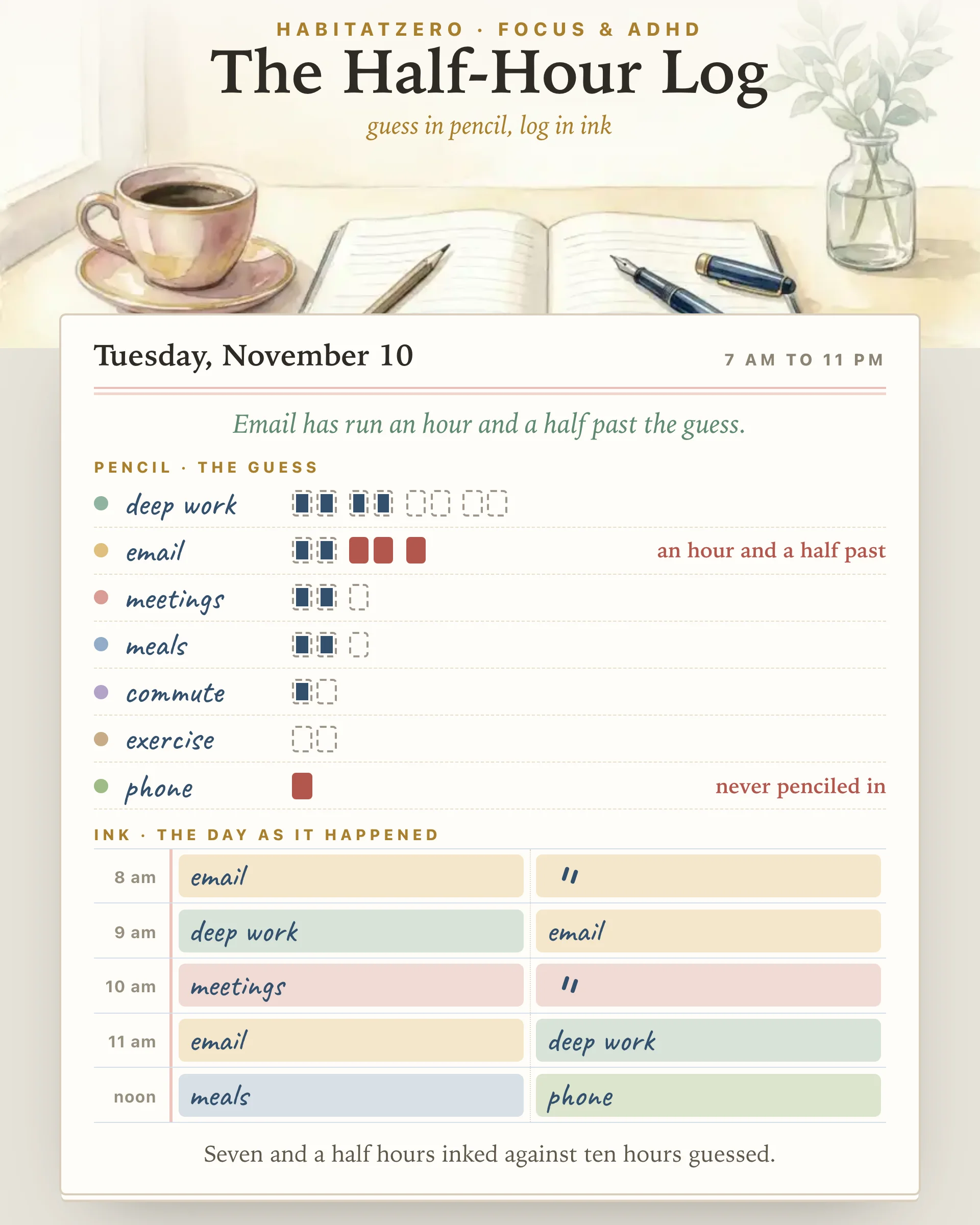
Ask someone where their workday goes and you will get a confident answer. Ask them to write it down every half hour for a day and the answer usually shifts. The distance between the day you think you had and the day you actually had is what a time log is for, and this page is built around that distance: you guess in pencil first, then log in ink, and the sheet shows where the ink ran past the pencil.
Most time log templates are blank grids. You fill the slots, add up the columns and look for a surprise. The catch is that a surprise depends on what you expected, and nothing on a blank grid records that. So this log opens with a guess. Before the first half hour is inked, you pencil in how long each thing on your list will take today: three hours of deep work, an hour of email, an hour and a half for meals.
People often underestimate how long their own tasks will take, and a review by Michael Roy, Nicholas Christenfeld and Craig McKenzie argued that part of the trouble lives in memory: we underestimate how long past tasks took, then build the next plan on that shortened memory. A log repairs the memory. The guess shows you which memories were running short.
Start with a short list. Tap the four or five things your days are usually made of, or write your own, up to eight. Each one gets a row of dashed pencil boxes, one box per half hour, and plus and minus buttons to size the guess.
Then log the day as it happens. Tap a half hour, pick what filled it, and the picker steps forward to the next slot, so catching up on a busy morning takes a handful of taps. A run of the same activity shows as ditto marks, the way it would on paper. Anything not on your list can be typed straight into the picker.
The first ink locks the pencil. You cannot adjust the guess once logging starts, because a guess you can edit after the fact has stopped being a guess. As the half hours fill, ink fills the pencil boxes. When an activity runs past its guess, the extra boxes turn red, and the line at the top of the sheet names the one furthest over. Anything you never guessed at gets its own line, since the half hours nobody planned for are often the most telling.
The day turns over at 4 a.m., so a late evening still belongs to the day it started. Open the page the next morning and yesterday's sheet stays readable but takes no new ink until you start a fresh page. The fresh page carries your list forward and shows what the last log held under each guess, which is exactly the number your memory would have trimmed.
Fifteen-minute slots catch more, but they are hard to keep up for a whole day. Hourly slots are easy to fill but blur a morning of small interruptions into one tidy block. Half an hour sits between the two: fine enough that three quick trips into your inbox show up as three entries, coarse enough that you can fill in the morning from memory at noon without inventing anything.
Recording the actual day rather than a typical one is the backbone of time-use research. The American Time Use Survey opens each interview by asking what the person was doing at 4 a.m. yesterday and walks forward through the full day, and its interviewers are trained to keep people on the activities actually done that day rather than a usual day. A personal log applies the same discipline to one ordinary Tuesday.
If you are logging to move a goal, such as more hours of focused work, keeping track helps. A meta-analysis of 138 experiments found that monitoring progress toward a goal made people more likely to reach it, with larger effects when the progress was physically recorded.
What no study shows is that logging in half hours will, on its own, make you more productive. The log is a measurement. It will also nudge the day a little, because it is hard not to tidy up behavior you know you are writing down, so treat the first logged day as a warm-up.
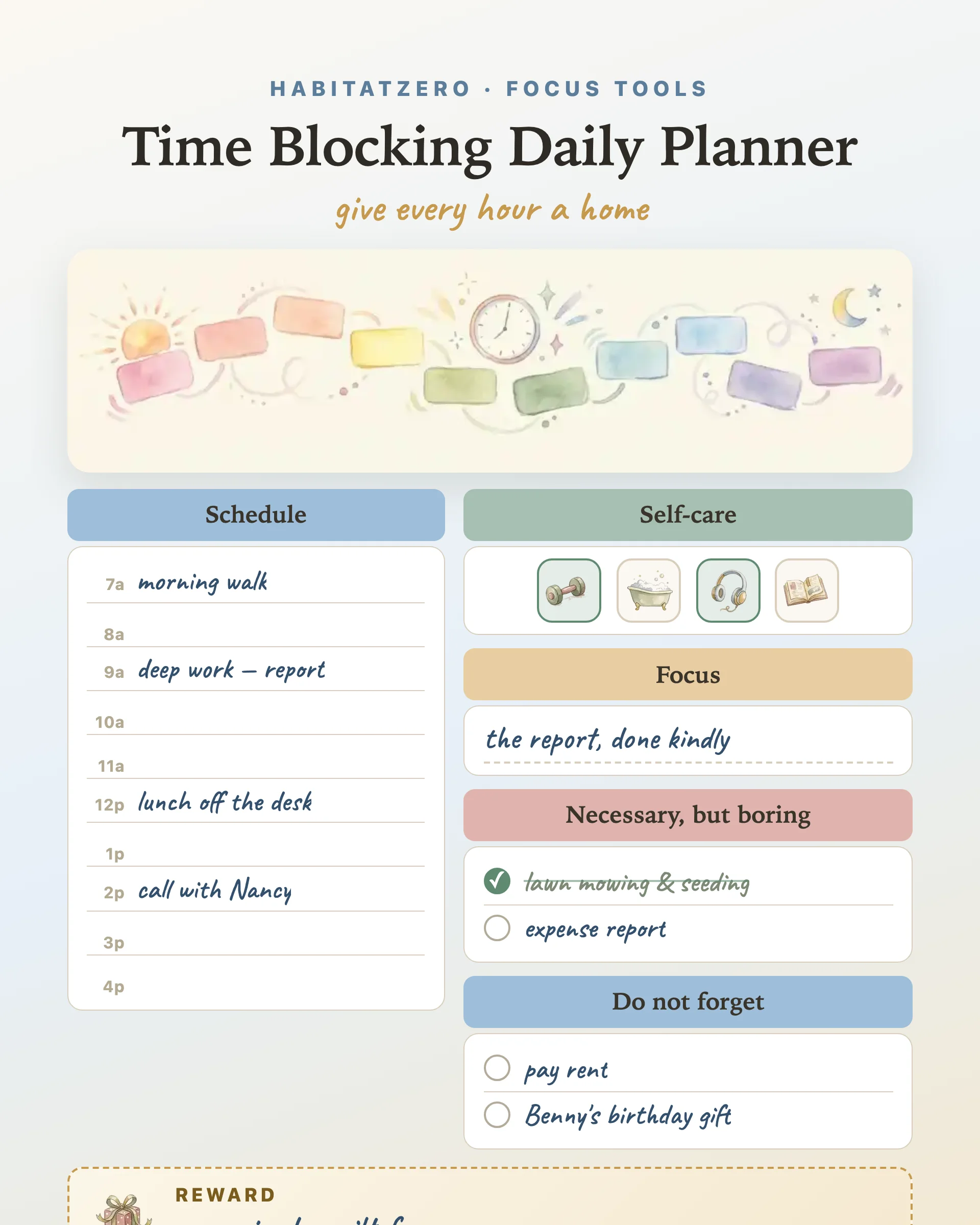
Keep it for three ordinary days, one of them on the weekend, before you change anything. If the same activity runs long on two of the three, take it seriously. Then put the numbers to work: size tomorrow's blocks honestly in the Time Blocking Daily Planner, give the stretch that keeps losing out a protected session with the Deep Work Planner, or step back with Where the Hours Go, which sets the whole week on one dial.
The page also prints cleanly, pencil rows and inked half hours included, if you would rather keep the day on paper.
When the same activity overruns every day, the fix is rarely more willpower. Usually it is a bigger guess.
A time log is a running record of what you actually did, kept in fixed slots while the day happens rather than pieced together from memory at night. Half-hour slots catch most switches between tasks without turning the log into a second job.
Catch up in small batches instead of stopping every thirty minutes. Checking in at lunch, mid-afternoon and before bed is usually enough to fill the slots while the hours are still fresh. Keep it for three ordinary days, one of them on the weekend, before drawing any conclusions.
No. A timesheet records paid hours for an employer or a client, usually by project. A time log records everything the day held, meals and phone time included, and it is for your eyes only, so you can see where the hours really went.
Because the surprise in a time log only shows up against an expectation. Research on how long tasks take suggests people misjudge future durations partly because they remember past ones as shorter than they were, so a guess set beside a real record shows exactly which memories run short.
You can look through the sample day on this page without signing in. To pencil in your own guesses, ink real half hours and have tomorrow's page remember today, open the log in HabitatZero at no cost.
By the team behind Fabulous, the science-based self-care app used by over 30 million people.