ADHD Daily Task OrganizerFocus & ADHD · ~10 min
About this template · Updated September 2026
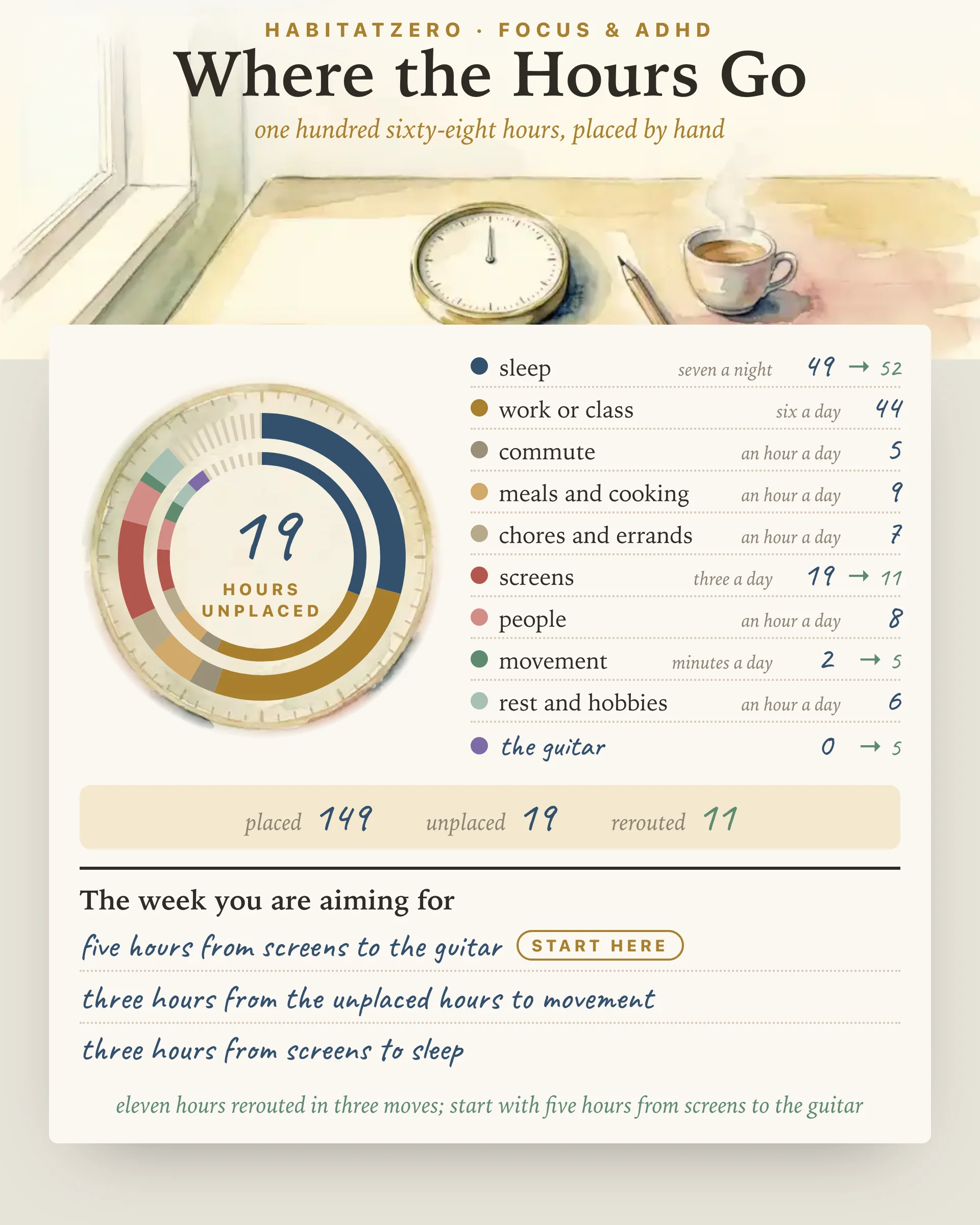
The oldest time management worksheet is a piece of arithmetic. A week has one hundred sixty-eight hours. You write down how many go to sleep, to work, to getting there and back, to eating, to the phone, and you add them up. The number left over is the interesting one, because it is almost never zero and almost never what you expected. Student advising offices have handed out versions of this sheet for decades, usually as a grid with a total at the bottom. This page is the same exercise built as a dial, so the adding happens while you slide and the shape of your week appears in front of you.
Most planning tools start at nine in the morning and stop when the laptop closes. That frame hides the lines that decide how a week actually feels: how much you sleep, how long the chores take, how many evenings dissolve into a screen. Budgeting the full one hundred sixty-eight puts those lines beside work, in the same units, on the same ring. A commute that costs seven hours a week looks different once it sits next to the two hours you gave to movement.
Each line of the ledger is a slider. Sleep first, because it is the easiest to know: seven a night makes forty-nine, and the hint under the line says so in plain words. Then work or class, the commute, meals, chores, screens, people, movement, rest. The last line is blank until you name it, and it is for the thing you keep meaning to do: the guitar, the novel, the run. Its number is usually small, and seeing that small number next to the screens line is the moment the sheet earns its keep.
As you slide, colored arcs fill the outer ring and the count in the middle falls. The dial will not let you place more than the week holds; push a line past what is left and it stops, and the status line tells you why. When you stop sliding, the number in the center is your unplaced hours. Do not fill them in to make the count tidy. Unplaced hours are real. They are transitions, waiting, half-watching, the twenty minutes between meaning to start and starting. The exercise is not to eliminate them but to see how many there are.
Then you move hours. Pick a line to take from, a line to give to, and an amount in ones, twos, threes, fives or tens. Each move is written under the dial in your own hand, and an inner ring draws the week you are aiming for. You get five moves, because a week that changes in more than five places at once is a week that snaps back by Thursday. One move gets marked as the place to start.
A 2021 meta-analysis asked the blunt question in its title, does time management work?, and found that it is moderately related to job performance and academic achievement, but that its strongest link is to wellbeing, and to life satisfaction in particular. That reframes what an audit like this is for. The point is less about squeezing more out of the week than about feeling that the week is yours.
The estimating step matters because people are poor at it in a specific direction. Buehler, Griffin and Ross's studies of the planning fallacy showed that people underestimate how long their own tasks will take, largely because they plan from the scenario in their head rather than from how long similar tasks took before. A weekly audit does not cure that bias, but it gives you a number to be wrong about, and a second pass a month later shows you by how much.
The move step borrows from a different body of work. Deciding in advance when, where and how you will act, what Gollwitzer and Sheeran call an implementation intention, has a medium-to-large effect on follow-through across the studies they pooled. "Three hours from screens to sleep" is not yet an implementation intention. "Phone on the shelf at ten on weeknights" is. The move you mark as first is the one to turn into a sentence like that.
What this sheet cannot do is tell you the right split. There is no correct number of hours for people or for rest, and the dial does not score you. It shows you a shape and a gap and asks what you would rather the shape looked like.
Sunday evening, while last week is still in memory, is the natural time. Fill it once honestly, make one or two moves, and come back in a month to slide the lines again and see whether the moves held. If the trouble is not where the hours go but what to do with a single day of them, the Time Blocking Daily Planner takes over from here. If the ledger shows the work line eating everything and you cannot tell what to drop, the ADHD Priority Matrix sorts the pile one card at a time.
The hours were always going somewhere. This page only asks you to watch where.
It is a sheet for estimating how the hours of a normal week are actually spent, category by category, so that the total can be compared with the one hundred sixty-eight hours a week contains. The gap between the two is usually the most useful thing on the page.
Seven days of twenty-four hours is one hundred sixty-eight, and every week has exactly that many, whoever you are. Budgeting the full week rather than the working day keeps sleep, chores and scrolling in the same picture as work, which is where most surprises live.
First, do not rush to fill them. Unplaced hours are often transitions, waiting, and low-grade scrolling that never felt like a category. Once you can see them, decide about a few of them with a move, and leave the rest as the slack a real week needs.
The filled dial prints cleanly from the browser: controls disappear and the ring, the numbers and your moves stay on the page. Filling it on screen first is faster than a blank grid, because the dial does the adding for you.
You can read the filled example on this page without an account. Sliding your own hours and keeping the moves from week to week happens inside HabitatZero, which costs nothing.
By the team behind Fabulous, the science-based self-care app used by over 30 million people.