ADHD Daily Task OrganizerFocus & ADHD · ~10 min
About this template · Updated July 2026
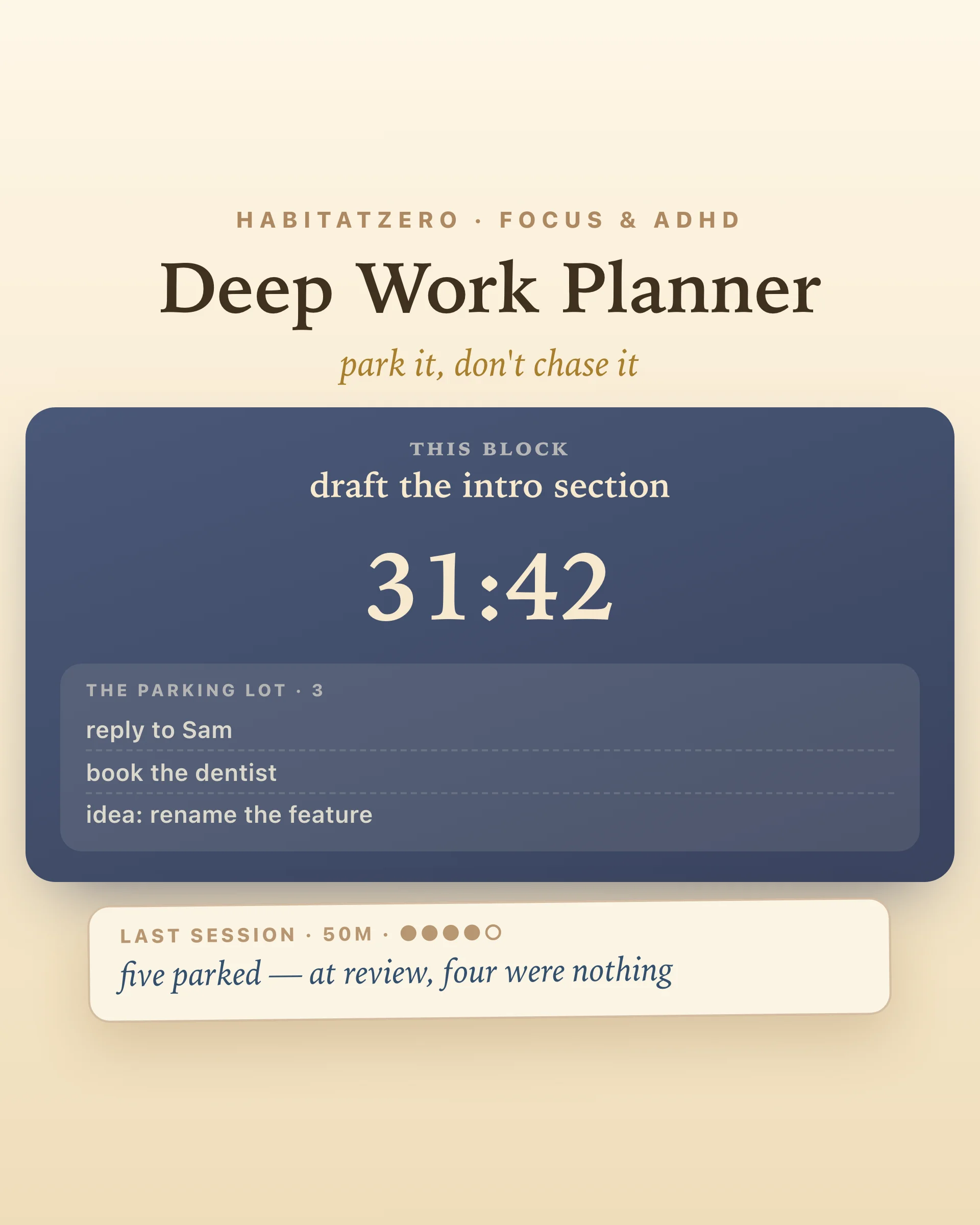
There's a specific lie we tell ourselves about focus: that it fails because of other people — the pings, the meetings, the open floor plan. Then you finally get a quiet morning, sit down with the important thing… and interrupt yourself. Should reply to Sam. Dentist. Is the other project on fire? What if we renamed the feature? The quiet was never the missing piece. The system for handling your own brain was.
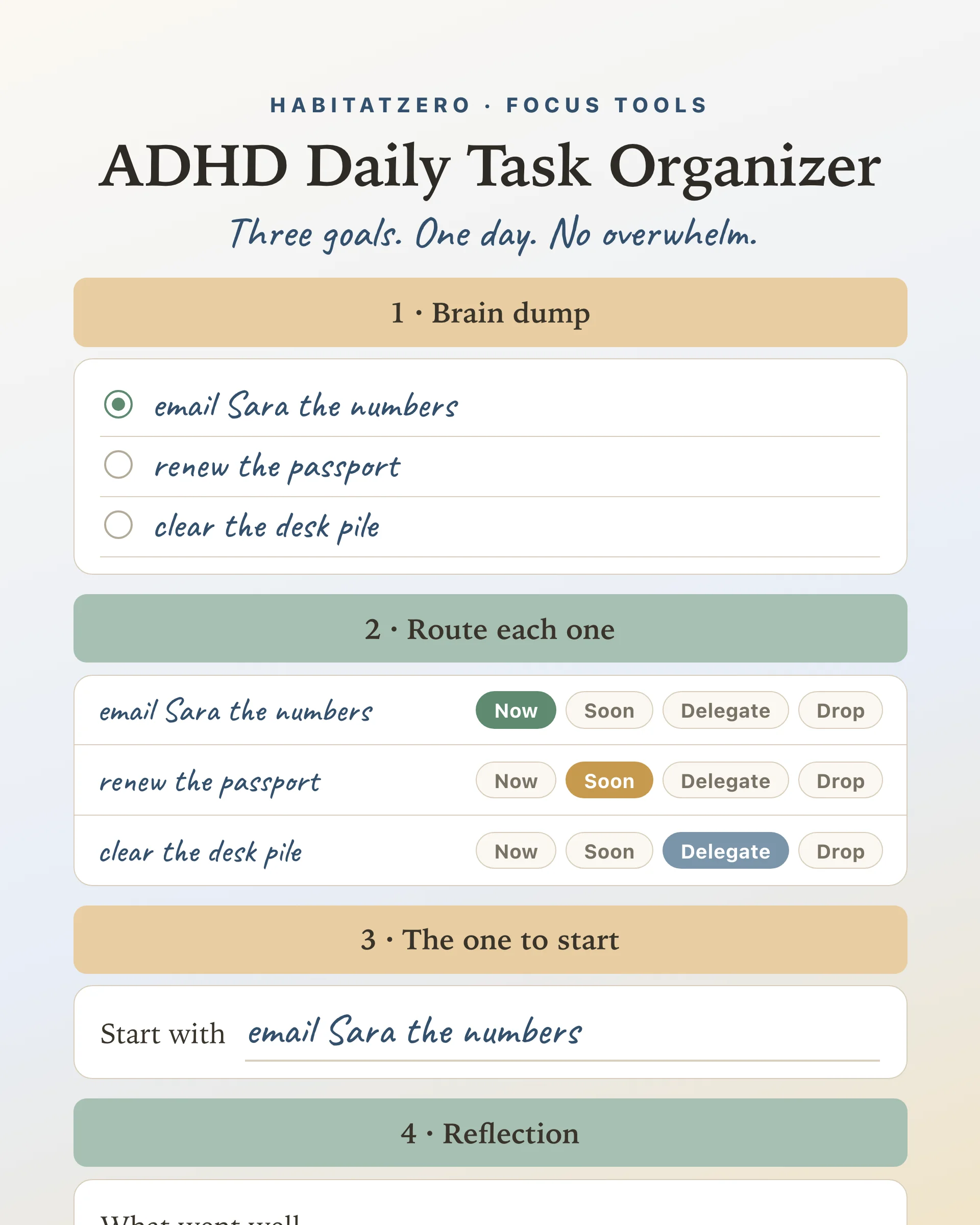
This planner is that system, wrapped around a single session: one named goal, one timed block, a parking lot for everything your mind throws at you, and a rating at the end so the log learns what deep work actually costs you.
Name the one thing. Not a topic — a finish line. "Draft the intro section" survives a 50-minute block; "work on the report" dissolves into browsing. Add what done looks like if the goal is slippery, pick your block — 25, 50, or 90 minutes — and start.
Park, don't chase. This is the heart of the tool. Mid-session, thoughts will arrive with impressive urgency. Each one goes into the parking lot — an input that stays open beside the timer — in five seconds flat. The thought is kept, your seat stays warm, and the session continues. By the end, the lot usually holds five to ten items, and you'll notice something humbling: at review time, most of them turn out to be nothing.
Rate and review. When the gong sounds, rate your focus one to five, then process the lot — most items get a two-minute cleanup or a calendar slot; a few get deleted with prejudice. The session log accumulates your evidence: which lengths, which times of day, which kinds of goals produce your best ratings. Ten sessions in, your personal deep-work recipe is sitting in the data.
Two findings explain why this simple mechanism outperforms willpower. The first is attention residue: research by Sophie Leroy showed that switching tasks leaves part of your attention behind on the task you left — you return to your work, but not all of you returns. Chasing a stray thought mid-session costs you twice: the detour, and the residue it smears over the next twenty minutes.
The second is the brutal arithmetic of re-entry: studies of interrupted knowledge work found that returning to a demanding task after a real interruption takes on the order of twenty minutes — which means a 50-minute block with two chased distractions isn't a 50-minute block at all; it's three fragments too short for anything deep. The parking lot works because it satisfies the thought's one demand — don't lose me — without paying either cost. Cal Newport's Deep Work made the case that this kind of focus is a trainable skill; the lot is the training wheel that makes early sessions survivable.
Start at 50. Use 25 when starting is the hard part — momentum converts short blocks into long ones — and reserve 90 for work you've already got traction on; past ninety minutes, quality falls faster than minutes accumulate. The rating exists precisely so you stop guessing: a week of 3/5 ratings on 90-minute blocks and 5/5 on 50s is your answer, written by you.
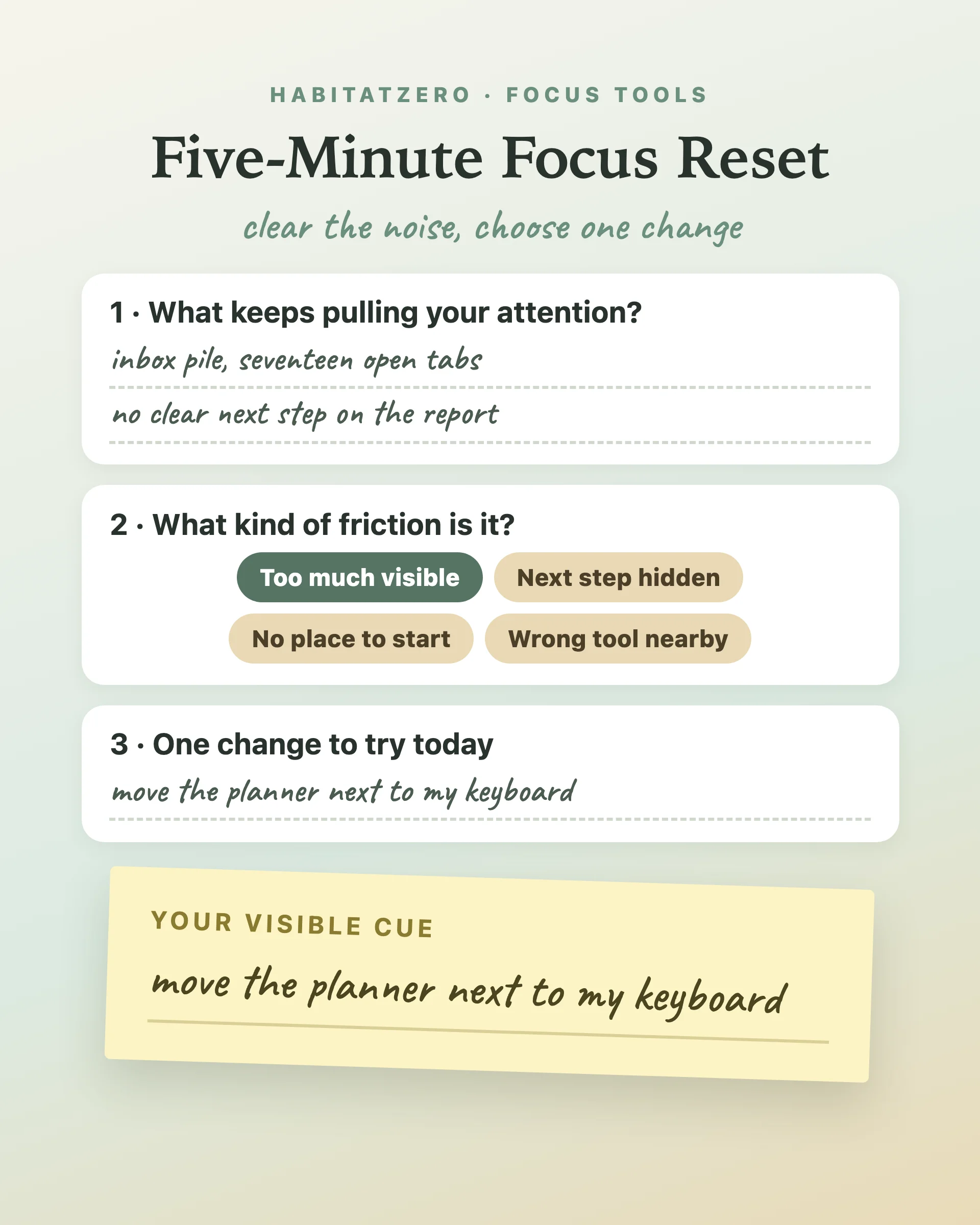
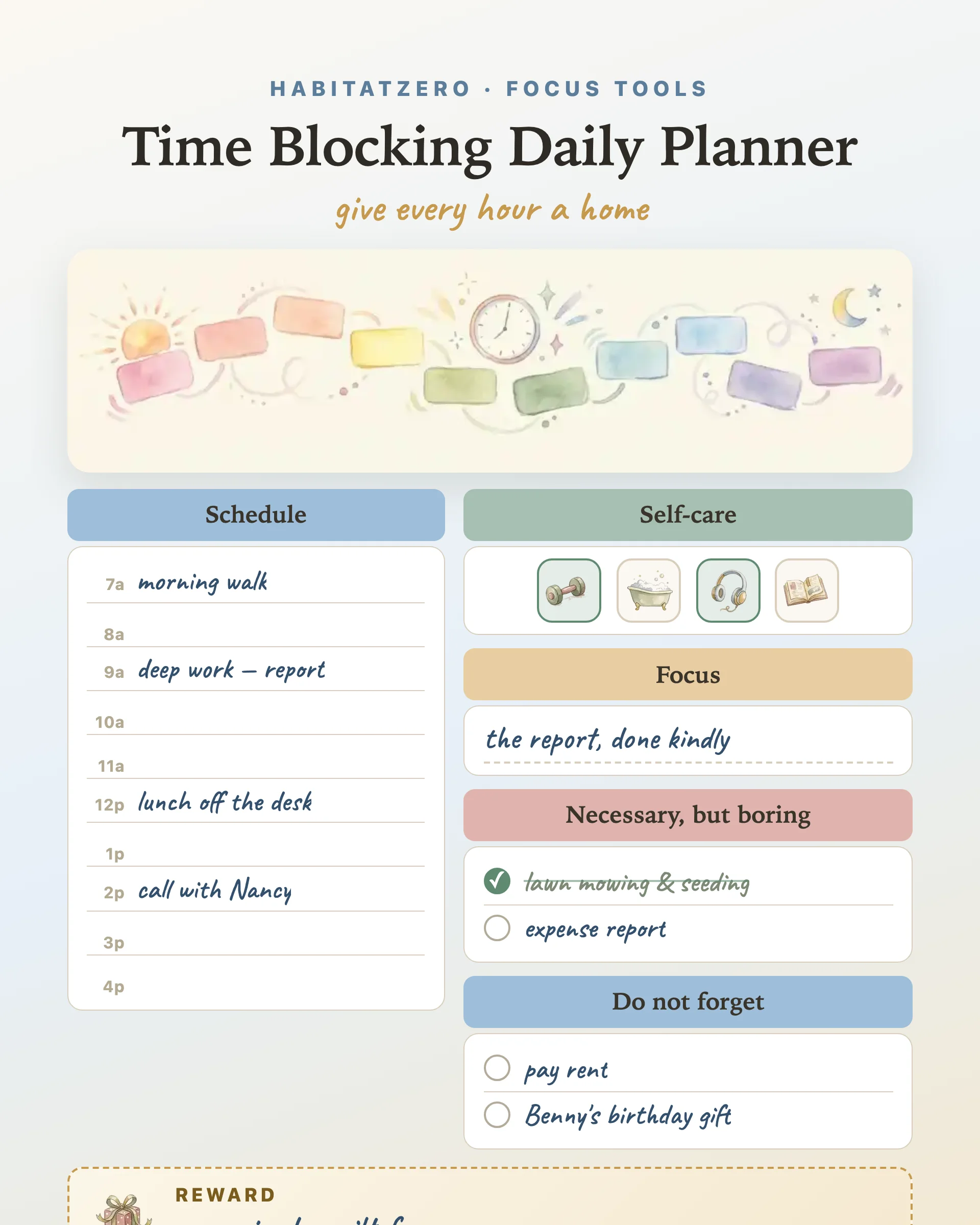
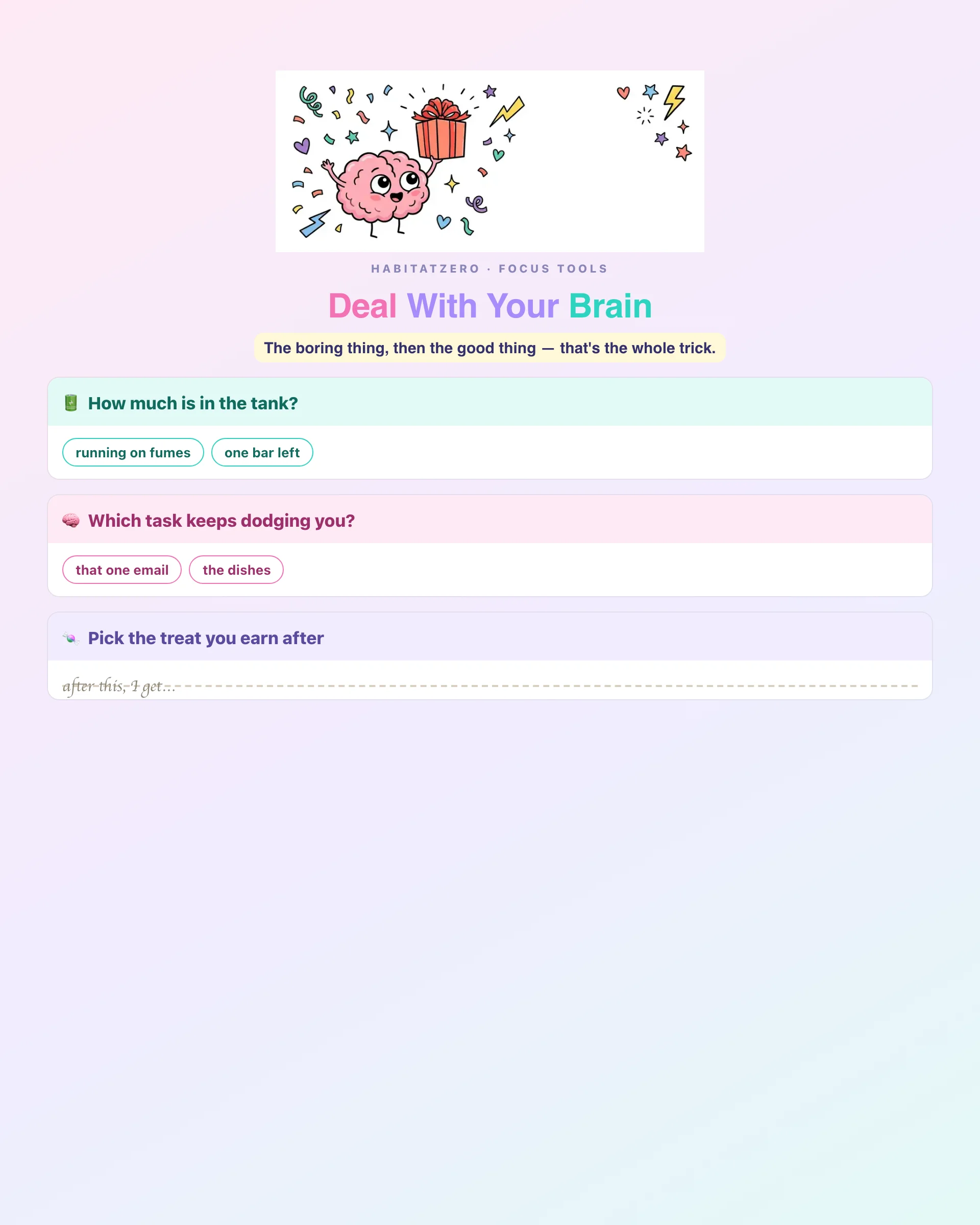
The planner runs one block; its neighbors run the day. Paint your deep blocks into the week with the Study Planner or slot them against real hours in the Time-Blocking Daily Planner. If the session won't start — the goal is named, the timer is ready, and you're reorganizing your desk — that's a starting problem, and Deal With Your Brain is built for it. And when the parked list reveals a genuinely overloaded mind, run it through the Overwhelm Recovery Protocol before the next block.
One goal. One block. One lot for everything else. That's deep work with the training wheels exactly where they belong.
A planned block of distraction-free time aimed at one cognitively demanding goal — the term comes from Cal Newport's book Deep Work. The operative word is planned: a session has a defined goal, a fixed length, and a rule for interruptions. Unplanned focus is just hoping.
A capture list that stays open beside your work. When a stray thought arrives mid-session — reply to Sam, book the dentist, what if we renamed the feature — you park it in five seconds and return to the task. Research on attention residue shows that switching tasks leaves part of your mind on the previous one; the lot lets the thought be safely kept without the switch.
Start at 50 minutes. Twenty-five works for warming up or hard-to-start days, and 90 approaches the practical ceiling for one unbroken block — beyond that, quality falls faster than the minutes add up. The session log is the honest answer for you personally: after ten rated sessions, your best length is usually visible in the data.
Because the cost isn't the interruption's length — it's the re-entry. Studies of interrupted work found people take on the order of twenty minutes to fully return to a demanding task after a real interruption, and attention-residue research shows performance drops even when the interruption is brief. Protecting a 50-minute block is really protecting the re-entry you'd otherwise pay for twice.
No — the timer here is a supporting actor. Plenty of good free pomodoro timers exist; what they lack is the planner around the countdown: a named goal, a parking lot for distractions, an end-of-session rating, and a log that learns your patterns. If all you need is a ticking tomato, use one; if you want the session to produce something, plan it.
Yes — free, browser-based, no signup or email. Your parked items and session log live with the worksheet, and in the Fabulous app they save and sync across devices.
It is the sharp end of one: a productivity planner narrowed to the single practice that moves the needle - one protected block of undistracted work with a finish line, plus a parking lot for everything that tries to interrupt. Pair it with a routine or day planner for the hours around the block.
By the team behind Fabulous, the science-based self-care app used by over 30 million people.