ADHD Daily Task OrganizerFocus & ADHD · ~10 min
About this template · Updated September 2026
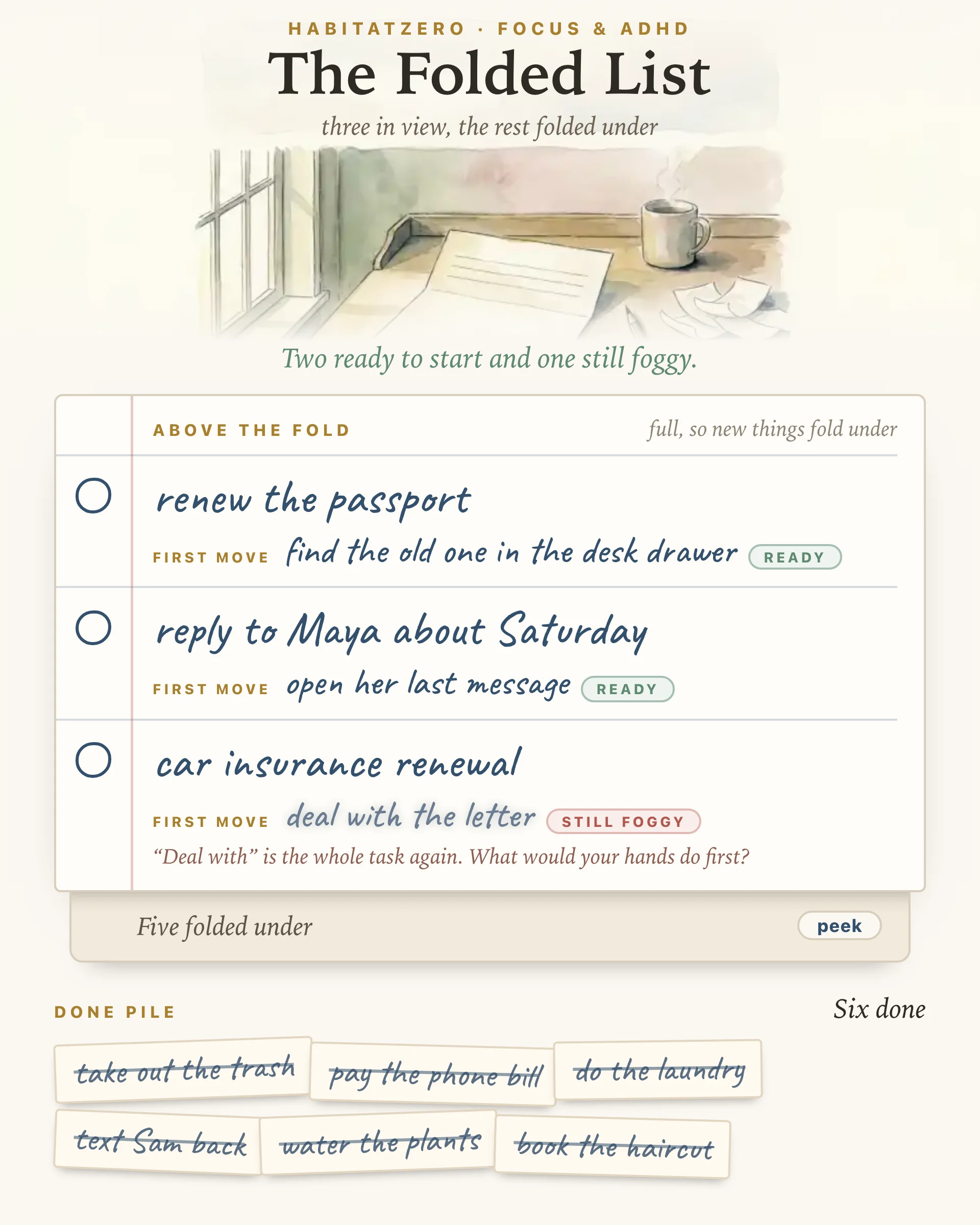
A long to-do list is supposed to be a relief. With ADHD it can turn into the opposite: forty lines, every one of them equally loud, and nothing that says where to begin. So you do the easiest thing on it, or copy it out again in a nicer notebook, or close the app and hope. The list was right about what needs doing. It was wrong about how much of it you should have to look at, and about how ready each line was to start.
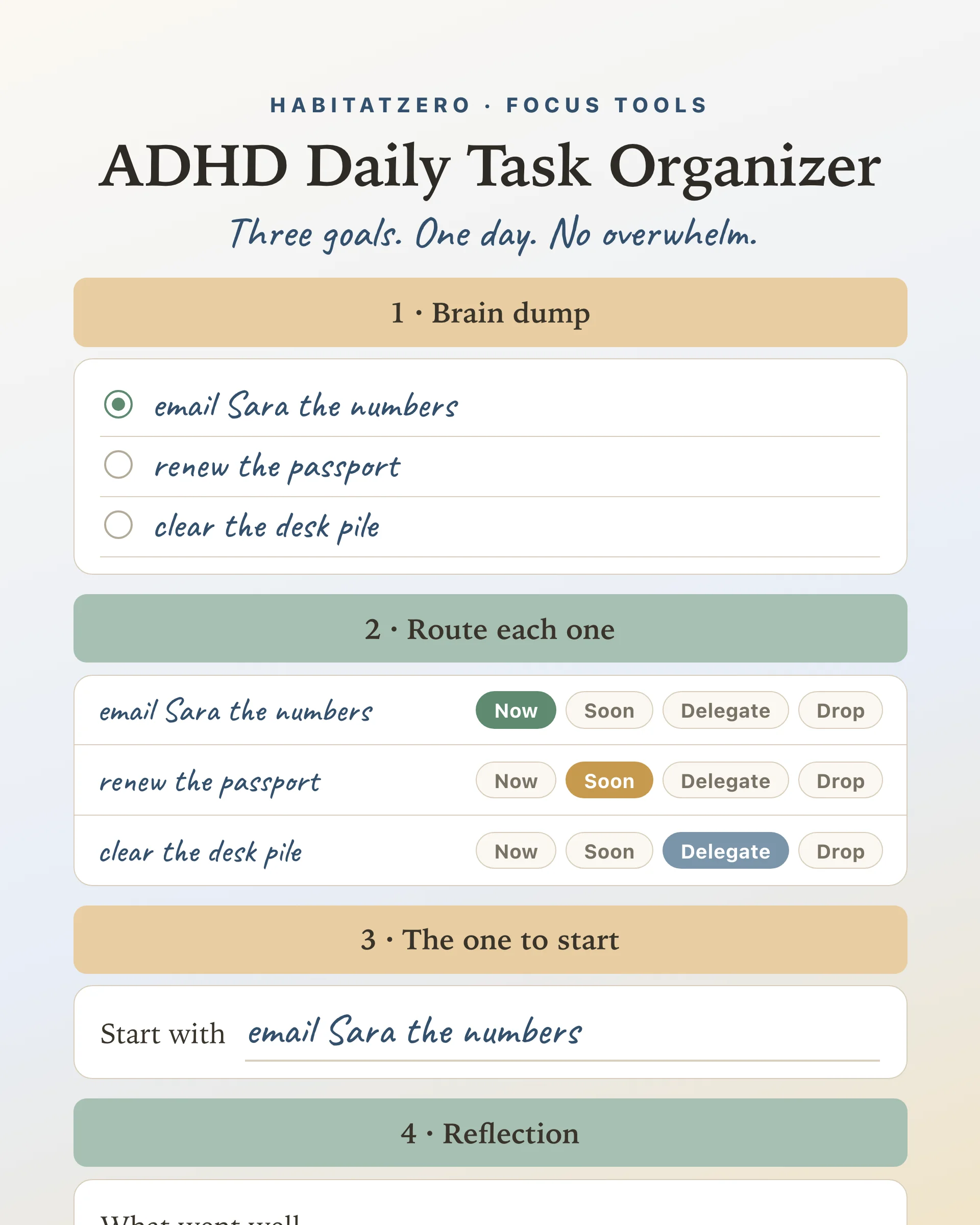
The Folded List changes three things about an ordinary list. Only three lines stay in view. Each of those three carries a first move, small and physical. And whatever you finish lands on a pile you can see, instead of disappearing.
Write things down the way they arrive, by typing or by tapping a starter. The first three land above the fold. The fourth folds under on its own, and so does everything after it, up to a full sheet of fifteen lines. Nothing is thrown away: the flap says how many are waiting, and a peek shows them. Cross off a line above the fold and a space opens; bring another one up, or leave the space empty for a while.
CHADD's page on to-do lists for adults with ADHD suggests keeping a list for the day separate from a list for the longer term, and numbering the three most important things. The fold does both jobs on one sheet, and it hides the long part instead of asking you to ignore it.
Why three and not seven? An influential review of short-term memory research concluded that people can hold about four chunks of information in mind at once, with estimates running from three to five. That is a finding about memory in laboratory tasks, not a law about lists, but it matches the feeling. Three things can sit in your head whole. You stop rereading the list every time you look up, because you already know what is on it.
A line like "car insurance" is really a small project with its start hidden inside. So each line above the fold asks for a first move: the first thing your hands would do, small enough to begin within two minutes. Find the letter. Open the renewal email. Put the form on the kitchen table. Verb chips start the sentence for you, and one tap writes "set a ten-minute timer" when nothing else comes.
The idea is close to what David Allen calls the next action in Getting Things Done, which he describes on his own site as the next visible physical activity required to move something forward. The Folded List is a small, separate take on that idea. It has no connection to David Allen or his company, and neither has reviewed or endorsed it.
There is some evidence that concrete wording makes starting easier. In one set of studies, people asked to send back a questionnaire by email within three weeks put the task off less when the questions got them thinking in concrete terms rather than abstract ones. Those studies were not about ADHD or to-do lists, so treat them as a pointer rather than proof.
The sheet also reads each first move back to you. If it opens with a phrase like deal with, sort out or work on, the line is tagged still foggy and asks what your hands would do first. A one-word move gets asked for its object, and a move that simply repeats the task is pointed out. It is a rough check on wording, not a verdict, and you can overrule it.
Crossing a line off an ordinary list makes it vanish, so the list can only ever show what remains. Here a finished line drops onto a small heap of paper slips, and the count above them grows. If you tapped too soon, the top slip can be put back. When the last line above the fold is crossed off, the sheet tells you the day already counts. Anything you do after that is extra, and whatever is still folded under will wait for tomorrow.
This is a way of writing a list. It is not a treatment for ADHD, and it cannot make an overfull week any smaller. What it can do is cut the visible part of the week down to a size you can start, and show you what you got through. On days when three feels like too many, a single line above the fold still counts as a list.
Open it in the morning, or whenever the whole list starts shouting at once. If your head is too loud to write anything in order, empty it first with a brain dump and carry the actions across. If choosing which three is the hard part, the ADHD Priority Matrix deals your pile one card at a time. And if a line has its first move and still will not start, The Shrinker walks one heavy task down in four passes until the first step is small enough to take.
The format matters less than three habits. Keep the part you look at short, park everything else on a separate list you do not have to read all day, and write each item as a physical first step rather than a topic. Letting finished items stay visible helps too, so the list shows progress alongside what remains.
For the part in front of you, about three. CHADD suggests numbering the three most important items on a daily list, and this page keeps exactly three above the fold while the others wait underneath. On a rough day, a single line is plenty.
Usually because a long list asks for several hard things at once: reading every line, choosing between them and starting one that is vague. Entries like taxes or car insurance hide their starting point, and finished lines vanish, so the page never shows how much you got through.
It is the first physical thing you would do to get a task going, small enough to begin within two minutes. Renew the passport is a task, while finding the old passport in the desk drawer is its first move. The idea is close to what David Allen calls the next action in Getting Things Done.
You can look through the filled-in example on this page without an account. Keeping a folded list of your own, with its first moves and done pile saved from one day to the next, happens once you personalize it in HabitatZero, at no cost.
By the team behind Fabulous, the science-based self-care app used by over 30 million people.