Wind-Down Routine BuilderSleep & Evenings · ~4 min
About this template · Updated September 2026
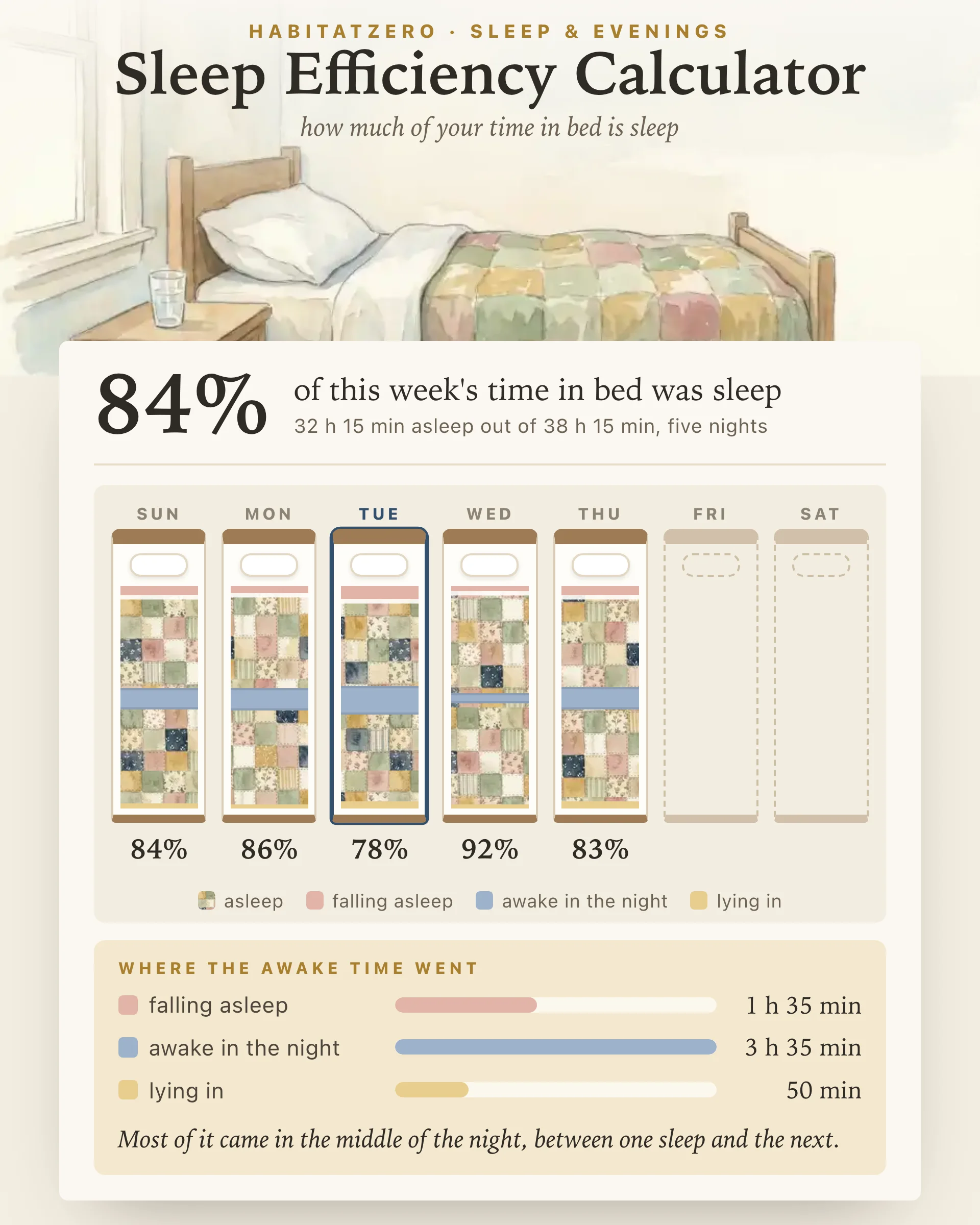
Sleep efficiency asks a plain question: of all the time you spent in bed, how much of it were you asleep? The answer is a percentage, and it earns its place because it pulls apart two problems that feel the same at 3 am. One is giving sleep too little time. The other is not sleeping through the time you already give it.
The usual formula is total sleep time divided by time in bed, times one hundred. Time in bed runs from the moment you get in to the moment you get up for the day. Total sleep time is what remains after you take away three kinds of waking: the wait before sleep arrives, the time awake in the middle of the night, and the stretch between waking for good and actually getting up.
Take one night. You get into bed at 10:45 pm and up at 6:30 am: seven hours and forty-five minutes in bed. Sleep took twenty minutes to come, you were up for forty-five minutes around 3 am, and you lay there ten minutes before rising. That is an hour and fifteen minutes awake and six hours and thirty minutes asleep, an efficiency of 84 percent.
The bottom half of that fraction is argued over. Reed and Sacco pointed out that time in bed, taken literally, also sweeps in reading, texting and television, which say nothing about how well you sleep. This page keeps the common version, getting in to getting up. If you read in bed first, decide once how to count that time, then count it the same way every night.
Around 85 percent is the line you will meet most often. Sleep restriction programs usually work toward it, as the same paper describes, and the National Sleep Foundation's sleep quality checklist for adults asks the plain version: were you asleep for about seven of every eight hours in bed? Two of its other questions match awake parts on this page: did sleep come within thirty minutes, and were you awake for twenty minutes or less after first dropping off?
Read a week, not a night, because everyone has rough ones. And a very high number is not always good news. If you are out the moment your head lands and still drag through the afternoon, the question may be how much time you give sleep, not how well you use it.
Each night gets its own bed, drawn from above. Set when you got in and when you got up; a night that crosses midnight is read as one stretch. Then tap the three awake parts. The bare sheet under the pillow is the wait for sleep, the band across the quilt is the time awake in the night, and the sheet at the foot is lying in. The quilt covers the rest, your sleep, and the bed's percentage appears beneath it.
The week's figure is not an average of percentages. It adds up all the sleep and all the time in bed first, so a short, broken night counts for exactly the hours it took. Below it, the page shows where the awake time went and names the largest share, and a short note, like late coffee or a child up at 2 am, shows up beside your lowest night.
The split tells you more than the headline. A long wait at the start points to the evening: the thoughts you carry to bed, a screen that ran late, or an afternoon coffee still at work. Long stretches awake in the middle of the night are worth raising with a clinician if they keep coming back. Lying in is the part most in your hands, since getting up when you wake for good takes it back without costing a minute of sleep.
The standard way to raise this number is sleep restriction therapy. You shrink the time in bed to roughly the sleep you are getting, then widen it again as the percentage climbs. It is a real treatment, and it is meant to be run with a clinician. It can leave you sleepier during the first weeks, and it is not for everyone: a UK trial of sleep restriction delivered by practice nurses was designed to leave out people with epilepsy or bipolar disorder, and to track falls and near misses on the road for everyone who took part.
If poor sleep has run on for weeks, or your days are starting to pay for it, see a doctor. The American College of Physicians recommends cognitive behavioral therapy for insomnia, CBT-I, as the first treatment for chronic insomnia in adults, before any sleeping pills. A filled week of beds from this page is a useful thing to bring along.
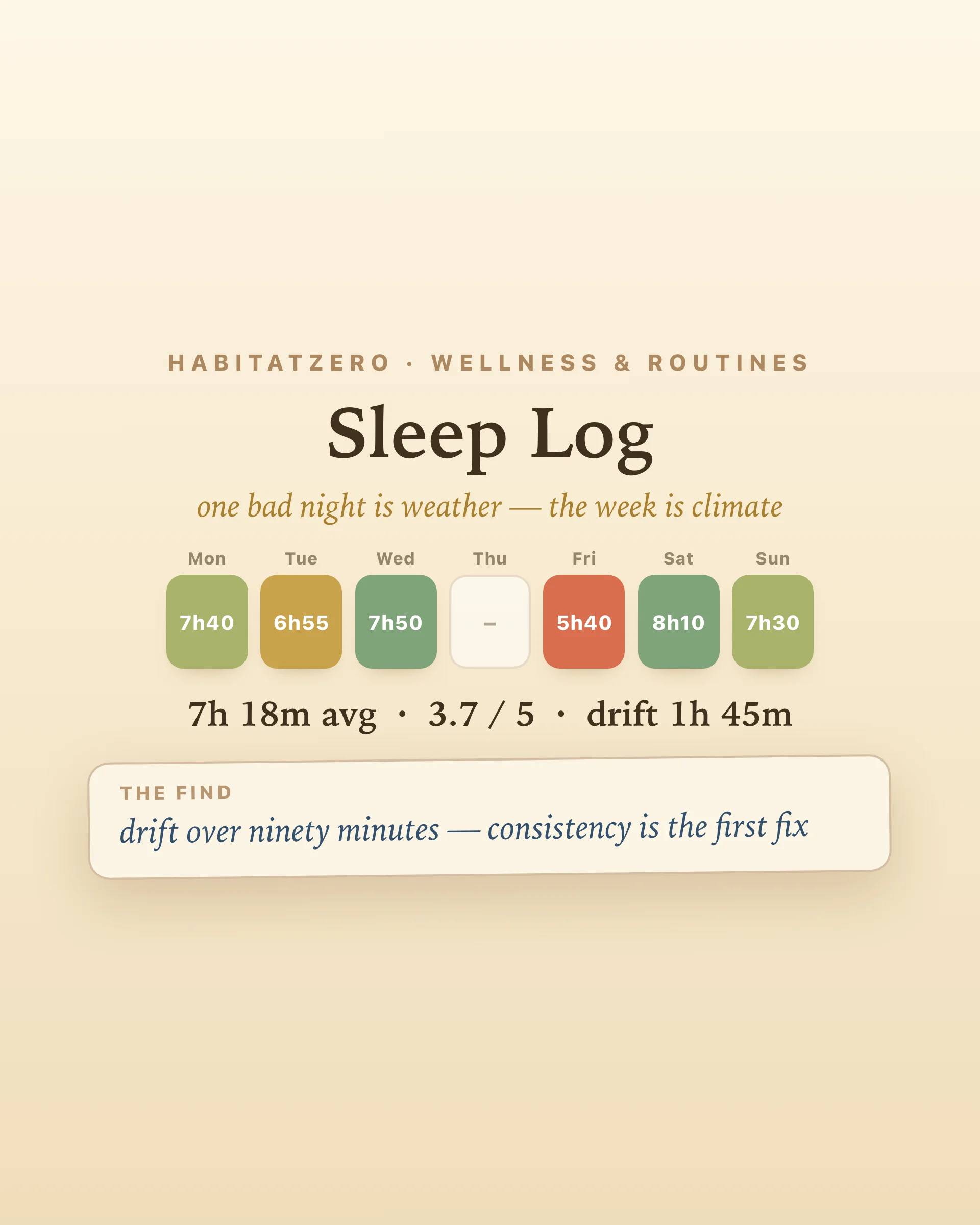
Fill in each bed in the morning while the night is fresh; a guess made days later is only a guess. Give it a full week before reading much into the figure, and for a longer record with a rating for each night, the Sleep Log keeps one. Then start a new week. The page keeps last week's number, so you can see which way your nights are moving.
It is the share of your time in bed that you spend asleep, written as a percentage. If you lie down for eight hours and sleep for seven of them, your sleep efficiency is about 88 percent.
Count the minutes from getting into bed to getting up, subtract the time it took to fall asleep, the time awake in the night and the time spent lying in, then divide what remains by the whole and multiply by one hundred. Seven hours and forty-five minutes in bed with an hour and fifteen minutes awake works out to 84 percent.
About 85 percent or higher is the line most often used. The National Sleep Foundation puts a similar question to adults: were you asleep for roughly seven of every eight hours in bed? Single nights swing a lot, so judge the figure over a week.
Shrinking time in bed on purpose is sleep restriction therapy, a treatment to run with a clinician. It can bring extra daytime sleepiness at first, and it is not suitable for everyone, including people with bipolar disorder or a seizure disorder.
The page shows a sample week so you can see how the beds fill in. To log your own nights and keep last week's figure beside this one, open it in HabitatZero, which costs nothing.
By the team behind Fabulous, the science-based self-care app used by over 30 million people.