The Overwhelm Recovery ProtocolWellness & Routines · ~5 min
About this template · Updated September 2026
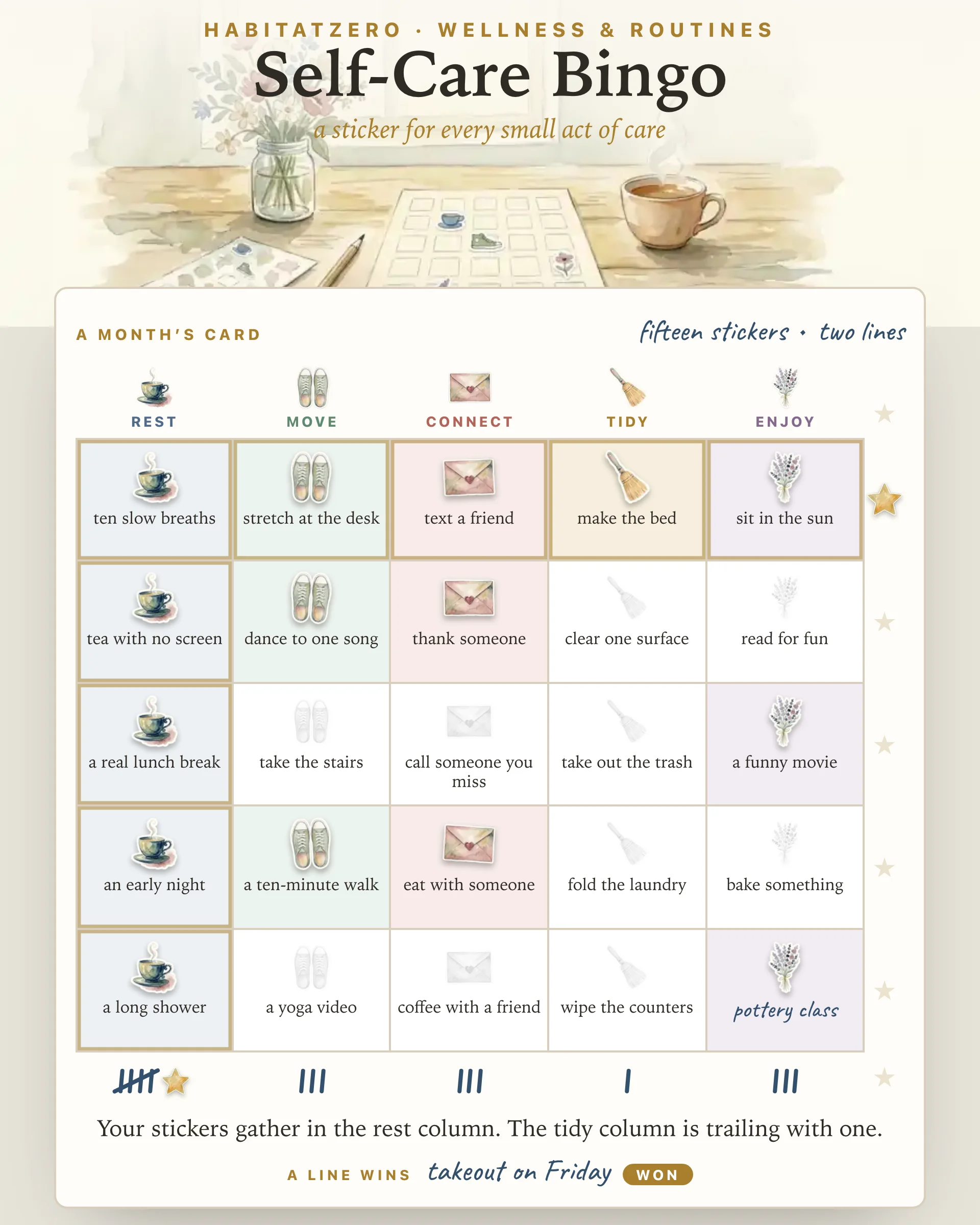
Self-care bingo trades the numbers on a bingo card for small acts of looking after yourself: an early night, a short walk, a text to a friend, a cleared counter. You mark a square on the day you do it. Five marks in a row, a column or a diagonal make a line, and marking all twenty-five squares is a blackout. Counselors, teachers and workplace wellness programs hand these cards out for a week or a month, because a card with open squares is easier to act on than a vague promise to take better care of yourself.
This card adds one twist that most printable versions skip. Each of its five columns holds a single kind of care, so after a week or two the card shows you which kinds you reach for and which ones never quite happen.
Most people have a default kind. Some rest well and hardly move; others keep a spotless kitchen and have not called a friend in a month. Because every column is one kind, a bare column stands out, and you can act on it this week.
Tap a square when you have done it and its sticker goes on: a teacup for rest, sneakers for movement, an envelope for connection, a broom for tidying, a bouquet for fun. The top row holds the smallest act of each kind, so it is the easiest line to finish. If you tap a square by mistake, tap it again and the card asks before the sticker peels off.
Every finished line earns a gold star where it leaves the card: rows at the right edge, columns at the foot, and the two diagonals in the corners. Tally marks under each column show which kind is running ahead.
Below the card, a short note says which columns your stickers gather in, which one trails, and which open square is worth trying next. That suggestion always comes from your thinnest column, and it favors a square that would finish a line or bring one close.
A week's card aims for one line, a fair target for seven days; a month's card aims for a blackout. Swap any square that does not fit your life for another from the same column, or write your own in a few words. You can name a small prize for a line and another for a blackout. When the week or month is over, start a new card; the old one goes onto a shelf, which soon shows whether the same column keeps coming up short.
The card also prints on one sheet, with faint outlines where the stickers go, so you can keep it on the fridge and fill it in with a pen.
Nobody has run a trial of self-care bingo itself, so think of the card as a nudge rather than a treatment. The ideas underneath it do have research behind them.
The US National Institute of Mental Health describes self-care as taking the time to do things that help you live well, and its list of tips covers regular exercise, sleep, relaxing activities and staying connected with people, much like the columns here.
Scheduling small enjoyable or meaningful activities on purpose is the heart of behavioral activation. A meta-analysis of twenty randomized studies found that behavioral activation raised well-being in non-clinical groups as well as in people with symptoms of depression.
The game part helps a little. Across sixteen randomized trials, adding game elements increased physical activity by a small to medium amount, and the effect shrank, without disappearing, in the months after the programs ended. Expect the same from a bingo card: it makes starting easier, and it will not carry you on its own. If the card stays blank for weeks because even the smallest square feels like too much, raise it with a doctor or therapist.
Start a card at a natural boundary, a Sunday evening or the first of the month, and keep it where you will see it. If you would like to know where your care runs thin before you begin, the Self-Care Wheel maps six sides of it in a few taps. Once the card shows which column you skip, the Self-Care Planner can give that kind of care a set day, and the Self-Care Checklist keeps a longer menu of small acts for the days you want more choice than twenty-five squares.
It is a bingo card whose twenty-five squares hold small acts of looking after yourself instead of numbers. You mark a square once you have done it, five marks in a line make a bingo, and marking every square is a blackout.
Pick acts small enough for a tired day: ten slow breaths, a ten-minute walk, texting a friend, making the bed, reading for fun. Spread them across different kinds of care so the card is not all rest or all chores. This card keeps rest, movement, connection, tidying and fun in separate columns for exactly that reason.
Give everyone the same card at the start of the month and let each person mark their own squares in private. A small prize for a first line and another for a blackout keeps it light. When you talk about it afterward, compare which columns filled up and which stayed empty, not who marked the most.
Either works. A week suits a quick reset, and one line is a fair goal for seven days. A month leaves room for the slower squares, which makes a blackout realistic. Decide before you begin so the goal does not drift halfway through.
No. The page shows a filled-in card you can explore, and the card prints on a single sheet if you would rather mark it with a pen. Personalizing it in HabitatZero, which is free, keeps your stickers, swapped squares and past cards together in one place.
By the team behind Fabulous, the science-based self-care app used by over 30 million people.