Reading JournalStudy & Learning · ~4 min
About this template · Updated September 2026
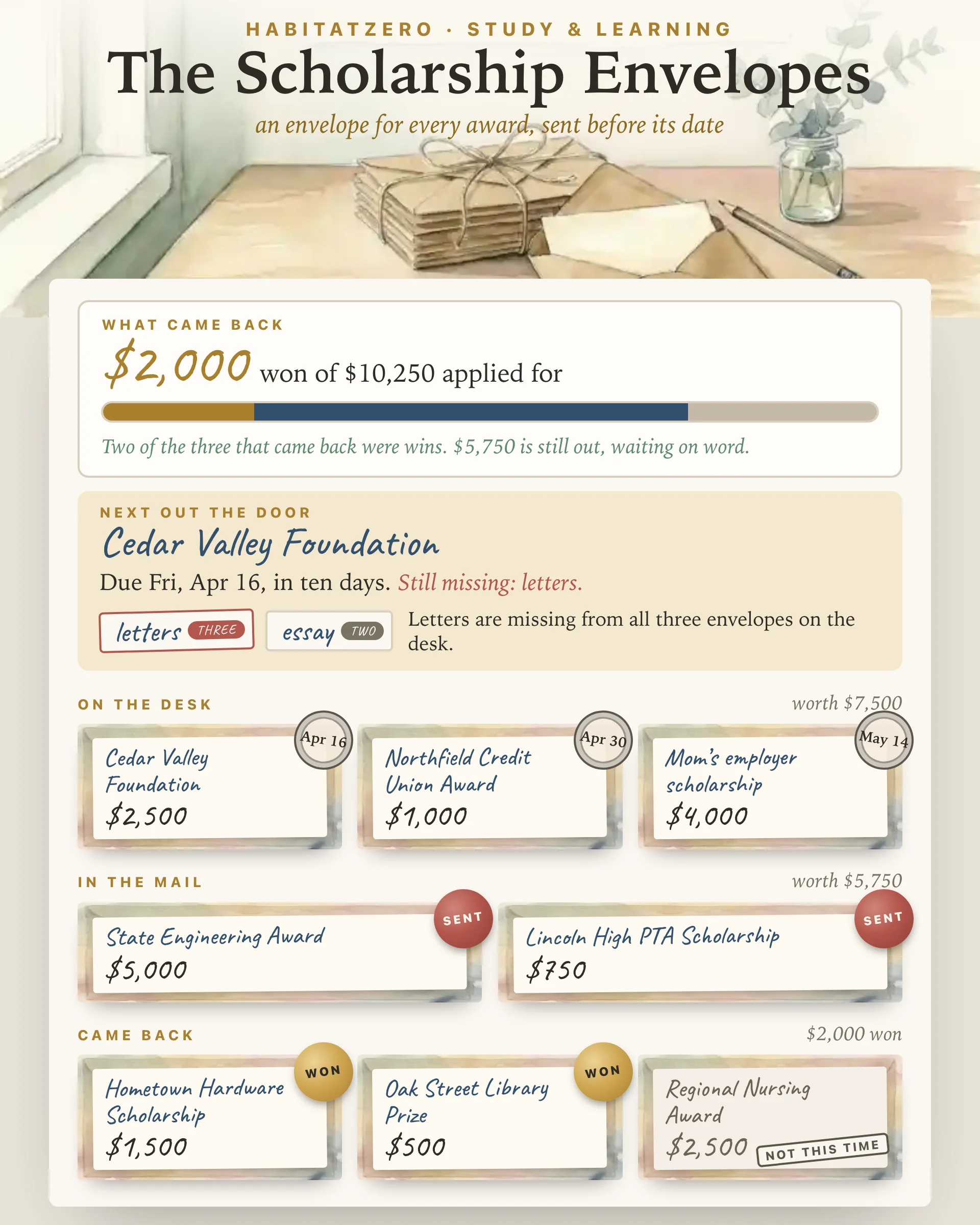
Scholarship season is less about finding money than about keeping hold of it. By October of senior year you might have a dozen awards in view, each with its own deadline, its own prompt, and its own short list of things to send: an essay, two letters, a transcript, proof that the FAFSA is filed. Some of those pieces depend on other people's calendars.
This page turns each award into an envelope. You address it, slip the pieces in as they get done, seal it before the date, and note what comes back. Along the way it keeps three readings a spreadsheet leaves to you: what is due next, which piece is holding the most envelopes up, and how the money you have won compares with the money you have applied for.
Write the award's name on the blank envelope, add what it pays and its deadline, and tap the pieces it asks for. It lands on the desk in date order. Tap a piece once it is finished and the dashed outline becomes a paper slip; the first slip moves the envelope from found to drafting. When everything is in, seal and send. If a piece is still missing, the first tap names it and a second tap sends the envelope anyway, since only you know whether a committee will take a late letter.
When word arrives, mark the envelope won or not this time. Both still count as applied for. If an award pays a different amount than it listed, open the envelope and change the figure; the tally follows to the cent.
The desk holds twenty-four envelopes. Past that, clear one that came back or passed its date.
Applications stall on the pieces you cannot finish alone: letters wait on a teacher's week, transcripts on a school office. The countdown at the top names the nearest deadline and what that envelope still lacks, and beneath it the desk counts which piece is missing from the most envelopes.
If letters top that count, ask now, and hand each writer a copy of The Brag Sheet so the letter can say something specific about you. If essays top it, look for overlap: prompts about a challenge, a goal or a community tend to repeat, and one strong draft planned with The Essay Outline can often be reshaped for the next award instead of started over.
The FAFSA works differently. You file it once for the school year and it counts toward every award that asks for it, so the page keeps a single FAFSA mark that fills in on every open envelope at once, while a sealed envelope keeps what it went out with. The Federal Student Aid deadline page gives 11:59 p.m. Central time on June 30, 2028 as the federal cutoff for the 2027–28 form, yet many states want it as soon as possible after October 1, 2026, and some state aid is handed out only until the funds run out.
An envelope is due through the end of its day on your own calendar. The next morning it reads as passed and drops out of the countdown and the desk's total, because an application that never went out is not money you are waiting on. If the deadline moved, change the date and the envelope comes back. Some awards close at a set hour in a named time zone, so read the fine print and aim for the day before.
Federal Student Aid points out that some scholarship deadlines fall as early as a year before college starts, which is why an envelope can go on the desk with no date yet and get one when the application opens. The same page asks you to tell your college about every award you win, because all your aid together cannot exceed the cost of attendance, so a win can change the rest of your package.
The tally sets the money you have won against everything you have applied for, with what is still out in between. Keeping that record is part of Federal Student Aid's own advice on protecting yourself during aid season, which suggests you keep track of the amounts you applied for and received. For a renewable award, write in one year's amount; renewal often comes with conditions, such as grades or staying enrolled, so count what is certain.
Real scholarships do not charge you for the chance to win them. The Federal Trade Commission puts it plainly: never pay to apply for a scholarship. Walk away from guarantees, processing or redemption fees, requests for a bank or card number to hold an award, and news that you are a finalist in a contest you never entered. An award that asks for money does not get an envelope.
Start the day you find your first award, whether that is the summer before senior year or a February evening with three deadlines in view. Parents can run the desk alongside a student while the essays stay in the student's own words. Look at the countdown once a week, and keep sending after the first envelope comes back as not this time, because one win can outweigh several misses.
Give every award one record with four facts: what it pays, when it is due, which pieces it asks for, and where it stands. Sort the records by deadline, look at the nearest one each week, and request letters and transcripts first, because those depend on someone else's calendar.
The award's name, amount and deadline, the pieces it wants (an essay, letters of recommendation, a transcript, a filed FAFSA, sometimes an interview) and its status, from found through drafting and sent to won or not this time. This one also sets the money won against the money applied for.
A spreadsheet can hold any column you like, but you build the formulas and remember to sort it. Here the date math and the money totals run on their own, and each envelope shows at a glance which piece it is still waiting on.
Real awards never charge you to apply. The Federal Trade Commission warns against processing or redemption fees, guaranteed winnings, requests for a bank or card number to hold an award, and news that you are a finalist in a contest you never entered.
This page shows a filled-in desk you can look through without signing up. To address envelopes of your own and watch the deadlines count down each time you open them, personalize the tracker in HabitatZero at no cost.
By the team behind Fabulous, the science-based self-care app used by over 30 million people.