
Leaves on a StreamEmotional Fitness · ~3 min
About this template · Updated September 2026
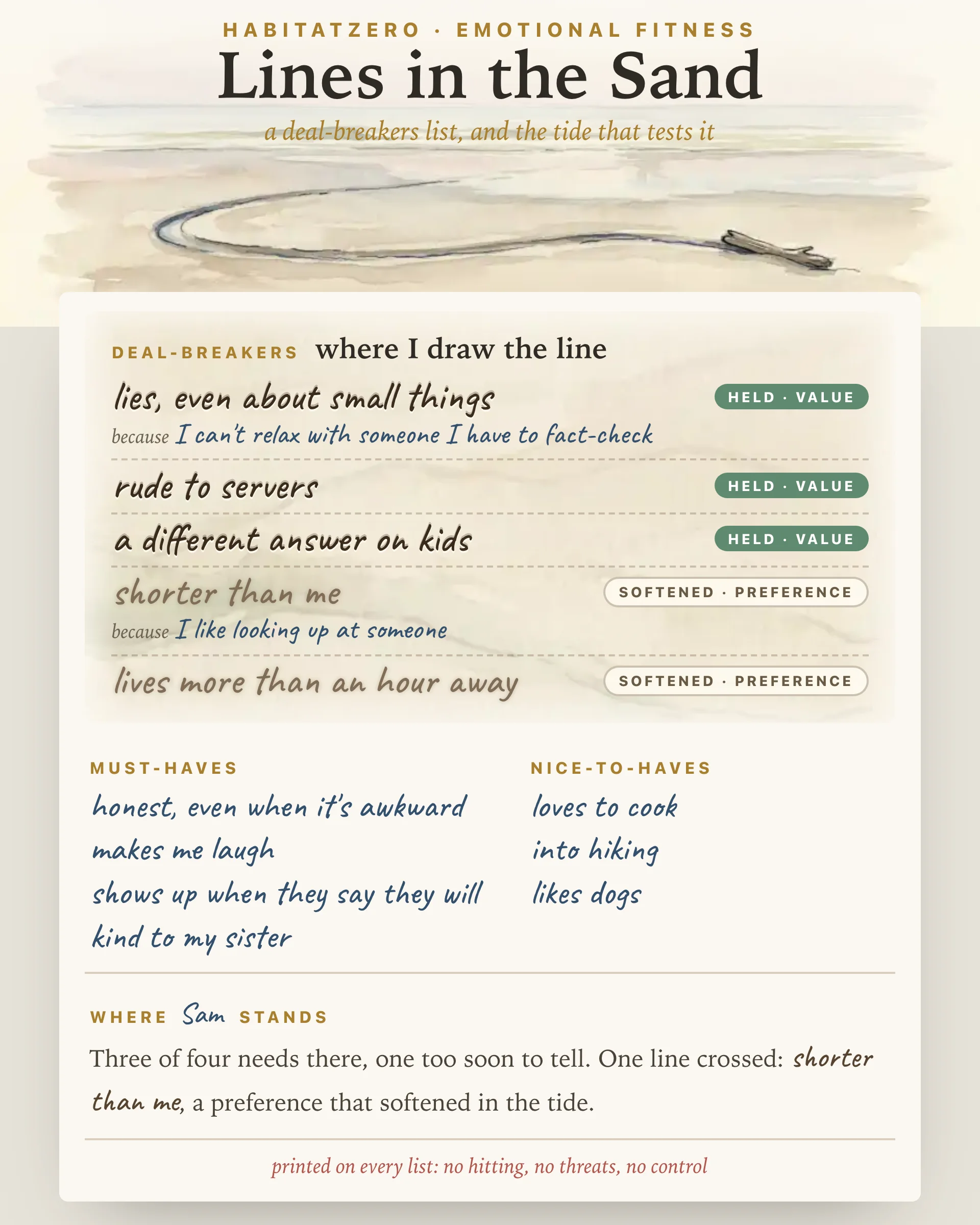
A deal-breaker is the one thing that ends it, however good the rest looks. Most people carry a few of them around unwritten, which is how they end up either overlooking the ones that matter or turning away someone kind over a detail that would have stopped mattering by the third date. Writing the list down helps. Testing each line before you trust it helps more.
This page is built for that second step. You draw your deal-breakers as lines in the sand, give each one a reason in your own words, and then let two questions wash over them like a tide. The lines that hold are standing on your values. The lines that soften are preferences: allowed, worth knowing about, and worth holding a little more loosely.
Start at the sand. Tap a suggested line such as rude to servers or write your own, up to five. Five is the ceiling on purpose, because a list that rules out everyone isn't protecting you from anything.
Under each line, finish the sentence that begins with because. Keep it short and honest: "I can't relax with someone I have to fact-check" tells you more about yourself than "honesty is important" ever will.
Then answer the tide's two questions for every line:
Once both are answered, a line that would last is marked held: it stands on a value. A line that would fade is marked softened: it reads as a preference. If you would bend on it as well, the page offers to move it to your nice-to-haves as a rather not, where it still counts without deciding anything on its own.
Below the sand you write what you need and what would be lovely: up to five must-haves and six nice-to-haves, each with an optional reason tucked behind a small why?. At the bottom, the check lets you hold one person up to the whole list. Mark each need and each line as you see it today, and the page reads back where that person stands. It never tells you to stay or to leave. A crossed preference gets called a conversation, and a crossed value gets called exactly that.
Deal-breakers have been studied head-on. Across six studies with more than 6,500 people, Peter Jonason and colleagues found that people weigh deal-breakers more heavily than deal-makers, and that deal-breakers get stronger when people picture a committed relationship rather than a casual one. What people steered away from clustered around undesirable personality traits and unhealthy lifestyles.
The split between must-haves and nice-to-haves has research behind it too. When Norman Li and colleagues handed people budgets of different sizes to design an ideal partner, they secured the necessities before spending on luxuries, and kindness and intelligence counted as necessities for men and women alike.
The case for holding preferences loosely comes from speed dating. In a study by Paul Eastwick and Eli Finkel, the ideals people described before the event failed to predict who they actually felt drawn to once they met face to face. What you think you want on paper and what you respond to in person are not always the same list.
Be clear about the limits. No study has validated the tide's two questions as a test; they are a structured way of asking yourself why, not a measurement of anything. Nor is there a proven right number of deal-breakers; the cap of five is a design choice that keeps every line earning its spot.
Three lines come printed on every list and never go through the questions: being hit or hurt, being threatened, and being controlled through money, your phone or who you are allowed to see. These are about safety, not taste and not values to weigh, so the page will not let you test them as preferences. If any of them is happening to you, the National Domestic Violence Hotline is free, confidential and answers around the clock. You can call 1-800-799-7233 or text START to 88788, and if you are in immediate danger, call 911 first.
Write your list while nobody new is in front of you, because a crush edits deal-breakers in real time. Between relationships is ideal, or early in dating before the first serious talk. Come back when someone starts to matter and use the check honestly, including too soon, which is a perfectly good answer on a third date.
If you want to look closely at a relationship you're already in, The Green Flag Line walks through the everyday signs of a healthy one. If you're unsure whether you want to date at all right now, Six Pots on the Sill is a gentler place to begin. And if your held lines point at values you'd like to name more precisely, the Core Values Worksheet helps you choose the few that get a vote.
Lists people write for themselves tend to include lying, cheating, cruelty toward others, untreated addiction, secrets about money and a different answer on whether to have children. Research on deal-breakers finds they cluster around unpleasant personality traits and unhealthy habits. Hitting, threats and control belong on every list and are never up for negotiation.
A deal-breaker stands on a value: it is about how you want to live or be treated, and it would still matter years from now with someone wonderful. A preference is about taste, like height, distance or hobbies, and a speed-dating study found that tastes stated in advance stopped predicting attraction once people actually met.
There is no research-backed number. This list stops at five so that each line has to earn its place, and a long list of firm preferences can quietly rule out people who would have been good for you. Two or three lines that hold on real values usually say more than ten that soften.
Non-negotiables are the needs and limits you will not trade away for anything else a partner offers. Safety comes first for everyone. Beyond that, many people count honesty, respect and agreement on big life questions such as children, faith or where to live.
The public page shows a filled-in example list so you can see how the tide sorts it. Drawing your own lines, testing them and holding someone up to the list happens in HabitatZero, which is free to use.
By the team behind Fabulous, the science-based self-care app used by over 30 million people.


